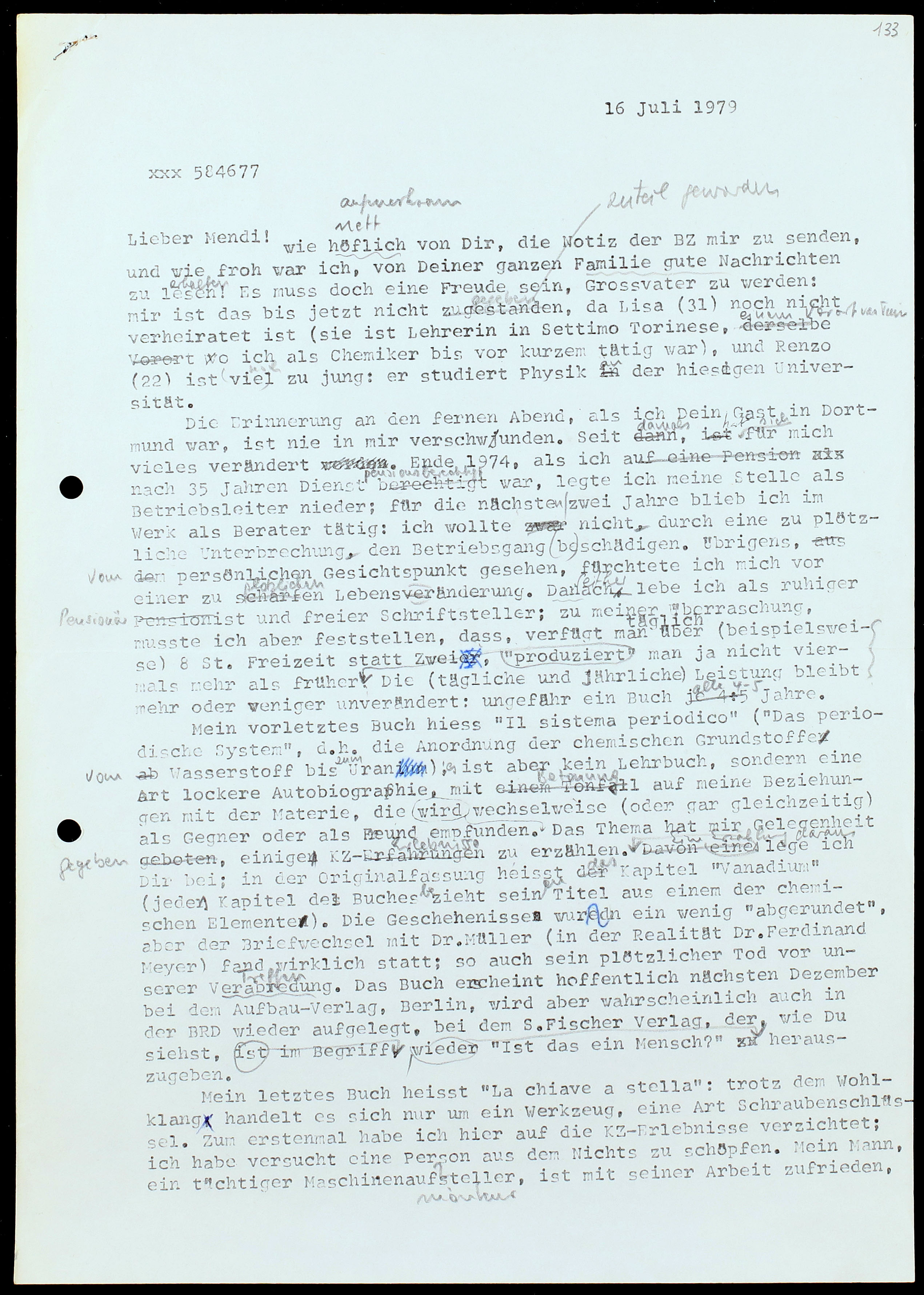
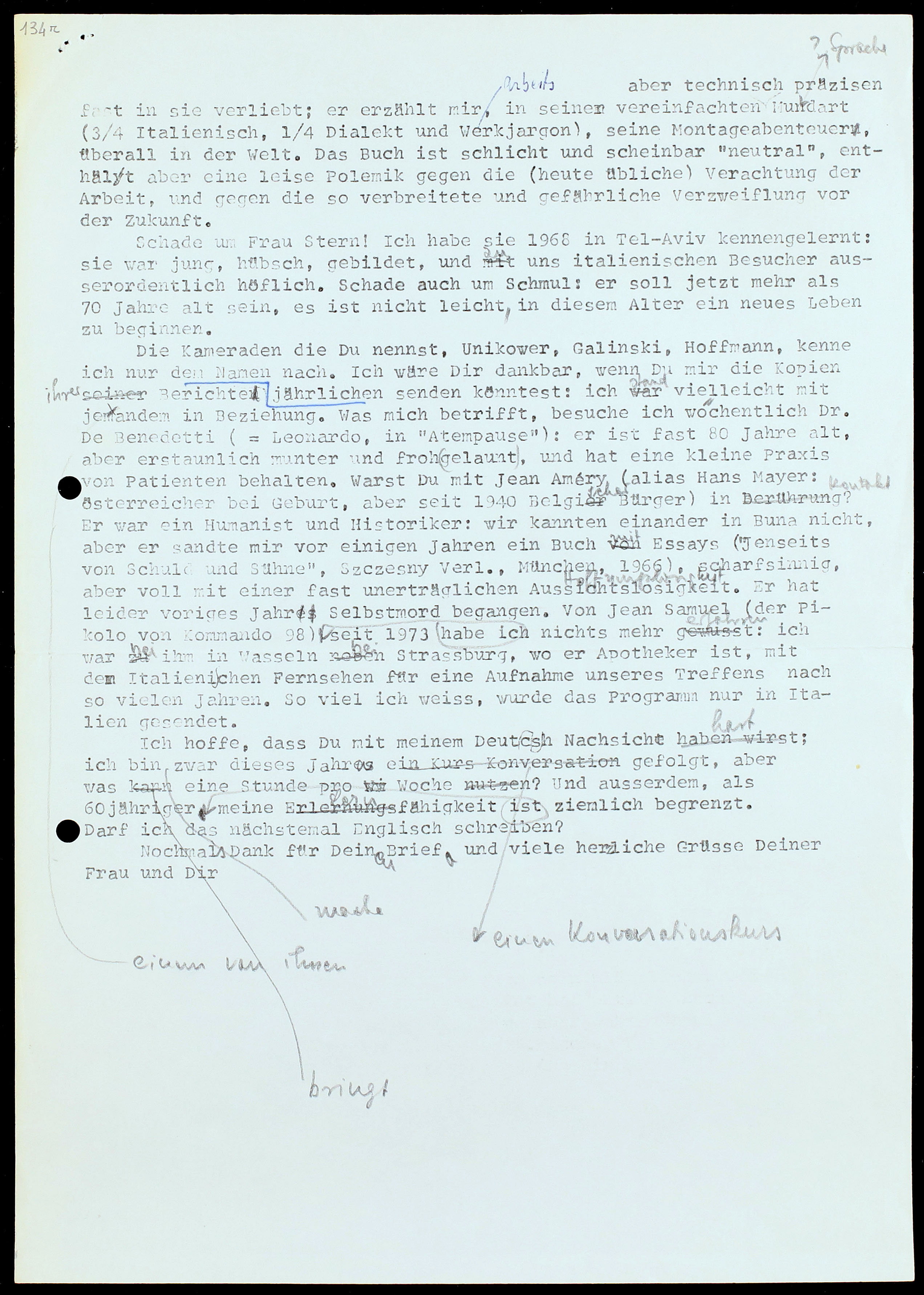
After many years of silence, Levi sends Davidovic this long letter informing him of his new status as a pensioner and telling him about his latest literary works; he also sends his friend the chapter “Vanadium” from The Periodic Table.
wie höflich von Dir, die Notiz der Bild-Zeitung mir zu senden, und wie froh war ich, von Deiner ganzen Familie gute Nachrichten zu lesen! Es muss doch eine Freude sein, Grossvater zu werden: mir ist das bis jetzt nicht gegeben, da Lisa (31) noch nicht verheiratet ist (sie ist Lehrerin in Settimo Torinese, einem Vorort von Turin wo ich als Chemiker bis vor kurzem tätig war), und Renzo (22) ist vielzu jung: er studiert Physik an der hiesigen Universität.
Die Erinnerung an den fernen Abend, als ich Dein Gast in Dortmund war, ist nie in mir verschwunden. Seit damals, hat sich für mich vieles verändert. Ende 1974, als ich nach 35 Jahren Dienst pensionsberechtigt war,legte ich meine Stelle als Betriebsleiter nieder; für die nächsten zwei Jahre blieb ich im Werk als Berater tätig: ich wollte nicht durch eine zu plötzliche Unterbrechung den Betriebsgang beschädigen.Übrigens, vom persönlichen Gesichtspunkt gesehen, fürchtete ich mich vor einer zu plötzlichen Lebensänderung.Danach, lebe ich als ruhiger Pensionärund freier Schriftsteller; zu meiner Überraschung, musste ich aber feststellen, dass, verfügt man täglich über (beispielweise) 8 Stunde Freizeit statt Zwei, man ja nicht viermals mehr als früher «produziert». Die (tägliche und jährliche) Leistung bleibt mehr oder weniger unverändert: ungefähr ein Buch alle 4-5 Jahre.
Mein vorletztes Buch hiess Il sistema periodico (Das periodische System), d.h. die Anordnung der Chemischen Grundstoffe vom Wasserstoff bis zum Uran): es ist aber kein Lehrbuch, sondern eine Art lockere Autobiographie, mir Betonung auf meine Beziehungen mit der Materie, die wechselweise (oder gar gleichzeitig) als Gegner oder als Freund empfunden wird. Das Thema hat mir Gelegenheit gegeben, einige KZ-Erlebnissezu erzählen. Eine Erzählung daraus lege ich Dir bei; in der Originalfassung heisst das Kapitel Vanadium (jedes Kapitel der Buches bezieht seinen Titel aus einem der chemischen Elemente). Die Geschehenisse wurden ein wenig «abgerundet»,[2] aber der Briefwechsel mit Dr. Müller (in der Realität Dr. Ferdinand Meyer) fand wirklich statt; so auch sein plötzlicher Tod vor unserer Verabredung. Das Buch erscheint hoffentlich nächsten Dezember bei dem Aufbau-Verlag, Berlin, wird aber wahrscheinlich auch in der BRD wieder aufgelegt, bei dem S. Fischer Verlag, der, wie Du siehst, im Begriff ist, Ist das ein Mensch? wiederherauszugeben.[3]
Mein letztes Buch heisst La chiave a stella: trotz dem Wohlklang handelt es sich nur um ein Werkzeug, eine Art Schraubenschlüssel. Zum erstmal habe ich hier auf die KZ-Erlebnisse verzichtet; ich habe versucht eine Person aus dem Nichts zu schöpfen. Mein Mann, ein tüchtiger Maschinenaufsteller,ist mit seiner Arbeit zufrieden, fast in sie verliebt; er erzählt mir, in seiner vereinfachten aber technisch präzisen Mundart(3/4 Italienisch, ¼ Dialekt und Werkjargon), seine Montageabenteuer, überall in der Welt. Das Buch ist schlicht und scheinbar «neutral», enthält aber eine leise Polemik gegen die (heute übliche) Verachtung der Arbeit, und gegen die so verbreitete und gefährliche Verzweiflung von der Zukunft.[4]
Schade um Frau Stern! Ich habe sie 1968 in Tel-Aviv kennengelernt: sie war jung, hübsch, gebildet, und zu uns italienischen Besucher ausserordentlich höflich.[5] Schade auch um Schmul: er soll jetzt mehr als 70 Jahre alt sein, es ist nicht leicht, in diesem Alter ein neues Leben zu beginnen.
Die Kameraden die Du nennst, Unikower, Galinski, Hoffmann, kenne ich nur dem Namen nach. Ich wäre Dir dankbar, wenn Du mir die Kopien ihres jährlichen Berichte senden könntest: ich stand vielleicht mit einem von Ihnen in Beziehung.[6] Was mich betrifft, besuche ich wöchentlich Dr. De Benedetti ( = Leonardo, in Atempause): er ist fast 80 Jahre alt, aber erstaunlich munter und frohgelaunt, und hat eine kleine Praxis von Patienten behalten. Warst Du mit Jean Améry (alias, Hans Mayer: österreicher bei Geburt, aber seit 1940 Belgischer Bürger) in Kontakt?Er war ein Humanist und Historiker: wir kannten einander in Buna nicht, aber er sandte mir vor einigen Jahren ein Buch mit Essays (Jenseits von Schuld und Sühne, Szczesny Verlag, München, 1966), scharfsinnig, aber voll mit einer fast unerträglichen Aussichtslosigkeit. Er hat leider voriges Jahr Selbstmord begangen.[7] Von Jean Samuel (der Pikolo von Kommando 98) habe ich seit 1973 nichts mehr erfahren: ich war bei ihm in Wasseln bei Strassburg, wo er Apotheker ist, mit den Italienischen Fernsehen für eine Aufnahme unseres Treffens nach so vielen Jahren. So viel ich weiss, wurde das Programm nur in Italien gesendet.[8]
Ich hoffe, dass Du mit meinem Deutsch Nachsicht hast; ich mache zwar dieses Jahr ein Konversationskurs, aber was bringt eine Stunde pro Woche? Und ausserdem, als 60 jähriger ist meine Lernfähigkeit ziemlich begrenzt.
Darf ich das nächstemal Englisch schreiben?
Nochmals Dank für Deinen Brief, und viele herzliche Grüsse Deiner Frau und Dir
16 luglio 1979
Caro Mendi![1]
che gentilezza da parte tua mandarmi il ritaglio della «Bild-Zeitung»! E quanto mi ha fatto piacere leggere buone notizie di tutta la tua famiglia! Dev’essere una grande gioia diventare nonno. A me, finora, questa fortuna non è toccata: Lisa (trentun anni) non è ancora sposata (insegna a Settimo Torinese, un comune alla periferia di Torino dove, fino a poco tempo fa, lavoravo come chimico). E Renzo (ventidue anni), invece, è ancora troppo giovane: studia fisica all’università di Torino.
Il ricordo di quella lontana sera in cui sono stato tuo ospite a Dortmund non mi ha mai abbandonato. Da allora molte cose sono cambiate nella mia vita. Alla fine del 1974, avendo maturato il diritto alla pensione dopo trentacinque anni di servizio, ho lasciato il mio posto di direttore di stabilimento; per i due anni successivi ho continuato a lavorare in fabbrica come consulente: non volevo che un’interruzione troppo brusca danneggiasse l’andamento dell’azienda. Del resto, dal punto di vista personale, temevo anch’io un cambiamento di vita troppo repentino. Da allora vivo come un tranquillo pensionato e faccio loscrittore indipendente. Con mia sorpresa, però, ho dovuto constatare che, anche disponendo ogni giorno, poniamo, di otto ore di tempo libero invece che di due, non si «produce» quattro volte più di prima. Il rendimento (quotidiano e annuale) resta più o meno lo stesso: all’incirca un libro ogni quattro o cinque anni.
Il mio penultimo libro si intitola Il sistema periodico (cioè lo schema che ordina gli elementi chimici dall’idrogeno all’uranio). Non è però un manuale, bensì una sorta di autobiografia libera, incentrata sul mio rapporto con la materia, che di volta in volta – o addirittura nello stesso momento – percepisco come avversaria o come alleata. Il tema mi ha anche offerto l’opportunità di raccontare alcuni episodi del Lager. Ti allego uno dei racconti: nell’edizione italiana il capitolo si intitola «Vanadio» (ogni capitolo del libro porta il nome di un elemento chimico). Le vicende sono state un po’ «arrotondate»,[2] ma lo scambio di lettere con il dottor Müller (che nella realtà si chiamava dottor Ferdinand Meyer) ha avuto luogo per davvero, così come la sua morte improvvisa prima del nostro incontro. Spero che il libro esca il prossimo dicembre presso l’Aufbau-Verlag di Berlino; probabilmente sarà poi pubblicato anche nella Repubblica Federale da S. Fischer che, come vedi, è in procinto di ristampare Se questo è un uomo.[3]
Il mio ultimo libro si intitola invece La chiave a stella: malgrado il bel suono, si tratta solo di un utensile, un tipo di chiave per bulloni. Per la prima volta qui ho rinunciato alle esperienze del Lager; ho cercato di creare un personaggio dal nulla. Il mio protagonista, un abilissimo montatore meccanico, è soddisfatto del lavoro che fa, ne è quasi innamorato; mi racconta, nel suo linguaggio semplice ma tecnicamente preciso (per tre quarti italiano, per un quarto dialetto e gergo di officina), le sue avventure di montatorein giro per il mondo. Il libro è semplice e apparentemente «neutro», ma contiene una sommessa polemica contro il disprezzo per il lavoro, oggi così diffuso, e contro quella disperazione nei confronti del futuro che è altrettanto diffusa e pericolosa.[4]
Che dispiacere per la signora Stern! L’avevo conosciuta a Tel Aviv nel 1968: era giovane, bella, colta e davvero molto gentile con noi italiani.[5] E mi dispiace anche per Schmul: ormai deve avere più di settant’anni e, a quell’età, ricominciare una nuova vita non è facile.
Le persone che nomini, Unikower, Galinski e Hoffmann, le conosco soltanto di nome. Ti sarei molto grato se potessi mandarmi copia dei loro resoconti annuali: forse con uno di loro ho avuto qualche contatto.[6] Quanto a me, vado a trovare ogni settimana il dottor De Benedetti (cioè Leonardo, nella Tregua): ha quasi ottant’anni, ma è straordinariamente vivace e di buon umore e continua a seguire un piccolo gruppo di pazienti. Hai mai avuto contatti con Jean Améry (alias Hans Mayer, austriaco di nascita ma dal 1940 cittadino belga)? Era un umanista e uno storico. A Buna non ci siamo conosciuti, ma qualche anno fa mi ha mandato una raccolta di saggi, (Jenseits von Schuld und Sühne, Szczesny Verlag, Monaco, 1966): un libro acutissimo, ma pervaso da una disperazione quasi insopportabile. Purtroppo l’anno scorso si è tolto la vita.[7] Di Jean Samuel(il Pikolo del Kommando 98) non ho più notizie dal 1973. Ero andato a trovarlo a Wasselonne, vicino a Strasburgo, dove fa il farmacista, insieme alla televisione italiana che voleva filmare il nostro incontro dopo tanti anni. Per quanto ne so, il programma è andato in onda soltanto in Italia.[8]
Spero che tu voglia essere indulgente con il mio tedesco. Quest’anno frequento un corso di conversazione, ma che cosa può fareun’ora alla settimana? E poi, a sessant’anni, la mia capacità di apprendimento è ormai piuttosto limitata.
Posso scriverti in inglese la prossima volta?
Ancora grazie per la tua lettera e molti cordiali saluti a te e a tua moglie
July 16, 1979
Dear Mendi![1]
How kind of you to send me the note from Bild, and how happy I was to read the good news about your whole family! It must be a joy to become a grandfather: I have not yet had that privilege, since Lisa(31) is not married yet (she is a teacher in Settimo Torinese, a suburb of Turin where I worked as a chemist until recently), and Renzo (22) is much too young—he is studying physics at the local university.
The memory of that long-ago evening when I was your guest in Dortmund has never faded from my mind. Since then, a lot has changed for me. At the end of 1974, when I became eligible for retirement after 35 years of service, I stepped down from my position as plant manager; for the next two years, I remained at the plant as a consultant: I did not want to disrupt operations with a sudden departure.Incidentally, from a personal standpoint, I was afraid of such a sudden change in my life. Since then, I have been living as a quiet retiree and freelance writer; to my surprise, however, I discovered that even if one has (for example) 8 hours of free time each day instead of two, one does not “produce” four times as much as before. My output (both daily and annual) remains more or less unchanged: about one book every 4–5 years.
My penultimate book was titled The Periodic Table, i.e., the arrangement of the basic chemical elements from hydrogen to uranium; however, it is not a textbook, but rather a kind of informal autobiography, with an emphasis on my relationship with matter, which is alternately (or even simultaneously) perceived as an adversary or a friend. The subject gave me the opportunity to recount some experiences from the concentration camps. I am enclosing one such story for you; in the original version, the chapter is titled “Vanadium” (each chapter of the book takes its title from one of the chemical elements). The events were “smoothed out”[2] a bit, but the correspondence with Dr. Müller (in reality, Dr. Ferdinand Meyer) actually took place; as did his sudden death before our scheduled meeting. The book will, I hope, be published next December by Aufbau-Verlag in Berlin, but it will likely also be reprinted in West Germany by S. Fischer Verlag, which, as you can see, is in the process of reissuing If This is a Man.[3]
My latest book is titled La chiave a stella (The Monkey’s Wrench): despite the melodious-sounding title, it refers to a simple tool. For the first time, I have omitted my concentration camp experiences in this one; I have tried to create a character out of thin air. My main character, a skilled machine fitter, is satisfied with his work—almost in love with it; he tells me, in his simplified yet technically precise vernacular (3/4 Italian, 1/4 dialect and shop jargon), about his adventures assembling things all over the world. The book is simple and seemingly “neutral,” but it contains a subtle critique of the (now commonplace) contempt for work, especially manual labor, and of the widespread and dangerous despair about the future.[4]
What a pity about Ms. Stern! I met her in Tel Aviv in 1968: she was young, pretty, well-educated, and exceptionally polite to us Italian visitors.[5] It is also a pity about Schmul: he is said to be over 70 now; it is not easy to start a new life at that age.
I know the comrades you mention—Unikover, Galinski, Hoffmann—only by name. I would be grateful if you could send me copies of their annual reports: I may have been in contact with one of them.[6] As for me, I visit Dr. De Benedetti(aka Leonardo, in The Truce) every week: he is almost 80 years old, but surprisingly lively and cheerful, and has kept a small practice of patients. Were you in contact with Jean Améry(alias Hans Mayer: Austrian by birth, but a Belgian citizen since 1940)?He was a humanist and historian: we did not know each other in Buna, but a few years ago he sent me a book of essays (Beyond Guilt and Atonement, Szczesny Verlag, Munich, 1966)—insightful, yet filled with an almost unbearable sense of hopelessness. Sadly, he committed suicide last year.[7] I have not heard anything from Jean Samuel (Pikolo from Kommando 98) since 1973: I visited him in Wasseln, outside Strasbourg, where he is a pharmacist, with the Italian national television service to film our reunion after so many years. As far as I know, the program was broadcast only in Italy.[8]
I hope you can forgive my German; I am taking a conversation course this year, but what good is one hour a week? And besides, as a 60-year-old, my ability to learn is rather limited.
May I write in English next time?
Thanks again for your letter, and warm regards to you and your wife
16 Juli 1979
Lieber Mendi![1]
wie höflich von Dir, die Notiz der Bild-Zeitung mir zu senden, und wie froh war ich, von Deiner ganzen Familie gute Nachrichten zu lesen! Es muss doch eine Freude sein, Grossvater zu werden: mir ist das bis jetzt nicht gegeben, da Lisa (31) noch nicht verheiratet ist (sie ist Lehrerin in Settimo Torinese, einem Vorort von Turin wo ich als Chemiker bis vor kurzem tätig war), und Renzo (22) ist vielzu jung: er studiert Physik an der hiesigen Universität.
Die Erinnerung an den fernen Abend, als ich Dein Gast in Dortmund war, ist nie in mir verschwunden. Seit damals, hat sich für mich vieles verändert. Ende 1974, als ich nach 35 Jahren Dienst pensionsberechtigt war,legte ich meine Stelle als Betriebsleiter nieder; für die nächsten zwei Jahre blieb ich im Werk als Berater tätig: ich wollte nicht durch eine zu plötzliche Unterbrechung den Betriebsgang beschädigen.Übrigens, vom persönlichen Gesichtspunkt gesehen, fürchtete ich mich vor einer zu plötzlichen Lebensänderung.Danach, lebe ich als ruhiger Pensionärund freier Schriftsteller; zu meiner Überraschung, musste ich aber feststellen, dass, verfügt man täglich über (beispielweise) 8 Stunde Freizeit statt Zwei, man ja nicht viermals mehr als früher «produziert». Die (tägliche und jährliche) Leistung bleibt mehr oder weniger unverändert: ungefähr ein Buch alle 4-5 Jahre.
Mein vorletztes Buch hiess Il sistema periodico (Das periodische System), d.h. die Anordnung der Chemischen Grundstoffe vom Wasserstoff bis zum Uran): es ist aber kein Lehrbuch, sondern eine Art lockere Autobiographie, mir Betonung auf meine Beziehungen mit der Materie, die wechselweise (oder gar gleichzeitig) als Gegner oder als Freund empfunden wird. Das Thema hat mir Gelegenheit gegeben, einige KZ-Erlebnissezu erzählen. Eine Erzählung daraus lege ich Dir bei; in der Originalfassung heisst das Kapitel Vanadium (jedes Kapitel der Buches bezieht seinen Titel aus einem der chemischen Elemente). Die Geschehenisse wurden ein wenig «abgerundet»,[2] aber der Briefwechsel mit Dr. Müller (in der Realität Dr. Ferdinand Meyer) fand wirklich statt; so auch sein plötzlicher Tod vor unserer Verabredung. Das Buch erscheint hoffentlich nächsten Dezember bei dem Aufbau-Verlag, Berlin, wird aber wahrscheinlich auch in der BRD wieder aufgelegt, bei dem S. Fischer Verlag, der, wie Du siehst, im Begriff ist, Ist das ein Mensch? wiederherauszugeben.[3]
Mein letztes Buch heisst La chiave a stella: trotz dem Wohlklang handelt es sich nur um ein Werkzeug, eine Art Schraubenschlüssel. Zum erstmal habe ich hier auf die KZ-Erlebnisse verzichtet; ich habe versucht eine Person aus dem Nichts zu schöpfen. Mein Mann, ein tüchtiger Maschinenaufsteller,ist mit seiner Arbeit zufrieden, fast in sie verliebt; er erzählt mir, in seiner vereinfachten aber technisch präzisen Mundart(3/4 Italienisch, ¼ Dialekt und Werkjargon), seine Montageabenteuer, überall in der Welt. Das Buch ist schlicht und scheinbar «neutral», enthält aber eine leise Polemik gegen die (heute übliche) Verachtung der Arbeit, und gegen die so verbreitete und gefährliche Verzweiflung von der Zukunft.[4]
Schade um Frau Stern! Ich habe sie 1968 in Tel-Aviv kennengelernt: sie war jung, hübsch, gebildet, und zu uns italienischen Besucher ausserordentlich höflich.[5] Schade auch um Schmul: er soll jetzt mehr als 70 Jahre alt sein, es ist nicht leicht, in diesem Alter ein neues Leben zu beginnen.
Die Kameraden die Du nennst, Unikower, Galinski, Hoffmann, kenne ich nur dem Namen nach. Ich wäre Dir dankbar, wenn Du mir die Kopien ihres jährlichen Berichte senden könntest: ich stand vielleicht mit einem von Ihnen in Beziehung.[6] Was mich betrifft, besuche ich wöchentlich Dr. De Benedetti ( = Leonardo, in Atempause): er ist fast 80 Jahre alt, aber erstaunlich munter und frohgelaunt, und hat eine kleine Praxis von Patienten behalten. Warst Du mit Jean Améry (alias, Hans Mayer: österreicher bei Geburt, aber seit 1940 Belgischer Bürger) in Kontakt?Er war ein Humanist und Historiker: wir kannten einander in Buna nicht, aber er sandte mir vor einigen Jahren ein Buch mit Essays (Jenseits von Schuld und Sühne, Szczesny Verlag, München, 1966), scharfsinnig, aber voll mit einer fast unerträglichen Aussichtslosigkeit. Er hat leider voriges Jahr Selbstmord begangen.[7] Von Jean Samuel (der Pikolo von Kommando 98) habe ich seit 1973 nichts mehr erfahren: ich war bei ihm in Wasseln bei Strassburg, wo er Apotheker ist, mit den Italienischen Fernsehen für eine Aufnahme unseres Treffens nach so vielen Jahren. So viel ich weiss, wurde das Programm nur in Italien gesendet.[8]
Ich hoffe, dass Du mit meinem Deutsch Nachsicht hast; ich mache zwar dieses Jahr ein Konversationskurs, aber was bringt eine Stunde pro Woche? Und ausserdem, als 60 jähriger ist meine Lernfähigkeit ziemlich begrenzt.
Darf ich das nächstemal Englisch schreiben?
Nochmals Dank für Deinen Brief, und viele herzliche Grüsse Deiner Frau und Dir
16 luglio 1979
Caro Mendi![1]
che gentilezza da parte tua mandarmi il ritaglio della «Bild-Zeitung»! E quanto mi ha fatto piacere leggere buone notizie di tutta la tua famiglia! Dev’essere una grande gioia diventare nonno. A me, finora, questa fortuna non è toccata: Lisa (trentun anni) non è ancora sposata (insegna a Settimo Torinese, un comune alla periferia di Torino dove, fino a poco tempo fa, lavoravo come chimico). E Renzo (ventidue anni), invece, è ancora troppo giovane: studia fisica all’università di Torino.
Il ricordo di quella lontana sera in cui sono stato tuo ospite a Dortmund non mi ha mai abbandonato. Da allora molte cose sono cambiate nella mia vita. Alla fine del 1974, avendo maturato il diritto alla pensione dopo trentacinque anni di servizio, ho lasciato il mio posto di direttore di stabilimento; per i due anni successivi ho continuato a lavorare in fabbrica come consulente: non volevo che un’interruzione troppo brusca danneggiasse l’andamento dell’azienda. Del resto, dal punto di vista personale, temevo anch’io un cambiamento di vita troppo repentino. Da allora vivo come un tranquillo pensionato e faccio loscrittore indipendente. Con mia sorpresa, però, ho dovuto constatare che, anche disponendo ogni giorno, poniamo, di otto ore di tempo libero invece che di due, non si «produce» quattro volte più di prima. Il rendimento (quotidiano e annuale) resta più o meno lo stesso: all’incirca un libro ogni quattro o cinque anni.
Il mio penultimo libro si intitola Il sistema periodico (cioè lo schema che ordina gli elementi chimici dall’idrogeno all’uranio). Non è però un manuale, bensì una sorta di autobiografia libera, incentrata sul mio rapporto con la materia, che di volta in volta – o addirittura nello stesso momento – percepisco come avversaria o come alleata. Il tema mi ha anche offerto l’opportunità di raccontare alcuni episodi del Lager. Ti allego uno dei racconti: nell’edizione italiana il capitolo si intitola «Vanadio» (ogni capitolo del libro porta il nome di un elemento chimico). Le vicende sono state un po’ «arrotondate»,[2] ma lo scambio di lettere con il dottor Müller (che nella realtà si chiamava dottor Ferdinand Meyer) ha avuto luogo per davvero, così come la sua morte improvvisa prima del nostro incontro. Spero che il libro esca il prossimo dicembre presso l’Aufbau-Verlag di Berlino; probabilmente sarà poi pubblicato anche nella Repubblica Federale da S. Fischer che, come vedi, è in procinto di ristampare Se questo è un uomo.[3]
Il mio ultimo libro si intitola invece La chiave a stella: malgrado il bel suono, si tratta solo di un utensile, un tipo di chiave per bulloni. Per la prima volta qui ho rinunciato alle esperienze del Lager; ho cercato di creare un personaggio dal nulla. Il mio protagonista, un abilissimo montatore meccanico, è soddisfatto del lavoro che fa, ne è quasi innamorato; mi racconta, nel suo linguaggio semplice ma tecnicamente preciso (per tre quarti italiano, per un quarto dialetto e gergo di officina), le sue avventure di montatorein giro per il mondo. Il libro è semplice e apparentemente «neutro», ma contiene una sommessa polemica contro il disprezzo per il lavoro, oggi così diffuso, e contro quella disperazione nei confronti del futuro che è altrettanto diffusa e pericolosa.[4]
Che dispiacere per la signora Stern! L’avevo conosciuta a Tel Aviv nel 1968: era giovane, bella, colta e davvero molto gentile con noi italiani.[5] E mi dispiace anche per Schmul: ormai deve avere più di settant’anni e, a quell’età, ricominciare una nuova vita non è facile.
Le persone che nomini, Unikower, Galinski e Hoffmann, le conosco soltanto di nome. Ti sarei molto grato se potessi mandarmi copia dei loro resoconti annuali: forse con uno di loro ho avuto qualche contatto.[6] Quanto a me, vado a trovare ogni settimana il dottor De Benedetti (cioè Leonardo, nella Tregua): ha quasi ottant’anni, ma è straordinariamente vivace e di buon umore e continua a seguire un piccolo gruppo di pazienti. Hai mai avuto contatti con Jean Améry (alias Hans Mayer, austriaco di nascita ma dal 1940 cittadino belga)? Era un umanista e uno storico. A Buna non ci siamo conosciuti, ma qualche anno fa mi ha mandato una raccolta di saggi, (Jenseits von Schuld und Sühne, Szczesny Verlag, Monaco, 1966): un libro acutissimo, ma pervaso da una disperazione quasi insopportabile. Purtroppo l’anno scorso si è tolto la vita.[7] Di Jean Samuel(il Pikolo del Kommando 98) non ho più notizie dal 1973. Ero andato a trovarlo a Wasselonne, vicino a Strasburgo, dove fa il farmacista, insieme alla televisione italiana che voleva filmare il nostro incontro dopo tanti anni. Per quanto ne so, il programma è andato in onda soltanto in Italia.[8]
Spero che tu voglia essere indulgente con il mio tedesco. Quest’anno frequento un corso di conversazione, ma che cosa può fareun’ora alla settimana? E poi, a sessant’anni, la mia capacità di apprendimento è ormai piuttosto limitata.
Posso scriverti in inglese la prossima volta?
Ancora grazie per la tua lettera e molti cordiali saluti a te e a tua moglie
July 16, 1979
Dear Mendi![1]
How kind of you to send me the note from Bild, and how happy I was to read the good news about your whole family! It must be a joy to become a grandfather: I have not yet had that privilege, since Lisa(31) is not married yet (she is a teacher in Settimo Torinese, a suburb of Turin where I worked as a chemist until recently), and Renzo (22) is much too young—he is studying physics at the local university.
The memory of that long-ago evening when I was your guest in Dortmund has never faded from my mind. Since then, a lot has changed for me. At the end of 1974, when I became eligible for retirement after 35 years of service, I stepped down from my position as plant manager; for the next two years, I remained at the plant as a consultant: I did not want to disrupt operations with a sudden departure.Incidentally, from a personal standpoint, I was afraid of such a sudden change in my life. Since then, I have been living as a quiet retiree and freelance writer; to my surprise, however, I discovered that even if one has (for example) 8 hours of free time each day instead of two, one does not “produce” four times as much as before. My output (both daily and annual) remains more or less unchanged: about one book every 4–5 years.
My penultimate book was titled The Periodic Table, i.e., the arrangement of the basic chemical elements from hydrogen to uranium; however, it is not a textbook, but rather a kind of informal autobiography, with an emphasis on my relationship with matter, which is alternately (or even simultaneously) perceived as an adversary or a friend. The subject gave me the opportunity to recount some experiences from the concentration camps. I am enclosing one such story for you; in the original version, the chapter is titled “Vanadium” (each chapter of the book takes its title from one of the chemical elements). The events were “smoothed out”[2] a bit, but the correspondence with Dr. Müller (in reality, Dr. Ferdinand Meyer) actually took place; as did his sudden death before our scheduled meeting. The book will, I hope, be published next December by Aufbau-Verlag in Berlin, but it will likely also be reprinted in West Germany by S. Fischer Verlag, which, as you can see, is in the process of reissuing If This is a Man.[3]
My latest book is titled La chiave a stella (The Monkey’s Wrench): despite the melodious-sounding title, it refers to a simple tool. For the first time, I have omitted my concentration camp experiences in this one; I have tried to create a character out of thin air. My main character, a skilled machine fitter, is satisfied with his work—almost in love with it; he tells me, in his simplified yet technically precise vernacular (3/4 Italian, 1/4 dialect and shop jargon), about his adventures assembling things all over the world. The book is simple and seemingly “neutral,” but it contains a subtle critique of the (now commonplace) contempt for work, especially manual labor, and of the widespread and dangerous despair about the future.[4]
What a pity about Ms. Stern! I met her in Tel Aviv in 1968: she was young, pretty, well-educated, and exceptionally polite to us Italian visitors.[5] It is also a pity about Schmul: he is said to be over 70 now; it is not easy to start a new life at that age.
I know the comrades you mention—Unikover, Galinski, Hoffmann—only by name. I would be grateful if you could send me copies of their annual reports: I may have been in contact with one of them.[6] As for me, I visit Dr. De Benedetti(aka Leonardo, in The Truce) every week: he is almost 80 years old, but surprisingly lively and cheerful, and has kept a small practice of patients. Were you in contact with Jean Améry(alias Hans Mayer: Austrian by birth, but a Belgian citizen since 1940)?He was a humanist and historian: we did not know each other in Buna, but a few years ago he sent me a book of essays (Beyond Guilt and Atonement, Szczesny Verlag, Munich, 1966)—insightful, yet filled with an almost unbearable sense of hopelessness. Sadly, he committed suicide last year.[7] I have not heard anything from Jean Samuel (Pikolo from Kommando 98) since 1973: I visited him in Wasseln, outside Strasbourg, where he is a pharmacist, with the Italian national television service to film our reunion after so many years. As far as I know, the program was broadcast only in Italy.[8]
I hope you can forgive my German; I am taking a conversation course this year, but what good is one hour a week? And besides, as a 60-year-old, my ability to learn is rather limited.
May I write in English next time?
Thanks again for your letter, and warm regards to you and your wife
Info
Notes
Tag
Sender: Primo Levi
Addressee: Emil Davidovič
Date of Drafting: 1979-07-16
Place of Writing: Turin
Description:photocopy of a typewritten carbon copy with handwritten corrections in pencil, blue ballpoint pen, and another pen with light blue liquid ink. On the back of sheet 134, notes have been written in pencil by an unknown hand: “1) Ich bin gesund und munter und hoffe das gleiche von Dir | 2) Ich freue mich, dass du gesund und munter bist (Wohlauf) | 3) am Tag vorher | 4) von mir aus gesehen” [ “1) I am healthy and cheerful and I hope you are, too | 2) I am glad that you are healthy and cheerful (in good health) | 3) the previous day | 4) from my point of view”].On the lower portion of the sheet is written: “> Ereignis [“event”] something that happens event | > Erlebnis [“experience”] | > Erfahrung [“experience”] | > Abenteuer (adventure).” “xxx 584677” is written in the upper left-hand corner: this is Levi’s new telephone number, typed onto the original sheet to correct the old number which most likely was part of the letterhead; a trace of it remains on the copy sheet.
1The letter has numerous handwritten interventions, most of which were not written by Levi. Most likely, the corrections were made by Hans Dieter Engert, Levi’s professor at the Goethe Institut in Turin from 1978 until 1981 (on his relationship with Engert, cf. I. Thomson, Primo Levi. A Life, cit., pp. 476-77 and C. Angier, Il doppio legame: vita di Primo Levi, Milan: Mondadori, 2004, pp. 617-18). Levi was in the habit of showing the professor the letters he wrote in German to verify their correctness, as he confirms in a letter to Engert on April 12, 1979, a copy of which is conserved at the Wiener Holocaust Library in London (Primo Levi biography: Ian Thomson papers, 1406/2/178). In this letter, he informs the professor that he has left photocopies of a few letters to and from Davidovic at the Goethe Institut for this purpose. See also the corresponding Insight. This also seems to be the case of this letter dated July 16, 1979, of which a photocopy with handwritten corrections is conserved in Levi’s archive. However, it is impossible to establish which version of the letter was sent to the rabbi. The text presents only the corrections that are unequivocably such and cannot be interpreted as mere suggestions; for a complete list of the interventions, see the relative section in the note to the text, at the entry Transcriptions.
2On the topic of the “smoothing out” in “Vanadium,” cf. M. Mengoni, I sommersi e i salvati di Primo Levi, cit., pp. 164-65. As Levi wrote in The Wrench, “I promised Faussone that I would follow his directions conscientiously, and in no case would I yield to the temptation, so common in my profession, to invent, embellish, and elaborate. I wouldn’t add anything to his account, but I might take out a couple of things, like a sculptor, when he carves a form from a block; and he expressed his approval” (CW II, p. 1055). In a 1985 interview, the concept was used to describe the process of composing a literary rendering of his stories about the Lager: “I had written some short stories after I returned from prison. I wrote them without realizing that they could be a book. After reading them, my friends in the Resistance told me to ‘smooth them out,’ to turn them into a book.” Cf. N. Orengo, “Come ho pubblicato il mio primo libro,” in Tuttolibri, June 1, 1985, p.1.
3As his correspondence with Joachim Meinert shows, Levi had received the German translation of “Vanadium” a few months earlier. In June 1979, the short story had already been published in Die Zeit on the initiative of Ruth Jakusch. Cf. letter 210.
4Cf. CW II, p. 1023: “If you put aside those prodigious, singular moments that destiny gives us, love of one’s work (a privilege enjoyed, unfortunately, only by a few) is the best, most concrete approximation of happiness on earth—but most people don’t realize this […]. Whenever work is exalted by someone in official ceremonies, an insidious rhetoric comes into play, based on the cynical belief that a medal and a few words of praise cost less, and are more valuable, than a pay increase. There also exists, however, a rhetoric on the other side, not so much cynical as profoundly stupid, that tends to denigrate work, to portray it as vile, as if we could do without work, our own or that of others, not just in some future utopia but here, today: as if anybody who works were by definition a servant, and as if, conversely, anyone who doesn’t work, or doesn’t know how to, or doesn’t want to were therefore a free man.”
5Cf. letter 180, n. 2. Davidovic had shared Stern’s address in letter 182, dated February 12, 1965.
6The name Heinz Galinski (cf. letter 193, n. 8) appears in the minutes of the International Auschwitz Committee meeting that was held on July 15, 1974; Langbein enclosed a copy of the minutes in his letter to Primo Levi dated July 26, 1974. At the moment, there is no archival confirmation of any direct contact with Unikower (letter 182, n. 18), Hoffman (letter 193, n. 9), or Galinski.
7Jean Améry committed suicide on October 17, 1978. Levi published the article “Jean Améry, the Philosopher-Suicide” on December 7, 1978 (CW II, pp. 1262-64).
8Levi went to Strasburg in March 1974 to record, with Jean Samuel, part of the documentary Il mestiere di raccontare by the director Gianfranco Albano. The video of their encounter is available in the archive Laboratorio Levi of RaiPlay.