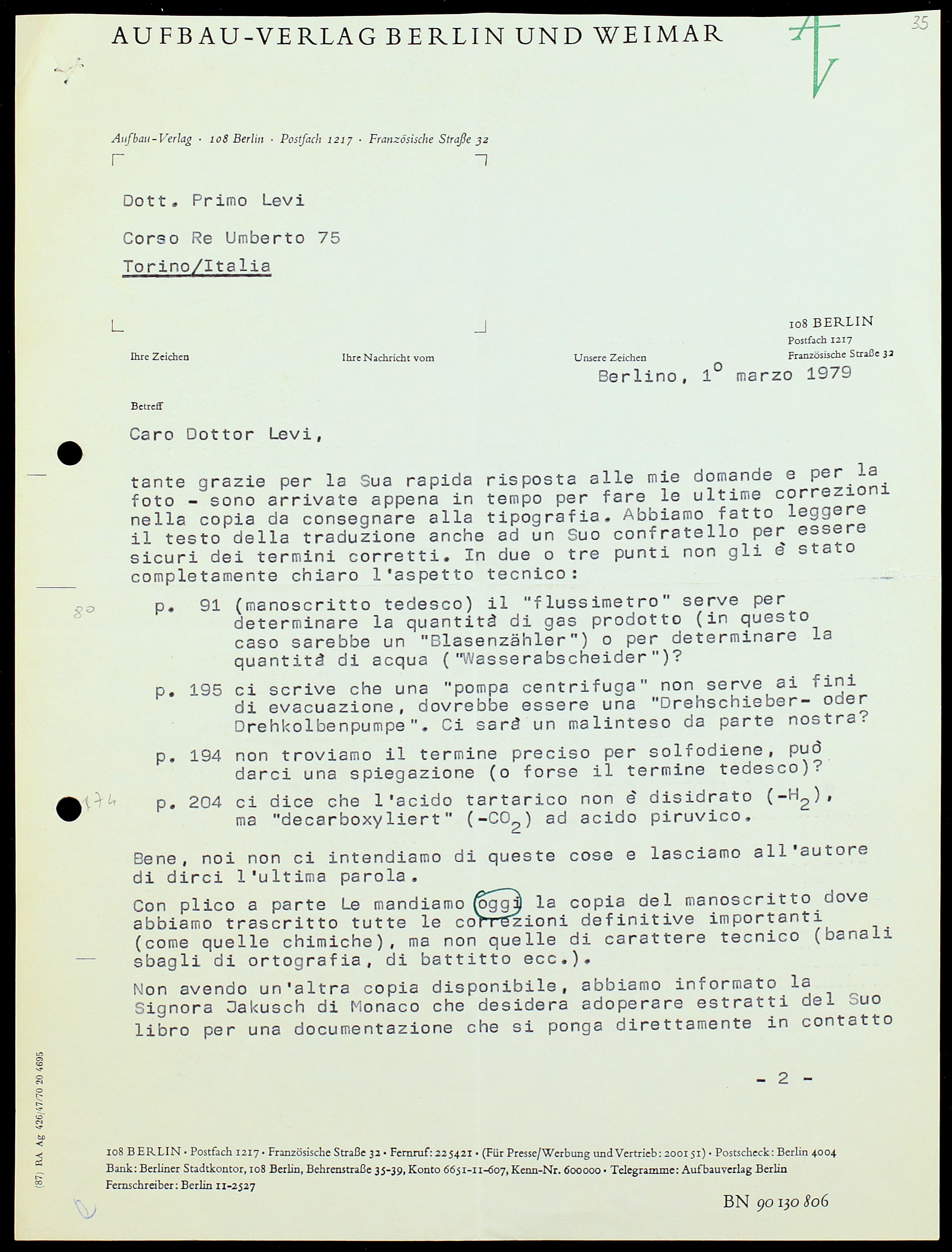
Joachim Meinert asks Primo Levi a few questions regarding the translation of various technical aspects in The Periodic Table. He also informs Levi that Ruth Jakusch is interested in publishing an excerpt from his book.
Dott. Primo Levi
Corso Re Umberto 75
Torino/Italia
Berlino, 1° marzo 1979
Caro Dottor Levi,
tante grazie per la Sua rapida risposta alle mie domande e per la foto – sono arrivate appena in tempo per fare le ultime correzioni nella copia da consegnare alla tipografia. Abbiamo fatto leggere il testo della traduzione anche ad un Suo confratello per essere sicuri dei termini corretti. In due o tre punti non gli è stato completamente chiaro l’aspetto tecnico:
p. 91 (manoscritto tedesco) il «flussimetro» serve per determinare la quantità di gas prodotto (in questo caso sarebbe un «Blasenzähler») o per determinare la quantità di acqua («Wasserabscheider»)?[1]
p. 195 ci scrive che una «pompa centrifuga» non serve ai fini di evacuazione, dovrebbe essere una «Drehschieber- oder Drehkolbenpumpe». Ci sarà un malinteso da parte nostra?[2]
p. 194 non troviamo il termine preciso per solfodiene, può darci una spiegazione (o forse il termine tedesco)?[3]
p. 204 ci dice che l’acido tartarico non è disidrato (-H2), ma «decarboxyliert» (-CO2) ad acido piruvico.[4]
Bene, noi non ci intendiamo di queste cose e lasciamo all’autore di dirci l’ultima parola.
Con plico a parte Le mandiamo oggi[5] la copia del manoscritto dove abbiamo trascritto tutte le correzioni definitive importanti (come quelle chimiche), ma non quelle di carattere tecnico (banali sbagli di ortografia, di battitto ecc.).
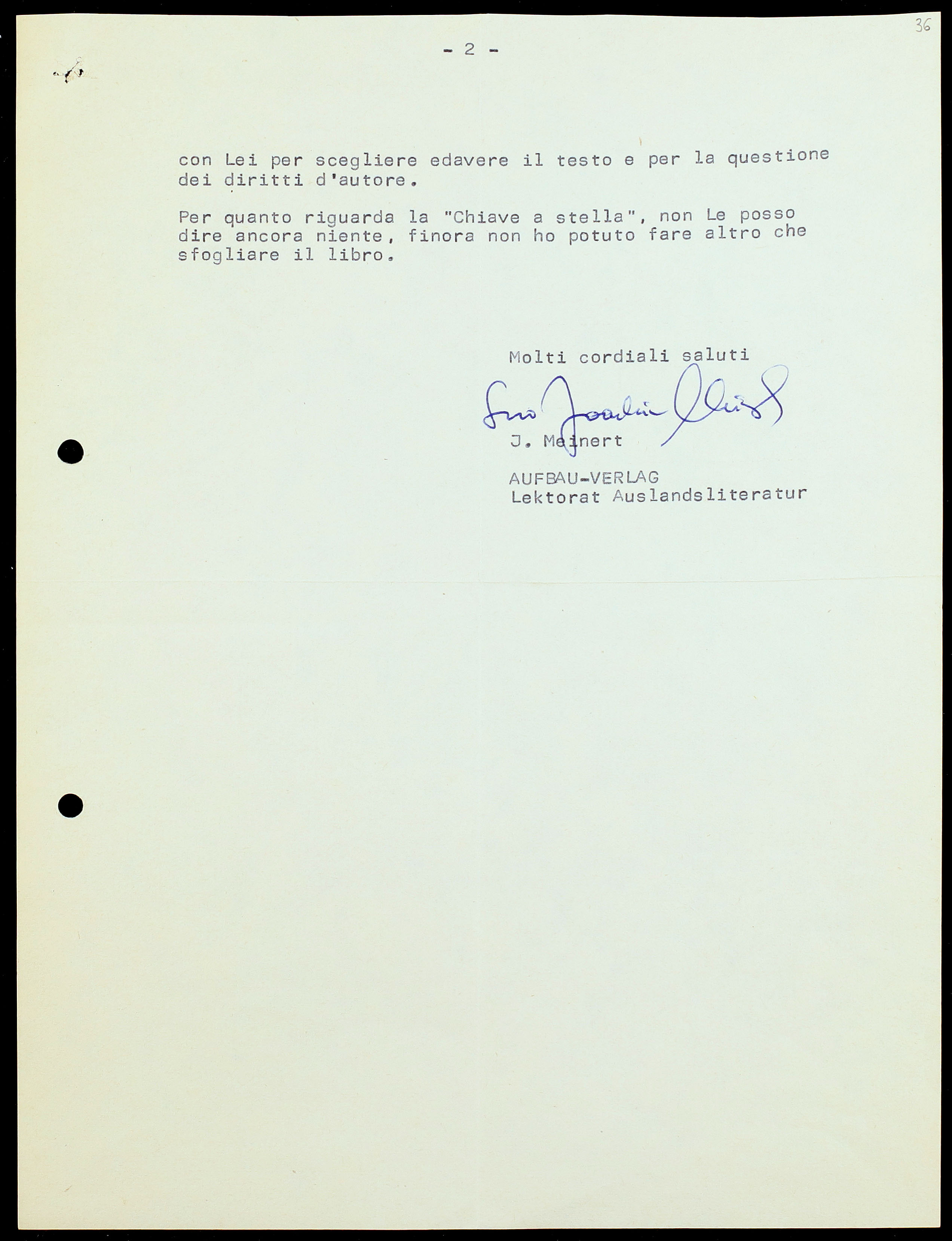
Non avendo un’altra copia disponibile, abbiamo informato la Signora Jakusch di Monaco che desidera adoperare estratti del Suo libro per una documentazione che si ponga direttamente in contatto con Lei per scegliere ed avere il testo e per la questione dei diritti d’autore.[6]
Per quanto riguarda laChiave a stella, non Le posso dire ancora niente, finora non ho potuto fare altro che sfogliare il libro.
Molti cordiali saluti
J. Meinert
AUFBAU-VERLAG
Lektorat Auslandsliteratur
Dott. Primo Levi
Corso Re Umberto 75
Torino/Italia
Berlino, 1° marzo 1979
Caro Dottor Levi,
tante grazie per la Sua rapida risposta alle mie domande e per la foto – sono arrivate appena in tempo per fare le ultime correzioni nella copia da consegnare alla tipografia. Abbiamo fatto leggere il testo della traduzione anche ad un Suo confratello per essere sicuri dei termini corretti. In due o tre punti non gli è stato completamente chiaro l’aspetto tecnico:
p. 91 (manoscritto tedesco) il «flussimetro» serve per determinare la quantità di gas prodotto (in questo caso sarebbe un «Blasenzähler») o per determinare la quantità di acqua («Wasserabscheider»)?[1]
p. 195 ci scrive che una «pompa centrifuga» non serve ai fini di evacuazione, dovrebbe essere una «Drehschieber- oder Drehkolbenpumpe». Ci sarà un malinteso da parte nostra?[2]
p. 194 non troviamo il termine preciso per solfodiene, può darci una spiegazione (o forse il termine tedesco)?[3]
p. 204 ci dice che l’acido tartarico non è disidrato (-H2), ma «decarboxyliert» (-CO2) ad acido piruvico.[4]
Bene, noi non ci intendiamo di queste cose e lasciamo all’autore di dirci l’ultima parola.
Con plico a parte Le mandiamo oggi[5] la copia del manoscritto dove abbiamo trascritto tutte le correzioni definitive importanti (come quelle chimiche), ma non quelle di carattere tecnico (banali sbagli di ortografia, di battitto ecc.).
Non avendo un’altra copia disponibile, abbiamo informato la Signora Jakusch di Monaco che desidera adoperare estratti del Suo libro per una documentazione che si ponga direttamente in contatto con Lei per scegliere ed avere il testo e per la questione dei diritti d’autore.[6]
Per quanto riguarda la Chiave a stella, non Le posso dire ancora niente, finora non ho potuto fare altro che sfogliare il libro.
Molti cordiali saluti
J. Meinert
AUFBAU-VERLAG
Lektorat Auslandsliteratur
Dr. Primo Levi Corso Re Umberto 75 Torino/Italia
Berlino, March 1, 1979
Dear Dr. Levi,
Many thanks for your prompt reply to my questions and for the photo – they arrived just in time to make the final corrections in the copy that was sent to the typographers. We have also had a colleague of yours read the translation to be sure that the terms were correct. He did not completely understand two or three of the technical aspects:
p. 91 (German manuscript) does the “flow meter” determine the quantity of gas produced (in this case, it would be a “Blasenzähler”) or the quantity of water (“Wasserabscheider”)?[1]
p. 195 he writes that a “centrifugal pump” is not intended for evacuation purposes;it should be a “Drehschieber- oder Drehkolbenpumpe.” Did we misunderstand?[2]
p. 194 we cannot find the precise term for “sulfur diene,” could you explain it to us (or perhaps provide us with the term in German)?[3]
p. 204 he tells us that tartaric acid is not dehydrated (-H2), but “decarboxyliert” (-CO2) to pyruvic acid.[4]
So, we do not understand these things and will let the author have the last word.
Today,[5] under separate cover, we are sending you a copy of the manuscript in which we have transcribed all the important final corrections (such as the chemical ones), but not the technical ones (banal misspellings, typographical errors, etc.).
Since we do not have another copy available, we have informed Mrs. Jakuschin Munich, who would like to use excerpts from your book in some research, that she should contact you directly to select and receive the texts, and also for the copyright.[6]
I still cannot tell you anything regarding The Wrench; so far, I have only been able to leaf through the book.
Many cordial greetings,
Meinert AUFBAU-VERLAG Lektorat Auslandsliteratur
Dott. Primo Levi
Corso Re Umberto 75
Torino/Italia
Berlino, 1° marzo 1979
Caro Dottor Levi,
tante grazie per la Sua rapida risposta alle mie domande e per la foto – sono arrivate appena in tempo per fare le ultime correzioni nella copia da consegnare alla tipografia. Abbiamo fatto leggere il testo della traduzione anche ad un Suo confratello per essere sicuri dei termini corretti. In due o tre punti non gli è stato completamente chiaro l’aspetto tecnico:
p. 91 (manoscritto tedesco) il «flussimetro» serve per determinare la quantità di gas prodotto (in questo caso sarebbe un «Blasenzähler») o per determinare la quantità di acqua («Wasserabscheider»)?[1]
p. 195 ci scrive che una «pompa centrifuga» non serve ai fini di evacuazione, dovrebbe essere una «Drehschieber- oder Drehkolbenpumpe». Ci sarà un malinteso da parte nostra?[2]
p. 194 non troviamo il termine preciso per solfodiene, può darci una spiegazione (o forse il termine tedesco)?[3]
p. 204 ci dice che l’acido tartarico non è disidrato (-H2), ma «decarboxyliert» (-CO2) ad acido piruvico.[4]
Bene, noi non ci intendiamo di queste cose e lasciamo all’autore di dirci l’ultima parola.
Con plico a parte Le mandiamo oggi[5] la copia del manoscritto dove abbiamo trascritto tutte le correzioni definitive importanti (come quelle chimiche), ma non quelle di carattere tecnico (banali sbagli di ortografia, di battitto ecc.).
Non avendo un’altra copia disponibile, abbiamo informato la Signora Jakusch di Monaco che desidera adoperare estratti del Suo libro per una documentazione che si ponga direttamente in contatto con Lei per scegliere ed avere il testo e per la questione dei diritti d’autore.[6]
Per quanto riguarda laChiave a stella, non Le posso dire ancora niente, finora non ho potuto fare altro che sfogliare il libro.
Molti cordiali saluti
J. Meinert
AUFBAU-VERLAG
Lektorat Auslandsliteratur
Dott. Primo Levi
Corso Re Umberto 75
Torino/Italia
Berlino, 1° marzo 1979
Caro Dottor Levi,
tante grazie per la Sua rapida risposta alle mie domande e per la foto – sono arrivate appena in tempo per fare le ultime correzioni nella copia da consegnare alla tipografia. Abbiamo fatto leggere il testo della traduzione anche ad un Suo confratello per essere sicuri dei termini corretti. In due o tre punti non gli è stato completamente chiaro l’aspetto tecnico:
p. 91 (manoscritto tedesco) il «flussimetro» serve per determinare la quantità di gas prodotto (in questo caso sarebbe un «Blasenzähler») o per determinare la quantità di acqua («Wasserabscheider»)?[1]
p. 195 ci scrive che una «pompa centrifuga» non serve ai fini di evacuazione, dovrebbe essere una «Drehschieber- oder Drehkolbenpumpe». Ci sarà un malinteso da parte nostra?[2]
p. 194 non troviamo il termine preciso per solfodiene, può darci una spiegazione (o forse il termine tedesco)?[3]
p. 204 ci dice che l’acido tartarico non è disidrato (-H2), ma «decarboxyliert» (-CO2) ad acido piruvico.[4]
Bene, noi non ci intendiamo di queste cose e lasciamo all’autore di dirci l’ultima parola.
Con plico a parte Le mandiamo oggi[5] la copia del manoscritto dove abbiamo trascritto tutte le correzioni definitive importanti (come quelle chimiche), ma non quelle di carattere tecnico (banali sbagli di ortografia, di battitto ecc.).
Non avendo un’altra copia disponibile, abbiamo informato la Signora Jakusch di Monaco che desidera adoperare estratti del Suo libro per una documentazione che si ponga direttamente in contatto con Lei per scegliere ed avere il testo e per la questione dei diritti d’autore.[6]
Per quanto riguarda la Chiave a stella, non Le posso dire ancora niente, finora non ho potuto fare altro che sfogliare il libro.
Molti cordiali saluti
J. Meinert
AUFBAU-VERLAG
Lektorat Auslandsliteratur
Dr. Primo Levi Corso Re Umberto 75 Torino/Italia
Berlino, March 1, 1979
Dear Dr. Levi,
Many thanks for your prompt reply to my questions and for the photo – they arrived just in time to make the final corrections in the copy that was sent to the typographers. We have also had a colleague of yours read the translation to be sure that the terms were correct. He did not completely understand two or three of the technical aspects:
p. 91 (German manuscript) does the “flow meter” determine the quantity of gas produced (in this case, it would be a “Blasenzähler”) or the quantity of water (“Wasserabscheider”)?[1]
p. 195 he writes that a “centrifugal pump” is not intended for evacuation purposes;it should be a “Drehschieber- oder Drehkolbenpumpe.” Did we misunderstand?[2]
p. 194 we cannot find the precise term for “sulfur diene,” could you explain it to us (or perhaps provide us with the term in German)?[3]
p. 204 he tells us that tartaric acid is not dehydrated (-H2), but “decarboxyliert” (-CO2) to pyruvic acid.[4]
So, we do not understand these things and will let the author have the last word.
Today,[5] under separate cover, we are sending you a copy of the manuscript in which we have transcribed all the important final corrections (such as the chemical ones), but not the technical ones (banal misspellings, typographical errors, etc.).
Since we do not have another copy available, we have informed Mrs. Jakuschin Munich, who would like to use excerpts from your book in some research, that she should contact you directly to select and receive the texts, and also for the copyright.[6]
I still cannot tell you anything regarding The Wrench; so far, I have only been able to leaf through the book.
Many cordial greetings,
Meinert AUFBAU-VERLAG Lektorat Auslandsliteratur
Info
Notes
Tag
Sender: Joachim Meinert
Addressee: Primo Levi
Date of Drafting: 1979-03-01
Place of Writing: East Berlin
Description: typewritten letter with handwritten signature in blue ballpoint pen on a sheet of letterhead paper. Besides the letterhead, the sheet also has a pre-printed section located between the address and the body of the letter: “Ihre Zeichen Ihre Nachricht vom Unsere Zeichen 108 BERLIN | Postfach 1217 | Französische Straße 32 | Betreff.” The sheet also has two alphanumerical codes: one is stamped diagonally on the inside margin: “87 RA Ag 426/47/70 20 4695” and one on the lower margin, to the right and just below the foot of the letter: “BN 90 130 806.”
Letterhead: AUFBAU-VERLAG BERLIN UND WEIMAR| Aufbau-Verlag 108 Berlin Postfach 1217 Französische Straße 32; at the foot of the page: 108 BERLIN • Postfach 1217• Französische Straße 32 • Fernruf: 225421 • (Für Presse/Werbung und Vertrieb: 2001 SI) • Postscheck: Berlin 4004 | Bank: Berliner Stadtkontor, 108 Berlin, Behrenstraße 35-39, Konto 6651-11-607, Kenn-Nr. 600000 • Telegramme: Aufbauverlag Berlin Fernschreiber; Berlin II-2527. The Aufbau logo is printed in green in the upper right-hand corner.
DOI:
1
The flow meter is a piece of equipment Levi employed to extract nickel from the mine waste at the asbestos mines in the Lanzo Valleys (near Turin), where he worked clandestinely in 1941. The story is recounted in “Nickel”: “In a moment, the equipment was assembled, the thermostat set to 800°C, the pressure reducer of the tank regulated, the flow meter put in place” (CW II, p. 817).
2
The reference is to the centrifugal pump of the boiler, a protagonist, along with the worker Lanza, in the short story “Sulfur”: “At three in the morning, the thermometer was at 200°: he had to create a vacuum. He raised the black handle, and the high, grating noise of the centrifugal pump was superimposed on the deep thunder of the burner” (CW II, pp. 885-6).
3
“Sulfur diene” is an imaginary chemical product mentioned in the short story “Sulfur” (CW II, p. 885), cf. following letter, n. 211.
4
In the short story “Arsenic,” a private client has Levi analyze a sample of sugar in order to verify the presence of other substances: “We then heated to 250°C a mixture of that bisulfate and tartaric acid, by means of which the latter dehydrates to pyruvic acid and is distilled” (CW II, p. 893).
5
“Today” is circled by hand in green ink.
6
Ruth Jakusch had been the director of the memorial at the Dachau concentration camp until 1975. She became interested in “Vanadium” after reading The Periodic Table, which had not yet been published in the two Germanies. The short story finally appeared in the daily newspaper Die Zeit on June 29, 1979, translated by Edith Plackmeyer, five months before Das periodische System was published by Aufbau. Its publication history and the correspondence between Primo Levi and Ruth Jakusch were reconstructed by Camilla Veneziani in her doctoral thesis La diffusione, la ricezione e la fortuna critica di Primo Levi nei paesi di area germanofona 1960-1987 (“The Circulation, Reception, and Critical Success of Primo Levi in German-speaking Countries 1960-1987”).