Davidovic gives Levi more news about their former prison companions and hopes to see his friend in person, hinting at a possible reunion of Auschwitz survivors planned for that May.
12.2.1965
Lieber Primo![1]
Dein ausführlicher Brief hat mir natürlich grosse Freude bereitet. Du schreibst ganz gut deutsch, so dass Du auch weiterhin mir deutsch schreiben kannst. Wenn Dir jedoch französisch leichter fällt, so kannst Du schreiben, denn mir würde das Schreiben zwar Schwierigkeiten bereiten, aber das mit Schreibmaschine Geschrieben werde ich wohl verstehen.
Nun zur Person. In Deinem Buche hast Du richtig geschrieben, dass ich aus der Karpato-Ukraine stamme; meine Geburtsstadt ist Chust. Ich bin nicht Slowake, sondern Tscheche. Ich sprach also nicht slowakisch, sondern tschechisch. Die anderen Sprachen stimmen. Wenn du Dich noch erinnerst, hast Du versucht im Tank mir italienisch beizubringen.[2] Partisan war ich nicht; militanter Zionist, das stimmt. Rechtswissenschaft habe ich nie studiert, sondern ich war Absolvent der philosophischen Fakultät in Brünn.[3]
Drogist war ich nie, ich war immer Rabbiner. Du schreibst aber richtig, das ich trotzdem in das Chemiker-Kommando kommen wollte. Die Szene vor der Prüfung liegt mir noch gut in Erinnerung. Es war ein oder zwei Tage nach dem 20. Juli 1944. Jemanden zu töten ist nur in einem Falle erlaubt; nur wenn ich die Sicherheit habe, dass er mich töten wird, wenn ich ihn nicht zuerst töte. In drei Fällen soll man sich eher töten lassen als das Verbot des Götzendienstes, der verbotenen Eheschliessung und der Tötung eines Menschen zu übertreten. An Goldner und Siwadjan kann ich mich nicht erinneren, hingegen sehr gut an Alberto. Schade um diesen Jungen. Meinen Schwager Izu[4] habe ich
am 21. Januar 1945 in Gleiwitz II. verloren und seither fehlt von ihm jede Spur. Schmul Stern[5] wohnt in RAMAT GAN Rechow Hamaagal 33. Eine Sache stimmt mir etwas nicht in Deinem Buche. War nicht Somogyi der beste Freund von SzantoBandi und ist er wirklich in Deinem Krankenblock gestorben?[6] Ich habe mich nämlich im Jahre 1946 in Rožňava – wo beide vor dem Kriege Apotheker waren – interessiert. Da schrieb man mir, dass sie, zwar gehört haben, dass Bandi befreit wurde, er kam jedoch nie nach Hause an. Sein Freund Somogyi ist jedoch nach Hause gekommen, hat jedoch in Verbindung mit einer Liebesgeschichte Selbstmord begangen. Oder irre ich mich vielleicht im Namen? Szánto war Apotheker in Rožňava /Slowakei/, in Prag hat er wahrscheinlich nur studiert. Ich kann mich schon nicht erinnern, dass unser Kapo Alex[7] hiesse. War nicht später unser Kapo ein belgischer[8] Jude, Cellist vom Beruf? Auch der Vorarbeiter war belgischer Jude und Celli[9] Sie waren beide sehr nett. Mit uns war noch ein Landsmann meines Schwagers,David Maged; mit ihm bin ich nach der Befreiung in Nordhausen zusammengetroffen. Während ich nach Hause gefahren bin, blieb er in Deutschland und jetzt lebt er in den USA.[10]Bela Fischer ist kein Chemiker, sondern Arzt.
Ich habe ihn nach der Befreiung in Budapest aufgesucht. Er wurde am Tage der Evakuierung Bunas von der Schreibstube als Arzt in das KB verlegt, denn die dortigen Aerzte haben es vorgezogen evakuiert zu werden.[11] Er war damals darüber sehr unglücklich. Das hat ihm jedoch das Leben gerettet. War nicht Jean Samuel dort mit seinem Onkel.[12] Wenn ich mich nicht irre war er ein sehr guter Mathematiker – er hat auch dort immer sich mit Mathematik – oder war das Chemie? – beschäftigt. Sein Onkel ist entweder in Gleiwitz oder Buchenwald gestorben. In Buchenwald, glaube ich, habe ich ihn zuletzt gesprochen. Er war wirklich ein sehr sympathischer, guter Junge.[13] An Arnold Silberlust kann ich mich sehr gut erinnern. Er ist beim ersten Bombenangrif[14] auf Buna, am 20. August 1944, fast wahnsinnig geworden. Warst auch du damals im Keller[15] des Hauptgebäudes, das am anderen Ende einen Volltreffer bekommen hat? Elias Lindzin, war er nicht so ein halber Stubendienst und immer so wild geschrien? Er war mit mir noch in Zwieberge. Sein weiteres Schicksal ist mir unbekannt. Die anderen von Dir erwähnten Kameraden sind mir ganz aus dem Gedächtnis geschwunden. Viele Kameraden aus Buna waren in Zwieberge.
Die meisten sind elend umgekommen. Anfangs Juni war ich schon in Prag und habe im Herbst den Posten eines Rabbiners in Warnsdorf / Böhmen/ angetreten, wo ich bis Juli 1949 blieb. Von Juli 1949 bis September 1962 war ich Kreisrabbiner in Prag. Dann war ich 10 Monate in Israel, wo ich in der Universitätsbibliothek gearbeitet habe. Seit Juli 1963 bin ich hier Landesrabbiner von Westfalen.
Ich bin mit meiner Arbeit[16] hier im grossen und ganzen zufrieden. Im Mai wollen sich die „Auschwitzer“ hier in Frankfurt treffen. Wäre es nicht möglich,[17] dass auch Du kämest?
Ich habe Dir nicht sofort geantwortet, da ich eben ein anderes Buch über Buna von Oszkár Betlen – früher Bettelheim –: Leben auf dem Acker des Todes, auf Empfehlung des Frankfurter Freundes: Dr. Unikower, der Schreiber in Buna war, fertig lesen wollte.[18] Es kostete mich grosse Ueberwindung, denn es ist voll kommunistischer Propaganda. Es ist mir nicht bekannt, dass die Kommunisten im Lager so organisiert waren und so sehr ihren Leidensgenossen geholfen haben.[19] Für heute genug. Schreibe etwas ausführlicher über Dein Leben: Scheinbar bist Du unverheiratet geblieben. Oder nicht? Es wäre schön eine baldige persönliche Zusammenkunft.
Also, sei recht herzlich gegrüsst auch im Namen meiner Frau von Deinem alten Leidensgenossen und Freund
Em Davidovic
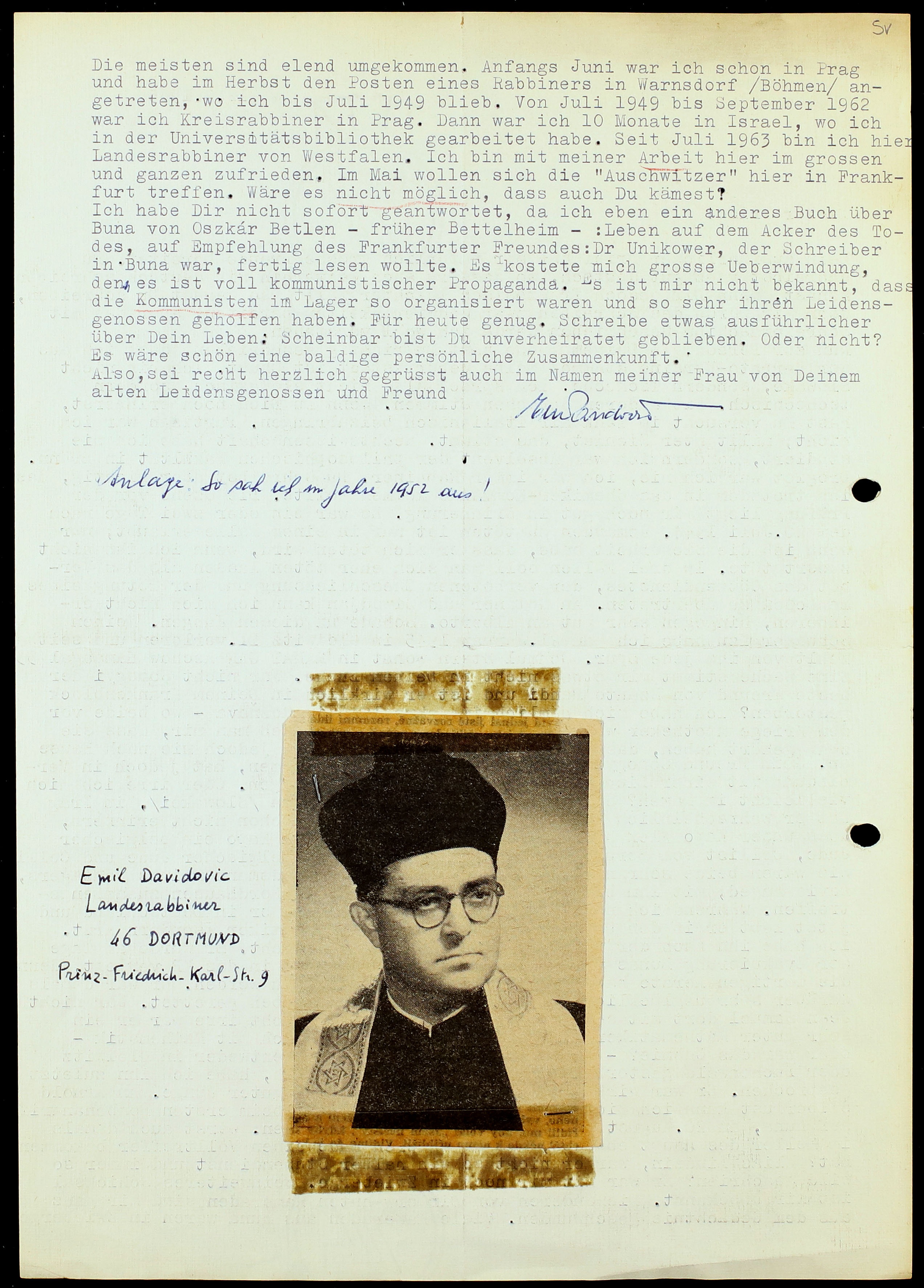
Anlage: So sah ich im Jahre 1952 aus![20]
12 febbraio 1965
Caro Primo![1]
naturalmente la tua lettera, così precisa, mi ha dato una grande gioia. Continua pure a scrivere in tedesco, te la cavi piuttosto bene. Se però ti viene più facile il francese, non c’è problema: avrei difficoltà a scriverlo, ma un testo battuto a macchina riesco a capirlo senz’altro.
E ora passiamo a me. Nel tuo libro hai scritto, giustamente, che provengo dalla Russia Subcarpatica; la mia città natale è Chust. Non sono slovacco, ma ceco. Dunque parlavo il ceco, e non lo slovacco. Le altrelingue sono giuste. Se ricordi, nella cisterna tentavi di insegnarmi l’italiano.[2] Non sono mai stato partigiano; sionista militante, questo sì. Non ho mai studiato giurisprudenza, ma mi sono laureato alla Facoltà di Filosofia di Brno.[3]
Non ho mai fatto il droghiere, sono sempre stato un rabbino. Hai scritto però correttamente che volevo comunque entrare nel Kommando chimico. Ho ancora ben impressa nella memoria la scena prima dell’esame. Sarà stato uno o duegiorni dopo il 20 luglio 1944. Uccidere qualcuno è lecito in un solo caso: se ho la certezza che l’altro mi ucciderà se io non lo ucciderò per primo. In tre casi, invece, ci si deve far uccidere piuttosto che infrangere il divieto dell’idolatria, delle unioni proibite e dell’omicidio. Goldner e Siwadjan non li ricordo, mentre ricordo benissimo Alberto. Che peccato per quel ragazzo. Mio cognato Izu[4] l’ho perso a Gleiwitz II e da allora non se n’è più saputo nulla. Schmul Stern[5] abita a RAMAT GAN, Rehov Hamaagal 33. C’è una cosa nel tuo libro che non mi torna del tutto. Somogyi non era il migliore amico di SzantoBandi? Ed è morto davvero nel blocco dell’infermeria dov’eri ricoverato tu?[6] Nel 1946, ho chiesto informazioni a Rožňava, dove entrambi erano farmacisti prima della guerra. Mi scrissero che avevano saputo della liberazione di Bandi, che però non era mai tornato a casa. Il suo amico Somogyi, invece, era rientrato, ma in seguito si era suicidato per una vicenda sentimentale. O forse mi confondo con i nomi? Szánto era farmacista a Rožňava (in Slovacchia), probabilmente a Praga aveva solo studiato. Inoltre, non ricordo che il nostro Kapo si chiamasse Alex.[7] In seguito il nostro Kapo non era forse un ebreo belga,[8] violoncellista di professione? Anche il caposquadraera un ebreo belga, e violoncellista.[9] Erano entrambi molto gentili. Con noi c’era anche un compaesano di mio cognato, David Maged; dopo la liberazione l’ho rincontrato a Nordhausen. Mentre io sono tornato a casa, lui è rimasto in Germania e ora vive negli Stati Uniti.[10]Bela Fischernon è un chimico, ma un medico.
Sono andato a trovarlo a Budapest dopo la liberazione. Il giorno dell’evacuazione di Buna fu trasferito dalla segreteria del campo al Ka-Be come medico, perché i medici che erano lì avevano preferito farsi evacuare.[11] All’epoca la cosa lo rese molto infelice, ma gli salvò la vita. Jean Samuel non era forse lì con suo zio?[12] Se non sbaglio era un ottimo matematico – anche lì continuava sempre a occuparsi di matematica… o era chimica? Lo zio è morto a Gleiwitz o a Buchenwald. Credo di avergli parlato per l’ultima volta a Buchenwald. Era davvero un ragazzo molto simpatico e buono.[13] Ricordo benissimo Arnold Silberlust. Durante il primo bombardamento aereo[14] su Buna, il 20 agosto 1944, quasi impazzì. C’eri anche tu[15] quel giorno nel seminterrato dell’edificio principale, che venne colpito in pieno all’altra estremità? Elias Lindzin non era quel mezzo addetto alle baracche che urlava sempre come un forsennato? Era con me anche a Zwieberge. Quale sia stato poi il suo destino non lo so. Gli altri compagni che hai menzionato mi sono del tutto passati di mente. Molti dei compagni di Buna finirono a Zwieberge.
La maggior parte di loro è morta di stenti. Ai primi di giugno io ero già tornato a Praga e in autunno avevo assunto l’incarico di rabbino a Warnsdorf (in Boemia), dove sono rimasto fino al luglio 1949. Dal luglio 1949 al settembre 1962 sono stato rabbino distrettuale a Praga. Poi ho trascorso dieci mesi in Israele, dove ho lavorato nella biblioteca universitaria. Dal luglio 1963 sono qui come rabbino capo della Vestfalia. Qui nel complesso sono soddisfatto del mio lavoro.[16]A maggio i compagni di Auschwitzsi ritroveranno a Francoforte. Non sarebbe possibile[17] per te venire?
Non ti ho risposto subito perché volevo finire di leggere un altro libro su Buna, è di Oszkár Betlen (un tempo Bettelheim) e s’intitola «Vita nel campo della morte». Me lo ha consigliato un amico di Francoforte, il dottor Unikower, che a Buna faceva lo scrivano.[18] Per finirlo ho dovuto fare un notevole sforzo, perché è pieno di propaganda comunista. Non mi risulta affatto che i comunisti[19] nel campo fossero così organizzati e che aiutassero tanto i loro compagni di sventura. Per oggi può bastare. Scrivimi qualcosa di più sulla tua vita: a quanto pare sei rimasto scapolo. Oppure no? Sarebbe bello potersi incontrare presto di persona.
Ti saluto di cuore, anche a nome di mia moglie, il tuo vecchio compagno di sventurae amico
Em Davidovic
Allegato: ecco com’ero nel 1952![20]
February 12, 1965
Dear Primo![1]
I was, of course, very pleased to receive your detailed letter. You write German quite well, so you can continue to write me in German. However, if French comes more easily to you, you may write in it as well; although it would be difficult for me to write in French, I should be able to understand a typewritten letter.
Now, about my background. In your book, you correctly wrote that I come from Carpathian Ukraine; my birthplace is Khust. I am not Slovak, but Czech. So I did not speak Slovak, but Czech. The other languages are correct. If you still remember, you tried to teach me Italian in the tank.[2] I was not a partisan; but a militant Zionist—that is correct. I never studied law; instead, I graduated from the Faculty of Philosophy in Brno.[3]
I was never a chemist; I was always a rabbi. But you are right that I still wanted to join the chemists’ unit. I still remember the scene before the exam very well. It was one or two days after July 20, 1944. Killing someone is permitted in only one case: only if I am certain that he will kill me if I do not kill him first. In three cases, one should rather let oneself be killed than violate the prohibitions against idolatry, forbidden marriage, and the killing of a human being. I do not remember Goldner or Sivadjan, but I remember Alberto very well. What a shame about these young men. I lost my brother-in-law Izu[4] on January 21, 1945, in Gleiwitz II, and there has been no trace of him since. Schmul Stern[5]lives at 33 Rechov Hamaagal in RAMAT GAN. There is one thing in your book that does not quite add up for me. SomogyiwasSzantoBandi’s best friend, was he not?[6] And did he really die in your infirmary? I actually inquired about this in 1946 in Rožňava—where both of them had been pharmacists before the war. They wrote back to me saying they had heard that Bandi had been liberated, but he never made it home. His friend Somogyi, however, did return home, but he committed suicide following a love affair. Or am I perhaps mistaken about the names? Szánto was a pharmacist in Rožňava (Slovakia); he probably only studied in Prague. I do not recall our Kapo being named Alex.[7] Later on, our Kapo was a Belgian[8] Jew, a professional cellist, right? The foreman was also a Belgian Jew and a cellist.[9] They were both very nice. There was also a fellow countryman of my brother-in-law, David Maged; I met up with him in Nordhausen after liberation. I went home, but he stayed in Germany and now lives in the U.S.A.[10]Bela Fischeris not a chemist, but a doctor.
I visited him in Budapest after liberation. On the day Buna was evacuated, he was transferred from the administrative office to the infirmary as a doctor, because the doctors there chose to be evacuated.[11] He was very unhappy about it at the time. However, that saved his life. Jean Samuel was there with his uncle, was he not?[12]If I am not mistaken, he was a very good mathematician—he was always working on math there—or was it chemistry? His uncledied either in Gleiwitz or Buchenwald. I believe I last spoke with him in Buchenwald. He really was a very likable, good young man.[13] I remember Arnold Silberlustvery well. He nearly went mad during the first bombing raid[14] on Buna, on August 20, 1944. Were youalso in the basement[15] of the main building at the time, the one that took a direct hit at the other end? Elias Lindzin—he was on partial barrack-room duty, was he not, always ranting and raving? He was still with me in Zwieberge. I don’t know what became of himafter that. The other comrades you mentioned have completely slipped my mind. Many comrades from Buna were in Zwieberge.
Most of them met a miserable end. By early June I was already in Prague, and in the fall I took up the post of rabbi in Warnsdorf, Bohemia, where I remained until July 1949. From July 1949 to September 1962, I served as district rabbi in Prague. Then I spent 10 months in Israel, where I worked at the university library. Since July 1963, I have been the chief rabbi of Westphalia.
I am, by and large, satisfied with my work[16]here. In May, a bunch of Auschwitz survivors plan to meet up in Frankfurt. Might it be possible[17]for you to come as well?
I did not reply to you right away because I wanted to finish reading another book about Buna by Oszkár Betlen—formerly Betterlheim—Leben auf dem Acker des Todes, on the recommendation of a friend of mine in Frankfurt, Dr. Unikover, who was a clerk in Buna.[18] It took a great deal of effort on my part, as it is full of communist propaganda. I was not aware that the communists in the camp were so well organized and helped their fellow prisoners to such an extent.[19] That is enough for today. Please write a bit more about your life: It seems you remained unmarried. Or not? It would be nice to meet in person soon.
So, warmest regards—on behalf of my wife as well—from your old fellow survivor and friend
Em Davidovic
Attachment: This is what I looked like in 1952![20]
12.2.1965
Lieber Primo![1]
Dein ausführlicher Brief hat mir natürlich grosse Freude bereitet. Du schreibst ganz gut deutsch, so dass Du auch weiterhin mir deutsch schreiben kannst. Wenn Dir jedoch französisch leichter fällt, so kannst Du schreiben, denn mir würde das Schreiben zwar Schwierigkeiten bereiten, aber das mit Schreibmaschine Geschrieben werde ich wohl verstehen.
Nun zur Person. In Deinem Buche hast Du richtig geschrieben, dass ich aus der Karpato-Ukraine stamme; meine Geburtsstadt ist Chust. Ich bin nicht Slowake, sondern Tscheche. Ich sprach also nicht slowakisch, sondern tschechisch. Die anderen Sprachen stimmen. Wenn du Dich noch erinnerst, hast Du versucht im Tank mir italienisch beizubringen.[2] Partisan war ich nicht; militanter Zionist, das stimmt. Rechtswissenschaft habe ich nie studiert, sondern ich war Absolvent der philosophischen Fakultät in Brünn.[3]
Drogist war ich nie, ich war immer Rabbiner. Du schreibst aber richtig, das ich trotzdem in das Chemiker-Kommando kommen wollte. Die Szene vor der Prüfung liegt mir noch gut in Erinnerung. Es war ein oder zwei Tage nach dem 20. Juli 1944. Jemanden zu töten ist nur in einem Falle erlaubt; nur wenn ich die Sicherheit habe, dass er mich töten wird, wenn ich ihn nicht zuerst töte. In drei Fällen soll man sich eher töten lassen als das Verbot des Götzendienstes, der verbotenen Eheschliessung und der Tötung eines Menschen zu übertreten. An Goldner und Siwadjan kann ich mich nicht erinneren, hingegen sehr gut an Alberto. Schade um diesen Jungen. Meinen Schwager Izu[4] habe ich
am 21. Januar 1945 in Gleiwitz II. verloren und seither fehlt von ihm jede Spur. Schmul Stern[5] wohnt in RAMAT GAN Rechow Hamaagal 33. Eine Sache stimmt mir etwas nicht in Deinem Buche. War nicht Somogyi der beste Freund von SzantoBandi und ist er wirklich in Deinem Krankenblock gestorben?[6] Ich habe mich nämlich im Jahre 1946 in Rožňava – wo beide vor dem Kriege Apotheker waren – interessiert. Da schrieb man mir, dass sie, zwar gehört haben, dass Bandi befreit wurde, er kam jedoch nie nach Hause an. Sein Freund Somogyi ist jedoch nach Hause gekommen, hat jedoch in Verbindung mit einer Liebesgeschichte Selbstmord begangen. Oder irre ich mich vielleicht im Namen? Szánto war Apotheker in Rožňava /Slowakei/, in Prag hat er wahrscheinlich nur studiert. Ich kann mich schon nicht erinnern, dass unser Kapo Alex[7] hiesse. War nicht später unser Kapo ein belgischer[8] Jude, Cellist vom Beruf? Auch der Vorarbeiter war belgischer Jude und Celli[9] Sie waren beide sehr nett. Mit uns war noch ein Landsmann meines Schwagers,David Maged; mit ihm bin ich nach der Befreiung in Nordhausen zusammengetroffen. Während ich nach Hause gefahren bin, blieb er in Deutschland und jetzt lebt er in den USA.[10]Bela Fischer ist kein Chemiker, sondern Arzt.
Ich habe ihn nach der Befreiung in Budapest aufgesucht. Er wurde am Tage der Evakuierung Bunas von der Schreibstube als Arzt in das KB verlegt, denn die dortigen Aerzte haben es vorgezogen evakuiert zu werden.[11] Er war damals darüber sehr unglücklich. Das hat ihm jedoch das Leben gerettet. War nicht Jean Samuel dort mit seinem Onkel.[12] Wenn ich mich nicht irre war er ein sehr guter Mathematiker – er hat auch dort immer sich mit Mathematik – oder war das Chemie? – beschäftigt. Sein Onkel ist entweder in Gleiwitz oder Buchenwald gestorben. In Buchenwald, glaube ich, habe ich ihn zuletzt gesprochen. Er war wirklich ein sehr sympathischer, guter Junge.[13] An Arnold Silberlust kann ich mich sehr gut erinnern. Er ist beim ersten Bombenangrif[14] auf Buna, am 20. August 1944, fast wahnsinnig geworden. Warst auch du damals im Keller[15] des Hauptgebäudes, das am anderen Ende einen Volltreffer bekommen hat? Elias Lindzin, war er nicht so ein halber Stubendienst und immer so wild geschrien? Er war mit mir noch in Zwieberge. Sein weiteres Schicksal ist mir unbekannt. Die anderen von Dir erwähnten Kameraden sind mir ganz aus dem Gedächtnis geschwunden. Viele Kameraden aus Buna waren in Zwieberge.
Die meisten sind elend umgekommen. Anfangs Juni war ich schon in Prag und habe im Herbst den Posten eines Rabbiners in Warnsdorf / Böhmen/ angetreten, wo ich bis Juli 1949 blieb. Von Juli 1949 bis September 1962 war ich Kreisrabbiner in Prag. Dann war ich 10 Monate in Israel, wo ich in der Universitätsbibliothek gearbeitet habe. Seit Juli 1963 bin ich hier Landesrabbiner von Westfalen.
Ich bin mit meiner Arbeit[16] hier im grossen und ganzen zufrieden. Im Mai wollen sich die „Auschwitzer“ hier in Frankfurt treffen. Wäre es nicht möglich,[17] dass auch Du kämest?
Ich habe Dir nicht sofort geantwortet, da ich eben ein anderes Buch über Buna von Oszkár Betlen – früher Bettelheim –: Leben auf dem Acker des Todes, auf Empfehlung des Frankfurter Freundes: Dr. Unikower, der Schreiber in Buna war, fertig lesen wollte.[18] Es kostete mich grosse Ueberwindung, denn es ist voll kommunistischer Propaganda. Es ist mir nicht bekannt, dass die Kommunisten im Lager so organisiert waren und so sehr ihren Leidensgenossen geholfen haben.[19] Für heute genug. Schreibe etwas ausführlicher über Dein Leben: Scheinbar bist Du unverheiratet geblieben. Oder nicht? Es wäre schön eine baldige persönliche Zusammenkunft.
Also, sei recht herzlich gegrüsst auch im Namen meiner Frau von Deinem alten Leidensgenossen und Freund
Em Davidovic
Anlage: So sah ich im Jahre 1952 aus![20]
12 febbraio 1965
Caro Primo![1]
naturalmente la tua lettera, così precisa, mi ha dato una grande gioia. Continua pure a scrivere in tedesco, te la cavi piuttosto bene. Se però ti viene più facile il francese, non c’è problema: avrei difficoltà a scriverlo, ma un testo battuto a macchina riesco a capirlo senz’altro.
E ora passiamo a me. Nel tuo libro hai scritto, giustamente, che provengo dalla Russia Subcarpatica; la mia città natale è Chust. Non sono slovacco, ma ceco. Dunque parlavo il ceco, e non lo slovacco. Le altrelingue sono giuste. Se ricordi, nella cisterna tentavi di insegnarmi l’italiano.[2] Non sono mai stato partigiano; sionista militante, questo sì. Non ho mai studiato giurisprudenza, ma mi sono laureato alla Facoltà di Filosofia di Brno.[3]
Non ho mai fatto il droghiere, sono sempre stato un rabbino. Hai scritto però correttamente che volevo comunque entrare nel Kommando chimico. Ho ancora ben impressa nella memoria la scena prima dell’esame. Sarà stato uno o duegiorni dopo il 20 luglio 1944. Uccidere qualcuno è lecito in un solo caso: se ho la certezza che l’altro mi ucciderà se io non lo ucciderò per primo. In tre casi, invece, ci si deve far uccidere piuttosto che infrangere il divieto dell’idolatria, delle unioni proibite e dell’omicidio. Goldner e Siwadjan non li ricordo, mentre ricordo benissimo Alberto. Che peccato per quel ragazzo. Mio cognato Izu[4] l’ho perso a Gleiwitz II e da allora non se n’è più saputo nulla. Schmul Stern[5] abita a RAMAT GAN, Rehov Hamaagal 33. C’è una cosa nel tuo libro che non mi torna del tutto. Somogyi non era il migliore amico di SzantoBandi? Ed è morto davvero nel blocco dell’infermeria dov’eri ricoverato tu?[6] Nel 1946, ho chiesto informazioni a Rožňava, dove entrambi erano farmacisti prima della guerra. Mi scrissero che avevano saputo della liberazione di Bandi, che però non era mai tornato a casa. Il suo amico Somogyi, invece, era rientrato, ma in seguito si era suicidato per una vicenda sentimentale. O forse mi confondo con i nomi? Szánto era farmacista a Rožňava (in Slovacchia), probabilmente a Praga aveva solo studiato. Inoltre, non ricordo che il nostro Kapo si chiamasse Alex.[7] In seguito il nostro Kapo non era forse un ebreo belga,[8] violoncellista di professione? Anche il caposquadraera un ebreo belga, e violoncellista.[9] Erano entrambi molto gentili. Con noi c’era anche un compaesano di mio cognato, David Maged; dopo la liberazione l’ho rincontrato a Nordhausen. Mentre io sono tornato a casa, lui è rimasto in Germania e ora vive negli Stati Uniti.[10]Bela Fischernon è un chimico, ma un medico.
Sono andato a trovarlo a Budapest dopo la liberazione. Il giorno dell’evacuazione di Buna fu trasferito dalla segreteria del campo al Ka-Be come medico, perché i medici che erano lì avevano preferito farsi evacuare.[11] All’epoca la cosa lo rese molto infelice, ma gli salvò la vita. Jean Samuel non era forse lì con suo zio?[12] Se non sbaglio era un ottimo matematico – anche lì continuava sempre a occuparsi di matematica… o era chimica? Lo zio è morto a Gleiwitz o a Buchenwald. Credo di avergli parlato per l’ultima volta a Buchenwald. Era davvero un ragazzo molto simpatico e buono.[13] Ricordo benissimo Arnold Silberlust. Durante il primo bombardamento aereo[14] su Buna, il 20 agosto 1944, quasi impazzì. C’eri anche tu[15] quel giorno nel seminterrato dell’edificio principale, che venne colpito in pieno all’altra estremità? Elias Lindzin non era quel mezzo addetto alle baracche che urlava sempre come un forsennato? Era con me anche a Zwieberge. Quale sia stato poi il suo destino non lo so. Gli altri compagni che hai menzionato mi sono del tutto passati di mente. Molti dei compagni di Buna finirono a Zwieberge.
La maggior parte di loro è morta di stenti. Ai primi di giugno io ero già tornato a Praga e in autunno avevo assunto l’incarico di rabbino a Warnsdorf (in Boemia), dove sono rimasto fino al luglio 1949. Dal luglio 1949 al settembre 1962 sono stato rabbino distrettuale a Praga. Poi ho trascorso dieci mesi in Israele, dove ho lavorato nella biblioteca universitaria. Dal luglio 1963 sono qui come rabbino capo della Vestfalia. Qui nel complesso sono soddisfatto del mio lavoro.[16]A maggio i compagni di Auschwitzsi ritroveranno a Francoforte. Non sarebbe possibile[17] per te venire?
Non ti ho risposto subito perché volevo finire di leggere un altro libro su Buna, è di Oszkár Betlen (un tempo Bettelheim) e s’intitola «Vita nel campo della morte». Me lo ha consigliato un amico di Francoforte, il dottor Unikower, che a Buna faceva lo scrivano.[18] Per finirlo ho dovuto fare un notevole sforzo, perché è pieno di propaganda comunista. Non mi risulta affatto che i comunisti[19] nel campo fossero così organizzati e che aiutassero tanto i loro compagni di sventura. Per oggi può bastare. Scrivimi qualcosa di più sulla tua vita: a quanto pare sei rimasto scapolo. Oppure no? Sarebbe bello potersi incontrare presto di persona.
Ti saluto di cuore, anche a nome di mia moglie, il tuo vecchio compagno di sventurae amico
Em Davidovic
Allegato: ecco com’ero nel 1952![20]
February 12, 1965
Dear Primo![1]
I was, of course, very pleased to receive your detailed letter. You write German quite well, so you can continue to write me in German. However, if French comes more easily to you, you may write in it as well; although it would be difficult for me to write in French, I should be able to understand a typewritten letter.
Now, about my background. In your book, you correctly wrote that I come from Carpathian Ukraine; my birthplace is Khust. I am not Slovak, but Czech. So I did not speak Slovak, but Czech. The other languages are correct. If you still remember, you tried to teach me Italian in the tank.[2] I was not a partisan; but a militant Zionist—that is correct. I never studied law; instead, I graduated from the Faculty of Philosophy in Brno.[3]
I was never a chemist; I was always a rabbi. But you are right that I still wanted to join the chemists’ unit. I still remember the scene before the exam very well. It was one or two days after July 20, 1944. Killing someone is permitted in only one case: only if I am certain that he will kill me if I do not kill him first. In three cases, one should rather let oneself be killed than violate the prohibitions against idolatry, forbidden marriage, and the killing of a human being. I do not remember Goldner or Sivadjan, but I remember Alberto very well. What a shame about these young men. I lost my brother-in-law Izu[4] on January 21, 1945, in Gleiwitz II, and there has been no trace of him since. Schmul Stern[5]lives at 33 Rechov Hamaagal in RAMAT GAN. There is one thing in your book that does not quite add up for me. SomogyiwasSzantoBandi’s best friend, was he not?[6] And did he really die in your infirmary? I actually inquired about this in 1946 in Rožňava—where both of them had been pharmacists before the war. They wrote back to me saying they had heard that Bandi had been liberated, but he never made it home. His friend Somogyi, however, did return home, but he committed suicide following a love affair. Or am I perhaps mistaken about the names? Szánto was a pharmacist in Rožňava (Slovakia); he probably only studied in Prague. I do not recall our Kapo being named Alex.[7] Later on, our Kapo was a Belgian[8] Jew, a professional cellist, right? The foreman was also a Belgian Jew and a cellist.[9] They were both very nice. There was also a fellow countryman of my brother-in-law, David Maged; I met up with him in Nordhausen after liberation. I went home, but he stayed in Germany and now lives in the U.S.A.[10]Bela Fischeris not a chemist, but a doctor.
I visited him in Budapest after liberation. On the day Buna was evacuated, he was transferred from the administrative office to the infirmary as a doctor, because the doctors there chose to be evacuated.[11] He was very unhappy about it at the time. However, that saved his life. Jean Samuel was there with his uncle, was he not?[12]If I am not mistaken, he was a very good mathematician—he was always working on math there—or was it chemistry? His uncledied either in Gleiwitz or Buchenwald. I believe I last spoke with him in Buchenwald. He really was a very likable, good young man.[13] I remember Arnold Silberlustvery well. He nearly went mad during the first bombing raid[14] on Buna, on August 20, 1944. Were youalso in the basement[15] of the main building at the time, the one that took a direct hit at the other end? Elias Lindzin—he was on partial barrack-room duty, was he not, always ranting and raving? He was still with me in Zwieberge. I don’t know what became of himafter that. The other comrades you mentioned have completely slipped my mind. Many comrades from Buna were in Zwieberge.
Most of them met a miserable end. By early June I was already in Prague, and in the fall I took up the post of rabbi in Warnsdorf, Bohemia, where I remained until July 1949. From July 1949 to September 1962, I served as district rabbi in Prague. Then I spent 10 months in Israel, where I worked at the university library. Since July 1963, I have been the chief rabbi of Westphalia.
I am, by and large, satisfied with my work[16]here. In May, a bunch of Auschwitz survivors plan to meet up in Frankfurt. Might it be possible[17]for you to come as well?
I did not reply to you right away because I wanted to finish reading another book about Buna by Oszkár Betlen—formerly Betterlheim—Leben auf dem Acker des Todes, on the recommendation of a friend of mine in Frankfurt, Dr. Unikover, who was a clerk in Buna.[18] It took a great deal of effort on my part, as it is full of communist propaganda. I was not aware that the communists in the camp were so well organized and helped their fellow prisoners to such an extent.[19] That is enough for today. Please write a bit more about your life: It seems you remained unmarried. Or not? It would be nice to meet in person soon.
So, warmest regards—on behalf of my wife as well—from your old fellow survivor and friend
Em Davidovic
Attachment: This is what I looked like in 1952![20]
Info
Notes
Tag
Sender: Emil Davidovič
Addressee: Primo Levi
Date of Drafting: 1965-02-12
Place of Writing: Dortmund
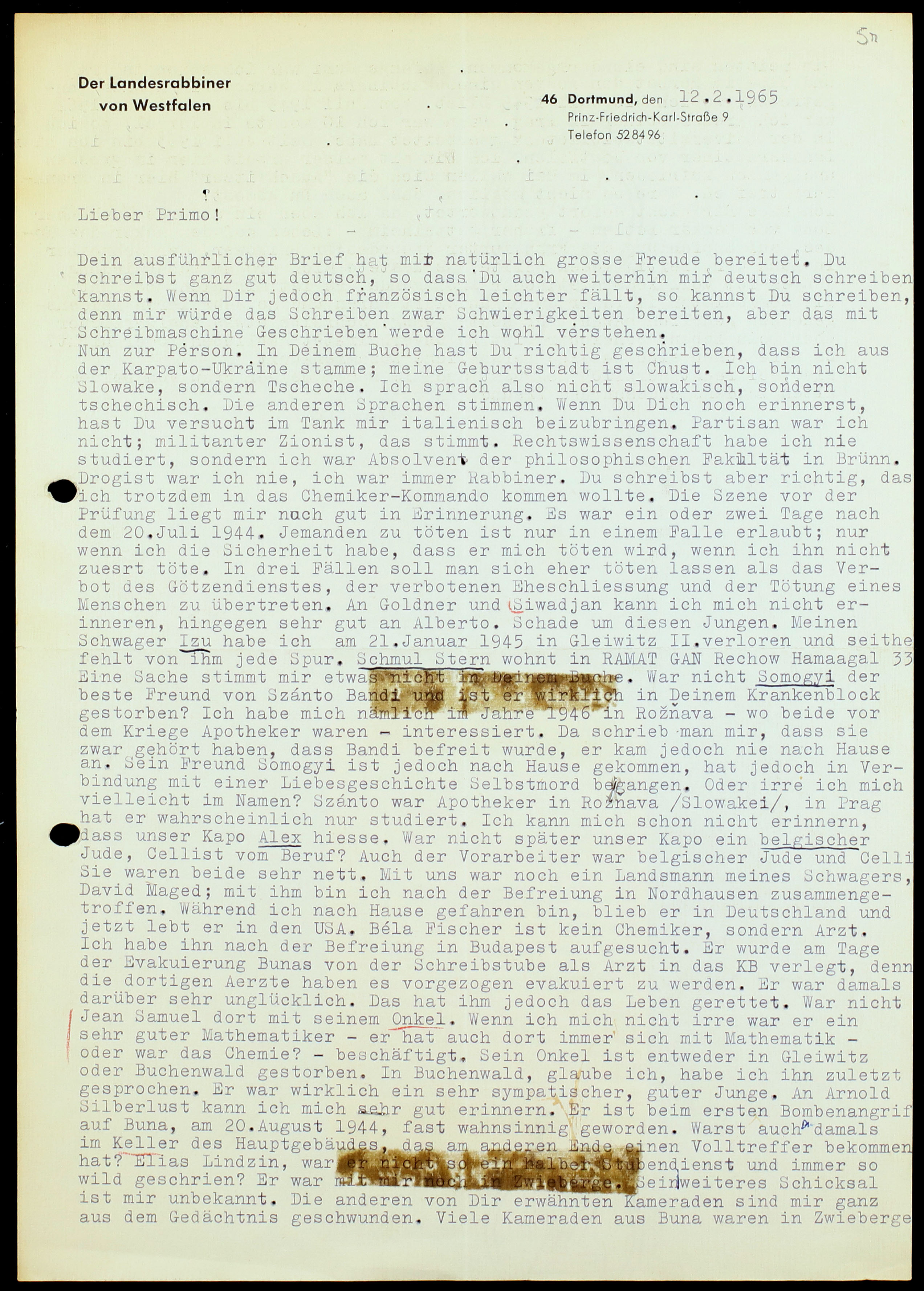
Description:Typewritten letter on letterhead paper with underlining in black fountain pen and red pencil, and handwritten signature in blue ballpoint pen. The front of the sheet has signs of adhesive tape in the center; in fact, on the back of the sheet a newspaper cutting with a photograph of Emil Davidovic is attached with adhesive tape and two staples. To the left of the photograph, Levi notes in black fountain pen the address of the correspondent: “Emil Davidovic | Landesrabbiner | 46 DORTMUND | Prinz-Friedrich-Karl-Str. 9.”
Enclosures:Lettera ds. di ED a PL, 12.2.1965, 1f. r/v. tedesco. Con una foto di ED
4“Izu” is underlined by hand in black fountain pen.
5“Schmul Stern” is underlined by hand in black fountain pen.
6“Somogyi” is underlined by hand in black fountain pen. The death of Somogyi is recounted in the chapter “The Story of Ten Days”: “It was Sómogyi’s turn. He was a Hungarian chemist, about fifty years old, thin, tall, and taciturn. Like the Dutchman, he was recovering from typhus and scarlet fever. But something new occurred: he was running a high fever. […] With the last gasp of life, he had fallen to the floor from his bunk: I heard the thud of his knees, of his hips, of his shoulders, of his head. […] Dawn. On the floor, the shameful disorder of skin and bones, the Sómogyi thing” (CW I, pp. 163-165).
7“Alex” is underlined by hand in black fountain pen. Alex is the Kapo of Kommando 98 when Levi is interviewed by Doktor Pannwitz. His figure is rendered memorable in the scene that concludes the chapter “Chemistry Examination,” in which “without hatred and without contempt” he wipes his grease-stained hand on Primo Levi’s shoulder (CW I, p. 102). The gesture made an impression on several German readers of Ist das ein Mensch? (OC III, p. 605), cf. the letters 148. Mr. and Mrs. L. to Primo Levi, undated; 153. Renate Martin to Primo Levi, February 23, 1972; and 167. S. to Primo Levi, September 5, 1962.
8“belgischer” is underlined by hand in black fountain pen.
9There is a lacuna at the end of the sheet, probably “Cellist.”
10David Maged was born on May 25, 1902 in Tachov (now in the Czech Republic), where he worked as a farmer. He was deported to Auschwitz in December 1943. At the moment of the liberation, in April 1945, he was at the Mittelbau-Dora concentration camp in Nordhausen. In the years immediately following the end of the war, he lived in the refugee camps of Ziegenhain and Butzbach, in West Germany. In August 1949, he emigrated to the United States and settled in Baltimore, Maryland (this information is sourced from file n. 257.082 MAGED, DAVID born 25.05.1902 in the digital Arolsen Archives).
11In a letter to Jean Samuel dated March 23, 1946, Primo Levi recalls that Bela Fischer had remained at Auschwitz “as a doctor” during the final days of imprisonment (cf. J. Samuel and J. Dreyfus, Mi chiamava Pikolo, cit., pp. 70-71). In “The Story of Ten Days,” Levi writes: “I went to look for a Hungarian doctor who had been left as a patient in the barracks opposite. When he heard talk of diphtheria he pulled back and ordered me to leave” (CW I, p. 161). It is difficult to establish whether Levi is referring to Fischer in this passage.
12“Onkel” (“uncle”) is underlined by hand in red pencil: on the inner margin of the sheet, a vertical line has been drawn by hand with the same pencil. At the moment of the liberation, he was in the concentration camp of Mittelbau-Dora in Nordhausen (a subcamp of Buchenwald).
13René Weil was born in Wintzenheim (France) in 1898 and died at Buchenwald on January 31, 1945. He had been deported to Auschwitz in March 1944 along with six other members of his family, including his nephew, Jean Samuel. His story is reconstructed inMi chiamava Pikolo, cit.
14There is a lacuna at the end of the sheet, “Bombenangriff.”
15“Keller” (“basement”) is underlined by hand in red pencil. “Du” (“you,” informal) is added by hand in blue ballpoint pen
16“Arbeit” (“work”) is underlined by hand in red pencil.
17“nicht möglich” (“might it not be possible”) is underlined by hand in red pencil.
18Franz Siegbert Unikower (1901-1997) was a German jurist of Jewish origin. He was deported to Auschwitz in 1943 and was employed in the “Schreibstube” (literally, the “secretariat”) at the Monowitz satellite office of the Central Camp’s Political Affairs Department. This satellite office was known as the “Abteilung II” (Department II) and the office in which Unikower worked was in charge of keeping the prison register. After the liberation, he worked in the DDR but was forced to flee the country in 1956 when he refused to take a public stand against Israel and align himself with the anti-Zionist position of the East German government. He moved to Frankfurt, where he worked as a legal consultant for the state of Hessen; he was a member of the Council of the Jewish Community of Frankfurt and a member of the Central Council of Jews in Germany. Cf. the biographical note written by Rolf Bartusel, which can be accessed here and B. Vierneisel, R. Ramsenthaler, Erinnerungszeichen Franz Siegbert Unikower: ein Portrait, Förderverein der Mahn- und Gedenkstätten, Wöbbelin e.V., 2011. Collaborating with Hermann Langbein, among others, he prepared research for the 1963 Frankfurt Trial, gathering testimony and tracking down survivors. Cf. K. Stengel, Hermann Langbein: Ein Auschwitz-Überlebender in den erinnerungspolitischen Konflikten der Nachkriegszeit, Frankfurt: Campus, 2012, pp. 364-65, and the Insight Hermann Langbein and the Nazi Trials. Starting in the early 1960s, he formed a group of former Auschwitz prisoners who were involved in preserving the memory of the Nazi deportation: the Auschwitz-Gruppe of Hessen (the “Auschwitzer” to which Davidovic refers in this letter).
19“Kommunisten” is underlined by hand in red pencil. Élet a halál földjén (“Life in the land of death”) was published in Budapest in 1959; it is the testimony of Oszkár Betlen, who was imprisoned at the Auschwitz III-Monowitz concentration camp. A Hungarian of Jewish origin and a member of the Communist Party, Betlen was deported to Monowitz in 1942, where he participated in the clandestine resistance. The book recounts their struggle against IG Farben, presented as a symbol of the economic and racial exploitation perpetrated by National Socialism. Even though in Élet a halál földjén Jewish deportation is subordinate to politics, Betlen insists on the moral dilemma raised by the way the lists of prisoners at the Lager were overseen. According to the author, the corruption within the Lager tended to reproduce the oppressors’ sectarian and nationalistic logic even within the resistance itself. The book was translated into German and published in East Germany in 1962 by Dietz Verlag of Berlin; it has not been translated into English. For more information, cf. Z. Kékesi and M. Zombory, “The Postwar Fight Against Fascism: Auschwitz Memory in Leftist Activism,” in Journal of Genocide Research, 2024, pp. 4-11. Primo Levi later became aware of Betlen and his testimony in the chapter “Resistance” in People in Auschwitz (cf. H. Langbein, People in Auschwitz, cit., p. 252).
20The postscript is written by hand in blue ballpoint pen. The comment refers to the photograph of Davidovic that is attached to the letter, cf. the description of the document.