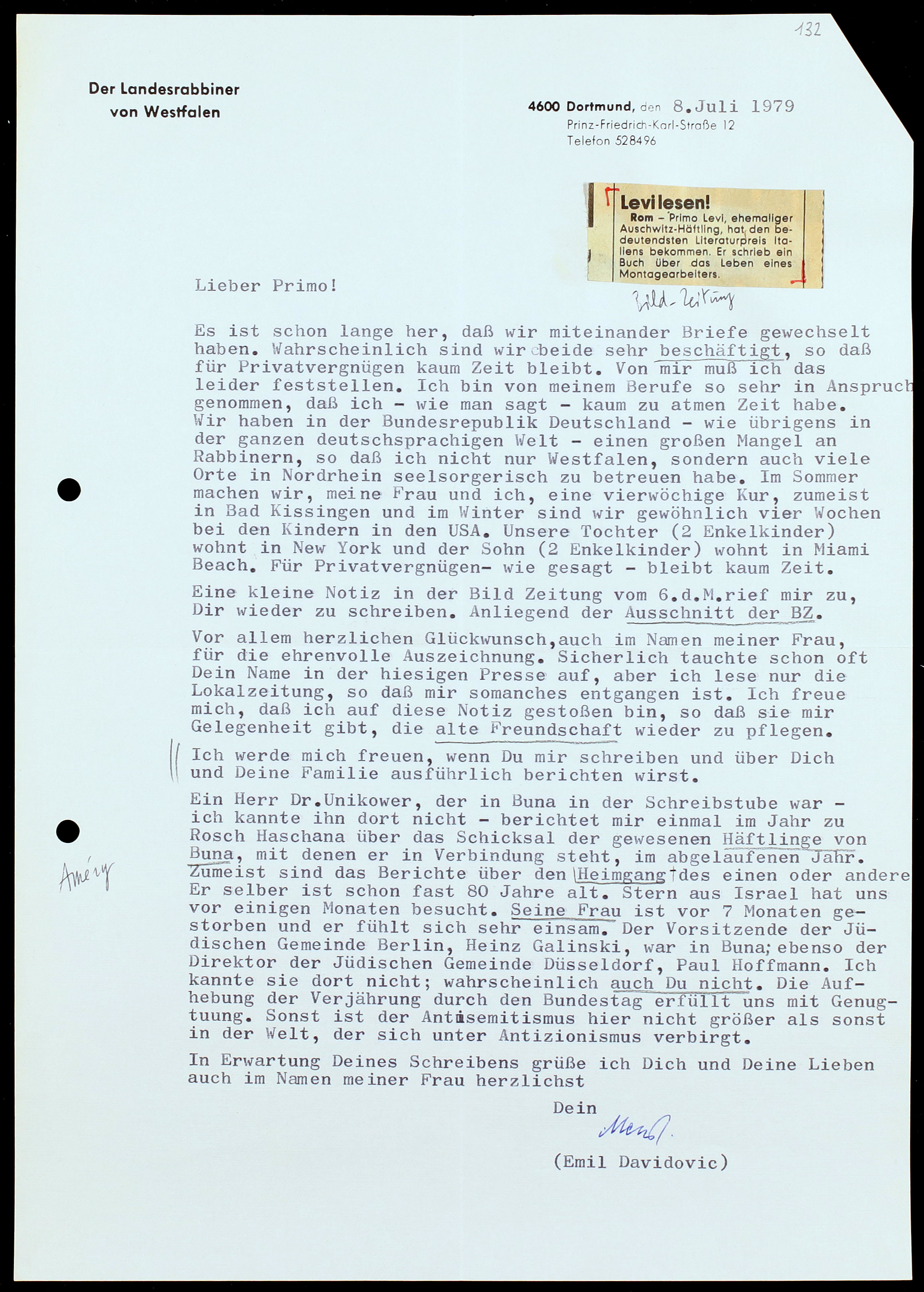
Davidovic writes to Primo Levi after reading in a local newspaper that Levi has won the Strega Prize. He tells him about his work and his family, that Schmul Stern was a guest of theirs, and that he has come into contact with other former prisoners at Auschwitz.
8. Juli 1979
Lieber Primo!
Es ist schon lange her, daß wir miteinander Briefe gewechselt haben. Wahrscheinlich sind wir beide sehr beschäftigt,[1] so daß für Privatvergnügen kaum Zeit bleibt. Von mir muß ich das leider feststellen. Ich bin von meinem Berufe so sehr in Anspruch genommen, daß ich – wie man sagt – kaum zu atmen Zeit habe. Wir haben in der Bundesrepublik Deutschland – wie übrigens in der ganzen deutschsprachigen Welt – einen großen Mangel an Rabbinern, so daß ich nicht nur Westfalen, sondern auch viele Orte in Nordrhein seelsorgerisch zu betreuen habe. Im Sommer machen wir, meine Frau und ich, eine vierwöchige Kur, zumeist in Bad Kissingen und im Winter sind wir gewöhnlich vier Wochen bei den Kindern in den USA. Unsere Tochter (2 Enkelkinder) wohnt in New York und der Sohn (2 Enkelkinder) wohnt in Miami Beach. Für Privatvergnügen – wie gesagt – bleibt kaum Zeit.
Eine kleine Notiz in der Bild Zeitung vom 6. dieses Monats rief mir zu, Dir wieder zu schreiben. Anliegend der Ausschnitt der BZ.[2]
Vor allem herzlichen Glückwunsch, auch im Namen meiner Frau, für die ehrenvolle Auszeichnung. Sicherlich tauchte schon oft Dein Name in der hiesigen Presse auf, aber ich lese nur die Lokalzeitung, so daß mir somanches entgangen ist. Ich freue mich, daß ich auf diese Notiz gestoßen bin, so daß sie mir Gelegenheit gibt, die alte Freundschaft[3] wieder zu pflegen.
Ich werde mich freuen, wenn Du mir schreiben und über Dich und Deine Familie ausführlich berichten wirst.[4]
Ein Herr Dr. Unikower, der in Buna in der Schreibstube war – ich kannte ihn dort nicht – berichtet mir einmal im Jahr zu Rosch Haschana über das Schicksal der gewesenen Häftlinge von Buna,[5] mit denen er in Verbindung steht, im abgelaufenen Jahr. Zumeist sind das Berichte über den Heimgang[6] des einen oder andere. Er selber ist schon fast 80 Jahre alt. Stern aus Israel hat uns vor einigen Monaten besucht. Seine Frau[7] ist vor 7 Monaten gestorben und er fühlt sich sehr einsam. Der Vorsitzende der Jüdischen Gemeinde Berlin, Heinz Galinski,[8] war in Buna; ebenso der Direktor der Jüdischen Gemeinde Düsseldorf, Paul Hoffmann.[9] Ich kannte sie dort nicht; wahrscheinlich auch Du nicht.[10] Die Aufhebung der Verjährung durch den Bundestag erfüllt uns mit Genugtuung.[11] Sonst ist der Antisemitismus hier nicht größer als sonst in der Welt, der sich unter Antizionismus verbirgt.
In Erwartung Deines Schreibens grüße ich Dich und Deine Lieben auch im Namen meiner Frau herzlichst
Dein
Mendi
(Emil Davidovic)
8 luglio 1979
Caro Primo!
è passato un bel po’ di tempo dall’ultima volta che ci siamo scritti. Probabilmente siamo entrambi molto occupati,[1] e alla fine resta ben poco tempoper i piaceri della vita privata. Per quanto mi riguarda, purtroppo, è proprio così. Il lavoro mi assorbe al punto che, come si dice, non ho quasi un attimo di respiro. Nella Repubblica Federale Tedesca – e del resto in tutto il mondo di lingua tedesca – c’è una grave carenza di rabbini, per cui devo occuparmi dell’assistenza spirituale non solo in Vestfalia, ma anche in molte località della Renania Settentrionale. D’estate io e mia moglie facciamo quattro settimane di cure termali, per lo più a Bad Kissingen, e d’inverno passiamo di solito quattro settimane dai nostri figli negli Stati Uniti. La figlia (due nipotini) vive a New York; il figlio (due nipotini) vive a Miami Beach. Per i piaceri della vita privata, come dicevo, rimane ben poco tempo.
Un trafiletto apparso sulla «Bild Zeitung» il 6 di questo mese mi ha spinto a scriverti di nuovo. Ti allego il ritaglio del giornale.[2]
Anzitutto, vive congratulazioni, anche a nome di mia moglie, per il prestigioso riconoscimento. Certamente il tuo nome sarà comparso molte altre volte sulla stampa tedesca, ma io leggo soltanto il giornale locale e così parecchie cose mi sfuggono. Sono contento di essermi imbattuto in questa notizia, perché mi offre l’occasione di riallacciare la nostra vecchia amicizia.[3]
Mi farà molto piacere se vorrai scrivermi e raccontarmi in dettaglio di te e della tua famiglia.[4]
Il dottor Unikower, che a Buna[5] lavorava nella segreteria che teneva i registri dei prigionieri o – io allora non lo conoscevo – ogni anno, in occasione di Rosh Hashanah, mi manda un resoconto di ciò che è accaduto nei dodici mesi appena trascorsi agli ex deportati di Buna con cui è rimasto in contatto. Per lo più sono notizie della scomparsa[6] dell’uno o dell’altro. Lui stesso ha ormai quasi ottant’anni. Qualche mese fa è venuto a trovarci Stern, da Israele. Sua moglie[7] è morta sette mesi fa e lui si sente molto solo. Anche Heinz Galinski[8], presidente della Comunità ebraica di Berlino, era stato a Buna, così come Paul Hoffmann[9], direttore della Comunità ebraica di Düsseldorf. Lì però non li conoscevo; probabilmente neppure tu.[10]L’abolizione della prescrizione decisa dal Bundestag ci riempie di soddisfazione.[11] Per il resto, qui l’antisemitismo non è maggiore che nel resto del mondo, dove si cela sotto le sembianze dell’antisionismo.
Nell’attesa di una tua lettera, saluto te e i tuoi cari con il più vivo affetto, anche a nome di mia moglie.
Tuo
Mendi
(Emil Davidovic)
July 8, 1979
Dear Primo!
It has been a long time since we last exchanged letters. We are probably both very busy,[1]so there is hardly any time left for personal pursuits. Unfortunately, that is certainly true for me. My job keeps me so busy that—as they say—I barely have time to breathe.
Here in the Federal Republic of Germany—just as, incidentally, throughout the entire German-speaking world—there is a severe shortage of rabbis, so I am responsible for providing pastoral care not only in Westphalia but also in many places in North Rhine-Westphalia.
In the summer, my wife and I take a four-week health retreat, usually in Bad Kissingen, and in the winter we typically spend four weeks with our children in the U.S. Our daughter (2 grandchildren) lives in New York, and our son (2 grandchildren) lives in Miami Beach. As I said, there is hardly any free time left for my own pursuits.
A small feature in the Bild magazine from the 6th of this month prompted me to write you again. The clipping is enclosed.[2]
Above all, congratulations—on behalf of my wife as well—on this honorable award. I am sure your name has appeared in the press here many times before, but I only read the local newspaper, so I have missed quite a few things. I am glad I came across this, as it gives me the opportunity to rekindle our old friendship.[3]
I would be delighted if you would write to me and tell me all about yourself and your family.[4]
One Dr. Unikover, who worked in the office at Buna—I did not know him there—reports to me once a year on Rosh Hashanah about the fate of the former prisoners of Buna,[5]with whom he is in contact, and how they have been over the past year. Mostly these are reports of someone or other passing on.[6] He himself is already nearly 80 years old. Stern visited us from Israel a few months ago. His wife[7]died seven months ago, and he is very lonely. The chairman of the Jewish Community of Berlin, Heinz Galinski,[8] was in Buna; so was the director of the Jewish Community of Düsseldorf, Paul Hoffmann.[9] I did not know them there; you probably did not, either.[10]The Bundestag’s repeal of the statute of limitations fills us with satisfaction.[11] Otherwise, Antisemitism is no more prevalent here than elsewhere in the world, where it hides under the guise of Anti-Zionism.
I look forward to hearing from you and send my warmest regards to you and your loved ones, on behalf of my wife as well,
Yours,
Mendi
(Emil Davidovic)
8. Juli 1979
Lieber Primo!
Es ist schon lange her, daß wir miteinander Briefe gewechselt haben. Wahrscheinlich sind wir beide sehr beschäftigt,[1] so daß für Privatvergnügen kaum Zeit bleibt. Von mir muß ich das leider feststellen. Ich bin von meinem Berufe so sehr in Anspruch genommen, daß ich – wie man sagt – kaum zu atmen Zeit habe. Wir haben in der Bundesrepublik Deutschland – wie übrigens in der ganzen deutschsprachigen Welt – einen großen Mangel an Rabbinern, so daß ich nicht nur Westfalen, sondern auch viele Orte in Nordrhein seelsorgerisch zu betreuen habe. Im Sommer machen wir, meine Frau und ich, eine vierwöchige Kur, zumeist in Bad Kissingen und im Winter sind wir gewöhnlich vier Wochen bei den Kindern in den USA. Unsere Tochter (2 Enkelkinder) wohnt in New York und der Sohn (2 Enkelkinder) wohnt in Miami Beach. Für Privatvergnügen – wie gesagt – bleibt kaum Zeit.
Eine kleine Notiz in der Bild Zeitung vom 6. dieses Monats rief mir zu, Dir wieder zu schreiben. Anliegend der Ausschnitt der BZ.[2]
Vor allem herzlichen Glückwunsch, auch im Namen meiner Frau, für die ehrenvolle Auszeichnung. Sicherlich tauchte schon oft Dein Name in der hiesigen Presse auf, aber ich lese nur die Lokalzeitung, so daß mir somanches entgangen ist. Ich freue mich, daß ich auf diese Notiz gestoßen bin, so daß sie mir Gelegenheit gibt, die alte Freundschaft[3] wieder zu pflegen.
Ich werde mich freuen, wenn Du mir schreiben und über Dich und Deine Familie ausführlich berichten wirst.[4]
Ein Herr Dr. Unikower, der in Buna in der Schreibstube war – ich kannte ihn dort nicht – berichtet mir einmal im Jahr zu Rosch Haschana über das Schicksal der gewesenen Häftlinge von Buna,[5] mit denen er in Verbindung steht, im abgelaufenen Jahr. Zumeist sind das Berichte über den Heimgang[6] des einen oder andere. Er selber ist schon fast 80 Jahre alt. Stern aus Israel hat uns vor einigen Monaten besucht. Seine Frau[7] ist vor 7 Monaten gestorben und er fühlt sich sehr einsam. Der Vorsitzende der Jüdischen Gemeinde Berlin, Heinz Galinski,[8] war in Buna; ebenso der Direktor der Jüdischen Gemeinde Düsseldorf, Paul Hoffmann.[9] Ich kannte sie dort nicht; wahrscheinlich auch Du nicht.[10] Die Aufhebung der Verjährung durch den Bundestag erfüllt uns mit Genugtuung.[11] Sonst ist der Antisemitismus hier nicht größer als sonst in der Welt, der sich unter Antizionismus verbirgt.
In Erwartung Deines Schreibens grüße ich Dich und Deine Lieben auch im Namen meiner Frau herzlichst
Dein
Mendi
(Emil Davidovic)
8 luglio 1979
Caro Primo!
è passato un bel po’ di tempo dall’ultima volta che ci siamo scritti. Probabilmente siamo entrambi molto occupati,[1] e alla fine resta ben poco tempoper i piaceri della vita privata. Per quanto mi riguarda, purtroppo, è proprio così. Il lavoro mi assorbe al punto che, come si dice, non ho quasi un attimo di respiro. Nella Repubblica Federale Tedesca – e del resto in tutto il mondo di lingua tedesca – c’è una grave carenza di rabbini, per cui devo occuparmi dell’assistenza spirituale non solo in Vestfalia, ma anche in molte località della Renania Settentrionale. D’estate io e mia moglie facciamo quattro settimane di cure termali, per lo più a Bad Kissingen, e d’inverno passiamo di solito quattro settimane dai nostri figli negli Stati Uniti. La figlia (due nipotini) vive a New York; il figlio (due nipotini) vive a Miami Beach. Per i piaceri della vita privata, come dicevo, rimane ben poco tempo.
Un trafiletto apparso sulla «Bild Zeitung» il 6 di questo mese mi ha spinto a scriverti di nuovo. Ti allego il ritaglio del giornale.[2]
Anzitutto, vive congratulazioni, anche a nome di mia moglie, per il prestigioso riconoscimento. Certamente il tuo nome sarà comparso molte altre volte sulla stampa tedesca, ma io leggo soltanto il giornale locale e così parecchie cose mi sfuggono. Sono contento di essermi imbattuto in questa notizia, perché mi offre l’occasione di riallacciare la nostra vecchia amicizia.[3]
Mi farà molto piacere se vorrai scrivermi e raccontarmi in dettaglio di te e della tua famiglia.[4]
Il dottor Unikower, che a Buna[5] lavorava nella segreteria che teneva i registri dei prigionieri o – io allora non lo conoscevo – ogni anno, in occasione di Rosh Hashanah, mi manda un resoconto di ciò che è accaduto nei dodici mesi appena trascorsi agli ex deportati di Buna con cui è rimasto in contatto. Per lo più sono notizie della scomparsa[6] dell’uno o dell’altro. Lui stesso ha ormai quasi ottant’anni. Qualche mese fa è venuto a trovarci Stern, da Israele. Sua moglie[7] è morta sette mesi fa e lui si sente molto solo. Anche Heinz Galinski[8], presidente della Comunità ebraica di Berlino, era stato a Buna, così come Paul Hoffmann[9], direttore della Comunità ebraica di Düsseldorf. Lì però non li conoscevo; probabilmente neppure tu.[10]L’abolizione della prescrizione decisa dal Bundestag ci riempie di soddisfazione.[11] Per il resto, qui l’antisemitismo non è maggiore che nel resto del mondo, dove si cela sotto le sembianze dell’antisionismo.
Nell’attesa di una tua lettera, saluto te e i tuoi cari con il più vivo affetto, anche a nome di mia moglie.
Tuo
Mendi
(Emil Davidovic)
July 8, 1979
Dear Primo!
It has been a long time since we last exchanged letters. We are probably both very busy,[1]so there is hardly any time left for personal pursuits. Unfortunately, that is certainly true for me. My job keeps me so busy that—as they say—I barely have time to breathe.
Here in the Federal Republic of Germany—just as, incidentally, throughout the entire German-speaking world—there is a severe shortage of rabbis, so I am responsible for providing pastoral care not only in Westphalia but also in many places in North Rhine-Westphalia.
In the summer, my wife and I take a four-week health retreat, usually in Bad Kissingen, and in the winter we typically spend four weeks with our children in the U.S. Our daughter (2 grandchildren) lives in New York, and our son (2 grandchildren) lives in Miami Beach. As I said, there is hardly any free time left for my own pursuits.
A small feature in the Bild magazine from the 6th of this month prompted me to write you again. The clipping is enclosed.[2]
Above all, congratulations—on behalf of my wife as well—on this honorable award. I am sure your name has appeared in the press here many times before, but I only read the local newspaper, so I have missed quite a few things. I am glad I came across this, as it gives me the opportunity to rekindle our old friendship.[3]
I would be delighted if you would write to me and tell me all about yourself and your family.[4]
One Dr. Unikover, who worked in the office at Buna—I did not know him there—reports to me once a year on Rosh Hashanah about the fate of the former prisoners of Buna,[5]with whom he is in contact, and how they have been over the past year. Mostly these are reports of someone or other passing on.[6] He himself is already nearly 80 years old. Stern visited us from Israel a few months ago. His wife[7]died seven months ago, and he is very lonely. The chairman of the Jewish Community of Berlin, Heinz Galinski,[8] was in Buna; so was the director of the Jewish Community of Düsseldorf, Paul Hoffmann.[9] I did not know them there; you probably did not, either.[10]The Bundestag’s repeal of the statute of limitations fills us with satisfaction.[11] Otherwise, Antisemitism is no more prevalent here than elsewhere in the world, where it hides under the guise of Anti-Zionism.
I look forward to hearing from you and send my warmest regards to you and your loved ones, on behalf of my wife as well,
Yours,
Mendi
(Emil Davidovic)
Info
Notes
Tag
Sender: Emil Davidovič
Addressee: Primo Levi
Date of Drafting: 1979-07-08
Place of Writing: Dortmund
Description:typewritten letter on letterhead paper, with handwritten insertions in black ballpoint pen, underlining in pencil, and handwritten signature in blue ballpoint pen. A newspaper clipping is glued to the upper right-hand corner, below the address and the date, with the news that The Wrench has won the Strega Prize. The upper right-hand corner has been cut diagonally.
Archive: Archivio privato di Primo Levi, Turin
Series: Corrispondenza, Corrispondenza generale, fascicolo 10, sottofascicolo 4, f. 132.
2“Ausschnitt der BZ.” (“the [BZ] clipping”) is underlined by hand in pencil. Below the date is a newspaper clipping, on which is written, framed by two handwritten marks in red ballpoint pen: “Levi lesen! | Rom – Primo Levi, ehemaliger Auschwitz-Häftling, hat den bedeutendsten Literaturpreis Italiens bekommen. Er schrieb ein Buch über das Leben eines Montagearbeiters” (“Read Levi! | Rome – Primo Levi, former prisoner at Auschwitz, has received Italy’s most important literary prize. He wrote a book about the life of an assembly-line worker”). Below the clipping, Levi notes by hand in black ballpoint pen: “Bild-Zeitung.”
3“alte Freundschaft” (“old friendship”) is underlined by hand in pencil. The reference is to The Wrench winning the Strega Prize, which Levi received in Rome on July 4, 1979. Cf. letter 214, in which Levi also shares the news with Joachim Meinert, a correspondent from the DDR. Levi had asked his opinion of the translation of the book published by Aufbau. Entitled Der Ringschlüssel, translated by Barbara Kleiner, The Wrench was only published in Germany in 1992, even though Levi had reached an agreement with the publisher Hanser in 1986, cf. letter 63.
4The paragraph is marked with two vertical lines written in pencil, on the inner margin of the sheet.
5“Häftlinge von Buna” is underlined by hand in pencil. Alongside this word, on the inner margin of the sheet, “Améry” is written by hand in black ballpoint pen. On Unikower, cf. letter 182, n. 19.
6“Heimgang” (“passing on”), underlined in pencil, is followed by a cross.
7“Seine Frau” (“his wife”) is underlined by hand in pencil.
8Heinz Galinski was deported to Auschwitz in February 1943; he was forced to take part in the death march to Buchenwald and, lastly, to Bergen-Belsen, where he was liberated by British troops (cf. his Häftlingspersonalbogen in the digital Arolsen Archives). He lost his wife Gisela Jakobsohn at Auschwitz (more information here). As president of the West Berlin community, Galinski was one of the members of the German Jewish world who did the most to condemn the anti-Semitic drift of the radical left following the Six-Day War, cf. J. Herf, Undeclared Wars with Israel East Germany and the West German Far Left, 1967–1989, New York: Cambridge University Press, 2016,pp. 108-112, and the biography of Theodor Fischer.
9Paul Hoffmannwas deported to Auschwitz-Monowitz in March 1943. When Auschwitz was evacuated by the Nazis, he was forced to participate in the dramatic transfer to Gleiwitz and Buchenwald. In April 1945, he was compelled to take part in one last death march to Flossenbürg. During the journey, he was able to detach himself from the group of prisoners and disappear without a trace in the forest around Eisenberg, in Thuringia, where he was assisted and freed by Allied troops. His prison experience is recounted in D. Hoffmann, Lebensspuren meines Vaters Eine Rekonstruktion aus dem Holocaust, Göttingen: Wallstein Verlag, 2007. A biographical file is available at the website of the Wollheim Memorial.
10“auch Du nicht” (“did not either”) is underlined by hand in pencil.
11On July 3, 1979, the West German parliament approved the bill, presented by the Social Democratic majority led by Helmut Schmidt, that abolished limitation periods for the crime of homicide. The vote concluded a 30-year debate on the problem of statutes of limitation for the crimes committed by the Third Reich up until May 8, 1945. In 1965, when the twenty-year limit sanctioned by the federal penal code was to expire, the Bundestag decided that the calculation actually became effective in 1949, the year that the first Adenauer government took office. On the one hand, this solution helped appease the protest of civil society against the risk of impunity for the Nazi past (cf. the biography of Brigitte Distler); on the other, it only postponed the problem until the end of the decade. In 1969, the parliament decided to extend the limitation period from twenty to thirty years, postponing the deadline until January 1, 1980. Cf. the article “Das Ende der “Verjährungsdebatte" – Warum Mord nicht verjährt” (2019), available on the website of the Bundeszentrale für politische Bildung.