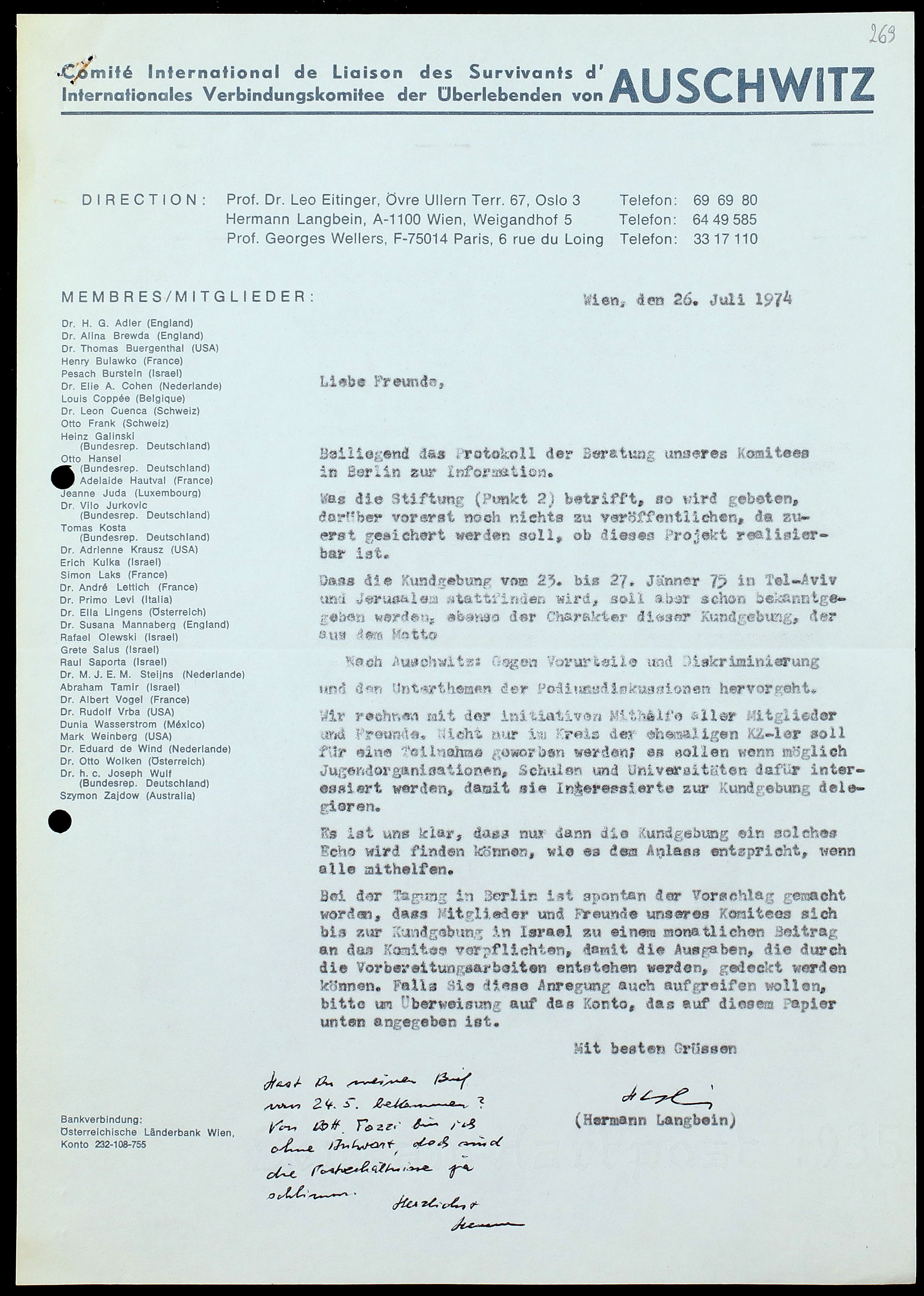
In a circular letter, Langbein updates the members of the Committees regarding the decisions made at the assembly that had just taken place in Berlin and shares an initial program of the ceremony celebrating the thirtieth anniversary of the Liberation of Auschwitz, which will be held in Israel in January 1975.
Beiliegend des Protokoll der Beratung unseres Komitees in Berlin zur Information.
Was die Stiftung (Punkt 2) betrifft, so wird gebeten, darüber vorerst noch nichts zu veröffentlichen, da zuerst gesichert werden soll, ob dieses Projekt realisierbar ist.
Dass die Kundgebung vom 23. bis 27. Jänner 75 in Tel-Aviv und Jerusalem stattfinden wird, soll aber schon bekanntgegeben werden, ebenso der Charakter dieser Kundgebung, der aus dem Motto «Nach Auschwitz: Gegen Vorurteile und Diskriminierung» und den Unterthemen der Podiumsdiskussionen hervorgeht.
Wir rechnen mit der initiativen Mithilfe aller Mitglieder und Freunde. Nicht nur im Kreis der ehemaligen KZ-ler soll für eine Teilnahme geworben werden; es sollen wenn möglich Jugendorganisationen, Schulen und Universitäten dafür interessiert werden, damit sie Interessierte zur Kundgebung delegieren.
Es ist uns klar, dass nur dann die Kundgebung ein solches Echo wird finden können, wie es dem Anlass entspricht, wenn alle mithelfen.
Bei der Tagung in Berlin ist spontan der Vorschlag gemacht worden, dass Mitglieder und Freunde unseres Komitees sich bis zur Kundgebung in Israel zu einem monatlichen Beitrag an das Komitees verpflichten, damit die Ausgaben, die durch die Vorbereitungsarbeiten entstehen werden, gedeckt werden können. Falls Sie diese Anregung auch aufgreifen wollen, bitte um Überweisung auf das Konto, das auf diesem Papier unter angegeben ist.
Mit besten Grüssen
(Hermann Langbein)[1]
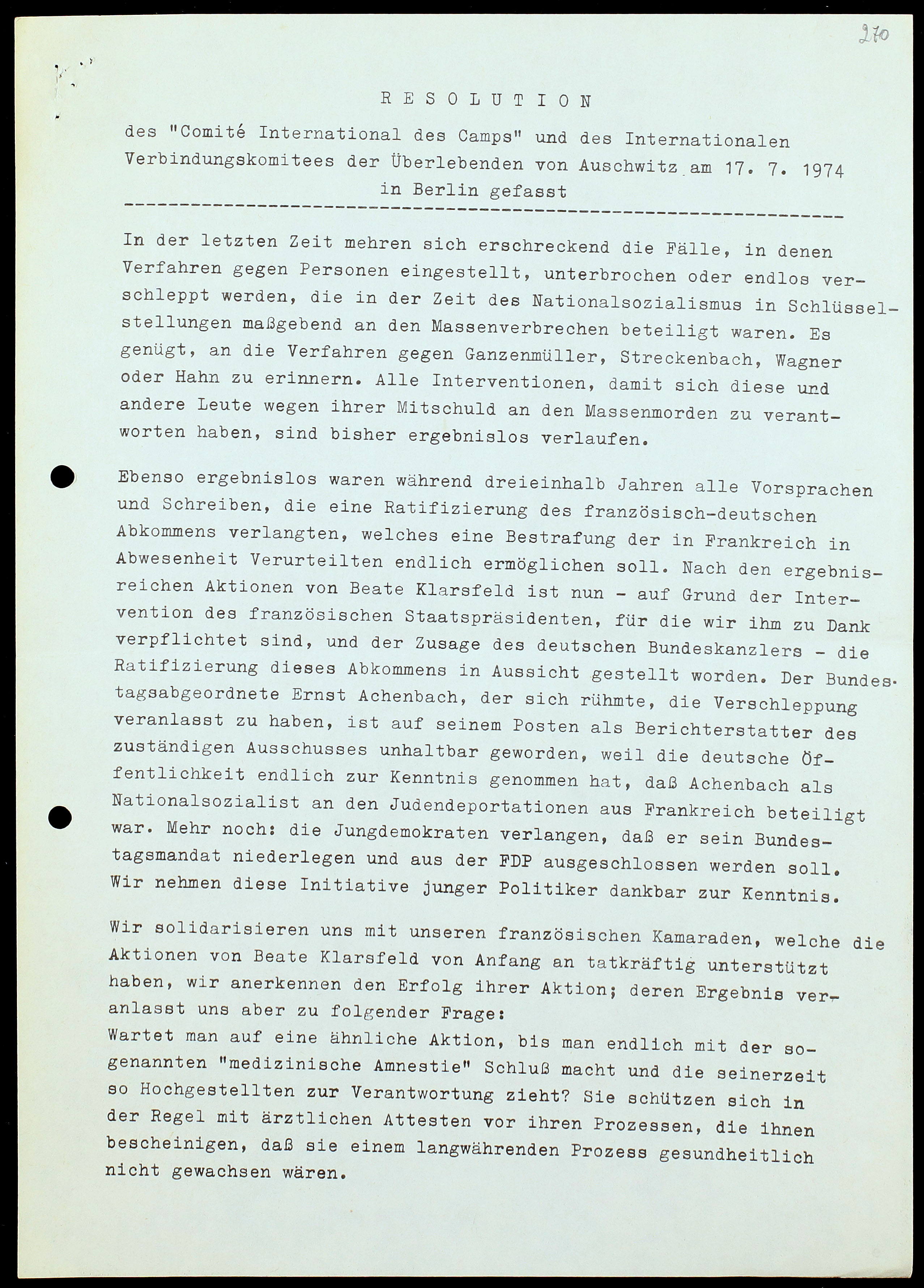
RESOLUTION
des „Comité International des Camps“ und des Internationalen Verbindungskomitees der Überlebenden von Auschwitz am 17.7.1974 in Berlin gefasst
In der letzten Zeit mehren sich erschreckend die Fälle, in denen Verfahren gegen Personen eingestellt, unterbrochen oder endlos verschleppt werden, die in der Zeit des Nationalsozialismus in Schlüsselstellungen maßgebend an den Massenverbrechen beteiligt waren. Es genügt, an die Verfahren gegen Ganzenmüller, Streckenbach, Wagner oder Hahn zu erinnern. Alle Interventionen, damit sich diese und andere Leute wegen ihrer Mitschuld an den Massenmorden zu verantworten haben, sind bisher ergebnislos verlaufen.
Ebenso ergebnislos waren während dreieinhalb Jahren alle Vorsprachen und Schreiben, die eine Ratifizierung des französisch-deutschen Abkommens verlangten, welches eine Bestrafung der in Frankreich in Abwesenheit Verurteilten endlich ermöglichen soll. Nach den ergebnisreichen Aktionen von Beate Klarsfeld ist nun – auf Grund der Intervention des französischen Staatspräsidenten, für die wir ihm zu Dank verpflichtet sind, und der Zusage des deutschen Bundeskanzlers – die Ratifizierung dieses Abkommens in Aussicht gestellt worden. Der Bundestagsabgeordnete Ernst Achenbach, der sich rühmte, die Verschleppung veranlasst zu haben, ist auf seinem Posten als Berichterstatter des zuständigen Ausschusses unhaltbar geworden, weil die deutsche Öffentlichkeit endlich zur Kenntnis genommen hat, daß Achenbach als Nationalsozialist an den Judendeportationen aus Frankreich beteiligt war. Mehr noch: die Jungdemokraten verlangen, daß er sein Bundestagsmandat niederlegen und aus der FDP ausgeschlossen werden soll.
Wir nehmen diese Initiative junger Politiker dankbar zur Kenntnis.
Wir solidarisieren uns mit unseren französischen Kamaraden, welche die Aktionen von Beate Klarsfeld von Anfang an tatkräftig unterstützt haben, wir anerkennen den Erfolg ihrer Aktion; deren Ergebnis veranlasst uns aber zu folgender Frage:
Wartet man auf eine ähnliche Aktion, bis man endlich mit der sogenannten „medizinische Amnestie“ Schluß macht und die seinerzeit so Hochgestellten zur Verantwortung zieht? Sie schützen sich in der Regel mit ärztlichen Attesten vor ihren Prozessen, die ihnen bescheinigen, daß sie einem langwährenden Prozess gesundheitlich nicht gewachsen wären.
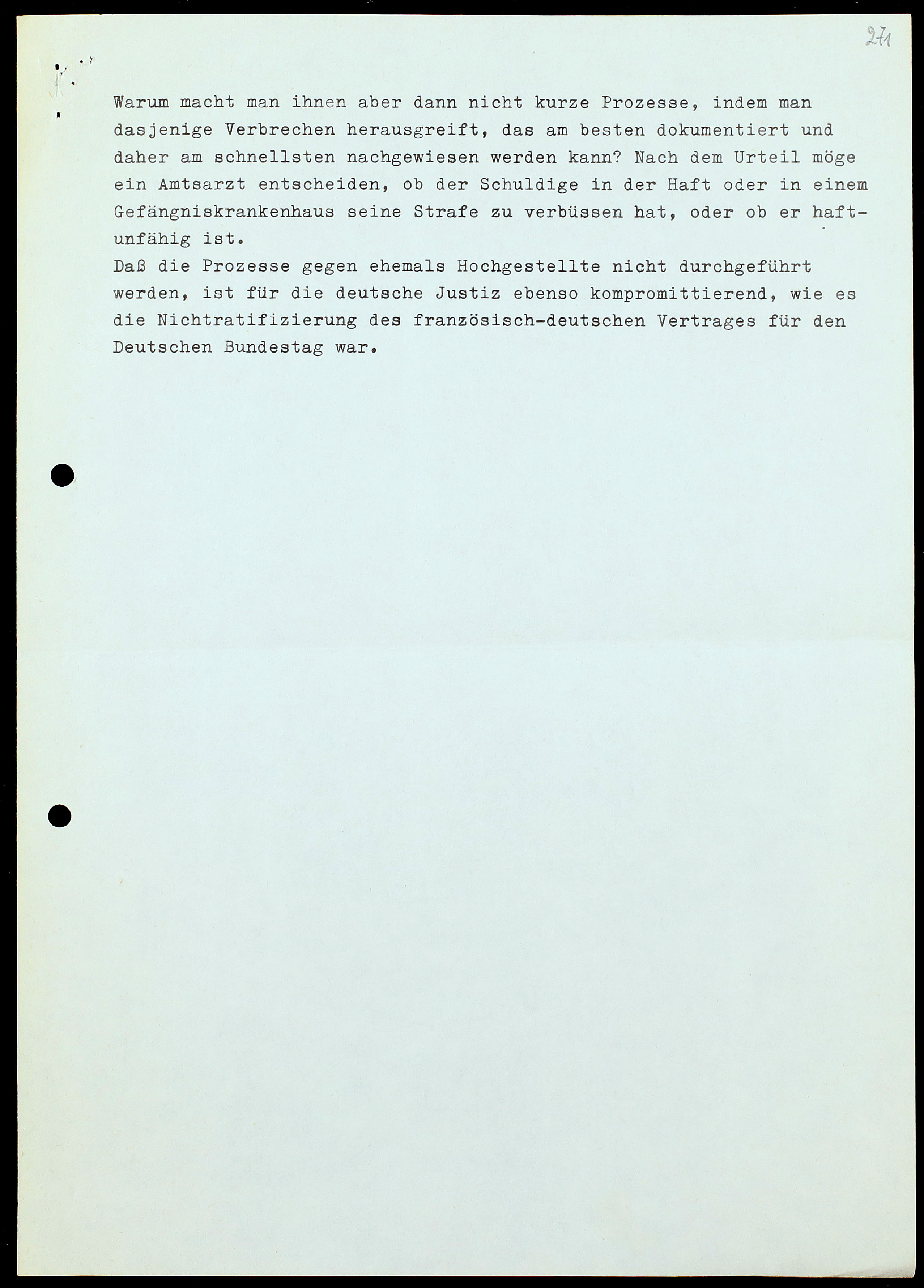
Warum macht man ihnen aber dann nicht kurze Prozesse, indem man dasjenige Verbrechen herausgreift, das am besten dokumentiert und daher am schnellsten nachgewiesen werden kann? Nach dem Urteil möge ein Amtsarzt entscheiden, ob der Schuldige in der Haft oder in einem Gefängniskrankenhaus seine Strafe zu verbüssen hat, oder ob er haftunfähig ist.
Daß die Prozesse gegen ehemals Hochgestellte nicht durchgeführt werden, ist für die deutsche Justiz ebenso kompromittierend, wie es die Nichtratifizierung des französisch-deutschen Vertrages für den Deutschen Bundestag war.
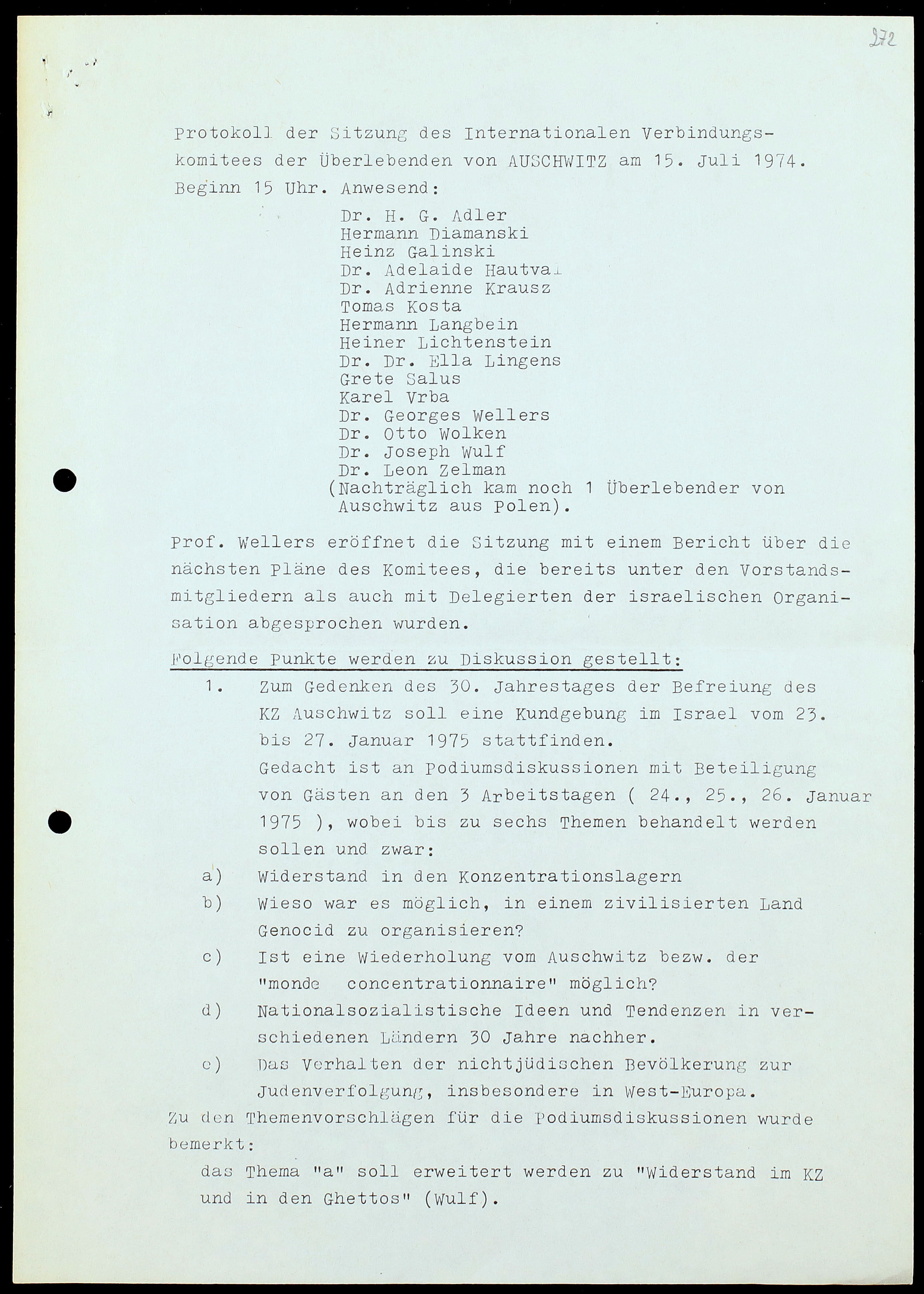
Protokoll der Sitzung des Internationalen Verbindungskomitees der Überlebenden von AUSCHWITZ am 15. Juli 1974. Beginn 15 Uhr. Anwesend:
Dr. H.G. Adler Hermann Diamanski Heinz Galinski Dr. Adelaide Hautval Dr. Adrienne Krausz Tomas Kosta Hermann Langbein Heiner Lichtenstein Dr. Dr. Ella Lingens Grete Salus Karel Vrba Dr. Georges Wellers Dr. Otto Wolken Dr. Joseph Wulf Dr. Leon Zelman
(Nachträglich kam noch 1 Überlebender von Auschwitz aus Polen).
Prof. Wellers eröffnet die Sitzung mit einem Bericht über die nächsten Plane des Komitees, die bereits unter den Vorstandsmitgliedern als auch mit Delegierten der israelischen Organisation abgesprochen wurden.
Folgende Punkte werden zu Diskussion gestellt:
1. Zum Gedenken des 30. Jahrestages der Befreiung des KZ Auschwitz soll eine Kundgebung in Israel vom 23. bis 27. Januar 1975 stattfinden.
Gedacht ist an Podiumsdiskussionen mit Beteiligung von Gästen an den 3 Arbeitstagen ( 24., 25., 26. Januar 1975), wobei bis zu sechs Themen behandelt werden sollen und zwar:
a) Widerstand in den Konzentrationslagern
b) Wieso war es möglich, in einem zivilisierten Land Genocid zu organisieren?
c) Ist eine Wiederholung vom Auschwitz bezw. der „monde concentrationnaire“ möglich?
d) Nationalsozialistische Ideen und Tendenzen in verschiedenen Ländern 30 Jahre nachher.
e) Das Verhalten der nichtjüdischen Bevölkerung zur Judenverfolgung, insbesondere in West-Europa.
Zu den Themenvorschlägen für die Podiumsdiskussionen wurde bemerkt:
das Thema „a“ soll erweitert werden zu „widerstand im KZ und in den Ghettos“ (Wulf).
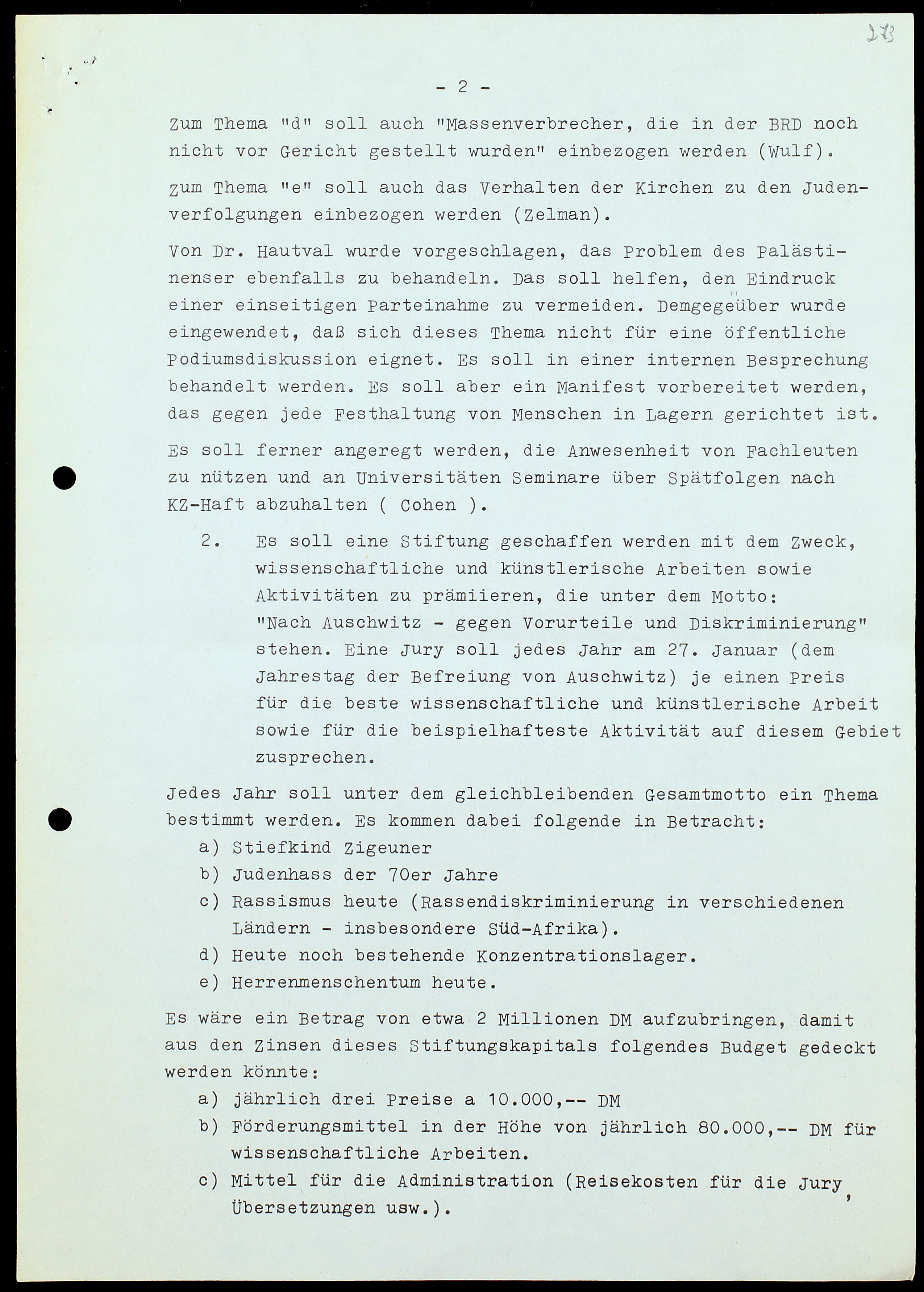
Zum Thema „d“ soll auch „Massenverbrecher, die in der BRD noch nicht vor Gericht gestellt wurden“ einbezogen werden (Wulf).
Zum Thema „e“ soll auch das Verhalten der Kirchen zu den Judenverfolgungen einbezogen werden (Zelman).
Von Dr. Hautval wurde vorgeschlagen, das Problem des Palästinenser ebenfalls zu behandeln. Das soll helfen, den Eindruck einer einseitigen Parteinahme zu vermeiden. Demgegeüber wurde eingewendet, daß sich dieses Thema nicht für eine öffentliche Podiumsdiskussion eignet. Es soll in einer internen Besprechung behandelt werden. Es soll aber ein Manifest vorbereitet werden, das gegen jede Festhaltung von Menschen in Lagern gerichtet ist.
Es soll ferner angeregt werden, die Anwesenheit von Fachleuten zu nützen und an Universitäten Seminare über Spätfolgen nach KZ-Haft abzuhalten (Cohen).
2. Es soll eine Stiftung geschaffen werden mit dem Zweck, wissenschaftliche und künstlerische Arbeiten sowie Aktivitäten zu prämiieren, die unter dem Motto: „Nach Auschwitz – gegen Vorurteile und Diskriminierung“ stehen. Eine Jury soll jedes Jahr am 27. Januar (dem Jahrestag der Befreiung von Auschwitz) je einen Preis für die beste wissenschaftliche und künstlerische Arbeit sowie für die beispielhafteste Aktivität auf diesem Gebiet zusprechen.
Jedes Jahr soll unter dem gleichbleibenden Gesamtmotto ein Thema bestimmt werden. Es kommen dabei folgende in Betracht:
a) Stiefkind Zigeuner
b) Judenhass der 70er Jahre
c) Rassismus heute (Rassendiskriminierung in verschiedenen Ländern – insbesondere Süd-Afrika).
d) Heute noch bestehende Konzentrationslager.
e) Herrenmenschentum heute.
Es wäre ein Betrag von etwa 2 Millionen DM aufzubringen, damit aus den Zinsen dieses Stiftungskapitals folgendes Budget gedeckt werden könnte:
a) jährlich drei Preise a 10.000,– DM
b) Förderungsmittel in der Höhe von jährlich 80.000,– DM für wissenschaftliche Arbeiten.
c) Mittel für die Administration (Reisekosten für die Jury, Übersetzungen usw.).
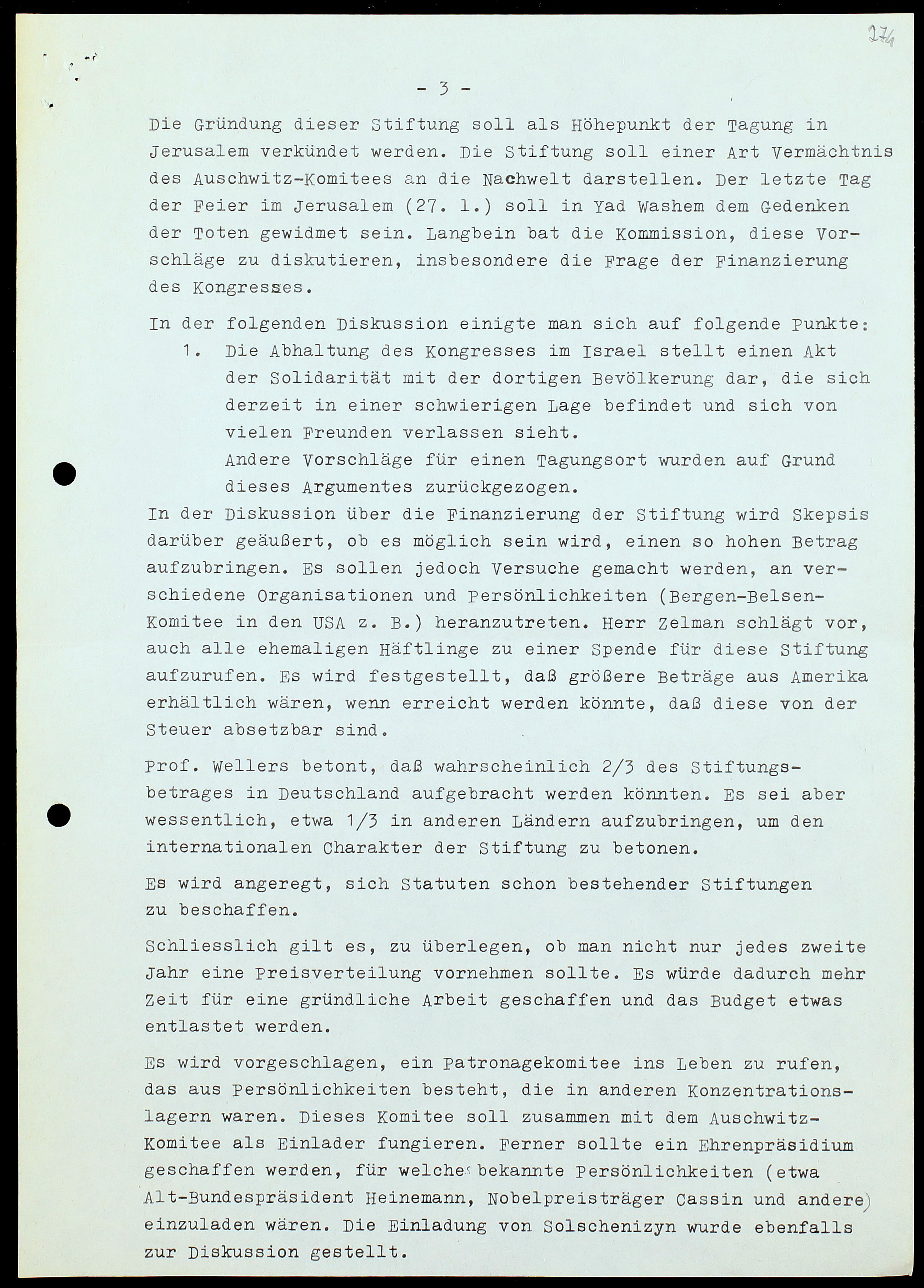
Die Gründung dieser Stiftung soll als Höhepunkt der Tagung in Jerusalem verkündet werden. Die Stiftung soll einer Art Vermächtnis des Auschwitz-Komitees an die Nachwelt darstellen. Der letzte Tag der Feier im Jerusalem (27. 1.) soll in Yad Washem dem Gedenken der Toten gewidmet sein. Langbein bat die Kommission, diese Vorschläge zu diskutieren, insbesondere die Frage der Finanzierung des Kongresses.
In der folgenden Diskussion einigte man sich auf folgende Punkte:
1. Die Abhaltung des Kongresses im Israel stellt einen Akt der Solidarität mit der dortigen Bevölkerung dar, die sich derzeit in einer schwierigen Lage befindet und sich von vielen Freunden verlassen sieht.
Andere Vorschläge für einen Tagungsort wurden auf Grund dieses Argumentes zurückgezogen.
In der Diskussion über die Finanzierung der Stiftung wird Skepsis darüber geäußert, ob es möglich sein wird, einen so hohen Betrag aufzubringen. Es sollen jedoch Versuche gemacht werden, an verschiedene Organisationen und Persönlichkeiten (Bergen-Belsen-Komitee in den USA z.B.) heranzutreten. Herr Zelman schlägt vor, auch alle ehemaligen Häftlinge zu einer Spende für diese Stiftung aufzurufen. Es wird festgestellt, daß größere Beträge aus Amerika erhältlich wären, wenn erreicht werden könnte, daß diese von der Steuer absetzbar sind.
Prof. Wellers betont, daß wahrscheinlich 2/3 des Stiftungs-betrages in Deutschland aufgebracht werden könnten. Es sei aber wesentlich, etwa 1/3 in anderen Ländern aufzubringen, um den internationalen Charakter der Stiftung zu betonen.
Es wird angeregt, sich Statuten schon bestehender Stiftungen zu beschaffen.
Schliesslich gilt es, zu überlegen, ob man nicht nur jedes zweite Jahr eine Preisverteilung vornehmen sollte. Es würde dadurch mehr Zeit für eine gründliche Arbeit geschaffen und das Budget etwas entlastet werden.
Es wird vorgeschlagen, ein Patronagekomitee ins Leben zu rufen, das aus Persönlichkeiten besteht, die in anderen Konzentrationslagern waren. Dieses Komitee soll zusammen mit dem Auschwitz-Komitee als Einlader fungieren. Ferner sollte ein Ehrenpräsidium geschaffen werden, für welches bekannte Persönlichkeiten (etwa Alt-Bundespräsident Heinemann, Nobelpreisträger Cassin und andere) einzuladen wären. Die Einladung von Solschenizyn wurde ebenfalls zur Diskussion gestellt.
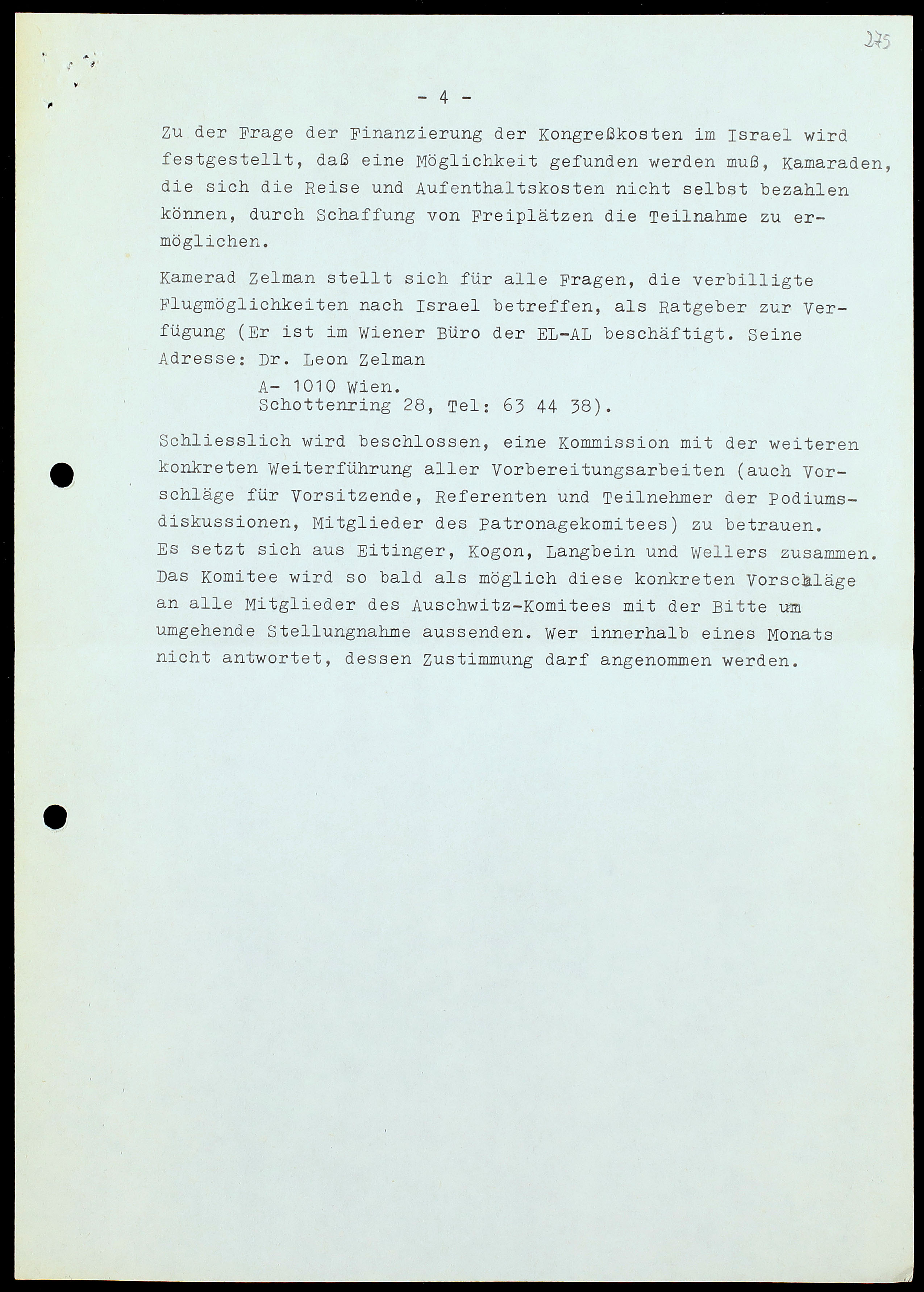
Zu der Frage der Finanzierung der Kongreßkosten im Israel wird festgestellt, daß eine Möglichkeit gefunden werden muß, Kamaraden, die sich die Reise und Aufenthaltskosten nicht selbst bezahlen können, durch Schaffung von Freiplätzen die Teilnahme zu ermöglichen.
Kamerad Zelman stellt sich für alle Fragen, die verbilligte Flugmöglichkeiten nach Israel betreffen, als Ratgeber zur Verfügung (Er ist im Wiener Büro der EL-AL beschäftigt. Seine Adresse:
Dr. Leon Zelman
A – 1010 Wien.
Schottenring 28, Tel: 63 44 38).
Schliesslich wird beschlossen, eine Kommission mit der weiteren konkreten Weiterführung aller Vorbereitungsarbeiten (auch Vorschläge für Vorsitzende, Referenten und Teilnehmer der Podiumsdiskussionen, Mitglieder des Patronagekomitees) zu betrauen.
Es setzt sich aus Eitinger, Kogon, Langbein und Wellers zusammen.
Das Komitee wird so bald als möglich diese konkreten Vorschläge an alle Mitglieder des Auschwitz-Komitees mit der Bitte um umgehende Stellungnahme aussenden. Wer innerhalb eines Monats nicht antwortet, dessen Zustimmung darf angenommen werden.
Vienna, 26 luglio 1974
Cari amici,
in allegato il verbale della riunione del nostro comitato a Berlino, che inviamo per conoscenza.
Per quanto riguarda la fondazione (punto 2), vi chiediamo, per il momento, di non pubblicare nulla al riguardo, in quanto occorre prima verificare la fattibilità del progetto.
Si può invece già annunciare che la manifestazione si terrà dal 23 al 27 gennaio ’75 a Tel-Aviv e Gerusalemme, così anche il carattere che la manifestazione avrà e che emerge dallo slogan «Dopo Auschwitz: contro i pregiudizi e la discriminazione» e dai temi delle tavole rotonde.
Contiamo sull’aiuto fattivo di tutti i membri e di tutti gli amici. La partecipazione non andrà promossa solo tra i sopravvissuti dei campi di concentramento; andrebbero anche coinvolte, se possibile, le organizzazioni giovanili, le scuole e le università affinché deleghino le persone interessate a partecipare.
Ci sembra chiaro che la manifestazione potrà trovare un’eco adeguata all’occasione solo con l’aiuto di tutti.
Alla riunione di Berlino si è proposto di chiedere ai membri e agli amici del nostro comitato di impegnarsi a dare un contributo mensile in vista della manifestazione in Israele, in modo da coprire le spese dei lavori preliminari. Se anche Lei volesse aderire a questa proposta, La preghiamo di effettuare un bonifico sul conto indicato in calce alla lettera.
Con i mei migliori saluti
(Hermann Langbein)[1]
RISOLUZIONE
del Comitato Internazionale dei Campi e del Comitato Internazionale di Collegamento dei Sopravvissuti di Auschwitz, adottata a Berlino il 17 luglio 1974.
Negli ultimi tempi si è registrato un allarmante aumento del numero di casi di archiviazione, sospensione o rinvio all’infinito dei procedimenti contro persone che occupavano posizioni chiave negli anni del nazionalsocialismo e si sono rese responsabili di crimini di massa. Basti ricordare i procedimenti contro Ganzenmüller, Streckenbach, Wagner e Hahn. Finora, tutte le azioni intraprese affinché queste e altre persone rispondessero della loro complicità negli omicidi di massa non hanno prodotto nessun risultato.
Altrettanto infruttuosi sono stati per tre anni e mezzo tutti gli appelli e le lettere con cui si chiedeva la ratifica dell’accordo franco-tedesco che avrebbe finalmente permesso di punire i condannati in contumacia in Francia. Adesso, con le azioni incisive portate avanti da Beate Klarsfeld, la ratifica di questo accordo è più vicina, per merito dell’intervento del presidente francese, al quale esprimiamo la nostra gratitudine, e della risposta positiva del cancelliere tedesco. Il deputato Ernst Achenbach, che si vantava di aver ordinato il rinvio dei processi, non è più difendibile nella sua posizione di portavoce della commissione parlamentare per i processi, perché l’opinione pubblica tedesca è finalmente venuta a conoscenza del fatto che Achenbach, in quanto nazionalsocialista, ha partecipato alle deportazioni degli ebrei dalla Francia. Non solo: i Giovani Democratici chiedono che Achenbach rimetta il suo mandato parlamentare e sia espulso dal Partito Liberale Democratico (FDP).
Prendiamo atto con gratitudine di questa iniziativa dei giovani politici.
Siamo solidali con i nostri compagni francesi che fin dall’inizio hanno sostenuto attivamente le iniziative di Beate Klarsfeld, di cui riconosciamo il successo; tuttavia il loro esito ci spinge a porci la seguente domanda:
Si attende forse un’azione analoga per porre fine una buona volta alla cosiddetta “amnistia medica” e chiamare a rispondere coloro che all’epoca ricoprivano alte cariche? Di norma, costoro si proteggono dai processi esibendo certificati medici che dichiarano la loro impossibilità di affrontare un lungo iter processuale per motivi di salute.
Ma perché allora non intentare contro di loro processi di breve durata, individuando il crimine meglio documentato e quindi più rapidamente dimostrabile? Dopo la sentenza, lasciamo che sia un ufficiale della sanità pubblica a decidere se il colpevole dovrà scontare la sua pena in carcere o in un ospedale penitenziario, oppure se non è passibile di pena detentiva.
Il fatto che i processi a coloro che ricoprivano alte cariche non arrivino al termine mina la fiducia nella giustizia tedesca, così come la mancata ratifica del trattato franco-tedesco ha minato la fiducia nel parlamento tedesco.
Verbale della riunione del Comitato Internazionale di Collegamento dei Sopravvissuti di Auschwitz del 15 luglio 1974. Inizio ore 15.00. Presenti:
Dott. H.G. Adler Hermann Diamanski Heinz Galinski Dott. Adelaide Hautval Dott. Adrienne Krausz Tomas Kosta Hermann Langbein Heiner Lichtenstein Dott. Ella Lingens Grete Salus Karel Vrba Dott. Georges Wellers Dott. Otto Wolken Dott. Joseph Wulf Dott. Leon Zelman
(in seguito si è aggiunto un sopravvissuto di Auschwitz arrivato dalla Polonia).
Il prof. Wellers ha aperto la riunione con una relazione sui prossimi progetti del comitato, che sono già stati discussi tra i membri del direttivo e con i delegati dell’organizzazione israeliana.
I punti proposti per la discussione sono i seguenti:
1. Per commemorare il trentennale della liberazione del campo di concentramento di Auschwitz, dal 23 al 27 gennaio 1975 si terrà una manifestazione in Israele.
L’idea è quella di organizzare delle tavole rotonde con la partecipazione di ospiti nei tre giorni lavorativi (24, 25, 26 gennaio 1975), con un massimo di sei temi da trattare, vale a dire:
a) la resistenza nei campi di concentramento;
b) perché in un Paese civile è stato possibile organizzare un genocidio;
c) se è possibile che si ripeta l’esperienza di Auschwitz o del “monde concentrationnaire”;
d) idee e tendenze nazionalsocialiste in diversi Paesi 30 anni dopo;
e) il comportamento della popolazione non ebraica nei confronti della persecuzione degli ebrei, soprattutto nell’Europa occidentale.
Per quanto riguarda i temi proposti per le tavole rotonde, è stato notato che:
il tema “a” dovrebbe essere esteso alla «resistenza nei campi di concentramento e nei ghetti» (Wulf);
il tema “d” dovrebbe includere «i responsabili di crimini di massa, che non sono stati ancora consegnati alla giustizia nella RFT» (Wulf);
il tema “e” dovrebbe includere anche il comportamento delle Chiese nei confronti della persecuzione degli ebrei (Zelman).
La dott. Hautval ha suggerito di trattare anche il problema dei palestinesi. In questo modo si eviterebbe di dare l’impressione di una partigianeria unilaterale. Tuttavia, si è obiettato che questo tema non è adatto a una tavola rotonda aperta al pubblico. Piuttosto andrebbe affrontato in una riunione interna. Verrà comunque preparato un manifesto contro ogni detenzione nei campi.
Si suggerisce inoltre di ricorrere alla presenza di esperti e di organizzare seminari presso le università sulle conseguenze psico-fisiche della detenzione nei campi di concentramento (Cohen).
2. Si dovrebbe creare una fondazione con il compito di assegnare premi per opere e attività scientifiche e artistiche che sviluppino lo slogan: «Dopo Auschwitz – contro i pregiudizi e la discriminazione». Ogni anno, il 27 gennaio (anniversario della Liberazione di Auschwitz), una giuria potrebbe assegnare un premio per il miglior lavoro scientifico e artistico e per l’attività più esemplare svolta in questo ambito.
Ogni anno potrebbe poi essere scelto un tema in linea con lo stesso slogan. Sono stati presi in considerazione i seguenti temi:
a) gli zingari ignorati e dimenticati;
b) l’odio contro gli ebrei negli anni ’70;
c) il razzismo oggi (discriminazione razziale in vari Paesi, soprattutto in Sudafrica);
d) i campi di concentramento che esistono ancora oggi;
e) il concetto di razza superiore oggi.
Bisognerebbe reperire circa 2 milioni di marchi tedeschi per coprire, con gli interessi del capitale della fondazione, le seguenti spese:
a) tre premi annuali, ciascuno con una dotazione di 10.000 DM;
b) fondi per 80.000 DM all’anno da destinare alla ricerca scientifica;
c) fondi per l’amministrazione (spese di viaggio per la giuria, traduzioni, ecc.).
La nascita della fondazione sarà annunciata come punto cruciale del congresso di Gerusalemme. La fondazione rappresenterà una sorta di lascito del Comitato di Auschwitz per i posteri. L’ultimo giorno delle celebrazioni che si terranno a Gerusalemme (27 gennaio) sarà dedicato alla memoria delle vittime presso lo Yad Vashem. Langbein ha chiesto alla commissione di discutere queste proposte, in particolare la questione del finanziamento del congresso.
Nella discussione che ne è seguita, sono stati concordati i seguenti punti:
1. organizzare il congresso in Israele rappresenta un atto di solidarietà con la sua popolazione, che attualmente si trova in una situazione difficile e si vede abbandonata da molti amici;
altre proposte per la sede del congresso sono state ritirate sulla base di questa argomentazione.
Discutendo del finanziamento della fondazione, viene espresso scetticismo sulla possibilità di raccogliere una somma così elevata. Tuttavia si cercherà di contattare diverse organizzazioni e personalità (ad esempio il Comitato di Bergen-Belsen negli Stati Uniti). Il sig. Zelman suggerisce di invitare tutti gli ex deportati a effettuare una donazione. Si fa notare che dall’America si potrebbero ricevere somme maggiori, se si riuscisse a ottenere la loro deducibilità dalle tasse.
Il prof. Wellers sottolinea che probabilmente i 2/3 dell’importo necessario per finanziare la fondazione si potrebbero raccogliere in Germania. Sarebbe comunque essenziale raccogliere circa 1/3 in altri Paesi per sottolineare il carattere internazionale della fondazione stessa.
Si suggerisce di reperire gli statuti delle fondazioni già esistenti.
Infine, si dovrebbe valutare se l’assegnazione del premio non potrebbe avvenire solo ogni due anni: ciò consentirebbe di avere più tempo a disposizione per svolgere un lavoro accurato, nonché di alleggerire un po’ le spese.
Si propone di istituire un comitato di promotori composto da ex-deportati in altri campi di concentramento. Questo organismo, insieme al Comitato di Auschwitz, dovrebbe avere la funzione di patrocinare la manifestazione. Andrebbe creato poi un comitato d’onore, composto da personaggi di spicco (come l’ex presidente della Repubblica Federale Heinemann, il premio Nobel Cassin e altri). Si è discusso poi della possibilità di invitare Solženicyn.
Per quanto riguarda la questione della copertura dei costi del congresso in Israele, si è stabilito che è necessario trovare una soluzione per consentire la partecipazione di coloro che non possono pagare di tasca propria le spese di viaggio e soggiorno, offrendo posti gratuiti.
L’amico Zelman si mette a disposizione come consulente per tutte le questioni riguardanti i voli più economici con destinazione Israele (è impiegato presso l’ufficio di Vienna della EL-AL. Indirizzo:
Dott. Leon Zelman
A – 1010 Vienna.
Schottenring 28, Tel: 63 44 38).
Infine si decide di affidare a una commissione il proseguimento concreto di tutti i lavori preliminari (anche di proporre presidenti, relatori e partecipanti alle tavole rotonde, membri del comitato patrocinatore).
La commissione è composta da Eitinger, Kogon, Langbein e Wellers.
Il comitato invierà queste proposte concrete a tutti i membri del Comitato di Auschwitz il prima possibile, con preghiera di rispondere con sollecitudine. Si riterrà che coloro che non risponderanno entro un mese abbiano dato il loro consenso.
Vienna, July 26, 1974
Dear Friends,
Please find enclosed the minutes from our recent committee meeting and deliberations.
Regarding the foundation (point 2), we request that nothing be made public yet, as we must first ascertain the feasibility of the undertaking.
Details that should, however, already be publicized are that the rally will take place January 23 to 27, 1975, in Tel Aviv and Jerusalem, under the heading of “After Auschwitz: Against Prejudice and Discrimination,” as well as the panel discussion topics.
We are counting on the support of all our members and friends in this initiative. Participation and attendance should be promoted not only among former concentration camp detainees, but also, whenever possible, among youth organizations, schools, and universities, so that they may send delegations to the demonstration.
It is clear to us that the rally will only succeed with everyone’s help, ensuring an impact befitting the occasion.
At the meeting in Berlin, the suggestion was made that members and friends of our committee commit to making a monthly contribution from now until the rally in Israel, in order to cover the expenses that will arise from the preparatory work. Should you wish to do so, please send funds via bank transfer to the account specified above.
With best regards,
(Hermann Langbein)[1]
RESOLUTION
of the International Committee of the Campsand the International Liaison Committee of Auschwitz Survivors made July 17, 1974, in Berlin.
Recently, there has been an alarming increase in the number of cases in which court proceedings against people who played a key role in mass crimes during the National Socialist era are discontinued, interrupted or delayed indefinitely. Suffice it to consider the court proceedings against Ganzenmüller, Streckenbach, Wagner, and Hahn. All attempts to ensure that these and others be held accountable for their complicity in mass murder have, so far, been unsuccessful.
All calls and letters over the past three and a half years demanding ratification of the Franco-German agreement, which would finally make it possible to punish those convicted in absentia in France, were equally fruitless. Following the successful actions of Beate Klarsfeld—which led to the intervention of the French President, to whom we are indebted, and the German Chancellor’s agreement—the prospect that this agreement will be ratified has now been announced. Ernst Achenbach, the Bundestag member who boasted of having ordered the delays, has become unfit for his position as spokesman of the responsible committee because the German public has finally become aware that Achenbach, as a National Socialist, was involved in the deportation of Jews from France. Furthermore, the Young Democrats are demanding that he resign from his Bundestag mandate and be expelled from the FDP.
We gratefully acknowledge the initiative of these young politicians.
We stand in solidarity with our French comrades, who have actively supported Beate Klarsfeld’s initiatives from the beginning, and recognize their success; however, the results lead us to pose the following question:
Will a similar intervention be necessary in order to finally put an end to so-called medical amnesty and hold those former higher-ups responsible? As a rule, they continue to shield themselves from justice by wielding medical certificates that supposedly confirm that their state of health makes them unable to endure a lengthy trial.
But then why not grant them short trials by selecting their best-documented crime, which would therefore be the quickest to prove? After the verdict, a medical officer could decide whether the guilty party is to serve his sentence in custody, or in a prison hospital, or whether he is unfit for serving a sentence in custody.
The fact that trials against formerly high-ranking figures have not been carried out is just as compromising for the German judiciary as the failure to ratify the Franco-German treaty was for the German Bundestag.
Minutes of the meeting of the International Liaison Committee of AUSCHWITZ Survivors held July 15, 1974. Called to order at 3:00 p.m. In attendance:
Dr. H.G. Adler Hermann Diamanski Heinz Galinski Dr. Adelaide Hautval Dr. Adrienne Krausz Tomas Kosta Hermann Langbein Heiner Lichtenstein Dr. Ella Lingens Grete Salus Karel Vrba Dr. Georges Wellers Dr. Otto Wolken Dr. Joseph Wulf Dr. Leon Zelman
(One additional survivor from Poland arrived later)
Prof. Wellers opened the meeting with a report on the committee’s upcoming plans, which have already been agreed upon among board members and delegates from the Israeli organization.
The proposed discussion points were as follows:
1. A demonstration is to take place in Israel from January 23 to 27, 1975, commemorating the 30th anniversary of the liberation of the Auschwitz concentration camp.
The plan is to hold panel discussions with guests over three working days (January 24, 25, and 26, 1975), where up to six topics will be discussed, specifically:
a) Resistance within the concentration camps;
b) What made it possible to organize a genocide in a civilized country;
c) Whether Auschwitz or the “monde concentrationnaire” could happen again;
d) National Socialist ideas and tendencies in various countries 30 years later;
e) How the non-Jewish population responded to the persecution of Jews, especially in Western Europe.
Additional observations regarding the suggested panel discussion topics:
Topic “a” should be expanded to “resistance within the concentration camps and ghettos” (Wulf).
Topic “d” should also include “mass criminals who have not yet been brought to justice in the Federal Republic of Germany” (Wulf).
Topic “e” should also include the Churches’ behavior with respect to the persecution of Jews (Zelman).
Dr. Hautval suggested that the Palestinian problem also be addressed. This would help avoid the impression of one-sided partisanship. Conversely, the objection was raised that this topic is not suitable for a public panel discussion; it should be discussed in an internal meeting. Nevertheless, a manifesto should be prepared arguing against any detention of people in camps.
A further recommendation was to take advantage of the presence of experts and hold seminars at universities on the long-term consequences of concentration camp imprisonment (Cohen).
2. A foundation should be created with the purpose of rewarding scientific and artistic work as well as activities that deal with the motto “After Auschwitz: Against Prejudice and Discrimination.” Annually on January 27 (the anniversary of the liberation of Auschwitz), a jury will award a prize to the best scientific and artistic work, as well as to the most exemplary initiative within this field.
Each year a theme should be chosen under the same overall motto. The following were proposed for consideration:
a) The marginalization of Gypsies;
b) Hatred of Jews in the ‘70s;
c) Racism today (racial discrimination in various countries—especially South Africa);
d) Concentration camps that still exist today;
e) Present-day notions of a “Master Race.”
An amount of approximately 2 million Deutschmarks (DM) would have to be raised so that the interest from the foundation’s capital could cover the following budget:
a) Three annual prizes of 10,000 DM each;
b) Funding of 80,000 DM annually for scientific work;
c) Administrative expenses (travel for the jury, translations, etc.).
The establishment of this foundation is to be announced as the highlight of the conference in Jerusalem. The foundation is intended to represent a legacy of sorts from the Auschwitz Committee to posterity. The last day of the celebration in Jerusalem (January 27) will be dedicated to commemoration of the dead at Yad Vashem. Langbein asked the commission to discuss these proposals, particularly the issue of funding for the congress.
In the discussion that followed, the following points were agreed upon:
1. Holding the congress in Israel is an act of solidarity with its population, which is currently in a difficult situation and feels abandoned by many of its friends.
In light of this argument, all other meeting location proposals were withdrawn.
In discussing the foundation’s funding, skepticism was expressed as to whether it will be possible to raise such a large amount. However, attempts should be made to approach various organizations and individuals (the Bergen-Belsen Committee in the USA, for example). Mr. Zelmansuggested approaching all former detainees to request donations. An observation was made that larger amounts would be available from America if they could be made tax-deductible.
Prof. Wellers emphasized that 2/3 of the amount could likely be raised in Germany. However, it is essential that 1/3 be raised in other countries in order to emphasize the international nature of the foundation.
A recommendation was made that statutes from existing foundations be obtained for reference.
One final consideration asked whether prizes might best be awarded only every other year. This would allow more time for laying thorough groundwork, and relieve some of the strain on the budget.
A proposal was made to establish a co-organizational committee consisting of people who were in other concentration camps. This committee, working together with the Auschwitz Committee, would act as host. Furthermore, an honorary chairmanship should be created, on which well-known personalities (such as former Federal President Heinemann, Nobel Prize winner Cassin, and others) would be invited to serve. Inviting Solzhenitsyn was also brought up for discussion.
Regarding financing the costs of the congress in Israel, a motion was made that a limited number of funded spots be reserved for attendees who cannot afford to pay their own travel and accommodation costs.
Zelman offered to serve as travel advisor for all questions regarding discounted flights to Israel (He works in the Vienna office of El-Al). His address:
Dr. Leon Zelman
A – 1010 Wien
Schottenring 28, Tel: 63 44 38.
Finally, a special commission is to be appointed and charged with continuing all preparatory work (including suggestions for chairmen, panel discussion speakers and participants, and members of the co-organizational committee).
It will consist of Eitinger, Kogon, Langbein and Wellers.
The committee will send these concrete proposals to all members of the Auschwitz Committee as soon as possible with a request for immediate comment. If no response is received within a month, your consent will be assumed.
Wien, den 26. Juli 1974
Liebe Freunde,
Beiliegend des Protokoll der Beratung unseres Komitees in Berlin zur Information.
Was die Stiftung (Punkt 2) betrifft, so wird gebeten, darüber vorerst noch nichts zu veröffentlichen, da zuerst gesichert werden soll, ob dieses Projekt realisierbar ist.
Dass die Kundgebung vom 23. bis 27. Jänner 75 in Tel-Aviv und Jerusalem stattfinden wird, soll aber schon bekanntgegeben werden, ebenso der Charakter dieser Kundgebung, der aus dem Motto «Nach Auschwitz: Gegen Vorurteile und Diskriminierung» und den Unterthemen der Podiumsdiskussionen hervorgeht.
Wir rechnen mit der initiativen Mithilfe aller Mitglieder und Freunde. Nicht nur im Kreis der ehemaligen KZ-ler soll für eine Teilnahme geworben werden; es sollen wenn möglich Jugendorganisationen, Schulen und Universitäten dafür interessiert werden, damit sie Interessierte zur Kundgebung delegieren.
Es ist uns klar, dass nur dann die Kundgebung ein solches Echo wird finden können, wie es dem Anlass entspricht, wenn alle mithelfen.
Bei der Tagung in Berlin ist spontan der Vorschlag gemacht worden, dass Mitglieder und Freunde unseres Komitees sich bis zur Kundgebung in Israel zu einem monatlichen Beitrag an das Komitees verpflichten, damit die Ausgaben, die durch die Vorbereitungsarbeiten entstehen werden, gedeckt werden können. Falls Sie diese Anregung auch aufgreifen wollen, bitte um Überweisung auf das Konto, das auf diesem Papier unter angegeben ist.
Mit besten Grüssen
(Hermann Langbein)[1]
RESOLUTION
des „Comité International des Camps“ und des Internationalen Verbindungskomitees der Überlebenden von Auschwitz am 17.7.1974 in Berlin gefasst
In der letzten Zeit mehren sich erschreckend die Fälle, in denen Verfahren gegen Personen eingestellt, unterbrochen oder endlos verschleppt werden, die in der Zeit des Nationalsozialismus in Schlüsselstellungen maßgebend an den Massenverbrechen beteiligt waren. Es genügt, an die Verfahren gegen Ganzenmüller, Streckenbach, Wagner oder Hahn zu erinnern. Alle Interventionen, damit sich diese und andere Leute wegen ihrer Mitschuld an den Massenmorden zu verantworten haben, sind bisher ergebnislos verlaufen.
Ebenso ergebnislos waren während dreieinhalb Jahren alle Vorsprachen und Schreiben, die eine Ratifizierung des französisch-deutschen Abkommens verlangten, welches eine Bestrafung der in Frankreich in Abwesenheit Verurteilten endlich ermöglichen soll. Nach den ergebnisreichen Aktionen von Beate Klarsfeld ist nun – auf Grund der Intervention des französischen Staatspräsidenten, für die wir ihm zu Dank verpflichtet sind, und der Zusage des deutschen Bundeskanzlers – die Ratifizierung dieses Abkommens in Aussicht gestellt worden. Der Bundestagsabgeordnete Ernst Achenbach, der sich rühmte, die Verschleppung veranlasst zu haben, ist auf seinem Posten als Berichterstatter des zuständigen Ausschusses unhaltbar geworden, weil die deutsche Öffentlichkeit endlich zur Kenntnis genommen hat, daß Achenbach als Nationalsozialist an den Judendeportationen aus Frankreich beteiligt war. Mehr noch: die Jungdemokraten verlangen, daß er sein Bundestagsmandat niederlegen und aus der FDP ausgeschlossen werden soll.
Wir nehmen diese Initiative junger Politiker dankbar zur Kenntnis.
Wir solidarisieren uns mit unseren französischen Kamaraden, welche die Aktionen von Beate Klarsfeld von Anfang an tatkräftig unterstützt haben, wir anerkennen den Erfolg ihrer Aktion; deren Ergebnis veranlasst uns aber zu folgender Frage:
Wartet man auf eine ähnliche Aktion, bis man endlich mit der sogenannten „medizinische Amnestie“ Schluß macht und die seinerzeit so Hochgestellten zur Verantwortung zieht? Sie schützen sich in der Regel mit ärztlichen Attesten vor ihren Prozessen, die ihnen bescheinigen, daß sie einem langwährenden Prozess gesundheitlich nicht gewachsen wären.
Warum macht man ihnen aber dann nicht kurze Prozesse, indem man dasjenige Verbrechen herausgreift, das am besten dokumentiert und daher am schnellsten nachgewiesen werden kann? Nach dem Urteil möge ein Amtsarzt entscheiden, ob der Schuldige in der Haft oder in einem Gefängniskrankenhaus seine Strafe zu verbüssen hat, oder ob er haftunfähig ist.
Daß die Prozesse gegen ehemals Hochgestellte nicht durchgeführt werden, ist für die deutsche Justiz ebenso kompromittierend, wie es die Nichtratifizierung des französisch-deutschen Vertrages für den Deutschen Bundestag war.
Protokoll der Sitzung des Internationalen Verbindungskomitees der Überlebenden von AUSCHWITZ am 15. Juli 1974. Beginn 15 Uhr. Anwesend:
Dr. H.G. Adler Hermann Diamanski Heinz Galinski Dr. Adelaide Hautval Dr. Adrienne Krausz Tomas Kosta Hermann Langbein Heiner Lichtenstein Dr. Dr. Ella Lingens Grete Salus Karel Vrba Dr. Georges Wellers Dr. Otto Wolken Dr. Joseph Wulf Dr. Leon Zelman
(Nachträglich kam noch 1 Überlebender von Auschwitz aus Polen).
Prof. Wellers eröffnet die Sitzung mit einem Bericht über die nächsten Plane des Komitees, die bereits unter den Vorstandsmitgliedern als auch mit Delegierten der israelischen Organisation abgesprochen wurden.
Folgende Punkte werden zu Diskussion gestellt:
1. Zum Gedenken des 30. Jahrestages der Befreiung des KZ Auschwitz soll eine Kundgebung in Israel vom 23. bis 27. Januar 1975 stattfinden.
Gedacht ist an Podiumsdiskussionen mit Beteiligung von Gästen an den 3 Arbeitstagen ( 24., 25., 26. Januar 1975), wobei bis zu sechs Themen behandelt werden sollen und zwar:
a) Widerstand in den Konzentrationslagern
b) Wieso war es möglich, in einem zivilisierten Land Genocid zu organisieren?
c) Ist eine Wiederholung vom Auschwitz bezw. der „monde concentrationnaire“ möglich?
d) Nationalsozialistische Ideen und Tendenzen in verschiedenen Ländern 30 Jahre nachher.
e) Das Verhalten der nichtjüdischen Bevölkerung zur Judenverfolgung, insbesondere in West-Europa.
Zu den Themenvorschlägen für die Podiumsdiskussionen wurde bemerkt:
das Thema „a“ soll erweitert werden zu „widerstand im KZ und in den Ghettos“ (Wulf).
Zum Thema „d“ soll auch „Massenverbrecher, die in der BRD noch nicht vor Gericht gestellt wurden“ einbezogen werden (Wulf).
Zum Thema „e“ soll auch das Verhalten der Kirchen zu den Judenverfolgungen einbezogen werden (Zelman).
Von Dr. Hautval wurde vorgeschlagen, das Problem des Palästinenser ebenfalls zu behandeln. Das soll helfen, den Eindruck einer einseitigen Parteinahme zu vermeiden. Demgegeüber wurde eingewendet, daß sich dieses Thema nicht für eine öffentliche Podiumsdiskussion eignet. Es soll in einer internen Besprechung behandelt werden. Es soll aber ein Manifest vorbereitet werden, das gegen jede Festhaltung von Menschen in Lagern gerichtet ist.
Es soll ferner angeregt werden, die Anwesenheit von Fachleuten zu nützen und an Universitäten Seminare über Spätfolgen nach KZ-Haft abzuhalten (Cohen).
2. Es soll eine Stiftung geschaffen werden mit dem Zweck, wissenschaftliche und künstlerische Arbeiten sowie Aktivitäten zu prämiieren, die unter dem Motto: „Nach Auschwitz – gegen Vorurteile und Diskriminierung“ stehen. Eine Jury soll jedes Jahr am 27. Januar (dem Jahrestag der Befreiung von Auschwitz) je einen Preis für die beste wissenschaftliche und künstlerische Arbeit sowie für die beispielhafteste Aktivität auf diesem Gebiet zusprechen.
Jedes Jahr soll unter dem gleichbleibenden Gesamtmotto ein Thema bestimmt werden. Es kommen dabei folgende in Betracht:
a) Stiefkind Zigeuner
b) Judenhass der 70er Jahre
c) Rassismus heute (Rassendiskriminierung in verschiedenen Ländern – insbesondere Süd-Afrika).
d) Heute noch bestehende Konzentrationslager.
e) Herrenmenschentum heute.
Es wäre ein Betrag von etwa 2 Millionen DM aufzubringen, damit aus den Zinsen dieses Stiftungskapitals folgendes Budget gedeckt werden könnte:
a) jährlich drei Preise a 10.000,– DM
b) Förderungsmittel in der Höhe von jährlich 80.000,– DM für wissenschaftliche Arbeiten.
c) Mittel für die Administration (Reisekosten für die Jury, Übersetzungen usw.).
Die Gründung dieser Stiftung soll als Höhepunkt der Tagung in Jerusalem verkündet werden. Die Stiftung soll einer Art Vermächtnis des Auschwitz-Komitees an die Nachwelt darstellen. Der letzte Tag der Feier im Jerusalem (27. 1.) soll in Yad Washem dem Gedenken der Toten gewidmet sein. Langbein bat die Kommission, diese Vorschläge zu diskutieren, insbesondere die Frage der Finanzierung des Kongresses.
In der folgenden Diskussion einigte man sich auf folgende Punkte:
1. Die Abhaltung des Kongresses im Israel stellt einen Akt der Solidarität mit der dortigen Bevölkerung dar, die sich derzeit in einer schwierigen Lage befindet und sich von vielen Freunden verlassen sieht.
Andere Vorschläge für einen Tagungsort wurden auf Grund dieses Argumentes zurückgezogen.
In der Diskussion über die Finanzierung der Stiftung wird Skepsis darüber geäußert, ob es möglich sein wird, einen so hohen Betrag aufzubringen. Es sollen jedoch Versuche gemacht werden, an verschiedene Organisationen und Persönlichkeiten (Bergen-Belsen-Komitee in den USA z.B.) heranzutreten. Herr Zelman schlägt vor, auch alle ehemaligen Häftlinge zu einer Spende für diese Stiftung aufzurufen. Es wird festgestellt, daß größere Beträge aus Amerika erhältlich wären, wenn erreicht werden könnte, daß diese von der Steuer absetzbar sind.
Prof. Wellers betont, daß wahrscheinlich 2/3 des Stiftungs-betrages in Deutschland aufgebracht werden könnten. Es sei aber wesentlich, etwa 1/3 in anderen Ländern aufzubringen, um den internationalen Charakter der Stiftung zu betonen.
Es wird angeregt, sich Statuten schon bestehender Stiftungen zu beschaffen.
Schliesslich gilt es, zu überlegen, ob man nicht nur jedes zweite Jahr eine Preisverteilung vornehmen sollte. Es würde dadurch mehr Zeit für eine gründliche Arbeit geschaffen und das Budget etwas entlastet werden.
Es wird vorgeschlagen, ein Patronagekomitee ins Leben zu rufen, das aus Persönlichkeiten besteht, die in anderen Konzentrationslagern waren. Dieses Komitee soll zusammen mit dem Auschwitz-Komitee als Einlader fungieren. Ferner sollte ein Ehrenpräsidium geschaffen werden, für welches bekannte Persönlichkeiten (etwa Alt-Bundespräsident Heinemann, Nobelpreisträger Cassin und andere) einzuladen wären. Die Einladung von Solschenizyn wurde ebenfalls zur Diskussion gestellt.
Zu der Frage der Finanzierung der Kongreßkosten im Israel wird festgestellt, daß eine Möglichkeit gefunden werden muß, Kamaraden, die sich die Reise und Aufenthaltskosten nicht selbst bezahlen können, durch Schaffung von Freiplätzen die Teilnahme zu ermöglichen.
Kamerad Zelman stellt sich für alle Fragen, die verbilligte Flugmöglichkeiten nach Israel betreffen, als Ratgeber zur Verfügung (Er ist im Wiener Büro der EL-AL beschäftigt. Seine Adresse:
Dr. Leon Zelman
A – 1010 Wien.
Schottenring 28, Tel: 63 44 38).
Schliesslich wird beschlossen, eine Kommission mit der weiteren konkreten Weiterführung aller Vorbereitungsarbeiten (auch Vorschläge für Vorsitzende, Referenten und Teilnehmer der Podiumsdiskussionen, Mitglieder des Patronagekomitees) zu betrauen.
Es setzt sich aus Eitinger, Kogon, Langbein und Wellers zusammen.
Das Komitee wird so bald als möglich diese konkreten Vorschläge an alle Mitglieder des Auschwitz-Komitees mit der Bitte um umgehende Stellungnahme aussenden. Wer innerhalb eines Monats nicht antwortet, dessen Zustimmung darf angenommen werden.
Vienna, 26 luglio 1974
Cari amici,
in allegato il verbale della riunione del nostro comitato a Berlino, che inviamo per conoscenza.
Per quanto riguarda la fondazione (punto 2), vi chiediamo, per il momento, di non pubblicare nulla al riguardo, in quanto occorre prima verificare la fattibilità del progetto.
Si può invece già annunciare che la manifestazione si terrà dal 23 al 27 gennaio ’75 a Tel-Aviv e Gerusalemme, così anche il carattere che la manifestazione avrà e che emerge dallo slogan «Dopo Auschwitz: contro i pregiudizi e la discriminazione» e dai temi delle tavole rotonde.
Contiamo sull’aiuto fattivo di tutti i membri e di tutti gli amici. La partecipazione non andrà promossa solo tra i sopravvissuti dei campi di concentramento; andrebbero anche coinvolte, se possibile, le organizzazioni giovanili, le scuole e le università affinché deleghino le persone interessate a partecipare.
Ci sembra chiaro che la manifestazione potrà trovare un’eco adeguata all’occasione solo con l’aiuto di tutti.
Alla riunione di Berlino si è proposto di chiedere ai membri e agli amici del nostro comitato di impegnarsi a dare un contributo mensile in vista della manifestazione in Israele, in modo da coprire le spese dei lavori preliminari. Se anche Lei volesse aderire a questa proposta, La preghiamo di effettuare un bonifico sul conto indicato in calce alla lettera.
Con i mei migliori saluti
(Hermann Langbein)[1]
RISOLUZIONE
del Comitato Internazionale dei Campi e del Comitato Internazionale di Collegamento dei Sopravvissuti di Auschwitz, adottata a Berlino il 17 luglio 1974.
Negli ultimi tempi si è registrato un allarmante aumento del numero di casi di archiviazione, sospensione o rinvio all’infinito dei procedimenti contro persone che occupavano posizioni chiave negli anni del nazionalsocialismo e si sono rese responsabili di crimini di massa. Basti ricordare i procedimenti contro Ganzenmüller, Streckenbach, Wagner e Hahn. Finora, tutte le azioni intraprese affinché queste e altre persone rispondessero della loro complicità negli omicidi di massa non hanno prodotto nessun risultato.
Altrettanto infruttuosi sono stati per tre anni e mezzo tutti gli appelli e le lettere con cui si chiedeva la ratifica dell’accordo franco-tedesco che avrebbe finalmente permesso di punire i condannati in contumacia in Francia. Adesso, con le azioni incisive portate avanti da Beate Klarsfeld, la ratifica di questo accordo è più vicina, per merito dell’intervento del presidente francese, al quale esprimiamo la nostra gratitudine, e della risposta positiva del cancelliere tedesco. Il deputato Ernst Achenbach, che si vantava di aver ordinato il rinvio dei processi, non è più difendibile nella sua posizione di portavoce della commissione parlamentare per i processi, perché l’opinione pubblica tedesca è finalmente venuta a conoscenza del fatto che Achenbach, in quanto nazionalsocialista, ha partecipato alle deportazioni degli ebrei dalla Francia. Non solo: i Giovani Democratici chiedono che Achenbach rimetta il suo mandato parlamentare e sia espulso dal Partito Liberale Democratico (FDP).
Prendiamo atto con gratitudine di questa iniziativa dei giovani politici.
Siamo solidali con i nostri compagni francesi che fin dall’inizio hanno sostenuto attivamente le iniziative di Beate Klarsfeld, di cui riconosciamo il successo; tuttavia il loro esito ci spinge a porci la seguente domanda:
Si attende forse un’azione analoga per porre fine una buona volta alla cosiddetta “amnistia medica” e chiamare a rispondere coloro che all’epoca ricoprivano alte cariche? Di norma, costoro si proteggono dai processi esibendo certificati medici che dichiarano la loro impossibilità di affrontare un lungo iter processuale per motivi di salute.
Ma perché allora non intentare contro di loro processi di breve durata, individuando il crimine meglio documentato e quindi più rapidamente dimostrabile? Dopo la sentenza, lasciamo che sia un ufficiale della sanità pubblica a decidere se il colpevole dovrà scontare la sua pena in carcere o in un ospedale penitenziario, oppure se non è passibile di pena detentiva.
Il fatto che i processi a coloro che ricoprivano alte cariche non arrivino al termine mina la fiducia nella giustizia tedesca, così come la mancata ratifica del trattato franco-tedesco ha minato la fiducia nel parlamento tedesco.
Verbale della riunione del Comitato Internazionale di Collegamento dei Sopravvissuti di Auschwitz del 15 luglio 1974. Inizio ore 15.00. Presenti:
Dott. H.G. Adler Hermann Diamanski Heinz Galinski Dott. Adelaide Hautval Dott. Adrienne Krausz Tomas Kosta Hermann Langbein Heiner Lichtenstein Dott. Ella Lingens Grete Salus Karel Vrba Dott. Georges Wellers Dott. Otto Wolken Dott. Joseph Wulf Dott. Leon Zelman
(in seguito si è aggiunto un sopravvissuto di Auschwitz arrivato dalla Polonia).
Il prof. Wellers ha aperto la riunione con una relazione sui prossimi progetti del comitato, che sono già stati discussi tra i membri del direttivo e con i delegati dell’organizzazione israeliana.
I punti proposti per la discussione sono i seguenti:
1. Per commemorare il trentennale della liberazione del campo di concentramento di Auschwitz, dal 23 al 27 gennaio 1975 si terrà una manifestazione in Israele.
L’idea è quella di organizzare delle tavole rotonde con la partecipazione di ospiti nei tre giorni lavorativi (24, 25, 26 gennaio 1975), con un massimo di sei temi da trattare, vale a dire:
a) la resistenza nei campi di concentramento;
b) perché in un Paese civile è stato possibile organizzare un genocidio;
c) se è possibile che si ripeta l’esperienza di Auschwitz o del “monde concentrationnaire”;
d) idee e tendenze nazionalsocialiste in diversi Paesi 30 anni dopo;
e) il comportamento della popolazione non ebraica nei confronti della persecuzione degli ebrei, soprattutto nell’Europa occidentale.
Per quanto riguarda i temi proposti per le tavole rotonde, è stato notato che:
il tema “a” dovrebbe essere esteso alla «resistenza nei campi di concentramento e nei ghetti» (Wulf);
il tema “d” dovrebbe includere «i responsabili di crimini di massa, che non sono stati ancora consegnati alla giustizia nella RFT» (Wulf);
il tema “e” dovrebbe includere anche il comportamento delle Chiese nei confronti della persecuzione degli ebrei (Zelman).
La dott. Hautval ha suggerito di trattare anche il problema dei palestinesi. In questo modo si eviterebbe di dare l’impressione di una partigianeria unilaterale. Tuttavia, si è obiettato che questo tema non è adatto a una tavola rotonda aperta al pubblico. Piuttosto andrebbe affrontato in una riunione interna. Verrà comunque preparato un manifesto contro ogni detenzione nei campi.
Si suggerisce inoltre di ricorrere alla presenza di esperti e di organizzare seminari presso le università sulle conseguenze psico-fisiche della detenzione nei campi di concentramento (Cohen).
2. Si dovrebbe creare una fondazione con il compito di assegnare premi per opere e attività scientifiche e artistiche che sviluppino lo slogan: «Dopo Auschwitz – contro i pregiudizi e la discriminazione». Ogni anno, il 27 gennaio (anniversario della Liberazione di Auschwitz), una giuria potrebbe assegnare un premio per il miglior lavoro scientifico e artistico e per l’attività più esemplare svolta in questo ambito.
Ogni anno potrebbe poi essere scelto un tema in linea con lo stesso slogan. Sono stati presi in considerazione i seguenti temi:
a) gli zingari ignorati e dimenticati;
b) l’odio contro gli ebrei negli anni ’70;
c) il razzismo oggi (discriminazione razziale in vari Paesi, soprattutto in Sudafrica);
d) i campi di concentramento che esistono ancora oggi;
e) il concetto di razza superiore oggi.
Bisognerebbe reperire circa 2 milioni di marchi tedeschi per coprire, con gli interessi del capitale della fondazione, le seguenti spese:
a) tre premi annuali, ciascuno con una dotazione di 10.000 DM;
b) fondi per 80.000 DM all’anno da destinare alla ricerca scientifica;
c) fondi per l’amministrazione (spese di viaggio per la giuria, traduzioni, ecc.).
La nascita della fondazione sarà annunciata come punto cruciale del congresso di Gerusalemme. La fondazione rappresenterà una sorta di lascito del Comitato di Auschwitz per i posteri. L’ultimo giorno delle celebrazioni che si terranno a Gerusalemme (27 gennaio) sarà dedicato alla memoria delle vittime presso lo Yad Vashem. Langbein ha chiesto alla commissione di discutere queste proposte, in particolare la questione del finanziamento del congresso.
Nella discussione che ne è seguita, sono stati concordati i seguenti punti:
1. organizzare il congresso in Israele rappresenta un atto di solidarietà con la sua popolazione, che attualmente si trova in una situazione difficile e si vede abbandonata da molti amici;
altre proposte per la sede del congresso sono state ritirate sulla base di questa argomentazione.
Discutendo del finanziamento della fondazione, viene espresso scetticismo sulla possibilità di raccogliere una somma così elevata. Tuttavia si cercherà di contattare diverse organizzazioni e personalità (ad esempio il Comitato di Bergen-Belsen negli Stati Uniti). Il sig. Zelman suggerisce di invitare tutti gli ex deportati a effettuare una donazione. Si fa notare che dall’America si potrebbero ricevere somme maggiori, se si riuscisse a ottenere la loro deducibilità dalle tasse.
Il prof. Wellers sottolinea che probabilmente i 2/3 dell’importo necessario per finanziare la fondazione si potrebbero raccogliere in Germania. Sarebbe comunque essenziale raccogliere circa 1/3 in altri Paesi per sottolineare il carattere internazionale della fondazione stessa.
Si suggerisce di reperire gli statuti delle fondazioni già esistenti.
Infine, si dovrebbe valutare se l’assegnazione del premio non potrebbe avvenire solo ogni due anni: ciò consentirebbe di avere più tempo a disposizione per svolgere un lavoro accurato, nonché di alleggerire un po’ le spese.
Si propone di istituire un comitato di promotori composto da ex-deportati in altri campi di concentramento. Questo organismo, insieme al Comitato di Auschwitz, dovrebbe avere la funzione di patrocinare la manifestazione. Andrebbe creato poi un comitato d’onore, composto da personaggi di spicco (come l’ex presidente della Repubblica Federale Heinemann, il premio Nobel Cassin e altri). Si è discusso poi della possibilità di invitare Solženicyn.
Per quanto riguarda la questione della copertura dei costi del congresso in Israele, si è stabilito che è necessario trovare una soluzione per consentire la partecipazione di coloro che non possono pagare di tasca propria le spese di viaggio e soggiorno, offrendo posti gratuiti.
L’amico Zelman si mette a disposizione come consulente per tutte le questioni riguardanti i voli più economici con destinazione Israele (è impiegato presso l’ufficio di Vienna della EL-AL. Indirizzo:
Dott. Leon Zelman
A – 1010 Vienna.
Schottenring 28, Tel: 63 44 38).
Infine si decide di affidare a una commissione il proseguimento concreto di tutti i lavori preliminari (anche di proporre presidenti, relatori e partecipanti alle tavole rotonde, membri del comitato patrocinatore).
La commissione è composta da Eitinger, Kogon, Langbein e Wellers.
Il comitato invierà queste proposte concrete a tutti i membri del Comitato di Auschwitz il prima possibile, con preghiera di rispondere con sollecitudine. Si riterrà che coloro che non risponderanno entro un mese abbiano dato il loro consenso.
Vienna, July 26, 1974
Dear Friends,
Please find enclosed the minutes from our recent committee meeting and deliberations.
Regarding the foundation (point 2), we request that nothing be made public yet, as we must first ascertain the feasibility of the undertaking.
Details that should, however, already be publicized are that the rally will take place January 23 to 27, 1975, in Tel Aviv and Jerusalem, under the heading of “After Auschwitz: Against Prejudice and Discrimination,” as well as the panel discussion topics.
We are counting on the support of all our members and friends in this initiative. Participation and attendance should be promoted not only among former concentration camp detainees, but also, whenever possible, among youth organizations, schools, and universities, so that they may send delegations to the demonstration.
It is clear to us that the rally will only succeed with everyone’s help, ensuring an impact befitting the occasion.
At the meeting in Berlin, the suggestion was made that members and friends of our committee commit to making a monthly contribution from now until the rally in Israel, in order to cover the expenses that will arise from the preparatory work. Should you wish to do so, please send funds via bank transfer to the account specified above.
With best regards,
(Hermann Langbein)[1]
RESOLUTION
of the International Committee of the Campsand the International Liaison Committee of Auschwitz Survivors made July 17, 1974, in Berlin.
Recently, there has been an alarming increase in the number of cases in which court proceedings against people who played a key role in mass crimes during the National Socialist era are discontinued, interrupted or delayed indefinitely. Suffice it to consider the court proceedings against Ganzenmüller, Streckenbach, Wagner, and Hahn. All attempts to ensure that these and others be held accountable for their complicity in mass murder have, so far, been unsuccessful.
All calls and letters over the past three and a half years demanding ratification of the Franco-German agreement, which would finally make it possible to punish those convicted in absentia in France, were equally fruitless. Following the successful actions of Beate Klarsfeld—which led to the intervention of the French President, to whom we are indebted, and the German Chancellor’s agreement—the prospect that this agreement will be ratified has now been announced. Ernst Achenbach, the Bundestag member who boasted of having ordered the delays, has become unfit for his position as spokesman of the responsible committee because the German public has finally become aware that Achenbach, as a National Socialist, was involved in the deportation of Jews from France. Furthermore, the Young Democrats are demanding that he resign from his Bundestag mandate and be expelled from the FDP.
We gratefully acknowledge the initiative of these young politicians.
We stand in solidarity with our French comrades, who have actively supported Beate Klarsfeld’s initiatives from the beginning, and recognize their success; however, the results lead us to pose the following question:
Will a similar intervention be necessary in order to finally put an end to so-called medical amnesty and hold those former higher-ups responsible? As a rule, they continue to shield themselves from justice by wielding medical certificates that supposedly confirm that their state of health makes them unable to endure a lengthy trial.
But then why not grant them short trials by selecting their best-documented crime, which would therefore be the quickest to prove? After the verdict, a medical officer could decide whether the guilty party is to serve his sentence in custody, or in a prison hospital, or whether he is unfit for serving a sentence in custody.
The fact that trials against formerly high-ranking figures have not been carried out is just as compromising for the German judiciary as the failure to ratify the Franco-German treaty was for the German Bundestag.
Minutes of the meeting of the International Liaison Committee of AUSCHWITZ Survivors held July 15, 1974. Called to order at 3:00 p.m. In attendance:
Dr. H.G. Adler Hermann Diamanski Heinz Galinski Dr. Adelaide Hautval Dr. Adrienne Krausz Tomas Kosta Hermann Langbein Heiner Lichtenstein Dr. Ella Lingens Grete Salus Karel Vrba Dr. Georges Wellers Dr. Otto Wolken Dr. Joseph Wulf Dr. Leon Zelman
(One additional survivor from Poland arrived later)
Prof. Wellers opened the meeting with a report on the committee’s upcoming plans, which have already been agreed upon among board members and delegates from the Israeli organization.
The proposed discussion points were as follows:
1. A demonstration is to take place in Israel from January 23 to 27, 1975, commemorating the 30th anniversary of the liberation of the Auschwitz concentration camp.
The plan is to hold panel discussions with guests over three working days (January 24, 25, and 26, 1975), where up to six topics will be discussed, specifically:
a) Resistance within the concentration camps;
b) What made it possible to organize a genocide in a civilized country;
c) Whether Auschwitz or the “monde concentrationnaire” could happen again;
d) National Socialist ideas and tendencies in various countries 30 years later;
e) How the non-Jewish population responded to the persecution of Jews, especially in Western Europe.
Additional observations regarding the suggested panel discussion topics:
Topic “a” should be expanded to “resistance within the concentration camps and ghettos” (Wulf).
Topic “d” should also include “mass criminals who have not yet been brought to justice in the Federal Republic of Germany” (Wulf).
Topic “e” should also include the Churches’ behavior with respect to the persecution of Jews (Zelman).
Dr. Hautval suggested that the Palestinian problem also be addressed. This would help avoid the impression of one-sided partisanship. Conversely, the objection was raised that this topic is not suitable for a public panel discussion; it should be discussed in an internal meeting. Nevertheless, a manifesto should be prepared arguing against any detention of people in camps.
A further recommendation was to take advantage of the presence of experts and hold seminars at universities on the long-term consequences of concentration camp imprisonment (Cohen).
2. A foundation should be created with the purpose of rewarding scientific and artistic work as well as activities that deal with the motto “After Auschwitz: Against Prejudice and Discrimination.” Annually on January 27 (the anniversary of the liberation of Auschwitz), a jury will award a prize to the best scientific and artistic work, as well as to the most exemplary initiative within this field.
Each year a theme should be chosen under the same overall motto. The following were proposed for consideration:
a) The marginalization of Gypsies;
b) Hatred of Jews in the ‘70s;
c) Racism today (racial discrimination in various countries—especially South Africa);
d) Concentration camps that still exist today;
e) Present-day notions of a “Master Race.”
An amount of approximately 2 million Deutschmarks (DM) would have to be raised so that the interest from the foundation’s capital could cover the following budget:
a) Three annual prizes of 10,000 DM each;
b) Funding of 80,000 DM annually for scientific work;
c) Administrative expenses (travel for the jury, translations, etc.).
The establishment of this foundation is to be announced as the highlight of the conference in Jerusalem. The foundation is intended to represent a legacy of sorts from the Auschwitz Committee to posterity. The last day of the celebration in Jerusalem (January 27) will be dedicated to commemoration of the dead at Yad Vashem. Langbein asked the commission to discuss these proposals, particularly the issue of funding for the congress.
In the discussion that followed, the following points were agreed upon:
1. Holding the congress in Israel is an act of solidarity with its population, which is currently in a difficult situation and feels abandoned by many of its friends.
In light of this argument, all other meeting location proposals were withdrawn.
In discussing the foundation’s funding, skepticism was expressed as to whether it will be possible to raise such a large amount. However, attempts should be made to approach various organizations and individuals (the Bergen-Belsen Committee in the USA, for example). Mr. Zelmansuggested approaching all former detainees to request donations. An observation was made that larger amounts would be available from America if they could be made tax-deductible.
Prof. Wellers emphasized that 2/3 of the amount could likely be raised in Germany. However, it is essential that 1/3 be raised in other countries in order to emphasize the international nature of the foundation.
A recommendation was made that statutes from existing foundations be obtained for reference.
One final consideration asked whether prizes might best be awarded only every other year. This would allow more time for laying thorough groundwork, and relieve some of the strain on the budget.
A proposal was made to establish a co-organizational committee consisting of people who were in other concentration camps. This committee, working together with the Auschwitz Committee, would act as host. Furthermore, an honorary chairmanship should be created, on which well-known personalities (such as former Federal President Heinemann, Nobel Prize winner Cassin, and others) would be invited to serve. Inviting Solzhenitsyn was also brought up for discussion.
Regarding financing the costs of the congress in Israel, a motion was made that a limited number of funded spots be reserved for attendees who cannot afford to pay their own travel and accommodation costs.
Zelman offered to serve as travel advisor for all questions regarding discounted flights to Israel (He works in the Vienna office of El-Al). His address:
Dr. Leon Zelman
A – 1010 Wien
Schottenring 28, Tel: 63 44 38.
Finally, a special commission is to be appointed and charged with continuing all preparatory work (including suggestions for chairmen, panel discussion speakers and participants, and members of the co-organizational committee).
It will consist of Eitinger, Kogon, Langbein and Wellers.
The committee will send these concrete proposals to all members of the Auschwitz Committee as soon as possible with a request for immediate comment. If no response is received within a month, your consent will be assumed.
Info
Notes
Tag
Sender: Hermann Langbein
Addressee: Primo Levi
Date of Drafting: 1974-07-26
Place of Writing: Wien
Description: Carbon copy of a typewritten circular letter on letterhead paper with handwritten signature and insertion in black ballpoint pen, stapler marks.
Enclosures: copy of a multi-page typewritten circular document entitled RESOLUTION, with signs of removed staples, undated (Primo Levi private archive, fasc. 7, sottofasc. 9, docs. from 1 to 12, ff. 270-275).
Archive: Archivio privato di Primo Levi, Turin
Series: Fasc. 7, sottofasc. 9, docc. da 1 a 12, f. 269
Folio: 7, front only
Letterhead: Comité International de Liaison des Survivants d’Auschwitz | Internationales Verbindungskomitee der Überlebenden von Auschwitz | Direction : Prof Dr. Leo Eitinger, Övre Ullern Terr. 67, Oslo 3 Telefon : 696980 | Hermann Langbein, A-1100 Wien, Weigandhof 5 Telefon : 6449585 | Prof. Georges Wellers, F-75014 Paris, 6 rue du Loing Telefon : 3317110 | Members / Miglieder : | Dr. H.G. Adler (England) | Dr. Alina Brewda (England) | Dr. Thomas Buergenthal (USA) | Henry Bulawko (France) | Pesach Burstein (Israel) | Dr. Elie A. Cohen (Nederlande) | Louis Coppée (Belgique) | Dr. Leon Cuenca (Schweiz) | Otto Frank (Schweiz) | Heinz Galinski (Bundesrep. Deutschland) | Otto Hansel (Bundesrep. Deutschland) | Dr. Adelaide Hautval (France) | Jeanne Juda (Luxembourg) | Dr. Vilo Jurkovic (Bundesrep. Deutschland) | Tomas Kosta (Bundesrep. Deutschland) | Dr. Adrienne Krausz (USA) | Erich Kulka (Israel) | Simon Laks (France) | Dr. André Lettich (France) | Dr. Primo Levi (Italia) | Dr. Ella Lingens (Österreich) | Dr. Susana Mannaberg (England) | Rafael Olewski (Israel) | Grete Salus (Israel) | Raul Saporta (Israel) | Dr. M.J.E.M. Steijns (Nederlande) | Abraham Tamir (Israel) | Dr. Albert Vogel (France) | Dr. Rudolf Vrba (USA) | Dunia Wasserstrom (México) | Mark Weinberg (USA) | Dr. Eduard de Wind (Nederlande) | Dr. Otto Wolken (Österreich) | Dr. h.c. Joseph Wulf (Bundesrep. Deutschland) | Szymon Zajdow (Australia) | Bankverbindung: | Österreichische Länderbank Wien. | Konto 232-108-755
DOI: https://doi.org/10.15160/AKC1-0Q39
1
A handwritten insertion in black ballpoint pen by Langbein: “Hast Du meinen Brief | vom 24. 5. Bekommen? | Von Dott. Tozzi bin ich | ohne Antwort, doch sind | die Postenverhältnisse ja | schlimm. | Herzlichst | Hermann.” (“Have you received | my letter dated 24.5? | I have received no reply | from Dr. Tozzi, but the mail service is, of course, | bad. | Best wishes | Hermann.”)