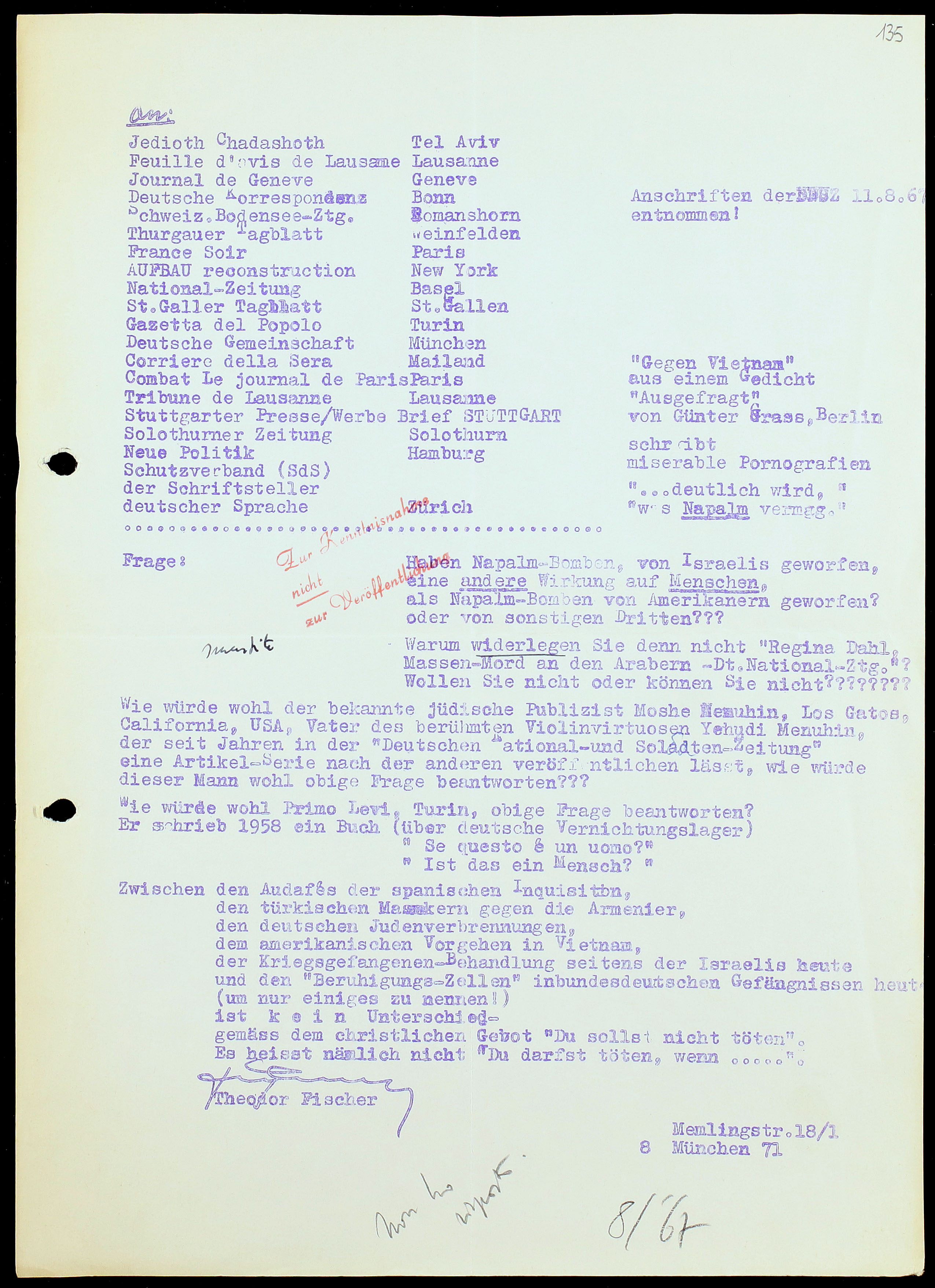
Fischer invia in copia a Levi questa lettera circolare inviata a numerose testate internazionali in cui condanna il trattamento dei prigionieri da parte di Israele in occasione della Guerra dei sei giorni, interpellando direttamente anche lo scrittore in merito.
Anschriften der 11.08.67 entnommen!
a:
Jedioth Chadashoth Tel Aviv Feuille d’avis de Lausane Lausanne Journal de Geneve Geneve Deutsche Korrespondenz Bonn Schweiz. Bogensee-Ztg. Romanshorn Thurgauer Tagblatt Weinfelden France Soir Paris AUFBAU reconstruction New York National-Zeitung Basel St.Galler Tagblatt St. Gallen Gazetta del Popolo Turin Deutsche Gemeinschaft München Corriere della Sera Mailand Combat Le journal de Paris Paris Tribune de Lausanne Lausanne Stuttgarter Presse/Werbe Brief STUTTGART Solothurner Zeitung Solothurn Neue Politik Hamburg Schutzverband (SdS) der Schriftsteller deutscher Sprache Zürich
„Gegen Vietnam”
aus einem Gedicht
„Ausgefragt”[1] von Günter Grass, Berlin
schreibt
miserable Pornografien
„…deutlich wird,”
„was Napalm vermag.”
Frage: Haben Napalm-Bomben, von Israelis geworfen, eine andere Wirkung auf Menschen,
als Napalm-Bomben von Amerikanern geworfen? oder von sonstigen Dritten??? Warum widerlegen[2] Sie denn nicht „Regina Dahl, Massen-Mord an den Araben -Dt.National-Ztg.”[3]? Wollen Sie nicht oder können Sie nicht????????
Wie wurde wohl der bekannte jüdische Publizist Moshe Nesuhin, Los Gatos, California, USA, Vater des berühmten Violinvirtuosen Yehudi Menuhin, der seit Jahren in der “Deutschen National- und Soldaten-Zeitung” eine Artikel-Serie nach der anderen veröffentlichen lässt, wie würde dieser Mann wohl obige Frage beantworten???[4]
Wie würde wohl Primo Levi, Turin, obige Frage beantworten? Er schrieb 1958 ein Buch. (über deutsche Vernichtungslager)
„Se questo è un uomo?”
„Ist das ein Mensch?”
Zwischen den Audafres der spanischen Inquisition,
den türkischen Massakern gegen die Armenier,
den deutschen Judenverbrennungen,
dem amerikanischen Vorgehen in Vietnam,
der Kriegsgefangenen-Behandlung seitens der Israelis heute
und den „Beruhigungs-Zellen” in bundesdeutschen Gefängnissen heut
(um nur einiges zu nennen! )
ist kein Unterschied-
gemäss dem christlichen Gebot „Du sollst nicht toten”.
Es heisst nämlich nicht „Du darfst töten, wenn…”.
Theodor Fischer
Memlingstr. 18/1
8 München 71
Indirizzi tratti dall’11 agosto 67!
a:
Jedioth Chadashoth Tel Aviv Feuille d’avis de Lausane Lausanne Journal de Geneve Geneve Deutsche Korrespondenz Bonn Schweiz. Bogensee-Ztg. Romanshorn Thurgauer Tagblatt Weinfelden France Soir Paris AUFBAU reconstruction New York National-Zeitung Basel St.Galler Tagblatt St. Gallen Gazetta del Popolo Turin Deutsche Gemeinschaft München Corriere della Sera Mailand Combat Le journal de Paris Paris Tribune de Lausanne Lausanne Stuttgarter Presse/Werbe Brief STUTTGART Solothurner Zeitung Solothurn Neue Politik Hamburg Schutzverband (SdS) der Schriftsteller deutscher Sprache Zürich
“Contro il Vietnam”
dalla poesia
„Ausgefragt”[1] di Günter Grass, Berlino
scrive
misere pornografie
“…dalle quali risulterà più chiaramente
cosa può fare il Napalm.”
Domanda: Le bombe al napalm lanciate dagli israeliani hanno forse un effetto diverso sugli esseri umani rispetto a quelle lanciate dagli Stati Uniti? O da qualche altro terzo soggetto???
Perché non smentite[2] “Regina Dahl, Sterminio degli arabi – Deutsche National-Zeitung”[3]?? Non volete o non potete????????
Come risponderebbe Moshe Menuhin, noto pubblicista ebreo di Los Gatos, California, USA, padre del celebre violinista Yehudi Menuhin, che da anni pubblica raffiche di articoli sul giornale “Deutschen National- und Soldaten-Zeitung”? Come risponderebbe quest’uomo alla domanda di cui sopra?[4]
Come risponderebbe alla stessa domanda Primo Levi di Torino? Nel 1958 ha scritto un libro (sui campi di sterminio nazisti)
“Se questo è un uomo” „Ist das ein Mensch?”
Tra gli autodafé dell’Inquisizione spagnola, i massacri turchi contro gli armeni,
le cremazioni di ebrei da parte dei tedeschi, l’intervento americano in Vietnam, il trattamento che gli israeliani riservano ai prigionieri di guerra oggi e le “celle di isolamento e contenimento” nelle carceri federali tedesche di oggi
(per citare solo alcuni esempi!)
non c’è alcuna differenza
secondo il comandamento cristiano “non uccidere”.
In realtà non è scritto: “puoi uccidere se…”.
Theodor Fischer
Memlingstr. 18/1
8 München 71
Addresses compiled August 11, 1967!
To:
Jedioth Chadashoth Tel Aviv Feuille d’avis de Lausane Lausanne Journal de Geneve Geneve Deutsche Korrespondenz Bonn Schweiz. Bogensee-Ztg. Romanshorn Thurgauer Tagblatt Weinfelden France Soir Paris AUFBAU reconstruction New York National-Zeitung Basel St.Galler Tagblatt St. Gallen Gazetta del Popolo Turin Deutsche Gemeinschaft München Corriere della Sera Mailand Combat Le journal de Paris Paris Tribune de Lausanne Lausanne Stuttgarter Presse/Werbe Brief STUTTGART Solothurner Zeitung Solothurn Neue Politik Hamburg Schutzverband (SdS) der Schriftsteller deutscher Sprache Zürich
In the poem “Against Vietnam” from the collection Ausgefragt (“Interrogated”)[1] Günter Grass, Berlin, writes miserable pornography “it becomes clear what napalm can do.”
Question: Do napalm bombs dropped by Israelis have a different effect on people than napalm bombs dropped by Americans? Or by other third parties??? Why don’t you refute[2] “Regina Dahl, Mass Murder of Arabs—Deutsche National-Zeitung”?[3]Don’t you want to, or can’t you????????
How would the well-known Jewish publicist Moshe Nesuhin, Los Gatos, California, USA, father of the famous violin virtuoso Yehudi Menuhin, who for years has been publishing a series of articles, one right after another, in the Deutschen National- und Soldaten-Zeitung, answer the above question???[4]
How would Primo Levi, Turin, answer the above question? In 1958, he wrote a book (about German extermination camps)
Se questo è un uomo? If This is a Man?
Between the auto-da–fésof the Spanish Inquisition, the Turkish massacres against the Armenians, the German burning of Jews, the American actions in Vietnam, the treatment of prisoners of war by the Israelis today, and the “calming cells” in German prisons today (to name just a few! ) there is no difference— according to the Christian commandment “Thou shalt not kill.” It does not say “Thou may kill if…”.
Theodor Fischer
Memlingstr. 18/1 8 Munich 71
Anschriften der 11.08.67 entnommen!
a:
Jedioth Chadashoth Tel Aviv Feuille d’avis de Lausane Lausanne Journal de Geneve Geneve Deutsche Korrespondenz Bonn Schweiz. Bogensee-Ztg. Romanshorn Thurgauer Tagblatt Weinfelden France Soir Paris AUFBAU reconstruction New York National-Zeitung Basel St.Galler Tagblatt St. Gallen Gazetta del Popolo Turin Deutsche Gemeinschaft München Corriere della Sera Mailand Combat Le journal de Paris Paris Tribune de Lausanne Lausanne Stuttgarter Presse/Werbe Brief STUTTGART Solothurner Zeitung Solothurn Neue Politik Hamburg Schutzverband (SdS) der Schriftsteller deutscher Sprache Zürich
„Gegen Vietnam”
aus einem Gedicht
„Ausgefragt”[1] von Günter Grass, Berlin
schreibt
miserable Pornografien
„…deutlich wird,”
„was Napalm vermag.”
Frage: Haben Napalm-Bomben, von Israelis geworfen, eine andere Wirkung auf Menschen,
als Napalm-Bomben von Amerikanern geworfen? oder von sonstigen Dritten??? Warum widerlegen[2] Sie denn nicht „Regina Dahl, Massen-Mord an den Araben -Dt.National-Ztg.”[3]? Wollen Sie nicht oder können Sie nicht????????
Wie wurde wohl der bekannte jüdische Publizist Moshe Nesuhin, Los Gatos, California, USA, Vater des berühmten Violinvirtuosen Yehudi Menuhin, der seit Jahren in der “Deutschen National- und Soldaten-Zeitung” eine Artikel-Serie nach der anderen veröffentlichen lässt, wie würde dieser Mann wohl obige Frage beantworten???[4]
Wie würde wohl Primo Levi, Turin, obige Frage beantworten? Er schrieb 1958 ein Buch. (über deutsche Vernichtungslager)
„Se questo è un uomo?”
„Ist das ein Mensch?”
Zwischen den Audafres der spanischen Inquisition,
den türkischen Massakern gegen die Armenier,
den deutschen Judenverbrennungen,
dem amerikanischen Vorgehen in Vietnam,
der Kriegsgefangenen-Behandlung seitens der Israelis heute
und den „Beruhigungs-Zellen” in bundesdeutschen Gefängnissen heut
(um nur einiges zu nennen! )
ist kein Unterschied-
gemäss dem christlichen Gebot „Du sollst nicht toten”.
Es heisst nämlich nicht „Du darfst töten, wenn…”.
Theodor Fischer
Memlingstr. 18/1
8 München 71
Indirizzi tratti dall’11 agosto 67!
a:
Jedioth Chadashoth Tel Aviv Feuille d’avis de Lausane Lausanne Journal de Geneve Geneve Deutsche Korrespondenz Bonn Schweiz. Bogensee-Ztg. Romanshorn Thurgauer Tagblatt Weinfelden France Soir Paris AUFBAU reconstruction New York National-Zeitung Basel St.Galler Tagblatt St. Gallen Gazetta del Popolo Turin Deutsche Gemeinschaft München Corriere della Sera Mailand Combat Le journal de Paris Paris Tribune de Lausanne Lausanne Stuttgarter Presse/Werbe Brief STUTTGART Solothurner Zeitung Solothurn Neue Politik Hamburg Schutzverband (SdS) der Schriftsteller deutscher Sprache Zürich
“Contro il Vietnam”
dalla poesia
„Ausgefragt”[1] di Günter Grass, Berlino
scrive
misere pornografie
“…dalle quali risulterà più chiaramente
cosa può fare il Napalm.”
Domanda: Le bombe al napalm lanciate dagli israeliani hanno forse un effetto diverso sugli esseri umani rispetto a quelle lanciate dagli Stati Uniti? O da qualche altro terzo soggetto???
Perché non smentite[2] “Regina Dahl, Sterminio degli arabi – Deutsche National-Zeitung”[3]?? Non volete o non potete????????
Come risponderebbe Moshe Menuhin, noto pubblicista ebreo di Los Gatos, California, USA, padre del celebre violinista Yehudi Menuhin, che da anni pubblica raffiche di articoli sul giornale “Deutschen National- und Soldaten-Zeitung”? Come risponderebbe quest’uomo alla domanda di cui sopra?[4]
Come risponderebbe alla stessa domanda Primo Levi di Torino? Nel 1958 ha scritto un libro (sui campi di sterminio nazisti)
“Se questo è un uomo” „Ist das ein Mensch?”
Tra gli autodafé dell’Inquisizione spagnola, i massacri turchi contro gli armeni,
le cremazioni di ebrei da parte dei tedeschi, l’intervento americano in Vietnam, il trattamento che gli israeliani riservano ai prigionieri di guerra oggi e le “celle di isolamento e contenimento” nelle carceri federali tedesche di oggi
(per citare solo alcuni esempi!)
non c’è alcuna differenza
secondo il comandamento cristiano “non uccidere”.
In realtà non è scritto: “puoi uccidere se…”.
Theodor Fischer
Memlingstr. 18/1
8 München 71
Addresses compiled August 11, 1967!
To:
Jedioth Chadashoth Tel Aviv Feuille d’avis de Lausane Lausanne Journal de Geneve Geneve Deutsche Korrespondenz Bonn Schweiz. Bogensee-Ztg. Romanshorn Thurgauer Tagblatt Weinfelden France Soir Paris AUFBAU reconstruction New York National-Zeitung Basel St.Galler Tagblatt St. Gallen Gazetta del Popolo Turin Deutsche Gemeinschaft München Corriere della Sera Mailand Combat Le journal de Paris Paris Tribune de Lausanne Lausanne Stuttgarter Presse/Werbe Brief STUTTGART Solothurner Zeitung Solothurn Neue Politik Hamburg Schutzverband (SdS) der Schriftsteller deutscher Sprache Zürich
In the poem “Against Vietnam” from the collection Ausgefragt (“Interrogated”)[1] Günter Grass, Berlin, writes miserable pornography “it becomes clear what napalm can do.”
Question: Do napalm bombs dropped by Israelis have a different effect on people than napalm bombs dropped by Americans? Or by other third parties??? Why don’t you refute[2] “Regina Dahl, Mass Murder of Arabs—Deutsche National-Zeitung”?[3]Don’t you want to, or can’t you????????
How would the well-known Jewish publicist Moshe Nesuhin, Los Gatos, California, USA, father of the famous violin virtuoso Yehudi Menuhin, who for years has been publishing a series of articles, one right after another, in the Deutschen National- und Soldaten-Zeitung, answer the above question???[4]
How would Primo Levi, Turin, answer the above question? In 1958, he wrote a book (about German extermination camps)
Se questo è un uomo? If This is a Man?
Between the auto-da–fésof the Spanish Inquisition, the Turkish massacres against the Armenians, the German burning of Jews, the American actions in Vietnam, the treatment of prisoners of war by the Israelis today, and the “calming cells” in German prisons today (to name just a few! ) there is no difference— according to the Christian commandment “Thou shalt not kill.” It does not say “Thou may kill if…”.
Theodor Fischer
Memlingstr. 18/1 8 Munich 71
Info
Note
Tag
Mittente: Theodor Fischer
Destinatario: Primo Levi
Data di stesura: 1967-08-11
Luogo di stesura: Monaco
Descrizione del documento: copia di lettera ds. a inchiostro blu con firma ms. Al centro del foglio è posto un timbro a inchiostro rosso dove si legge: “Zur Kenntnisnahme | nicht | zur Veröffentlichung” (“per conoscenza | non | per pubblicazione”). Sono presenti inserti ms. di a stilografica nera e, di Levi, a matita grigia. Sul margine inferiore del foglio Levi annota ms. a matita: «Non ho | risposto.| 8/’67».
Archivio: Archivio privato di Primo Levi, Torino
Segnatura: Complesso di fondi Primo Levi, Fondo Primo Levi, Corrispondenza, Corrispondenti particolari, Fasc. 20, sottofasc. 1, doc., f. 135
Fogli: 1, solo recto
DOI:
1Ausgefragt (“Interrogato”) è una raccolta di poesie di Günter Grass del 1967, edita a Berlino da Neuwied e non tradotta in italiano. I versi che seguono sono tratti dalla poesia In In Ohnmacht gefallen (Privi di potere): «Bald wird es preiswerte Bildbände |mit besseren Fotos geben, |auf denen deutlicher wird, |was Napalm vermag». Del testo esiste una versione italiana nell’antologia Poesia tedesca del Novecento, Rizzoli, 1977, a cura e con la traduzione di Anna Maria Giachino e Gabriella Rossetto Sertoli: «Presto ci saranno libri di fotografie a buon prezzo| con foto migliori, | dalle quali risulterà più chiaramente | cosa può fare il napalm».
2
Levi sottolinea «widerlegen» a stilografica nera e annota, nel margine esterno del foglio: «smentite».
3Fischer si riferisce all’articolo della reporter e giornalista Regina Dahl, Israels Auschwitz in der Wüste. Der Massenmord an den Arabern (“L’Auschwitz di Israele nel deserto. Il massacro degli arabi”) apparso in prima pagina sulla rivista di estrema destra Deutschen National-Zeitung und Soldaten-Zeitung il 21 luglio del 1967. Per maggiori dettagli cfr. la biografia di Theodor Fischer.
4
Moshe Mesuhin (1893-1983), scrittore americano (nato in Biellorussia) di origini ebraiche. Dopo essersi trasferito con la famiglia in Palestina, nel 1913 proseguì i suoi studi negli Stati Uniti. Dal 1919 insegnerà lingua ebraica in California. Noto per le sue posizioni anti-sioniste, nel 1965 pubblicherà il volume The decadence of Judaism in our time, la cui prima parte è interamente dedicata alla genesi del sionismo e il conflitto arabo-isrealiano. A partire da quell’anno, Mesuhin verrà ingaggiato, in virtù delle sue origini e delle sue posizioni, dal Deutschen National-Zeitung und Soldaten-Zeitung, divenendo in poco tempo una delle firme più controverse. Nell’autunno del 1967 comparirà in prima pagina un suo articolo recante il titolo: Israele, i vostri nazisti — ciò che io, da ebreo, disprezzo di Israele. La collaborazione di Mesuhin con il National-Zeitung fu problematica soprattutto per la fama e la statura morale del figlio Yehudi Menuhin. Violinista di fama internazionale, quest’ultimo fu il primo artista ebreo a esibirsi in Germania dopo il conflitto mondiale. Un gesto di riconciliazione destinato a diventare uno dei simboli della rinascita tedesca dopo la tragedia hitleriana. Cfr. W. Long, The New Nazi of Germany, Chilton book, New York 1968, pp 183-188.