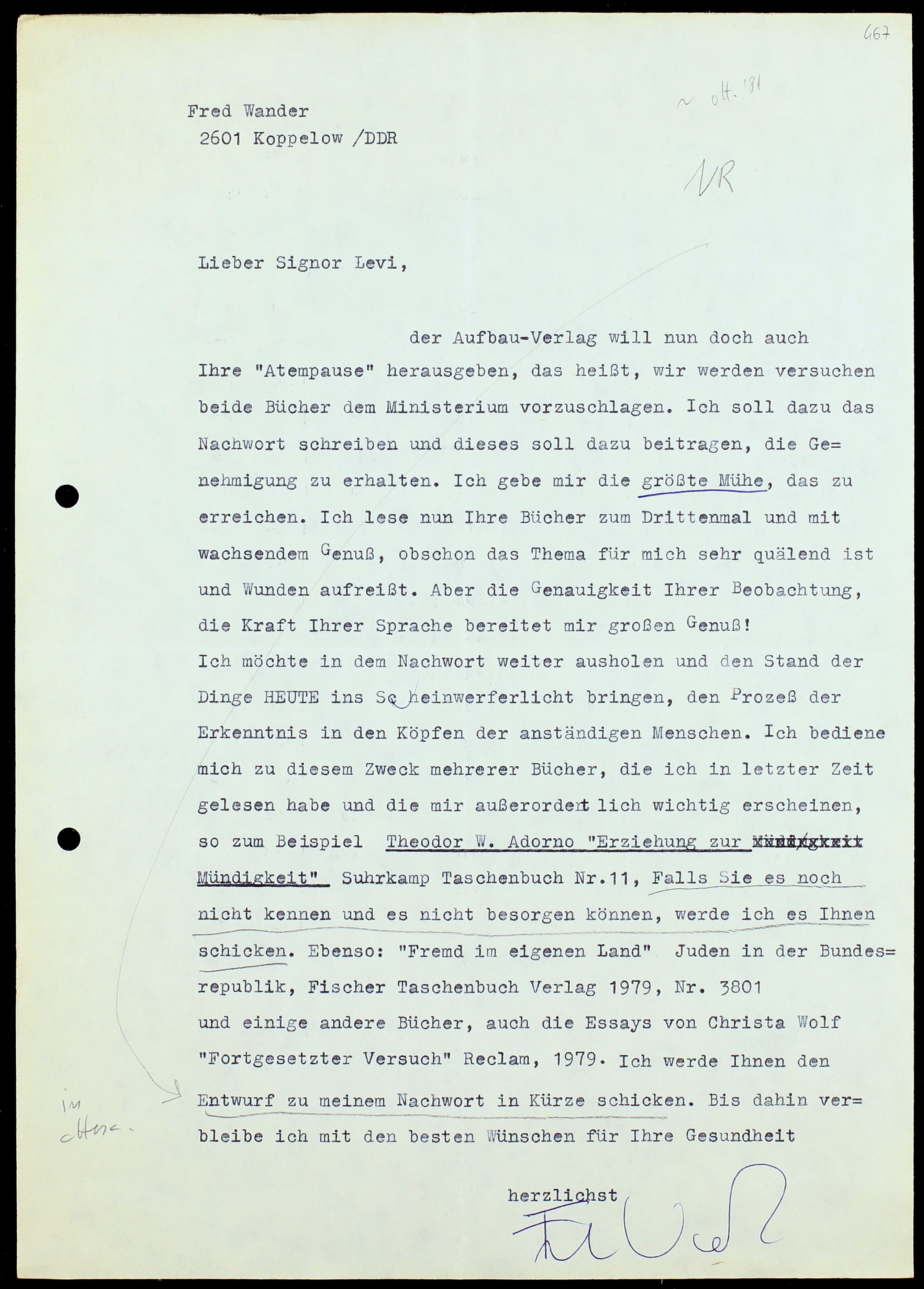
Wander torna a scrivere a Levi annunciando che Aufbau ha intenzione di pubblicare anche Atempause. Sta inoltre lavorando all’introduzione e menziona a Levi alcuni saggi che vorrebbe usare per puntare l’attenzione del lettore sull’attualità.
der Aufbau-Verlag will nun doch auch Ihre Atempause herausgeben, das heißt, wir werden versuchen beide Bücher dem Ministerium vorzuschlagen. Ich soll dazu das Nachwort schreiben und dieses soll dazu beitragen, die Genehmigung zu erhalten.[2] Ich gebe mir die größte Mühe,[3] das zu erreichen. Ich lese nun Ihre Bücher zum Drittenmal und mit wachsendem Genuß, obschon das Thema für mich sehr quälend ist und Wunden aufreißt. Aber die Genauigkeit Ihrer Beobachtung, die Kraft Ihrer Sprache bereitet mir großen Genuß!
Ich möchte in dem Nachwort weiter ausholen und den Stand der Dinge HEUTE ins Scheinwerferlicht bringen, den Prozeß der Erkenntnis in den Köpfen der anständigen Menschen. Ich bediene mich zu diesem Zweck mehrerer Bücher, die ich in letzter Zeit gelesen habe und die mir außerordentlich wichtig erscheinen, so zum Beispiel Theodor W. AdornoErziehung zur Mündigkeit, Suhrkamp Taschenbuch Nr. 11, Falls Sie es noch nicht kennen und es nicht besorgen können, werde ich es Ihnen schicken.[4] Ebenso: Fremd im eigenen Land.Juden in der Bundesrepublik, Fischer Taschenbuch Verlag 1979, Nr. 3801 und einige andere Bücher, auch die Essays von Christa WolfFortgesetzter VersuchReclam, 1979.[5] Ich werde Ihnen den Entwurf zu meinem Nachwort in Kürze schicken. Bis dahin verbleibe ich mit den besten Wünschen für Ihre Gesundheit
Herzlichst
Fred Wander
2601 Koppelow / DDR[1]
Caro Signor Levi,
l’Aufbau-Verlag ha infine deciso di pubblicare anche La tregua; o meglio, cercheremo di proporre entrambi i titoli al Ministero. A me è stato affidato il compito di scrivere la postfazione, che dovrà contribuire a ottenere l’autorizzazione alla pubblicazione.[2] Sto facendo tutto il possibile[3] per raggiungere questo scopo. Leggo ora i Suoi libri per la terza volta, e ogni rilettura me li fa apprezzare ancora di più, sebbene l’argomento sia per me estremamente doloroso e riapra delle ferite. Eppure la precisione del suo sguardo e la forza della sua lingua mi procurano un piacere straordinario!
Vorrei dare alla postfazione una prospettiva più ampia e mettere sotto i riflettori lo stato delle cose OGGI, il percorso di presa di coscienza che è in atto nelle menti delle persone oneste. A questo scopo mi sto servendo di alcuni libri che ho letto negli ultimi tempi e che considero di straordinaria importanza; per esempio Educazione alla maturità di Theodor W. Adorno (Suhrkamp Taschenbuch, n. 11). Se ancora non lo conosce e non riesce a procurarselo, sarò lieto di inviarglielo io.[4] E poi: Stranieri in patria. Gli ebrei nella repubblica federale tedesca (Fischer Taschenbuch Verlag, 1979, n. 3801) e altri libri, compresa la raccolta di saggi di Christa WolfTentativo permanente (Reclam, 1979). A breve Le invierò la bozza della mia postfazione.[5] Nel frattempo le porgo i miei migliori auguri per la sua salute.
Con i miei saluti più cari,
Fred Wander
Fred Wander
2601 Koppelow / DDR [1]
Dear Mr. Levi,
Aufbau has now decided to publish The Truce after all; that is, we shall try to propose both your books to the Ministry. I am to write the afterword, which is intended to help secure approval.[2] I am doing my very best[3] to achieve this. I am now reading your books for the third time and with growing enjoyment, even though the subject matter is very distressing for me and opens old wounds anew. But the precision of your observations and the power of your language give me great pleasure!
In the afterword, I would like to go into greater depth and shine a spotlight on the state of affairs TODAY, on the process of realization taking place in the minds of most decent people. To this end, I am drawing on several books I have read recently which seem extraordinarily important to me—for example, Theodor W. Adorno’s Education for Maturity and Responsibility (Suhrkamp Taschenbuch No. 11). If you have not yet read it and cannot obtain a copy, I will send it to you.[4] Also: “Strangers in Their Own Country: Jews in the Federal Republic of Germany,” Fischer Taschenbuch Verlag 1979, No. 3801 and several other books, including Christa Wolf’s essays, “A Continuing Attempt” Reclam, 1979.[5] I will send you the draft of my afterword shortly. Until then, I send my best wishes and hope you are well.
Warmly,
Fred Wander
Fred Wander
2601 Koppelow / DDR[1]
Lieber Signor Levi,
der Aufbau-Verlag will nun doch auch Ihre Atempause herausgeben, das heißt, wir werden versuchen beide Bücher dem Ministerium vorzuschlagen. Ich soll dazu das Nachwort schreiben und dieses soll dazu beitragen, die Genehmigung zu erhalten.[2] Ich gebe mir die größte Mühe,[3] das zu erreichen. Ich lese nun Ihre Bücher zum Drittenmal und mit wachsendem Genuß, obschon das Thema für mich sehr quälend ist und Wunden aufreißt. Aber die Genauigkeit Ihrer Beobachtung, die Kraft Ihrer Sprache bereitet mir großen Genuß!
Ich möchte in dem Nachwort weiter ausholen und den Stand der Dinge HEUTE ins Scheinwerferlicht bringen, den Prozeß der Erkenntnis in den Köpfen der anständigen Menschen. Ich bediene mich zu diesem Zweck mehrerer Bücher, die ich in letzter Zeit gelesen habe und die mir außerordentlich wichtig erscheinen, so zum Beispiel Theodor W. AdornoErziehung zur Mündigkeit, Suhrkamp Taschenbuch Nr. 11, Falls Sie es noch nicht kennen und es nicht besorgen können, werde ich es Ihnen schicken.[4] Ebenso: Fremd im eigenen Land.Juden in der Bundesrepublik, Fischer Taschenbuch Verlag 1979, Nr. 3801 und einige andere Bücher, auch die Essays von Christa WolfFortgesetzter VersuchReclam, 1979.[5] Ich werde Ihnen den Entwurf zu meinem Nachwort in Kürze schicken. Bis dahin verbleibe ich mit den besten Wünschen für Ihre Gesundheit
Herzlichst
Fred Wander
2601 Koppelow / DDR[1]
Caro Signor Levi,
l’Aufbau-Verlag ha infine deciso di pubblicare anche La tregua; o meglio, cercheremo di proporre entrambi i titoli al Ministero. A me è stato affidato il compito di scrivere la postfazione, che dovrà contribuire a ottenere l’autorizzazione alla pubblicazione.[2] Sto facendo tutto il possibile[3] per raggiungere questo scopo. Leggo ora i Suoi libri per la terza volta, e ogni rilettura me li fa apprezzare ancora di più, sebbene l’argomento sia per me estremamente doloroso e riapra delle ferite. Eppure la precisione del suo sguardo e la forza della sua lingua mi procurano un piacere straordinario!
Vorrei dare alla postfazione una prospettiva più ampia e mettere sotto i riflettori lo stato delle cose OGGI, il percorso di presa di coscienza che è in atto nelle menti delle persone oneste. A questo scopo mi sto servendo di alcuni libri che ho letto negli ultimi tempi e che considero di straordinaria importanza; per esempio Educazione alla maturità di Theodor W. Adorno (Suhrkamp Taschenbuch, n. 11). Se ancora non lo conosce e non riesce a procurarselo, sarò lieto di inviarglielo io.[4] E poi: Stranieri in patria. Gli ebrei nella repubblica federale tedesca (Fischer Taschenbuch Verlag, 1979, n. 3801) e altri libri, compresa la raccolta di saggi di Christa WolfTentativo permanente (Reclam, 1979). A breve Le invierò la bozza della mia postfazione.[5] Nel frattempo le porgo i miei migliori auguri per la sua salute.
Con i miei saluti più cari,
Fred Wander
Fred Wander
2601 Koppelow / DDR [1]
Dear Mr. Levi,
Aufbau has now decided to publish The Truce after all; that is, we shall try to propose both your books to the Ministry. I am to write the afterword, which is intended to help secure approval.[2] I am doing my very best[3] to achieve this. I am now reading your books for the third time and with growing enjoyment, even though the subject matter is very distressing for me and opens old wounds anew. But the precision of your observations and the power of your language give me great pleasure!
In the afterword, I would like to go into greater depth and shine a spotlight on the state of affairs TODAY, on the process of realization taking place in the minds of most decent people. To this end, I am drawing on several books I have read recently which seem extraordinarily important to me—for example, Theodor W. Adorno’s Education for Maturity and Responsibility (Suhrkamp Taschenbuch No. 11). If you have not yet read it and cannot obtain a copy, I will send it to you.[4] Also: “Strangers in Their Own Country: Jews in the Federal Republic of Germany,” Fischer Taschenbuch Verlag 1979, No. 3801 and several other books, including Christa Wolf’s essays, “A Continuing Attempt” Reclam, 1979.[5] I will send you the draft of my afterword shortly. Until then, I send my best wishes and hope you are well.
Warmly,
Fred Wander
Info
Note
Tag
Mittente: Fred Wander
Destinatario: Primo Levi
Data di stesura: 1981-10-01
Luogo di stesura: Berlino Est
Descrizione del documento: lettera ds. su foglio bianco con firma ms. a biro blu, sottolineature a stilografica blu e a matita e interventi a matita.
Archivio: Archivio privato di Primo Levi, Torino
Segnatura: Corrispondenza, Corrispondenza generale, fascicolo 12, sottofascicolo 21, f. 467.
Fogli: 1, solo recto
DOI:
1Levi appunta a matita in alto a destra «ott. ‘81» e, poco sotto, «NR» (probabilmente intende «non risposto»). Si vede inoltre una freccia ms. a matita che riporta in basso in corrispondenza della frase «Entwurf zu meinem Nachwort in Kürze schicken» (“A breve Le invierò la bozza della mia postfazione”), a sua volta sottolineata a matita. Accanto Levi annota «in attesa».
2Nelle intenzioni di Aufbau la postfazione di Wander doveva da un lato conferire legittimità al testo di Levi grazie all’autorità di uno scrittore ebreo che aveva vissuto la deportazione ed era ben accreditato in DDR, dall’altro guidare la lettura e l’interpretazione da parte del pubblico, giustificando e mettendo in prospettiva soggettiva i passaggi più critici dei due libri (nel caso di Ist das ein Mensch? il giudizio negativo sui prigionieri politici, l’assenza di riferimenti alla resistenza nei campi e alla solidarietà tra prigionieri; nel caso di Atempause una rappresentazione caricaturale dell’Armata Rossa).
3«größte Mühe» (“tutto il possibile”) è sottolineato ms. a stilografica blu.
4«Falls Sie es noch nicht kennen und es nicht besorgen können, werde ich es Ihnen schicken» (“Se ancora non lo conosce e non riesce a procurarselo, sarò lieto di inviarglielo io”) è sottolineato ms. a matita. Si tratta del volume del tardo Adorno, Erziehung zur Mündigkeit (“Educazione alla maturità”, di cui non esiste una traduzione italiana): raccoglie una serie di discorsi e conversazioni con Hellmut Becker tra il 1959 e il 1969, che riguardano la pedagogia e la possibilità di educare l’uomo contro la barbarie. In continuità con l’Adorno della Dialettica dell’illuminismo, Mündigkeit è la maturità intesa come il contrario dello stato di minorità (Unmündigkeit) kantiano.
5
Il volume Fortgesetzter Versuch (“Tentativo permanente”), del 1979, è la raccolta di saggi e interviste di Wolf successiva ai grandi romanzi degli anni Sessanta e Settanta che l’hanno consacrata come voce imprescindibile nel dibattito pubblico della DDR. Contiene anche il saggio su Fred Wander, Gedächtnis und Gedenken (pp. 268-67), uscito già nel 1972 su «Sinn und Form» e poi come postfazione a Der siebente Brunnen nel 1985, quando il romanzo verrà ripubblicato su licenza in Germania Ovest dall’editore Luchterhand.