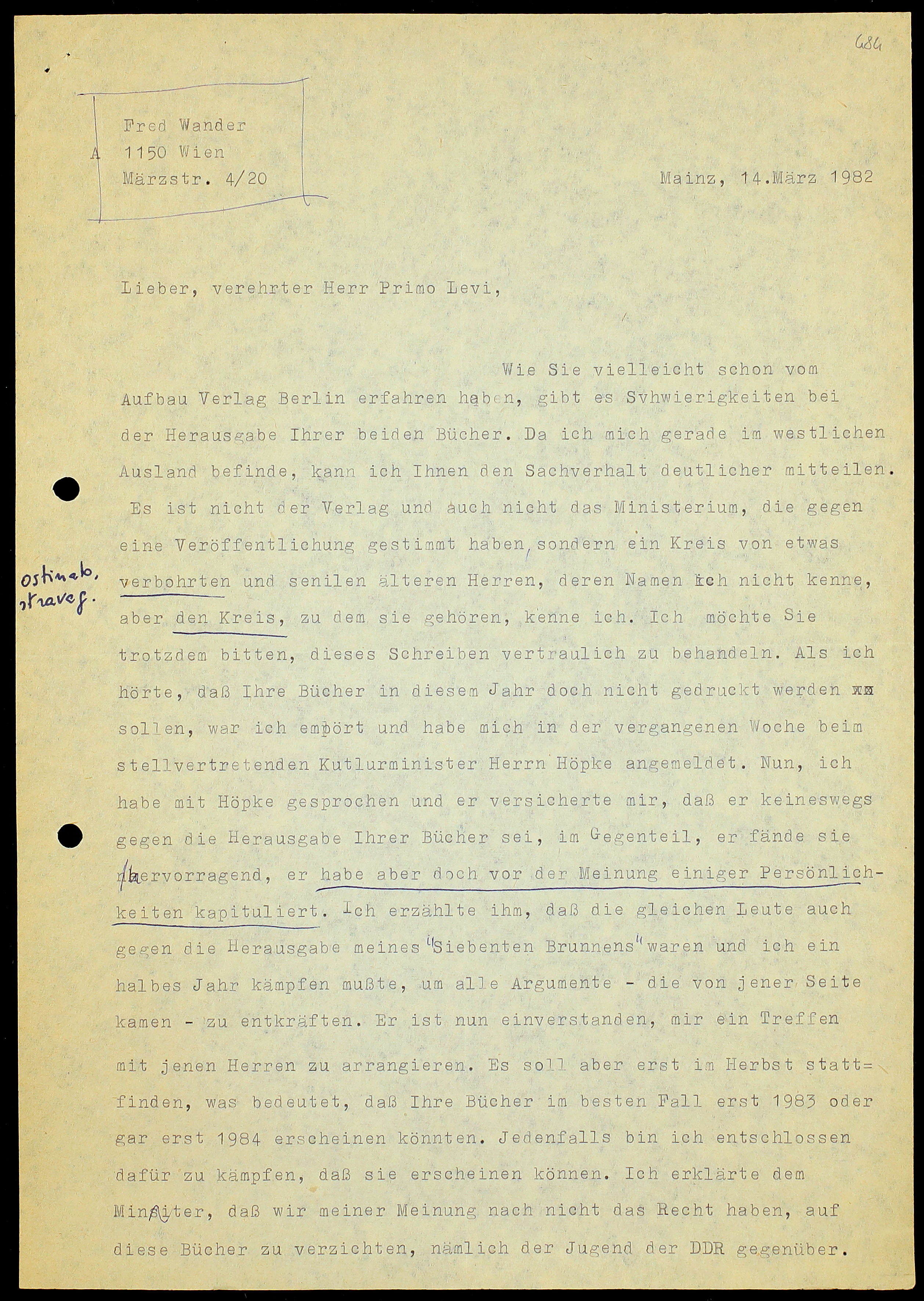
Wander comunica a Levi il fallimento del progetto di pubblicazione di Ist das ein Mensch? e Atempause, bocciato dal Comitato dei Combattenti della Resistenza Antifascista (KdAW) della DDR.
Wie Sie vielleicht schon vom Aufbau Verlag Berlin erfahren haben, gibt es Schwierigkeiten bei der Herausgabe Ihrer beiden Bücher.Da ich mich gerade im westlichen Ausland befinde, kann ich Ihnen den Sachverhalt deutlicher mitteilen.
Es ist nicht der Verlag und auch nicht das Ministerium, die gegen eine Veröffentlichung gestimmt haben, sondern ein Kreis von etwas verbohrten[1] und senilen älteren Herren,[2] deren Namen ich nicht kenne, aber den Kreis,[3] zu dem sie gehören, kenne ich. Ich möchte Sie trotzdem bitten, dieses Schreiben vertraulich zu behandeln. Als ich hörte, daß Ihre Bücher in diesem Jahr doch nicht gedruckt werden sollen, war ich empört und habe mich in der vergangenen Woche beim stellvertretenden Kulturminister Herrn Höpcke angemeldet. Nun, ich habe mit Höpcke gesprochen und er versicherte mir, daß er keineswegs gegen die Herausgabe IhrerBücher sei, im Gegenteil, er fände sie hervorragend, er habe aber doch vor der Meinung einiger Persönlichkeiten kapituliert.[4] Ich erzählte ihm, daß die gleichen Leute auch gegen die Herausgabe meines Siebenten Brunnens waren und ich ein halbes Jahr kämpfen mußte, um alle Argumente – die von jener Seite kamen – zu entkräften.[5] Er ist nun einverstanden, mir ein Treffen mit jenen Herren zu arrangieren. Es soll aber erst im Herbst stattfinden, was bedeutet, daß Ihre Bücher in besten Fall erst 1983 oder gar erst 1984 erscheinen könnten. Jedenfalls bin ich entschlossen dafür zu kämpfen, daß sie erscheinen können. Ich erklärte dem Minister, daß wir meiner Meinung nach nicht das Recht haben, auf diese Bücher zu verzichten, nämlich der Jugend der DDR gegenüber.
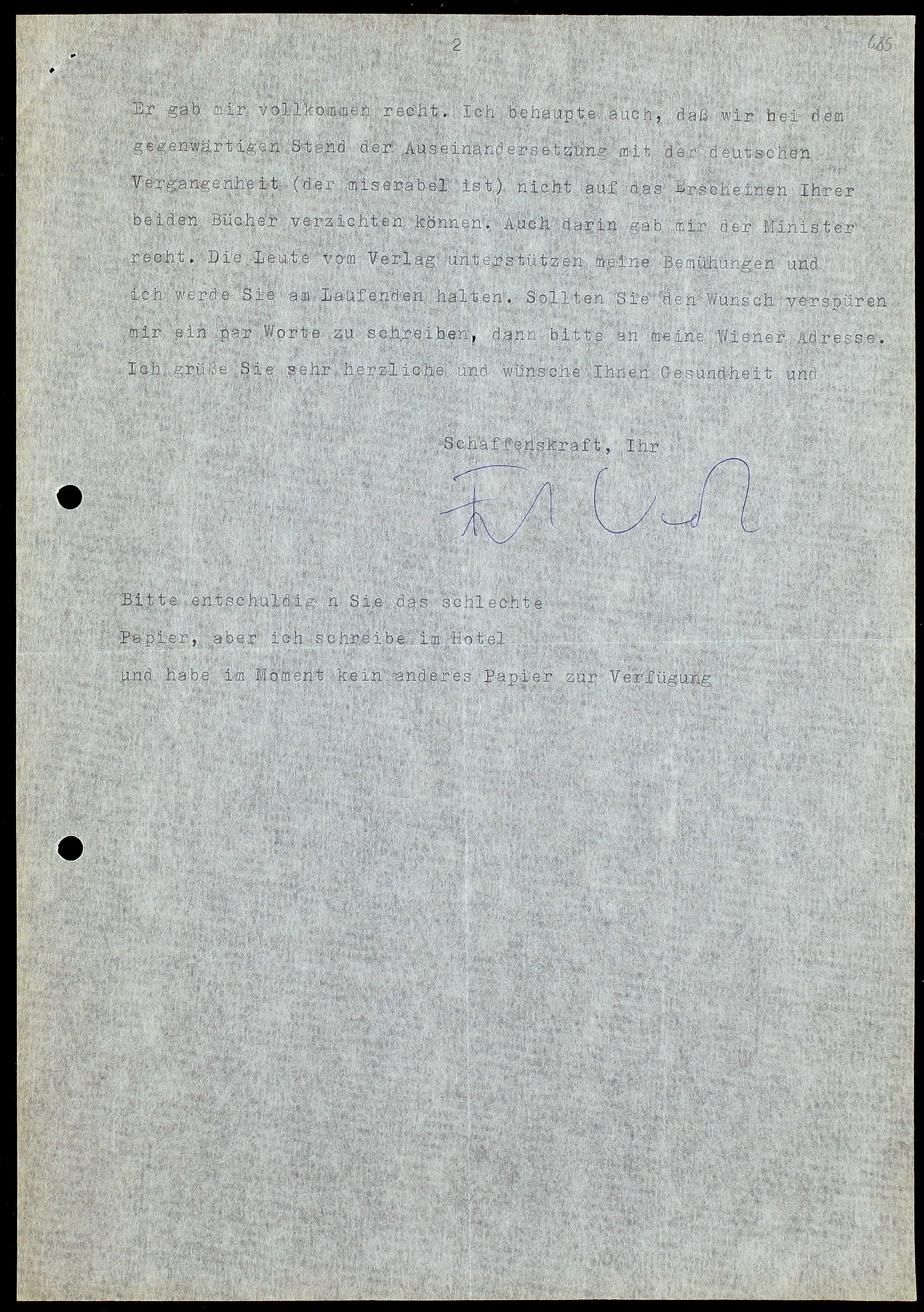
Er gab mir vollkommen recht. Ich behaupte auch, daß wir bei dem gegenwärtigen Stand der Auseinandersetzung mit der deutschen Vergangenheit (der miserabel ist) nicht auf das Erscheinen Ihrer beiden Bücher verzichten können. Auch darin gab mir der Minister recht. Die Leute vom Verlag unterstützen meine Bemühungen und ich werde Sie an Laufenden halten. Sollten Sie den Wunsch verspüren mir ein paar Worte zu schreiben, dann bitte an meine Wiener Adresse.
Ich grüße Sie sehr herzliche und wünsche Ihnen Gesundheit und
Schaffenskraft, Ihr
Fred Wander
Bitte entschuldigen Sie das schlechte Papier, aber ich schreibe im Hotel und habe in Moment kein anderes Papier zur Verfügung
Fred Wander
1150 Wien
Warustr. 4/20
Magonza, 14 marzo 1982
Caro, stimatissimo Signor Primo Levi,
come forse avrà già saputo dall’Aufbau Verlag di Berlino, sono sorte delle difficoltà per la pubblicazione dei Suoi due libri. Poiché in questo momento mi trovo all’estero, a Ovest, posso spiegarLe la situazione con maggiore chiarezza.
Non sono stati né la casa editrice né il Ministero a pronunciarsi contro la pubblicazione, bensì una cerchia di anziani signori alquanto ottusi[1] e senili,[2] dei quali non conosco i nomi, ma conosco l’ambiente a cui appartengono.[3] Le chiedo dunque la cortesia di trattare questa lettera con la massima riservatezza. Quando ho saputo che quest’anno i Suoi libri non sarebbero andati in stampa, mi sono indignato e la settimana scorsa ho chiesto un incontro con il viceministro della Cultura, il Signor Höpcke. Ho parlato con lui e mi ha assicurato di non essere affatto contrario alla pubblicazione delle Sueopere; al contrario, le considera eccellenti. Ha tuttavia finito per capitolare di fronte al parere di alcune personalità.[4] Gli ho raccontato che le stesse persone si erano opposte anche alla pubblicazione del mio Il settimo pozzo e che avevo dovuto lottare per sei mesi per smontare tutte le argomentazioni provenienti da quel fronte.[5] Ora si è detto disposto a organizzarmi un incontro con quei signori. L’incontro, però, dovrebbe tenersi soltanto in autunno, e questo significa che, nella migliore delle ipotesi, i Suoi libri potranno uscire solo nel 1983, se non addirittura nel 1984. In ogni caso, sono determinato a lottare perché vengano pubblicati. Ho spiegato al Ministro che, a mio parere, non abbiamo il diritto di rinunciare a questi libri, in particolare nei confronti dei giovani della DDR.
Mi ha dato pienamente ragione. Ho anche sostenuto che non possiamo fare e meno di far uscire i suoi libri proprio per lo stato attuale del dibattito sul passato tedesco (che è deplorevole). Anche su questo il Ministro mi ha dato ragione. La casa editrice appoggia i miei sforzi e La terrò al corrente. Se dovesse sentire il desiderio di scrivermi due righe, La prego di farlo al mio indirizzo di Vienna.
La saluto molto cordialmente e le auguro salute ed energia creativa.
Suo
Fred Wander
La prego di scusare la pessima qualità della carta, ma Le scrivo dall’albergo e al momento non ne ho altra a disposizione.
Fred Wander 1150 Vienna Warustr. 4/20
Mainz, March 14, 1982
Dear, esteemed Mr. Primo Levi,
As you may have already learned from Aufbau VerlagBerlin, there are difficulties regarding the publication of your two books. Since I am currently abroad in the West, I am able to explain the situation to you in greater detail.
It was neither the publishing house nor the ministry that voted against publication, but rather a circle of somewhat stubborn[1] and senile older gentlemen,[2] whose names I do not know, though I am familiar with the circle to which they belong.[3] Nevertheless, I would ask you to treat this letter as confidential. When I heard that your books were not to be printed this year after all, I was outraged and made an appointment last week with the Deputy Minister of Culture, Mr. Höpcke. Well, I spoke with Höpcke, and he assured me that he was by no means opposed to the publication of yourbooks—on the contrary, he thought they were excellent—but that he had nevertheless yielded to the opinion of certain influential figures.[4] I told him that the same people were also opposed to the publication of my book The Seventh Well and that I had to fight for half a year to refute all the arguments from their side.[5] He has now agreed to arrange a meeting for me with those gentlemen. However, it is not scheduled to take place until the fall, which means that, in the best-case scenario, your books could be published in 1983 or 1984 at the earliest. In any case, I am determined to fight to ensure that they can be published. I explained to the minister that, in my opinion, we do not have the right to forgo these books, especially not for the sake of the youth of the DDR.
He agreed with me completely. I also maintain that, given the current state of reckoning with Germany’s past (which is dismal), we cannot do without the publication of your two books. The minister agreed with me on this point as well. The people at the publishing house are supporting my efforts, and I will keep you informed of developments. Should you feel inclined to write me a brief reply, please send it to my address in Vienna.
I send you my warmest regards and wish you good health and creative energy.
Yours,
Fred Wander
Please excuse the poor quality of this paper, I am writing from a hotel and have no other paper available at the moment
Fred Wander
1150 Wien
Warustr. 4/20
Mainz, 14. März 1982
Lieber, verehrter Herr Primo Levi,
Wie Sie vielleicht schon vom Aufbau Verlag Berlin erfahren haben, gibt es Schwierigkeiten bei der Herausgabe Ihrer beiden Bücher.Da ich mich gerade im westlichen Ausland befinde, kann ich Ihnen den Sachverhalt deutlicher mitteilen.
Es ist nicht der Verlag und auch nicht das Ministerium, die gegen eine Veröffentlichung gestimmt haben, sondern ein Kreis von etwas verbohrten[1] und senilen älteren Herren,[2] deren Namen ich nicht kenne, aber den Kreis,[3] zu dem sie gehören, kenne ich. Ich möchte Sie trotzdem bitten, dieses Schreiben vertraulich zu behandeln. Als ich hörte, daß Ihre Bücher in diesem Jahr doch nicht gedruckt werden sollen, war ich empört und habe mich in der vergangenen Woche beim stellvertretenden Kulturminister Herrn Höpcke angemeldet. Nun, ich habe mit Höpcke gesprochen und er versicherte mir, daß er keineswegs gegen die Herausgabe IhrerBücher sei, im Gegenteil, er fände sie hervorragend, er habe aber doch vor der Meinung einiger Persönlichkeiten kapituliert.[4] Ich erzählte ihm, daß die gleichen Leute auch gegen die Herausgabe meines Siebenten Brunnens waren und ich ein halbes Jahr kämpfen mußte, um alle Argumente – die von jener Seite kamen – zu entkräften.[5] Er ist nun einverstanden, mir ein Treffen mit jenen Herren zu arrangieren. Es soll aber erst im Herbst stattfinden, was bedeutet, daß Ihre Bücher in besten Fall erst 1983 oder gar erst 1984 erscheinen könnten. Jedenfalls bin ich entschlossen dafür zu kämpfen, daß sie erscheinen können. Ich erklärte dem Minister, daß wir meiner Meinung nach nicht das Recht haben, auf diese Bücher zu verzichten, nämlich der Jugend der DDR gegenüber.
Er gab mir vollkommen recht. Ich behaupte auch, daß wir bei dem gegenwärtigen Stand der Auseinandersetzung mit der deutschen Vergangenheit (der miserabel ist) nicht auf das Erscheinen Ihrer beiden Bücher verzichten können. Auch darin gab mir der Minister recht. Die Leute vom Verlag unterstützen meine Bemühungen und ich werde Sie an Laufenden halten. Sollten Sie den Wunsch verspüren mir ein paar Worte zu schreiben, dann bitte an meine Wiener Adresse.
Ich grüße Sie sehr herzliche und wünsche Ihnen Gesundheit und
Schaffenskraft, Ihr
Fred Wander
Bitte entschuldigen Sie das schlechte Papier, aber ich schreibe im Hotel und habe in Moment kein anderes Papier zur Verfügung
Fred Wander
1150 Wien
Warustr. 4/20
Magonza, 14 marzo 1982
Caro, stimatissimo Signor Primo Levi,
come forse avrà già saputo dall’Aufbau Verlag di Berlino, sono sorte delle difficoltà per la pubblicazione dei Suoi due libri. Poiché in questo momento mi trovo all’estero, a Ovest, posso spiegarLe la situazione con maggiore chiarezza.
Non sono stati né la casa editrice né il Ministero a pronunciarsi contro la pubblicazione, bensì una cerchia di anziani signori alquanto ottusi[1] e senili,[2] dei quali non conosco i nomi, ma conosco l’ambiente a cui appartengono.[3] Le chiedo dunque la cortesia di trattare questa lettera con la massima riservatezza. Quando ho saputo che quest’anno i Suoi libri non sarebbero andati in stampa, mi sono indignato e la settimana scorsa ho chiesto un incontro con il viceministro della Cultura, il Signor Höpcke. Ho parlato con lui e mi ha assicurato di non essere affatto contrario alla pubblicazione delle Sueopere; al contrario, le considera eccellenti. Ha tuttavia finito per capitolare di fronte al parere di alcune personalità.[4] Gli ho raccontato che le stesse persone si erano opposte anche alla pubblicazione del mio Il settimo pozzo e che avevo dovuto lottare per sei mesi per smontare tutte le argomentazioni provenienti da quel fronte.[5] Ora si è detto disposto a organizzarmi un incontro con quei signori. L’incontro, però, dovrebbe tenersi soltanto in autunno, e questo significa che, nella migliore delle ipotesi, i Suoi libri potranno uscire solo nel 1983, se non addirittura nel 1984. In ogni caso, sono determinato a lottare perché vengano pubblicati. Ho spiegato al Ministro che, a mio parere, non abbiamo il diritto di rinunciare a questi libri, in particolare nei confronti dei giovani della DDR.
Mi ha dato pienamente ragione. Ho anche sostenuto che non possiamo fare e meno di far uscire i suoi libri proprio per lo stato attuale del dibattito sul passato tedesco (che è deplorevole). Anche su questo il Ministro mi ha dato ragione. La casa editrice appoggia i miei sforzi e La terrò al corrente. Se dovesse sentire il desiderio di scrivermi due righe, La prego di farlo al mio indirizzo di Vienna.
La saluto molto cordialmente e le auguro salute ed energia creativa.
Suo
Fred Wander
La prego di scusare la pessima qualità della carta, ma Le scrivo dall’albergo e al momento non ne ho altra a disposizione.
Fred Wander 1150 Vienna Warustr. 4/20
Mainz, March 14, 1982
Dear, esteemed Mr. Primo Levi,
As you may have already learned from Aufbau VerlagBerlin, there are difficulties regarding the publication of your two books. Since I am currently abroad in the West, I am able to explain the situation to you in greater detail.
It was neither the publishing house nor the ministry that voted against publication, but rather a circle of somewhat stubborn[1] and senile older gentlemen,[2] whose names I do not know, though I am familiar with the circle to which they belong.[3] Nevertheless, I would ask you to treat this letter as confidential. When I heard that your books were not to be printed this year after all, I was outraged and made an appointment last week with the Deputy Minister of Culture, Mr. Höpcke. Well, I spoke with Höpcke, and he assured me that he was by no means opposed to the publication of yourbooks—on the contrary, he thought they were excellent—but that he had nevertheless yielded to the opinion of certain influential figures.[4] I told him that the same people were also opposed to the publication of my book The Seventh Well and that I had to fight for half a year to refute all the arguments from their side.[5] He has now agreed to arrange a meeting for me with those gentlemen. However, it is not scheduled to take place until the fall, which means that, in the best-case scenario, your books could be published in 1983 or 1984 at the earliest. In any case, I am determined to fight to ensure that they can be published. I explained to the minister that, in my opinion, we do not have the right to forgo these books, especially not for the sake of the youth of the DDR.
He agreed with me completely. I also maintain that, given the current state of reckoning with Germany’s past (which is dismal), we cannot do without the publication of your two books. The minister agreed with me on this point as well. The people at the publishing house are supporting my efforts, and I will keep you informed of developments. Should you feel inclined to write me a brief reply, please send it to my address in Vienna.
I send you my warmest regards and wish you good health and creative energy.
Yours,
Fred Wander
Please excuse the poor quality of this paper, I am writing from a hotel and have no other paper available at the moment
Info
Note
Tag
Mittente: Fred Wander
Destinatario: Primo Levi
Data di stesura: 1982-03-14
Luogo di stesura: Berlino Est
Descrizione del documento: lettera ds. su carta velina con firma ms. a biro blu e sottolineature e inserti ms. a stilografica blu. L’indirizzo di Wander è riquadrato da quattro segni ms. a biro blu.
1
«verbohrten» è sottolineato a stilografica blu. Accanto, sul margine interno del foglio Levi annota «ostinato, stravag.».
2
Si tratta del Komitees der Antifaschistischen Widerstandskämpfer (KdAW), ente creato nel 1953 con stretti legami con la SED, che di fatto funzionava come organo censorio parallelo al Ministero della cultura. In quegli anni era diretto da Otto Funke, che firma il definitivo parere negativo sui libri di Levi il 24 novembre 1981. A pesare particolarmente sul veto del KdAW fu probabilmente l’appartenenza di Levi al Comitato internazionale di collegamento dei reduci di Auschwitz (CILAA), animato da Hermann Langbein tra gli altri e dichiaratamente anti-sovietico. Levi aveva firmato l’adesione con una lettera a Langbein del 15 luglio 1970, che si può trovare qui: lettera 25. Sulla vicenda si veda l’Approfondimento.
3
«den Kreis» è sottolineato a stilografica blu.
4
«habe aber doch vor der Meinung einiger Persönlichkeiten kapituliert» è sottolineato a stilografica blu.
5Der siebente Brunnen, uscito per Aufbau nel 1971, fu sottoposto alle perizie previste dal sistema di autorizzazione alla stampa in uso nella DDR. In questo caso furono chiesti tre pareri, uno interno alla casa editrice (Wolfgang Trampe, 1/07/1970) e due esterni (di Walter Czollek, 15/06/70 e di Helle Carola Gärtner-Scholle, 07/08/70). Il libro fu duramente criticato dal KdAW, perché l’immagine che offriva della resistenza nei campi di concentramento non era conforme all’interpretazione che il partito voleva imporre. Tutta la vicenda è ricostruita in Ulrike Schneider, Jean Améry und Fred Wander: Erinnerung und Poetologie in der deutsch-deutschen Nachkriegszeit, De Gruyter, Berlin 2012, pp. 231-39. I pareri di lettura sono disponibili sulla piattaforma Argus del Bundesarchiv, Fred Wander: Der siebente Brunnen; Druck-Nr. 120/101/71; 1971; Gutachten: Walter Czollek, Trampe, Helle Carola Gärtner-Scholle (https://www.argus.bstu.bundesarchiv.de/dr1_druck/mets/dr1_druck_2099a/index.htm?target=midosaFraContent&backlink=http://argus-bstu:8080/barch/MidosaSEARCH/dr1_druck/index.htm-kid-4d8d0650-ba19-4c1f-ab32-597472c2e5d0&sign=DR%201/2099a).