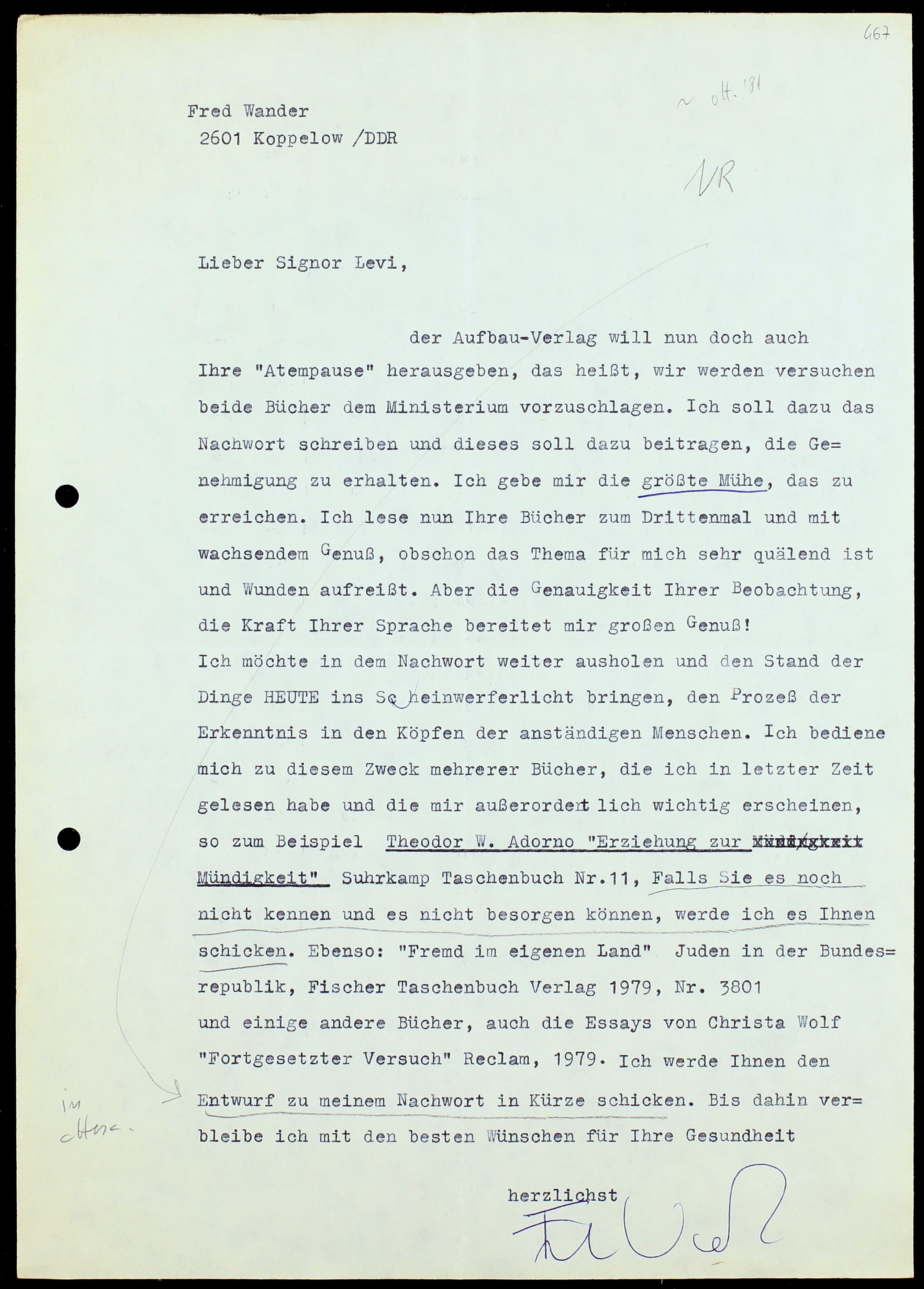
Wander writes to Levi once again to announce that Aufbau intends to publish Atempause, as well. He is working on the afterword and mentions to Levi a few essays he would like to use to call the reader’s attention to current events.
der Aufbau-Verlag will nun doch auch Ihre Atempause herausgeben, das heißt, wir werden versuchen beide Bücher dem Ministerium vorzuschlagen. Ich soll dazu das Nachwort schreiben und dieses soll dazu beitragen, die Genehmigung zu erhalten.[2] Ich gebe mir die größte Mühe,[3] das zu erreichen. Ich lese nun Ihre Bücher zum Drittenmal und mit wachsendem Genuß, obschon das Thema für mich sehr quälend ist und Wunden aufreißt. Aber die Genauigkeit Ihrer Beobachtung, die Kraft Ihrer Sprache bereitet mir großen Genuß!
Ich möchte in dem Nachwort weiter ausholen und den Stand der Dinge HEUTE ins Scheinwerferlicht bringen, den Prozeß der Erkenntnis in den Köpfen der anständigen Menschen. Ich bediene mich zu diesem Zweck mehrerer Bücher, die ich in letzter Zeit gelesen habe und die mir außerordentlich wichtig erscheinen, so zum Beispiel Theodor W. AdornoErziehung zur Mündigkeit, Suhrkamp Taschenbuch Nr. 11, Falls Sie es noch nicht kennen und es nicht besorgen können, werde ich es Ihnen schicken.[4] Ebenso: Fremd im eigenen Land.Juden in der Bundesrepublik, Fischer Taschenbuch Verlag 1979, Nr. 3801 und einige andere Bücher, auch die Essays von Christa WolfFortgesetzter VersuchReclam, 1979.[5] Ich werde Ihnen den Entwurf zu meinem Nachwort in Kürze schicken. Bis dahin verbleibe ich mit den besten Wünschen für Ihre Gesundheit
Herzlichst
Fred Wander
2601 Koppelow / DDR[1]
Caro Signor Levi,
l’Aufbau-Verlag ha infine deciso di pubblicare anche La tregua; o meglio, cercheremo di proporre entrambi i titoli al Ministero. A me è stato affidato il compito di scrivere la postfazione, che dovrà contribuire a ottenere l’autorizzazione alla pubblicazione.[2] Sto facendo tutto il possibile[3] per raggiungere questo scopo. Leggo ora i Suoi libri per la terza volta, e ogni rilettura me li fa apprezzare ancora di più, sebbene l’argomento sia per me estremamente doloroso e riapra delle ferite. Eppure la precisione del suo sguardo e la forza della sua lingua mi procurano un piacere straordinario!
Vorrei dare alla postfazione una prospettiva più ampia e mettere sotto i riflettori lo stato delle cose OGGI, il percorso di presa di coscienza che è in atto nelle menti delle persone oneste. A questo scopo mi sto servendo di alcuni libri che ho letto negli ultimi tempi e che considero di straordinaria importanza; per esempio Educazione alla maturità di Theodor W. Adorno (Suhrkamp Taschenbuch, n. 11). Se ancora non lo conosce e non riesce a procurarselo, sarò lieto di inviarglielo io.[4] E poi: Stranieri in patria. Gli ebrei nella repubblica federale tedesca (Fischer Taschenbuch Verlag, 1979, n. 3801) e altri libri, compresa la raccolta di saggi di Christa WolfTentativo permanente (Reclam, 1979). A breve Le invierò la bozza della mia postfazione.[5] Nel frattempo le porgo i miei migliori auguri per la sua salute.
Con i miei saluti più cari,
Fred Wander
Fred Wander
2601 Koppelow / DDR [1]
Dear Mr. Levi,
Aufbau has now decided to publish The Truce after all; that is, we shall try to propose both your books to the Ministry. I am to write the afterword, which is intended to help secure approval.[2] I am doing my very best[3] to achieve this. I am now reading your books for the third time and with growing enjoyment, even though the subject matter is very distressing for me and opens old wounds anew. But the precision of your observations and the power of your language give me great pleasure!
In the afterword, I would like to go into greater depth and shine a spotlight on the state of affairs TODAY, on the process of realization taking place in the minds of most decent people. To this end, I am drawing on several books I have read recently which seem extraordinarily important to me—for example, Theodor W. Adorno’s Education for Maturity and Responsibility (Suhrkamp Taschenbuch No. 11). If you have not yet read it and cannot obtain a copy, I will send it to you.[4] Also: “Strangers in Their Own Country: Jews in the Federal Republic of Germany,” Fischer Taschenbuch Verlag 1979, No. 3801 and several other books, including Christa Wolf’s essays, “A Continuing Attempt” Reclam, 1979.[5] I will send you the draft of my afterword shortly. Until then, I send my best wishes and hope you are well.
Warmly,
Fred Wander
Fred Wander
2601 Koppelow / DDR[1]
Lieber Signor Levi,
der Aufbau-Verlag will nun doch auch Ihre Atempause herausgeben, das heißt, wir werden versuchen beide Bücher dem Ministerium vorzuschlagen. Ich soll dazu das Nachwort schreiben und dieses soll dazu beitragen, die Genehmigung zu erhalten.[2] Ich gebe mir die größte Mühe,[3] das zu erreichen. Ich lese nun Ihre Bücher zum Drittenmal und mit wachsendem Genuß, obschon das Thema für mich sehr quälend ist und Wunden aufreißt. Aber die Genauigkeit Ihrer Beobachtung, die Kraft Ihrer Sprache bereitet mir großen Genuß!
Ich möchte in dem Nachwort weiter ausholen und den Stand der Dinge HEUTE ins Scheinwerferlicht bringen, den Prozeß der Erkenntnis in den Köpfen der anständigen Menschen. Ich bediene mich zu diesem Zweck mehrerer Bücher, die ich in letzter Zeit gelesen habe und die mir außerordentlich wichtig erscheinen, so zum Beispiel Theodor W. AdornoErziehung zur Mündigkeit, Suhrkamp Taschenbuch Nr. 11, Falls Sie es noch nicht kennen und es nicht besorgen können, werde ich es Ihnen schicken.[4] Ebenso: Fremd im eigenen Land.Juden in der Bundesrepublik, Fischer Taschenbuch Verlag 1979, Nr. 3801 und einige andere Bücher, auch die Essays von Christa WolfFortgesetzter VersuchReclam, 1979.[5] Ich werde Ihnen den Entwurf zu meinem Nachwort in Kürze schicken. Bis dahin verbleibe ich mit den besten Wünschen für Ihre Gesundheit
Herzlichst
Fred Wander
2601 Koppelow / DDR[1]
Caro Signor Levi,
l’Aufbau-Verlag ha infine deciso di pubblicare anche La tregua; o meglio, cercheremo di proporre entrambi i titoli al Ministero. A me è stato affidato il compito di scrivere la postfazione, che dovrà contribuire a ottenere l’autorizzazione alla pubblicazione.[2] Sto facendo tutto il possibile[3] per raggiungere questo scopo. Leggo ora i Suoi libri per la terza volta, e ogni rilettura me li fa apprezzare ancora di più, sebbene l’argomento sia per me estremamente doloroso e riapra delle ferite. Eppure la precisione del suo sguardo e la forza della sua lingua mi procurano un piacere straordinario!
Vorrei dare alla postfazione una prospettiva più ampia e mettere sotto i riflettori lo stato delle cose OGGI, il percorso di presa di coscienza che è in atto nelle menti delle persone oneste. A questo scopo mi sto servendo di alcuni libri che ho letto negli ultimi tempi e che considero di straordinaria importanza; per esempio Educazione alla maturità di Theodor W. Adorno (Suhrkamp Taschenbuch, n. 11). Se ancora non lo conosce e non riesce a procurarselo, sarò lieto di inviarglielo io.[4] E poi: Stranieri in patria. Gli ebrei nella repubblica federale tedesca (Fischer Taschenbuch Verlag, 1979, n. 3801) e altri libri, compresa la raccolta di saggi di Christa WolfTentativo permanente (Reclam, 1979). A breve Le invierò la bozza della mia postfazione.[5] Nel frattempo le porgo i miei migliori auguri per la sua salute.
Con i miei saluti più cari,
Fred Wander
Fred Wander
2601 Koppelow / DDR [1]
Dear Mr. Levi,
Aufbau has now decided to publish The Truce after all; that is, we shall try to propose both your books to the Ministry. I am to write the afterword, which is intended to help secure approval.[2] I am doing my very best[3] to achieve this. I am now reading your books for the third time and with growing enjoyment, even though the subject matter is very distressing for me and opens old wounds anew. But the precision of your observations and the power of your language give me great pleasure!
In the afterword, I would like to go into greater depth and shine a spotlight on the state of affairs TODAY, on the process of realization taking place in the minds of most decent people. To this end, I am drawing on several books I have read recently which seem extraordinarily important to me—for example, Theodor W. Adorno’s Education for Maturity and Responsibility (Suhrkamp Taschenbuch No. 11). If you have not yet read it and cannot obtain a copy, I will send it to you.[4] Also: “Strangers in Their Own Country: Jews in the Federal Republic of Germany,” Fischer Taschenbuch Verlag 1979, No. 3801 and several other books, including Christa Wolf’s essays, “A Continuing Attempt” Reclam, 1979.[5] I will send you the draft of my afterword shortly. Until then, I send my best wishes and hope you are well.
Warmly,
Fred Wander
Info
Notes
Tag
Sender: Fred Wander
Addressee: Primo Levi
Date of Drafting: 1981-10-01
Place of Writing: East Berlin
Description: typewritten letter on white paper with handwritten signature in blue ballpoint pen, underlining in blue fountain pen and pencil, and insertions in pencil.
Archive: Archivio privato di Primo Levi, Turin
Series: Corrispondenza, Corrispondenza generale, fascicolo 12, sottofascicolo 21, f. 467.
Folio: 1, front only
DOI:
1
Levi notes in pencil in the upper right-hand corner “ott. ‘81” (“Oct. ‘81”) and slightly below “NR” (which probably stands for “non risposto” [“no response”]). An arrow drawn by hand in pencil points below to the phrase “Entwurf zu meinem Nachwort in Kürze schicken” (“I will send you the draft of my afterword shortly”), which is, in turn, underlined in pencil. Alongside it, Levi notes “in attesa” (“pending”).
2
On the one hand, Aufbau had intended for Wander’s afterword to legitimize Levi’s book through the authority of a Jewish author who had experienced deportation and had much credit in the DDR. On the other hand, it was also meant to guide the public’s reading and interpretation, justifying and putting into subjective perspective the more critical passages of the two books (in the case of Ist das ein Mensch?, a negative judgment of the political prisoners, and the absence of references to resistance in the Lagers and solidarity among the prisoners; in the case of Atempause, a caricatural representation of the Red Army).
3
“größte Mühe” (“doing my very best”) is underlined by hand in blue fountain pen.
4
“Falls Sie es noch nicht kennen und es nicht besorgen können, werde ich es Ihnen schicken” (“If you have not yet read it and cannot obtain a copy, I will send it to you”) is underlined by hand in pencil. The reference is to Theodor Adorno’s late-career book, Erziehung zur Mündigkeit (“Education for Maturity and Responsibility,” not published in English): a collection of discussions and conversations with Hellmut Becker between 1959 and 1969 on the topic of pedagogy and the possibility of educating people against barbarity. In line with Adorno’s own Dialectic of Enlightenment, Mündigkeit envisions maturity as the opposite of the Kantian state of immaturity (Unmündigkeit).
5
The book Fortgesetzter Versuch (“Ongoing attempt”), published in 1979, is a collection of Wolf’s essays and interviews following the publication of her great novels of the 1960s and ‘70s, which established her as an indispensable voice in public debates in the DDR. It also contains her essay on Fred Wander, “Gedächtnis und Gedenken” (pp. 258-67), published first in 1972 in Sinn und Form and later as the afterword of Der siebente Brunnen (The Seventh Well) in 1985, when the novel was republished under license in West Germany by the publishing company Luchterhand.