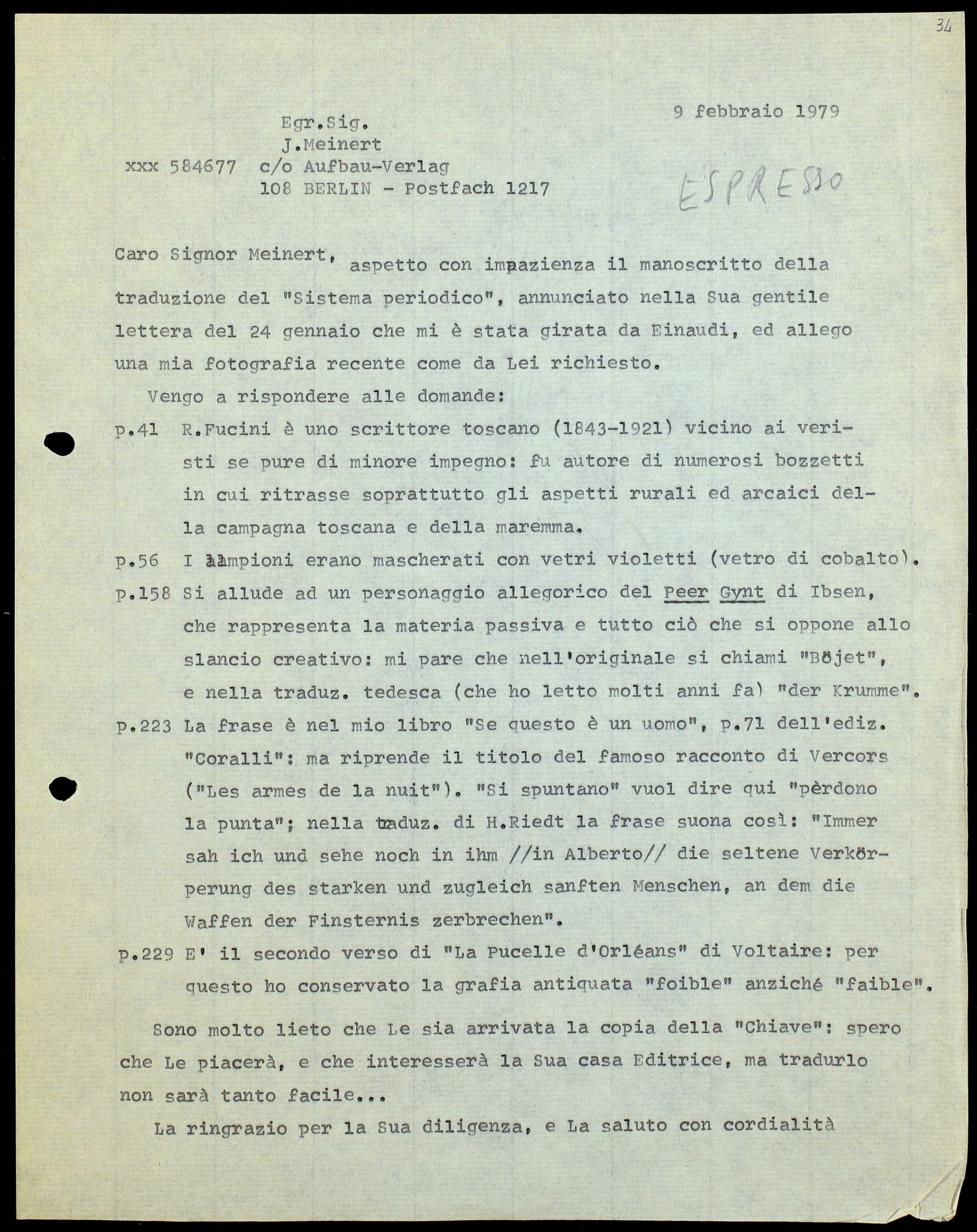
Primo Levi answers Meinert’s questions, explaining the meaning and the origin of a few of the quotes in The Periodic Table. He hopes that the publishing company Aufbau will like The Wrench and perhaps publish it.
XXX 584677
Egr.sig.
J.Meinert
c/o Aufbau-Verlag
108 BERLIN – Postfach 1217
9 febbraio 1979
Caro Signor Meinert,
aspetto con impazienza il manoscritto della traduzione delSistema periodico, annunciato nella Sua gentile lettera del 24 gennaio che mi è stata girata da Einaudi, ed allego una mia fotografia recente come da Lei richiesto.
Vengo a rispondere alle domande:
p. 41 R. Fucini è uno scrittore toscano (1843-1921) vicino ai veristi se pure di minore impegno: fu autore di numerosi bozzetti in cui ritrasse soprattutto gli aspetti rurali ed arcaici della campagna toscana e della maremma.
p. 56 I lampioni erano mascherati con vetri violetti (vetro di cobalto).
p. 158 si allude ad un personaggio allegorico delPeer Gynt di Ibsen, che rappresenta la materia passiva e tutto ciò che si oppone allo slancio creativo:[1] mi pare che nell’originale si chiami «Böjet», e nella traduzione tedesca (che ho letto molti anni fa) «der Krumme».[2]
p. 223 La frase è nel mio libro Se questo è un uomo, p. 71 dell’edizione «Coralli»: ma riprende il titolo del famoso racconto di Vercors (Les armes de la nuit).[3] «Si spuntano» vuol dire qui «pèrdono la punta»; nella traduzione di H. Riedt la frase suona così: «Immer sah ich und sehe noch in ihm //in Alberto// die seltene Verkörperung des starken und zugleich sanften Menschen, an dem die Waffen der Finsternis zerbrechen».[4]
p. 229 È il secondo verso di La Pucelle d’Orléans di Voltaire: per questo ho conservato la grafia antiquata «foible» anziché «faible».
Sono molto lieto che le sia arrivata la copia della Chiave: spero che Le piacerà, e che interesserà la Sua casa Editrice, ma tradurlo non sarà tanto facile…
La ringrazio per la Sua diligenza, e La saluto con cordialità
XXX 584677
Egr.sig.
J.Meinert
c/o Aufbau-Verlag
108 BERLIN – Postfach 1217
9 febbraio 1979
Caro Signor Meinert,
aspetto con impazienza il manoscritto della traduzione delSistema periodico, annunciato nella Sua gentile lettera del 24 gennaio che mi è stata girata da Einaudi, ed allego una mia fotografia recente come da Lei richiesto.
Vengo a rispondere alle domande:
p. 41 R. Fucini è uno scrittore toscano (1843-1921) vicino ai veristi se pure di minore impegno: fu autore di numerosi bozzetti in cui ritrasse soprattutto gli aspetti rurali ed arcaici della campagna toscana e della maremma.
p. 56 I lampioni erano mascherati con vetri violetti (vetro di cobalto).
p. 158 si allude ad un personaggio allegorico delPeer Gynt di Ibsen, che rappresenta la materia passiva e tutto ciò che si oppone allo slancio creativo:[1] mi pare che nell’originale si chiami «Böjet», e nella traduzione tedesca (che ho letto molti anni fa) «der Krumme».[2]
p. 223 La frase è nel mio libro Se questo è un uomo, p. 71 dell’edizione «Coralli»: ma riprende il titolo del famoso racconto di Vercors (Les armes de la nuit).[3] «Si spuntano» vuol dire qui «pèrdono la punta»; nella traduzione di H. Riedt la frase suona così: «Immer sah ich und sehe noch in ihm //in Alberto// die seltene Verkörperung des starken und zugleich sanften Menschen, an dem die Waffen der Finsternis zerbrechen».[4]
p. 229 È il secondo verso di La Pucelle d’Orléans di Voltaire: per questo ho conservato la grafia antiquata «foible» anziché «faible».
Sono molto lieto che le sia arrivata la copia della Chiave: spero che Le piacerà, e che interesserà la Sua casa Editrice, ma tradurlo non sarà tanto facile…
La ringrazio per la Sua diligenza, e La saluto con cordialità
XXX 584677
Egr.sig.
J.Meinert
c/o Aufbau-Verlag
108 BERLIN – Postfach 1217
February 9, 1979
Dear Mr. Meinert,
I anxiously await the manuscript of the translation of The Periodic Table, which you announced in your kind letter dated January 24, which was forwarded to me by Einaudi, and, as per your request, I enclose a recent photograph of myself.
To answer your questions:
p. 41 R. Fucini was a Tuscan writer (1843-1921) associated with the literary movement “verismo,” though less politically committed: he wrote various prose sketches portraying, above all, rural and archaic aspects of the countryside in Tuscany and the Maremma.
p. 56 The street lamps were masked with violet blue glass (cobalt glass).
p. 158 The reference is to an allegorical character inPeer Gyntby Ibsen, who represents passive matter and all that stands in the way of the creative impulse[1]: I believe that in the original text he was called “Böjet,” and in the German translation (which I read many years ago), “der Krumme.”[2]
p. 223 The quote can be found in my book Se questo è un uomo [If This Is a Man], p. 71 in the “Coralli” edition: but it refers to the title of the famous short story by Vercors (Les armes de la nuit).[3] Here, “to blunt” means “to lose its point;” in the translation by H. Riedt the sentence goes like this: “Immer sah ich und sehe noch in ihm //in Alberto// die seltene Verkörperung des starken und zugleich sanften Menschen, an dem die Waffen der Finsternis zerbrechen.”[4]
p. 229 This is the second verse of La Pucelle d’Orléans by Voltaire: that is why I kept the antiquated spelling “foible” instead of “faible.”
I am very happy that the copy of The Wrench arrived: I hope you like it and that it will interest your publishing house, but it will not be very easy to translate…
I thank you for your diligence and send you my best wishes
XXX 584677
Egr.sig.
J.Meinert
c/o Aufbau-Verlag
108 BERLIN – Postfach 1217
9 febbraio 1979
Caro Signor Meinert,
aspetto con impazienza il manoscritto della traduzione delSistema periodico, annunciato nella Sua gentile lettera del 24 gennaio che mi è stata girata da Einaudi, ed allego una mia fotografia recente come da Lei richiesto.
Vengo a rispondere alle domande:
p. 41 R. Fucini è uno scrittore toscano (1843-1921) vicino ai veristi se pure di minore impegno: fu autore di numerosi bozzetti in cui ritrasse soprattutto gli aspetti rurali ed arcaici della campagna toscana e della maremma.
p. 56 I lampioni erano mascherati con vetri violetti (vetro di cobalto).
p. 158 si allude ad un personaggio allegorico delPeer Gynt di Ibsen, che rappresenta la materia passiva e tutto ciò che si oppone allo slancio creativo:[1] mi pare che nell’originale si chiami «Böjet», e nella traduzione tedesca (che ho letto molti anni fa) «der Krumme».[2]
p. 223 La frase è nel mio libro Se questo è un uomo, p. 71 dell’edizione «Coralli»: ma riprende il titolo del famoso racconto di Vercors (Les armes de la nuit).[3] «Si spuntano» vuol dire qui «pèrdono la punta»; nella traduzione di H. Riedt la frase suona così: «Immer sah ich und sehe noch in ihm //in Alberto// die seltene Verkörperung des starken und zugleich sanften Menschen, an dem die Waffen der Finsternis zerbrechen».[4]
p. 229 È il secondo verso di La Pucelle d’Orléans di Voltaire: per questo ho conservato la grafia antiquata «foible» anziché «faible».
Sono molto lieto che le sia arrivata la copia della Chiave: spero che Le piacerà, e che interesserà la Sua casa Editrice, ma tradurlo non sarà tanto facile…
La ringrazio per la Sua diligenza, e La saluto con cordialità
XXX 584677
Egr.sig.
J.Meinert
c/o Aufbau-Verlag
108 BERLIN – Postfach 1217
9 febbraio 1979
Caro Signor Meinert,
aspetto con impazienza il manoscritto della traduzione delSistema periodico, annunciato nella Sua gentile lettera del 24 gennaio che mi è stata girata da Einaudi, ed allego una mia fotografia recente come da Lei richiesto.
Vengo a rispondere alle domande:
p. 41 R. Fucini è uno scrittore toscano (1843-1921) vicino ai veristi se pure di minore impegno: fu autore di numerosi bozzetti in cui ritrasse soprattutto gli aspetti rurali ed arcaici della campagna toscana e della maremma.
p. 56 I lampioni erano mascherati con vetri violetti (vetro di cobalto).
p. 158 si allude ad un personaggio allegorico delPeer Gynt di Ibsen, che rappresenta la materia passiva e tutto ciò che si oppone allo slancio creativo:[1] mi pare che nell’originale si chiami «Böjet», e nella traduzione tedesca (che ho letto molti anni fa) «der Krumme».[2]
p. 223 La frase è nel mio libro Se questo è un uomo, p. 71 dell’edizione «Coralli»: ma riprende il titolo del famoso racconto di Vercors (Les armes de la nuit).[3] «Si spuntano» vuol dire qui «pèrdono la punta»; nella traduzione di H. Riedt la frase suona così: «Immer sah ich und sehe noch in ihm //in Alberto// die seltene Verkörperung des starken und zugleich sanften Menschen, an dem die Waffen der Finsternis zerbrechen».[4]
p. 229 È il secondo verso di La Pucelle d’Orléans di Voltaire: per questo ho conservato la grafia antiquata «foible» anziché «faible».
Sono molto lieto che le sia arrivata la copia della Chiave: spero che Le piacerà, e che interesserà la Sua casa Editrice, ma tradurlo non sarà tanto facile…
La ringrazio per la Sua diligenza, e La saluto con cordialità
XXX 584677
Egr.sig.
J.Meinert
c/o Aufbau-Verlag
108 BERLIN – Postfach 1217
February 9, 1979
Dear Mr. Meinert,
I anxiously await the manuscript of the translation of The Periodic Table, which you announced in your kind letter dated January 24, which was forwarded to me by Einaudi, and, as per your request, I enclose a recent photograph of myself.
To answer your questions:
p. 41 R. Fucini was a Tuscan writer (1843-1921) associated with the literary movement “verismo,” though less politically committed: he wrote various prose sketches portraying, above all, rural and archaic aspects of the countryside in Tuscany and the Maremma.
p. 56 The street lamps were masked with violet blue glass (cobalt glass).
p. 158 The reference is to an allegorical character inPeer Gyntby Ibsen, who represents passive matter and all that stands in the way of the creative impulse[1]: I believe that in the original text he was called “Böjet,” and in the German translation (which I read many years ago), “der Krumme.”[2]
p. 223 The quote can be found in my book Se questo è un uomo [If This Is a Man], p. 71 in the “Coralli” edition: but it refers to the title of the famous short story by Vercors (Les armes de la nuit).[3] Here, “to blunt” means “to lose its point;” in the translation by H. Riedt the sentence goes like this: “Immer sah ich und sehe noch in ihm //in Alberto// die seltene Verkörperung des starken und zugleich sanften Menschen, an dem die Waffen der Finsternis zerbrechen.”[4]
p. 229 This is the second verse of La Pucelle d’Orléans by Voltaire: that is why I kept the antiquated spelling “foible” instead of “faible.”
I am very happy that the copy of The Wrench arrived: I hope you like it and that it will interest your publishing house, but it will not be very easy to translate…
I thank you for your diligence and send you my best wishes
Info
Notes
Tag
Sender: Primo Levi
Addressee: Joachim Meinert
Date of Drafting: 1979-02-09
Place of Writing: Turin
Description: carbon copy on onionskin paper of a typewritten letter. Below the date is a handwritten note in pencil by Levi: “ESPRESSO.”
1
Cf. the box Ibsen in Primo Levi's Works. In the translation by Edith Plackmeyer, Levi’s explanation is included as a note: “Allegorische Gestalt aus Henrik Ibsen Drama ‘Peer Gynt,’ verkörpert die passive, den schöpferischen Drang lähmende Materie” (“An allegorical figure in the drama by Henrik Ibsen Peer Gynt, he embodies passive material that paralyzes the creative impulse”). Cf. P. Levi, Das periodische System, Berlin: Aufbau, 1988, 2 ed., p. 175. Levi himself refers to this explanation in the Italian school edition of The Periodic Table, published in July 1979: “[the Big Curve] represents passive matter, and everything that stands in the way of the creative impulse of people” (OC I, p. 1435).
2
Until now, it had never been established that Levi had read Ibsen’s Peer Gynt in German. Cf. the box Ibsen in Primo Levi's Works.
3Se questo è un uomo [If This Is a Man] was published in the Einaudi series “I Coralli” in 1963. This quote from The Weapons of the Night by Vercors was published for the first time in the 1958 edition (CW I, p. 54) but Levi explicitly revealed the source in a note in the Italian school edition of If This Is a Man in 1973 (OC I, p. 1413). In East Germany, Les armes de la nuit was translated and published by the publishing company Aufbau with the title Waffen der Nacht.
4
Cf. P. Levi, Ist das ein Mensch?, Frankfurt: Fischer Verlag, 1961, p. 59. Levi had already discussed this quote in 1960 with his German translator, Heinz Riedt, cf. P. Levi, Il carteggio con Heinz Riedt, edited by M. Mengoni, Turin: Einaudi, 2024, p. 36.