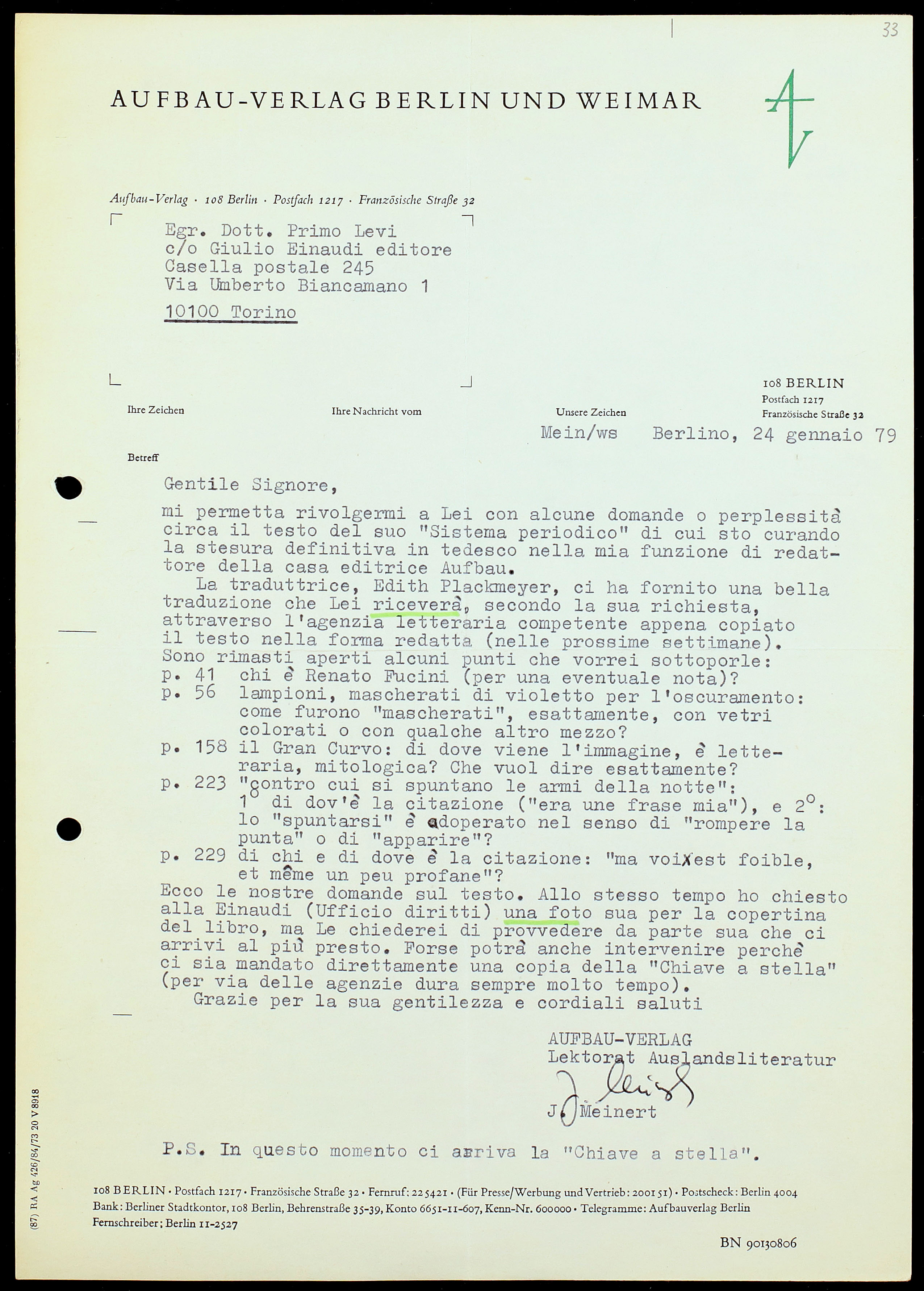
Joachim Meinert, an editor at the publishing company Aufbau in East Berlin, writes to Primo Levi to ask a few questions regarding the manuscript of the German translation of The Periodic Table.
Egr. Dott. Primo Levi c/o Giulio Einaudi editore Casella postale 245 Via Umberto Biancamano 1 10100 Torino
Berlino, 24 gennaio 79
Gentile Signore,
mi permetta rivolgermi a Lei con alcune domande o perplessità circa il testo del suo Sistema periodico di cui sto curando la stesura definitiva in tedesco nella mia funzione di redattore della casa editrice Aufbau.[1]
La traduttrice, Edith Plackmeyer, ci ha fornito una bella traduzione che Lei riceverà,[2] secondo la sua richiesta, attraverso l’agenzia letteraria competente appena copiato il testo nella forma redatta (nelle prossime settimane).
Sono rimasti aperti alcuni punti che vorrei sottoporle:
p. 41 chi è Renato Fucini (per una eventuale nota)?[3]
p. 56 lampioni, mascherati di violetto per l’oscuramento: come furono «mascherati» esattamente, con vetri colorati o con qualche altro mezzo?[4]
p. 158 il Gran Curvo: di dove viene l’immagine, è letteraria, mitologica? Che vuol dire esattamente?[5]
p. 223 «contro cui si puntano le armi della notte»: 1° di dov’è la citazione («era une frase mia»), e 2°: lo «spuntarsi» è adoperato nel senso di «rompere la punta» o di «apparire»?[6]
p. 229 di chi e di dove è la citazione: «ma voix[7] est foible, et même un peu profane»?[8]
Ecco le nostre domande sul testo. Allo stesso tempo ho chiesto alla Einaudi (Ufficio diritti) una foto[9] sua per la copertina del libro, ma Le chiederei di provvedere da parte sua che ci arrivi al più presto. Forse potrà anche intervenire perché ci sia mandato direttamente una copia dellaChiave a stella (per via delle agenzie dura sempre molto tempo).
Grazie per la sua gentilezza e cordiali saluti
AUFBAU-VERLAG Lektorat Auslandsliteratur[10] J. Meinert
P.S. In questo momento ci arriva la Chiave a stella.[11]
Egr. Dott. Primo Levi c/o Giulio Einaudi editore Casella postale 245 Via Umberto Biancamano 1 10100 Torino
Berlino, 24 gennaio 79
Gentile Signore,
mi permetta rivolgermi a Lei con alcune domande o perplessità circa il testo del suo Sistema periodico di cui sto curando la stesura definitiva in tedesco nella mia funzione di redattore della casa editrice Aufbau.[1]
La traduttrice, Edith Plackmeyer, ci ha fornito una bella traduzione che Lei riceverà,[2] secondo la sua richiesta, attraverso l’agenzia letteraria competente appena copiato il testo nella forma redatta (nelle prossime settimane).
Sono rimasti aperti alcuni punti che vorrei sottoporle:
p. 41 chi è Renato Fucini (per una eventuale nota)?[3]
p. 56 lampioni, mascherati di violetto per l’oscuramento: come furono «mascherati» esattamente, con vetri colorati o con qualche altro mezzo?[4]
p. 158 il Gran Curvo: di dove viene l’immagine, è letteraria, mitologica? Che vuol dire esattamente?[5]
p. 223 «contro cui si puntano le armi della notte»: 1° di dov’è la citazione («era une frase mia»), e 2°: lo «spuntarsi» è adoperato nel senso di «rompere la punta» o di «apparire»?[6]
p. 229 di chi e di dove è la citazione: «ma voix[7] est foible, et même un peu profane»?[8]
Ecco le nostre domande sul testo. Allo stesso tempo ho chiesto alla Einaudi (Ufficio diritti) una foto[9] sua per la copertina del libro, ma Le chiederei di provvedere da parte sua che ci arrivi al più presto. Forse potrà anche intervenire perché ci sia mandato direttamente una copia dellaChiave a stella (per via delle agenzie dura sempre molto tempo).
Grazie per la sua gentilezza e cordiali saluti
AUFBAU-VERLAG Lektorat Auslandsliteratur[10] J. Meinert
P.S. In questo momento ci arriva la Chiave a stella.[11]
Dr. Primo Levi
c/o Giulio Einaudi editore
Casella postale 245
Via Umberto Biancamano 1
10100 Torino
Berlin, January 24, ’79
Dear Sir:
I take the liberty of writing to you with a few questions or doubts regarding the text of your Periodic Table, whose final draft in German I am editing in my capacity as an editor at the publishing company Aufbau.[1]
The translator, Edith Plackmeyer, has given us a fine translation which you will receive,[2] as per your request, through the relevant literary agency as soon as the text is set in its edited form (in the upcoming weeks).
A few points remain unresolved, which I would like to submit to you:
p. 41 who is Renato Fucini (for a possible note)?[3]
p. 56 street lamps, masked with violet for the blackout: how exactly were they “masked,” with colored glass or by some other means?[4]
p. 158 the Big Curve: where does the image come from, is it literary mythological? What does it mean, exactly?[5]
p. 223 “contro cui si spuntano le armi della notte” (“against whom the weapons of darkness were blunted”): where does the quote come from (“the phrase was mine”), and 2) is “spuntarsi” (“blunted”) used in the sense of “rompere la punta” (“breaking its point”) or of “apparire” (“emerging”)?[6]
p. 229 where does the quote: “ma voix[7] est foible, et même un peu profane” come from?[8]
These are our questions regarding the text. At the same time, I have asked Einaudi (Rights Office) for a photo[9] of you for the book’s cover, but I ask you to please make sure it arrives as soon as possible. Perhaps you could also intercede and have a copy of The Wrench sent directly to us (going through agencies always takes a long time).
Thank you for your courtesy, best regards
AUFBAU-VERLAG
Lektorat Auslandsliteratur [10]
J. Meinert
P.S. We received The Wrench[11] this very moment.
Egr. Dott. Primo Levi c/o Giulio Einaudi editore Casella postale 245 Via Umberto Biancamano 1 10100 Torino
Berlino, 24 gennaio 79
Gentile Signore,
mi permetta rivolgermi a Lei con alcune domande o perplessità circa il testo del suo Sistema periodico di cui sto curando la stesura definitiva in tedesco nella mia funzione di redattore della casa editrice Aufbau.[1]
La traduttrice, Edith Plackmeyer, ci ha fornito una bella traduzione che Lei riceverà,[2] secondo la sua richiesta, attraverso l’agenzia letteraria competente appena copiato il testo nella forma redatta (nelle prossime settimane).
Sono rimasti aperti alcuni punti che vorrei sottoporle:
p. 41 chi è Renato Fucini (per una eventuale nota)?[3]
p. 56 lampioni, mascherati di violetto per l’oscuramento: come furono «mascherati» esattamente, con vetri colorati o con qualche altro mezzo?[4]
p. 158 il Gran Curvo: di dove viene l’immagine, è letteraria, mitologica? Che vuol dire esattamente?[5]
p. 223 «contro cui si puntano le armi della notte»: 1° di dov’è la citazione («era une frase mia»), e 2°: lo «spuntarsi» è adoperato nel senso di «rompere la punta» o di «apparire»?[6]
p. 229 di chi e di dove è la citazione: «ma voix[7] est foible, et même un peu profane»?[8]
Ecco le nostre domande sul testo. Allo stesso tempo ho chiesto alla Einaudi (Ufficio diritti) una foto[9] sua per la copertina del libro, ma Le chiederei di provvedere da parte sua che ci arrivi al più presto. Forse potrà anche intervenire perché ci sia mandato direttamente una copia dellaChiave a stella (per via delle agenzie dura sempre molto tempo).
Grazie per la sua gentilezza e cordiali saluti
AUFBAU-VERLAG Lektorat Auslandsliteratur[10] J. Meinert
P.S. In questo momento ci arriva la Chiave a stella.[11]
Egr. Dott. Primo Levi c/o Giulio Einaudi editore Casella postale 245 Via Umberto Biancamano 1 10100 Torino
Berlino, 24 gennaio 79
Gentile Signore,
mi permetta rivolgermi a Lei con alcune domande o perplessità circa il testo del suo Sistema periodico di cui sto curando la stesura definitiva in tedesco nella mia funzione di redattore della casa editrice Aufbau.[1]
La traduttrice, Edith Plackmeyer, ci ha fornito una bella traduzione che Lei riceverà,[2] secondo la sua richiesta, attraverso l’agenzia letteraria competente appena copiato il testo nella forma redatta (nelle prossime settimane).
Sono rimasti aperti alcuni punti che vorrei sottoporle:
p. 41 chi è Renato Fucini (per una eventuale nota)?[3]
p. 56 lampioni, mascherati di violetto per l’oscuramento: come furono «mascherati» esattamente, con vetri colorati o con qualche altro mezzo?[4]
p. 158 il Gran Curvo: di dove viene l’immagine, è letteraria, mitologica? Che vuol dire esattamente?[5]
p. 223 «contro cui si puntano le armi della notte»: 1° di dov’è la citazione («era une frase mia»), e 2°: lo «spuntarsi» è adoperato nel senso di «rompere la punta» o di «apparire»?[6]
p. 229 di chi e di dove è la citazione: «ma voix[7] est foible, et même un peu profane»?[8]
Ecco le nostre domande sul testo. Allo stesso tempo ho chiesto alla Einaudi (Ufficio diritti) una foto[9] sua per la copertina del libro, ma Le chiederei di provvedere da parte sua che ci arrivi al più presto. Forse potrà anche intervenire perché ci sia mandato direttamente una copia dellaChiave a stella (per via delle agenzie dura sempre molto tempo).
Grazie per la sua gentilezza e cordiali saluti
AUFBAU-VERLAG Lektorat Auslandsliteratur[10] J. Meinert
P.S. In questo momento ci arriva la Chiave a stella.[11]
Dr. Primo Levi
c/o Giulio Einaudi editore
Casella postale 245
Via Umberto Biancamano 1
10100 Torino
Berlin, January 24, ’79
Dear Sir:
I take the liberty of writing to you with a few questions or doubts regarding the text of your Periodic Table, whose final draft in German I am editing in my capacity as an editor at the publishing company Aufbau.[1]
The translator, Edith Plackmeyer, has given us a fine translation which you will receive,[2] as per your request, through the relevant literary agency as soon as the text is set in its edited form (in the upcoming weeks).
A few points remain unresolved, which I would like to submit to you:
p. 41 who is Renato Fucini (for a possible note)?[3]
p. 56 street lamps, masked with violet for the blackout: how exactly were they “masked,” with colored glass or by some other means?[4]
p. 158 the Big Curve: where does the image come from, is it literary mythological? What does it mean, exactly?[5]
p. 223 “contro cui si spuntano le armi della notte” (“against whom the weapons of darkness were blunted”): where does the quote come from (“the phrase was mine”), and 2) is “spuntarsi” (“blunted”) used in the sense of “rompere la punta” (“breaking its point”) or of “apparire” (“emerging”)?[6]
p. 229 where does the quote: “ma voix[7] est foible, et même un peu profane” come from?[8]
These are our questions regarding the text. At the same time, I have asked Einaudi (Rights Office) for a photo[9] of you for the book’s cover, but I ask you to please make sure it arrives as soon as possible. Perhaps you could also intercede and have a copy of The Wrench sent directly to us (going through agencies always takes a long time).
Thank you for your courtesy, best regards
AUFBAU-VERLAG
Lektorat Auslandsliteratur [10]
J. Meinert
P.S. We received The Wrench[11] this very moment.
Info
Notes
Tag
Sender: Joachim Meinert
Addressee: Primo Levi
Date of Drafting: 2026-06-15
Place of Writing: East Berlin
Description: typewritten letter on a sheet of letterhead paper. Besides the letterhead, the sheet also has a pre-printed section located between the address and the body of the letter: “Ihre Zeichen Ihre Nachricht vom Unsere Zeichen 108 BERLIN | Postfach 1217 | Französische Straße 32 | Betreff.” The sheet also has two alphanumerical codes: one is stamped diagonally on the inside margin: “(87) BA Ag 426/84/73 20 V8918” and one on the lower margin, to the right and just below the foot of the letter: “BN 90 130 806.”
Letterhead: AUFBAU-VERLAG BERLIN UND WEIMAR| Aufbau-Verlag 108 Berlin Postfach 1217 Französische Straße 32; at the foot of the page: 108 BERLIN • Postfach 1217• Französische Straße 32 • Fernruf: 225421 • (Für Presse/Werbung und Vertrieb: 2001 SI) • Postscheck: Berlin 4004 | Bank: Berliner Stadtkontor, 108 Berlin, Behrenstraße 35-39, Konto 6651-11-607, Kenn-Nr. 600000 • Telegramme: Aufbauverlag Berlin Fernschreiber; Berlin II-2527. The Aufbau logo is printed in green in the upper right-hand corner.
DOI:
1
On editorial circumstances related to the publication of The Periodic Table in East Germany, cf. the relative box.
2
“riceverà” (“will receive”) is underlined by hand in light green felt-tip pen. The accent on the ‘a’ is added by hand in black ballpoint pen. The same additions have been made on all the accented vowels.
3
In The Periodic Table, the author Renato Fucini is ironically recalled in “Iron” to introduce Sandro Delmastro, the story’s protagonist : “He came to class in threadbare corduroy knickerbockers, gray wool knee socks, and sometimes a black cloak that made me think of Renato Fucini” (CW II, p. 785).
4
The passage can be found in Potassium and the street lamps are those on Via Valperga Caluso, which young Levi traverses on his bicycle: “it was now night, and the light of the street lamps, masked with violet for the blackout, could not defeat the fog and the shadows” (CW II, p. 797). During the Second World War, masking the street lamps was a defensive measure used to diminish urban illumination in order to make enemy air attacks more difficult.
5The Big Curve is evoked in Chromium in relation to the mystery of the livering of paints that Levi must try to solve: “the adversary was the same, the non-me, the Big Curve, Hyle” (CW II, p. 879). Cf. the box Ibsen in Primo Levi's Work.
6
The reference is to a point in the short story Vanadium in which Levi, commenting the letter from his German correspondent Lothar Müller, quotes a passage in If This Is a Man: “He attributed the facts of Auschwitz to Man, without differentiating; he deplored them, and found consolation in the thought of other men cited in my book, Alberto, Lorenzo, ‘against whom the weapons of darkness were blunted’: the phrase was mine, but repeated by him it sounded to me hypocritical and false” (CW II, p. 934).
7
The x in “voix” and the circumflex accent in “mê me” have been added by hand in black ballpoint pen.
8
This is the opening line of the short story “Carbon”: “The reader will have been aware for some time now that this is not a chemistry treatise: my presumption does not reach so far, ‘ma voix est foible, et même un peu profane’” (CW II, 939).
9
“a photo” is underlined by hand in light-green ink.
10
The editor in charge of foreign literature.
11
Einaudi published the Italian edition of The Wrench in late November 1978.