Levi replies enthusiastically to his friend’s letter, giving news about the fate of various companions at the Lager and asking for information about the destiny of others. After his correspondence with Jean Samuel (Pikolo in If This Is a Man), which took place in 1946, this is the second time, to the best of our knowledge, that Levi dialogues with a former companion regarding the fate of other members of Chemical Kommando 98.
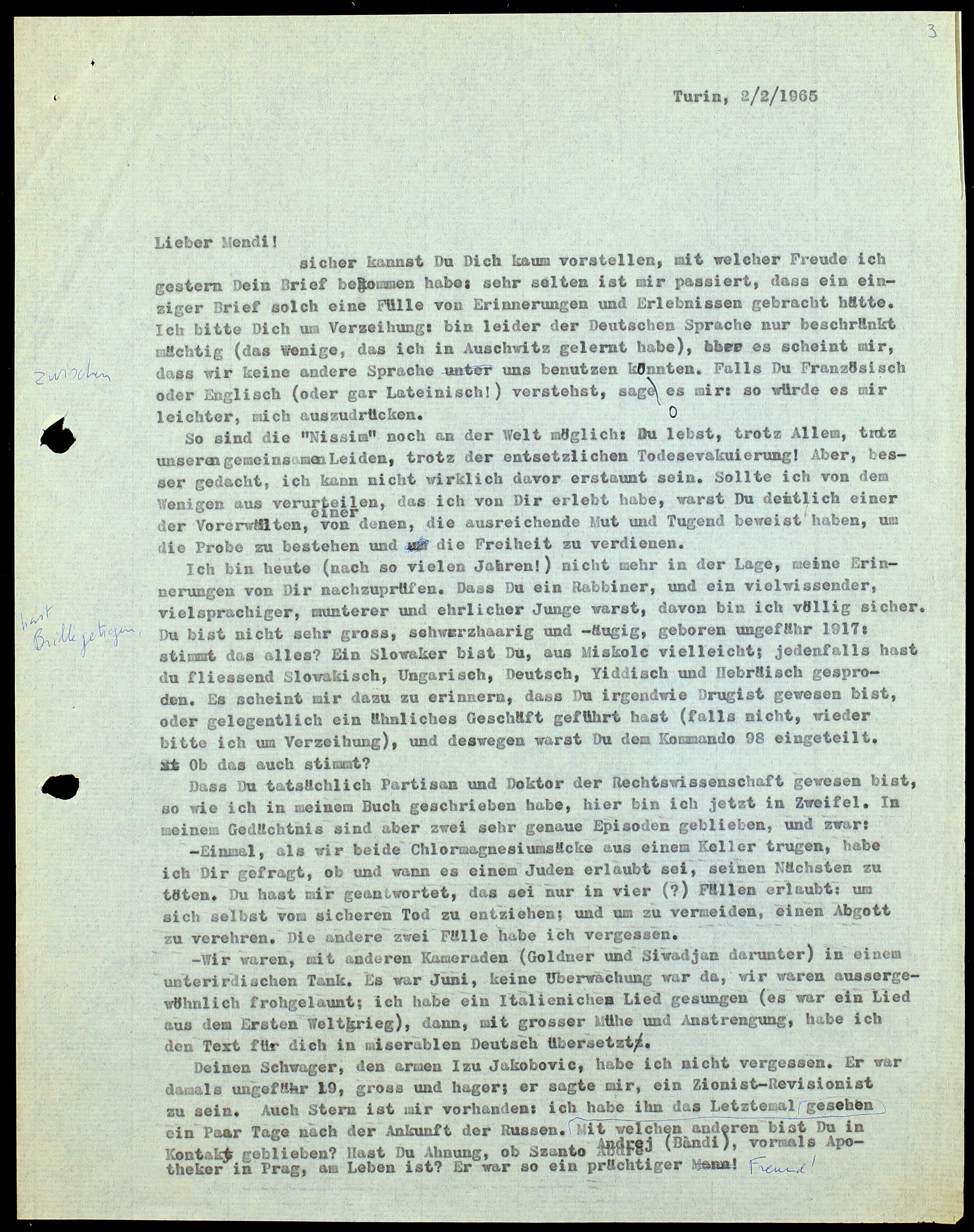
sicher kannst Du Dich kaum vorstellen, mit welcher Freude ich gestern Dein Brief bekommen habe: sehr selten ist mir passiert, dass ein einziger Brief solch eine Fülle von Erinnerungen und Erlebnissen gebracht hätte. Ich bitte Dich um Verzeihung: bin leider der Deutschen Sprache nur beschränkt mächtig (das wenige, das ich in Auschwitz gelernt habe), aber es scheint mir, dass wir keine andere Sprache zwischen[1] uns benutzen konnten.[2] Falls Du Französisch oder Englisch (oder gar Lateinisch!) verstehst, sage es mir: so würde es mir leichter, mich auszudrücken.
So sind die «Nissim»[3] noch an der Welt möglich: Du lebst, trotz Allem, trotz unseren gemeinsamen Leiden, trotz der entsetzlichen Todesevakuierung! Aber, besser gedacht, ich kann nicht wirklich davor erstaunt sein.[4] Sollte ich von dem Wenigen aus verurteilen, das ich von Dir erlebt habe, warst Du deutlich einer der Vorerwälten, einer[5] von denen, die ausreichende Mut und Tugend beweist haben, um die Probe zu bestehen und[6] die Freiheit zu verdienen.
Ich bin heute (nach so vielen Jahren!) nicht mehr in der Lage, meine Erinnerungen von Dir nachzuprüfen. Dass Du ein Rabbiner, und ein vielwissender, vielsprachiger, munterer und ehrlicher Junge warst, davon bin ich völlig sicher.[7] Du bist nicht sehr gross, schwarzhaarig und -äugig, geboren ungefähr 1917: stimmt das alles? Ein Slowaker bist Du, aus Miskolc vielleicht; jedenfalls hast du fliessend Slovakisch, Ungarisch, Deutsch, Yiddisch und Hebräisch gesprochen. Es scheint mir dazu zu erinnern, dass Du irgendwie Drugist gewesen bist, oder gelegentlich ein ähnliches Geschäft geführt hast (falls nicht, wieder bitte ich um Verzeihung), und deswegen warst Du dem Kommando 98 eingeteilt. Ob das auch stimmt?
Dass Du tatsächlich Partisan und Doktor der Rechtswissenschaft gewesen bist, so wie ich in meinem Buch geschrieben habe, hier bin ich jetzt in Zweifel. In meinem Gedächtnis sind aber zwei sehr genaue Episoden geblieben, und zwar:
– Einmal, als wir beide Chlormagnesiumsäcke aus einem Keller trugen, habe ich Dir gefragt, ob und wann es einem Juden erlaubt sei, seinen Nächsten zu töten. Du hast mir geantwortet, das sei nur in vier (?) Fällen erlaubt: um sich selbst vom sicheren Tod zu entziehen; und um zu vermeiden, einen Abgott zu verehren. Die andere zwei Fälle habe ich vergessen.[8]
– Wir waren, mit anderen Kameraden (Goldnerund Siwadjan[9] darunter) in einem unterirdischen Tank. Es war Juni, keine Überwachung war da, wir waren aussergewöhnlich frohgelaunt; ich habe ein ItalienichesLied gesungen (es war ein Lied aus dem Ersten Weltkrieg), dann, mit grosser Mühe und Anstrengung, habe ich den Text für dich in miserablen Deutsch übersetzt.[10]
Deinen Schwager, den armen Izu Jakobovic, habe ich nicht vergessen.[11] Er war damals ungefähr 19, gross und hager; er sagte mir, ein Zionist-Revisionist zu sein. Auch Stern ist mir vorhanden: ich habe ihn das Letztemal ein Paar Tage nach der Ankunft der Russen gesehen.[12] Mit welchen anderen bist du in Kontakt geblieben? Hast du Ahnung, ob Szanto Andrej (Bàndi), vormals Apotheker in Prag, am Leben ist? Er war so ein prächtiger Freund![13]
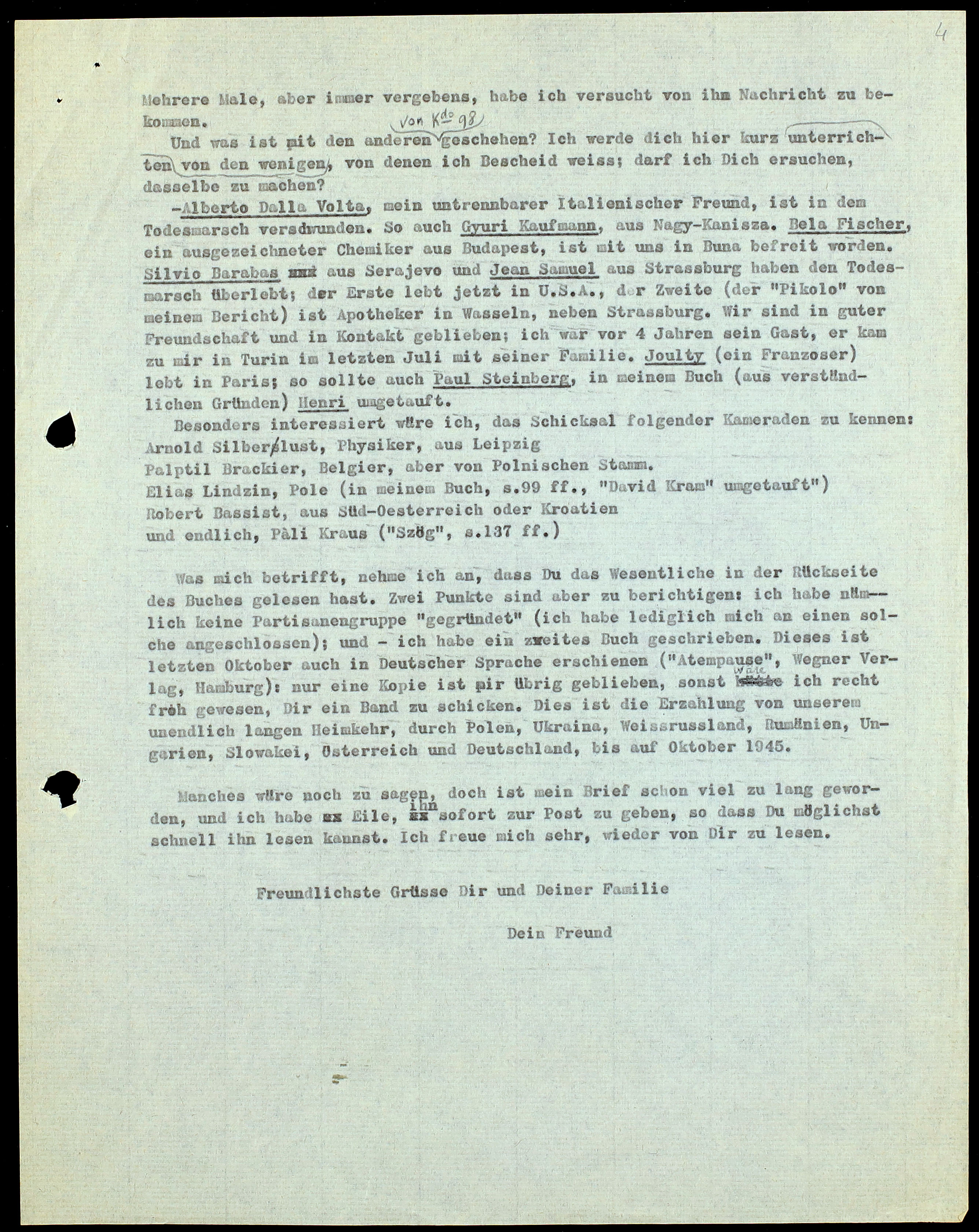
Mehrere Male, aber immer vergebens, habe ich versucht von ihm Nachricht zu bekommen.
Und was ist mit den anderen von K.do 98[14] geschehen? Ich werde dich hier kurz von den wenigen unterrichten,[15] von denen ich Bescheid weiss; darf ich Dich ersuchen, dasselbe zu machen?
– Alberto Dalla Volta, mein untrennbarer Italienischer Freund, ist in dem Todesmarsch verschwunden. So auch Gyuri Kaufmann, aus Nagy-Kanisza. Bela Fischer, ein ausgezeichneter Chemiker aus Budapest, ist mit uns in Buna befreit worden. Silvio Barabas[16] aus Sarajevo und Jean Samuel aus Strassburg haben den Todesmarsch überlebt; der Erste lebt jetzt in U.S.A., der Zweite (der «Pikolo» von meinem Bericht) ist Apotheker in Wasseln, neben Strassburg. Wir sind in guter Freundschaft und in Kontakt geblieben; ich war vor 4 Jahren sein Gast, er kam zu mir in Turin im letzten Juli mit seiner Familie. Joulty (ein Franzoser) lebt in Paris; so sollte auch Paul Steinberg, in meinem Buch (aus verständlichen Gründen) Henri umgetauft.[17]
Besonders interessiert wäre ich, das Schicksal folgender Kameraden zu kennen:
Arnold Silberlust, Physiker, aus Leipzig
Palptil Brackier, Belgier, aber von Polnischen Stamm.
Elias Lindzin, Pole (in meinem Buch, s.99 ff., «David Kram» umgetauft)
Robert Bassist, aus Süd-Oesterreich oder Kroatien und endlich,[18]Pàli Kraus («Szög», s. 137 ff.)[19]
Was mich betrifft, nehme ich an, dass Du das Wesentliche in der Rückseite des Buches gelesen hast. Zwei Punkte sind aber zu berichtigen: ich habe nämlich keine Partisanengruppe «gegründet» (ich habe lediglich mich an einen solche angeschlossen); und – ich habe ein zweites Buch geschrieben.[20] Dieses ist letzten Oktober auch in Deutscher Sprache erschienen (Atempause, Wegner Verlag, Hamburg): nur eine Kopie ist mir übrig geblieben, sonst wäre[21] ich recht froh gewesen, Dir ein Band zu schicken. Dies ist die Erzählung von unserem unendlich langen Heimkehr, durch Polen, Ukraina, Weissrussland, Rumänien, Ungarien, Slowakei, Österreich und Deutschland, bis auf Oktober 1945.
Manches wäre noch zu sagen, doch ist mein Brief schon viel zu lang geworden, und ich habe Eile, ihn[22] sofort zur Post zu geben, so dass Du möglichst schnell ihn lesen kannst. Ich freue mich sehr, wieder von Dir zu lesen.
Freundlichste Grüsse Dir und Deiner Familie
Dein Freund
Torino, 2/2/1965
Caro Mendi!
di certo non puoi immaginare con quanta gioia ieri ho ricevuto la tua lettera: molto raramente mi è capitato che una sola lettera portasse con sé una tale quantità di ricordi e di esperienze. Ti chiedo perdono: purtroppo ho una conoscenza limitata del tedesco (quel poco che ho imparato ad Auschwitz), ma credo che tra[1] noi non possiamo[2] usare nessun’altra lingua. Se conosci il francese o l’inglese (o magari il latino!), dimmelo: in questo caso mi sarebbe più facile esprimermi.
Dunque i «nissim»[3] sono ancora possibili a questo mondo: sei vivo, nonostante tutto, nonostante le sofferenze che abbiamo condiviso, nonostante la terribile marcia della morte! Ma a pensarci meglio non dovrei stupirmene.[4] Per quel poco che ho avuto modo di conoscere di te, eri chiaramente uno degli eletti, uno[5] di coloro che hanno dimostrato sufficiente coraggio e virtù per superare la prova e[6] meritare la libertà.
Oggi (dopo così tanti anni!) non sono più in grado di verificare i ricordi che ho di te. Ma di una cosa sono del tutto certo: che tu fossi un rabbino e un giovane colto, poliglotta, coraggioso e onesto.[7]Non sei molto alto, hai capelli e occhi scuri, e sei natointorno al 1917: è esatto? Sei slovacco, forse di Miskolc; in ogni caso parlavi fluentemente slovacco, ungherese, tedesco, yiddisch ed ebraico. Mi sembra anche di ricordare che tu facessi qualcosa come il droghiere, o che avessi esercitato occasionalmente un’attività analoga (in caso contrario, ti chiedo di nuovo scusa) e che per questo fossi stato assegnato al Kommando 98. È giusto anche questo?
Adesso ho qualche dubbio, invece, sul fatto tu sia stato partigiano e dottore in Legge, come ho scritto nel mio libro. Nella memoria sono rimasti impressi però due episodi precisi, e cioè:
– Una volta, mentre insieme trasportavamo su da una cantina dei sacchi di cloruro di magnesio, ti ho domandato se e quando è consentito a un ebreo uccidere. Mi rispondesti che era consentito solo in quattro (?) casi: per sottrarsi a morte certa e per evitare di adorare un idolo. Gli altri due li ho dimenticati.[8]
– Eravamo in una cisterna sotterranea insieme ad altri compagni (tra cui Goldner e Siwadjan[9]). Era giugno, non c’era sorveglianza, eravamo insolitamente di buon umore: ho cantato una canzone italiana (era una canzone della Prima guerra mondiale), poi, con grande sforzo e fatica, ho tradotto il testo per te in un tedesco pessimo.[10]
Tuo cognato, il povero Izu Jakobovic, non l’ho dimenticato.[11] Allora aveva all’incirca 19 anni, era alto e magro; mi disse di essere un sionista revisionista. Ho presente anche Stern: l’ho visto l’ultima volta qualche giorno dopo l’arrivo dei russi.[12] Sei rimasto in contatto con qualcun altro? Hai idea se Szanto Andrej (Bàndi), un tempo farmacista a Praga, sia ancora vivo? Era un amico splendido![13]
Più volte, ma sempre invano, ho cercato di avere sue notizie.
E cosa è successo agli altri del Kommando 98?[14]Brevemente ti informo qui dei pochi di cui so qualcosa:[15] posso chiederti di fare lo stesso?
– Alberto Dalla Volta, il mio inseparabile amico italiano, è scomparso nella marcia della morte. E così Gyuri Kaufmann, di Nagy-Kanisza. Bela Fischer, un eccellente chimico di Budapest, è stato liberato con noi a Buna. Silvio Barabas[16]di Sarajevo e Jean Samuel di Strasburgo sono sopravvissuti alla marcia della morte; adesso il primo vive negli Stati Uniti, il secondo (il «Pikolo» del mio racconto) è farmacista a Wasselonne, vicino a Strasburgo. Siamo rimasti buoni amici e ci teniamo in contatto; quattro anni fa sono stato suo ospite, e lo scorso luglio è venuto da me a Torino con la famiglia. Joulty (un francese) vive a Parigi; così dovrebbe essere anche per Paul Steinberg, che nel mio libro (per ragioni comprensibili) ho ribattezzato Henri.[17]
Sarei particolarmente interessato a conoscere il destino dei seguenti compagni:
Arnold Silberlust, fisico, di Lipsia
Palptil Brackier, belga, ma di origine polacca
Elias Lindzin, polacco (nel mio libro, p. 99 e segg., ribattezzato «David Kram»)
Robert Bassist, dell’Austria meridionale o della Croazia, e infine[18]Pàli Kraus («Szög», p. 137 e segg.)[19]
Per quanto riguarda me, suppongo che tu abbia letto l’essenziale nella quarta di copertina del libro. Due punti sono però da correggere: non ho «fondato» nessun gruppo partigiano (mi sono semplicemente unito a uno di questi); e… ho scritto un secondo libro.[20] Anche questo è uscito lo scorso ottobre in lingua tedesca (Atempause, Wegner Verlag, Hamburg): me ne è rimasta solo una copia, altrimenti sarei stato[21] davvero felice di spedirtene una. È il racconto del nostro lungo, infinito viaggio di ritorna a casa, passando per la Polonia, l’Ucraina, la Bielorussia, la Romania, l’Ungheria, la Slovacchia, l’Austria e la Germania, fino all’ottobre del 1945.
Ci sarebbero ancora molte cose da dire, ma la mia lettera è già diventata fin troppo lunga e ho fretta di imbucarla[22] subito, in modo che tu possa leggerla il prima possibile. Spero vivamente di ricevere presto tue notizie.
I più affettuosi saluti a te e alla tua famiglia
il tuo amico
Turin, February 2, 1965
Dear Mendi!
You can hardly imagine how delighted I was to receive your letter yesterday: rarely has a single letter brought back such a wealth of memories and experiences. Please forgive me: unfortunately, my command of the German language is limited (to what little I learned in Auschwitz), but it seems to me we have no other language between[1]us.[2]If you understand French or English (or even Latin!), please let me know: that would make it easier for me to express myself.
So it seems “nissim”[3] are still possible in this world: you are alive, despite everything, despite our shared suffering, despite that horrific evacuation toward death! But, on second thought, I cannot truly be surprised by this.[4] Judging by what little I knew of you, you were clearly one of the chosen ones, one[5]of those who demonstrated sufficient courage and virtue to pass the test and[6]earn freedom.
Today (after so many years!), I can no longer be sure my memories of you are accurate. I am absolutely certain that you were a rabbi—a knowledgeable, multilingual, lively, and honest young man.[7]You are not too tall, you have black hair and eyes, and were born around 1917: is all of that correct? You are Slovak, perhaps from Miskolc; in any case, you spoke Slovak, Hungarian, German, Yiddish, and Hebrew fluently. I seem to recall that you were somehow a pharmacist, or ran a similar business on occasion (if not, I again beg your pardon), and that’s why you were assigned to Kommando 98. Is that true, too?
As to whether you were actually a partisan with a doctorate in law, as I wrote in my book—I now have my doubts. However, two very specific episodes are etched in my memory, namely:
– Once, when the two of us were carrying bags of magnesium chloride out of a basement, I asked you whether and when a Jew was permitted to kill his fellows. You replied that it was permitted only in four (?) cases: to save oneself from certain death; and to avoid worshipping an idol. I have forgotten the other two cases.[8]
– We were in an underground bunker with some other comrades (including Goldner and Siwadjan[9]). It was June; there were no guards around, and we were in an exceptionally cheerful mood. I sang an Italian song (a song from World War I), and then, with great difficulty and effort, I translated the lyrics into dreadful German[10]for you.
I have not forgotten your brother-in-law, poor Izu Jakobovic.[11] He was about 19 at the time, tall and gaunt; he told me he was a Revisionist Zionist. I remember Stern, too: I last saw him a couple of days after the Russians arrived.[12] Who else have you stayed in touch with? Do you have any idea whether Szanto Andrej(Bàndi), formerly a pharmacist in Prague, is still alive? He was such a wonderful friend![13]
I have tried several times, but always in vain, to get news of him.
And what has become of the others from Kommando 98?[14] I will briefly tell you here about the few[15]I know of; may I ask you to do the same?
– Alberto Dalla Volta, my inseparable Italian friend, disappeared during the death march. So did Gyuri Kaufmann, from Nagy-Kanisza. Bela Fischer, an outstanding chemist from Budapest, was liberated with us in Buna. Silvio Barabas[16]from Sarajevo and Jean Samuelfrom Strasbourg survived the death march; the former now lives in the U.S.A., while the latter (“Pikolo” in my book) is a pharmacist in Wasseln, near Strasbourg. We have remained in close contact and are good friends; I was his guest four years ago, and he visited me in Turin last July with his family. Joulty(a Frenchman) lives in Paris; so does Paul Steinberg, whose name I changed (for understandable reasons) to Henri in the book.[17]
I would be particularly interested in learning the fate of the following comrades:
Arnold Silberlust, a physicist from Leipzig
Palptil Brackier, a Belgian of Polish descent
Elias Lindzin, a Pole (whose name I changed to David Kram in my book, pp. 99ff.)
Robert Bassist, from southern Austria or Croatia; and, finally,[18]Pàli Kraus(Szög, pp. 137ff.)[19]
As for me, I assume you have read the basics from the back of the book. However, two points need to be corrected: namely, I did not “found” a partisan group (I merely joined one); and—I have written a second book.[20] It was also published in German last October (as Atempause, Wegner Verlag, Hamburg): I have only one copy left; otherwise I would have been[21]quite happy to send you a copy. It tells the story of our interminably long journey home, through Poland, Ukraine, Belarus, Romania, Hungary, Slovakia, Austria, and Germany, up to October 1945.
There is still much more to say, but my letter is already far too long, and I am in a hurry to mail it[22]right away so you can read it as soon as possible. I look forward to hearing from you again.
Warmest regards to you and your family
Your friend
Turin, 2/2/1965
Lieber Mendi!
sicher kannst Du Dich kaum vorstellen, mit welcher Freude ich gestern Dein Brief bekommen habe: sehr selten ist mir passiert, dass ein einziger Brief solch eine Fülle von Erinnerungen und Erlebnissen gebracht hätte. Ich bitte Dich um Verzeihung: bin leider der Deutschen Sprache nur beschränkt mächtig (das wenige, das ich in Auschwitz gelernt habe), aber es scheint mir, dass wir keine andere Sprache zwischen[1] uns benutzen konnten.[2] Falls Du Französisch oder Englisch (oder gar Lateinisch!) verstehst, sage es mir: so würde es mir leichter, mich auszudrücken.
So sind die «Nissim»[3] noch an der Welt möglich: Du lebst, trotz Allem, trotz unseren gemeinsamen Leiden, trotz der entsetzlichen Todesevakuierung! Aber, besser gedacht, ich kann nicht wirklich davor erstaunt sein.[4] Sollte ich von dem Wenigen aus verurteilen, das ich von Dir erlebt habe, warst Du deutlich einer der Vorerwälten, einer[5] von denen, die ausreichende Mut und Tugend beweist haben, um die Probe zu bestehen und[6] die Freiheit zu verdienen.
Ich bin heute (nach so vielen Jahren!) nicht mehr in der Lage, meine Erinnerungen von Dir nachzuprüfen. Dass Du ein Rabbiner, und ein vielwissender, vielsprachiger, munterer und ehrlicher Junge warst, davon bin ich völlig sicher.[7] Du bist nicht sehr gross, schwarzhaarig und -äugig, geboren ungefähr 1917: stimmt das alles? Ein Slowaker bist Du, aus Miskolc vielleicht; jedenfalls hast du fliessend Slovakisch, Ungarisch, Deutsch, Yiddisch und Hebräisch gesprochen. Es scheint mir dazu zu erinnern, dass Du irgendwie Drugist gewesen bist, oder gelegentlich ein ähnliches Geschäft geführt hast (falls nicht, wieder bitte ich um Verzeihung), und deswegen warst Du dem Kommando 98 eingeteilt. Ob das auch stimmt?
Dass Du tatsächlich Partisan und Doktor der Rechtswissenschaft gewesen bist, so wie ich in meinem Buch geschrieben habe, hier bin ich jetzt in Zweifel. In meinem Gedächtnis sind aber zwei sehr genaue Episoden geblieben, und zwar:
– Einmal, als wir beide Chlormagnesiumsäcke aus einem Keller trugen, habe ich Dir gefragt, ob und wann es einem Juden erlaubt sei, seinen Nächsten zu töten. Du hast mir geantwortet, das sei nur in vier (?) Fällen erlaubt: um sich selbst vom sicheren Tod zu entziehen; und um zu vermeiden, einen Abgott zu verehren. Die andere zwei Fälle habe ich vergessen.[8]
– Wir waren, mit anderen Kameraden (Goldnerund Siwadjan[9] darunter) in einem unterirdischen Tank. Es war Juni, keine Überwachung war da, wir waren aussergewöhnlich frohgelaunt; ich habe ein ItalienichesLied gesungen (es war ein Lied aus dem Ersten Weltkrieg), dann, mit grosser Mühe und Anstrengung, habe ich den Text für dich in miserablen Deutsch übersetzt.[10]
Deinen Schwager, den armen Izu Jakobovic, habe ich nicht vergessen.[11] Er war damals ungefähr 19, gross und hager; er sagte mir, ein Zionist-Revisionist zu sein. Auch Stern ist mir vorhanden: ich habe ihn das Letztemal ein Paar Tage nach der Ankunft der Russen gesehen.[12] Mit welchen anderen bist du in Kontakt geblieben? Hast du Ahnung, ob Szanto Andrej (Bàndi), vormals Apotheker in Prag, am Leben ist? Er war so ein prächtiger Freund![13]
Mehrere Male, aber immer vergebens, habe ich versucht von ihm Nachricht zu bekommen.
Und was ist mit den anderen von K.do 98[14] geschehen? Ich werde dich hier kurz von den wenigen unterrichten,[15] von denen ich Bescheid weiss; darf ich Dich ersuchen, dasselbe zu machen?
– Alberto Dalla Volta, mein untrennbarer Italienischer Freund, ist in dem Todesmarsch verschwunden. So auch Gyuri Kaufmann, aus Nagy-Kanisza. Bela Fischer, ein ausgezeichneter Chemiker aus Budapest, ist mit uns in Buna befreit worden. Silvio Barabas[16] aus Sarajevo und Jean Samuel aus Strassburg haben den Todesmarsch überlebt; der Erste lebt jetzt in U.S.A., der Zweite (der «Pikolo» von meinem Bericht) ist Apotheker in Wasseln, neben Strassburg. Wir sind in guter Freundschaft und in Kontakt geblieben; ich war vor 4 Jahren sein Gast, er kam zu mir in Turin im letzten Juli mit seiner Familie. Joulty (ein Franzoser) lebt in Paris; so sollte auch Paul Steinberg, in meinem Buch (aus verständlichen Gründen) Henri umgetauft.[17]
Besonders interessiert wäre ich, das Schicksal folgender Kameraden zu kennen:
Arnold Silberlust, Physiker, aus Leipzig
Palptil Brackier, Belgier, aber von Polnischen Stamm.
Elias Lindzin, Pole (in meinem Buch, s.99 ff., «David Kram» umgetauft)
Robert Bassist, aus Süd-Oesterreich oder Kroatien und endlich,[18]Pàli Kraus («Szög», s. 137 ff.)[19]
Was mich betrifft, nehme ich an, dass Du das Wesentliche in der Rückseite des Buches gelesen hast. Zwei Punkte sind aber zu berichtigen: ich habe nämlich keine Partisanengruppe «gegründet» (ich habe lediglich mich an einen solche angeschlossen); und – ich habe ein zweites Buch geschrieben.[20] Dieses ist letzten Oktober auch in Deutscher Sprache erschienen (Atempause, Wegner Verlag, Hamburg): nur eine Kopie ist mir übrig geblieben, sonst wäre[21] ich recht froh gewesen, Dir ein Band zu schicken. Dies ist die Erzählung von unserem unendlich langen Heimkehr, durch Polen, Ukraina, Weissrussland, Rumänien, Ungarien, Slowakei, Österreich und Deutschland, bis auf Oktober 1945.
Manches wäre noch zu sagen, doch ist mein Brief schon viel zu lang geworden, und ich habe Eile, ihn[22] sofort zur Post zu geben, so dass Du möglichst schnell ihn lesen kannst. Ich freue mich sehr, wieder von Dir zu lesen.
Freundlichste Grüsse Dir und Deiner Familie
Dein Freund
Torino, 2/2/1965
Caro Mendi!
di certo non puoi immaginare con quanta gioia ieri ho ricevuto la tua lettera: molto raramente mi è capitato che una sola lettera portasse con sé una tale quantità di ricordi e di esperienze. Ti chiedo perdono: purtroppo ho una conoscenza limitata del tedesco (quel poco che ho imparato ad Auschwitz), ma credo che tra[1] noi non possiamo[2] usare nessun’altra lingua. Se conosci il francese o l’inglese (o magari il latino!), dimmelo: in questo caso mi sarebbe più facile esprimermi.
Dunque i «nissim»[3] sono ancora possibili a questo mondo: sei vivo, nonostante tutto, nonostante le sofferenze che abbiamo condiviso, nonostante la terribile marcia della morte! Ma a pensarci meglio non dovrei stupirmene.[4] Per quel poco che ho avuto modo di conoscere di te, eri chiaramente uno degli eletti, uno[5] di coloro che hanno dimostrato sufficiente coraggio e virtù per superare la prova e[6] meritare la libertà.
Oggi (dopo così tanti anni!) non sono più in grado di verificare i ricordi che ho di te. Ma di una cosa sono del tutto certo: che tu fossi un rabbino e un giovane colto, poliglotta, coraggioso e onesto.[7]Non sei molto alto, hai capelli e occhi scuri, e sei natointorno al 1917: è esatto? Sei slovacco, forse di Miskolc; in ogni caso parlavi fluentemente slovacco, ungherese, tedesco, yiddisch ed ebraico. Mi sembra anche di ricordare che tu facessi qualcosa come il droghiere, o che avessi esercitato occasionalmente un’attività analoga (in caso contrario, ti chiedo di nuovo scusa) e che per questo fossi stato assegnato al Kommando 98. È giusto anche questo?
Adesso ho qualche dubbio, invece, sul fatto tu sia stato partigiano e dottore in Legge, come ho scritto nel mio libro. Nella memoria sono rimasti impressi però due episodi precisi, e cioè:
– Una volta, mentre insieme trasportavamo su da una cantina dei sacchi di cloruro di magnesio, ti ho domandato se e quando è consentito a un ebreo uccidere. Mi rispondesti che era consentito solo in quattro (?) casi: per sottrarsi a morte certa e per evitare di adorare un idolo. Gli altri due li ho dimenticati.[8]
– Eravamo in una cisterna sotterranea insieme ad altri compagni (tra cui Goldner e Siwadjan[9]). Era giugno, non c’era sorveglianza, eravamo insolitamente di buon umore: ho cantato una canzone italiana (era una canzone della Prima guerra mondiale), poi, con grande sforzo e fatica, ho tradotto il testo per te in un tedesco pessimo.[10]
Tuo cognato, il povero Izu Jakobovic, non l’ho dimenticato.[11] Allora aveva all’incirca 19 anni, era alto e magro; mi disse di essere un sionista revisionista. Ho presente anche Stern: l’ho visto l’ultima volta qualche giorno dopo l’arrivo dei russi.[12] Sei rimasto in contatto con qualcun altro? Hai idea se Szanto Andrej (Bàndi), un tempo farmacista a Praga, sia ancora vivo? Era un amico splendido![13]
Più volte, ma sempre invano, ho cercato di avere sue notizie.
E cosa è successo agli altri del Kommando 98?[14]Brevemente ti informo qui dei pochi di cui so qualcosa:[15] posso chiederti di fare lo stesso?
– Alberto Dalla Volta, il mio inseparabile amico italiano, è scomparso nella marcia della morte. E così Gyuri Kaufmann, di Nagy-Kanisza. Bela Fischer, un eccellente chimico di Budapest, è stato liberato con noi a Buna. Silvio Barabas[16]di Sarajevo e Jean Samuel di Strasburgo sono sopravvissuti alla marcia della morte; adesso il primo vive negli Stati Uniti, il secondo (il «Pikolo» del mio racconto) è farmacista a Wasselonne, vicino a Strasburgo. Siamo rimasti buoni amici e ci teniamo in contatto; quattro anni fa sono stato suo ospite, e lo scorso luglio è venuto da me a Torino con la famiglia. Joulty (un francese) vive a Parigi; così dovrebbe essere anche per Paul Steinberg, che nel mio libro (per ragioni comprensibili) ho ribattezzato Henri.[17]
Sarei particolarmente interessato a conoscere il destino dei seguenti compagni:
Arnold Silberlust, fisico, di Lipsia
Palptil Brackier, belga, ma di origine polacca
Elias Lindzin, polacco (nel mio libro, p. 99 e segg., ribattezzato «David Kram»)
Robert Bassist, dell’Austria meridionale o della Croazia, e infine[18]Pàli Kraus («Szög», p. 137 e segg.)[19]
Per quanto riguarda me, suppongo che tu abbia letto l’essenziale nella quarta di copertina del libro. Due punti sono però da correggere: non ho «fondato» nessun gruppo partigiano (mi sono semplicemente unito a uno di questi); e… ho scritto un secondo libro.[20] Anche questo è uscito lo scorso ottobre in lingua tedesca (Atempause, Wegner Verlag, Hamburg): me ne è rimasta solo una copia, altrimenti sarei stato[21] davvero felice di spedirtene una. È il racconto del nostro lungo, infinito viaggio di ritorna a casa, passando per la Polonia, l’Ucraina, la Bielorussia, la Romania, l’Ungheria, la Slovacchia, l’Austria e la Germania, fino all’ottobre del 1945.
Ci sarebbero ancora molte cose da dire, ma la mia lettera è già diventata fin troppo lunga e ho fretta di imbucarla[22] subito, in modo che tu possa leggerla il prima possibile. Spero vivamente di ricevere presto tue notizie.
I più affettuosi saluti a te e alla tua famiglia
il tuo amico
Turin, February 2, 1965
Dear Mendi!
You can hardly imagine how delighted I was to receive your letter yesterday: rarely has a single letter brought back such a wealth of memories and experiences. Please forgive me: unfortunately, my command of the German language is limited (to what little I learned in Auschwitz), but it seems to me we have no other language between[1]us.[2]If you understand French or English (or even Latin!), please let me know: that would make it easier for me to express myself.
So it seems “nissim”[3] are still possible in this world: you are alive, despite everything, despite our shared suffering, despite that horrific evacuation toward death! But, on second thought, I cannot truly be surprised by this.[4] Judging by what little I knew of you, you were clearly one of the chosen ones, one[5]of those who demonstrated sufficient courage and virtue to pass the test and[6]earn freedom.
Today (after so many years!), I can no longer be sure my memories of you are accurate. I am absolutely certain that you were a rabbi—a knowledgeable, multilingual, lively, and honest young man.[7]You are not too tall, you have black hair and eyes, and were born around 1917: is all of that correct? You are Slovak, perhaps from Miskolc; in any case, you spoke Slovak, Hungarian, German, Yiddish, and Hebrew fluently. I seem to recall that you were somehow a pharmacist, or ran a similar business on occasion (if not, I again beg your pardon), and that’s why you were assigned to Kommando 98. Is that true, too?
As to whether you were actually a partisan with a doctorate in law, as I wrote in my book—I now have my doubts. However, two very specific episodes are etched in my memory, namely:
– Once, when the two of us were carrying bags of magnesium chloride out of a basement, I asked you whether and when a Jew was permitted to kill his fellows. You replied that it was permitted only in four (?) cases: to save oneself from certain death; and to avoid worshipping an idol. I have forgotten the other two cases.[8]
– We were in an underground bunker with some other comrades (including Goldner and Siwadjan[9]). It was June; there were no guards around, and we were in an exceptionally cheerful mood. I sang an Italian song (a song from World War I), and then, with great difficulty and effort, I translated the lyrics into dreadful German[10]for you.
I have not forgotten your brother-in-law, poor Izu Jakobovic.[11] He was about 19 at the time, tall and gaunt; he told me he was a Revisionist Zionist. I remember Stern, too: I last saw him a couple of days after the Russians arrived.[12] Who else have you stayed in touch with? Do you have any idea whether Szanto Andrej(Bàndi), formerly a pharmacist in Prague, is still alive? He was such a wonderful friend![13]
I have tried several times, but always in vain, to get news of him.
And what has become of the others from Kommando 98?[14] I will briefly tell you here about the few[15]I know of; may I ask you to do the same?
– Alberto Dalla Volta, my inseparable Italian friend, disappeared during the death march. So did Gyuri Kaufmann, from Nagy-Kanisza. Bela Fischer, an outstanding chemist from Budapest, was liberated with us in Buna. Silvio Barabas[16]from Sarajevo and Jean Samuelfrom Strasbourg survived the death march; the former now lives in the U.S.A., while the latter (“Pikolo” in my book) is a pharmacist in Wasseln, near Strasbourg. We have remained in close contact and are good friends; I was his guest four years ago, and he visited me in Turin last July with his family. Joulty(a Frenchman) lives in Paris; so does Paul Steinberg, whose name I changed (for understandable reasons) to Henri in the book.[17]
I would be particularly interested in learning the fate of the following comrades:
Arnold Silberlust, a physicist from Leipzig
Palptil Brackier, a Belgian of Polish descent
Elias Lindzin, a Pole (whose name I changed to David Kram in my book, pp. 99ff.)
Robert Bassist, from southern Austria or Croatia; and, finally,[18]Pàli Kraus(Szög, pp. 137ff.)[19]
As for me, I assume you have read the basics from the back of the book. However, two points need to be corrected: namely, I did not “found” a partisan group (I merely joined one); and—I have written a second book.[20] It was also published in German last October (as Atempause, Wegner Verlag, Hamburg): I have only one copy left; otherwise I would have been[21]quite happy to send you a copy. It tells the story of our interminably long journey home, through Poland, Ukraine, Belarus, Romania, Hungary, Slovakia, Austria, and Germany, up to October 1945.
There is still much more to say, but my letter is already far too long, and I am in a hurry to mail it[22]right away so you can read it as soon as possible. I look forward to hearing from you again.
Warmest regards to you and your family
Your friend
Info
Notes
Tag
Sender: Primo Levi
Addressee: Emil Davidovič
Date of Drafting: 1965-02-02
Place of Writing: Turin
Description:carbon copy on onionskin paper of a typewritten letter with handwritten insertions in blue ballpoint pen and black fountain pen.
1“unter,” (“under”) is crossed out by hand in blue ballpoint pen and corrected by hand to “zwischen” (“between”) on the inner margin of the sheet.
2Levi emends the preceding version, “könnten,” with a handwritten sign in black fountain pen below the line. On German as the common language between the two correspondents, see the relevant Insight.
3“miracles” in Hebrew.
4Levi already knew something about the fate of Emil Davidovic in early 1946. This can be inferred from a letter to Jean Samuel (Pikolo in If This Is a Man) dated March 2, 1946: “Emil Davidovic (nicknamed Mendi, the Slovakian rabbi) is also alive; here in Italy, I met a Jewish girl, a fellow countrywoman of his, who told me that she had seen him in Prague, on his way to Palestine” (cf. Mi chiamava Pikolo, cit., p. 74). Again through his correspondence with Samuel, it also appears that Levi had already tried to contact his former companion, the rabbi. On October 29, 1946, he wrote: “I have also written to Emil Dawidowic (the Slovakian rabbi in Kommando 98, short, eyeglasses), someone told me they had seen him in Italy: no reply. It seems that he has left for Eretz” (ibid, pp. 87-88). We do not know who gave him this information, and no letter sent to him by Levi has yet been found in the archive. Davidovic had, in fact, planned on moving with his family to Mandatory Palestine during the years right after the liberation but he only managed to do so in 1962, cf. the biography.
5“einer” is typed in above the line.
6“um” follows, deleted in blue ballpoint pen.
7On the inner margin of the sheet, “hast Brille getragen,” (“you wore glasses,”) is written by hand in blue ballpoint pen.
8The episode is not recounted in either If This Is a Man or in the later stories that Levi wrote about his imprisonment at Auschwitz.
9Goldner is mentioned in the chapter “The Canto of Ulysses” (CW I, p. 103). Levi only gave one detail about him in writing to Jean Samuel, “Hungarian” (cf. Mi chiamava Pikolo, cit., p. 154). The Goldner in these pages must not be confused with the character of the same name in the 1966 theatrical version of If This Is a Man (OC I, pp. 1230-31), in which Levi changed Rappoport’s name to Goldner; but Rappoport later becomes the protagonist of the short story Capaneus (CW II, pp. 1349-54). Siwadjan appears at the beginning of “The Canto of Ulysses” (written “Sivadjan”); he, too, is a member of the Chemical Kommando at Buna. Levi writes more about him in his letter to Davidovic dated February 28, 1965 (cf. Letter 183, n. 17).
10“übersetztz” is emended to “übersetzt.” The passage recalls a very similar situation described at the beginning of the chapter “The Canto of Ulysses”: “There were six of us, scraping and cleaning the inside of an underground gas tank; the daylight reached us only through a small door. It was a luxury job, because no one was supervising us; but it was cold and damp” (CW I, p. 103).
11The list of former members of the Chemical Kommando at Buna that Levi sends to Jean Samuel (July 31, 1961, cf. Letter 180, n. 2) relates: “IZU (foade) JAKOBOVIC, brother-in-law of the preceding (Emil Davidovic), a big, naïve fellow.” Born in Sighet in 1925, Isidor Jakobovitz was deported to Auschwitz in 1944 with his father Moritz, his mother Regina, and his sisters Hinda and Chilli (the latter was the wife of Emil Davidovic). On January 18, 1945, Isidor was transferred with his brother-in-law to the concentration camp at Gleiwitz; he disappeared without a trace a few days later. In 1977, Emil Davidovic registered his death at Yad Vashem.
12With a transposition mark handwritten in blue ballpoint pen, Levi moves “gesehen” (“seen”) after “Russen” (“Russians”).
13“Mann!” (“Man!”), crossed out by hand in blue ballpoint pen, is corrected by hand to “Freund!” (“Friend!”) on the same line. In a letter to Jean Samuel in 1961, Andrejn Szanto is remembered as a “pharmacist in Prague, but Hungarian; a dear friend of mine and Alberto’s” (cf. Mi chiamava Pikolo, cit., p. 153). His name does not feature in If This Is a Man but it recurs frequently in the 1966 theatrical version. With the pseudonym “Bandi,” Szánto became the protagonist of the short story “A Disciple,” published for the first time in 1961 in the anthology of testimony Secondo Risorgimento (edited by Piemonte Artistico e Culturale on the occasion of the exhibition of plastic and figurative arts commemorating the Resistance for the Centennial of the Unification of Italy). It was reprinted, with modifications, in La Stampa in 1975, and lastly in Lilith (CW II, pp. 1366-69).
14“von K.do 98” (“of Kommando 98”) is most likely added by hand on the original, but a trace of it remains on the carbon copy.
15Levi moves “von den wenigen” (“about the few”) in front of “unterrichten” (“tell you”) with a transposition mark drawn by hand, most likely on the original, but a trace of it remains on the carbon copy.
16Gyorgy (Szorgi) Kaufmann, a prisoner of Hungarian origin, is never mentioned in If This Is a Man, nor in Levi’s other short stories about the Lager; and yet Levi remembered him so well that he tried, unsuccessfully, to contact him through the Joint American Jewish Distribution Committee in 1946, starting from the little information that Jean Samuel had given him in a letter (cf. Mi chiamava Pikolo, cit., p. 36 and p. 87).Béla Fischer is one of the protagonists of the chapter “A Good Day.” In the list of companions of the Chemical Kommando that he sent to Jean Samuel (cf. Letter 180, n. 2), Levi remembers him as a “Hungarian, a famous biochemist: he worked with Szent-Gyorgyi on the formula for vitamin C” (cf.Mi chiamava Pikolo, cit., p. 153). Levi recounted a few more details about Kaufmann and Fischer in a 1985 interview with the Hungarian translator of If This Is a Man, Vera Székács: “I had many Hungarian friends at the Lager. One, Kaufmann Juri, was a chemist like me, but he was less fortunate and was unable to enter the IG-Farben laboratory like I did (…) He was from Nagykanizsa; in the last days before the liberation, he said to me: ‘If you don’t find your family or your home anymore, come to me,’ and I invited him to do the same. Juri died during the evacuation march of the Lager, in January 1945 […]. Another friend of mine was Fischer Béla, a well-known chemist who, I seem to remember, had worked with Szent-Györgyi” (OC III, p. 782). Born in 1920, Silvio Barabas was a Jew from Sarajevo who was arrested at Tarzo, in the province of Treviso, and deported to Auschwitz. “Silvio Barabas, a young Yugoslavian with eyeglasses who was also in the 98 for a long time, lives in Italy, in Padua; we correspond” (cf. Mi chiamava Pikolo, cit., p. 74). In fact, Levi tracked down Barabas in late 1945 and received important information from him about the evacuation march from Auschwitz on January 17, 1945 (cf. P. Levi, Così fu Auschwitz. Testimonianze 1945-1986. Con Leonardo De Benedetti, edited by F. Levi and D. Scarpa, Turin: Einaudi, 2015, pp. 210-11 and G. Dalla Volta, Vite da ariani, Brescia: Enrico Damiani Editore, 2024, which transcribes, at pp. 495-496, a large portion of Barabas’ letter to Levi from December 1945). Barabas returned to Italy to continue his chemistry studies at the University of Padua. He later tried to emigrate to Palestine but ended up going to North America and settling down in Canada, where he had a career at the World Health Organization. He continued to write to Levi: photocopies of a few of their letters are held at the Wiener Library in London. He died in 2006 (cf. Personal file of Barabas, Silvio in the digital Arolsen Archives and the CDEC Digital Library).
17Albert Joulty was born in Warsaw in 1912; he grew up with his family in France and was deported to Auschwitz in 1943. He, too, was part of Kommando 98 and experienced the evacuation of the camp with Jean Samuel, with whom he remained in contact after his return to France. He died shortly thereafter (“he passed away very soon, in the 1950s, worn out by the consequences of the deportation,” cf. Mi chiamava Pikolo, cit., pp. 53-54 and p. 148). He does not appear in If This Is a Man but is featured in the short story written in 1977 (and later included in Lilith) “Our Seal,” in which he is presented as a “mathematician from Paris” (CW II, p. 1370). Henri (Paul Steinberg) is one of the four privileged prisoners described in the chapter “The Drowned and the Saved” (CW I, p. 93-95). To Levi, the story of Henri at Auschwitz illustrates a very specific technique for “salvation”: the cunning and methodical use of compassion as an instrument of corruption to obtain favors and privileges, from jailors and fellow prisoners alike. Levi concludes the chapter with unusually harsh words: “I know that Henri is alive today. I would give much to know his life as a free man, but I do not want to see him again” (CW I, p. 95). In 1946, he learned from Jean Samuel that Steinberg had survived but his friend Pikolo did not know the man’s address and it was impossible to contact him (cf., Mi chiamava Pikolo, cit., pp. 86-88). In 1995, Paul Steinberg published his own memoirs in the book Chroniques d’ailleurs (translated into English in 2000), in which he tackles Primo Levi’s judgment of him (cf. P. Steinberg, Speak You Also: A Survivor’s Reckoning, New York: Henry Holt and Company, 2000, pp.129-31); he died in 1999. For an overview of the relationship between Levi and Paul Steinberg, cf. S. Luzzatto, Primo Levi e i suoi compagni, Rome: Donzelli, 2024, pp. 32-46.
18“Silberlust, the tinsmith” appears in the chapter “The Last One,” where, in exchange for three rations of bread, he builds for Levi and Alberto a “menaschka,” a more capacious pot capable of containing the extra soup that Lorenzo Perrone procured for them every evening (CW I, p. 138). In the list of names that he prepared for Jean Samuel in 1961 (cf. Letter 180, n. 2) he wrote: “Arnold Silberlust, from Leipzig: one of the few ‘civil’ people, a mathematician” (cf. Mi chiamava Pikolo, cit., p. 152). Silberlust died on March 23, 1945 in the Buchenwald concentration camp (cf. the relative file in the digital Arsolsen Archives).Palptil (Paltiel) Brackier was one of the three prisoners (plus Levi and Jean Kandel, cf. letter 196, n. 10) who were chosen by Doktor Pannwitz for Kommando 98 (CW I, p. 132); “from Liège (but of Polish origin), a chemist” (cf. Mi chiamava Pikolo, cit., p. 152 and theYad Vashem Digital Archives); neither he nor Kandel survived Auschwitz. Elias Lindzin, one of the most memorable characters in If This Is a Man, was, like Henri, one of the four privileged prisoners described in the chapter “The Drowned and the Saved” (CW I, p. 90-93). An epitome of brute, mindless strength, Levi defines him as “the fittest, the human type best suited to this way of life”, and he reappears constantly in Levi’s works about Auschwitz, from the theatrical version of If This Is a Man to short stories in Lilith, down to the radio version in Italian of The Drowned and the Saved (OC III, p. 1291). In preparation for the publication of Ist das ein Mensch?, Levi made sure to change the man’s name, and the book’s translator, Heinz Riedt, came up with the idea of using David Kram (cf. P. Levi, Il carteggio con Heinz Riedt, cit., pp. 33 and 38). His life before and after the Lager has been reconstructed in Primo Levi e i suoi compagni, cit., pp. 25 and 32. Robert Bassist, born in Vienna in 1905, does not appear in If This Is a Man but from Levi’s correspondence withJean Samuel, we know that Pikolo remained by his side during the evacuation of Auschwitz, only to lose track of him in May 1945 (cf. Mi chiamava Pikolo, cit., pp. 58-74). On the basis of testimony deposited at Yad Vashem in 1999, Bassist does not appear to have survived.
19Kraus is the protagonist of the eponymous chapter in If This Is a Man. Since Levi had no information regarding the destiny of his former prison companion, he decided to change his name in the German translation and, in agreement with Heinz Riedt, called him “Szög” (cf. Il carteggio con Heinz Riedt, cit., pp. 25 and 42). Kraus – whose real name was Pál Krausz – survived the deportation and, after working for a while as a doctor in Pest, Hungary, in the 1950s he emigrated to Israel (cf. Primo Levi e i suoi compagni, cit., pp. 71-74). Levi revealed that he was aware if this in a 1980 interview with Daniela Amsallem, in which he recounted that he had unsuccessfully tried to track him down (OC III, p. 886).
20A passage on the back cover of the 1961 edition of Ist da ein Mensch? reads: “In September 1943, he fled from the German troops to the Aosta Valley. There, he founded a partisan group belonging to the clandestine movement Giustizia e Libertà [...]. Besides a number of stories and essays, he has written this one book, which is now being published for the first time in German” (“Im September 1943 floh er vor den deutschen Truppen ins Aostatal. Dort gründete er eine zur Untergrundbewegung Giustizia e Libertà gehörende Partisanengruppe [...]. Außer einigen Erzählungen und Essays schrieb er nur dieses Buch, das nunmehr zum ersten Male in deutscher Sprache vorliegt”). Cf. Letter 110, n. 4.
21“wäre” (“would be”) is a handwritten correction of “hätte” (“would have”), most likely made on the original, a trace remains on the carbon copy.
22“ihn” is a typewritten correction above the line of “es,” crossed out with two x’s.