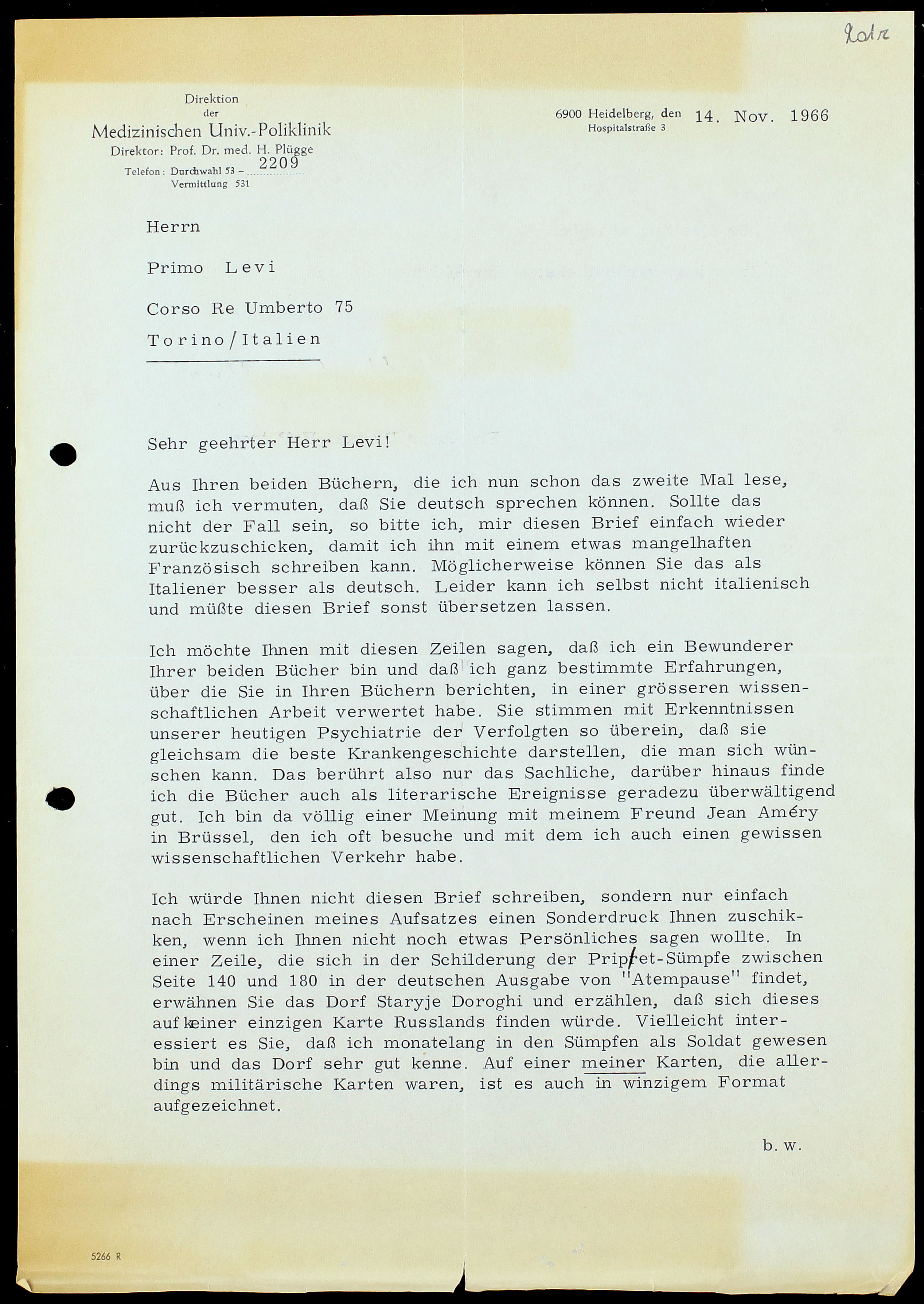
Herbert Plügge, a doctor and the director of the Heidelberg University Hospital, writes that a few observations Levi made about prisoners in his books correspond closely with their current psychiatric research and were therefore used in an essay of his, which he would send to Levi.
6900 Heidelberg, den 14. Nov. 1966
Hospitalstraße 3
Herrn Primo Levi Corso Re Umberto 75 Torino/Italien
Sehr geehrter Herr Levi!
Aus Ihren beidenBüchern, die ich nun schon das zweite Mal lese, muß ich vermuten, daß Sie deutsch sprechen können. Sollte das nicht der Fall sein, so bitte ich, mir diesen Brief einfach wieder zurückzuschicken, damit ich ihn mit einem etwas mangelhaften Französisch schreiben kann. Möglicherweise können Sie das als Italiener besser als deutsch. Leider kann ich selbst nicht italienisch und müßte diesen Brief sonst übersetzen lassen.
Ich möchte Ihnen mit diesen Zeilen sagen, daß ich ein Bewunderer IhrerbeidenBücher bin und daß ich ganz bestimmte Erfahrungen, über die Sie in Ihren Büchern berichten, in einer grösseren wissenschaftlichen Arbeit verwertet habe.[1] Sie stimmen mit Erkenntnissen unserer heutigen Psychiatrie der Verfolgten so überein, daß sie gleichsam die beste Krankengeschichte[2] darstellen, die man sich wünschen kann. Das berührt also nur das Sachliche, darüber hinaus finde ich dieBücher auch als literarische Ereignisse geradezu überwältigend gut. Ich bin da völlig einer Meinung mit meinem Freund Jean Améry in Brüssel, den ich oft besuche und mit dem ich auch einen gewissen wissenschaftlichen Verkehr habe.[3]
Ich würde Ihnen nicht diesen Brief schreiben, sondern nur einfach nach Erscheinen meines Aufsatzes einen Sonderdruck Ihnen zuschicken,[4] wenn ich Ihnen nicht noch etwas Persönliches sagen wollte. In einer Zeile, die sich in der Schilderung der Pripret-Sümpfe[5] zwischen Seite 140 und 180 in der deutschen Ausgabe von Atempausefindet, erwähnen Sie das Dorf Staryje Doroghi und erzählen, daß sich dieses auf keiner einzigen Karte Russlands finden würde.[6] Vielleicht interessiert es Sie, daß ich monatelang in den Sümpfen als Soldat gewesen bin und das Dorf sehr gut kenne.[7] Auf einer meiner[8] Karten, die allerdings militärische Karten waren, ist es auch in winzigem Format aufgezeichnet.
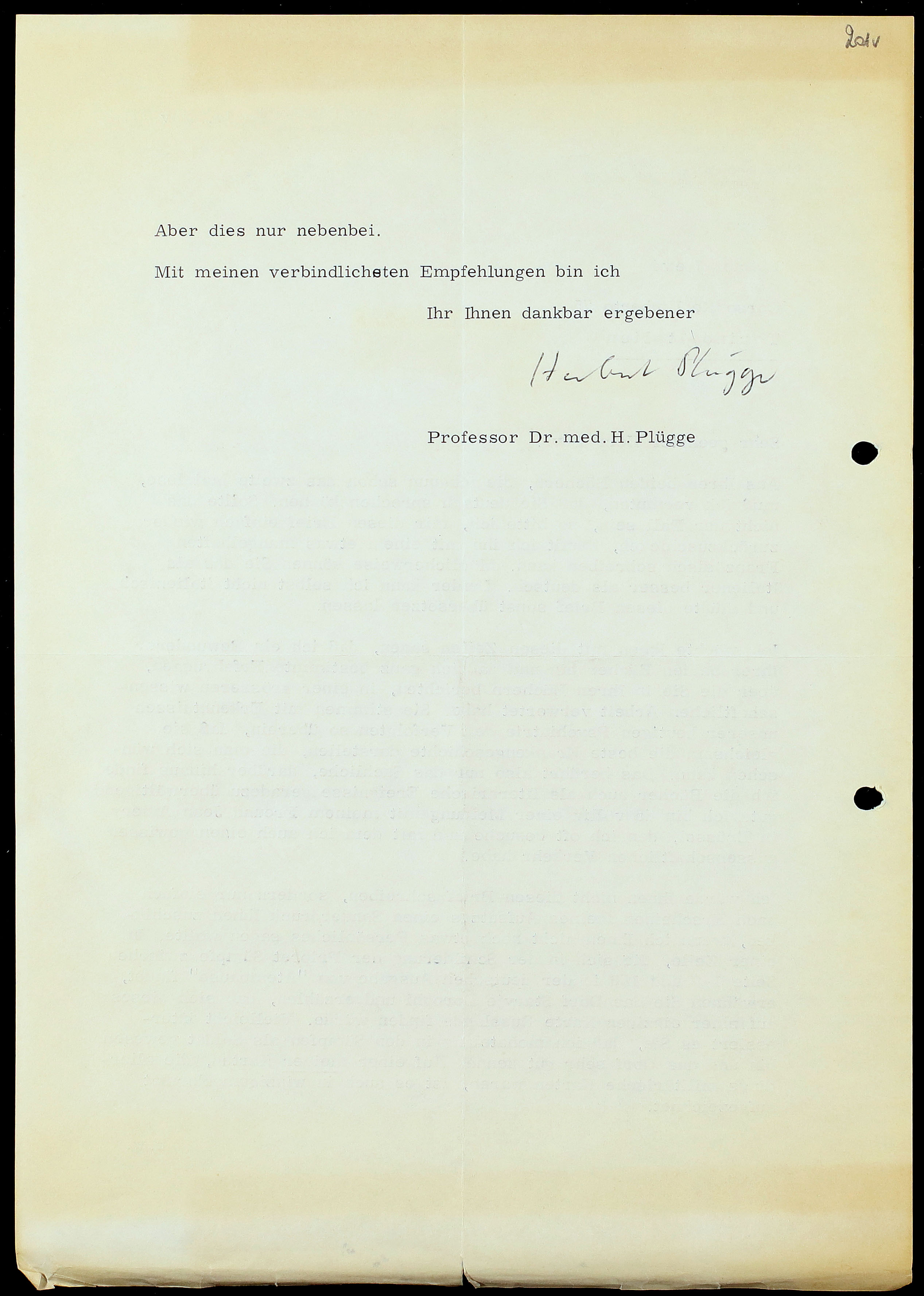
Aber dies nur nebenbei.
Mit meinen verbindlichsten Empfehlungen bin ich
Ihr Ihnen dankbar ergebener
Herbert Plügge Professor Dr. med. H. Plügge
6900 Heidelberg, 14 novembre 1966 Hospitalstraße 3
Signor Primo Levi Corso Re Umberto 75 Torino/Italia
Stimatissimo Signor Levi!
dai Suoi duelibri, che sto leggendo ora per la seconda volta, deduco che Lei parli tedesco. Se così non fosse, La prego semplicemente di rispedirmi questa lettera, così che possa riscriverla nel mio francese un po’ zoppicante. Forse, essendo Lei italiano, Le risulterà più comprensibile del tedesco. In caso contrario, dovrei far tradurre questa lettera, perché purtroppo a mia volta non conosco l’italiano.
Con queste righe desidero dirLe che sono un ammiratore dei Suoi duelibri e che ho utilizzato alcune esperienze specifiche da Lei descritte in un mio lavoro scientifico di ampio respiro.[1] Esse coincidono perfettamente con le conoscenze attuali della psichiatria dedicata alle vittime perseguitate, tanto da rappresentare una sorta di anamnesi ideale,[2] come difficilmente se ne trovano. Questo per quanto riguarda l’aspetto scientifico. Ma al di là di ciò, trovo che i Suoilibri siano anche eventi letterari di straordinaria qualità. Condivido in pieno l’opinione del mio amico Jean Améry di Bruxelles, che vado a trovare spesso e con cui ho anche scambi di natura scientifica.[3]
Non Le avrei scritto questa lettera, e mi sarei limitato piuttosto a spedirLe, una volta pubblicato, una copia del mio saggio,[4] se non avessi da comunicarLe anche qualcosa di personale. In una riga che si trova nella descrizione delle paludi del Pripet,[5] tra le pagine 140 e 180 dell’edizione tedesca di La tregua, lei menziona Staryje Doroghi e racconta che questo non si trova su nessuna mappa della Russia.[6] Forse Le interesserà sapere che ho trascorso mesi in quelle paludi come soldato e conosco molto bene il villaggio.[7]Su una delle mie mappe,[8] che però erano carte militari, è effettivamente segnato, anche se a caratteri minuscoli.
Ma questo è solo un dettaglio.
La saluto con viva cordialità e stima
Suo devoto e grato
Herbert Plügge Prof. Dott. H. Plügge
6900 Heidelberg, Nov. 14, 1966 Hospitalstraße 3
Mr. Primo Levi Corso Re Umberto 75 Turin/Italy
Dear Mr. Levi!
Having just read both ofyour books for the second time, I must assume that you speak German. If this is not the case, please simply return this letter to me so I can write it in my somewhat imperfect French. As an Italian, you may understand French better than German. Unfortunately, I myself do not speak Italian, and would otherwise have to have this letter translated.
I would like to tell you I admire both ofyour books, and that I have used certain experiences you describe in your books for a larger scientific work.[1]They correspond so closely with the findings of our current psychiatric research on persecution that they represent, as it were, the best case history[2]one could wish for. That is just the factual aspect; beyond that, I also find thebooks to be overwhelmingly good as literary works. I completely agree with my friend Jean Améry in Brussels, whom I visit often and with whom I also have a longstanding scientific dialogue.[3]
I would not be writing you this letter, and would instead simply send you a print copy of my essay once it is published,[4] if I did not also want to tell you something personal. In a line describing the Pripet Marshes[5] between pages 140 and 180 in the German edition of The Truce, you mention the village of Staryje Doroghi and say that it cannot be found on any map of Russia.[6] You may be interested to know that I spent months in those marshes as a soldier, and I know the village very well.[7] It is also marked in tiny print on one of my maps,[8] although they were military maps.
But this is just an aside.
With my sincerest regards, I remain, Yours gratefully,
Herbert Plügge Professor H. Plügge, MD
6900 Heidelberg, den 14. Nov. 1966
Hospitalstraße 3
Herrn Primo Levi Corso Re Umberto 75 Torino/Italien
Sehr geehrter Herr Levi!
Aus Ihren beidenBüchern, die ich nun schon das zweite Mal lese, muß ich vermuten, daß Sie deutsch sprechen können. Sollte das nicht der Fall sein, so bitte ich, mir diesen Brief einfach wieder zurückzuschicken, damit ich ihn mit einem etwas mangelhaften Französisch schreiben kann. Möglicherweise können Sie das als Italiener besser als deutsch. Leider kann ich selbst nicht italienisch und müßte diesen Brief sonst übersetzen lassen.
Ich möchte Ihnen mit diesen Zeilen sagen, daß ich ein Bewunderer IhrerbeidenBücher bin und daß ich ganz bestimmte Erfahrungen, über die Sie in Ihren Büchern berichten, in einer grösseren wissenschaftlichen Arbeit verwertet habe.[1] Sie stimmen mit Erkenntnissen unserer heutigen Psychiatrie der Verfolgten so überein, daß sie gleichsam die beste Krankengeschichte[2] darstellen, die man sich wünschen kann. Das berührt also nur das Sachliche, darüber hinaus finde ich dieBücher auch als literarische Ereignisse geradezu überwältigend gut. Ich bin da völlig einer Meinung mit meinem Freund Jean Améry in Brüssel, den ich oft besuche und mit dem ich auch einen gewissen wissenschaftlichen Verkehr habe.[3]
Ich würde Ihnen nicht diesen Brief schreiben, sondern nur einfach nach Erscheinen meines Aufsatzes einen Sonderdruck Ihnen zuschicken,[4] wenn ich Ihnen nicht noch etwas Persönliches sagen wollte. In einer Zeile, die sich in der Schilderung der Pripret-Sümpfe[5] zwischen Seite 140 und 180 in der deutschen Ausgabe von Atempausefindet, erwähnen Sie das Dorf Staryje Doroghi und erzählen, daß sich dieses auf keiner einzigen Karte Russlands finden würde.[6] Vielleicht interessiert es Sie, daß ich monatelang in den Sümpfen als Soldat gewesen bin und das Dorf sehr gut kenne.[7] Auf einer meiner[8] Karten, die allerdings militärische Karten waren, ist es auch in winzigem Format aufgezeichnet.
Aber dies nur nebenbei.
Mit meinen verbindlichsten Empfehlungen bin ich
Ihr Ihnen dankbar ergebener
Herbert Plügge Professor Dr. med. H. Plügge
6900 Heidelberg, 14 novembre 1966 Hospitalstraße 3
Signor Primo Levi Corso Re Umberto 75 Torino/Italia
Stimatissimo Signor Levi!
dai Suoi duelibri, che sto leggendo ora per la seconda volta, deduco che Lei parli tedesco. Se così non fosse, La prego semplicemente di rispedirmi questa lettera, così che possa riscriverla nel mio francese un po’ zoppicante. Forse, essendo Lei italiano, Le risulterà più comprensibile del tedesco. In caso contrario, dovrei far tradurre questa lettera, perché purtroppo a mia volta non conosco l’italiano.
Con queste righe desidero dirLe che sono un ammiratore dei Suoi duelibri e che ho utilizzato alcune esperienze specifiche da Lei descritte in un mio lavoro scientifico di ampio respiro.[1] Esse coincidono perfettamente con le conoscenze attuali della psichiatria dedicata alle vittime perseguitate, tanto da rappresentare una sorta di anamnesi ideale,[2] come difficilmente se ne trovano. Questo per quanto riguarda l’aspetto scientifico. Ma al di là di ciò, trovo che i Suoilibri siano anche eventi letterari di straordinaria qualità. Condivido in pieno l’opinione del mio amico Jean Améry di Bruxelles, che vado a trovare spesso e con cui ho anche scambi di natura scientifica.[3]
Non Le avrei scritto questa lettera, e mi sarei limitato piuttosto a spedirLe, una volta pubblicato, una copia del mio saggio,[4] se non avessi da comunicarLe anche qualcosa di personale. In una riga che si trova nella descrizione delle paludi del Pripet,[5] tra le pagine 140 e 180 dell’edizione tedesca di La tregua, lei menziona Staryje Doroghi e racconta che questo non si trova su nessuna mappa della Russia.[6] Forse Le interesserà sapere che ho trascorso mesi in quelle paludi come soldato e conosco molto bene il villaggio.[7]Su una delle mie mappe,[8] che però erano carte militari, è effettivamente segnato, anche se a caratteri minuscoli.
Ma questo è solo un dettaglio.
La saluto con viva cordialità e stima
Suo devoto e grato
Herbert Plügge Prof. Dott. H. Plügge
6900 Heidelberg, Nov. 14, 1966 Hospitalstraße 3
Mr. Primo Levi Corso Re Umberto 75 Turin/Italy
Dear Mr. Levi!
Having just read both ofyour books for the second time, I must assume that you speak German. If this is not the case, please simply return this letter to me so I can write it in my somewhat imperfect French. As an Italian, you may understand French better than German. Unfortunately, I myself do not speak Italian, and would otherwise have to have this letter translated.
I would like to tell you I admire both ofyour books, and that I have used certain experiences you describe in your books for a larger scientific work.[1]They correspond so closely with the findings of our current psychiatric research on persecution that they represent, as it were, the best case history[2]one could wish for. That is just the factual aspect; beyond that, I also find thebooks to be overwhelmingly good as literary works. I completely agree with my friend Jean Améry in Brussels, whom I visit often and with whom I also have a longstanding scientific dialogue.[3]
I would not be writing you this letter, and would instead simply send you a print copy of my essay once it is published,[4] if I did not also want to tell you something personal. In a line describing the Pripet Marshes[5] between pages 140 and 180 in the German edition of The Truce, you mention the village of Staryje Doroghi and say that it cannot be found on any map of Russia.[6] You may be interested to know that I spent months in those marshes as a soldier, and I know the village very well.[7] It is also marked in tiny print on one of my maps,[8] although they were military maps.
But this is just an aside.
With my sincerest regards, I remain, Yours gratefully,
Herbert Plügge Professor H. Plügge, MD
Info
Notes
Tag
Sender: Herbert Plügge
Addressee: Primo Levi
Date of Drafting: 1966-11-14
Place of Writing: Heidelberg
Description:typewritten letter on letterhead paper with handwritten signature in black ballpoint pen. Folio 201r has insertions and underlining handwritten by Plügge in black ballpoint pen.
Archive: Archivio privato di Primo Levi, Turin
Series: Complesso di fondi Primo Levi, Fondo Primo Levi, Corrispondenza, Corrispondenti particolari, Fasc.020, sottofasc. 001, doc.069, f.201r/v
Folio: 1, front and back
Letterhead: Direktion
Der
Medizinischen Univ.-Poliklinik
Direktor: Prof. Dr. med. H. Plügge
Telefon: Durchwahl 53 - 2209
Vermittlung 531
DOI: https://doi.org/10.15160/7hp3-4x65
1The reference is to “Über die Arten der menschlichen Befangenheit”(“On the forms of human imprisonment”), an article published in the journal Jahrbuch für Psychologie und Psychotherapie in 1967. As in many other studies by Plügge, the essay combines an analysis of clinical cases with phenomenological reflections on experiencing illness. In this contribution, Plügge analyzes existential inhibition [Befangenheit] as a consequence of the trauma of illness, drawing parallels with the testimony of survivors of Nazi deportation. The two examples taken into consideration are Intellettuale ad Auschwitz (“An Intellectual at Auschwitz”)by Améry and The Truce by Primo Levi.
2The concept and the procedure of “anamnesis” are central to Plügge’s medical approach, both from a diagnostic standpoint (as a shift from quantitative clinical research to qualitative research) and as an instrument of phenomenological analysis of the patient’s existential condition (a topic to which Plügge dedicated his most distinctly philosophical research). To this regard, see the biography of Herbert Plügge. As Plügge wrote in 1965: “Anamnesis is a joint effort by the doctor and the patient in an attempt to find, or at least trace, the pathway toward an objective fact, that is to say, the pathological fact of the illness and the meaning of this illness to the patient,” cf. H. Plügge, “Über die Anamnese” in Der Mensch und sein Leib, Tübingen: Max Niemeyer Verlag, 1967, p. 114.
3In March 1969, the journal Merkur published a review Jean Améry wrote of two books by Plügge (Wohlbefinden und Mißbefinden [“Well-being and malaise”] from 1962 and Der Mensch und sein Leib [“Man and his body”] from 1967); the review was entitled “Die Welt des leidenden Menschen. Hinweis auf zwei Bücher von Herbert Plügge” (“The world of the suffering human. Regarding two books by Herbert Plügge”). Améry openly acknowledges his fascination with Plügge’s medical-phenomenological studies in his 1968 book On Aging: Revolt and Resignation. Along with the philosophers Vladimir Jankelevitc and André Gorz, he indicates Plügge as one of the three primary sources of the book, and his Wohlbefinden und Mißbefinden from 1962 is defined as “incomparably thoughtful,” cf. J. Améry, On Aging: Revolt and Resignation, Bloomington and Indianapolis: Indiana University Press, 1994, pp. 120 and 130. On this topic, see the biography of Herbert Plügge.
4“zuschikken” typewritten.
5In the chapter “A Little Hen” from The Truce, Levi describes the Pripet marshes he must traverse with his travel companions: “We left with a certain bravado: the weather was splendid, we were fairly well nourished, and the idea of a long walk in the heart of that legendary country, the Pripet Marshes, had in itself a certain fascination. But our opinion very quickly changed. In no other part of Europe, I believe, can you walk for ten hours and find yourself always in the same place, as in a nightmare: always ahead of you the road leads straight to the horizon, always on both sides is steppe and forest, and always behind you the road goes straight to the opposite horizon, like the wake of a ship; and there are no villages, no houses, no smoke, not a milestone that in some way might indicate that a little distance has been gained; and you do not meet a living soul, except flocks of crows, or a hawk cruising lazily in the wind” (CW I, p. 324).
6“But on no map is the village called Starye Doroghi, our final destination, marked” (The Truce. CW I, p. 321). The city, whose correct name is Staryya Darohi, is located in Belarus, a few kilometers south of Minsk.
7Between July and August 1941, during the early days of their invasion of the Soviet Union, the German army perpetrated the first massacres of civilians, for the most part Jews, in the Pripet marshes, on the border between Ukraine and Belarus. Levi shows he is well acquainted with these events, when he writes in his notes for the school edition of The Truce: “Legendary because it was the theater of gigantic, bloody battles. The Pripet marshes were often mentioned, but never described, in chronicles of the war” (OC I, p. 1396). The battles of the Pripet marshes also return in If Not Now, When?, published in 1981 (CW II, pp. 1655 and 1667).
8“meiner” is underlined by Plügge in black ballpoint pen.