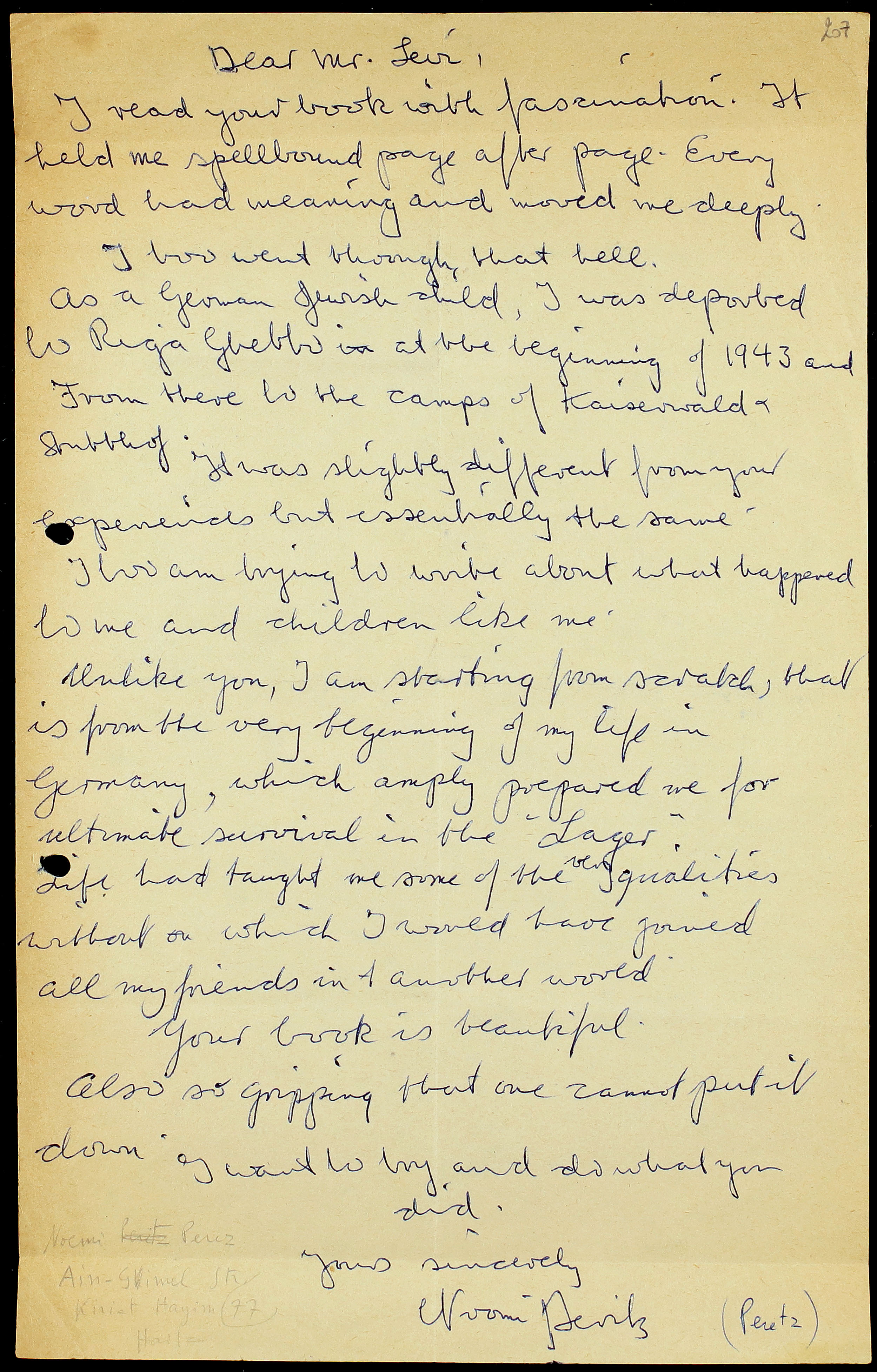
Noomi Peritz, a German Jew corresponding from Haifa (Israel), writes that she was enchanted by Ist das ein Mensch? and that, as a child, she, too, had been deported to the concentration camps of Kaiserwald (Riga) and Stutthof (Gdansk).
Dear Mr. Levi,
I read your book with fascination. It held spellbound page after page. Every word had meaning and moved me deeply.
I too went through that hell.
As a German Jewish child, I was deported[1] to Riga Ghetto[2] at the beginning of 1943 and from there to the camps of Kaiserwald[3] – Stutthof.[4]
It was slightly different from your experiences but essentially the same.
I too am beginning to write about what happened to me and children like me.[5]
Unlike you, I am starting from scratch, that is from the very beginning of my life in Germany, which amply prepared me for ultimate survival in the “Lager”.
Life had taught me some of the very qualities without which I would have joined all my friends in another world.
Your book is beautiful.
Also so gripping that one cannot put it down.
I want to try and do what you did.
Yours sincerely
Noomi Peritz
Gentile Signor Levi,
ho letto affascinata il Suo libro. Mi ha tenuta avvinta pagina dopo pagina. Ogni parola aveva significato e mi ha toccato profondamente.
Anche io ho attraversato quell’inferno.
In quanto bambina ebrea tedesca, sono stata deportata[1] nel ghetto di Riga[2] all’inizio del 1943 e da lì nei campi di Kaiserwald[3]-Stutthof.[4]
È stato leggermente diverso dalle Sue esperienze ma essenzialmente la stessa cosa.
Anche io sto cominciando a scrivere di quello che è successo a me e a bambini come me.[5]
A differenza Sua, io sto cominciando da zero, cioè dall’inizio della mia vita in Germania, che mi ha ampliamente preparata alla sopravvivenza nel «Lager».
La vita mi ha insegnato alcune qualità senza le quali sarei finita anche io all’altro mondo come tutti i miei amici.
Il Suo libro è molto bello.
E anche così avvincente che non lo si può mettere giù.
Voglio provare a fare quello che ha fatto Lei.
Sua
Noomi Peritz
Dear Mr. Levi,
I read your book with fascination. It held spellbound page after page. Every word had meaning and moved me deeply.
I too went through that hell.
As a German Jewish child, I was deported[1] to Riga Ghetto[2] at the beginning of 1943 and from there to the camps of Kaiserwald[3] – Stutthof.[4]
It was slightly different from your experiences but essentially the same.
I too am beginning to write about what happened to me and children like me.[5]
Unlike you, I am starting from scratch, that is from the very beginning of my life in Germany, which amply prepared me for ultimate survival in the “Lager”.
Life had taught me some of the very qualities without which I would have joined all my friends in another world.
Your book is beautiful.
Also so gripping that one cannot put it down.
I want to try and do what you did.
Yours sincerely
Noomi Peritz
Dear Mr. Levi,
I read your book with fascination. It held spellbound page after page. Every word had meaning and moved me deeply.
I too went through that hell.
As a German Jewish child, I was deported[1] to Riga Ghetto[2] at the beginning of 1943 and from there to the camps of Kaiserwald[3] – Stutthof.[4]
It was slightly different from your experiences but essentially the same.
I too am beginning to write about what happened to me and children like me.[5]
Unlike you, I am starting from scratch, that is from the very beginning of my life in Germany, which amply prepared me for ultimate survival in the “Lager”.
Life had taught me some of the very qualities without which I would have joined all my friends in another world.
Your book is beautiful.
Also so gripping that one cannot put it down.
I want to try and do what you did.
Yours sincerely
Noomi Peritz
Gentile Signor Levi,
ho letto affascinata il Suo libro. Mi ha tenuta avvinta pagina dopo pagina. Ogni parola aveva significato e mi ha toccato profondamente.
Anche io ho attraversato quell’inferno.
In quanto bambina ebrea tedesca, sono stata deportata[1] nel ghetto di Riga[2] all’inizio del 1943 e da lì nei campi di Kaiserwald[3]-Stutthof.[4]
È stato leggermente diverso dalle Sue esperienze ma essenzialmente la stessa cosa.
Anche io sto cominciando a scrivere di quello che è successo a me e a bambini come me.[5]
A differenza Sua, io sto cominciando da zero, cioè dall’inizio della mia vita in Germania, che mi ha ampliamente preparata alla sopravvivenza nel «Lager».
La vita mi ha insegnato alcune qualità senza le quali sarei finita anche io all’altro mondo come tutti i miei amici.
Il Suo libro è molto bello.
E anche così avvincente che non lo si può mettere giù.
Voglio provare a fare quello che ha fatto Lei.
Sua
Noomi Peritz
Dear Mr. Levi,
I read your book with fascination. It held spellbound page after page. Every word had meaning and moved me deeply.
I too went through that hell.
As a German Jewish child, I was deported[1] to Riga Ghetto[2] at the beginning of 1943 and from there to the camps of Kaiserwald[3] – Stutthof.[4]
It was slightly different from your experiences but essentially the same.
I too am beginning to write about what happened to me and children like me.[5]
Unlike you, I am starting from scratch, that is from the very beginning of my life in Germany, which amply prepared me for ultimate survival in the “Lager”.
Life had taught me some of the very qualities without which I would have joined all my friends in another world.
Your book is beautiful.
Also so gripping that one cannot put it down.
I want to try and do what you did.
Yours sincerely
Noomi Peritz
Info
Notes
Tag
Sender: Noomi Blumenfeld-Peritz
Addressee: Primo Levi
Date of Drafting: 0000-01-01
Place of Writing: Haifa
Description:handwritten letter in blue fountain pen. On the lower margin of the sheet, alongside the correspondent’s signature, are two handwritten notes by Levi: to the right, in blue ballpoint pen, he has written: “(Peretz),” and to the left he has written in pencil: “Noemi Peritz Perez | Ain Glimel Str | Kiriat Hayin 77 | Haifa.” It is not clear which is the correct spelling of the woman’s last name: Peritz – Peretz – Perez (mm206x325).
Archive: Archivio privato di Primo Levi, Turin
Series: Complesso di fondi Primo Levi, Fondo Primo Levi, Corrispondenza, Corrispondenti particolari, Fasc. 20, sottofasc. 1, doc. 074, f.207
Folio: 1 front only
DOI: https://doi.org/10.15160/v0vb-0421
1Regarding the experience of Noomi Peritz during the years of the racial laws, cf. the section Correspondence in her biography.
2The Riga ghetto was instituted on October 25, 1941. Due to the great number of arrivals, it was often overcrowded and, as a result, mass killings of the population were frequently conducted by the SS to “reduce” the number of inhabitants. One of the bloodiest of these massacres was the Aktion Dünamünde in March 1942, when approximately 3,800 people, primarily children and the elderly, were shot in Biķernieki forest. The Riga ghetto was closed on November 2, 1943 and its survivors were subsequently transferred to the concentration camp of Kaiserwald. Cf. G. Schneider, Journey Into Terror. Story of the Riga Ghetto, Westport: Praeger, 2001.
3The concentration camp of Riga-Kaiserwald was instituted on March 15, 1943. It housed the survivors of the Jewish ghettos that had been constructed in Latvia following the Nazi occupation. Kaiserwald was not used as an extermination camp and its function was to provide slave labor to the German companies that had opened factories in Riga. One of the major industries that took advantage of the forced labor of the inmates, in particular the prisoners, was the AEG-Allgemeine Elektrizitäts-Gesellschaft. The camp was liberated by the Red Army on October 13, 1944.
4The concentration camp of Stutthof (near Danzig) was instituted on September 2, 1939. A gas chamber was installed between 1943 and 1944. When the camp of Kaiserwald was evacuated during the Russian advance in August 1944, the prisoners were subsequently transferred to Stutthof. It was liberated by the Red Army on May 9, 1945.
5At the moment, no written testimony by Noomi Peritz has come to light.