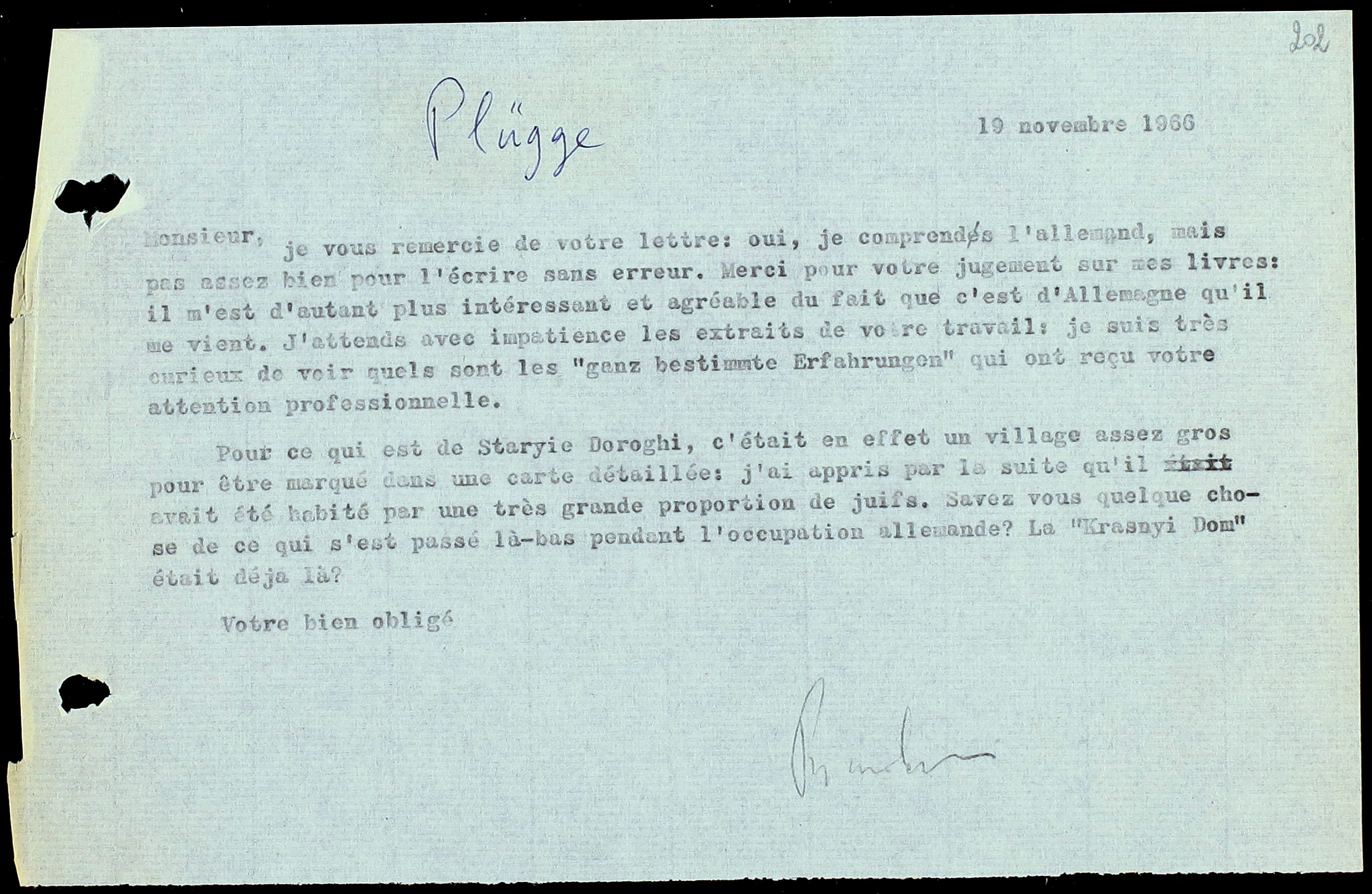
Levi thanks Plügge and says he looks forward to reading the paper.
19 novembre 1966
Monsieur,
je vous remercie de votre lettre: oui, je comprends l’allemand, mais pas assez bien pour l’écrire sans erreur. Merci pour votre jugement sur meslivres: il m’est d’autant plus intéressant et agréable du fait que c’est d’Allemagne qu’il me vient. J’attends avec impatience les extraits de votre travail: je suis très curieux de voir quels sont les “ganz bestimmte Erfahrungen” qui ont reçu votre attention professionnelle.
Pour ce qui est de Staryie Doroghi, c’était en effet un village assez gros pour être marqué dans une carte détaillée: j’ai appris par la suite qu’il avait été habité par une très grande proportion de juifs. Savez vous quelque chose de ce qui s’est passé là-bas pendant l’occupation allemande?[1]La “Krasnyi Dom” était déja là?[2]
Votre bien obligé
Primo Levi
19 novembre 1966
Signore,
La ringrazio della Sua lettera: sì, capisco il tedesco, ma non così bene da scriverlo senza errori. Grazie per il giudizio sui mieilibri: lo reputo tanto più interessante e gradevole per il fatto che mi arriva dalla Germania. Attendo con impazienza gli estratti del Suo saggio: sono assai curioso di vedere quali sono le “esperienze molto specifiche” che hanno ricevuto la Sua attenzione professionale.
Quanto a Staryie Doroghi, era infatti un paese abbastanza grande da essere segnato su una carta dettagliata: ho appreso in seguito che era abitato da un’altissima percentuale di ebrei. Lei ha notizia di che cos’è successo lì durante l’occupazione tedesca?[1] C’era già la “Krasnyi Dom”?[2]
Con riconoscenza
Primo Levi
November 19, 1960
Sir,
I thank you for your letter: yes, I understand German, but not well enough to write it without mistakes. Thank you for your opinion of mybooks: it is especially interesting and enjoyable for me because it comes to me from Germany. I am eagerly awaiting the excerpts of your work: I am very curious to see what the “ganz bestimmte Erfahrungen” are that have received your professional attention.
Regarding Staryie Doroghi, it was indeed a village large enough to be marked on a detailed map: I learned later that it had been inhabited by a very large percentage of Jews. Do you know anything about what happened there during the German occupation?[1]Was the “Krasnyi Dom” already there?[2]
Gratefully
Primo Levi
19 novembre 1966
Monsieur,
je vous remercie de votre lettre: oui, je comprends l’allemand, mais pas assez bien pour l’écrire sans erreur. Merci pour votre jugement sur meslivres: il m’est d’autant plus intéressant et agréable du fait que c’est d’Allemagne qu’il me vient. J’attends avec impatience les extraits de votre travail: je suis très curieux de voir quels sont les “ganz bestimmte Erfahrungen” qui ont reçu votre attention professionnelle.
Pour ce qui est de Staryie Doroghi, c’était en effet un village assez gros pour être marqué dans une carte détaillée: j’ai appris par la suite qu’il avait été habité par une très grande proportion de juifs. Savez vous quelque chose de ce qui s’est passé là-bas pendant l’occupation allemande?[1]La “Krasnyi Dom” était déja là?[2]
Votre bien obligé
Primo Levi
19 novembre 1966
Signore,
La ringrazio della Sua lettera: sì, capisco il tedesco, ma non così bene da scriverlo senza errori. Grazie per il giudizio sui mieilibri: lo reputo tanto più interessante e gradevole per il fatto che mi arriva dalla Germania. Attendo con impazienza gli estratti del Suo saggio: sono assai curioso di vedere quali sono le “esperienze molto specifiche” che hanno ricevuto la Sua attenzione professionale.
Quanto a Staryie Doroghi, era infatti un paese abbastanza grande da essere segnato su una carta dettagliata: ho appreso in seguito che era abitato da un’altissima percentuale di ebrei. Lei ha notizia di che cos’è successo lì durante l’occupazione tedesca?[1] C’era già la “Krasnyi Dom”?[2]
Con riconoscenza
Primo Levi
November 19, 1960
Sir,
I thank you for your letter: yes, I understand German, but not well enough to write it without mistakes. Thank you for your opinion of mybooks: it is especially interesting and enjoyable for me because it comes to me from Germany. I am eagerly awaiting the excerpts of your work: I am very curious to see what the “ganz bestimmte Erfahrungen” are that have received your professional attention.
Regarding Staryie Doroghi, it was indeed a village large enough to be marked on a detailed map: I learned later that it had been inhabited by a very large percentage of Jews. Do you know anything about what happened there during the German occupation?[1]Was the “Krasnyi Dom” already there?[2]
Gratefully
Primo Levi
Info
Notes
Tag
Sender: Primo Levi
Addressee: Herbert Plügge
Date of Drafting: 1966-11-19
Place of Writing: Turin
Description:copy of typewritten letter on onionskin paper with handwritten signature in black ballpoint pen. In the upper margin of the sheet, “Plügge” is handwritten by Levi in blue ballpoint pen.
Archive: Archivio privato di Primo Levi, Turin
Series: Complesso di fondi Primo Levi, Fondo Primo Levi, Corrispondenza, Corrispondenti particolari, Fasc.020, sottofasc. 001, doc.070, f.202
Folio: 1, front only
DOI: https://doi.org/10.15160/9nh5-mx09
1Levi is referring to the massacres perpetrated during the summer of 1941 against the Jewish population as the Germans advanced on Moscow. On this topic, see Christopher Browning, The Origins of the Final Solution, Lincoln: University of Nebraska Press, 2004, in particular chapters 7 and 8 (pp. 244-373), and Henning Pieper, Fegelein’s horsemen and genocidal warfare, London: Palgrave Macmillan, 2015, in particular pp. 69-121.
2The reference is to the “Red House,” the immense building that housed the fourteen hundred Italians awaiting repatriation, cf. CW I, p. 333.