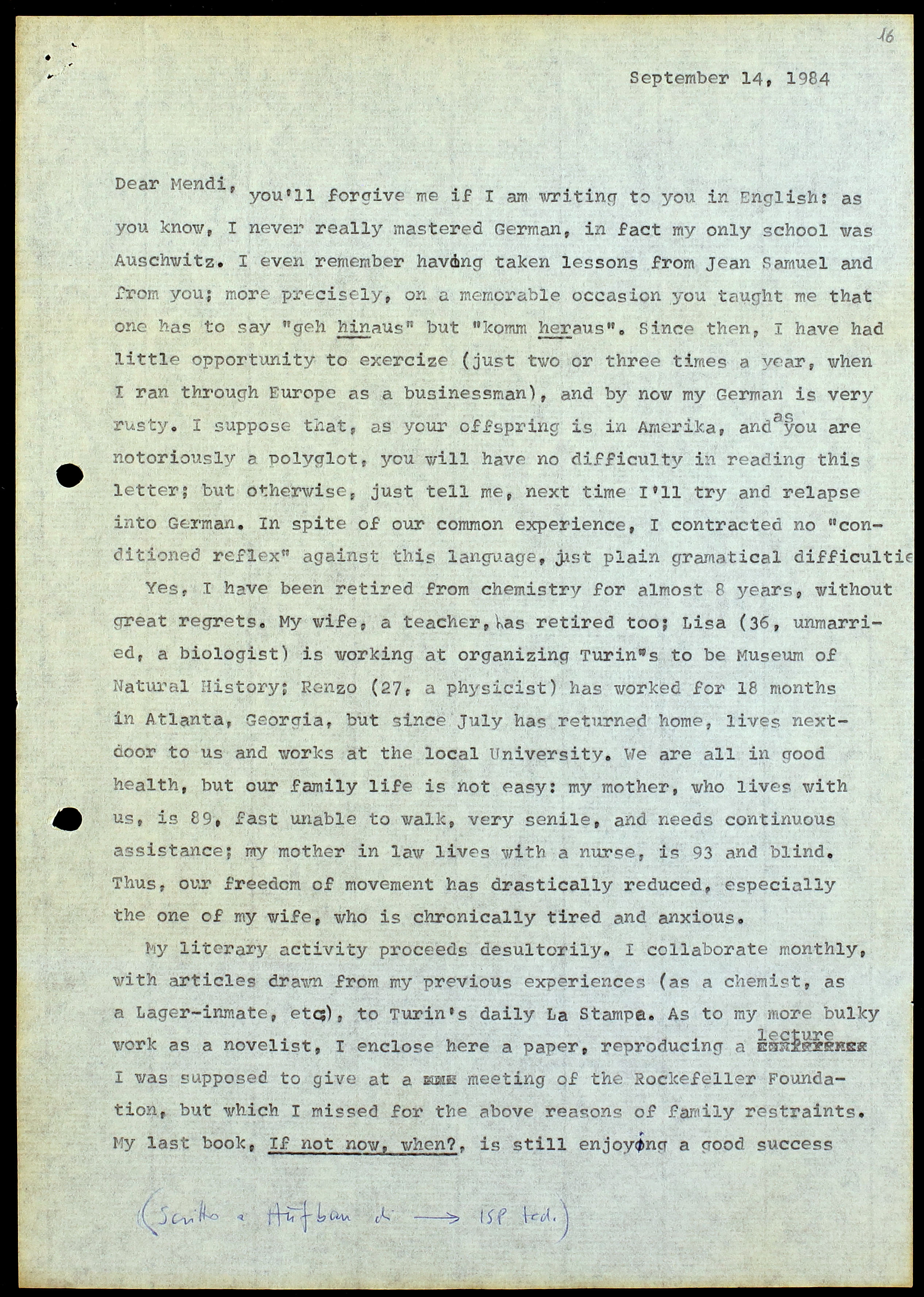
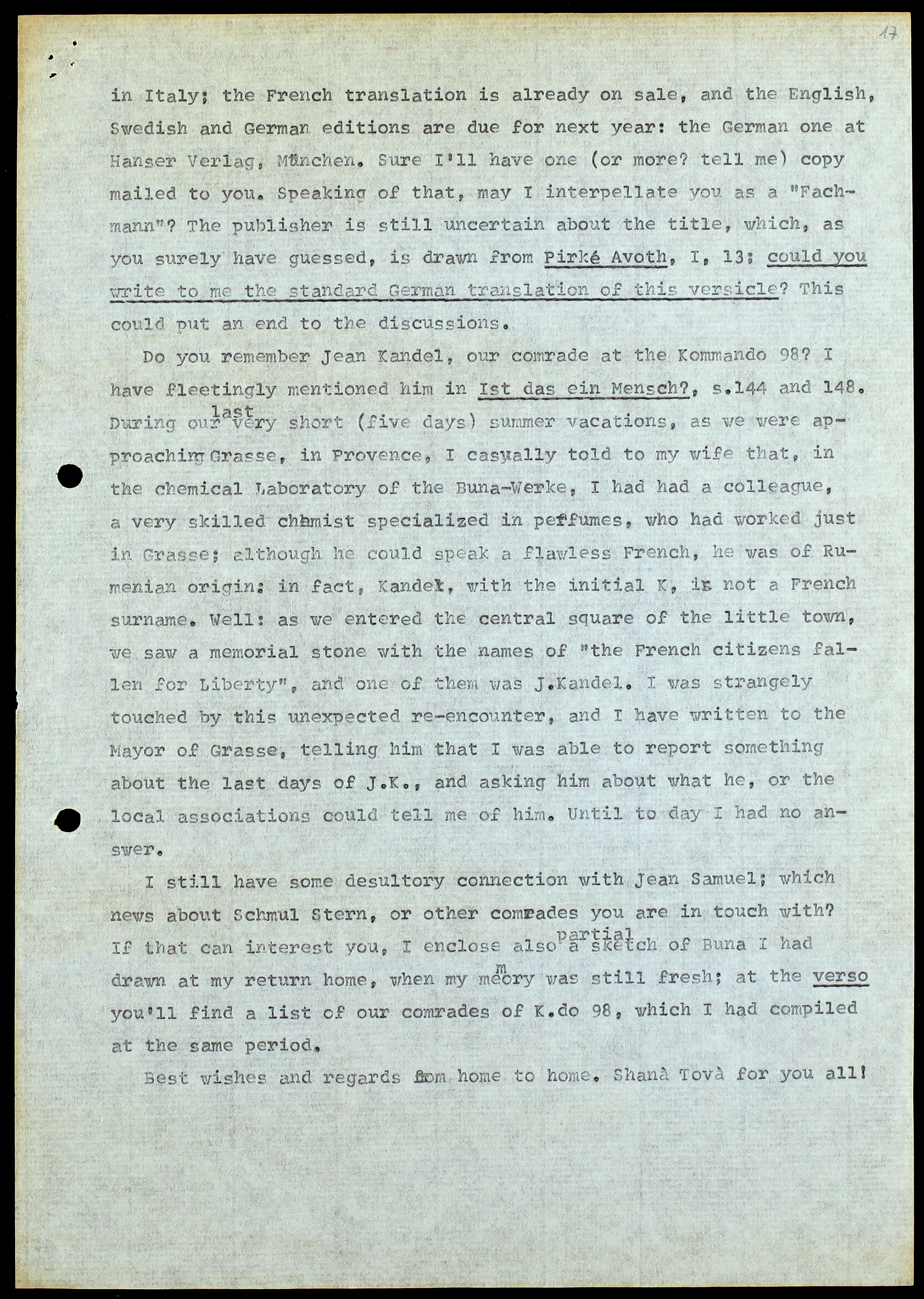
Levi risponde agli auguri di Davidovic e lo informa degli ultimi sviluppi editoriali legati a Se non ora quando?. Gli invia un vecchio schizzo del campo accompagnato da un elenco di nomi dei compagni del Kommando chimico 98.
you’ll forgive me if I am writing to you in English: as you know, I never really mastered German, in fact my only school was Auschwitz. I even remember having taken lessons from Jean Samuel and from you; more precisely, on a memorable occasion you taught me that one has to say “geh hinaus” but “komm heraus”. [1] Since then, I have had little opportunity to exercize (just two or three times a year, when I ran through Europe as a businessman), and by now my German is very rusty. I suppose that, as your offspring is in Amerika, and as[2] you are notoriously a polyglot, you will have no difficulty in reading this letter; but otherwise, just tell me, next time I’ll try and relapse into German. In spite of our common experience, I contracted no “conditioned reflex” against this language, just plain gramatical difficulties.
Yes, I have been retired from chemistry for almost 8 years, without great regrets. My wife, a teacher, has[3] retired too; Lisa (36, unmarried, a biologist) is working at organizing Turin’s to be Museum of Natural History; Renzo (27, a physicist) has worked for 18 months in Atlanta, Georgia, but since July has returned home, lives next-door to us and works at the local University. We are all in good health, but our family life is not easy: my mother, who lives with us, is 89, fast unable to walk, very senile, and needs continuous assistance; my mother in law lives with a nurse, is 93 and blind. Thus, our freedom of movement has drastically reduced, especially the one of my wife, who is chronically tired and anxious.
My literary activity proceeds desultorily. I collaborate monthly, with articles drawn from my previous experiences (as a chemist, as a Lager-inmate, etc), to Turin’s daily «La Stampa».[4] As to my more bulky work as a novelist,[5] I enclose here a paper, reproducing a lecture I was supposed to give at a meeting of the Rockefeller Foundation, but which I missed for the above reasons of family restraints.[6] My last book. If not now, when?, is still enjoying a good success in Italy; the French translation is already on sale, and the English, Swedish and German editions are due for next year: the German one at Hanser Verlag, München. Sure I’ll have one (or more? tell me) copy mailed to you. Speaking of that, may I interpellate you as a “Fachmann”? The publisher is still uncertain about the title,[7] which, as you surely have guessed, is drawn from Pirké Avoth, I, 13:[8]could you write to me the standard German translation of this versicle? This could put an end to the discussions.
Do you remember Jean Kandel, our comrade at the Kommando 98? I have fleetingly mentioned him in Ist das ein Mensch?, s. 144 and 148.[9] During our last[10] very short (five days) summer vacations, as we were approaching Grasse, in Provence, I casually told to my wife that, in the chemical Laboratory of the Buna-Werke, I had had a colleague, a very skilled chemist specialized in perfumes, who had worked just in Grasse; although he could speak a flawless French, he was of Rumenian origin: in fact, Kandel, with the initial K, is not a French surname. Well: as we entered the central square of the little town, we saw a memorial stone with the names of «the French citizens fallen for Liberty», and one of them was J. Kandel.[11]I was strangely touched by this unexpected re-encounter, and I have written to the Mayor of Grasse, telling him that I was able to report something about the last days of J.K., and asking him about what he, or the local associations could tell me of him. Until to day I had no answer.
I still have some desultory connection with Jean Samuel; which news about Schmul Stern, or other comrades you are in touch with? If that can interest you, I enclose also a partial[12] sketch of Buna I had drawn at my return home, when my memory[13]was still fresh; at the verso you’ll find a list of our comrades of Kommando 98, which I had compiled at the same period.[14]
Best wishes and regards from home to home, Shanà Tovà for you all!
14 settembre 1984
Caro Mendi,
mi perdonerai se ti scrivo in inglese: come sai, non ho mai davvero padroneggiato il tedesco, di fatto la mia unica scuola è stata Auschwitz. Ricordo anche di aver preso lezioni da te e da Jean Samuel; più precisamente, in un’occasione memorabile mi avete insegnato che si dice «geh hinaus» ma «komm heraus».[1] Da allora, ho avuto poche opportunità per esercitarmi (solo due o tre volte all’anno, quando corro in giro per l’Europa da uomo d’affari), e ormai il mio tedesco è molto arrugginito. Presumo che, essendo i tuoi figli in America, ed essendo tu[2] notoriamente un poliglotta, non avrai difficoltà a leggere questa lettera; se così non fosse, dimmelo e la prossima volta cercherò tornare al tedesco. Nonostante la nostra comune esperienza, non mi è venuto nessun «riflesso condizionato» contro questa lingua, si tratta solo di difficoltà grammaticali.
Sì, come chimico sono in pensione da quasi 8 anni, senza grandi rimpianti. Anche mia moglie, insegnante, è[3] in pensione; Lisa (36 anni, non sposata, biologa) sta lavorando all’organizzazione del futuro Museo di Scienze naturali di Torino; Renzo (27 anni, fisico) ha lavorato per 18 mesi ad Atlanta, Georgia, ma da luglio è tornato a casa, abita accanto a noi e lavora all’università locale. Siamo tutti in buona salute, ma la nostra vita famigliare non è facile; mia madre, che abita con noi, ha 89 anni, ormai non cammina quasi più, soffre di demenza senile e ha bisogno di continua assistenza; mia suocera abita con un’assistente domiciliare, ha 93 anni ed è cieca. Quindi la nostra libertà di movimento si è drasticamente ridotta, specie quella di mia moglie, che è perennemente stanca e ansiosa.
La mia attività letteraria procede a singhiozzi. Collaboro mensilmente al quotidiano torinese «La Stampa» con articoli che trattano delle mie passate esperienze (di chimico, di prigioniero nel Lager, ecc.).[4] Quanto al mio più corposo lavoro di romanziere[5], allego qui la riproduzione di una conferenza che avrei dovuto tenere alla Rockefeller Foundation, ma che ho disertato per le suddette ragioni di impegni famigliari.[6] Il mio ultimo libro, Se non ora, quando?, in Italia sta ancora avendo un buon successo; la traduzione francese è già in commercio, e per il prossimo anno si attendono quella inglese, svedese e tedesca: la tedesca presso la Hanser Verlag di Monaco. Di sicuro te ne farò spedire una copia (o più d’una? dimmi tu). A questo proposito, posso interpellarti in quanto «specialista»? L’editore è ancora incerto riguardo al titolo,[7] che, come certo avrai intuito, è tratto dal Pirké Avoth I, 13:[8]potresti scrivermi la traduzione tedesca standard di questo versetto? Ciò potrebbe porre fine alle discussioni.
Ti ricordi di Jean Kandel, nostro compagno al Kommando 98? L’ho menzionato di sfuggita in Se questo è un uomo, pp. 144 e 148 dell’edizione tedesca.[9] Durante la nostra ultima[10] breve (cinque giorni) vacanza estiva, mentre arrivavamo a Grasse, in Provenza, mi è venuto da raccontare a mia moglie che nel laboratorio chimico della Buna-Werke avevo avuto un collega, un chimico molto competente specializzato in profumi, che aveva lavorato proprio a Grasse; sebbene parlasse un francese impeccabile, era di origini rumene: difatti, Kandel, con la K iniziale, non è un cognome francese. Ebbene: appena entrati nella piazza centrale della cittadina, abbiamo visto una lapide coi nomi dei «cittadini francesi caduti per la libertà», e uno di loro era J. Kandel.[11] Sono stato stranamente toccato da questo ri-incontro inatteso, e ho scritto al sindaco di Grasse, dicendogli che avrei potuto riferire qualcosa sugli ultimi giorni di J.K., e chiedendogli che cosa lui, o le associazioni locali, potessero dirmi di lui. Fino a oggi non ho avuto risposta.
Ho ancora qualche saltuario rapporto con Jean Samuel; tu che notizie hai di Schmul Stern, o di altri compagni con cui sei rimasto in contatto? Se può interessarti, allego anche un parziale schizzo[12] della Buna disegnato al mio ritorno a casa, quando i miei ricordi[13] erano ancora freschi; sul verso troverai un elenco dei nostri compagni del Kommando 98, che ho compilato in quello stesso periodo.[14]
I miei migliori auguri e saluti da casa a casa, Shanà Tovà a tutti voi!
September 14, 1984
Dear Mendi,
you’ll forgive me if I am writing to you in English: as you know, I never really mastered German, in fact my only school was Auschwitz. I even remember having taken lessons from Jean Samuel and from you; more precisely, on a memorable occasion you taught me that one has to say “geh hinaus” but “komm heraus”. [1] Since then, I have had little opportunity to exercize (just two or three times a year, when I ran through Europe as a businessman), and by now my German is very rusty. I suppose that, as your offspring is in Amerika, and as[2] you are notoriously a polyglot, you will have no difficulty in reading this letter; but otherwise, just tell me, next time I’ll try and relapse into German. In spite of our common experience, I contracted no “conditioned reflex” against this language, just plain gramatical difficulties.
Yes, I have been retired from chemistry for almost 8 years, without great regrets. My wife, a teacher, has[3] retired too; Lisa (36, unmarried, a biologist) is working at organizing Turin’s to be Museum of Natural History; Renzo (27, a physicist) has worked for 18 months in Atlanta, Georgia, but since July has returned home, lives next-door to us and works at the local University. We are all in good health, but our family life is not easy: my mother, who lives with us, is 89, fast unable to walk, very senile, and needs continuous assistance; my mother in law lives with a nurse, is 93 and blind. Thus, our freedom of movement has drastically reduced, especially the one of my wife, who is chronically tired and anxious.
My literary activity proceeds desultorily. I collaborate monthly, with articles drawn from my previous experiences (as a chemist, as a Lager-inmate, etc), to Turin’s daily «La Stampa».[4] As to my more bulky work as a novelist,[5] I enclose here a paper, reproducing a lecture I was supposed to give at a meeting of the Rockefeller Foundation, but which I missed for the above reasons of family restraints.[6] My last book. If not now, when?, is still enjoying a good success in Italy; the French translation is already on sale, and the English, Swedish and German editions are due for next year: the German one at Hanser Verlag, München. Sure I’ll have one (or more? tell me) copy mailed to you. Speaking of that, may I interpellate you as a “Fachmann”? The publisher is still uncertain about the title,[7] which, as you surely have guessed, is drawn from Pirké Avoth, I, 13:[8]could you write to me the standard German translation of this versicle? This could put an end to the discussions.
Do you remember Jean Kandel, our comrade at the Kommando 98? I have fleetingly mentioned him in Ist das ein Mensch?, s. 144 and 148.[9] During our last[10] very short (five days) summer vacations, as we were approaching Grasse, in Provence, I casually told to my wife that, in the chemical Laboratory of the Buna-Werke, I had had a colleague, a very skilled chemist specialized in perfumes, who had worked just in Grasse; although he could speak a flawless French, he was of Rumenian origin: in fact, Kandel, with the initial K, is not a French surname. Well: as we entered the central square of the little town, we saw a memorial stone with the names of «the French citizens fallen for Liberty», and one of them was J. Kandel.[11]I was strangely touched by this unexpected re-encounter, and I have written to the Mayor of Grasse, telling him that I was able to report something about the last days of J.K., and asking him about what he, or the local associations could tell me of him. Until to day I had no answer.
I still have some desultory connection with Jean Samuel; which news about Schmul Stern, or other comrades you are in touch with? If that can interest you, I enclose also a partial[12] sketch of Buna I had drawn at my return home, when my memory[13] was still fresh; at the verso you’ll find a list of our comrades of Kommando 98, which I had compiled at the same period.[14]
Best wishes and regards from home to home, Shanà Tovà for you all!
September 14, 1984
Dear Mendi,
you’ll forgive me if I am writing to you in English: as you know, I never really mastered German, in fact my only school was Auschwitz. I even remember having taken lessons from Jean Samuel and from you; more precisely, on a memorable occasion you taught me that one has to say “geh hinaus” but “komm heraus”. [1] Since then, I have had little opportunity to exercize (just two or three times a year, when I ran through Europe as a businessman), and by now my German is very rusty. I suppose that, as your offspring is in Amerika, and as[2] you are notoriously a polyglot, you will have no difficulty in reading this letter; but otherwise, just tell me, next time I’ll try and relapse into German. In spite of our common experience, I contracted no “conditioned reflex” against this language, just plain gramatical difficulties.
Yes, I have been retired from chemistry for almost 8 years, without great regrets. My wife, a teacher, has[3] retired too; Lisa (36, unmarried, a biologist) is working at organizing Turin’s to be Museum of Natural History; Renzo (27, a physicist) has worked for 18 months in Atlanta, Georgia, but since July has returned home, lives next-door to us and works at the local University. We are all in good health, but our family life is not easy: my mother, who lives with us, is 89, fast unable to walk, very senile, and needs continuous assistance; my mother in law lives with a nurse, is 93 and blind. Thus, our freedom of movement has drastically reduced, especially the one of my wife, who is chronically tired and anxious.
My literary activity proceeds desultorily. I collaborate monthly, with articles drawn from my previous experiences (as a chemist, as a Lager-inmate, etc), to Turin’s daily «La Stampa».[4] As to my more bulky work as a novelist,[5] I enclose here a paper, reproducing a lecture I was supposed to give at a meeting of the Rockefeller Foundation, but which I missed for the above reasons of family restraints.[6] My last book. If not now, when?, is still enjoying a good success in Italy; the French translation is already on sale, and the English, Swedish and German editions are due for next year: the German one at Hanser Verlag, München. Sure I’ll have one (or more? tell me) copy mailed to you. Speaking of that, may I interpellate you as a “Fachmann”? The publisher is still uncertain about the title,[7] which, as you surely have guessed, is drawn from Pirké Avoth, I, 13:[8]could you write to me the standard German translation of this versicle? This could put an end to the discussions.
Do you remember Jean Kandel, our comrade at the Kommando 98? I have fleetingly mentioned him in Ist das ein Mensch?, s. 144 and 148.[9] During our last[10] very short (five days) summer vacations, as we were approaching Grasse, in Provence, I casually told to my wife that, in the chemical Laboratory of the Buna-Werke, I had had a colleague, a very skilled chemist specialized in perfumes, who had worked just in Grasse; although he could speak a flawless French, he was of Rumenian origin: in fact, Kandel, with the initial K, is not a French surname. Well: as we entered the central square of the little town, we saw a memorial stone with the names of «the French citizens fallen for Liberty», and one of them was J. Kandel.[11]I was strangely touched by this unexpected re-encounter, and I have written to the Mayor of Grasse, telling him that I was able to report something about the last days of J.K., and asking him about what he, or the local associations could tell me of him. Until to day I had no answer.
I still have some desultory connection with Jean Samuel; which news about Schmul Stern, or other comrades you are in touch with? If that can interest you, I enclose also a partial[12] sketch of Buna I had drawn at my return home, when my memory[13]was still fresh; at the verso you’ll find a list of our comrades of Kommando 98, which I had compiled at the same period.[14]
Best wishes and regards from home to home, Shanà Tovà for you all!
14 settembre 1984
Caro Mendi,
mi perdonerai se ti scrivo in inglese: come sai, non ho mai davvero padroneggiato il tedesco, di fatto la mia unica scuola è stata Auschwitz. Ricordo anche di aver preso lezioni da te e da Jean Samuel; più precisamente, in un’occasione memorabile mi avete insegnato che si dice «geh hinaus» ma «komm heraus».[1] Da allora, ho avuto poche opportunità per esercitarmi (solo due o tre volte all’anno, quando corro in giro per l’Europa da uomo d’affari), e ormai il mio tedesco è molto arrugginito. Presumo che, essendo i tuoi figli in America, ed essendo tu[2] notoriamente un poliglotta, non avrai difficoltà a leggere questa lettera; se così non fosse, dimmelo e la prossima volta cercherò tornare al tedesco. Nonostante la nostra comune esperienza, non mi è venuto nessun «riflesso condizionato» contro questa lingua, si tratta solo di difficoltà grammaticali.
Sì, come chimico sono in pensione da quasi 8 anni, senza grandi rimpianti. Anche mia moglie, insegnante, è[3] in pensione; Lisa (36 anni, non sposata, biologa) sta lavorando all’organizzazione del futuro Museo di Scienze naturali di Torino; Renzo (27 anni, fisico) ha lavorato per 18 mesi ad Atlanta, Georgia, ma da luglio è tornato a casa, abita accanto a noi e lavora all’università locale. Siamo tutti in buona salute, ma la nostra vita famigliare non è facile; mia madre, che abita con noi, ha 89 anni, ormai non cammina quasi più, soffre di demenza senile e ha bisogno di continua assistenza; mia suocera abita con un’assistente domiciliare, ha 93 anni ed è cieca. Quindi la nostra libertà di movimento si è drasticamente ridotta, specie quella di mia moglie, che è perennemente stanca e ansiosa.
La mia attività letteraria procede a singhiozzi. Collaboro mensilmente al quotidiano torinese «La Stampa» con articoli che trattano delle mie passate esperienze (di chimico, di prigioniero nel Lager, ecc.).[4] Quanto al mio più corposo lavoro di romanziere[5], allego qui la riproduzione di una conferenza che avrei dovuto tenere alla Rockefeller Foundation, ma che ho disertato per le suddette ragioni di impegni famigliari.[6] Il mio ultimo libro, Se non ora, quando?, in Italia sta ancora avendo un buon successo; la traduzione francese è già in commercio, e per il prossimo anno si attendono quella inglese, svedese e tedesca: la tedesca presso la Hanser Verlag di Monaco. Di sicuro te ne farò spedire una copia (o più d’una? dimmi tu). A questo proposito, posso interpellarti in quanto «specialista»? L’editore è ancora incerto riguardo al titolo,[7] che, come certo avrai intuito, è tratto dal Pirké Avoth I, 13:[8]potresti scrivermi la traduzione tedesca standard di questo versetto? Ciò potrebbe porre fine alle discussioni.
Ti ricordi di Jean Kandel, nostro compagno al Kommando 98? L’ho menzionato di sfuggita in Se questo è un uomo, pp. 144 e 148 dell’edizione tedesca.[9] Durante la nostra ultima[10] breve (cinque giorni) vacanza estiva, mentre arrivavamo a Grasse, in Provenza, mi è venuto da raccontare a mia moglie che nel laboratorio chimico della Buna-Werke avevo avuto un collega, un chimico molto competente specializzato in profumi, che aveva lavorato proprio a Grasse; sebbene parlasse un francese impeccabile, era di origini rumene: difatti, Kandel, con la K iniziale, non è un cognome francese. Ebbene: appena entrati nella piazza centrale della cittadina, abbiamo visto una lapide coi nomi dei «cittadini francesi caduti per la libertà», e uno di loro era J. Kandel.[11] Sono stato stranamente toccato da questo ri-incontro inatteso, e ho scritto al sindaco di Grasse, dicendogli che avrei potuto riferire qualcosa sugli ultimi giorni di J.K., e chiedendogli che cosa lui, o le associazioni locali, potessero dirmi di lui. Fino a oggi non ho avuto risposta.
Ho ancora qualche saltuario rapporto con Jean Samuel; tu che notizie hai di Schmul Stern, o di altri compagni con cui sei rimasto in contatto? Se può interessarti, allego anche un parziale schizzo[12] della Buna disegnato al mio ritorno a casa, quando i miei ricordi[13] erano ancora freschi; sul verso troverai un elenco dei nostri compagni del Kommando 98, che ho compilato in quello stesso periodo.[14]
I miei migliori auguri e saluti da casa a casa, Shanà Tovà a tutti voi!
September 14, 1984
Dear Mendi,
you’ll forgive me if I am writing to you in English: as you know, I never really mastered German, in fact my only school was Auschwitz. I even remember having taken lessons from Jean Samuel and from you; more precisely, on a memorable occasion you taught me that one has to say “geh hinaus” but “komm heraus”. [1] Since then, I have had little opportunity to exercize (just two or three times a year, when I ran through Europe as a businessman), and by now my German is very rusty. I suppose that, as your offspring is in Amerika, and as[2] you are notoriously a polyglot, you will have no difficulty in reading this letter; but otherwise, just tell me, next time I’ll try and relapse into German. In spite of our common experience, I contracted no “conditioned reflex” against this language, just plain gramatical difficulties.
Yes, I have been retired from chemistry for almost 8 years, without great regrets. My wife, a teacher, has[3] retired too; Lisa (36, unmarried, a biologist) is working at organizing Turin’s to be Museum of Natural History; Renzo (27, a physicist) has worked for 18 months in Atlanta, Georgia, but since July has returned home, lives next-door to us and works at the local University. We are all in good health, but our family life is not easy: my mother, who lives with us, is 89, fast unable to walk, very senile, and needs continuous assistance; my mother in law lives with a nurse, is 93 and blind. Thus, our freedom of movement has drastically reduced, especially the one of my wife, who is chronically tired and anxious.
My literary activity proceeds desultorily. I collaborate monthly, with articles drawn from my previous experiences (as a chemist, as a Lager-inmate, etc), to Turin’s daily «La Stampa».[4] As to my more bulky work as a novelist,[5] I enclose here a paper, reproducing a lecture I was supposed to give at a meeting of the Rockefeller Foundation, but which I missed for the above reasons of family restraints.[6] My last book. If not now, when?, is still enjoying a good success in Italy; the French translation is already on sale, and the English, Swedish and German editions are due for next year: the German one at Hanser Verlag, München. Sure I’ll have one (or more? tell me) copy mailed to you. Speaking of that, may I interpellate you as a “Fachmann”? The publisher is still uncertain about the title,[7] which, as you surely have guessed, is drawn from Pirké Avoth, I, 13:[8]could you write to me the standard German translation of this versicle? This could put an end to the discussions.
Do you remember Jean Kandel, our comrade at the Kommando 98? I have fleetingly mentioned him in Ist das ein Mensch?, s. 144 and 148.[9] During our last[10] very short (five days) summer vacations, as we were approaching Grasse, in Provence, I casually told to my wife that, in the chemical Laboratory of the Buna-Werke, I had had a colleague, a very skilled chemist specialized in perfumes, who had worked just in Grasse; although he could speak a flawless French, he was of Rumenian origin: in fact, Kandel, with the initial K, is not a French surname. Well: as we entered the central square of the little town, we saw a memorial stone with the names of «the French citizens fallen for Liberty», and one of them was J. Kandel.[11]I was strangely touched by this unexpected re-encounter, and I have written to the Mayor of Grasse, telling him that I was able to report something about the last days of J.K., and asking him about what he, or the local associations could tell me of him. Until to day I had no answer.
I still have some desultory connection with Jean Samuel; which news about Schmul Stern, or other comrades you are in touch with? If that can interest you, I enclose also a partial[12] sketch of Buna I had drawn at my return home, when my memory[13] was still fresh; at the verso you’ll find a list of our comrades of Kommando 98, which I had compiled at the same period.[14]
Best wishes and regards from home to home, Shanà Tovà for you all!
Info
Note
Tag
Mittente: Primo Levi
Destinatario: Emil Davidovič
Data di stesura: 1984-09-14
Luogo di stesura: Torino
Descrizione del documento:copia carbone su carta velina di lettera ds. con inserti ms. a biro blu e a matita.
1Si tratta di una notizia finora inedita. In due occasioni, infatti, Levi aveva attribuito l’insegnamento del tedesco nel Lager al solo Jean Samuel. La prima è la conversazione con Paola Valabrega del 1981: «ho studiato tedesco nel Lager per ragioni di sopravvivenza: mi pagavo le lezioni con il pane, proprio da quel Pikolo del Canto di Ulisse» (OC III, p. 899). La seconda si trova nel capitolo «Comunicare» dei Sommersi e i salvati: «supplicai [...] un alsaziano di tenermi un corso privato ed accelerato, distribuito in brevi lezioni somministrate sottovoce, fra il momento del coprifuoco e quello in cui cedevamo al sonno; lezioni da compensarsi con pane, altra moneta non c’era. Lui accettò, e credo che mai pane fu meglio speso» (OC II, p. 1205). Cfr. D. Scarpa, Cose di scuola. Primo Levi e Dante, in Per intelletto umano/e per autoritadi”: il contesto di formazione e diffusione culturale del poema dantesco: atti del I Convegno Hypermedia Dante Network: (Pisa-Firenze, 29-31 ottobre 2020), a cura di A cura di L.M. G. Livraghi e G. Tomazzoli, Cesati editore, Firenze 2022,pp. 175-76. Per approfondire si veda Primo Levi e la lingua tedesca.
2«as» è aggiunto ds. sopra il rigo.
3In «has retired» (“è in pensione”), Levi aggiunge la lettera «h» ms. a matita.
4Coerentemente con l’idea di aggiornare Davidovic sulle proprie attività letterarie, Levi annota a biro blu sul margine basso del f. 16 di aver scritto ad Aufbau di far inviare a Davidovic la versione tedesca del Sistema periodico: «(scritto a Aufbau di → ISP ted.)».
5Levi aveva intensificato la sua collaborazione con il quotidiano torinese «La Stampa» dalla fine degli anni Settanta. Molti dei suoi scritti erano già stati raccolti nel volume Lilìt e altri racconti del 1981. Il 31 maggio del 1984 aveva ricevuto la targa d’argento del Circolo della Stampa. Cfr. R. Rizzo, Premiati per aver testimoniato talento e civiltà del Piemonte, in «La Stampa», 1 giugno 1984, p. 23.
6Si tratta di Itinerario di uno scrittore ebreo, il testo in cui Levi ripercorre la sua carriera letteraria alla luce dell’identità ebraica, preparato per la conferenza internazionale Continuity and Transformation. Jewish Writing Since World War II organizzata a Bellagio tra il 29 novembre e il 3 dicembre del 1982 dal Rockefeller Institute. Impossibilitato a partecipare, Levi inviò comunque il suo testo, che fu messo agli atti e pubblicato nel gennaio del 1984 dalla rivista di letteratura ebraica «Prooftexts» con il titolo Beyond Survival. Nello stesso anno, il saggio era apparso sul numero di maggio-agosto della rivista «La Rassegna Mensile di Israel» (ora in OC II, pp. 1573-86; per la vicenda, cfr. A. Baldini, Il primo romanzo di Primo Levi e l’invasione israeliana del Libano (1982), in «Allegoria», n. 87, 2023, pp. 76-77).
7La traduttrice Barbara Kleiner aveva posto a Levi il problema della traduzione tedesca del titolo di Se non ora, quando? in una lettera del 10 settembre 1984: «Io, spontaneamente, direi: “Wenn nicht jetzt, wann dann?”; una recensione sulla Züricher Zeitung però traduceva con “Wann, wenn nicht jetzt?”, indicandolo come citazione dal Talmud. Lei sa per caso, qual è la formulazione canonizzata nella traduzione tedesca?». In corrispondenza del paragrafo, sul margine sinistro Levi annota ms. a matita «v. Mendi». Il dattiloscritto della lettera è conservato nell’Archivio Privato di Primo Levi.
8Il Pirké avot (“Massime dei padri”) è una raccolta di massime morali che fa parte del Talmud. Nella nota che chiude Se non ora, quando?, Levi riporta la seguente traduzione dell’intero passaggio: «Se io non sono per me, chi è per me? Ma se io sono soltanto per me, che cosa sono io? E se non adesso, quando?». «Naturalmente», spiega, «l’interpretazione che di questo detto io attribuisco ai personaggi non è quella ortodossa» (OC II, p. 673). In una intervista del 1982 con Dina Luce, spiega nel dettaglio il contenuto di questa interpretazione: «agli albori del sionismo, ancora nel secolo scorso, dopo il processo Dreyfus, la propaganda sionista si era impadronita di questo detto: “Se non ora, quando?” era stato interpretato in modo semplificatorio, cioè, se non otteniamo la nostra indipendenza ora, quando la otterremo?, ed era stato inserito in alcune canzoni sioniste. Mi era sembrato adatto come titolo di questo libro, in cui si parla di un aspetto particolare del sionismo nell’Europa orientale, cioè inteso come riscatto nazionale e come recupero di un’identità» (OC III, p. 311).
11Levi si riferisce al Monument aux Morts de la Résistance et de la Déportation (“Monumento ai morti della Resistenza e della Deportazione”). La lapide commemorativa recita: «Au Patriotes de la Resistance morts pour la France» (“Ai patrioti della resistenza morti per la Francia”). Un’immagine in cui è visibile anche il nome «Kandel J.» è disponibile su Wikimedia Commons. Jean Kandel, nato il 1° luglio del 1906, è morto il 12 marzo 1945 a Ellrich-Juliushütte, sotto-campo di Mittelbau-Dora (cfr. la relativa scheda negli archivi digitali Arolsen).
12«partial» è aggiunto ds. sopra il rigo.
13Ds. «meory», emendato ds. con una «m» sopra il rigo.
14L’allegato non ci è pervenuto. Dalla descrizione che ne fa Levi, è possibile che si tratti della fotocopia di un disegno (ora pubblicato in Album Primo Levi, a cura di R. Mori e D. Scarpa, Einaudi, Torino 2017, p. 71) che risale al 1946 e consiste in una minuziosa ricostruzione delle diverse sezioni che componevano il campo, tra le quali il cancello recante l’insegna «Arbeit macht frei», la piazza dell’appello e il Ka-Be. Levi ne aveva inviato una copia a Jean Samuel già nel 1946, e sempre all’ex compagno francese aveva spedito, nel 1961, anche un elenco dei nomi dei membri del Kommando 98 (cfr. Mi chiamava Pikolo, cit., pp. 152-54). Nel caso di questo allegato, dato che Levi descrive un solo foglio riempito sul recto e sul verso, è possibile è che abbia spedito o una fotocopia fronte retro dei due originali, oppure un altro documento a noi finora sconosciuto, un originale che conteneva uno schizzo di Auschwitz e, sull’altra facciata, l’elenco di nomi.