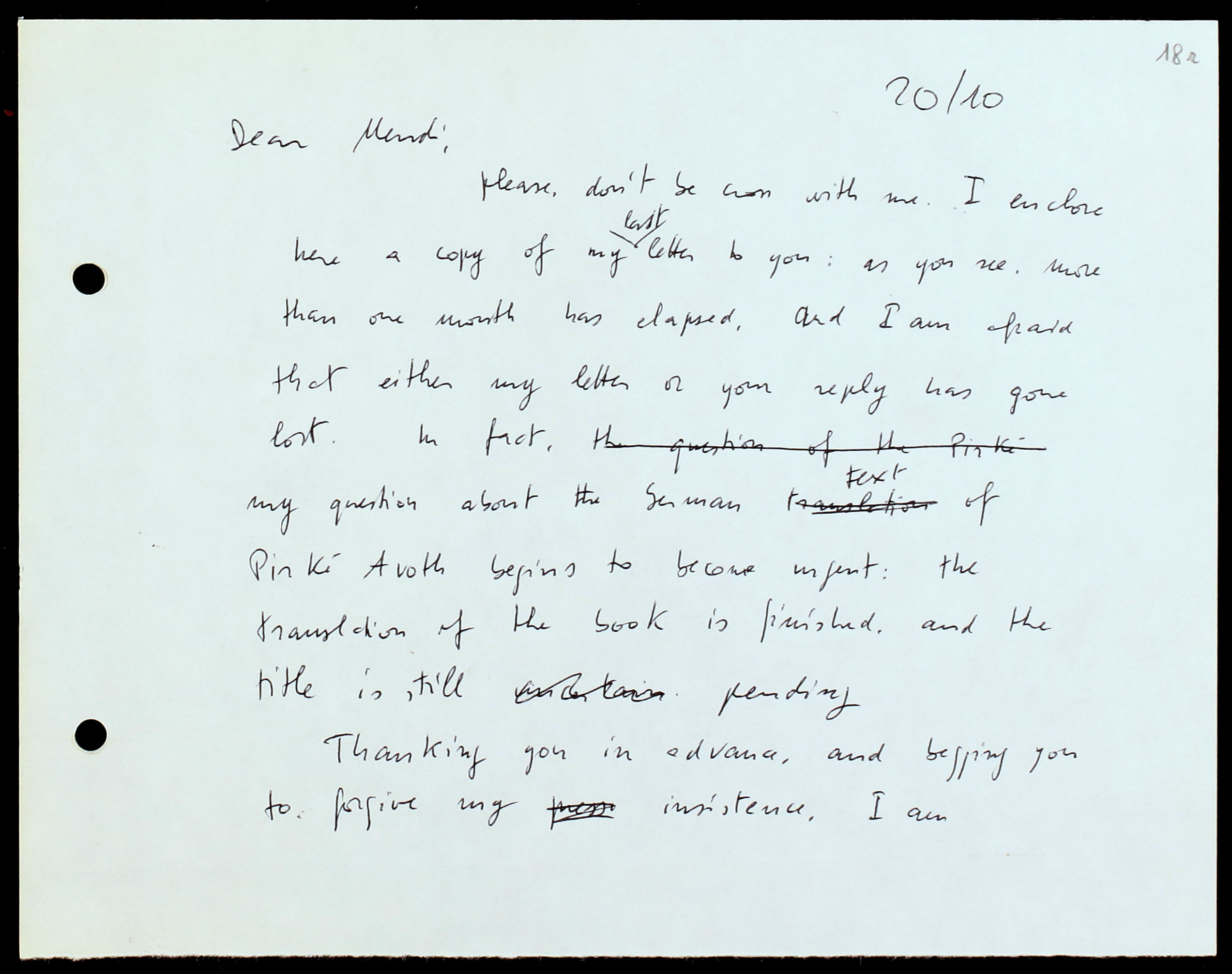
Levi scrive un biglietto di accompagnamento per reinoltrare a Davidovic una copia dell’ultima lettera che ha scritto, temendo che l’amico non l’abbia ricevuta. Dato che si tratta di una minuta, non sappiamo se Levi abbia inviato il biglietto in questa forma.
20/10
Dear Mendi,
please, don’t be cross with me. I enclose here a copy of my last[1] letter to you: as you see, more than one month has elapsed, and I am afraid that either my letter or your reply has gone lost. In fact,[2] my question about the German text[3]of Pirké Avoth begins to become urgent: the translation of the bookis finished, and the title is still pending.[4]
Thanking you in advance, and begging you to forgive my insistence.[5] I am
20/10
Caro Mendi,
per favore, non avertene a male. Allego qui una copia della mia ultima[1] lettera per te: come vedi è passato più di un mese, e temo che o la mia lettera o la tua risposta siano andate perse. In effetti[2] la mia domanda sul testo tedesco[3] del Pirké Avoth comincia a diventare urgente: la traduzione del libro è finita, e il titolo è ancora in sospeso.[4]
Grazie in anticipo, e ti prego di perdonare la mia insistenza.[5] Il tuo
20/10
Dear Mendi,
please, don’t be cross with me. I enclose here a copy of my last[1] letter to you: as you see, more than one month has elapsed, and I am afraid that either my letter or your reply has gone lost. In fact,[2] my question about the German text[3]of Pirké Avoth begins to become urgent: the translation of the bookis finished, and the title is still pending.[4]
Thanking you in advance, and begging you to forgive my insistence.[5] I am
20/10
Dear Mendi,
please, don’t be cross with me. I enclose here a copy of my last[1] letter to you: as you see, more than one month has elapsed, and I am afraid that either my letter or your reply has gone lost. In fact,[2] my question about the German text[3]of Pirké Avoth begins to become urgent: the translation of the bookis finished, and the title is still pending.[4]
Thanking you in advance, and begging you to forgive my insistence.[5] I am
20/10
Caro Mendi,
per favore, non avertene a male. Allego qui una copia della mia ultima[1] lettera per te: come vedi è passato più di un mese, e temo che o la mia lettera o la tua risposta siano andate perse. In effetti[2] la mia domanda sul testo tedesco[3] del Pirké Avoth comincia a diventare urgente: la traduzione del libro è finita, e il titolo è ancora in sospeso.[4]
Grazie in anticipo, e ti prego di perdonare la mia insistenza.[5] Il tuo
20/10
Dear Mendi,
please, don’t be cross with me. I enclose here a copy of my last[1] letter to you: as you see, more than one month has elapsed, and I am afraid that either my letter or your reply has gone lost. In fact,[2] my question about the German text[3]of Pirké Avoth begins to become urgent: the translation of the bookis finished, and the title is still pending.[4]
Thanking you in advance, and begging you to forgive my insistence.[5] I am
Info
Note
Tag
Mittente: Primo Levi
Destinatario: Emil Davidovič
Data di stesura: 1984-10-20
Luogo di stesura: Torino
Descrizione del documento:minuta di biglietto ms. a biro nera (mm162x290). Sul verso del foglio si leggono alcuni appunti ms. di mano leviana: «Ein | 90 M d.d.a. | +7 anticipo LT | +7 “ ISEIS | 104 | + crediti maturandi» (“Einaudi | 90 Mesi diritto d’autore | +7 anticipo La tregua | +7 anticipo I sommersi e i salvati | 104 | + crediti maturandi ”).
Archivio: Archivio privato di Primo Levi, Torino
Segnatura: Corrispondenza, Corrispondenti particolari, fascicolo 22, sottofascicolo 1, f. 18r/v.
Fogli: 1, recto e verso
DOI:
1«Last» (“ultima”) è aggiunto sopra il rigo.
2Segue, cancellato da una riga orizzontale, «the question of the Pirké».
3«translation» è cancellato da due righe orizzontali e corretto sopra il rigo in «text».
4«uncertain» è cancellato con un segno e corretto in «pending».
5«press» è cancellato con due righe orizzontali, segue «insistence».