Accogliendo l’invito di Levi, Martin racconta la sua vita in Germania negli anni a cavallo tra la Repubblica di Weimar e la presa del potere di Hitler.
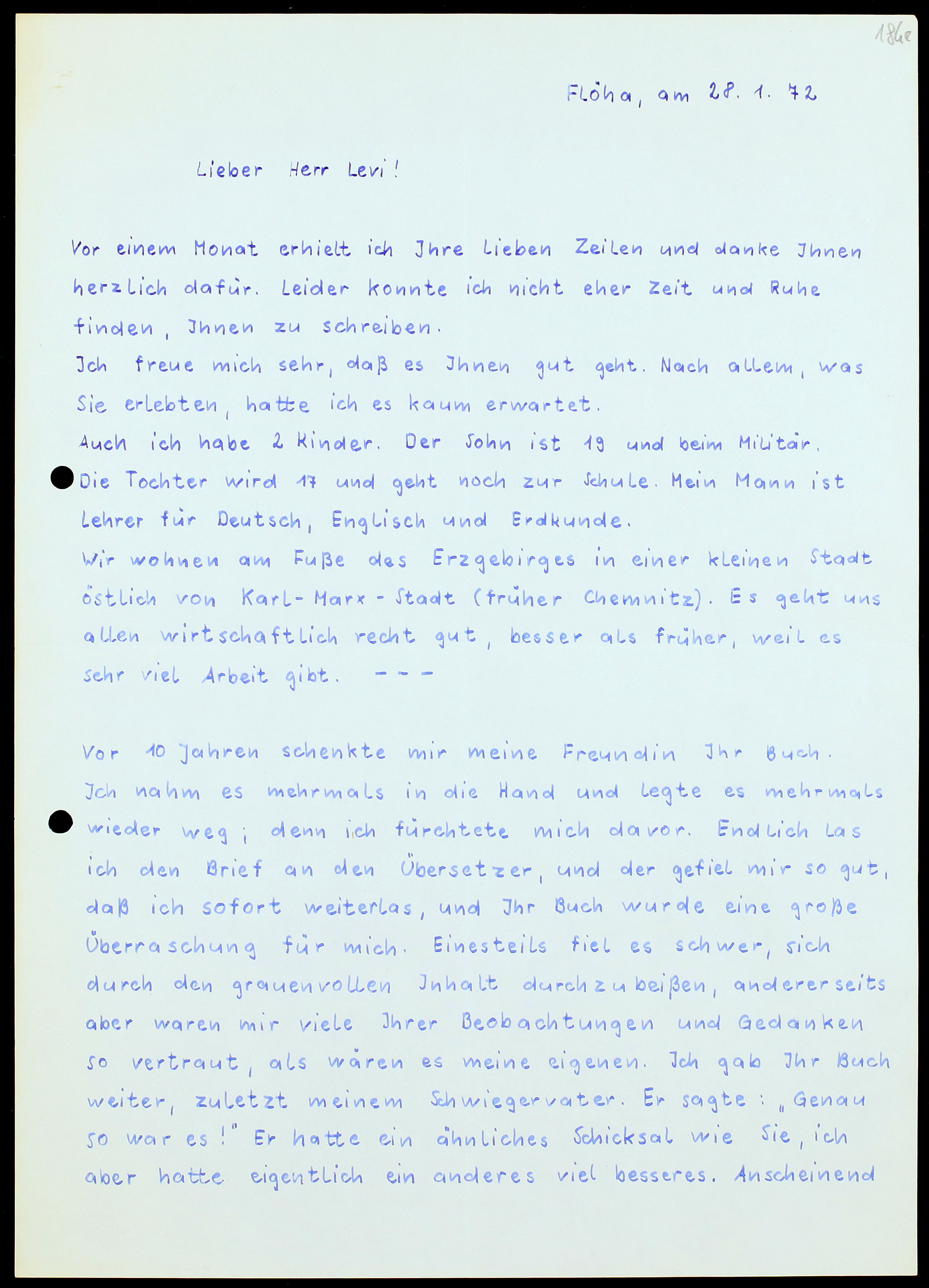
Flöha, am 28. 1. 72
Lieber Herr Levi!
Vor einem Monat erhielt ich Ihre Lieben Zeilen und danke Ihnen herzlich dafür. Leider konnte ich nicht eher Zeit und Ruhe finden, Ihnen zu schreiben.
Ich freue mich sehr, daß es Ihnen gut geht. Nach allem, was Sie erlebten, hatte ich es kaum erwartet.
Auch ich habe 2 Kinder. Der Sohn ist 19 und beim Militär. Die Tochter wird 17 und geht noch zur Schule. Mein Mann ist Lehrer für Deutsch, Englisch und Erdkunde.
Wir wohnen am Fuße des Erzgebirges in einer kleinen Stadt östlich von Karl – Marx – Stadt (früher Chemnitz). Es geht uns allen wirtschaftlich recht gut, besser als früher, weil es sehr viel Arbeit gibt. —
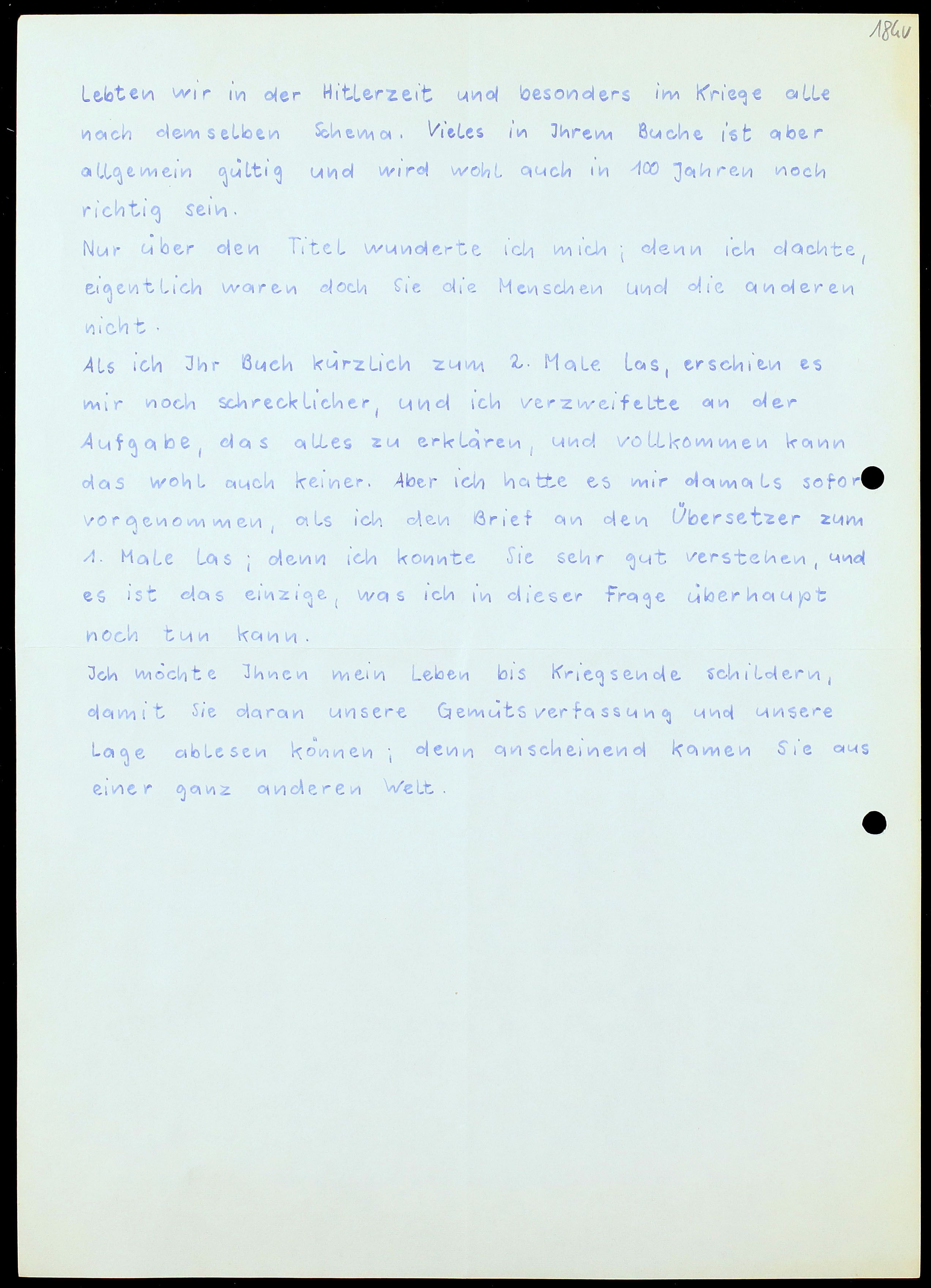
Vor 10 Jahren schenkte mir meine Freundin Ihr Buch.[1] Ich nahm es mehrmals in die Hand und legte es mehrmals wieder weg; denn ich fürchtete mich davor. Endlich Las ich den Brief an den Übersetzer, und der gefiel mir so gut, daß ich sofort weiterlas, und Ihr Buch wurde eine große Überraschung für mich. Einesteils fiel es schwer, sich durch den grauenvollen Inhalt durchzubeißen, andererseits aber waren mir viele Ihrer Beobachtungen und Gedanken so vertraut, als wären es meine eigenen. Ich gab Ihr Buch weiter, zuletzt meinem Schwiegervater. Er sagte: „Genau so war es!” Er hatte ein ähnliches Schicksal wie Sie, ich aber hatte eigentlich ein anderes viel besseres. Anscheinend Lebten wir in der Hitlerzeit und besonders im Kriege alle nach demselben Schema. Vieles in Ihrem Buche ist aber allgemein gültig und wird wohl auch in 100 Jahren noch richtig sein.
Nur über den Titel wunderte ich mich; denn ich dachte, eigentlich waren doch Sie die Menschen und die anderen nicht.
Als ich Ihr Buch kürzlich zum 2. Male las, erschien es mir noch schrecklicher, und ich verzweifelte an der Aufgabe, das alles zu erklären, und vollkommen kann das wohl auch keiner. Aber ich hatte es mir damals sofort vorgenommen, als ich den Brief an den Übersetzer zum 1. Male las; denn ich konnte Sie sehr gut verstehen, und es ist das einzige, was ich in dieser Frage überhaupt noch tun kann.
Ich möchte Ihnen mein Leben bis Kriegsende schildern, damit Sie daran unsere Gemütsverfassung und unsere Lage ablesen können; denn anscheinend kamen Sie aus einer ganz anderen Welt.
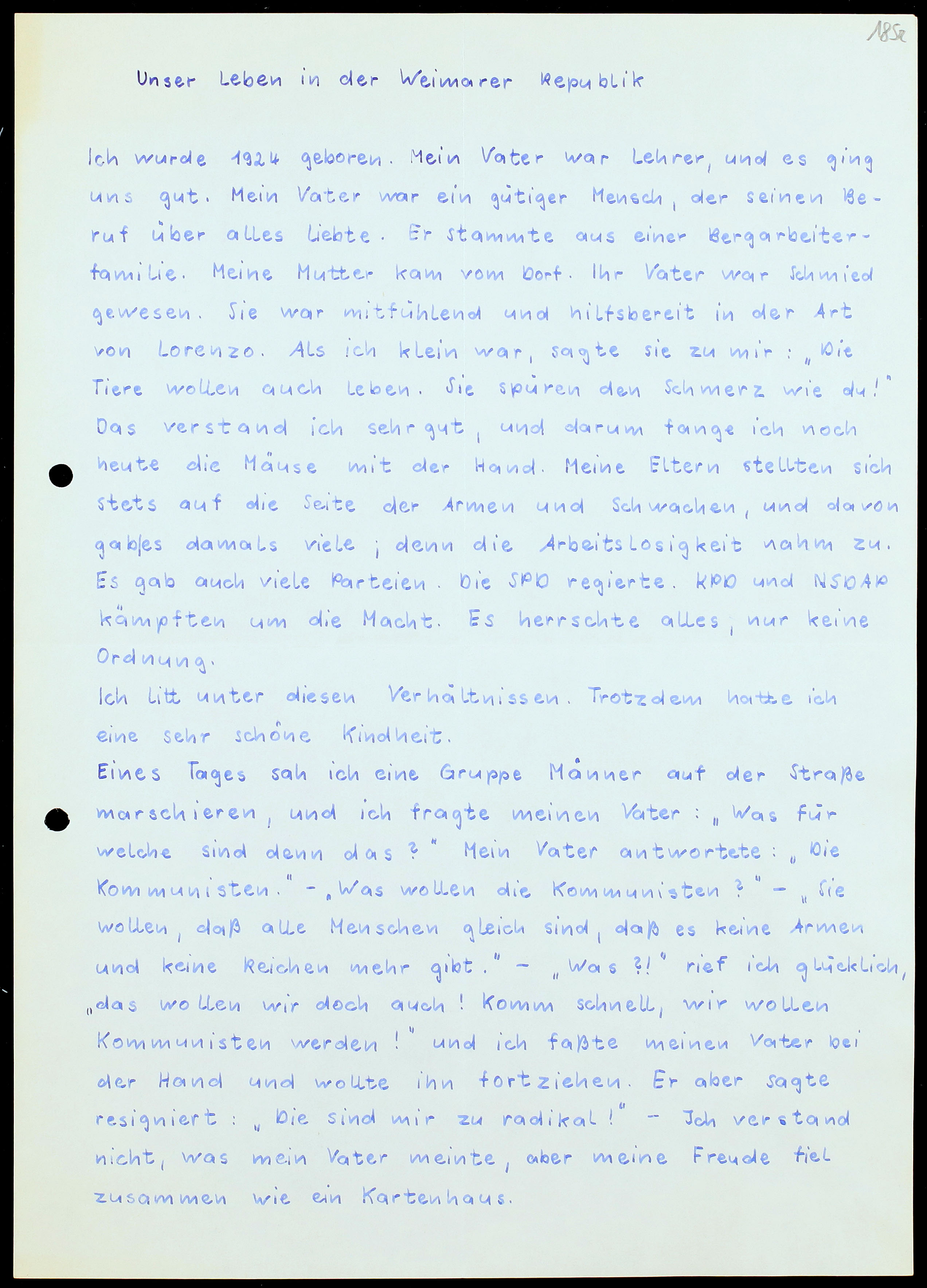
Unser Leben in der Weimarer Republik
Ich wurde 1924 geboren. Mein Vater war Lehrer, und es ging uns gut. Mein Vater war ein gütiger Mensch, der seinen Beruf über alles liebte. Er stammte aus einer Bergarbeiterfamilie. Meine Mutter kam vom Dorf. Ihr Vater war Schmied gewesen. Sie war mitfühlend und hilfsbereit in der Art von Lorenzo. Als ich klein war, sagte sie zu mir: „Die Tiere wollen auch leben. Sie spüren den Schmerz wie du!” Das verstand ich sehr gut, und darum fange ich noch heute die Mäuse mit der Hand. MeineEltern stellten sich stets auf die Seite der Armen und Schwachen, und davon gab es damals viele; denn die Arbeitslosigkeit nahm zu. Es gab auch viele Parteien. Die SPD regierte. KPD und NSDAP kämpften um die Macht. Es herrschte alles, nur keine Ordnung.
Ich litt unter diesen Verhältnissen. Trotzdem hatte ich eine sehr schöne Kindheit.
Eines Tages sah ich eine Gruppe Männer auf der Straße marschieren, und ich fragte meinen Vater: „Was für welche sind denn das?” Mein Vater antwortete: „Die Kommunisten.” – „Was wollen die Kommunisten?” – „Sie wollen, daß alle Menschen gleich sind, daß es keine Armen und keine Reichen mehr gibt.” – „Was?!” rief ich glücklich, „das wollen wir doch auch! Komm schnell, wir wollen Kommunisten werden!” und ich faßte meinen Vater bei der Hand und wollte ihn fortziehen. Er aber sagte resigniert: „Die sind mir zu radikal!” – Ich verstand nicht, was mein Vater meinte, aber meine Freude fiel zusammen wie ein Kartenhaus.
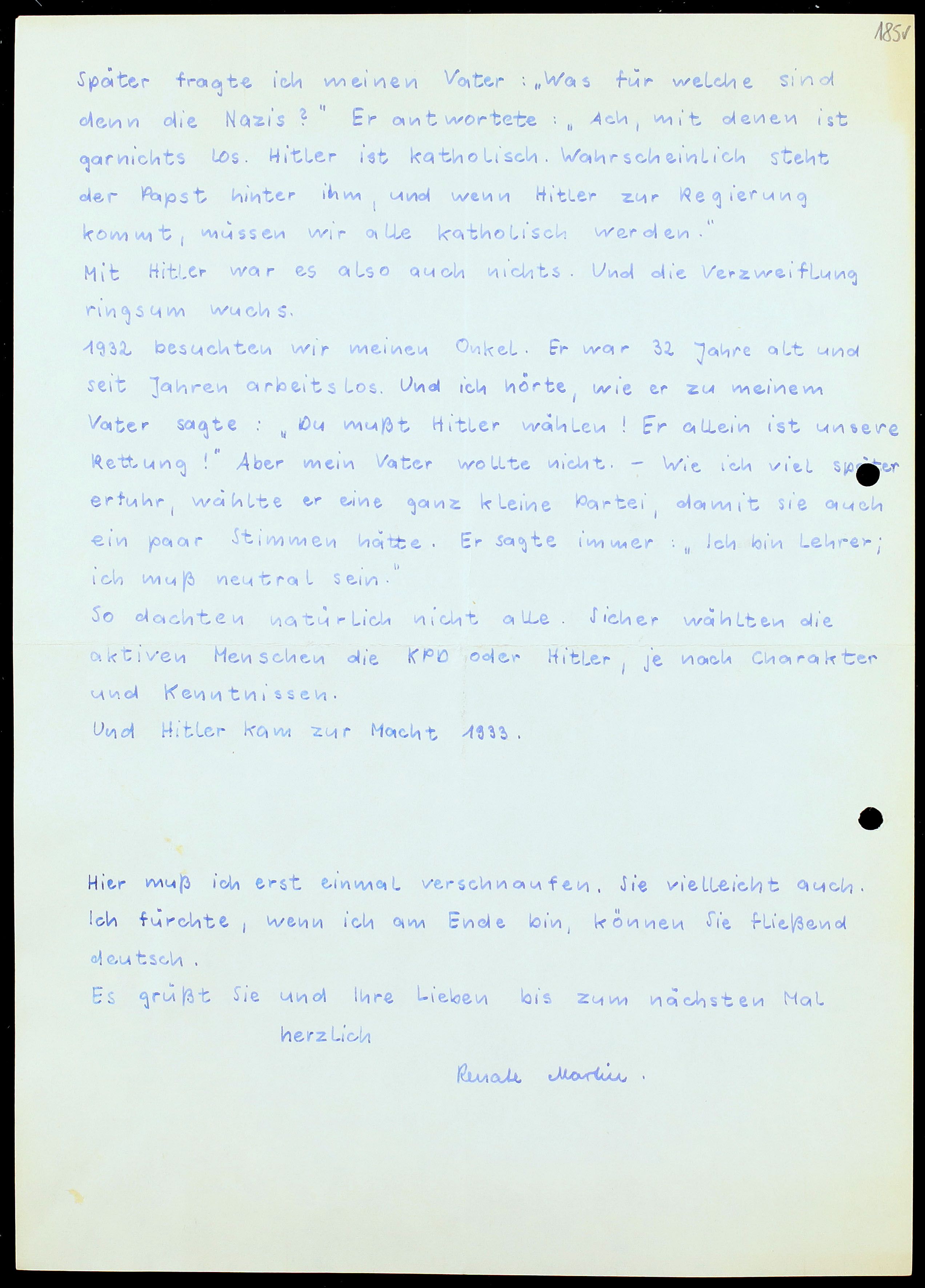
Später fragte ich meinen Vater: „Was für welche sind denn die Nazis?” Er antwortete: „ Ach, mit denen ist gar nichts los. Hitler ist katholisch. Wahrscheinlich steht der Papst hinter ihm, und wenn Hitler zur Regierung kommt, müssen wir alle katholisch werden.”
Mit Hitler war es also auch nichts. Und die Verzweiflung ringsum wuchs.
1932 besuchten wir meinen Onkel. Er war 32 Jahre alt und seit Jahren arbeitslos. Und ich hörte, wie er zu meinem Vater sagte: „Du mußt Hitler wählen! Er allein ist unsere Rettung!” Aber mein Vater wollte nicht. – Wie ich viel später erfuhr, wählte er eine ganz kleine Partei, damit sie auch ein paar Stimmen hätte. Er sagte immer: „Ich bin Lehrer; ich muß neutral sein.”
So dachten natürlich nicht alle. Sicher wählten die aktiven Menschen die KPD oder Hitler, je nach Charakter und Kenntnissen.
Und Hitler kam zur Macht 1933.
Hier muß ich erst einmal verschnaufen, Sie vielleicht auch. Ich fürchte, wenn ich am Ende bin, können Sie fließend deutsch.
Es grüßt sie und Ihre Lieben bis zum nächsten Mal
herzlich
Renate Martin
Flöha, 28 gennaio 72
Caro Signor Levi!
un mese fa ho ricevuto la Sua gentile lettera e La ringrazio di cuore. Purtroppo non ho trovato prima il tempo e la tranquillità per risponderLe.
Sono molto felice che stia bene. Dopo tutto quello che ha passato, quasi non me l’aspettavo.
Anch’io ho due figli. Mio figlio ha 19 anni e sta assolvendo il servizio militare. Mia figlia ne compirà 17 e va ancora a scuola. Mio marito è insegnante di tedesco, inglese e geografia.
Viviamo ai piedi dei Monti Metalliferi, in una piccola città a est di Karl-Marx-Stadt (quella che un tempo si chiamava Chemnitz). Economicamente stiamo tutti abbastanza bene, meglio di prima, perché il lavoro non manca. —
Una mia amica mi aveva regalato il Suo libro dieci anni fa.[1] L’ho preso in mano più volte e altrettante l’ho rimesso via, perché ne avevo paura. Alla fine ho letto la lettera al traduttore e mi è piaciuta così tanto che ho continuato a leggere: il Suo libro è stato per me una grande sorpresa. Da un lato era difficile farsi strada tra contenuti così atroci, dall’altro però molte delle Sue osservazioni e riflessioni mi erano così familiari che sembravano mie. L’ho passato ad altri, da ultimo a mio suocero. Che ha detto: «È andata esattamente così!». Lui ha avuto una sorte simile alla Sua[2], mentre io ne ho avuta una molto migliore. A quanto pare, nel periodo hitleriano e specialmente durante la guerra, abbiamo vissuto tutti secondo lo stesso schema. Molto di ciò che Lei scrive nel Suo libro è però universalmente valido e probabilmente sarà vero anche per i prossimi cent’anni.
Solo il titolo mi ha lasciato perplessa, perché pensavo che in realtà foste voi gli uomini veri e non gli altri.
Quando, di recente, l’ho letto per la seconda volta, il Suo libro mi è sembrato ancora più terribile e ho perso ogni speranza di poter mai spiegare tutto questo, e d’altronde nessuno, forse, potrà mai riuscirci del tutto. Eppure, già nel leggere la lettera al traduttore per la prima volta, mi ero ripromessa di scriverLe perché La capivo molto bene, e questa è forse l’unica cosa che posso ancora fare al riguardo.
Vorrei raccontarLe la mia vita fino alla fine della guerra, affinché possa comprendere il nostro stato d’animo e la nostra condizione, perché a quanto pare Lei proveniva da un mondo completamente diverso.
La nostra vita nella Repubblica di Weimar
Sono nata nel 1924. Mio padre era insegnante e stavamo bene. Lui era un uomo gentile e amava il suo mestiere sopra ogni cosa. Veniva da una famiglia di minatori. Mia madre, figlia di un fabbro, era cresciuta in paese. Era compassionevole e sempre pronta ad aiutare gli altri, proprio come Lorenzo. Quando ero piccola, mi diceva: «Anche gli animali vogliono vivere. Sentono il dolore proprio come lo senti tu!» Io, questo, lo capivo benissimo, e ancora oggi catturo i topi con le mani. I mieigenitori stavano sempre dalla parte dei poveri e dei deboli, e all’epoca erano anche molti, perché la disoccupazione era in aumento. C’erano anche molti partiti. Il partito socialdemocratico era al governo. Il partito comunista e il partito nazionalsocialista lottavano per il potere. Regnava di tutto, tranne che l’ordine.
Io soffrivo per quella situazione. Eppure ho avuto un’infanzia molto bella.
Un giorno vidi un gruppo di uomini marciare per strada e chiesi a mio padre: «Chi è quella gente?». Mio padre rispose: «Sono i comunisti». «E cosa vogliono i comunisti?». «Vogliono che tutti gli uomini siano uguali, che non ci siano più poveri né ricchi». «Cosa?!», esclamai felice. «Ma è la stessa cosa che vogliamo noi! Dai, diventiamo subito comunisti!», e presi mio padre per mano, cercando di trascinarlo con me. Lui però rispose rassegnato: «Sono troppo radicali per me!». Non capivo cosa intendesse, ma la mia gioia crollò come un castello di carte.
Più tardi chiesi a mio padre: «E i nazisti che tipo di persone sono?». Lui rispose: «Ah, con quelli non c’è niente da fare. Hitler è cattolico. Probabilmente ha dietro il Papa, e se Hitler va al governo, ci toccherà diventare tutti cattolici».
Quindi nemmeno Hitler andava bene. E la disperazione intorno a noi cresceva.
Nel 1932 andammo a trovare mio zio. Aveva 32 anni ed era disoccupato da anni. Sentii che diceva a mio padre: «Devi votare Hitler! Solo lui può salvarci!». Ma mio padre si rifiutava. Come seppi molto tempo dopo, votò per un partitino minuscolo, solo perché anche quello avesse qualche voto. Diceva sempre: «Sono un insegnante, devo essere neutrale».
Naturalmente non tutti la pensavano così. Di sicuro chi era più attivo votava per il partito comunista o per Hitler, a seconda del carattere e del livello di istruzione.
E così, nel 1933, Hitler salì al potere.
A questo punto devo fermarmi e prendere fiato, e forse dovrà farlo anche Lei. Temo che quando avrò finito, Lei saprà parlare tedesco alla perfezione.
Saluto Lei e i Suoi cari, alla prossima,
cordialmente,
Renate Martin
Flöha, January 28, 1972
Dear Mr. Levi!
I received your kind letter a month ago and thank you very much for it. Unfortunately, I was not able to find the time and leisure to write to you until now.
I am very happy to hear that you are well. After everything you have been through, I would hardly have expected as much.
I, too, have two children. My son is 19 and in the military. My daughter is turning 17 and still in school. My husband teaches German, English, and geography.
We live at the foot of the Ore Mountains in a small town east of Karl-Marx-Stadt (formerly Chemnitz). We are all doing quite well financially, better than before, because there is a lot of work. —
Ten years ago, a friend of mine gave me your book as a gift.[1] Several times I picked it up and put it down again because I was afraid of it. Finally, I read the letter to the translator, and liked it so much that I immediately continued reading, and your book became a big surprise for me. On the one hand, it was difficult to get through the gruesome content; on the other, many of your observations and thoughts were familiar to me, as if they were my own. I have passed your book on, most recently to my father-in-law. He said, “That’s exactly how it was!” He had a fate similar to yours[2], but I had a different, much better one. Apparently, we all lived following the same pattern during the Hitler era and especially during the war. Much of what you wrote in your bookis universally true, though, and will probably still be true in 100 years.
I was really only surprised by the title, because I thought you were the man, and that the others were not.
When I read your book for the second time, recently, it seemed even more terrible to me, and I despaired of the task of explaining it all, which no one could ever do completely. But I had immediately decided to do so when I read the letter to the translator for the first time, because I understood you very well, and that is the only thing I can still do when it comes to this subject.
I would like to describe my life to you, up until the end of the war, so that you can understand our state of mind and our situation; because it seems that you came from a completely different world.
Our life in the Weimar Republic
I was born in 1924. My father was a teacher, and we were well off. My father was a kind man who loved his job more than anything else. He came from a family of miners. My mother came from a village. Her father had been a blacksmith. She was compassionate and helpful, like Lorenzo. When I was little, she would say to me: “Animals want to live too. They feel pain just like you do!” I understood that very well, which is why, even today, I still catch mice with my hands. My parents always sided with the poor and weak, and there were many such people back then because unemployment was on the rise. There were also many political parties. The SPD was in power. The KPD and NSDAP fought for power. Everything prevailed except order.
I suffered under these conditions. Nevertheless, I had a very happy childhood.
One day I saw a group of men marching down the street and asked my father, “Who are those people?” My father replied, “The communists.”—“What do the communists want?”—“They want everyone to be equal, so that there are neither poor nor rich people anymore.”—“What?!” I exclaimed happily, “That’s what we want too! Come on, let’s become communists!” And I grabbed my father by the hand and tried to pull him away. But he, sounding resigned, said “They’re too radical for me!”—I didn’t understand what my father meant, but my joy collapsed like a house of cards.
Later, I asked my father, “What kind of people are the Nazis?” He replied, “Oh, they cannot be resoned with. Hitler is a Catholic. The Pope is probably behind him, and if Hitler comes to power, we’ll all have to become Catholics.”
So Hitler was no good either. And the despair around us grew.
In 1932, we visited my uncle. He was 32 years old and had been unemployed for years. And I heard him say to my father, “You must vote for Hitler! Only he can save us!” But my father did not want to.—As I learned much later, he voted for a tiny minority party so that it would have a few votes, too. He always said, “I’m a teacher; I must be neutral.”
Of course, not everyone thought that way. Certainly, more active people voted for the KPD or Hitler, depending on their personal character and education.
And Hitlercame to power in 1933.
I need to take a breather here, and perhaps you do, too. I am afraid that by the time I am finished, you will be fluent in German.
Best regards to you and your loved ones until next time,
Sincerely,
Renate Martin
Flöha, am 28. 1. 72
Lieber Herr Levi!
Vor einem Monat erhielt ich Ihre Lieben Zeilen und danke Ihnen herzlich dafür. Leider konnte ich nicht eher Zeit und Ruhe finden, Ihnen zu schreiben.
Ich freue mich sehr, daß es Ihnen gut geht. Nach allem, was Sie erlebten, hatte ich es kaum erwartet.
Auch ich habe 2 Kinder. Der Sohn ist 19 und beim Militär. Die Tochter wird 17 und geht noch zur Schule. Mein Mann ist Lehrer für Deutsch, Englisch und Erdkunde.
Wir wohnen am Fuße des Erzgebirges in einer kleinen Stadt östlich von Karl – Marx – Stadt (früher Chemnitz). Es geht uns allen wirtschaftlich recht gut, besser als früher, weil es sehr viel Arbeit gibt. —
Vor 10 Jahren schenkte mir meine Freundin Ihr Buch.[1] Ich nahm es mehrmals in die Hand und legte es mehrmals wieder weg; denn ich fürchtete mich davor. Endlich Las ich den Brief an den Übersetzer, und der gefiel mir so gut, daß ich sofort weiterlas, und Ihr Buch wurde eine große Überraschung für mich. Einesteils fiel es schwer, sich durch den grauenvollen Inhalt durchzubeißen, andererseits aber waren mir viele Ihrer Beobachtungen und Gedanken so vertraut, als wären es meine eigenen. Ich gab Ihr Buch weiter, zuletzt meinem Schwiegervater. Er sagte: „Genau so war es!” Er hatte ein ähnliches Schicksal wie Sie, ich aber hatte eigentlich ein anderes viel besseres. Anscheinend Lebten wir in der Hitlerzeit und besonders im Kriege alle nach demselben Schema. Vieles in Ihrem Buche ist aber allgemein gültig und wird wohl auch in 100 Jahren noch richtig sein.
Nur über den Titel wunderte ich mich; denn ich dachte, eigentlich waren doch Sie die Menschen und die anderen nicht.
Als ich Ihr Buch kürzlich zum 2. Male las, erschien es mir noch schrecklicher, und ich verzweifelte an der Aufgabe, das alles zu erklären, und vollkommen kann das wohl auch keiner. Aber ich hatte es mir damals sofort vorgenommen, als ich den Brief an den Übersetzer zum 1. Male las; denn ich konnte Sie sehr gut verstehen, und es ist das einzige, was ich in dieser Frage überhaupt noch tun kann.
Ich möchte Ihnen mein Leben bis Kriegsende schildern, damit Sie daran unsere Gemütsverfassung und unsere Lage ablesen können; denn anscheinend kamen Sie aus einer ganz anderen Welt.
Unser Leben in der Weimarer Republik
Ich wurde 1924 geboren. Mein Vater war Lehrer, und es ging uns gut. Mein Vater war ein gütiger Mensch, der seinen Beruf über alles liebte. Er stammte aus einer Bergarbeiterfamilie. Meine Mutter kam vom Dorf. Ihr Vater war Schmied gewesen. Sie war mitfühlend und hilfsbereit in der Art von Lorenzo. Als ich klein war, sagte sie zu mir: „Die Tiere wollen auch leben. Sie spüren den Schmerz wie du!” Das verstand ich sehr gut, und darum fange ich noch heute die Mäuse mit der Hand. MeineEltern stellten sich stets auf die Seite der Armen und Schwachen, und davon gab es damals viele; denn die Arbeitslosigkeit nahm zu. Es gab auch viele Parteien. Die SPD regierte. KPD und NSDAP kämpften um die Macht. Es herrschte alles, nur keine Ordnung.
Ich litt unter diesen Verhältnissen. Trotzdem hatte ich eine sehr schöne Kindheit.
Eines Tages sah ich eine Gruppe Männer auf der Straße marschieren, und ich fragte meinen Vater: „Was für welche sind denn das?” Mein Vater antwortete: „Die Kommunisten.” – „Was wollen die Kommunisten?” – „Sie wollen, daß alle Menschen gleich sind, daß es keine Armen und keine Reichen mehr gibt.” – „Was?!” rief ich glücklich, „das wollen wir doch auch! Komm schnell, wir wollen Kommunisten werden!” und ich faßte meinen Vater bei der Hand und wollte ihn fortziehen. Er aber sagte resigniert: „Die sind mir zu radikal!” – Ich verstand nicht, was mein Vater meinte, aber meine Freude fiel zusammen wie ein Kartenhaus.
Später fragte ich meinen Vater: „Was für welche sind denn die Nazis?” Er antwortete: „ Ach, mit denen ist gar nichts los. Hitler ist katholisch. Wahrscheinlich steht der Papst hinter ihm, und wenn Hitler zur Regierung kommt, müssen wir alle katholisch werden.”
Mit Hitler war es also auch nichts. Und die Verzweiflung ringsum wuchs.
1932 besuchten wir meinen Onkel. Er war 32 Jahre alt und seit Jahren arbeitslos. Und ich hörte, wie er zu meinem Vater sagte: „Du mußt Hitler wählen! Er allein ist unsere Rettung!” Aber mein Vater wollte nicht. – Wie ich viel später erfuhr, wählte er eine ganz kleine Partei, damit sie auch ein paar Stimmen hätte. Er sagte immer: „Ich bin Lehrer; ich muß neutral sein.”
So dachten natürlich nicht alle. Sicher wählten die aktiven Menschen die KPD oder Hitler, je nach Charakter und Kenntnissen.
Und Hitler kam zur Macht 1933.
Hier muß ich erst einmal verschnaufen, Sie vielleicht auch. Ich fürchte, wenn ich am Ende bin, können Sie fließend deutsch.
Es grüßt sie und Ihre Lieben bis zum nächsten Mal
herzlich
Renate Martin
Flöha, 28 gennaio 72
Caro Signor Levi!
un mese fa ho ricevuto la Sua gentile lettera e La ringrazio di cuore. Purtroppo non ho trovato prima il tempo e la tranquillità per risponderLe.
Sono molto felice che stia bene. Dopo tutto quello che ha passato, quasi non me l’aspettavo.
Anch’io ho due figli. Mio figlio ha 19 anni e sta assolvendo il servizio militare. Mia figlia ne compirà 17 e va ancora a scuola. Mio marito è insegnante di tedesco, inglese e geografia.
Viviamo ai piedi dei Monti Metalliferi, in una piccola città a est di Karl-Marx-Stadt (quella che un tempo si chiamava Chemnitz). Economicamente stiamo tutti abbastanza bene, meglio di prima, perché il lavoro non manca. —
Una mia amica mi aveva regalato il Suo libro dieci anni fa.[1] L’ho preso in mano più volte e altrettante l’ho rimesso via, perché ne avevo paura. Alla fine ho letto la lettera al traduttore e mi è piaciuta così tanto che ho continuato a leggere: il Suo libro è stato per me una grande sorpresa. Da un lato era difficile farsi strada tra contenuti così atroci, dall’altro però molte delle Sue osservazioni e riflessioni mi erano così familiari che sembravano mie. L’ho passato ad altri, da ultimo a mio suocero. Che ha detto: «È andata esattamente così!». Lui ha avuto una sorte simile alla Sua[2], mentre io ne ho avuta una molto migliore. A quanto pare, nel periodo hitleriano e specialmente durante la guerra, abbiamo vissuto tutti secondo lo stesso schema. Molto di ciò che Lei scrive nel Suo libro è però universalmente valido e probabilmente sarà vero anche per i prossimi cent’anni.
Solo il titolo mi ha lasciato perplessa, perché pensavo che in realtà foste voi gli uomini veri e non gli altri.
Quando, di recente, l’ho letto per la seconda volta, il Suo libro mi è sembrato ancora più terribile e ho perso ogni speranza di poter mai spiegare tutto questo, e d’altronde nessuno, forse, potrà mai riuscirci del tutto. Eppure, già nel leggere la lettera al traduttore per la prima volta, mi ero ripromessa di scriverLe perché La capivo molto bene, e questa è forse l’unica cosa che posso ancora fare al riguardo.
Vorrei raccontarLe la mia vita fino alla fine della guerra, affinché possa comprendere il nostro stato d’animo e la nostra condizione, perché a quanto pare Lei proveniva da un mondo completamente diverso.
La nostra vita nella Repubblica di Weimar
Sono nata nel 1924. Mio padre era insegnante e stavamo bene. Lui era un uomo gentile e amava il suo mestiere sopra ogni cosa. Veniva da una famiglia di minatori. Mia madre, figlia di un fabbro, era cresciuta in paese. Era compassionevole e sempre pronta ad aiutare gli altri, proprio come Lorenzo. Quando ero piccola, mi diceva: «Anche gli animali vogliono vivere. Sentono il dolore proprio come lo senti tu!» Io, questo, lo capivo benissimo, e ancora oggi catturo i topi con le mani. I mieigenitori stavano sempre dalla parte dei poveri e dei deboli, e all’epoca erano anche molti, perché la disoccupazione era in aumento. C’erano anche molti partiti. Il partito socialdemocratico era al governo. Il partito comunista e il partito nazionalsocialista lottavano per il potere. Regnava di tutto, tranne che l’ordine.
Io soffrivo per quella situazione. Eppure ho avuto un’infanzia molto bella.
Un giorno vidi un gruppo di uomini marciare per strada e chiesi a mio padre: «Chi è quella gente?». Mio padre rispose: «Sono i comunisti». «E cosa vogliono i comunisti?». «Vogliono che tutti gli uomini siano uguali, che non ci siano più poveri né ricchi». «Cosa?!», esclamai felice. «Ma è la stessa cosa che vogliamo noi! Dai, diventiamo subito comunisti!», e presi mio padre per mano, cercando di trascinarlo con me. Lui però rispose rassegnato: «Sono troppo radicali per me!». Non capivo cosa intendesse, ma la mia gioia crollò come un castello di carte.
Più tardi chiesi a mio padre: «E i nazisti che tipo di persone sono?». Lui rispose: «Ah, con quelli non c’è niente da fare. Hitler è cattolico. Probabilmente ha dietro il Papa, e se Hitler va al governo, ci toccherà diventare tutti cattolici».
Quindi nemmeno Hitler andava bene. E la disperazione intorno a noi cresceva.
Nel 1932 andammo a trovare mio zio. Aveva 32 anni ed era disoccupato da anni. Sentii che diceva a mio padre: «Devi votare Hitler! Solo lui può salvarci!». Ma mio padre si rifiutava. Come seppi molto tempo dopo, votò per un partitino minuscolo, solo perché anche quello avesse qualche voto. Diceva sempre: «Sono un insegnante, devo essere neutrale».
Naturalmente non tutti la pensavano così. Di sicuro chi era più attivo votava per il partito comunista o per Hitler, a seconda del carattere e del livello di istruzione.
E così, nel 1933, Hitler salì al potere.
A questo punto devo fermarmi e prendere fiato, e forse dovrà farlo anche Lei. Temo che quando avrò finito, Lei saprà parlare tedesco alla perfezione.
Saluto Lei e i Suoi cari, alla prossima,
cordialmente,
Renate Martin
Flöha, January 28, 1972
Dear Mr. Levi!
I received your kind letter a month ago and thank you very much for it. Unfortunately, I was not able to find the time and leisure to write to you until now.
I am very happy to hear that you are well. After everything you have been through, I would hardly have expected as much.
I, too, have two children. My son is 19 and in the military. My daughter is turning 17 and still in school. My husband teaches German, English, and geography.
We live at the foot of the Ore Mountains in a small town east of Karl-Marx-Stadt (formerly Chemnitz). We are all doing quite well financially, better than before, because there is a lot of work. —
Ten years ago, a friend of mine gave me your book as a gift.[1] Several times I picked it up and put it down again because I was afraid of it. Finally, I read the letter to the translator, and liked it so much that I immediately continued reading, and your book became a big surprise for me. On the one hand, it was difficult to get through the gruesome content; on the other, many of your observations and thoughts were familiar to me, as if they were my own. I have passed your book on, most recently to my father-in-law. He said, “That’s exactly how it was!” He had a fate similar to yours[2], but I had a different, much better one. Apparently, we all lived following the same pattern during the Hitler era and especially during the war. Much of what you wrote in your bookis universally true, though, and will probably still be true in 100 years.
I was really only surprised by the title, because I thought you were the man, and that the others were not.
When I read your book for the second time, recently, it seemed even more terrible to me, and I despaired of the task of explaining it all, which no one could ever do completely. But I had immediately decided to do so when I read the letter to the translator for the first time, because I understood you very well, and that is the only thing I can still do when it comes to this subject.
I would like to describe my life to you, up until the end of the war, so that you can understand our state of mind and our situation; because it seems that you came from a completely different world.
Our life in the Weimar Republic
I was born in 1924. My father was a teacher, and we were well off. My father was a kind man who loved his job more than anything else. He came from a family of miners. My mother came from a village. Her father had been a blacksmith. She was compassionate and helpful, like Lorenzo. When I was little, she would say to me: “Animals want to live too. They feel pain just like you do!” I understood that very well, which is why, even today, I still catch mice with my hands. My parents always sided with the poor and weak, and there were many such people back then because unemployment was on the rise. There were also many political parties. The SPD was in power. The KPD and NSDAP fought for power. Everything prevailed except order.
I suffered under these conditions. Nevertheless, I had a very happy childhood.
One day I saw a group of men marching down the street and asked my father, “Who are those people?” My father replied, “The communists.”—“What do the communists want?”—“They want everyone to be equal, so that there are neither poor nor rich people anymore.”—“What?!” I exclaimed happily, “That’s what we want too! Come on, let’s become communists!” And I grabbed my father by the hand and tried to pull him away. But he, sounding resigned, said “They’re too radical for me!”—I didn’t understand what my father meant, but my joy collapsed like a house of cards.
Later, I asked my father, “What kind of people are the Nazis?” He replied, “Oh, they cannot be resoned with. Hitler is a Catholic. The Pope is probably behind him, and if Hitler comes to power, we’ll all have to become Catholics.”
So Hitler was no good either. And the despair around us grew.
In 1932, we visited my uncle. He was 32 years old and had been unemployed for years. And I heard him say to my father, “You must vote for Hitler! Only he can save us!” But my father did not want to.—As I learned much later, he voted for a tiny minority party so that it would have a few votes, too. He always said, “I’m a teacher; I must be neutral.”
Of course, not everyone thought that way. Certainly, more active people voted for the KPD or Hitler, depending on their personal character and education.
And Hitlercame to power in 1933.
I need to take a breather here, and perhaps you do, too. I am afraid that by the time I am finished, you will be fluent in German.
Best regards to you and your loved ones until next time,
Sincerely,
Renate Martin
Info
Note
Tag
Mittente: Renate Windisch-Martin
Destinatario: Primo Levi
Data di stesura: 1972-01-28
Luogo di stesura: Flöha
Descrizione del documento: lettera ms. a biro blu su foglio bianco.
Archivio: Archivio privato di Primo Levi, Torino
Segnatura: Complesso di fondi Primo Levi, Fondo Primo Levi, Corrispondenza, Corrispondenti particolari, Fasc.020, sottofasc.001, doc.065, f. 184r/v, 185r/v.
Fogli: 2, recto e verso
DOI:
1
Si tratta della signora Neumann, vicina di casa di Renate Martin negli anni Cinquanta, cfr. la sezione Carteggi della biografia di Renate Martin.
I
Cfr. la sezione Carteggi della biografia di Renate Martin.