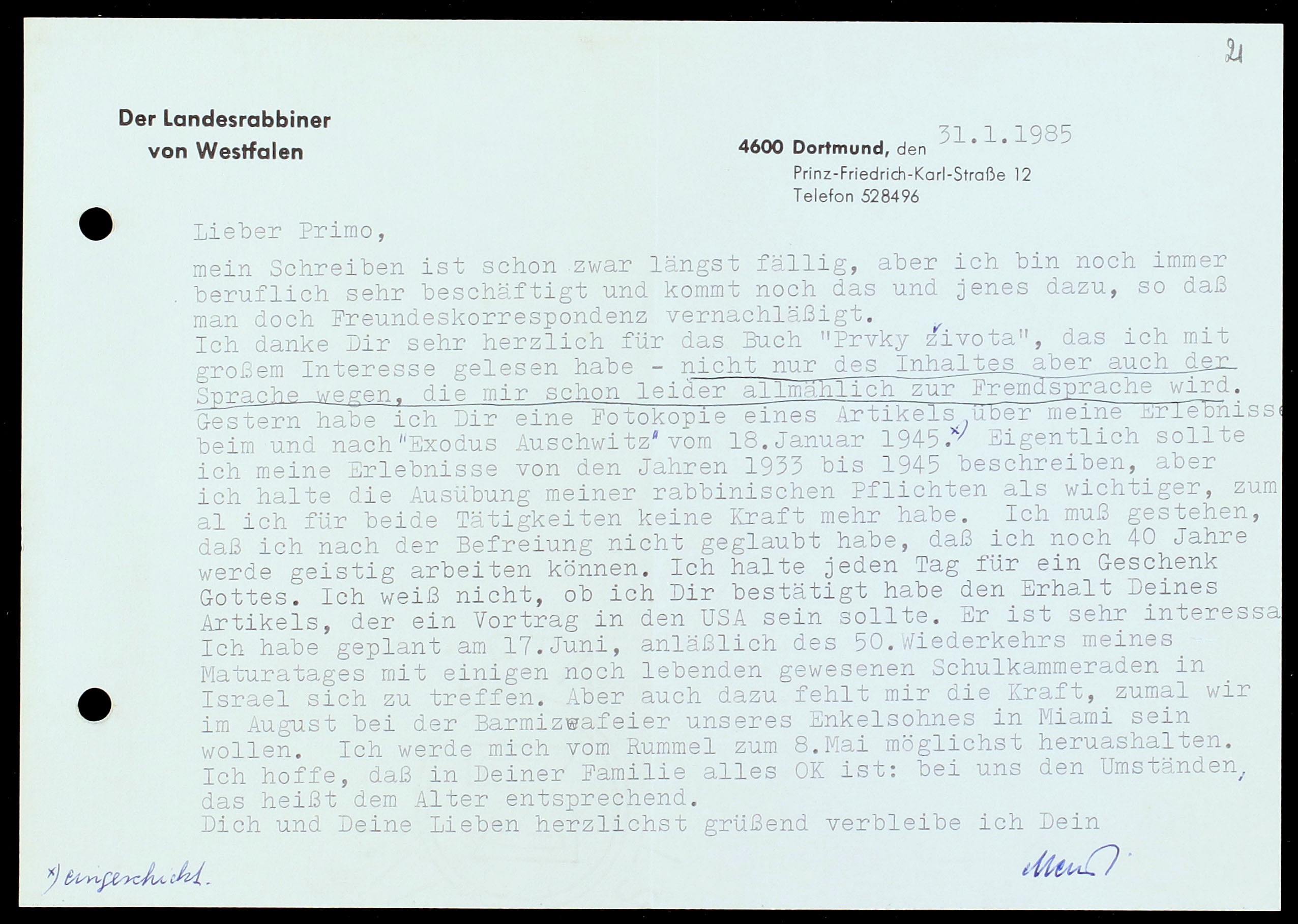
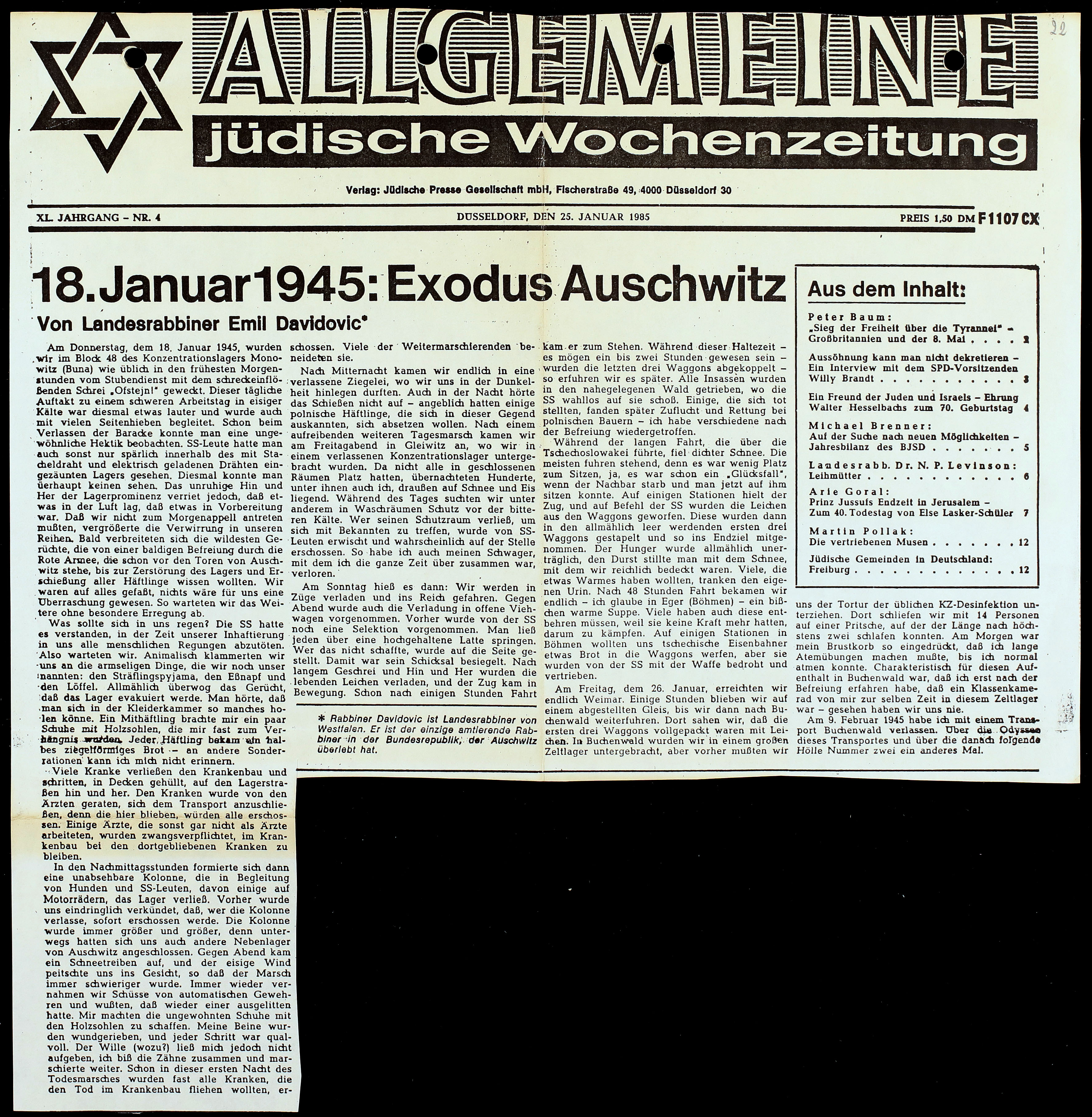
Davidovic reciprocates Levi’s gift of the Czech translation of The Periodic Table by sending Levi a piece of his own about the evacuation march from Auschwitz.
31.1.1985
Lieber Primo,
mein Schreiben ist schon zwar längst fällig, aber ich bin noch immer beruflich sehr beschäftigt und kommt noch das und jenes dazu, so daß man doch Freundeskorrespondenz vernachläßigt.
Ich danke Dir sehr herzlich für das Buch Prvky života,[1] das ich mit großem Interesse gelesen habe – nicht nur des Inhaltes aber auch der Sprache wegen, die mir schon leider allmählich zur Fremdsprache wird.[2]
Gestern habe ich Dir eine Fotokopie eines Artikels, über meine Erlebnisse beim und nach Exodus Auschwitz vom 18. Januar 1945.[3] Eigentlich sollte ich meine Erlebnisse von den Jahren 1933 bis 1945 beschreiben, aber ich halte die Ausübung meiner rabbinischen Pflichten als wichtiger, zumal ich für beide Tätigkeiten keine Kraft mehr habe. Ich muß gestehen, daß ich nach der Befreiung nicht geglaubt habe, daß ich noch 40 Jahre werde geistig arbeiten können. Ich halte jeden Tag für ein Geschenk Gottes. Ich weiß nicht, ob ich Dir bestätigt habe den Erhalt Deines Artikels,[4] der ein Vortrag in den USA sein sollte. Er ist sehr interessa[5]
Ich habe geplant am 17. Juni, anläßlich des 50.Wiederkehrs meines Maturatages mit einigen noch lebenden gewesenen Schulkameraden in Israel sich zu treffen. Aber auch dazu fehlt mir die Kraft, zumal wir im August bei der Barmizwafeier unseres Enkelsohnes in Miami sein wollen. Ich werde mich vom Rummel zum 8. Mai möglichst heraushalten.[6]
Ich hoffe, daß in Deiner Familie alles OK ist: bei uns den Umständen, das heißt dem Alter entsprechend.
Dich und Deine Lieben herzlichst grüßend verbleibe ich Dein
Mendi
18. Januar 1945: Exodus Auschwitz
Von Landesrabbiner Emil Davidovic
Am Donnerstag, dem 18. Januar 1945, wurden wir im Block 48 des Konzentrationslagers Monowitz (Buna) wie üblich in den frühesten Morgenstunden vom Stubendienst mit dem schreckeneinflößenden Schrei „Ofstejn!“ geweckt. Dieser tägliche Auftakt zu einem schweren Arbeitstag in eisiger Kälte war diesmal etwas lauter und wurde auch mit vielen Seitenhieben begleitet. Schon beim Verlassen der Baracke konnte man eine ungewöhnliche Hektik beobachten. SS-Leute hatte man auch sonst nur spärlich innerhalb des mit Stacheldraht und elektrisch geladenen Drähten eingezäunten Lagers gesehen. Diesmal konnte man überhaupt keinen sehen. Das unruhige Hin und Her der Lagerprominenz verriet jedoch, daß etwas in der Luft lag, daß etwas in Vorbereitung war. Daß wir nicht zum Morgenappell antreten mussten, vergrößerte die Verwirrung in unseren Reihen. Bald verbreiteten sich die wildesten Gerüchte, die von einer baldigen Befreiung durch die Rote Armee, die schon vor den Toren von Auschwitz stehe, bis zur Zerstörung des Lagers und Erschießung aller Häftlinge wissen wollten. Wir waren auf alles gefaßt, nichts wäre für uns eine Überraschung gewesen. So warteten wir das Weitere ohne besondere Erregung ab.
Was sollte sich in uns regen? Die SS hatte es verstanden, in der Zeit unserer Inhaftierung in uns alle menschlichen Regungen abzutöten. Also warteten wir. Ängstlich klammerten wir uns an die armseligen Dinge, die wir noch unser nannten: den Sträflingspyjama, den Eßnapf und den Löffel. Allmählich überwog das Gerücht, daß das Lager evakuiert werde. Man hörte, daß man sich in der Kleiderkammer so manches holen könne. Ein Mithäftling brachte mir ein paar Schuhe mit Holzsohlen, die mir fast zum Verhängnis wurden. Jeder Häftling bekam ein halbes ziegelförmiges Brot – an andere Sonderrationen kann ich mich nicht erinnern.
Viele Kranke verließen den Krankenbau und schritten, in Decken gehüllt, auf den Lagerstraßen hin und her. Den Kranken wurde von den Ärzten geraten, sich dem Transport anzuschließen, denn die hier blieben, würden alle erschossen. Einige Ärzte, die sonst gar nicht als Ärzte arbeiteten, wurden zwangsverpflichtet, im Krankenbau bei den dortgebliebenen Kranken zu bleiben.
In den Nachmittagsstunden formierte sich dann eine unabsehbare Kolonne, die in Begleitung von Hunden und SS-Leuten, davon einige auf Motorrädern, das Lager verließ. Vorher wurde uns eindringlich verkündet, daß, wer die Kolonne verlasse, sofort erschossen werde. Die Kolonne wurde immer größer und größer, denn unterwegs hatten sich auch andere Nebenlager von Auschwitz angeschlossen. Gegen Abend kam ein Schneetreiben auf, und der eisige Wind peitschte uns ins Gesicht, so daß der Marsch immer schwieriger wurde. Immer wieder vernahmen wir Schüsse von automatischen Gewehren und wußten, daß wieder einer ausgebüchst hatte. Mir machten die ungewohnten Schuhe mit den Holzsohlen zu schaffen. Meine Beine wurden wundgerieben, und jeder Schritt war qualvoll. Der Wille (wozu?) ließ mich jedoch nicht aufgeben, ich biß die Zähne zusammen und marschierte weiter. Schon in dieser ersten Nacht des Todesmarsches wurden fast alle Kranken, die den Tod im Krankenbau fliehen wollten, erschossen. Viele der Weitermarschierenden beneideten sie.
Nach Mitternacht kamen wir endlich in eine verlassene Ziegelei, wo wir uns in der Dunkelheit hinlegen durften. Auch in der Nacht hörte das Schießen nicht auf – angeblich hatten einige polnische Häftlinge, die sich in dieser Gegend auskannten, sich absetzen wollen. Nach einem aufreibenden weiteren Tagesmarsch kamen wir am Freitagabend in Gleiwitz an, wo wir in einem verlassenen Konzentrationslager untergebracht wurden. Da nicht alle in geschlossenen Räumen Platz hatten, übernachten Hunderte, unter ihnen auch ich, draußen auf Schnee und Eis liegend. Während des Tages suchten wir unter anderem in Waschräumen Schutz vor der bitteren Kälte. Wer seinen Schutzraum verließ, um sich mit Bekannten zu treffen, wurde von SS-Leuten erwischt und wahrscheinlich auf der Stelle erschossen. So habe ich auch meinen Schwager, mit dem ich die ganze Zeit über zusammen war, verloren.
Am Sonntag hieß es dann: Wir werden in Züge verladen und ins Reich gefahren. Gegen Abend wurde auch die Verladung in offene Viehwagen vorgenommen. Vorher wurde von der SS noch eine Selektion vorgenommen. Man ließ jeden über eine hochgehaltene Latte springen. Wer das nicht schaffte, wurde auf die Seite gestellt. Damit war sein Schicksal besiegelt. Nach langem Geschrei und Hin und Her wurden die lebenden Leichen verladen, und der Zug kam in Bewegung. Schon nach einigen Stunden Fahrt kam er zum Stehen. Während dieser Haltezeit – es mögen ein bis zwei Stunden gewesen sein – wurden die letzten drei Waggons abgekoppelt – so erfuhren wir es später. Alle Insassen wurden in den nahegelegenen Wald getrieben, wo die SS wahllos auf sie schoß. Einige, die sich tot stellten, fanden später Zuflucht und Rettung bei polnischen Bauern – ich habe verschiedene nach der Befreiung wiedergetroffen.
Während der langen Fahrt, die über die Tschechoslowakei führte, fiel dichter Schnee. Die meisten fuhren stehend, denn es war wenig Platz zum Sitzen; ja, es war schon ein „Glücksfall“, wenn der Nachbar starb und man jetzt auf ihm sitzen konnte. Auf einigen Stationen hielt der Zug, und auf Befehl der SS wurden die Leichen aus den Waggons geworfen. Diese wurden dann in den allmählich leer werdenden ersten drei Waggons gestapelt und so ins Endziel mitgenommen. Der Hunger wurde allmählich unerträglich, der Durst stillte man mit dem Schnee, mit dem wir reichlich bedeckt waren. Viele, die etwas Warmes haben wollten, tranken den eigenen Urin. Nach 48 Stunden Fahrt bekamen wir endlich – ich glaube in Eger (Böhmen) – ein bißchen warme Suppe. Viele haben auch diese entbehren müssen, weil sie keine Kraft mehr hatten, darum zu kämpfen. Auf einigen Stationen in Böhmen wollten uns tschechische Eisenbahner etwas Brot in die Waggons werfen, aber sie wurden von der SS mit der Waffe bedroht und vertrieben.
Am Freitag, dem 26. Januar, erreichten wir endlich Weimar. Einige Stunden blieben wir auf einem abgestellten Gleis, bis wir dann nach Buchenwald weiterfuhren. Dort sahen wir, daß die ersten drei Waggons vollgepackt waren mit Leichen. In Buchenwald wurden wir in einem großen Zeltlager untergebracht, aber vorher mußten wir uns der Tortur der üblichen KZ-Desinfektion unterziehen. Dort schliefen wir mit 14 Personen auf einer Pritsche, auf der der Länge nach höchstens zwei schlafen konnten. Am Morgen war mein Brustkorb so eingedrückt, daß ich lange Atemübungen machen mußte, bis ich normal atmen konnte. Charakteristisch für diesen Aufenthalt in Buchenwald war, daß ich erst nach der Befreiung erfahren habe, daß ein Klassenkamerad von mir zur selben Zeit in diesem Zeltlager war – gesehen haben wir uns nie.
Am 9. Februar 1945 habe ich mit einem Transport Buchenwald verlassen. Über die Odyssee dieses Transportes und über die danach folgende Hölle Nummer zwei ein anderes Mal.
* Rabbiner Davidovic ist Landesrabbiner von Westfalen. Er ist der einzige amtierende Rabbiner in der Bundesrepublik, der Auschwitz überlebt hat.
31 gennaio 1985
Caro Primo,
la mia lettera è già in grande ritardo, ma sono ancora molto impegnato con il lavoro e, a questo, si aggiunge sempre l’una o l’altra incombenza, così che finisco per trascurare perfino la corrispondenza con gli amici.
Ti ringrazio di cuore per il libro Prvky života,[1] che ho letto con grande interesse non solo per il suo contenuto, ma anche per la lingua in cui è scritto, il ceco, che purtroppo sta diventando anche per me una lingua straniera.[2]
Ieri ti ho spedito la fotocopia di un articolo sulle mie vicende durante e dopo l’«esodo da Auschwitz» del 18 gennaio 1945. In realtà avrei dovuto raccontare la mia esperienza degli anni dal 1933 al 1945,[3] ma considero più importante dedicarmi ai miei doveri di rabbino, a maggior ragione non avendo più le forze per mandare avanti entrambe le attività. Devo confessarti che, dopo la liberazione, non avrei mai creduto di poter svolgere un lavoro spiritualeper altri quarant’anni. Considero ogni giorno un dono di Dio. Non so se ti ho mai confermato di aver ricevuto il tuo articolo,[4] quello destinato alla tua conferenza negli Stati Uniti. L’ho trovato molto interessante.[5]
Il 17 giugno, a cinquant’anni dal mio diploma, avevo in programma di incontrare in Israele alcuni dei miei ex compagni di scuola ancora in vita. Ma anche per questo mi mancano le forze, soprattutto perché in agosto vorremmo essere a Miami per il Bar Mitzvah di nostro nipote. Per quanto mi riguarda, cercherò di tenermi il più possibile alla larga dal trambusto delle celebrazioni dell’8 maggio.[6]
Spero che da voi in famiglia tutto proceda bene; da noi, alla fin fine, le cose vanno come ci si può aspettare alla nostra età.
Ti saluto te e i tuoi cari con grandissimo affetto, tuo
Mendi
18 gennaio 1945: esodo da Auschwitz
di Emil Davidovic, rabbino capo della Vestfalia
Giovedì 18 gennaio 1945, nel blocco 48 del campo di concentramento di Monowitz (Buna), fummo svegliati, come di consueto, nelle primissime ore del mattino dagli addetti al servizio della camerata che gridavano con voce terrificante: «Ofstejn!» («In piedi!») Quel quotidiano preludio a una dura giornata di lavoro nel gelo polare fu, questa volta, ancora più fragoroso e accompagnato da una raffica di percosse e spintoni. Già uscendo dalla baracca si poteva notare un’insolita frenesia. Se in genere gli uomini delle SS si vedevano solo di rado all’interno del campo recintato da filo spinato ed elettrificato, stavolta non se ne vedeva neanche uno. L’irrequieto andirivieni dei cosiddetti Prominenti del Lager lasciava intuire che c’era nell’aria qualcosa, chequalcosa si stava preparando. Il fatto che non dovessimo schierarci per l’appello del mattino accrebbe ulteriormente la confusione tra le nostre file. Ben presto cominciarono a circolare le voci più disparate: c’era chi sosteneva che la liberazione da parte dell’Armata Rossa, ormai alle porte di Auschwitz, fosse imminente, e chi invece parlava della distruzione del campo e della fucilazione di tutti i prigionieri. Eravamo pronti a tutto: nulla ci avrebbe sorpreso. Così aspettammo gli sviluppi senza particolare emozione.
Che cosa avrebbe potuto ancora muoversi dentro di noi? Durante la nostra prigionia le SS erano riuscite ad annientare ogni sentimento umano. Così aspettammo. Ci aggrappavamo con angoscia alle poche miserabili cose che ancora chiamavamo nostre: il pigiama da detenuto, la gamella e il cucchiaio. A poco a poco prevalse la voce che il campo sarebbe stato evacuato. Si diceva che nel magazzino degli indumentisi potesse recuperare qualcosa. Un compagno di prigionia mi procurò un paio di scarpe con la suola di legno, che per poco non mi costarono la vita. A ogni prigioniero venne data una mezza pagnotta a forma di mattone; di altre razioni speciali non ho memoria.
Molti malati lasciarono l’infermeria e si aggiravano per le vie del campo avvolti nelle coperte. I medici consigliavano loro di unirsi al trasporto, perché chi fosse rimasto sarebbe stato fucilato. Alcuni medici, che in genere non esercitavano come tali, furono costretti a rimanere nell’infermeria insieme ai malati che non partivano.
Nel pomeriggio si formò una colonna interminabile che lasciò il campo scortata da cani e uomini delle SS, alcuni dei quali in motocicletta. Prima della partenza ci annunciarono con fermezza che chiunque avesse abbandonato la colonna sarebbe stato fucilato sul posto. La colonna diventava sempre più lunga, perché via via si univano altri sottocampi di Auschwitz. Verso sera cominciò una bufera di neve e un vento gelido ci sferzava in viso, rendendo la marcia sempre più difficile. Continuavamo a sentire raffiche di armi automatiche e ogni volta sapevamo che qualcuno aveva tentato la fuga. Io soffrivo terribilmente per quelle scarpe con la suola di legno, alle quali non ero abituato. Avevo le gambe piagate e ogni passo era un supplizio. Eppure la volontà (di fare cosa, poi?) mi impedì di desistere: strinsi i denti e continuai a marciare. Già durante quella prima notte di marcia furono uccisi quasi tutti i malati che avevano cercato di sfuggire alla morte in infermeria. Molti di coloro che invece proseguivano li invidiavano.
Dopo la mezzanotte arrivammo finalmente a una fornace abbandonata, dove ci fu permesso di sdraiarci al buio. Anche durante la notte gli spari non cessarono: pare che alcuni prigionieri polacchi, pratici della zona, avessero tentato di allontanarsi. Venerdì sera, dopo un’altra estenuante giornata di marcia giungemmo a Gleiwitz, dove fummo sistemati in un campo di concentramento ormai abbandonato. Poiché al chiuso non c’era posto per tutti, centinaia di persone, e tra loro anch’io, trascorsero la notte all’aperto, sdraiate sulla neve e sul ghiaccio. Durante il giorno cercavamo riparo dal gelo pungente, tra l’altro, nei lavatoi. Chi lasciava quel riparo per andare in cerca di qualche conoscente veniva scoperto dalle SS e con ogni probabilità fucilato sul posto. Fu così che persi anche mio cognato, con il quale ero rimasto insieme per tutto il tempo.
Domenica ci dissero che saremmo stati caricati sui treni e trasferiti nel Reich. Verso sera cominciarono a caricarci su carri bestiame scoperti. Prima, però, le SS effettuarono un’ulteriore selezione: bisognavasaltare sopra un’asticella tenuta sollevata. Chi non ci riusciva veniva messo da una parte, e con ciò il suo destino era segnato. Dopo un gran sbraitare e un confuso viavai, quelle larve umane furono caricate e il treno si mise in movimento. Dopo poche ore di viaggio si fermò. Durante quella sosta –forse di un’ora o due – gli ultimi tre vagoni furono sganciati, come avremmo saputo in seguito. Tutte le persone a bordo furono condotte nel bosco vicino, dove le SS aprirono il fuoco all’impazzata. Alcuni, fingendosi morti, riuscirono poi a trovare rifugio e salvezza presso dei contadini polacchi; dopo la liberazione ne rividi diversi.
Durante il lungo viaggio attraversola Cecoslovacchia, la neve cadeva fitta. La maggior parte di noi viaggiava in piedi, perché lo spazio per sedersi era pochissimo; anzi, era quasi un “colpo di fortuna” se il vicino moriva, perché almeno ci si poteva sedere sul suo corpo. In alcune stazioni il treno si fermava e, su ordine delle SS, i cadaveri venivano gettati fuori dai vagoni. Venivano poi ammucchiati nei primi tre che andavano via via svuotandosi, e trasportati così fino alla destinazione finale. La fame, intanto, diventava sempre più insopportabile; la sete veniva placata con la neve che ci ricopriva in abbondanza. Molti, desiderando qualcosa di caldo, arrivavano a bere la propria urina. Dopo quarantotto ore di viaggio ricevemmo finalmente – credo a Eger, in Boemia – un po’ di minestra calda. Molti dovettero farne a meno, perché non avevano più la forza di lottare per ottenerla. In alcune stazioni della Boemia i ferrovieri cechi cercarono di gettarci del pane nei vagoni, ma furono minacciati con le armi dalle SS e allontanati.
Venerdì 26 gennaio raggiungemmo finalmente Weimar. Restammo per alcune ore su un binario morto, poi ripartimmo verso Buchenwald. Lì vedemmo che i primi tre vagoni erano stipati di cadaveri. A Buchenwald fummo sistemati in un grande accampamento, ma prima dovemmo sottoporci alla tortura della consueta disinfezione da Lager. Dormivamo in quattordici in una cuccetta in cui, per il lungo, avrebbero potuto coricarsi al massimo due persone. Al mattino avevo il torace così schiacciato che dovetti fare lunghi esercizi di respirazione prima di tornarea respirare normalmente. Un particolare emblematico di quel periodo trascorso a Buchenwald è che soltanto dopo la liberazione venni a sapere che, nello stesso accampamento e nello stesso periodo, si trovava anche un mio compagno di scuola: non ci incontrammo mai.
Il 9 febbraio 1945 lasciai Buchenwald con un trasporto. Dell’odissea di quel convoglio e dell’inferno numero due che ne seguì racconterò un’altra volta.
* Il rabbino Davidovic è rabbino capo della Vestfalia. È l’unico rabbino in carica nella Repubblica Federale di Germania sopravvissuto ad Auschwitz.
January 31, 1985
Dear Primo,
I am long overdue in writing to you, but I am still very busy with work, and with this and that coming up, I have ended up neglecting my correspondence with friends.
I thank you very much for the book Prvky života,[1] which I read with great interest—not only because of the content, but also because of the language, which, unfortunately, is gradually becoming a foreign language to me.[2]
Yesterday I sent you a photocopy of an article about my experiences during and after the “Exodus from Auschwitz” on January 18, 1945.[3] I was actually supposed to describe my experiences from 1933 to 1945, but I consider the fulfillment of my rabbinical duties more important than writing, since I no longer have the strength to do both. I must admit that, after liberation, I did not believe I would still be able to engage in intellectual work for another 40 years. I consider every day a gift from God. I do not know if I confirmed receipt of your article,[4] the one intended to be a lecture in the U.S.A. It is very interesting.[5]
I had planned to meet up in Israel on June 17 with some of my former classmates who are still alive, to mark the 50th anniversary of my high school graduation. But I lack the energy for that as well, especially since we want to be in Miami in August for our grandson’s bar mitzvah celebration. I will stay out of the commotion surrounding May 8 as much as possible.[6]
I hope everything is going well with your family; as for us, things are going as one would expect given our age.
Sending warm regards to you and your loved ones, yours,
Mendi
January 18, 1945: Exodus from Auschwitz
By Chief Rabbi Emil Davidovic
On Thursday, January 18, 1945, we in Block 48 of the Monowitz (Buna) concentration camp were awakened, as usual in the early morning hours, by the barracks guard with the terrifying shout Ofstejn!—“get up!” This time, this daily prelude to a grueling workday in the freezing cold was somewhat louder than usual, and was also accompanied by many blows to the side. Even as we left the barracks, we detected an unusual sense of urgency. SS men were usually seen only sparingly within the camp, which was cordoned off by barbed wire and electric fences. This time, not a single one was anywhere in sight. However, the restless comings and goings of the camp’s leadership revealed that something was in the air, that something was in the works. The fact that we did not have to line up for morning roll call only added to our confusion. Soon the wildest rumors began to spread, ranging from imminent liberation by the Red Army—which was said to already be at the gates of Auschwitz—to the destruction of the camp and the shooting of all the prisoners. We were prepared for anything; nothing would have come as a surprise to us. So we waited, without any particular agitation, to see what would happen next.
What was there to be stirred up within us? The SS had managed to kill off our every human emotion during our time in captivity. So we waited. Anxiously, we clung to the meager possessions we still called our own: the prisoner’s pajamas, the food bowl, and the spoon. Gradually, the rumor that the camp was being evacuated gained steam. We heard that one could get all sorts of things from the clothing store. A fellow prisoner brought me a pair of shoes with wooden soles, which nearly proved my undoing. Every prisoner received half a brick-shaped loaf of bread—I cannot recall any other special rations.
Many sick prisoners left the infirmary and walked back and forth along the camp roads, wrapped in blankets. The doctors advised the sick to join the transport, because those who remained here would all be shot. Some doctors, who otherwise did not work as doctors at all, were forcibly conscripted to stay in the infirmary with the sick who remained there.
That afternoon, an immense column formed, which then exited the camp accompanied by dogs and SS men, some of whom were on motorcycles. Beforehand, we were sternly warned that anyone who left the column would be shot on the spot. The column grew larger and larger, as other subcamps of Auschwitz had joined us along the way. Toward evening, a snowstorm set in, and the icy wind whipped our faces, making the march increasingly difficult. Again and again we heard the crack of automatic rifle fire and knew that yet another prisoner had tried to escape. The unfamiliar shoes with wooden soles were giving me trouble. My legs were rubbed raw, and every step was agonizing. However, my will (to do what?) would not let me give up; I gritted my teeth and kept marching. Already on that first night of the death march, almost all the sick prisoners who had tried to escape death in the infirmary were shot. Many of those still marching envied them.
After midnight, we finally arrived at an abandoned brick factory, where we were allowed to lie down in the darkness. The shooting did not stop even at night—apparently, some Polish prisoners who knew the area well had tried to escape. After another grueling day’s march, we arrived in Gleiwitz on Friday evening, where we were housed in an abandoned concentration camp. Since there was not enough room for everyone indoors, hundreds of us—myself included—spent the night lying outside on the snow and ice. During the day, we sought shelter from the bitter cold in places like the washrooms. Anyone who left their shelter to meet with acquaintances was caught by SS men and likely shot on the spot. That is how I lost my brother-in-law, with whom I had remained together the entire time.
On Sunday, we were told we would be loaded onto trains and taken to the German Reich. Toward evening, the loading into open cattle cars began. Before that, the SS carried out another selection. They made everyone jump over a slat held up high. Anyone who could not make it was set aside. That sealed their fate. After a long commotion and much back-and-forth, the living corpses were loaded, and the train began to move. After just a few hours, it came to a stop. During this stop—it may have been one or two hours—the last three cars were uncoupled, as we later learned. All the passengers were herded into the nearby forest, where the SS shot them indiscriminately. Some who pretended to be dead later found refuge and were rescued by Polish farmers—I met several of them again after liberation.
During the long journey, which led across Czechoslovakia, heavy snow fell. Most people traveled standing up, since there was little room to sit; indeed, it was a “stroke of luck” if your neighbor died and you could now sit in his place. The train stopped at several stations, and on the orders of the SS, the bodies were thrown out of the cars. These were then piled into the first three cars, which were gradually emptying, and carried on to the final destination. Our hunger gradually grew unbearable, and we quenched our thirst with the snow that covered us in abundance. Many who wanted something warm drank their own urine. After a 48-hour journey, we finally received—I believe in Eger (Bohemia)—a little warm soup. Many had to go without even this because they no longer had the strength to fight for it. At some stations in Bohemia, Czech railroad workers tried to throw some bread into our cars, but they were threatened at gunpoint by the SS and driven away.
On Friday, January 26, we finally reached Weimar. We remained on a side track for a few hours before continuing on to Buchenwald. There we saw that the first three cars were packed full of corpses. In Buchenwald, we were housed in a large tent camp, but first we had to undergo the ordeal of the standard concentration-camp disinfection. There, 14 of us slept on a bunk that could accommodate at most two people lying lengthwise. In the morning, my chest was so compressed that I had to do breathing exercises for a long time before I could breathe normally. A defining feature of this stay in Buchenwald was that I did not learn until after liberation that a classmate of mine had been in that same tent camp at the same time—we never saw each other.
On February 9, 1945, I left Buchenwald on a transport. Some other time I shall tell you about the odyssey of that transport and the second hell that followed.
* Rabbi Davidovic is the Chief Rabbi of Westphalia. He is the only rabbi currently serving in the Federal Republic of Germany who survived Auschwitz.
31.1.1985
Lieber Primo,
mein Schreiben ist schon zwar längst fällig, aber ich bin noch immer beruflich sehr beschäftigt und kommt noch das und jenes dazu, so daß man doch Freundeskorrespondenz vernachläßigt.
Ich danke Dir sehr herzlich für das Buch Prvky života,[1] das ich mit großem Interesse gelesen habe – nicht nur des Inhaltes aber auch der Sprache wegen, die mir schon leider allmählich zur Fremdsprache wird.[2]
Gestern habe ich Dir eine Fotokopie eines Artikels, über meine Erlebnisse beim und nach Exodus Auschwitz vom 18. Januar 1945.[3] Eigentlich sollte ich meine Erlebnisse von den Jahren 1933 bis 1945 beschreiben, aber ich halte die Ausübung meiner rabbinischen Pflichten als wichtiger, zumal ich für beide Tätigkeiten keine Kraft mehr habe. Ich muß gestehen, daß ich nach der Befreiung nicht geglaubt habe, daß ich noch 40 Jahre werde geistig arbeiten können. Ich halte jeden Tag für ein Geschenk Gottes. Ich weiß nicht, ob ich Dir bestätigt habe den Erhalt Deines Artikels,[4] der ein Vortrag in den USA sein sollte. Er ist sehr interessa[5]
Ich habe geplant am 17. Juni, anläßlich des 50.Wiederkehrs meines Maturatages mit einigen noch lebenden gewesenen Schulkameraden in Israel sich zu treffen. Aber auch dazu fehlt mir die Kraft, zumal wir im August bei der Barmizwafeier unseres Enkelsohnes in Miami sein wollen. Ich werde mich vom Rummel zum 8. Mai möglichst heraushalten.[6]
Ich hoffe, daß in Deiner Familie alles OK ist: bei uns den Umständen, das heißt dem Alter entsprechend.
Dich und Deine Lieben herzlichst grüßend verbleibe ich Dein
Mendi
18. Januar 1945: Exodus Auschwitz
Von Landesrabbiner Emil Davidovic
Am Donnerstag, dem 18. Januar 1945, wurden wir im Block 48 des Konzentrationslagers Monowitz (Buna) wie üblich in den frühesten Morgenstunden vom Stubendienst mit dem schreckeneinflößenden Schrei „Ofstejn!“ geweckt. Dieser tägliche Auftakt zu einem schweren Arbeitstag in eisiger Kälte war diesmal etwas lauter und wurde auch mit vielen Seitenhieben begleitet. Schon beim Verlassen der Baracke konnte man eine ungewöhnliche Hektik beobachten. SS-Leute hatte man auch sonst nur spärlich innerhalb des mit Stacheldraht und elektrisch geladenen Drähten eingezäunten Lagers gesehen. Diesmal konnte man überhaupt keinen sehen. Das unruhige Hin und Her der Lagerprominenz verriet jedoch, daß etwas in der Luft lag, daß etwas in Vorbereitung war. Daß wir nicht zum Morgenappell antreten mussten, vergrößerte die Verwirrung in unseren Reihen. Bald verbreiteten sich die wildesten Gerüchte, die von einer baldigen Befreiung durch die Rote Armee, die schon vor den Toren von Auschwitz stehe, bis zur Zerstörung des Lagers und Erschießung aller Häftlinge wissen wollten. Wir waren auf alles gefaßt, nichts wäre für uns eine Überraschung gewesen. So warteten wir das Weitere ohne besondere Erregung ab.
Was sollte sich in uns regen? Die SS hatte es verstanden, in der Zeit unserer Inhaftierung in uns alle menschlichen Regungen abzutöten. Also warteten wir. Ängstlich klammerten wir uns an die armseligen Dinge, die wir noch unser nannten: den Sträflingspyjama, den Eßnapf und den Löffel. Allmählich überwog das Gerücht, daß das Lager evakuiert werde. Man hörte, daß man sich in der Kleiderkammer so manches holen könne. Ein Mithäftling brachte mir ein paar Schuhe mit Holzsohlen, die mir fast zum Verhängnis wurden. Jeder Häftling bekam ein halbes ziegelförmiges Brot – an andere Sonderrationen kann ich mich nicht erinnern.
Viele Kranke verließen den Krankenbau und schritten, in Decken gehüllt, auf den Lagerstraßen hin und her. Den Kranken wurde von den Ärzten geraten, sich dem Transport anzuschließen, denn die hier blieben, würden alle erschossen. Einige Ärzte, die sonst gar nicht als Ärzte arbeiteten, wurden zwangsverpflichtet, im Krankenbau bei den dortgebliebenen Kranken zu bleiben.
In den Nachmittagsstunden formierte sich dann eine unabsehbare Kolonne, die in Begleitung von Hunden und SS-Leuten, davon einige auf Motorrädern, das Lager verließ. Vorher wurde uns eindringlich verkündet, daß, wer die Kolonne verlasse, sofort erschossen werde. Die Kolonne wurde immer größer und größer, denn unterwegs hatten sich auch andere Nebenlager von Auschwitz angeschlossen. Gegen Abend kam ein Schneetreiben auf, und der eisige Wind peitschte uns ins Gesicht, so daß der Marsch immer schwieriger wurde. Immer wieder vernahmen wir Schüsse von automatischen Gewehren und wußten, daß wieder einer ausgebüchst hatte. Mir machten die ungewohnten Schuhe mit den Holzsohlen zu schaffen. Meine Beine wurden wundgerieben, und jeder Schritt war qualvoll. Der Wille (wozu?) ließ mich jedoch nicht aufgeben, ich biß die Zähne zusammen und marschierte weiter. Schon in dieser ersten Nacht des Todesmarsches wurden fast alle Kranken, die den Tod im Krankenbau fliehen wollten, erschossen. Viele der Weitermarschierenden beneideten sie.
Nach Mitternacht kamen wir endlich in eine verlassene Ziegelei, wo wir uns in der Dunkelheit hinlegen durften. Auch in der Nacht hörte das Schießen nicht auf – angeblich hatten einige polnische Häftlinge, die sich in dieser Gegend auskannten, sich absetzen wollen. Nach einem aufreibenden weiteren Tagesmarsch kamen wir am Freitagabend in Gleiwitz an, wo wir in einem verlassenen Konzentrationslager untergebracht wurden. Da nicht alle in geschlossenen Räumen Platz hatten, übernachten Hunderte, unter ihnen auch ich, draußen auf Schnee und Eis liegend. Während des Tages suchten wir unter anderem in Waschräumen Schutz vor der bitteren Kälte. Wer seinen Schutzraum verließ, um sich mit Bekannten zu treffen, wurde von SS-Leuten erwischt und wahrscheinlich auf der Stelle erschossen. So habe ich auch meinen Schwager, mit dem ich die ganze Zeit über zusammen war, verloren.
Am Sonntag hieß es dann: Wir werden in Züge verladen und ins Reich gefahren. Gegen Abend wurde auch die Verladung in offene Viehwagen vorgenommen. Vorher wurde von der SS noch eine Selektion vorgenommen. Man ließ jeden über eine hochgehaltene Latte springen. Wer das nicht schaffte, wurde auf die Seite gestellt. Damit war sein Schicksal besiegelt. Nach langem Geschrei und Hin und Her wurden die lebenden Leichen verladen, und der Zug kam in Bewegung. Schon nach einigen Stunden Fahrt kam er zum Stehen. Während dieser Haltezeit – es mögen ein bis zwei Stunden gewesen sein – wurden die letzten drei Waggons abgekoppelt – so erfuhren wir es später. Alle Insassen wurden in den nahegelegenen Wald getrieben, wo die SS wahllos auf sie schoß. Einige, die sich tot stellten, fanden später Zuflucht und Rettung bei polnischen Bauern – ich habe verschiedene nach der Befreiung wiedergetroffen.
Während der langen Fahrt, die über die Tschechoslowakei führte, fiel dichter Schnee. Die meisten fuhren stehend, denn es war wenig Platz zum Sitzen; ja, es war schon ein „Glücksfall“, wenn der Nachbar starb und man jetzt auf ihm sitzen konnte. Auf einigen Stationen hielt der Zug, und auf Befehl der SS wurden die Leichen aus den Waggons geworfen. Diese wurden dann in den allmählich leer werdenden ersten drei Waggons gestapelt und so ins Endziel mitgenommen. Der Hunger wurde allmählich unerträglich, der Durst stillte man mit dem Schnee, mit dem wir reichlich bedeckt waren. Viele, die etwas Warmes haben wollten, tranken den eigenen Urin. Nach 48 Stunden Fahrt bekamen wir endlich – ich glaube in Eger (Böhmen) – ein bißchen warme Suppe. Viele haben auch diese entbehren müssen, weil sie keine Kraft mehr hatten, darum zu kämpfen. Auf einigen Stationen in Böhmen wollten uns tschechische Eisenbahner etwas Brot in die Waggons werfen, aber sie wurden von der SS mit der Waffe bedroht und vertrieben.
Am Freitag, dem 26. Januar, erreichten wir endlich Weimar. Einige Stunden blieben wir auf einem abgestellten Gleis, bis wir dann nach Buchenwald weiterfuhren. Dort sahen wir, daß die ersten drei Waggons vollgepackt waren mit Leichen. In Buchenwald wurden wir in einem großen Zeltlager untergebracht, aber vorher mußten wir uns der Tortur der üblichen KZ-Desinfektion unterziehen. Dort schliefen wir mit 14 Personen auf einer Pritsche, auf der der Länge nach höchstens zwei schlafen konnten. Am Morgen war mein Brustkorb so eingedrückt, daß ich lange Atemübungen machen mußte, bis ich normal atmen konnte. Charakteristisch für diesen Aufenthalt in Buchenwald war, daß ich erst nach der Befreiung erfahren habe, daß ein Klassenkamerad von mir zur selben Zeit in diesem Zeltlager war – gesehen haben wir uns nie.
Am 9. Februar 1945 habe ich mit einem Transport Buchenwald verlassen. Über die Odyssee dieses Transportes und über die danach folgende Hölle Nummer zwei ein anderes Mal.
* Rabbiner Davidovic ist Landesrabbiner von Westfalen. Er ist der einzige amtierende Rabbiner in der Bundesrepublik, der Auschwitz überlebt hat.
31 gennaio 1985
Caro Primo,
la mia lettera è già in grande ritardo, ma sono ancora molto impegnato con il lavoro e, a questo, si aggiunge sempre l’una o l’altra incombenza, così che finisco per trascurare perfino la corrispondenza con gli amici.
Ti ringrazio di cuore per il libro Prvky života,[1] che ho letto con grande interesse non solo per il suo contenuto, ma anche per la lingua in cui è scritto, il ceco, che purtroppo sta diventando anche per me una lingua straniera.[2]
Ieri ti ho spedito la fotocopia di un articolo sulle mie vicende durante e dopo l’«esodo da Auschwitz» del 18 gennaio 1945. In realtà avrei dovuto raccontare la mia esperienza degli anni dal 1933 al 1945,[3] ma considero più importante dedicarmi ai miei doveri di rabbino, a maggior ragione non avendo più le forze per mandare avanti entrambe le attività. Devo confessarti che, dopo la liberazione, non avrei mai creduto di poter svolgere un lavoro spiritualeper altri quarant’anni. Considero ogni giorno un dono di Dio. Non so se ti ho mai confermato di aver ricevuto il tuo articolo,[4] quello destinato alla tua conferenza negli Stati Uniti. L’ho trovato molto interessante.[5]
Il 17 giugno, a cinquant’anni dal mio diploma, avevo in programma di incontrare in Israele alcuni dei miei ex compagni di scuola ancora in vita. Ma anche per questo mi mancano le forze, soprattutto perché in agosto vorremmo essere a Miami per il Bar Mitzvah di nostro nipote. Per quanto mi riguarda, cercherò di tenermi il più possibile alla larga dal trambusto delle celebrazioni dell’8 maggio.[6]
Spero che da voi in famiglia tutto proceda bene; da noi, alla fin fine, le cose vanno come ci si può aspettare alla nostra età.
Ti saluto te e i tuoi cari con grandissimo affetto, tuo
Mendi
18 gennaio 1945: esodo da Auschwitz
di Emil Davidovic, rabbino capo della Vestfalia
Giovedì 18 gennaio 1945, nel blocco 48 del campo di concentramento di Monowitz (Buna), fummo svegliati, come di consueto, nelle primissime ore del mattino dagli addetti al servizio della camerata che gridavano con voce terrificante: «Ofstejn!» («In piedi!») Quel quotidiano preludio a una dura giornata di lavoro nel gelo polare fu, questa volta, ancora più fragoroso e accompagnato da una raffica di percosse e spintoni. Già uscendo dalla baracca si poteva notare un’insolita frenesia. Se in genere gli uomini delle SS si vedevano solo di rado all’interno del campo recintato da filo spinato ed elettrificato, stavolta non se ne vedeva neanche uno. L’irrequieto andirivieni dei cosiddetti Prominenti del Lager lasciava intuire che c’era nell’aria qualcosa, chequalcosa si stava preparando. Il fatto che non dovessimo schierarci per l’appello del mattino accrebbe ulteriormente la confusione tra le nostre file. Ben presto cominciarono a circolare le voci più disparate: c’era chi sosteneva che la liberazione da parte dell’Armata Rossa, ormai alle porte di Auschwitz, fosse imminente, e chi invece parlava della distruzione del campo e della fucilazione di tutti i prigionieri. Eravamo pronti a tutto: nulla ci avrebbe sorpreso. Così aspettammo gli sviluppi senza particolare emozione.
Che cosa avrebbe potuto ancora muoversi dentro di noi? Durante la nostra prigionia le SS erano riuscite ad annientare ogni sentimento umano. Così aspettammo. Ci aggrappavamo con angoscia alle poche miserabili cose che ancora chiamavamo nostre: il pigiama da detenuto, la gamella e il cucchiaio. A poco a poco prevalse la voce che il campo sarebbe stato evacuato. Si diceva che nel magazzino degli indumentisi potesse recuperare qualcosa. Un compagno di prigionia mi procurò un paio di scarpe con la suola di legno, che per poco non mi costarono la vita. A ogni prigioniero venne data una mezza pagnotta a forma di mattone; di altre razioni speciali non ho memoria.
Molti malati lasciarono l’infermeria e si aggiravano per le vie del campo avvolti nelle coperte. I medici consigliavano loro di unirsi al trasporto, perché chi fosse rimasto sarebbe stato fucilato. Alcuni medici, che in genere non esercitavano come tali, furono costretti a rimanere nell’infermeria insieme ai malati che non partivano.
Nel pomeriggio si formò una colonna interminabile che lasciò il campo scortata da cani e uomini delle SS, alcuni dei quali in motocicletta. Prima della partenza ci annunciarono con fermezza che chiunque avesse abbandonato la colonna sarebbe stato fucilato sul posto. La colonna diventava sempre più lunga, perché via via si univano altri sottocampi di Auschwitz. Verso sera cominciò una bufera di neve e un vento gelido ci sferzava in viso, rendendo la marcia sempre più difficile. Continuavamo a sentire raffiche di armi automatiche e ogni volta sapevamo che qualcuno aveva tentato la fuga. Io soffrivo terribilmente per quelle scarpe con la suola di legno, alle quali non ero abituato. Avevo le gambe piagate e ogni passo era un supplizio. Eppure la volontà (di fare cosa, poi?) mi impedì di desistere: strinsi i denti e continuai a marciare. Già durante quella prima notte di marcia furono uccisi quasi tutti i malati che avevano cercato di sfuggire alla morte in infermeria. Molti di coloro che invece proseguivano li invidiavano.
Dopo la mezzanotte arrivammo finalmente a una fornace abbandonata, dove ci fu permesso di sdraiarci al buio. Anche durante la notte gli spari non cessarono: pare che alcuni prigionieri polacchi, pratici della zona, avessero tentato di allontanarsi. Venerdì sera, dopo un’altra estenuante giornata di marcia giungemmo a Gleiwitz, dove fummo sistemati in un campo di concentramento ormai abbandonato. Poiché al chiuso non c’era posto per tutti, centinaia di persone, e tra loro anch’io, trascorsero la notte all’aperto, sdraiate sulla neve e sul ghiaccio. Durante il giorno cercavamo riparo dal gelo pungente, tra l’altro, nei lavatoi. Chi lasciava quel riparo per andare in cerca di qualche conoscente veniva scoperto dalle SS e con ogni probabilità fucilato sul posto. Fu così che persi anche mio cognato, con il quale ero rimasto insieme per tutto il tempo.
Domenica ci dissero che saremmo stati caricati sui treni e trasferiti nel Reich. Verso sera cominciarono a caricarci su carri bestiame scoperti. Prima, però, le SS effettuarono un’ulteriore selezione: bisognavasaltare sopra un’asticella tenuta sollevata. Chi non ci riusciva veniva messo da una parte, e con ciò il suo destino era segnato. Dopo un gran sbraitare e un confuso viavai, quelle larve umane furono caricate e il treno si mise in movimento. Dopo poche ore di viaggio si fermò. Durante quella sosta –forse di un’ora o due – gli ultimi tre vagoni furono sganciati, come avremmo saputo in seguito. Tutte le persone a bordo furono condotte nel bosco vicino, dove le SS aprirono il fuoco all’impazzata. Alcuni, fingendosi morti, riuscirono poi a trovare rifugio e salvezza presso dei contadini polacchi; dopo la liberazione ne rividi diversi.
Durante il lungo viaggio attraversola Cecoslovacchia, la neve cadeva fitta. La maggior parte di noi viaggiava in piedi, perché lo spazio per sedersi era pochissimo; anzi, era quasi un “colpo di fortuna” se il vicino moriva, perché almeno ci si poteva sedere sul suo corpo. In alcune stazioni il treno si fermava e, su ordine delle SS, i cadaveri venivano gettati fuori dai vagoni. Venivano poi ammucchiati nei primi tre che andavano via via svuotandosi, e trasportati così fino alla destinazione finale. La fame, intanto, diventava sempre più insopportabile; la sete veniva placata con la neve che ci ricopriva in abbondanza. Molti, desiderando qualcosa di caldo, arrivavano a bere la propria urina. Dopo quarantotto ore di viaggio ricevemmo finalmente – credo a Eger, in Boemia – un po’ di minestra calda. Molti dovettero farne a meno, perché non avevano più la forza di lottare per ottenerla. In alcune stazioni della Boemia i ferrovieri cechi cercarono di gettarci del pane nei vagoni, ma furono minacciati con le armi dalle SS e allontanati.
Venerdì 26 gennaio raggiungemmo finalmente Weimar. Restammo per alcune ore su un binario morto, poi ripartimmo verso Buchenwald. Lì vedemmo che i primi tre vagoni erano stipati di cadaveri. A Buchenwald fummo sistemati in un grande accampamento, ma prima dovemmo sottoporci alla tortura della consueta disinfezione da Lager. Dormivamo in quattordici in una cuccetta in cui, per il lungo, avrebbero potuto coricarsi al massimo due persone. Al mattino avevo il torace così schiacciato che dovetti fare lunghi esercizi di respirazione prima di tornarea respirare normalmente. Un particolare emblematico di quel periodo trascorso a Buchenwald è che soltanto dopo la liberazione venni a sapere che, nello stesso accampamento e nello stesso periodo, si trovava anche un mio compagno di scuola: non ci incontrammo mai.
Il 9 febbraio 1945 lasciai Buchenwald con un trasporto. Dell’odissea di quel convoglio e dell’inferno numero due che ne seguì racconterò un’altra volta.
* Il rabbino Davidovic è rabbino capo della Vestfalia. È l’unico rabbino in carica nella Repubblica Federale di Germania sopravvissuto ad Auschwitz.
January 31, 1985
Dear Primo,
I am long overdue in writing to you, but I am still very busy with work, and with this and that coming up, I have ended up neglecting my correspondence with friends.
I thank you very much for the book Prvky života,[1] which I read with great interest—not only because of the content, but also because of the language, which, unfortunately, is gradually becoming a foreign language to me.[2]
Yesterday I sent you a photocopy of an article about my experiences during and after the “Exodus from Auschwitz” on January 18, 1945.[3] I was actually supposed to describe my experiences from 1933 to 1945, but I consider the fulfillment of my rabbinical duties more important than writing, since I no longer have the strength to do both. I must admit that, after liberation, I did not believe I would still be able to engage in intellectual work for another 40 years. I consider every day a gift from God. I do not know if I confirmed receipt of your article,[4] the one intended to be a lecture in the U.S.A. It is very interesting.[5]
I had planned to meet up in Israel on June 17 with some of my former classmates who are still alive, to mark the 50th anniversary of my high school graduation. But I lack the energy for that as well, especially since we want to be in Miami in August for our grandson’s bar mitzvah celebration. I will stay out of the commotion surrounding May 8 as much as possible.[6]
I hope everything is going well with your family; as for us, things are going as one would expect given our age.
Sending warm regards to you and your loved ones, yours,
Mendi
January 18, 1945: Exodus from Auschwitz
By Chief Rabbi Emil Davidovic
On Thursday, January 18, 1945, we in Block 48 of the Monowitz (Buna) concentration camp were awakened, as usual in the early morning hours, by the barracks guard with the terrifying shout Ofstejn!—“get up!” This time, this daily prelude to a grueling workday in the freezing cold was somewhat louder than usual, and was also accompanied by many blows to the side. Even as we left the barracks, we detected an unusual sense of urgency. SS men were usually seen only sparingly within the camp, which was cordoned off by barbed wire and electric fences. This time, not a single one was anywhere in sight. However, the restless comings and goings of the camp’s leadership revealed that something was in the air, that something was in the works. The fact that we did not have to line up for morning roll call only added to our confusion. Soon the wildest rumors began to spread, ranging from imminent liberation by the Red Army—which was said to already be at the gates of Auschwitz—to the destruction of the camp and the shooting of all the prisoners. We were prepared for anything; nothing would have come as a surprise to us. So we waited, without any particular agitation, to see what would happen next.
What was there to be stirred up within us? The SS had managed to kill off our every human emotion during our time in captivity. So we waited. Anxiously, we clung to the meager possessions we still called our own: the prisoner’s pajamas, the food bowl, and the spoon. Gradually, the rumor that the camp was being evacuated gained steam. We heard that one could get all sorts of things from the clothing store. A fellow prisoner brought me a pair of shoes with wooden soles, which nearly proved my undoing. Every prisoner received half a brick-shaped loaf of bread—I cannot recall any other special rations.
Many sick prisoners left the infirmary and walked back and forth along the camp roads, wrapped in blankets. The doctors advised the sick to join the transport, because those who remained here would all be shot. Some doctors, who otherwise did not work as doctors at all, were forcibly conscripted to stay in the infirmary with the sick who remained there.
That afternoon, an immense column formed, which then exited the camp accompanied by dogs and SS men, some of whom were on motorcycles. Beforehand, we were sternly warned that anyone who left the column would be shot on the spot. The column grew larger and larger, as other subcamps of Auschwitz had joined us along the way. Toward evening, a snowstorm set in, and the icy wind whipped our faces, making the march increasingly difficult. Again and again we heard the crack of automatic rifle fire and knew that yet another prisoner had tried to escape. The unfamiliar shoes with wooden soles were giving me trouble. My legs were rubbed raw, and every step was agonizing. However, my will (to do what?) would not let me give up; I gritted my teeth and kept marching. Already on that first night of the death march, almost all the sick prisoners who had tried to escape death in the infirmary were shot. Many of those still marching envied them.
After midnight, we finally arrived at an abandoned brick factory, where we were allowed to lie down in the darkness. The shooting did not stop even at night—apparently, some Polish prisoners who knew the area well had tried to escape. After another grueling day’s march, we arrived in Gleiwitz on Friday evening, where we were housed in an abandoned concentration camp. Since there was not enough room for everyone indoors, hundreds of us—myself included—spent the night lying outside on the snow and ice. During the day, we sought shelter from the bitter cold in places like the washrooms. Anyone who left their shelter to meet with acquaintances was caught by SS men and likely shot on the spot. That is how I lost my brother-in-law, with whom I had remained together the entire time.
On Sunday, we were told we would be loaded onto trains and taken to the German Reich. Toward evening, the loading into open cattle cars began. Before that, the SS carried out another selection. They made everyone jump over a slat held up high. Anyone who could not make it was set aside. That sealed their fate. After a long commotion and much back-and-forth, the living corpses were loaded, and the train began to move. After just a few hours, it came to a stop. During this stop—it may have been one or two hours—the last three cars were uncoupled, as we later learned. All the passengers were herded into the nearby forest, where the SS shot them indiscriminately. Some who pretended to be dead later found refuge and were rescued by Polish farmers—I met several of them again after liberation.
During the long journey, which led across Czechoslovakia, heavy snow fell. Most people traveled standing up, since there was little room to sit; indeed, it was a “stroke of luck” if your neighbor died and you could now sit in his place. The train stopped at several stations, and on the orders of the SS, the bodies were thrown out of the cars. These were then piled into the first three cars, which were gradually emptying, and carried on to the final destination. Our hunger gradually grew unbearable, and we quenched our thirst with the snow that covered us in abundance. Many who wanted something warm drank their own urine. After a 48-hour journey, we finally received—I believe in Eger (Bohemia)—a little warm soup. Many had to go without even this because they no longer had the strength to fight for it. At some stations in Bohemia, Czech railroad workers tried to throw some bread into our cars, but they were threatened at gunpoint by the SS and driven away.
On Friday, January 26, we finally reached Weimar. We remained on a side track for a few hours before continuing on to Buchenwald. There we saw that the first three cars were packed full of corpses. In Buchenwald, we were housed in a large tent camp, but first we had to undergo the ordeal of the standard concentration-camp disinfection. There, 14 of us slept on a bunk that could accommodate at most two people lying lengthwise. In the morning, my chest was so compressed that I had to do breathing exercises for a long time before I could breathe normally. A defining feature of this stay in Buchenwald was that I did not learn until after liberation that a classmate of mine had been in that same tent camp at the same time—we never saw each other.
On February 9, 1945, I left Buchenwald on a transport. Some other time I shall tell you about the odyssey of that transport and the second hell that followed.
* Rabbi Davidovic is the Chief Rabbi of Westphalia. He is the only rabbi currently serving in the Federal Republic of Germany who survived Auschwitz.
Info
Notes
Tag
Sender: Emil Davidovič
Addressee: Primo Levi
Date of Drafting: 1985-01-31
Place of Writing: Dortmund
Description:lettera ds. con firma e inserto ms. a biro blu, mm150x210. Sono presenti sottolineature a biro nera e inserti a biro blu
Enclosures:The clipping of Davidovic’s article (mm290x295) in the Allgemeine jüdische Wochenzeitung, XL. Jahrgang – nr. 4, Dusseldorf, 25. Januar 1985, which Davidovic mentioned in his letter, is published here as an enclosure.
Archive: Archivio privato di Primo Levi, Turin
Series: Corrispondenza, Corrispondenti particolari, fascicolo 22, sottofascicolo 1, f. 21.
2“nicht nur des Inhaltes aber auch der Sprache wegen, die mir schon leider allmählich zur Fremdsprache wird”(“not only because of the content, but also because of the language, which, unfortunately, is gradually becoming a foreign language to me”) is underlined by hand in black ballpoint pen. Emil Davidovic spoke Yiddish at home but he had studied Czech when he attended elementary school in Chust, his hometown in the multi-ethnic region of Transcarpathia. He also learned Hungarian, Ruthenian, and Hebrew during his childhood and adolescence, followed by German during his university studies in Brno, Vienna, and Berlin; it was thanks to his advanced proficiency in the German language that he was nominated rabbi in Dortmund in 1962. Regarding Davidovic’s multilingualism, see the relative biography.
3Davidovic adds an “x” as a superscript, followed by a closing parenthesis that refers to the bottom of the page, where the note “x) eingeschickt” (“sent”) is written. The short story 18 Januar 1945. Exodus Auschwitz (“January 18, 1945. Exodus from Auschwitz”) was published on January 25, 1985 on the first page of the weekly Allgemeine jüdische Wochenzeitung on the occasion of the fortieth anniversary of the liberation of the camp.
5In 1985, celebrations were to be held for the fortieth anniversary of the end of the Second World War, a problematic anniversary in West Germany right from its institutionalization in 1970, since it had always been marked by a “liberation-catastrophe” dualism and the political clash between East and West. On the occasion of the fortieth anniversary, May 8, 1985, the West German president Richard von Weizsäcker dedicated the central portion of his speech at the Bundestag to the extermination of the Jewish population. The video of his speech is available here (cf. P. Hoeres, “Vom Paradox zur Eindeutigkeit Der 8. Mai in der westdeutschen Erinnerungskultur,” in Der 8. Mai im Geschichtsbild der Deutschen und ihrer Nachbarn, edited by B. Heidenreich, E. Brockdorff, A. Rödder, Wiesbaden; Hessische Landeszentrale für politische Bildung, 2016, pp. 47-58). The situation was slightly different in the DDR; on this, cf. Letter 225 of the correspondence between Primo Levi and Joachim Meinert, n. 7.
6Nel 1985 si sarebbero tenute le celebrazioni per i quarant’anni dalla fine del secondo conflitto mondiale, ricorrenza problematica nella Repubblica Federale fin dalla sua istituzionalizzazione nel 1970, da sempre cioè segnata dal dualismo liberazione-catastrofe e dallo scontro politico tra Est e Ovest. Proprio in occasione del quarantesimo anniversario, l’8 maggio 1985, il presidente federale Richard von Weizsäcker avrebbe dedicato la parte centrale del suo storico discorso al Bundestag allo sterminio della popolazione ebraica. Il video dell’intervento è disponibile qui (cfr. P. Hoeres, Vom Paradox zur Eindeutigkeit Der 8. Mai in der westdeutschen Erinnerungskultur, in Der 8. Mai im Geschichtsbild der Deutschen und ihrer Nachbarn, a cura di B. Heidenreich, E. Brockdorff, A. Rödder, Hessische Landeszentrale für politische Bildung, Wiesbaden 2016, pp. 47-58). Nella DDR le cose stavano in parte diversamente, e su questo cfr. la Lettera 225 del carteggio tra Primo Levi e Joachim Meinert, n. 7.