Meinert writes once again to Primo Levi to share a number of considerations behind the rejection of If This Is a Man, which he believes is also motivated by the differences between the testimony in the book and the significance that Auschwitz has in the public and political memory of the DDR.
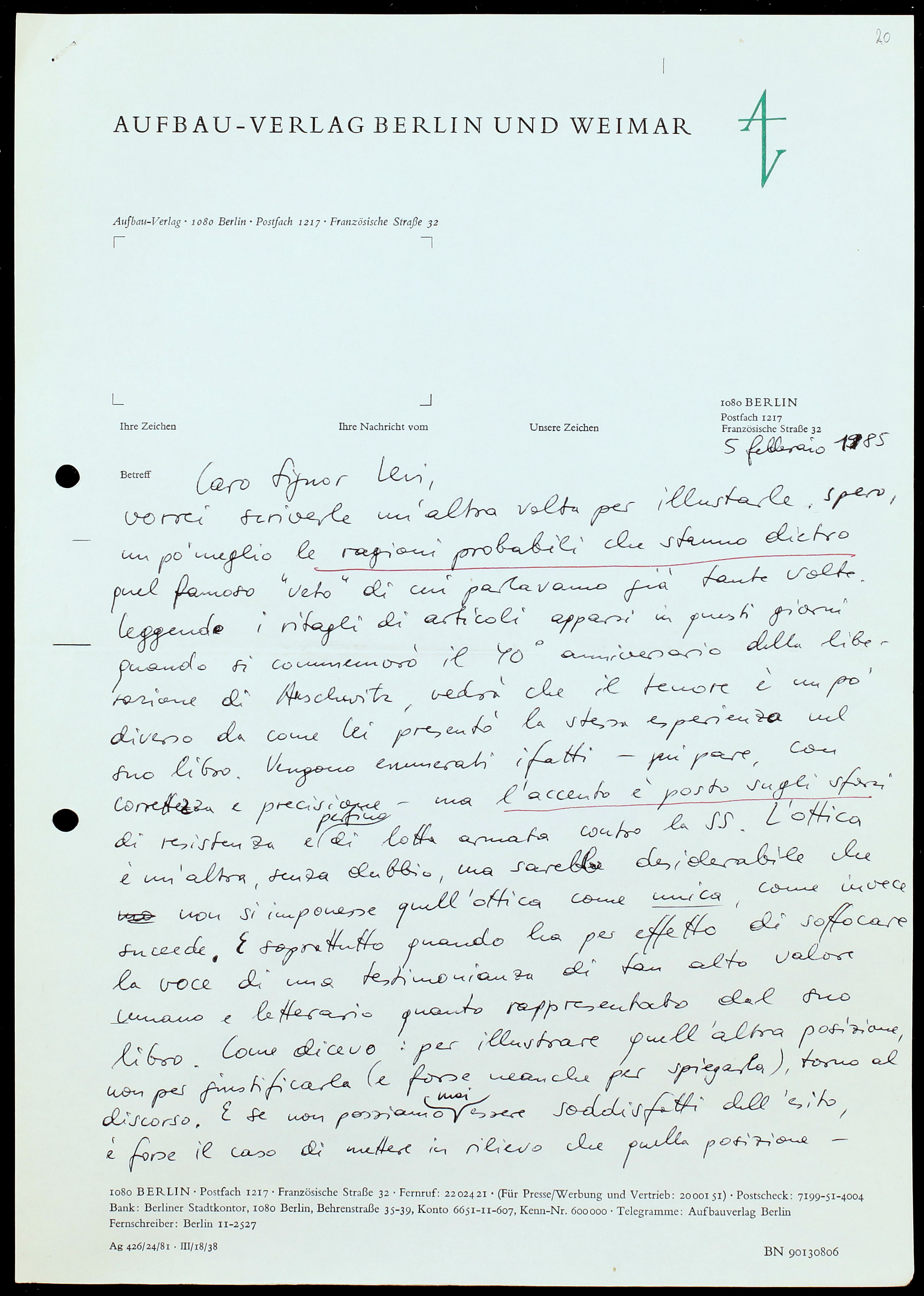
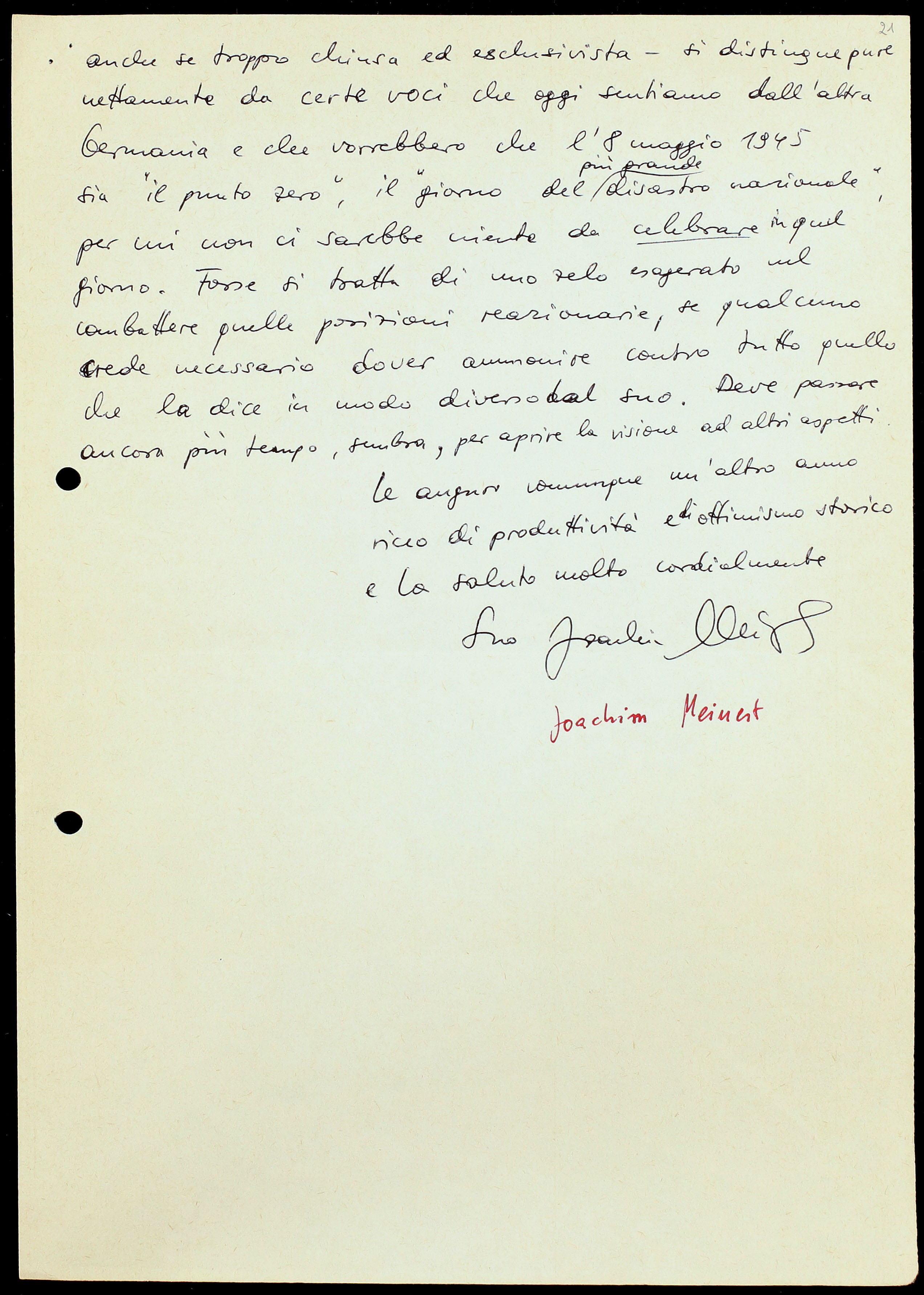
vorrei scriverle un’altra volta per illustrarle, spero, un po’ meglio le ragioni probabili che stanno dietro quel famoso «veto» di cui parlavamo già tante volte.[1] Leggendo i ritagli di articoli apparsi in questi giorni quando si commemorò il 40° anniversario della liberazione di Auschwitz, vedrà che il tenore è un po’ diverso da come Lei presentò la stessa esperienza nel suo libro. Vengono enumerati i fatti – mi pare, con correttezza e precisione – ma l’accento è posto sugli sforzi di resistenza e persino[2] di lotta armata contro la SS. L’ottica è un’altra, senza dubbio, ma sarebbe desiderabile che non si imponesse quell’ottica come unica,[3] come invece succede. E soprattutto quando ha per effetto di soffocare la voce di una testimonianza di tan alto valore umano e letterario quanto rappresentato dal Suo libro.[4] Come dicevo: per illustrare quell’altra posizione, non per giustificarla (e forse neanche per spiegarla), torno al discorso. E se non possiamo mai[5] essere soddisfatti dell’esito, è forse il caso di mettere in rilievo che quella posizione anche se troppo chiusa ed esclusivista – si distingue pure nettamente da certe voci che oggi sentiamo dall’altra Germania e che vorrebbero che l’8 maggio 1945 sia «il punto zero», il «giorno del più grande[6] disastro nazionale», per cui non ci sarebbe niente de celebrare in quel giorno.[7] Forse si tratta di uno zelo esagerato nel combattere quelle posizioni reazionarie, se qualcuno crede necessario dover ammonire contro tutto quello che la dice in modo diverso dal suo. Deve passare ancora più tempo, sembra, per aprire la visione ad altri aspetti.
Le auguro comunque un altro anno
ricco di produttività e di ottimismo storico
e La saluto molto cordialmente.
Joachim Meinert[8]
5 febbraio 1985
Caro Signor Levi,
vorrei scriverle un’altra volta per illustrarle, spero, un po’ meglio le ragioni probabili che stanno dietro quel famoso «veto» di cui parlavamo già tante volte.[1] Leggendo i ritagli di articoli apparsi in questi giorni quando si commemorò il 40° anniversario della liberazione di Auschwitz, vedrà che il tenore è un po’ diverso da come Lei presentò la stessa esperienza nel suo libro. Vengono enumerati i fatti – mi pare, con correttezza e precisione – ma l’accento è posto sugli sforzi di resistenza e persino[2] di lotta armata contro la SS. L’ottica è un’altra, senza dubbio, ma sarebbe desiderabile che non si imponesse quell’ottica come unica,[3] come invece succede. E soprattutto quando ha per effetto di soffocare la voce di una testimonianza di tan alto valore umano e letterario quanto rappresentato dal Suo libro.[4] Come dicevo: per illustrare quell’altra posizione, non per giustificarla (e forse neanche per spiegarla), torno al discorso. E se non possiamo mai[5] essere soddisfatti dell’esito, è forse il caso di mettere in rilievo che quella posizione anche se troppo chiusa ed esclusivista – si distingue pure nettamente da certe voci che oggi sentiamo dall’altra Germania e che vorrebbero che l’8 maggio 1945 sia «il punto zero», il «giorno del più grande[6] disastro nazionale», per cui non ci sarebbe niente de celebrare in quel giorno.[7] Forse si tratta di uno zelo esagerato nel combattere quelle posizioni reazionarie, se qualcuno crede necessario dover ammonire contro tutto quello che la dice in modo diverso dal suo. Deve passare ancora più tempo, sembra, per aprire la visione ad altri aspetti.
Le auguro comunque un altro anno
ricco di produttività e di ottimismo storico
e La saluto molto cordialmente.
Joachim Meinert[8]
February 5, 1985
Dear Mr. Levi,
I would like to write to you once again to illustrate, I hope a bit better, the probable reasons behind that famous “veto” we have already discussed many times.[1] If you read the newspaper clippings published these days, when the 40th anniversary of the liberation of Auschwitz is being commemorated, you will see that the tone is slightly different compared to the way you presented this same experience in your book. The facts are enumerated – it seems to me, correctly and precisely – but the stress is placed on the efforts of resistance and, even[2] armed struggle against the SS. That point of view is doubtless different but it would be desirable that it not be imposed as the only[3] one, as is instead the case. And, above all, when it has the effect of suffocating the voice of testimony of such human and literary value as represented in your book.[4] As I said: I return to the discussion to illustrate that other position, not to justify it (and perhaps not even to explain it). And if we can never[5] be satisfied with the result, perhaps this position should be highlighted, even if it is too closed and exclusivist – it clearly stands apart from certain voices that we hear today from the other Germany, that would like May 8, 1945 to be “point zero,” the “day of the biggest[6] national disaster,” and thus think there is nothing to celebrate on that day.[7] Perhaps it is exaggerated zeal to contrast those reactionary positions, if people find it necessary to warn against everything that differs from what they say. It appears that more time must pass before we can broaden the view to other aspects.
In any case, I wish you another year full of productivity and historical optimism and I sent you very cordial greetings.
Joachim Meinert[8]
5 febbraio 1985
Caro Signor Levi,
vorrei scriverle un’altra volta per illustrarle, spero, un po’ meglio le ragioni probabili che stanno dietro quel famoso «veto» di cui parlavamo già tante volte.[1] Leggendo i ritagli di articoli apparsi in questi giorni quando si commemorò il 40° anniversario della liberazione di Auschwitz, vedrà che il tenore è un po’ diverso da come Lei presentò la stessa esperienza nel suo libro. Vengono enumerati i fatti – mi pare, con correttezza e precisione – ma l’accento è posto sugli sforzi di resistenza e persino[2] di lotta armata contro la SS. L’ottica è un’altra, senza dubbio, ma sarebbe desiderabile che non si imponesse quell’ottica come unica,[3] come invece succede. E soprattutto quando ha per effetto di soffocare la voce di una testimonianza di tan alto valore umano e letterario quanto rappresentato dal Suo libro.[4] Come dicevo: per illustrare quell’altra posizione, non per giustificarla (e forse neanche per spiegarla), torno al discorso. E se non possiamo mai[5] essere soddisfatti dell’esito, è forse il caso di mettere in rilievo che quella posizione anche se troppo chiusa ed esclusivista – si distingue pure nettamente da certe voci che oggi sentiamo dall’altra Germania e che vorrebbero che l’8 maggio 1945 sia «il punto zero», il «giorno del più grande[6] disastro nazionale», per cui non ci sarebbe niente de celebrare in quel giorno.[7] Forse si tratta di uno zelo esagerato nel combattere quelle posizioni reazionarie, se qualcuno crede necessario dover ammonire contro tutto quello che la dice in modo diverso dal suo. Deve passare ancora più tempo, sembra, per aprire la visione ad altri aspetti.
Le auguro comunque un altro anno
ricco di produttività e di ottimismo storico
e La saluto molto cordialmente.
Joachim Meinert[8]
5 febbraio 1985
Caro Signor Levi,
vorrei scriverle un’altra volta per illustrarle, spero, un po’ meglio le ragioni probabili che stanno dietro quel famoso «veto» di cui parlavamo già tante volte.[1] Leggendo i ritagli di articoli apparsi in questi giorni quando si commemorò il 40° anniversario della liberazione di Auschwitz, vedrà che il tenore è un po’ diverso da come Lei presentò la stessa esperienza nel suo libro. Vengono enumerati i fatti – mi pare, con correttezza e precisione – ma l’accento è posto sugli sforzi di resistenza e persino[2] di lotta armata contro la SS. L’ottica è un’altra, senza dubbio, ma sarebbe desiderabile che non si imponesse quell’ottica come unica,[3] come invece succede. E soprattutto quando ha per effetto di soffocare la voce di una testimonianza di tan alto valore umano e letterario quanto rappresentato dal Suo libro.[4] Come dicevo: per illustrare quell’altra posizione, non per giustificarla (e forse neanche per spiegarla), torno al discorso. E se non possiamo mai[5] essere soddisfatti dell’esito, è forse il caso di mettere in rilievo che quella posizione anche se troppo chiusa ed esclusivista – si distingue pure nettamente da certe voci che oggi sentiamo dall’altra Germania e che vorrebbero che l’8 maggio 1945 sia «il punto zero», il «giorno del più grande[6] disastro nazionale», per cui non ci sarebbe niente de celebrare in quel giorno.[7] Forse si tratta di uno zelo esagerato nel combattere quelle posizioni reazionarie, se qualcuno crede necessario dover ammonire contro tutto quello che la dice in modo diverso dal suo. Deve passare ancora più tempo, sembra, per aprire la visione ad altri aspetti.
Le auguro comunque un altro anno
ricco di produttività e di ottimismo storico
e La saluto molto cordialmente.
Joachim Meinert[8]
February 5, 1985
Dear Mr. Levi,
I would like to write to you once again to illustrate, I hope a bit better, the probable reasons behind that famous “veto” we have already discussed many times.[1] If you read the newspaper clippings published these days, when the 40th anniversary of the liberation of Auschwitz is being commemorated, you will see that the tone is slightly different compared to the way you presented this same experience in your book. The facts are enumerated – it seems to me, correctly and precisely – but the stress is placed on the efforts of resistance and, even[2] armed struggle against the SS. That point of view is doubtless different but it would be desirable that it not be imposed as the only[3] one, as is instead the case. And, above all, when it has the effect of suffocating the voice of testimony of such human and literary value as represented in your book.[4] As I said: I return to the discussion to illustrate that other position, not to justify it (and perhaps not even to explain it). And if we can never[5] be satisfied with the result, perhaps this position should be highlighted, even if it is too closed and exclusivist – it clearly stands apart from certain voices that we hear today from the other Germany, that would like May 8, 1945 to be “point zero,” the “day of the biggest[6] national disaster,” and thus think there is nothing to celebrate on that day.[7] Perhaps it is exaggerated zeal to contrast those reactionary positions, if people find it necessary to warn against everything that differs from what they say. It appears that more time must pass before we can broaden the view to other aspects.
In any case, I wish you another year full of productivity and historical optimism and I sent you very cordial greetings.
Joachim Meinert[8]
Info
Notes
Tag
Sender: Joachim Meinert
Addressee: Primo Levi
Date of Drafting: 1985-02-05
Place of Writing: East Berlin
Description: handwritten letter in black ballpoint pen on a sheet of letterhead paper with underlining written by hand. Besides the letterhead, the sheet also has a pre-printed section located between the address and the body of the letter: “Ihre Zeichen Ihre Nachricht vom Unsere Zeichen 108 BERLIN | Postfach 1217 | Französische Straße 32 | Betreff.” The sheet also has two alphanumerical codes: “87 RA Ag 426/47/70 20 4695” and one on the lower margin, to the right and just below the foot of the letter: “BN 90 130 806.”
Letterhead: AUFBAU-VERLAG BERLIN UND WEIMAR| Aufbau-Verlag 108 Berlin Postfach 1217 Französische Straße 32; at the foot of the page: 108 BERLIN • Postfach 1217• Französische Straße 32 • Fernruf: 225421 • (Für Presse/Werbung und Vertrieb: 2001 SI) • Postscheck: Berlin 4004 | Bank: Berliner Stadtkontor, 108 Berlin, Behrenstraße 35-39, Konto 6651-11-607, Kenn-Nr. 600000 • Telegramme: Aufbauverlag Berlin Fernschreiber; Berlin II-2527. The Aufbau logo is printed in green in the upper right-hand corner.
DOI:
1
“le ragioni probabili che stanno dietro” (“the probable reasons behind”) is underlined by hand in red ballpoint pen by Levi.
2
“l’accento è posto sugli sforzi” (“the stress is placed on the efforts”) is underlined by hand in red ballpoint pen by Levi. “perfino” (“even”) is added by hand above the line written by Meinert.
3
“unica” (“only”) is underlined by hand in pencil.
4
In the German Democratic Republic, the memory of the Nazi extermination centered for the most part on the contributions of communist resistance. In this way, antifascism, a founding value of the German Federal Republic, ended up obscuring the forms of non-political deportation, such as the racial deportation conducted against the Jewish population. This marginalization was also impacted by the DDR’s complicated relationship with Israel. For an overview, Cf. Barbara Grüning, “Memorie dell’olocausto nella Germania riunificata: quali eredità dalla DDR?” [“Memories of the Holocaust in Unified Germany: What Legacy from the DDR?”] in Paradigma lager: vecchi e nuovi conflitti del mondo contemporaneo [“Lager Paradigm. Old and New Conflicts of the Contemporary World”], edited by S. Casilio, L. Guerrieri, A. Cegna, Bologna: Clueb, 2010, pp. 35-47.
5
“mai” (“never”) is added by hand above the line written by Meinert.
6
“il più grande” (“biggest”) is added by hand above the line written by Meinert.
7
“celebrare” (“celebrate”) is underlined by hand in pencil. In the GDR, May 8th was celebrated as the day of liberation of the German people from Hitler’s fascism (Tag der Befreiung des deutschen Volkes vom Hitlerfaschismus); in contrast, starting with the end of WWII this was a divisive anniversary in West Germany. In this regard, the words pronounced in 1949 by the liberal Theodor Heuss (who would become the first president of the Federal Republic of Germany) became famous in the German debates: “for each one of us, May 8, 1945 remains the most tragic and controversial paradox in history. Why? Because we were liberated and destroyed at the same time.” The outcome was the paradox of a “catastrophe” (or “year/point zero”) that had also been a “liberation.” These two antithetical readings of the end of the war became the playing field for one of the political-ideological contrasts between the conservative forces and the socialist front. Cf. P. Hoeres, “Vom Paradox zur Eindeutigkeit Der 8. Mai in der westdeutschen Erinnerungskultur,” in Der 8. Mai im Geschichtsbild der Deutschen und ihrer Nachbarn, edited by B. Heidenreich, E. Brockdorff, A. Rödder, Wiesbaden: Hessische Landeszentrale für politische Bildung, 2016, pp. 47-58.
8Below the signature, Levi notes Meinert’s first and last names by hand in red ballpoint pen.