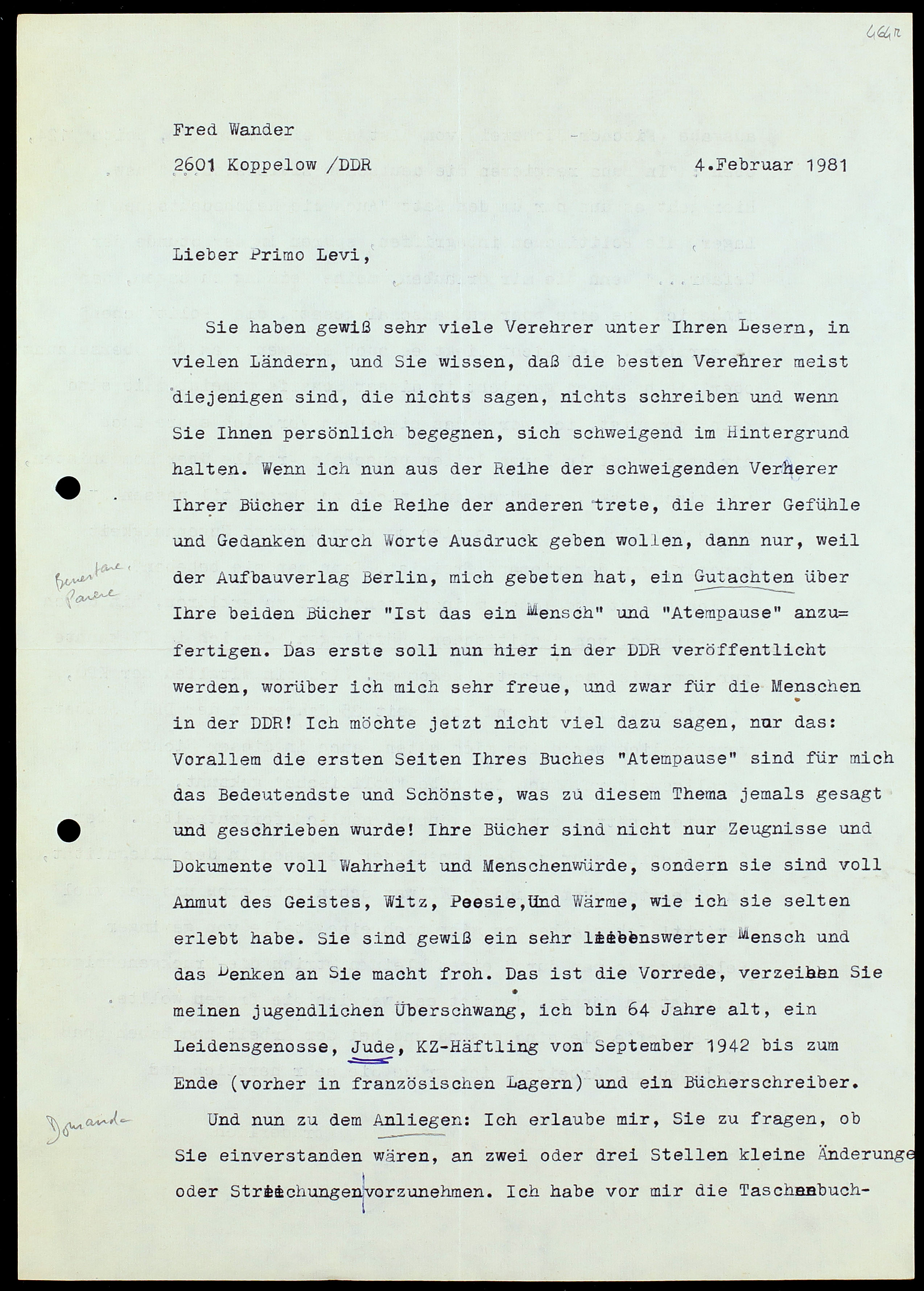
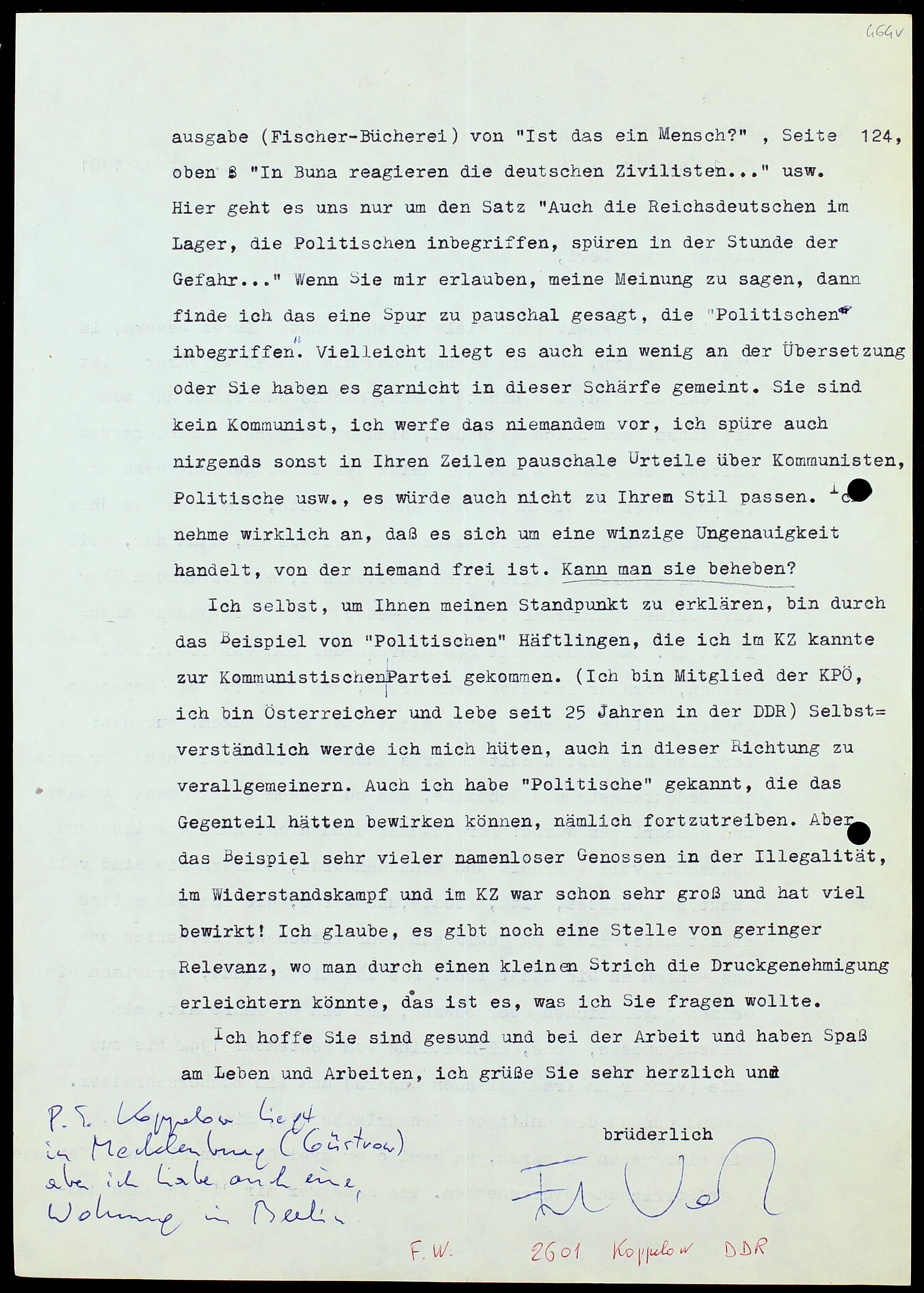
Tasked by the Aufbau publishing house with preparing a reader’s report on Ist das ein Mensch? and Die Atempause, Fred Wander contacts the author. After highly praising the two books and presenting himself to Levi as a Jew and former deportee, he points out a few problematic passages of Ist das ein Mensch? which the publishing house would like to modify in order to facilitate approval from the DDR’s Ministry of Culture.
Sie haben gewiß sehr viele Verehrer unter Ihren Lesern, in vielen Ländern, und Sie wissen, daß die besten Verehrer meist diejenigen sind, die nichts sagen, nichts schreiben und wenn Sie Ihnen persönlich begegnen, sich schweigend im Hintergrund halten. Wenn ich nun aus der Reihe der schweigenden Verehrer Ihrer Bücher in die Reihe der anderen trete, die ihrer Gefühle und Gedanken durch Worte Ausdruck geben wollen, dann nur, weil der Aufbauverlag Berlin, mich gebeten hat, ein Gutachten[1] über Ihre beiden Bücher Ist das ein Mensch und Atempause anzufertigen.[2] Das erste soll nun hier in der DDR veröffentlicht werden, worüber ich mich sehr freue, und zwar für die Menschen in der DDR! Ich möchte jetzt nicht viel dazu sagen, nur das:
Vorallem die ersten Seiten Ihres Buches Atempause sind für mich das Bedeutendste und Schönste, was zu diesem Thema jemals gesagt und geschrieben wurde! Ihre Bücher sind nicht nur Zeugnisse und Dokumente voll Wahrheit und Menschenwürde, sondern sie sind voll Anmut des Geistes, Witz, Poesie, und Wärme, wie ich sie selten erlebt habe. Sie sind gewiß ein sehr liebenswerter Mensch und das Denken an Sie macht froh. Das ist die Vorrede, verzeihen Sie meinen jugendlichen Überschwang, ich bin 64 Jahre alt, ein Leidensgenosse, Jude,[3] KZ-Häftling von September 1942 bis zum Ende (vorher in französischen Lagern) und ein Bücherschreiber.[4]
Und nun zu dem Anliegen:[5] Ich erlaube mir, Sie zu fragen, ob Sie einverstanden wären, an zwei oder drei Stellen kleine Änderungen oder Streichungen vorzunehmen. Ich habe vor mir die Taschenbuchausgabe (Fischer-Bücherei) von Ist das ein Mensch?, Seite 124, oben: „In Buna reagieren die deutschen Zivilisten…“ usw. Hier geht es uns nur um den Satz „Auch die Reichsdeutschen im Lager, die Politischen inbegriffen, spüren in der Stunde der Gefahr…“[6] Wenn Sie mir erlauben, meine Meinung zu sagen, dann finde ich das eine Spur zu pauschal gesagt, die „Politischen inbegriffen“. Vielleicht liegt es auch ein wenig an der Übersetzung oder Sie haben es garnicht in dieser Schärfe gemeint.[7] Sie sind kein Kommunist, ich werfe das niemandem vor, ich spüre auch nirgends sonst in Ihren Zeilen pauschale Urteile über Kommunisten, Politische usw., es würde auch nicht zu Ihrem Stil passen. Ich nehme wirklich an, daß es sich und eine winzige Ungenauigkeit handelt, von der niemand frei ist. Kann man sie beheben?[8]
Ich selbst, um Ihnen meinen Standpunkt zu erklären, bin durch das Beispiel von „Politischen“ Häftlingen, die ich im KZ kannte zur kommunistischen Partei gekommen. (Ich bin Mitglied der KPÖ, ich bin Österreicher und lebe seit 25 Jahren in der DDR) Selbstverständlich werde ich mich hüten, auch in dieser Richtung zu verallgemeinern. Auch ich habe „Politische“ gekannt, die das Gegenteil hätten bewirken können, nämlich fortzutreiben. Aber das Beispiel sehr vieler namenloser Genossen in der Illegalität, im Widerstandskampf und im KZ war schon sehr groß und hat viel bewirkt! Ich glaube, es gibt noch eine Stelle von geringer Relevanz, wo man durch einen kleinen Strich die Druckgenehmigung erleichtern könnte, das ist es, was ich Sie fragen wollte.
Ich hoffe Sie sind gesund und bei der Arbeit und haben Spaß am Leben und Arbeiten, ich grüße Sie sehr herzlich und brüderlich
Fred Wander[9]
Fred Wander 2601 Koppelow / DDR
4 febbraio 1981
Caro Primo Levi,
Lei avrà certamente moltissimi ammiratori fra i Suoi lettori, in molti Paesi, e saprà bene che gli ammiratori migliori sono per lo più quelli che non dicono nulla, non scrivono nulla e, quando La incontrano di persona, restano in silenzio sullo sfondo. Se adesso esco dalla schiera degli ammiratori silenziosi per unirmi a quella degli altri, e cioè di chi desidera esprimere a parole i propri sentimenti e pensieri, è soltanto perché l’Aufbauverlag di Berlino mi ha chiesto di redigere un parere[1] sui Suoi due libri Se questo è un uomo e La tregua.[2] Il primo sta per essere pubblicato qui nella DDR, cosa di cui mi rallegro molto, soprattutto per i lettori della DDR! Non intendo aggiungere molto, soltanto questo:
Le prime pagine della Tregua, in particolare, sono per me quanto di più importante e più bello sia mai stato detto o scritto su questo tema! I Suoi libri sono testimonianze e documenti non soltanto colmi di verità e dignità umana, ma anche ricchi di grazia, umorismo, poesia e calore, come raramente mi è accaduto di incontrare. Lei dev’essere certamente una persona molto amabile, e pensarLa allarga il cuore. Questa era la premessa; mi perdoni lo slancio giovanile: ho sessantaquattro anni, sono un Suo compagno di sofferenza, ebreo,[3] internato in campo di concentramento dal settembre 1942 fino alla fine (prima ancora ero stato nei campi francesi) e scrivo libri.[4]
E ora vengo alla questione che mi preme:[5] mi permetto di chiederLe se sarebbe disposto ad apportare, in due o tre punti, piccole modifiche o tagli. Ho davanti a me l’edizione tascabile (Fischer-Bücherei) di Se questo è un uomo, pagina 124, in alto: «Nella Buna imperversavano i civili tedeschi…» ecc. Qui ci interessa unicamente la frase: «Anche i Reichsdeutsche del Lager, politici compresi, nell’ora del pericolo risentirono…».[6] Se posso permettermi, trovo che «politici compresi» sia una formulazione un po’ troppo sommaria. Forse dipende in parte anche dalla traduzione, oppure Lei non intendeva esprimersi in termini così categorici.[7] Lei non è comunista, cosa che non rimprovererei a nessuno; e in nessun’altra delle Sue pagine noto giudizi sommari sui comunisti, sui politici e via dicendo, cosa che non sarebbe nemmeno nel Suo stile. Presumo davvero che si tratti di una piccolissima imprecisione, da cui nessuno è esente. Sarebbe possibile correggerla?[8]
Quanto a me, per spiegarLe il mio punto di vista, sono entrato nel partito comunista proprio grazie all’esempio di alcuni prigionieri «politici» che avevo conosciuto nel Lager. (Sono iscritto al KPÖ, sono austriaco e vivo da venticinque anni nella DDR). Naturalmente mi guarderò bene dal generalizzare anche in questa direzione. Anch’io ho conosciuto dei «politici» che avrebbero potuto fare su di me l’effetto contrario, e cioè allontanarmi. Ma l’esempio di moltissimi compagni senza nome nella clandestinità, nella lotta di resistenza e nel Lager è stato davvero grande e ha dato non pochi frutti! Credo che ci sia ancora un altro punto, di scarsa rilevanza, dove un piccolo taglio potrebbe agevolare l’autorizzazione alla stampa: ecco ciò che volevo chiederLe.
Spero che sia in buona salute e all’opera, e che trovi gioia nella vita e nel lavoro. La saluto con grande cordialità e
fraternamente
Fred Wander[9]
Fred Wander 2601 Koppelow / DDR
February 4, 1981
Dear Primo Levi,
You surely must have a great deal of admirers among your readers, in many countries, and you know that the best admirers are usually those who say nothing, write nothing, and, when they meet you in person, silently stay in the background. If I have now chosen to step forward from the ranks of your books’ silent admirers to join the ranks of those who express their feelings and thoughts through words, it is only because the Berlin-based publisher Aufbauverlag has asked me to evaluate[1] your two books, If This is a Man and The Truce.[2] The former shall now be published here in the DDR, which makes me very happy—especially for the people of the DDR! I do not wish to say much more about it now, except this:
First and foremost, the opening pages of your book The Truceare, for me, the most significant and beautiful thing ever said or written on this subject! Not only do your books bear witness as documents full of truth and human dignity, they are also full of spiritual grace, wit, poetry, and warmth the likes of which I have rarely experienced. You are certainly a very endearing person, and thinking of you brings me joy. This is merely an introduction; please forgive my youthful exuberance—I am 64 years old, a fellow survivor, Jewish,[3] I was a concentration camp prisoner from September 1942 to the end (and had been in French camps before then), and a writer.[4]
And now to the matter at hand:[5] I should like to ask if you might agree to make a few minor changes or deletions in two or three places. I have the paperback edition (Fischer-Bücherei) of If This is a Man, which at the top of page 124 reads: “In Buna, the German civilians react…” etc. We are solely concerned with the sentence “Even the citizens of the German Reich in the camp, including the political prisoners, feel the hour of danger…”[6] If you’ll allow me to express my opinion, I find this phrasing—“including the political prisoners”—a touch too sweeping. Perhaps it is in part due to the translation, or perhaps you did not mean it quite so strongly.[7] You are not a communist; I do not accuse anyone of that, nor do I sense any sweeping judgments about communists, political prisoners, etc., anywhere else in your writing—it would not fit your style anyway. I truly assume that this is simply a minor inaccuracy, from which no one is immune. Can it be corrected?[8]
To explain my own position, I myself joined the Communist Party through the example of “political” prisoners I knew in the concentration camp. (I am a member of the KPÖ; I am Austrian and have been living in the DDR for 25 years.) Of course, I will be careful not to generalize in this direction either. I, too, have known “political” prisoners who could have had the opposite effect—namely, that of driving people away. But the example set by so many nameless comrades operating underground, in the resistance struggle, and in concentration camps, was truly immense and had a profound impact! I believe there is one more passage of minor relevance where a small change could facilitate this work being approved for printing; that is what I wanted to ask you about.
I hope you are in good health, back at work, and enjoying your life and work. I send you my warmest and most
brotherly regards
Fred Wander[9]
Fred Wander 2601 Koppelow / DDR
4. Februar 1981
Lieber Primo Levi,
Sie haben gewiß sehr viele Verehrer unter Ihren Lesern, in vielen Ländern, und Sie wissen, daß die besten Verehrer meist diejenigen sind, die nichts sagen, nichts schreiben und wenn Sie Ihnen persönlich begegnen, sich schweigend im Hintergrund halten. Wenn ich nun aus der Reihe der schweigenden Verehrer Ihrer Bücher in die Reihe der anderen trete, die ihrer Gefühle und Gedanken durch Worte Ausdruck geben wollen, dann nur, weil der Aufbauverlag Berlin, mich gebeten hat, ein Gutachten[1] über Ihre beiden Bücher Ist das ein Mensch und Atempause anzufertigen.[2] Das erste soll nun hier in der DDR veröffentlicht werden, worüber ich mich sehr freue, und zwar für die Menschen in der DDR! Ich möchte jetzt nicht viel dazu sagen, nur das:
Vorallem die ersten Seiten Ihres Buches Atempause sind für mich das Bedeutendste und Schönste, was zu diesem Thema jemals gesagt und geschrieben wurde! Ihre Bücher sind nicht nur Zeugnisse und Dokumente voll Wahrheit und Menschenwürde, sondern sie sind voll Anmut des Geistes, Witz, Poesie, und Wärme, wie ich sie selten erlebt habe. Sie sind gewiß ein sehr liebenswerter Mensch und das Denken an Sie macht froh. Das ist die Vorrede, verzeihen Sie meinen jugendlichen Überschwang, ich bin 64 Jahre alt, ein Leidensgenosse, Jude,[3] KZ-Häftling von September 1942 bis zum Ende (vorher in französischen Lagern) und ein Bücherschreiber.[4]
Und nun zu dem Anliegen:[5] Ich erlaube mir, Sie zu fragen, ob Sie einverstanden wären, an zwei oder drei Stellen kleine Änderungen oder Streichungen vorzunehmen. Ich habe vor mir die Taschenbuchausgabe (Fischer-Bücherei) von Ist das ein Mensch?, Seite 124, oben: „In Buna reagieren die deutschen Zivilisten…“ usw. Hier geht es uns nur um den Satz „Auch die Reichsdeutschen im Lager, die Politischen inbegriffen, spüren in der Stunde der Gefahr…“[6] Wenn Sie mir erlauben, meine Meinung zu sagen, dann finde ich das eine Spur zu pauschal gesagt, die „Politischen inbegriffen“. Vielleicht liegt es auch ein wenig an der Übersetzung oder Sie haben es garnicht in dieser Schärfe gemeint.[7] Sie sind kein Kommunist, ich werfe das niemandem vor, ich spüre auch nirgends sonst in Ihren Zeilen pauschale Urteile über Kommunisten, Politische usw., es würde auch nicht zu Ihrem Stil passen. Ich nehme wirklich an, daß es sich und eine winzige Ungenauigkeit handelt, von der niemand frei ist. Kann man sie beheben?[8]
Ich selbst, um Ihnen meinen Standpunkt zu erklären, bin durch das Beispiel von „Politischen“ Häftlingen, die ich im KZ kannte zur kommunistischen Partei gekommen. (Ich bin Mitglied der KPÖ, ich bin Österreicher und lebe seit 25 Jahren in der DDR) Selbstverständlich werde ich mich hüten, auch in dieser Richtung zu verallgemeinern. Auch ich habe „Politische“ gekannt, die das Gegenteil hätten bewirken können, nämlich fortzutreiben. Aber das Beispiel sehr vieler namenloser Genossen in der Illegalität, im Widerstandskampf und im KZ war schon sehr groß und hat viel bewirkt! Ich glaube, es gibt noch eine Stelle von geringer Relevanz, wo man durch einen kleinen Strich die Druckgenehmigung erleichtern könnte, das ist es, was ich Sie fragen wollte.
Ich hoffe Sie sind gesund und bei der Arbeit und haben Spaß am Leben und Arbeiten, ich grüße Sie sehr herzlich und brüderlich
Fred Wander[9]
Fred Wander 2601 Koppelow / DDR
4 febbraio 1981
Caro Primo Levi,
Lei avrà certamente moltissimi ammiratori fra i Suoi lettori, in molti Paesi, e saprà bene che gli ammiratori migliori sono per lo più quelli che non dicono nulla, non scrivono nulla e, quando La incontrano di persona, restano in silenzio sullo sfondo. Se adesso esco dalla schiera degli ammiratori silenziosi per unirmi a quella degli altri, e cioè di chi desidera esprimere a parole i propri sentimenti e pensieri, è soltanto perché l’Aufbauverlag di Berlino mi ha chiesto di redigere un parere[1] sui Suoi due libri Se questo è un uomo e La tregua.[2] Il primo sta per essere pubblicato qui nella DDR, cosa di cui mi rallegro molto, soprattutto per i lettori della DDR! Non intendo aggiungere molto, soltanto questo:
Le prime pagine della Tregua, in particolare, sono per me quanto di più importante e più bello sia mai stato detto o scritto su questo tema! I Suoi libri sono testimonianze e documenti non soltanto colmi di verità e dignità umana, ma anche ricchi di grazia, umorismo, poesia e calore, come raramente mi è accaduto di incontrare. Lei dev’essere certamente una persona molto amabile, e pensarLa allarga il cuore. Questa era la premessa; mi perdoni lo slancio giovanile: ho sessantaquattro anni, sono un Suo compagno di sofferenza, ebreo,[3] internato in campo di concentramento dal settembre 1942 fino alla fine (prima ancora ero stato nei campi francesi) e scrivo libri.[4]
E ora vengo alla questione che mi preme:[5] mi permetto di chiederLe se sarebbe disposto ad apportare, in due o tre punti, piccole modifiche o tagli. Ho davanti a me l’edizione tascabile (Fischer-Bücherei) di Se questo è un uomo, pagina 124, in alto: «Nella Buna imperversavano i civili tedeschi…» ecc. Qui ci interessa unicamente la frase: «Anche i Reichsdeutsche del Lager, politici compresi, nell’ora del pericolo risentirono…».[6] Se posso permettermi, trovo che «politici compresi» sia una formulazione un po’ troppo sommaria. Forse dipende in parte anche dalla traduzione, oppure Lei non intendeva esprimersi in termini così categorici.[7] Lei non è comunista, cosa che non rimprovererei a nessuno; e in nessun’altra delle Sue pagine noto giudizi sommari sui comunisti, sui politici e via dicendo, cosa che non sarebbe nemmeno nel Suo stile. Presumo davvero che si tratti di una piccolissima imprecisione, da cui nessuno è esente. Sarebbe possibile correggerla?[8]
Quanto a me, per spiegarLe il mio punto di vista, sono entrato nel partito comunista proprio grazie all’esempio di alcuni prigionieri «politici» che avevo conosciuto nel Lager. (Sono iscritto al KPÖ, sono austriaco e vivo da venticinque anni nella DDR). Naturalmente mi guarderò bene dal generalizzare anche in questa direzione. Anch’io ho conosciuto dei «politici» che avrebbero potuto fare su di me l’effetto contrario, e cioè allontanarmi. Ma l’esempio di moltissimi compagni senza nome nella clandestinità, nella lotta di resistenza e nel Lager è stato davvero grande e ha dato non pochi frutti! Credo che ci sia ancora un altro punto, di scarsa rilevanza, dove un piccolo taglio potrebbe agevolare l’autorizzazione alla stampa: ecco ciò che volevo chiederLe.
Spero che sia in buona salute e all’opera, e che trovi gioia nella vita e nel lavoro. La saluto con grande cordialità e
fraternamente
Fred Wander[9]
Fred Wander 2601 Koppelow / DDR
February 4, 1981
Dear Primo Levi,
You surely must have a great deal of admirers among your readers, in many countries, and you know that the best admirers are usually those who say nothing, write nothing, and, when they meet you in person, silently stay in the background. If I have now chosen to step forward from the ranks of your books’ silent admirers to join the ranks of those who express their feelings and thoughts through words, it is only because the Berlin-based publisher Aufbauverlag has asked me to evaluate[1] your two books, If This is a Man and The Truce.[2] The former shall now be published here in the DDR, which makes me very happy—especially for the people of the DDR! I do not wish to say much more about it now, except this:
First and foremost, the opening pages of your book The Truceare, for me, the most significant and beautiful thing ever said or written on this subject! Not only do your books bear witness as documents full of truth and human dignity, they are also full of spiritual grace, wit, poetry, and warmth the likes of which I have rarely experienced. You are certainly a very endearing person, and thinking of you brings me joy. This is merely an introduction; please forgive my youthful exuberance—I am 64 years old, a fellow survivor, Jewish,[3] I was a concentration camp prisoner from September 1942 to the end (and had been in French camps before then), and a writer.[4]
And now to the matter at hand:[5] I should like to ask if you might agree to make a few minor changes or deletions in two or three places. I have the paperback edition (Fischer-Bücherei) of If This is a Man, which at the top of page 124 reads: “In Buna, the German civilians react…” etc. We are solely concerned with the sentence “Even the citizens of the German Reich in the camp, including the political prisoners, feel the hour of danger…”[6] If you’ll allow me to express my opinion, I find this phrasing—“including the political prisoners”—a touch too sweeping. Perhaps it is in part due to the translation, or perhaps you did not mean it quite so strongly.[7] You are not a communist; I do not accuse anyone of that, nor do I sense any sweeping judgments about communists, political prisoners, etc., anywhere else in your writing—it would not fit your style anyway. I truly assume that this is simply a minor inaccuracy, from which no one is immune. Can it be corrected?[8]
To explain my own position, I myself joined the Communist Party through the example of “political” prisoners I knew in the concentration camp. (I am a member of the KPÖ; I am Austrian and have been living in the DDR for 25 years.) Of course, I will be careful not to generalize in this direction either. I, too, have known “political” prisoners who could have had the opposite effect—namely, that of driving people away. But the example set by so many nameless comrades operating underground, in the resistance struggle, and in concentration camps, was truly immense and had a profound impact! I believe there is one more passage of minor relevance where a small change could facilitate this work being approved for printing; that is what I wanted to ask you about.
I hope you are in good health, back at work, and enjoying your life and work. I send you my warmest and most
brotherly regards
Fred Wander[9]
Info
Notes
Tag
Sender: Fred Wander
Addressee: Primo Levi
Date of Drafting: 1981-02-04
Place of Writing: East Berlin
Description: typewritten letter with handwritten signature and insertions in blue ballpoint pen, pencil, and blue fountain pen. On the lower margin of sheet 464v, Levi notes the address in red ballpoint pen: “F.W. 2601 Koppelow DDR.”
Archive: Archivio privato di Primo Levi, Turin
Series: Corrispondenza, Corrispondenza generale, fascicolo 12, sottofascicolo 21, f. 464r/v.
Folio: 1, front and back
DOI:
1
“Gutachten” is underlined by hand in pencil. On the inner margin of the sheet, alongside the word, Levi notes by hand in pencil “Benestare, | Parere” (“Approval, | Opinion”).
2
After Das periodische System was published by Aufbau in 1979, Joachim Meinert, the editor of the publishing company, proposed republishing under license first Ist das ein Mensch? and afterward Atempause, which had been published in West Germany in 1961 and 1964, respectively. Fred Wander was commissioned to prepare an external reader’s report, which was required in order to request authorization to publish from the Hauptverwaltung Verlage und Buchhandel (the official censorship board of the Ministry of Culture) and, later, an afterword for the two books. Meinert reconstructs the events in “Geschichte eines Verbots,” Sinn und Form, 2: 2000, pp. 149-99; various documents regarding the episode are published as an appendix to the article, including Wander’s reader’s report and his afterword. For more information, see the insight “If This Is a Man” and “The Truce” in the DDR: An Attempt at Reconstruction.
3
“Jude” (“Jew”) is underlined by hand with a double line in blue fountain pen.
5
“Anliegen” is underlined by hand in pencil. On the inner margin of the sheet, alongside the word, Levi notes by hand in pencil “Domanda” (“Matter at hand”).
6
The original passage: “At Buna the German civilians raged with the fury of the secure man who wakes from a long dream of domination, and sees his ruin and is unable to understand it. The Reichsdeutsche of the Lager as well, including the political prisoners, felt in the hour of danger the ties of blood and soil” (CW I, p. 112).
7
The German translation is a faithful rendition of the original and, in fact, Riedt himself had asked Levi to confirm his intention to use the Nazi slogan “of blood and soil.” In November 1959, Levi replied: “As to this matter, the discussion would be very lengthy; nobody has ever been able to explain to me why, in Auschwitz, a great majority of the ‘red triangles’ had behaved rather poorly, as opposed to what occurred, for example, in Buchenwald. But it might also be that this judgment of mine is wrong, and is based on the few cases of which I had firsthand knowledge. At the time, I was not a very objective judge,” Il carteggio con Heinz Riedt, edited by M. Mengoni, Turin: Einaudi, 2024, p. 22.
8
“Kann man sie beheben?” (“Can it be corrected?”) is underlined by hand in pencil.
9
To the left of his signature, Wander adds by hand in blue ballpoint pen: “P.S. Koppelow liegt | in Mecklenburg (Güstrow) | aber ich habe auch eine Wohnung in Berlin” (“P.S. Koppelow is in Mecklenburg (Güstrow) but I also have an apartment in Berlin”).