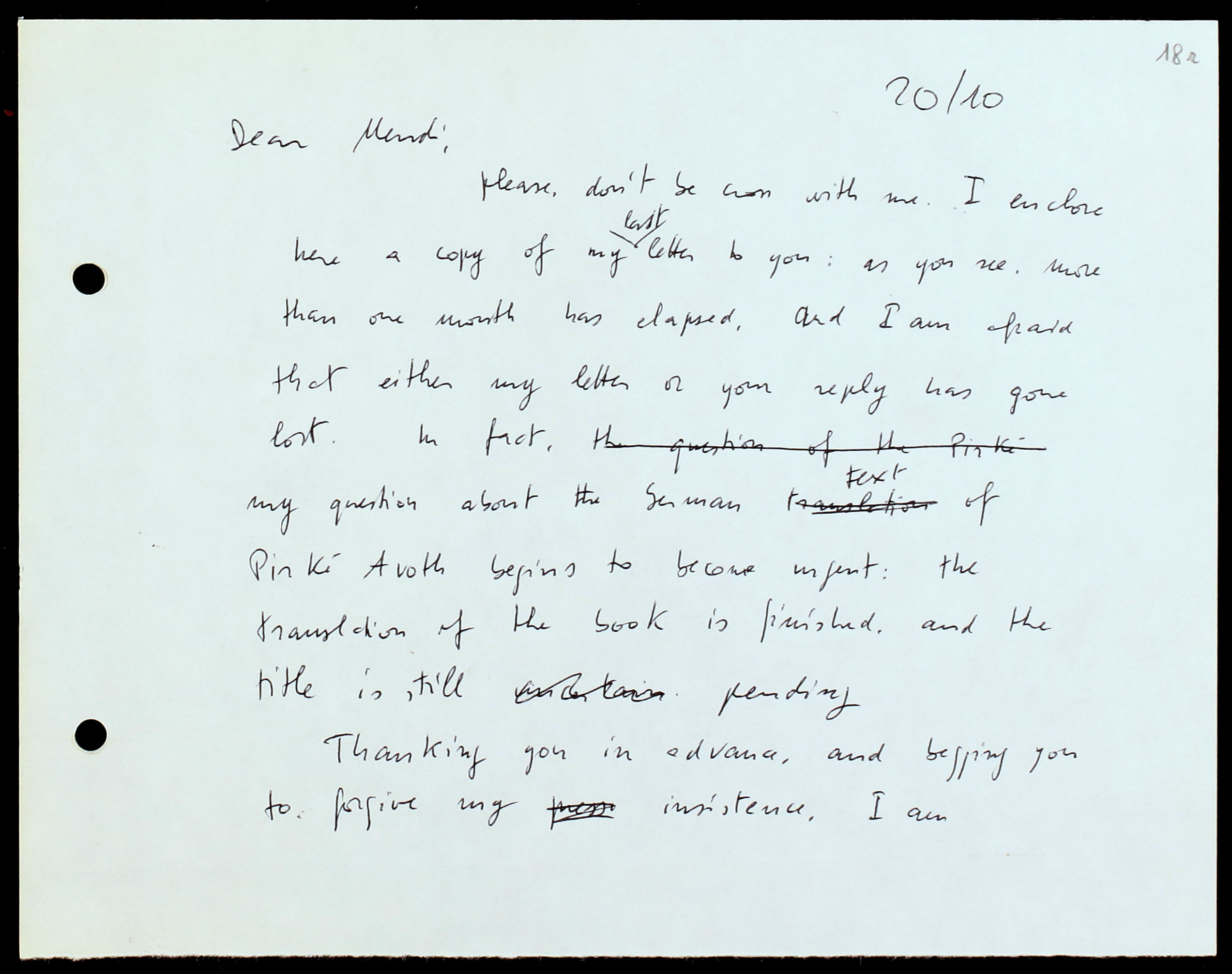
Levi writes an accompanying note with which he forwards a copy of the last letter he wrote to Davidovic, fearing that his friend may not have received it. Since it is a rough draft, we do not know whether Levi sent the note in this format.
20/10
Dear Mendi,
please, don’t be cross with me. I enclose here a copy of my last[1] letter to you: as you see, more than one month has elapsed, and I am afraid that either my letter or your reply has gone lost. In fact,[2] my question about the German text[3]of Pirké Avoth begins to become urgent: the translation of the bookis finished, and the title is still pending.[4]
Thanking you in advance, and begging you to forgive my insistence.[5] I am
20/10
Caro Mendi,
per favore, non avertene a male. Allego qui una copia della mia ultima[1] lettera per te: come vedi è passato più di un mese, e temo che o la mia lettera o la tua risposta siano andate perse. In effetti[2] la mia domanda sul testo tedesco[3] del Pirké Avoth comincia a diventare urgente: la traduzione del libro è finita, e il titolo è ancora in sospeso.[4]
Grazie in anticipo, e ti prego di perdonare la mia insistenza.[5] Il tuo
20/10
Dear Mendi,
please, don’t be cross with me. I enclose here a copy of my last[1] letter to you: as you see, more than one month has elapsed, and I am afraid that either my letter or your reply has gone lost. In fact,[2] my question about the German text[3]of Pirké Avoth begins to become urgent: the translation of the bookis finished, and the title is still pending.[4]
Thanking you in advance, and begging you to forgive my insistence.[5] I am
20/10
Dear Mendi,
please, don’t be cross with me. I enclose here a copy of my last[1] letter to you: as you see, more than one month has elapsed, and I am afraid that either my letter or your reply has gone lost. In fact,[2] my question about the German text[3]of Pirké Avoth begins to become urgent: the translation of the bookis finished, and the title is still pending.[4]
Thanking you in advance, and begging you to forgive my insistence.[5] I am
20/10
Caro Mendi,
per favore, non avertene a male. Allego qui una copia della mia ultima[1] lettera per te: come vedi è passato più di un mese, e temo che o la mia lettera o la tua risposta siano andate perse. In effetti[2] la mia domanda sul testo tedesco[3] del Pirké Avoth comincia a diventare urgente: la traduzione del libro è finita, e il titolo è ancora in sospeso.[4]
Grazie in anticipo, e ti prego di perdonare la mia insistenza.[5] Il tuo
20/10
Dear Mendi,
please, don’t be cross with me. I enclose here a copy of my last[1] letter to you: as you see, more than one month has elapsed, and I am afraid that either my letter or your reply has gone lost. In fact,[2] my question about the German text[3]of Pirké Avoth begins to become urgent: the translation of the bookis finished, and the title is still pending.[4]
Thanking you in advance, and begging you to forgive my insistence.[5] I am
Info
Notes
Tag
Sender: Primo Levi
Addressee: Emil Davidovič
Date of Drafting: 1984-10-20
Place of Writing: Turin
Description:rough draft of a card written by hand in black ballpoint pen (mm162x290). On the back of the card are a few notes written by hand by Levi: “Ein | 90 M d.d.a. | +7 anticipo LT | +7 “ ISEIS | 104 | + crediti maturandi” (“Einaudi | 90 Months copyright | +7 advance The Truce | +7 advance The Drowned and the Saved | 104 | + credits accrued”).
Archive: Archivio privato di Primo Levi, Turin
Series: Corrispondenza, Corrispondenti particolari, fascicolo 22, sottofascicolo 1, f. 18r/v.
Folio: 1, front and back
DOI:
1“Last” is added above the line.
2“the question of the Pirkei” follows, crossed out by a horizontal line.
3“translation” is crossed out with two horizontal lines, and corrected above the line to “text.”
4“uncertain” is crossed out with a mark and corrected to “pending.”
5“press” is crossed out with two horizontal lines, followed by “insistence.”