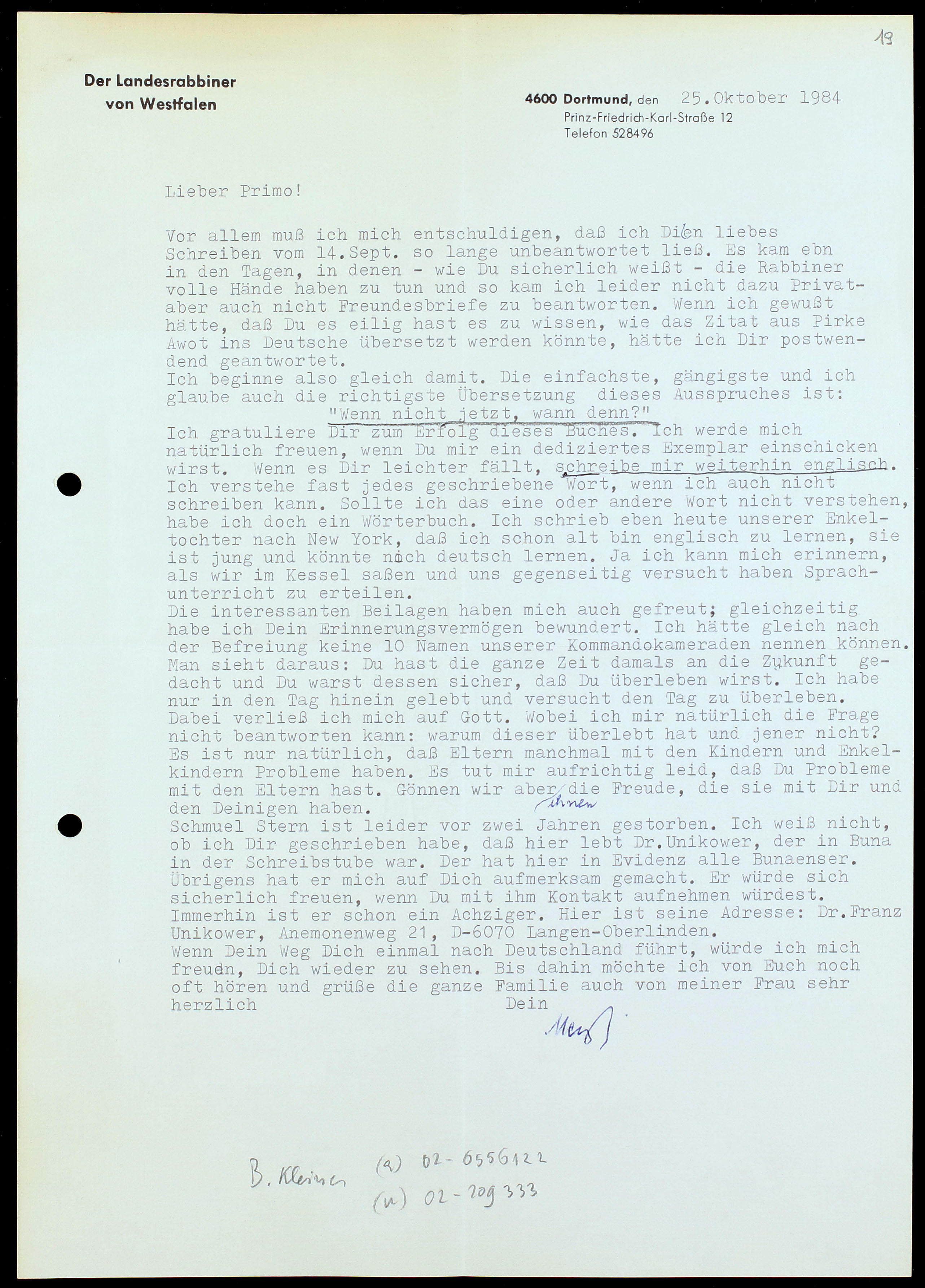
Davidovic answers Levi’s question regarding the correct German translation of the title If Not Now, When? and suggests that he contact Franz Unikower, another former prisoner at Monowitz.
25. Oktober 1984
Lieber Primo!
Vor allem muß ich mich entschuldigen, daß ich Dein liebes Schreiben vom 14. September so lange unbeantwortet ließ. Es kam eben in den Tagen, in denen – wie Du sicherlich weißt – die Rabbiner volle Hände haben zu tun und so kam ich leider nicht dazu Privat- aber auch nicht Freundesbriefe zu beantworten. Wenn ich gewußt hätte, daß Du es eilig hast es zu wissen, wie das Zitat aus Pirke Awot ins Deutsche übersetzt werden könnte, hätte ich Dir postwendend geantwortet.
Ich beginne also gleich damit. Die einfachste, gängigste und ich glaube auch die richtigste Übersetzung dieses Ausspruches ist:
„Wenn nicht jetzt, wann denn?“[1]
Ich gratuliere Dir zum Erfolg dieses Buches. Ich werde mich natürlich freuen, wenn Du mir ein dediziertes Exemplar einschicken wirst. Wenn es Dir leichter fällt, schreibe mir weiterhin englisch.[2]
Ich verstehe fast jedes geschriebene Wort, wenn ich auch nicht schreiben kann. Sollte ich das eine oder andere Wort nicht verstehen, habe ich doch ein Wörterbuch. Ich schrieb eben heute unserer Enkeltochter nach New York, daß ich schon alt bin englisch zu lernen, sie ist jung und könnte noch deutsch lernen. Ja ich kann mich erinnern, als wir im Kessel saßen und uns gegenseitig versucht haben Sprachunterricht zu erteilen.
Die interessanten Beilagen haben mich auch gefreut; gleichzeitig habe ich Dein Erinnerungsvermögen bewundert. Ich hätte gleich nach der Befreiung keine 10 Namen unserer Kommandokameraden nennen können. Man sieht daraus: Du hast die ganze Zeit damals an die Zukunft gedacht und Du warst dessen sicher, daß Du überleben wirst. Ich habe nur in den Tag hinein gelebt und versucht den Tag zu überleben. Dabei verließ ich mich auf Gott. Wobei ich mir natürlich die Frage nicht beantworten kann: warum dieser überlebt hat und jener nicht?
Es ist nur natürlich, daß Eltern manchmal mit den Kindern und Enkelkindern Probleme haben. Es tut mir aufrichtig leid, daß Du Probleme mit den Eltern hast. Gönnen wir aberihnen[3] die Freude, die sie mit Dir und den Deinigen haben.
Schmuel Stern ist leider vor zwei Jahren gestorben. Ich weiß nicht, ob ich Dir geschrieben habe, daß hier lebt Dr. Unikower, der in Buna in der Schreibstube war. Der hat hier in Evidenz alle Bunaenser. Übrigens hat er mich auf Dich aufmerksam gemacht. Er würde sich sicherlich freuen, wenn Du mit ihm Kontakt aufnehmen würdest. Immerhin ist er schon ein Achtziger. Hier ist seine Adresse: Dr. Franz Unikower, Anemonenweg 21, D-6070 Langen-Oberlinden.[4]
Wenn Dein Weg einmal nach Deutschland führt, würde ich mich freuen, Dich wieder zu sehen. Bis dahin möchte ich von Euch noch oft hören und grüße die ganze Familie auch von meiner Frau sehr herzlich
Dein
Mendi[5]
25 ottobre 1984
Caro Primo!
anzitutto devo scusarmi per aver lasciato così a lungo senza risposta la tua cara lettera del 14 settembre. È arrivata proprio nei giorni in cui, come certamente saprai, noi rabbini siamo sommersi dal lavoro e purtroppo non ho trovato il tempo di rispondere alle lettere private né a quelle degli amici. Se avessi saputo che avevi urgenza di sapere come si potesse tradurre in tedesco la citazione dei Pirkei Avot, ti avrei risposto a stretto giro.
Comincio quindi subito da questo. La traduzione più semplice, la più comune e, credo, anche la più giusta è:
«Wenn nicht jetzt, wann denn?»[1]
Mi congratulo con te per il successo del libro. Naturalmente mi farà molto piacere se me ne invierai una copia con dedica. Se per te è più facile, continua pure a scrivermi in inglese.[2] A leggerlo capisco quasi tutto, anche se non sono in grado di scriverlo. E se qualche parola mi sfugge, ho sempre il dizionario. Proprio oggi ho scritto a nostra nipote a New York che sono ormai troppo vecchio per imparare l’inglese, mentre lei è giovane e farebbe ancora in tempo a imparare il tedesco. Sì, mi ricordo quando, seduti nella cisterna, cercavamo di impartirci a vicenda lezioni di lingua
Mi hanno fatto molto piacere anche gli interessanti allegati; al tempo stesso ho ammirato la tua memoria. Io, subito dopo la liberazione, non sarei riuscito a ricordare nemmeno dieci nomi dei nostri compagni di Kommando. Da questo si capisce che tu, allora, pensavi al futuro ed eri certo che saresti sopravvissuto. Io invece vivevo alla giornata e cercavo soltanto di arrivare a quella dopo. Nel farlo, mi affidavo a Dio. Rimane però una domanda alla quale naturalmente non so dare risposta: perché uno è sopravvissuto e un altro no?
È del tutto naturale che a volte i genitori abbiano dei problemi con i figli e con i nipoti. Mi dispiace sinceramente dei tuoi problemi con i genitori. Ma concediamo loro[3] almeno la gioia che ricevono da te e dai tuoi cari.
Purtroppo Schmuel Stern è morto due anni fa. Non so se ti ho già scritto che qui vive il dottor Unikower: a Buna lavorava nella segreteria. E ha i registri di tutte le persone che sono passate da Buna.
È stato proprio lui, tra l’altro, a richiamare la mia attenzione su di te. Sono certo che sarebbe molto felice se ti mettessi in contatto con lui. Ormai ha ottant’anni. Ti scrivo il suo indirizzo: Dott. Franz Unikower, Anemonenweg 21, D-6070 Langen-Oberlinden.[4]
Se un giorno i tuoi passi dovessero portarti in Germania, sarei davvero felice di rivederti. Fino ad allora spero di ricevere spesso vostre notizie e saluto con grande affetto tutta la famiglia, anche a nome di mia moglie.
Tuo
Mendi[5]
October 25, 1984
Dear Primo!
First and foremost, I must apologize for leaving your kind letter of September 14 unanswered for so long. It arrived at a time when—as you surely know—rabbis have their hands full, and so I unfortunately did not get around to answering personal letters or notes from friends. If I had known that you were in a hurry to find out how the quote from Pirkei Avot could be translated into German, I would have replied immediately.
So I will start there. The simplest, most common, and, I believe, also the most accurate translation of that saying is:
“Wenn nicht jetzt, wann denn?”[1]
I congratulate you on the success of this book. I will of course be delighted if you sent me a signed copy. If it is easier for you, please keep writing me in English.[2] I understand almost every written word, even though I cannot write it. If there is a word or two I do not understand, I always have the dictionary. Just today I wrote to our granddaughter in New York saying I am too old to learn English—she is young and could still learn German. Yes, I remember when we were trapped in the hollows and tried to teach each other languages.
I also enjoyed the intriguing enclosures; at the same time, I admired your memory. Right after liberation, I would not have been able to name even 10 of our fellow prisoners. This shows that you were thinking about the future the whole time back then, and you were certain that you would survive. I just lived from day to day, trying to survive each day. In doing so, I relied on God. Though, of course, I cannot answer the question of why some survived while others did not.
It is only natural that parents sometimes have problems with their children and grandchildren. I am truly sorry that you are having problems with your parents. But let us allow them[3] to enjoy the time they have with you and your family.
Unfortunately, Schmuel Stern passed away two years ago. I cannot recall whether I have written you that Dr. Unikover, who worked in the office in Buna, lives here. He has a record of everyone from Buna here. By the way, he is the one who told me about you. He would certainly be happy if you got in touch with him. After all, he is already in his eighties. Here is his address: Dr. Franz Unikover, Anemonenweg 21, D-6070 Langen-Oberlinden.[4]
If you ever find yourself in Germany, I would be delighted to see you again. Until then, I hope to hear from you often, and my wife and I send our warmest regards to the whole family,
Yours,
Mendi[5]
25. Oktober 1984
Lieber Primo!
Vor allem muß ich mich entschuldigen, daß ich Dein liebes Schreiben vom 14. September so lange unbeantwortet ließ. Es kam eben in den Tagen, in denen – wie Du sicherlich weißt – die Rabbiner volle Hände haben zu tun und so kam ich leider nicht dazu Privat- aber auch nicht Freundesbriefe zu beantworten. Wenn ich gewußt hätte, daß Du es eilig hast es zu wissen, wie das Zitat aus Pirke Awot ins Deutsche übersetzt werden könnte, hätte ich Dir postwendend geantwortet.
Ich beginne also gleich damit. Die einfachste, gängigste und ich glaube auch die richtigste Übersetzung dieses Ausspruches ist:
„Wenn nicht jetzt, wann denn?“[1]
Ich gratuliere Dir zum Erfolg dieses Buches. Ich werde mich natürlich freuen, wenn Du mir ein dediziertes Exemplar einschicken wirst. Wenn es Dir leichter fällt, schreibe mir weiterhin englisch.[2]
Ich verstehe fast jedes geschriebene Wort, wenn ich auch nicht schreiben kann. Sollte ich das eine oder andere Wort nicht verstehen, habe ich doch ein Wörterbuch. Ich schrieb eben heute unserer Enkeltochter nach New York, daß ich schon alt bin englisch zu lernen, sie ist jung und könnte noch deutsch lernen. Ja ich kann mich erinnern, als wir im Kessel saßen und uns gegenseitig versucht haben Sprachunterricht zu erteilen.
Die interessanten Beilagen haben mich auch gefreut; gleichzeitig habe ich Dein Erinnerungsvermögen bewundert. Ich hätte gleich nach der Befreiung keine 10 Namen unserer Kommandokameraden nennen können. Man sieht daraus: Du hast die ganze Zeit damals an die Zukunft gedacht und Du warst dessen sicher, daß Du überleben wirst. Ich habe nur in den Tag hinein gelebt und versucht den Tag zu überleben. Dabei verließ ich mich auf Gott. Wobei ich mir natürlich die Frage nicht beantworten kann: warum dieser überlebt hat und jener nicht?
Es ist nur natürlich, daß Eltern manchmal mit den Kindern und Enkelkindern Probleme haben. Es tut mir aufrichtig leid, daß Du Probleme mit den Eltern hast. Gönnen wir aberihnen[3] die Freude, die sie mit Dir und den Deinigen haben.
Schmuel Stern ist leider vor zwei Jahren gestorben. Ich weiß nicht, ob ich Dir geschrieben habe, daß hier lebt Dr. Unikower, der in Buna in der Schreibstube war. Der hat hier in Evidenz alle Bunaenser. Übrigens hat er mich auf Dich aufmerksam gemacht. Er würde sich sicherlich freuen, wenn Du mit ihm Kontakt aufnehmen würdest. Immerhin ist er schon ein Achtziger. Hier ist seine Adresse: Dr. Franz Unikower, Anemonenweg 21, D-6070 Langen-Oberlinden.[4]
Wenn Dein Weg einmal nach Deutschland führt, würde ich mich freuen, Dich wieder zu sehen. Bis dahin möchte ich von Euch noch oft hören und grüße die ganze Familie auch von meiner Frau sehr herzlich
Dein
Mendi[5]
25 ottobre 1984
Caro Primo!
anzitutto devo scusarmi per aver lasciato così a lungo senza risposta la tua cara lettera del 14 settembre. È arrivata proprio nei giorni in cui, come certamente saprai, noi rabbini siamo sommersi dal lavoro e purtroppo non ho trovato il tempo di rispondere alle lettere private né a quelle degli amici. Se avessi saputo che avevi urgenza di sapere come si potesse tradurre in tedesco la citazione dei Pirkei Avot, ti avrei risposto a stretto giro.
Comincio quindi subito da questo. La traduzione più semplice, la più comune e, credo, anche la più giusta è:
«Wenn nicht jetzt, wann denn?»[1]
Mi congratulo con te per il successo del libro. Naturalmente mi farà molto piacere se me ne invierai una copia con dedica. Se per te è più facile, continua pure a scrivermi in inglese.[2] A leggerlo capisco quasi tutto, anche se non sono in grado di scriverlo. E se qualche parola mi sfugge, ho sempre il dizionario. Proprio oggi ho scritto a nostra nipote a New York che sono ormai troppo vecchio per imparare l’inglese, mentre lei è giovane e farebbe ancora in tempo a imparare il tedesco. Sì, mi ricordo quando, seduti nella cisterna, cercavamo di impartirci a vicenda lezioni di lingua
Mi hanno fatto molto piacere anche gli interessanti allegati; al tempo stesso ho ammirato la tua memoria. Io, subito dopo la liberazione, non sarei riuscito a ricordare nemmeno dieci nomi dei nostri compagni di Kommando. Da questo si capisce che tu, allora, pensavi al futuro ed eri certo che saresti sopravvissuto. Io invece vivevo alla giornata e cercavo soltanto di arrivare a quella dopo. Nel farlo, mi affidavo a Dio. Rimane però una domanda alla quale naturalmente non so dare risposta: perché uno è sopravvissuto e un altro no?
È del tutto naturale che a volte i genitori abbiano dei problemi con i figli e con i nipoti. Mi dispiace sinceramente dei tuoi problemi con i genitori. Ma concediamo loro[3] almeno la gioia che ricevono da te e dai tuoi cari.
Purtroppo Schmuel Stern è morto due anni fa. Non so se ti ho già scritto che qui vive il dottor Unikower: a Buna lavorava nella segreteria. E ha i registri di tutte le persone che sono passate da Buna.
È stato proprio lui, tra l’altro, a richiamare la mia attenzione su di te. Sono certo che sarebbe molto felice se ti mettessi in contatto con lui. Ormai ha ottant’anni. Ti scrivo il suo indirizzo: Dott. Franz Unikower, Anemonenweg 21, D-6070 Langen-Oberlinden.[4]
Se un giorno i tuoi passi dovessero portarti in Germania, sarei davvero felice di rivederti. Fino ad allora spero di ricevere spesso vostre notizie e saluto con grande affetto tutta la famiglia, anche a nome di mia moglie.
Tuo
Mendi[5]
October 25, 1984
Dear Primo!
First and foremost, I must apologize for leaving your kind letter of September 14 unanswered for so long. It arrived at a time when—as you surely know—rabbis have their hands full, and so I unfortunately did not get around to answering personal letters or notes from friends. If I had known that you were in a hurry to find out how the quote from Pirkei Avot could be translated into German, I would have replied immediately.
So I will start there. The simplest, most common, and, I believe, also the most accurate translation of that saying is:
“Wenn nicht jetzt, wann denn?”[1]
I congratulate you on the success of this book. I will of course be delighted if you sent me a signed copy. If it is easier for you, please keep writing me in English.[2] I understand almost every written word, even though I cannot write it. If there is a word or two I do not understand, I always have the dictionary. Just today I wrote to our granddaughter in New York saying I am too old to learn English—she is young and could still learn German. Yes, I remember when we were trapped in the hollows and tried to teach each other languages.
I also enjoyed the intriguing enclosures; at the same time, I admired your memory. Right after liberation, I would not have been able to name even 10 of our fellow prisoners. This shows that you were thinking about the future the whole time back then, and you were certain that you would survive. I just lived from day to day, trying to survive each day. In doing so, I relied on God. Though, of course, I cannot answer the question of why some survived while others did not.
It is only natural that parents sometimes have problems with their children and grandchildren. I am truly sorry that you are having problems with your parents. But let us allow them[3] to enjoy the time they have with you and your family.
Unfortunately, Schmuel Stern passed away two years ago. I cannot recall whether I have written you that Dr. Unikover, who worked in the office in Buna, lives here. He has a record of everyone from Buna here. By the way, he is the one who told me about you. He would certainly be happy if you got in touch with him. After all, he is already in his eighties. Here is his address: Dr. Franz Unikover, Anemonenweg 21, D-6070 Langen-Oberlinden.[4]
If you ever find yourself in Germany, I would be delighted to see you again. Until then, I hope to hear from you often, and my wife and I send our warmest regards to the whole family,
Yours,
Mendi[5]
Info
Notes
Tag
Sender: Emil Davidovič
Addressee: Primo Levi
Date of Drafting: 1984-10-25
Place of Writing: Dortmund
Description:typewritten letter with handwritten insertions in blue ballpoint pen, underlining in pencil and black ballpoint pen, and handwritten signature in blue ballpoint pen.
Archive: Archivio privato di Primo Levi, Turin
Series: Corrispondenza, Corrispondenti particolari, fascicolo 22, sottofascicolo 1, f. 19.
1“Wenn nicht jetzt, wann denn?” is underlined by hand in pencil. The book was published by Hanser in 1986 with the title Wann, wenn nicht jetzt?, translated by Barbara Kleiner (cf. infra, n. 4).
2“schreibe mir weiterhin englisch” (“keep writing me in English”) is underlined by hand in black ballpoint pen
3“ihnen” (“them”) is written by hand in blue ballpoint pen above the line, accompanied by an addition sign.
4On Unikower’s activity at the Schreibstube of Buna-Monowitz, cf. letter 182, n. 19.
5On the lower margin of the sheet, Levi notes by hand in pencil: “B. Kleiner (a) 02- 6556122 | (u) 02-209333.” This is the telephone number of the translator of If Not Now, When?.