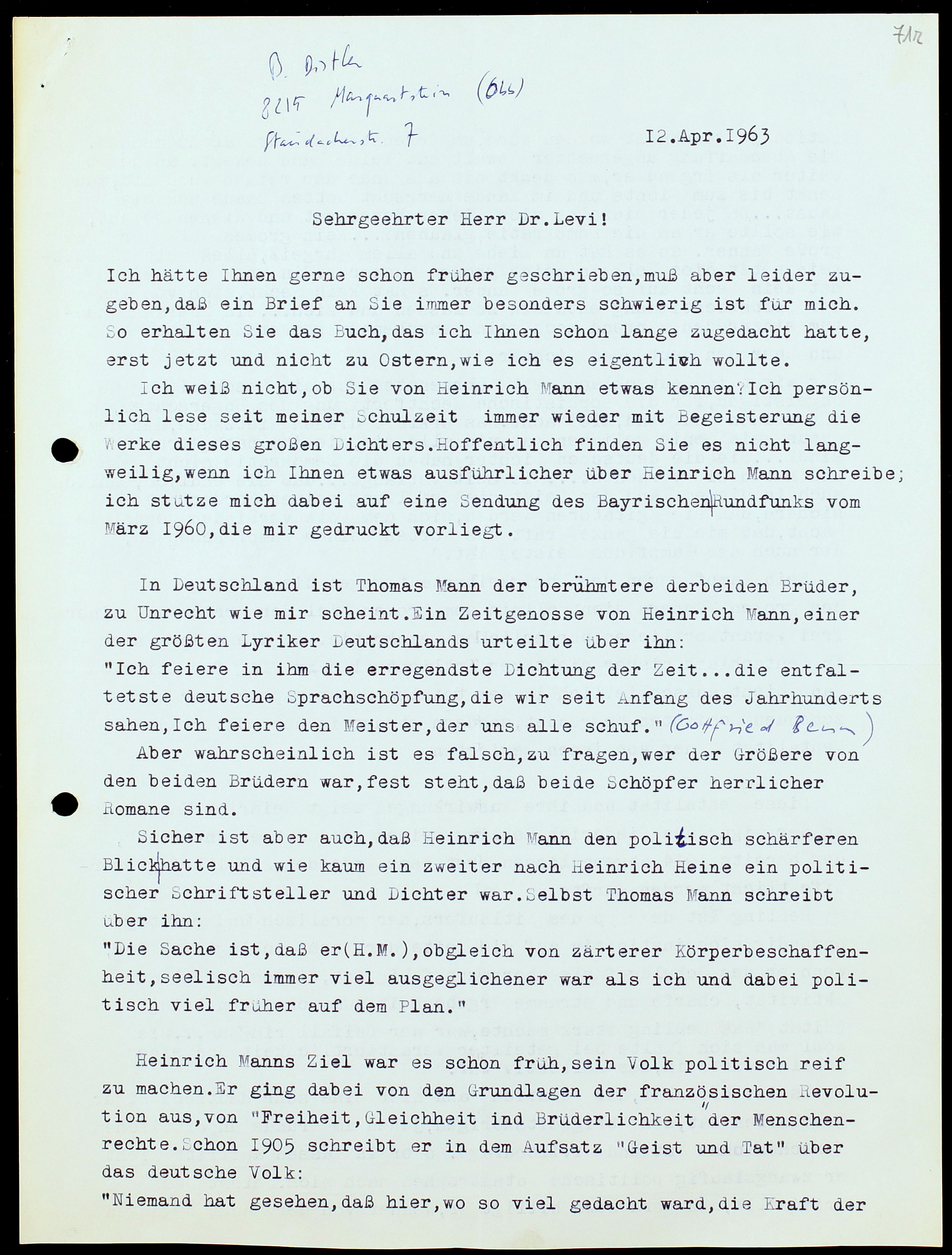
Ich hätte Ihnen gerne schon früher geschrieben, muß aber leider zugeben, daß ein Brief an Sie immer besonders schwierig ist für mich. So erhalten Sie das Buch, das ich Ihnen schon lange zugedacht hatte, erst jetzt und nicht zu Ostern, wie ich es eigentlich wollte.
Ich weiß nicht, ob Sie von Heinrich Mann etwas kennen? Ich persönlich lese seit meiner Schulzeit immer wieder mit Begeisterung die Werke dieses großen Dichters. Hoffentlich finden Sie es nicht langweilig, wenn ich Ihnen etwas ausführlicher über Heinrich Mann schreibe; ich stütze mich dabei auf eine Sendung des Bayerischen Rundfunks vom März 1960, die mir gedruckt vorliegt.[1]
In Deutschland ist Thomas Mann der berühmtere derbeiden Brüder, zu Unrecht wie mir scheint. Ein Zeitgenosse von Heinrich Mann, einer der größten Lyriker Deutschlands urteilte über ihn:
«Ich feiere in ihm die erregendste Dichtung der Zeit…die entfaltetste deutsche Sprachschöpfung, die wir seit Anfang des Jahrhunderts sahen, Ich feiere den Meister, der uns alle schuf». (GottfriedBenn)[2]
Aber wahrscheinlich ist es falsch, zu fragen, wer der Größere von den beiden Brüdern war, fest steht, daß beide Schöpfer herrlicher Romane sind.
Sicher ist aber auch, daß Heinrich Mann den politisch schärferen Blick hatte und wie kaum ein zweiter nach Heinrich Mann ein politischer Schriftsteller und Dichter war. Selbst Thomas Mann schreibt über ihn:
„Die Sache ist, daß er (H.M.), obgleich von zärterer Körperbeschaffenheit, seelisch immer viel ausgeglichener war als ich und dabei politisch viel früher auf dem Plan”.
Heinrich Manns Ziel war es schon früh, sein Volk politisch reif zu machen. Er ging dabei von den Grundlagen der französischen Revolutionaus, von „Freiheit, Gleichheit und Brüderlichkeit” der Menschenrechte. Schon 1905 schreibt er in dem Aufsatz Geist und Tat über das deutsche Volk:
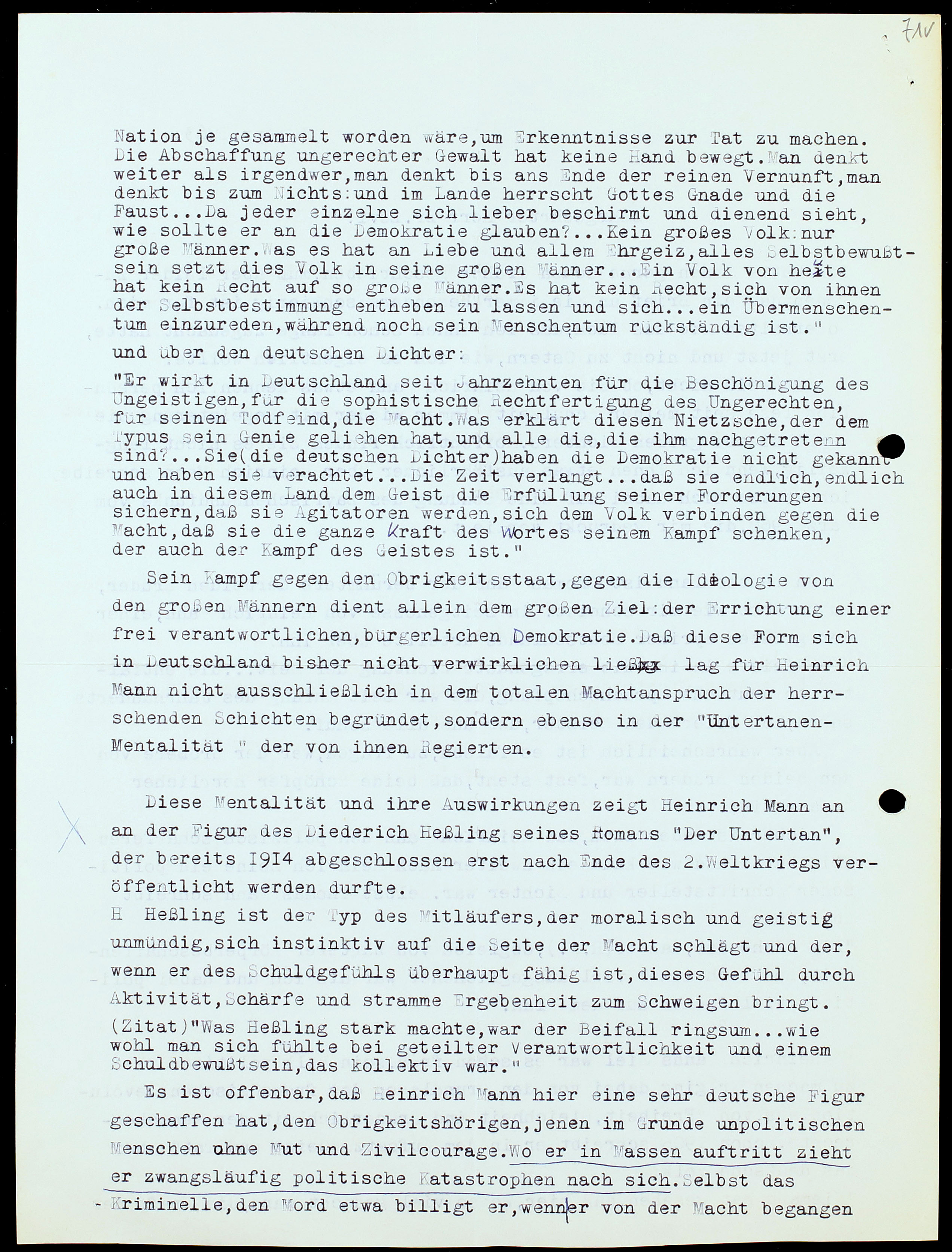
„Niemand hat gesehen, daß hier, wo so viel gedacht ward, die Kraft der Nation je gesammelt worden wäre, um Erkenntnisse zur Tat zu machen. Die Abschaffung ungerechter Gewalt hat keine Hand bewegt. Man denkt weiter als irgendwer, man denkt bis ans Ende der reinen Vernunft, man denkt bis zum Nichts: und im Lande herrscht Gottes Gnade und die Faust…Da jeder einzelne sich lieber beschirmt und dienend sieht, wie sollte er an die Demokratie glauben?…Kein großes Volk: nur große Männer. Was es hat an Liebe und allem Ehrgeiz, alles Selbstbewußtsein setzt dies Volk in seine großen Männer…Ein Volk von heute hat kein Recht auf so große Männer. Es hat kein Recht, sich von ihnen der Selbstbestimmung entheben zu lassen und sich…ein Übermenschentum einzureden, während noch sein Menschentum rückständig ist“.[3]
Und über den deutschen Dichter:
„Er wirkt in Deutschland seit Jahrzehnten für die Beschönigung des Ungeistigen, für die sophistische Rechtfertigung des Ungerechten, für seinen Todfeind, die Macht. Was erklärt diesen Nietzsche, der dem Typus sein Genie geliehen hat, und alle die, die ihm nachgetretenn sind?…Sie (die deutschen Dichter) haben die Demokratie nicht gekannt und haben sie verachtet…Die Zeit verlangt…daß sie endlich, endlich auch in diesem Land dem Geist die Erfüllung seiner Forderungen sichern, daß sie Agitatoren werden, sich dem Volk verbinden gegen die Macht, daß sie die ganze Kraft des Wortes seinem Kampf schenken, der auch der Kampf des Geistes ist“.[4]
Sein kampf gegen den Obrigkeitsstaat, gegen die Ideologie von den großen Männern dient allein dem großen Ziel: der Errichtung einer frei verantwortlichen, bürgerlichen Demokratie. Daß diese Form sich in Deutschland bisher nicht verwirklichen ließ lag für Heinrich Mann nicht ausschließlich in dem totalen Machtanspruch der herrschenden Schichten begründet, sondern ebenso in der „UntertanenMentalität“ der von ihnen Regierten.
Diese Mentalität und ihre Auswirkungen zeigt Heinrich Mannan an der Figur des Diederich Heßling seines Romans Der Untertan, der bereits 1914 abgeschlossen erst nach Ende des 2. Weltkriegs veröffentlicht werden durfte.[5]
H Heßling ist der Typ des Mitläufers, der moralisch und geistig unmündig, sich instinktiv auf die Seite der Macht schlägt und der, wenn er des Schuldgefühls überhaupt fähig ist, dieses Gefühl durch Aktivität, Schärfe und stramme Ergebenheit zum Schweigen bringt.
(Zitat) „Was Heßling stark machte, war der Beifall ringsum…wie wohl man sich fühlte bei geteilter Verantwortlichkeit und einem Schuldbewußtsein, das kollektiv war“.
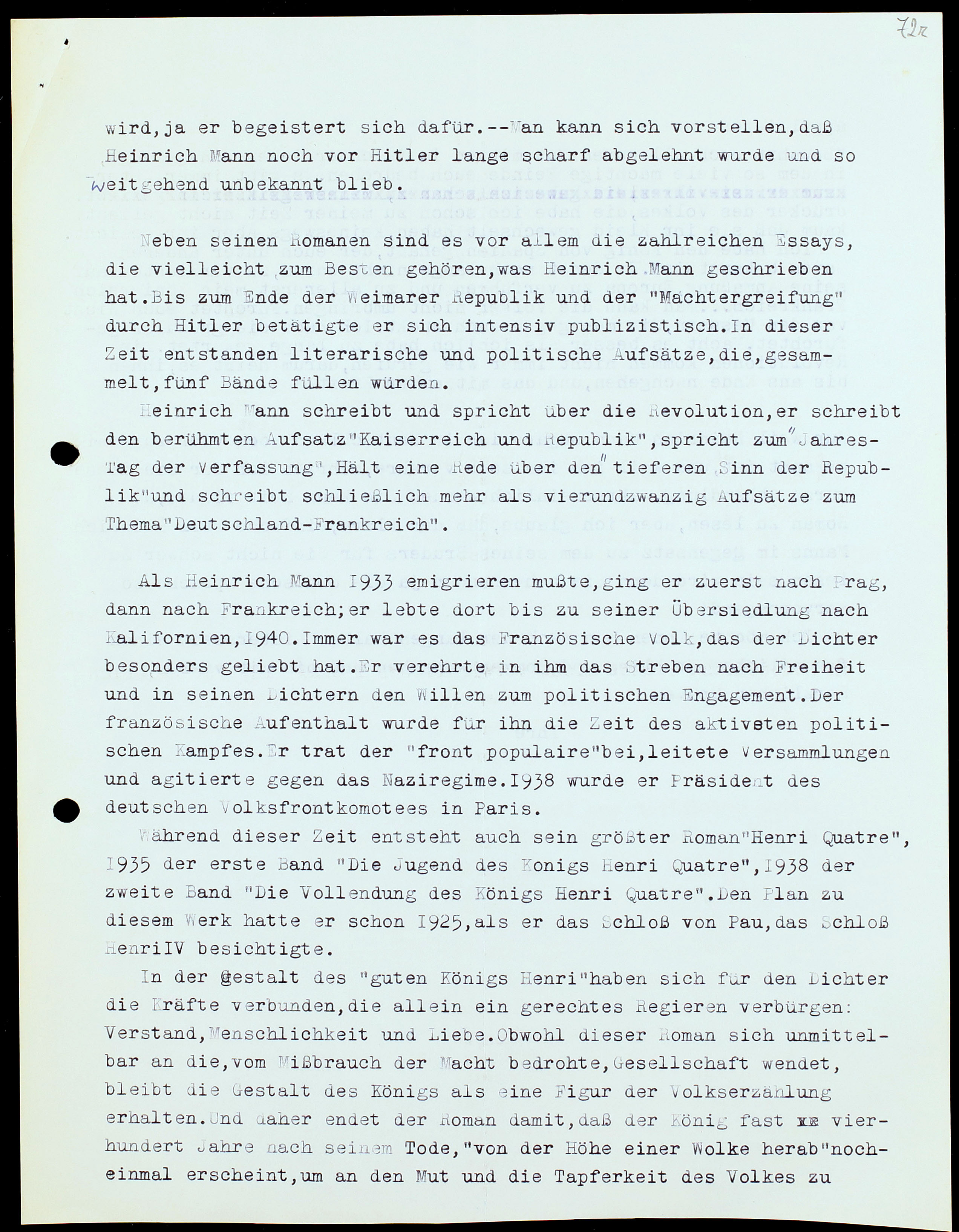
Es ist offenbar, daß Heinrich Mann hier eine sehr deutsche Figur geschaffen hat, den Obrigkeitshörigen, jenen im Grunde unpolitischen Menschen ohne Mut und Zivilcourage. Wo er in Massen auftritt zieht er zwangsläufig politische Katastrophen nach sich.[6] Selbst das Kriminelle, den Mord etwa billigt er, wenn er von der Macht begangen wird, ja er begeistert sich dafür. – Man kann sich vorstellen, daß Heinrich Mann noch vor Hitler lange scharf abgelehnt wurde und so weitgehend unbekannt blieb.
Neben seinen Romanen sind es vor allem die zahlreichen Essays, die vielleicht zum Besten gehören, was Heinrich Mann geschrieben hat. Bis zum Ende der Weimarer Republik und der „Machtergreifung” durch Hitler betätigte er sich intensiv publizistisch. In dieser Zeit entstanden literarische und politische Aufsätze, die, gesammelt, fünf Bände füllen wurden.
Heinrich Mannschreibt und spricht über die Revolution, er schreibt den berühmten Aufsatz „Kaiserreich und Republik“, spricht zum „Jahrestag der Verfassung“, Hält eine Rede über den „tieferen Sinn der Republik“ und schreibt schließlich mehr als vierundzwanzig Aufsätze zum Thema „Deutschland-Frankreich“.[7]
Als Heinrich Mann1933 emigrieren mußte, ging er zuerst nach Prag, dann nach Frankreich; er lebte dort bis zu seiner Übersiedlung nach Kalifornien, 1940. Immer war es das Französische Volk, das der Dichter besonders geliebt hat. Er verehrte in ihm das Streben nach Freiheit und in seinen Dichtern den Willen zum politischen Engagement. Der französische Aufenthalt wurde für ihn die Zeit des aktivsten politischen Kampfes. Er trat der „front populaire” bei, leitete Versammlungen und agitierte gegen das Naziregime. 1938 wurde er Präsident des deutschen Volksfrontkomitees in Paris.[8]
Während dieser Zeit entsteht auch sein größter Roman Henri Quatre, 1935 der erste Band Die Jugend des Konigs Henri Quatre, 1938 der zweite Band Die Vollendung des Königs Henri Quatre. Den Plan zu diesem Werk hatte er schon 1925, als er das Schloß von Pau, das Schloß Henri IV besichtigte.
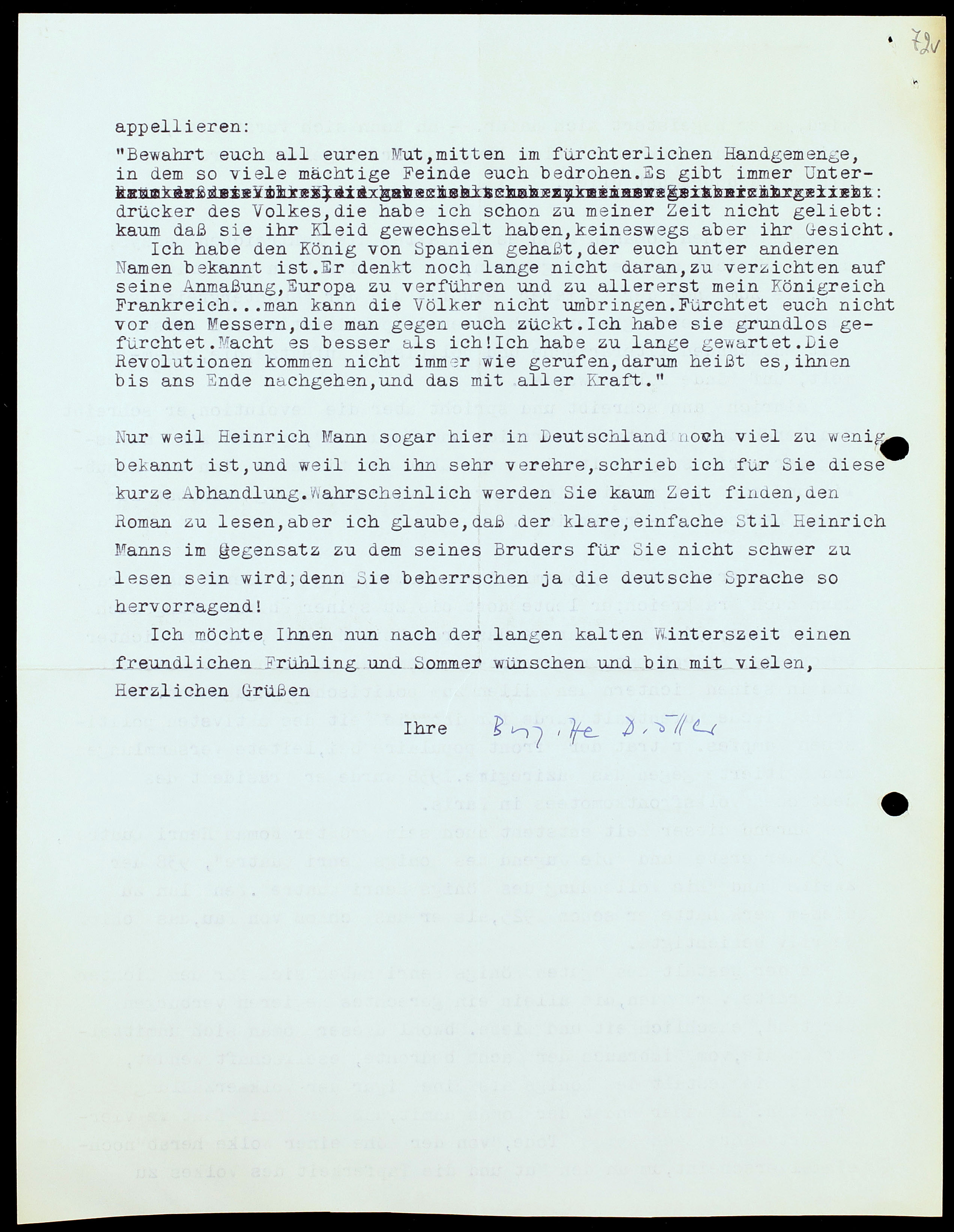
In der Gestalt des „guten Königs Henri“ haben sich für den Dichter die Kräfte verbunden, die allein ein gerechtes Regieren verbürgen: Verstand, Menschlichkeit und Liebe. Obwohl dieser Roman sich unmittelbar an die, vom Mißbrauch der Macht bedrohte, Gesellschaft wendet, bleibt die Gestalt des Königs als eine Figur der Volkserzählung erhalten. Und daher endet der Roman damit, daß der König fast vierhundert Jahre nach seinem Tode, „von der Höhe einer Wolke herab“ nocheinmal erscheint, um an den Mut und die Tapferkeit des Volkes zu appellieren:
„Bewahrt euch all euren Mut, mitten im fürchterlichen Handgemenge, in dem so viele mächtige Feinde euch bedrohen. Es gibt immer Unterdrücker des Volkes die habe ich schon zu meiner Zeit nicht geliebt: kaum daß sie ihr Kleid gewechselt haben, keineswegs aber ihr Gesicht.
Ich habe den König von Spanien gehaßt, der euch unter anderen Namen bekannt ist. Er denkt noch lange nicht daran, zu verzichten auf seine Anmaßung, Europa zu verführen und zu allererst mein Königreich Frankreich…man kann die Völker nicht umbringen. Fürchtet euch nicht vor den Messern, die man gegen euch zückt. Ich habe sie grundlos gefürchtet. Macht es besser als ich! Ich habe zu lange gewartet. Die Revolutionen kommen nicht immer wie gerufen, darum heißt es, ihnen bis ans Ende nachgehen, und das mit aller Kraft“.
Nur weil Heinrich Mann sogar hier in Deutschland noch viel zu wenig bekannt ist, und weil ich ihn sehr verehre, schrieb ich für Sie diese kurze Abhandlung. Wahrscheinlich werden Sie kaum Zeit finden, den Roman zu lesen, aber ich glaube, daß der klare, einfache Stil Heinrich Manns im Gegensatz zu dem seines Bruders für Sie nicht schwer zu lesen sein wird; denn Sie beherrschen ja die deutsche Sprache so hervorragend!
Ich möchte Ihnen nun nach der langen kalten Winterszeit einen freundlichen Frühling und Sommer wünschen und bin mit vielen, Herzlichen Grüßen
Ihre Brigitte Distler
12 aprile 1963
Stimatissimo Dottor Levi!
avrei voluto scriverLe già da tempo, ma devo purtroppo ammettere che scrivere una lettera a Lei mi riesce sempre particolarmente difficile. Dunque riceve solo adesso, e non a Pasqua come avrei voluto, il libro che da tanto tempo avevo pensato di destinarLe.
Non so se ha già letto qualcosa di Heinrich Mann. Personalmente è dai tempi della scuola che leggo sempre con entusiasmo le opere di questo grande scrittore. Spero di non annoiarLa se mi dilungo un po’ su Heinrich Mann; e per farlo mi baserò su una trasmissione dell’emittente Bayerischer Rundfunk, andata in onda marzo 1960, di cui possiedo il testo a stampa.[1]
In Germania, Thomas Mannè il più famoso dei due fratelli, secondo me ingiustamente. Un contemporaneo di Heinrich Mann, uno dei più grandi poeti della Germania, ha detto di lui:
«In lui celebro la poesia più dirompente di questo tempo… la più compiuta creazione in lingua tedesca che abbiamo avuto dall’inizio del secolo. Celebro il maestro che ha forgiato tutti noi». (Gottfried Benn)[2]
Probabilmente è sbagliato chiedersi chi fosse il più grande tra i due fratelli, posto che entrambi sono stati autori di splendidi romanzi.
Di certo però Heinrich Mann aveva uno sguardo politicamente più perspicace ed è stato poeta e scrittore politico come pochi altri dopo Heinrich Mann. Lo stesso Thomas Mann scrive di lui:
«Il fatto è che lui (H.M.), sebbene di costituzione fisica più delicata, è sempre stato molto più equilibrato di me e, al tempo stesso, politicamente molto più precoce.»
Fin da giovane, Heinrich Mann si era posto l’obiettivo di rendere politicamente maturo il suo popolo. Partiva dai principi della Rivoluzione francese, da «libertà, uguaglianza e fraternità», dai diritti umani. Già nel 1905, nel suo saggioSpirito e azione, scriveva del popolo tedesco:
«Nessuno ha mai visto qui, dove tanto si è pensato, le forze della nazione unirsi per trasformare il pensiero in atto concreto. Non una mano si è levata per abolire la violenza ingiusta. Si continua a pensare più di chiunque altro, si pensa fino all’estremo della ragion pura, fino al nulla: e nel paese regnano la grazia di Dio e il pugno… Se ogni singolo individuo preferisce sapersi protetto e servire, come può credere nella democrazia? … Non un grande popolo, ma grandi uomini. È nei suoi grandi uomini che questo popolo riversa tutto l’amore, l’ambizione, la coscienza di sé … Oggi un popolo non ha il diritto di avere così grandi uomini. Non ha il diritto di dare loro la facoltà di privarlo dell’autodeterminazione e di lusingarlo con l’illusione di un superomismo, quando la sua stessa umanità ha ancora tanta strada da fare.»[3]
e sul poeta tedesco:
«Da decenni si adopera in Germania per abbellire ciò che privo di spirito, per giustificare con sofismi l’ingiusto, per il suo nemico mortale: il potere. Come spiegare questo Nietzsche, che ha prestato il suo genio a quel modello, e tutti coloro che hanno calcato le sue orme? … Loro (i poeti tedeschi) non hanno conosciuto la democrazia e l’hanno disprezzata… Il tempo esige che finalmente, finalmente anche in questo paese assicurino allo spirito la realizzazione delle sue istanze, che diventino agitatori, che si uniscano al popolo contro il potere, che donino alla sua lotta, che è anche la lotta dello spirito, tutta la forza della parola.»[4]
La sua lotta contro lo stato autoritario, contro l’ideologia dei grandi uomini, serviva unicamente al grande obiettivo di instaurare una democrazia civile e responsabile. Che questa forma, in Germania, non si fosse ancora realizzata, per Heinrich Mannnon dipendeva esclusivamente dalla pretesa di potere totale da parte delle classi dominanti, ma anche dalla “mentalità da sudditi” di coloro che erano governati.
Questa mentalità e le sue conseguenze Heinrich Mann le rappresenta nella figura di Diederich Heßling, protagonista del suo romanzo Il suddito, che aveva terminato di scrivere già nel 1914, ma che poté essere pubblicato solo dopo la fine della Seconda guerra mondiale.[5]
Heßling è il tipo del gregario, immaturo moralmente e intellettualmente, che d’istinto si schiera dalla parte del potere e, se pure capace di sensi di colpa, li mette a tacere con l’attività, la durezza e la cieca obbedienza.
(Citazione) «Lo rendeva forte il consenso che sentiva tutt’intorno, la folla, da cui tante braccia si sporgevano ad aiutarlo, la maggioranza schiacciante, dentro e fuori… Come ci si sentiva bene dividendo la responsabilità, in un senso di colpa collettiva!»
Quello che lo faceva forte era l’applauso che scrosciava intorno… era la strapotente maggioranza che si metteva dalla sua che rendeva forte Heßling era l’approvazione generale… Come ci si sente bene quando responsabilità è condivisa e quando si ha la coscienza di una colpa che è collettiva!»
È evidente che Heinrich Mann ha costruito un personaggio molto tedesco: l’uomo ossequioso verso l’autorità, fondamentalmente apolitico, privo di coraggio civile. Quando si presenta in massa, porta inevitabilmente con sé la catastrofe politica.[6] Quest’uomo giustifica persino l’atto criminale, l’omicidio per esempio, se è commesso dal potere, e anzi se ne entusiasma. Non c’è da stupirsi che Heinrich Mann fosse duramente rifiutato già prima di Hitler, per poi rimanere a lungo sconosciuto ai più.
Oltre ai suoi romanzi, sono soprattutto i numerosi saggi a costituire forse la parte migliore della sua produzione. Fino alla fine della Repubblica di Weimar e alla “presa di potere” da parte di Hitler, si impegnò intensamente come pubblicista. In quel periodo nacquero saggi letterari e politici che, insieme, riempiono cinque volumi.
Heinrich Mannscrive e parla di rivoluzione, compone il celebre saggio “Kaiserreich und Republik” [Impero e repubblica], parla nell’«anniversario della Costituzione». Tiene un discorso sul “senso più profondo della repubblica” e scrive più di ventiquattro saggi sul tema “Germania-Francia”.[7]
Quando nel 1933 dovette emigrare, Heinrich Mann andò prima a Praga, poi in Francia, dove visse fino al 1940, anno del suo trasferimento in California. Fu sempre il popolo francese che amò in modo particolare, venerandone la tensione verso la libertà e, nei suoi scrittori, la volontà di impegno politico. Il periodo francese fu per lui il più attivo nella lotta politica: aderì al front populaire, presiedette assemblee, fece propaganda contro il regime nazista. Nel 1938 divenne presidente del Fronte popolare tedesco a Parigi.[8]
In quegli anni nacque anche il suo romanzo, il più grande, sulla figura di Enrico IV, il primo volume,La giovinezza di Enrico IV, nel 1935, e il secondo volume, Maturità e destino di Enrico IV, nel 1938. Il progetto lo aveva concepito già nel 1925, quando visitò il castello di Pau, residenza di Enrico IV.
Nella figura del «buon re Enrico» lo scrittore vedeva riunite quelle forze che sole garantiscono un governo giusto: ragione, umanità e amore. Sebbene il romanzo si rivolga direttamente a una società minacciata dall’abuso del potere, la figura del sovrano resta quella di un racconto popolare. Perciò il romanzo termina con il re che, quasi quattro secoli dopo la sua morte, «dalla sommità di una nuvola» appare ancora una volta per esortare il popolo al coraggio e all’ardimento:
«Serbate tutto il vostro coraggio, in mezzo alla mischia terribile in cui tanti potenti nemici vi minacciano. Ci sono sempre oppressori del popolo, che io già al mio tempo non ho amato: hanno appena cambiato l’abito, ma il volto è rimasto lo stesso.
Ho odiato il re di Spagna, che vi è noto sotto altri nomi. Non pensa affatto a rinunciare alla sua pretesa di sedurre l’Europa e in primis il mio regno di Francia… Non si possono uccidere i popoli. Non abbiate paura dei coltelli che si levano contro di voi. Io li ho temuti senza ragione. Fate meglio di me! Io ho aspettato troppo a lungo. Le rivoluzioni non arrivano sempre quando le si invoca, perciò bisogna seguirle fino in fondo, e con tutte le forze».
Ho scritto per Lei questa breve trattazione perché Heinrich Mann è ancora oggi troppo poco conosciuto in Germania, e perché lo ammiro molto. Probabilmente non avrà tempo di leggere il romanzo, ma credo che lo stile chiaro e semplice di Heinrich Mann, a differenza di quello del fratello, non Le risulterà difficile da leggere, dato che Lei padroneggia la lingua tedesca in modo eccellente!
Dopo questo lungo e freddo inverno, Le auguro una primavera e un’estate di serenità e Le mando tanti cordiali saluti
Sua Brigitte Distler
April 12, 1963
Dear Mr. Levi,
I would have liked to write to you sooner, but I must admit that writing to you is always particularly difficult for me. So you are only now receiving the book I had intended to send you a long time ago, and not at Easter, as I had originally planned.
I don’t know if you are familiar with Heinrich Mann. Personally, I have been reading the works of this great writer with enthusiasm since my school days. I hope you will not find it boring if I go into a little more detail about Heinrich Mann; I am basing my comments on a Bavarian Radio broadcast from March 1960, of which I have a printed transcription.[1]
In Germany, Thomas Mann is the more famous of the two brothers, unjustly so, in my opinion. One of Germany’s greatest poets, who was also a contemporary of Heinrich Mann, said of him:
“I celebrate him for the most exciting writing of our time…the most highly developed creative writing in the German language since the beginning of the century. I celebrate the master who created us all.” (Gottfried Benn)[2]
But it is probably wrong to ask which of the two brothers was greater; certainly both of them have written wonderful novels.
It is also certain that Heinrich Mann had a keener political eye and was, like hardly anyone else since Heinrich Heine, a political writer and poet. Even Thomas Mann wrote of him:
“The thing is, although he (H.M.) was more delicate physically, he was always much more balanced than I was emotionally, and was also politically engaged much earlier.”
Heinrich Mann’s goal from early on was to bring his people to political maturity. He based his approach on the principles of the French Revolution, on the human rights of “liberty, equality, and fraternity.” As early as 1905, he wrote in his essay Spirit and Deed about the German people:
“No one has ensured that here, where so much has been thought, the power of the nation has ever been gathered to turn insights into action. The abolition of unjust violence has not moved a finger. People ponder more than anyone else, they ponder to the end of pure reason, they ponder to the point of nothingness: and in the countryside, God’s grace and the clenched fist reign supreme… Since every individual prefers to protect and serve himself, how can he believe in democracy?… [In Germany] There is no great people: only great men. Whatever love and ambition it has, all its self-confidence, this people puts into its great men… A people of today has no right to such great men. It has no right to allow them to deprive it of self-determination and to persuade itself… of superhumanity, while its humanity is still backward.”[3]
And of the typical German poet and writer:
“For decades, he has been working in Germany to whitewash the unspiritual, to sophistically justify the unjust, to promote his mortal enemy, power. What can ever explain Nietzsche, who lent his genius to the type, and all those who followed in his footsteps?… They (German poets and writers) did not know democracy and despised it… The times demand… that they finally, finally ensure that the spirit fulfills its demands in this country too, that they become agitators, that they unite with the people against power, that they devote all the power of the word to its struggle, which is also the struggle of the spirit.”[4]
His struggle against the authoritarian state, against the ideology of great men, serves only one great goal: the establishment of a free, responsible, civil democracy. For Heinrich Mann, the fact that this had not yet been realized in Germany was not solely due to the ruling classes’ total claim to power, but also to the “loyal-subject mentality” of those they ruled.
Heinrich Mann illustrates this mentality and its effects in the character of Diederich Hessling in his novel The Loyal Subject, which was completed in 1914 but was not allowed to be published until after the end of World War II.[5]
Hessling is the type of tacit supporter who is morally and intellectually immature, instinctively sides with power, and, if he is capable of feeling guilt at all, silences this feeling through activity, stridency, and staunch devotion.
(Quote) “What made Hessling strong was the applause all around him… how good it felt to share responsibility and a collective sense of guilt.”
It is clear that Heinrich Mann created a very German character here, one who obeys authority, a fundamentally apolitical person lacking courage and moral conviction. Wherever he appears in large numbers, he inevitably brings political disaster in his wake.[6] Even crime, such as murder, is something he approves of when committed by those in power; indeed, he is enthusiastic about it.—One can well imagine that Heinrich Mann was staunchly rejected even before Hitler, and thus remained largely unknown.
In addition to his novels, it is above all his numerous essays that are perhaps among the best of Heinrich Mann’s writings. Until the end of the Weimar Republic and Hitler’s “seizure of power,” he was intensively involved in journalism. During this period, he wrote literary and political essays, which, when collected, filled five volumes.
Heinrich Mann wrote and spoke about revolution, penned the famous essay Empire and Republic, gave a speech on the “anniversary of the constitution,” spoke about the “deeper meaning of the republic,” and ultimately wrote more than twenty-four essays about “German-French relations”.[7]
When Heinrich Mann was forced to emigrate in 1933, he went first to Prague, then to France, where he lived until he moved to California in 1940. He always particularly loved the French people. He admired their striving for freedom and, in their poets and writers, their willingness to engage in politics. His stay in France became a period of intense political struggle for him. He joined the “front populaire”, led meetings, and campaigned against the Nazi regime. In 1938, he became president of the Volksfrontkomitee (German popular front) in Paris.[8]
During this time, he also wrote his greatest novel, Henri Quatre, the first volume of which, The Youth of King Henry IV, was published in 1935, followed by the second volume, The Consummation of King Henry IV, in 1938. He had already conceived the plan for this work in 1925 when he visited Pau and the castle of King Henry IV of France.
In the character of “good King Henry,” the writer combined the sole forces capable of guaranteeing just rule: reason, humanity, and love. Although this novel is directly addressed to a society threatened by the abuse of power, the figure of the king remains a character from folk tales. And so the novel ends with the king appearing once more, almost four hundred years after his death, “from the height of a cloud,” to appeal to the courage and bravery of the people:
“Safeguard all your courage in the midst of this terrible fight in which so many powerful enemies threaten you. There are always oppressors of the people, whom I did not love even in my time: they have changed their clothes, but by no means their faces.
“I hated the King of Spain, who is known to you by other names. He has no intention of renouncing his presumption of seducing Europe and, first and foremost, my kingdom of France… you cannot kill the people. Do not fear the daggers that are drawn against you. I feared them without reason. Do better than I did! I waited too long. Revolutions do not always come when they are needed, so it is important that you pursue them, to the end, with all your strength.”
It is only because Heinrich Mann is still far too little known even here in Germany, and because I admire him greatly, that I have written this short essay for you. You probably have too little time to read the novel, but I believe Heinrich Mann’s clear, simple prose style, in contrast to his brother’s, will not be difficult for you to read, since you have such an excellent command of the German language!
After the long, cold winter, I wish you a pleasant spring and summer and send you my warmest regards.
Yours, Brigitte Distler
12 April 1963
Sehrgeehrter Herr Dr.Levi!
Ich hätte Ihnen gerne schon früher geschrieben, muß aber leider zugeben, daß ein Brief an Sie immer besonders schwierig ist für mich. So erhalten Sie das Buch, das ich Ihnen schon lange zugedacht hatte, erst jetzt und nicht zu Ostern, wie ich es eigentlich wollte.
Ich weiß nicht, ob Sie von Heinrich Mann etwas kennen? Ich persönlich lese seit meiner Schulzeit immer wieder mit Begeisterung die Werke dieses großen Dichters. Hoffentlich finden Sie es nicht langweilig, wenn ich Ihnen etwas ausführlicher über Heinrich Mann schreibe; ich stütze mich dabei auf eine Sendung des Bayerischen Rundfunks vom März 1960, die mir gedruckt vorliegt.[1]
In Deutschland ist Thomas Mann der berühmtere derbeiden Brüder, zu Unrecht wie mir scheint. Ein Zeitgenosse von Heinrich Mann, einer der größten Lyriker Deutschlands urteilte über ihn:
«Ich feiere in ihm die erregendste Dichtung der Zeit…die entfaltetste deutsche Sprachschöpfung, die wir seit Anfang des Jahrhunderts sahen, Ich feiere den Meister, der uns alle schuf». (GottfriedBenn)[2]
Aber wahrscheinlich ist es falsch, zu fragen, wer der Größere von den beiden Brüdern war, fest steht, daß beide Schöpfer herrlicher Romane sind.
Sicher ist aber auch, daß Heinrich Mann den politisch schärferen Blick hatte und wie kaum ein zweiter nach Heinrich Mann ein politischer Schriftsteller und Dichter war. Selbst Thomas Mann schreibt über ihn:
„Die Sache ist, daß er (H.M.), obgleich von zärterer Körperbeschaffenheit, seelisch immer viel ausgeglichener war als ich und dabei politisch viel früher auf dem Plan”.
Heinrich Manns Ziel war es schon früh, sein Volk politisch reif zu machen. Er ging dabei von den Grundlagen der französischen Revolutionaus, von „Freiheit, Gleichheit und Brüderlichkeit” der Menschenrechte. Schon 1905 schreibt er in dem Aufsatz Geist und Tat über das deutsche Volk:
„Niemand hat gesehen, daß hier, wo so viel gedacht ward, die Kraft der Nation je gesammelt worden wäre, um Erkenntnisse zur Tat zu machen. Die Abschaffung ungerechter Gewalt hat keine Hand bewegt. Man denkt weiter als irgendwer, man denkt bis ans Ende der reinen Vernunft, man denkt bis zum Nichts: und im Lande herrscht Gottes Gnade und die Faust…Da jeder einzelne sich lieber beschirmt und dienend sieht, wie sollte er an die Demokratie glauben?…Kein großes Volk: nur große Männer. Was es hat an Liebe und allem Ehrgeiz, alles Selbstbewußtsein setzt dies Volk in seine großen Männer…Ein Volk von heute hat kein Recht auf so große Männer. Es hat kein Recht, sich von ihnen der Selbstbestimmung entheben zu lassen und sich…ein Übermenschentum einzureden, während noch sein Menschentum rückständig ist“.[3]
Und über den deutschen Dichter:
„Er wirkt in Deutschland seit Jahrzehnten für die Beschönigung des Ungeistigen, für die sophistische Rechtfertigung des Ungerechten, für seinen Todfeind, die Macht. Was erklärt diesen Nietzsche, der dem Typus sein Genie geliehen hat, und alle die, die ihm nachgetretenn sind?…Sie (die deutschen Dichter) haben die Demokratie nicht gekannt und haben sie verachtet…Die Zeit verlangt…daß sie endlich, endlich auch in diesem Land dem Geist die Erfüllung seiner Forderungen sichern, daß sie Agitatoren werden, sich dem Volk verbinden gegen die Macht, daß sie die ganze Kraft des Wortes seinem Kampf schenken, der auch der Kampf des Geistes ist“.[4]
Sein kampf gegen den Obrigkeitsstaat, gegen die Ideologie von den großen Männern dient allein dem großen Ziel: der Errichtung einer frei verantwortlichen, bürgerlichen Demokratie. Daß diese Form sich in Deutschland bisher nicht verwirklichen ließ lag für Heinrich Mann nicht ausschließlich in dem totalen Machtanspruch der herrschenden Schichten begründet, sondern ebenso in der „UntertanenMentalität“ der von ihnen Regierten.
Diese Mentalität und ihre Auswirkungen zeigt Heinrich Mannan an der Figur des Diederich Heßling seines Romans Der Untertan, der bereits 1914 abgeschlossen erst nach Ende des 2. Weltkriegs veröffentlicht werden durfte.[5]
H Heßling ist der Typ des Mitläufers, der moralisch und geistig unmündig, sich instinktiv auf die Seite der Macht schlägt und der, wenn er des Schuldgefühls überhaupt fähig ist, dieses Gefühl durch Aktivität, Schärfe und stramme Ergebenheit zum Schweigen bringt.
(Zitat) „Was Heßling stark machte, war der Beifall ringsum…wie wohl man sich fühlte bei geteilter Verantwortlichkeit und einem Schuldbewußtsein, das kollektiv war“.
Es ist offenbar, daß Heinrich Mann hier eine sehr deutsche Figur geschaffen hat, den Obrigkeitshörigen, jenen im Grunde unpolitischen Menschen ohne Mut und Zivilcourage. Wo er in Massen auftritt zieht er zwangsläufig politische Katastrophen nach sich.[6] Selbst das Kriminelle, den Mord etwa billigt er, wenn er von der Macht begangen wird, ja er begeistert sich dafür. – Man kann sich vorstellen, daß Heinrich Mann noch vor Hitler lange scharf abgelehnt wurde und so weitgehend unbekannt blieb.
Neben seinen Romanen sind es vor allem die zahlreichen Essays, die vielleicht zum Besten gehören, was Heinrich Mann geschrieben hat. Bis zum Ende der Weimarer Republik und der „Machtergreifung” durch Hitler betätigte er sich intensiv publizistisch. In dieser Zeit entstanden literarische und politische Aufsätze, die, gesammelt, fünf Bände füllen wurden.
Heinrich Mannschreibt und spricht über die Revolution, er schreibt den berühmten Aufsatz „Kaiserreich und Republik“, spricht zum „Jahrestag der Verfassung“, Hält eine Rede über den „tieferen Sinn der Republik“ und schreibt schließlich mehr als vierundzwanzig Aufsätze zum Thema „Deutschland-Frankreich“.[7]
Als Heinrich Mann1933 emigrieren mußte, ging er zuerst nach Prag, dann nach Frankreich; er lebte dort bis zu seiner Übersiedlung nach Kalifornien, 1940. Immer war es das Französische Volk, das der Dichter besonders geliebt hat. Er verehrte in ihm das Streben nach Freiheit und in seinen Dichtern den Willen zum politischen Engagement. Der französische Aufenthalt wurde für ihn die Zeit des aktivsten politischen Kampfes. Er trat der „front populaire” bei, leitete Versammlungen und agitierte gegen das Naziregime. 1938 wurde er Präsident des deutschen Volksfrontkomitees in Paris.[8]
Während dieser Zeit entsteht auch sein größter Roman Henri Quatre, 1935 der erste Band Die Jugend des Konigs Henri Quatre, 1938 der zweite Band Die Vollendung des Königs Henri Quatre. Den Plan zu diesem Werk hatte er schon 1925, als er das Schloß von Pau, das Schloß Henri IV besichtigte.
In der Gestalt des „guten Königs Henri“ haben sich für den Dichter die Kräfte verbunden, die allein ein gerechtes Regieren verbürgen: Verstand, Menschlichkeit und Liebe. Obwohl dieser Roman sich unmittelbar an die, vom Mißbrauch der Macht bedrohte, Gesellschaft wendet, bleibt die Gestalt des Königs als eine Figur der Volkserzählung erhalten. Und daher endet der Roman damit, daß der König fast vierhundert Jahre nach seinem Tode, „von der Höhe einer Wolke herab“ nocheinmal erscheint, um an den Mut und die Tapferkeit des Volkes zu appellieren:
„Bewahrt euch all euren Mut, mitten im fürchterlichen Handgemenge, in dem so viele mächtige Feinde euch bedrohen. Es gibt immer Unterdrücker des Volkes die habe ich schon zu meiner Zeit nicht geliebt: kaum daß sie ihr Kleid gewechselt haben, keineswegs aber ihr Gesicht.
Ich habe den König von Spanien gehaßt, der euch unter anderen Namen bekannt ist. Er denkt noch lange nicht daran, zu verzichten auf seine Anmaßung, Europa zu verführen und zu allererst mein Königreich Frankreich…man kann die Völker nicht umbringen. Fürchtet euch nicht vor den Messern, die man gegen euch zückt. Ich habe sie grundlos gefürchtet. Macht es besser als ich! Ich habe zu lange gewartet. Die Revolutionen kommen nicht immer wie gerufen, darum heißt es, ihnen bis ans Ende nachgehen, und das mit aller Kraft“.
Nur weil Heinrich Mann sogar hier in Deutschland noch viel zu wenig bekannt ist, und weil ich ihn sehr verehre, schrieb ich für Sie diese kurze Abhandlung. Wahrscheinlich werden Sie kaum Zeit finden, den Roman zu lesen, aber ich glaube, daß der klare, einfache Stil Heinrich Manns im Gegensatz zu dem seines Bruders für Sie nicht schwer zu lesen sein wird; denn Sie beherrschen ja die deutsche Sprache so hervorragend!
Ich möchte Ihnen nun nach der langen kalten Winterszeit einen freundlichen Frühling und Sommer wünschen und bin mit vielen, Herzlichen Grüßen
Ihre Brigitte Distler
12 aprile 1963
Stimatissimo Dottor Levi!
avrei voluto scriverLe già da tempo, ma devo purtroppo ammettere che scrivere una lettera a Lei mi riesce sempre particolarmente difficile. Dunque riceve solo adesso, e non a Pasqua come avrei voluto, il libro che da tanto tempo avevo pensato di destinarLe.
Non so se ha già letto qualcosa di Heinrich Mann. Personalmente è dai tempi della scuola che leggo sempre con entusiasmo le opere di questo grande scrittore. Spero di non annoiarLa se mi dilungo un po’ su Heinrich Mann; e per farlo mi baserò su una trasmissione dell’emittente Bayerischer Rundfunk, andata in onda marzo 1960, di cui possiedo il testo a stampa.[1]
In Germania, Thomas Mannè il più famoso dei due fratelli, secondo me ingiustamente. Un contemporaneo di Heinrich Mann, uno dei più grandi poeti della Germania, ha detto di lui:
«In lui celebro la poesia più dirompente di questo tempo… la più compiuta creazione in lingua tedesca che abbiamo avuto dall’inizio del secolo. Celebro il maestro che ha forgiato tutti noi». (Gottfried Benn)[2]
Probabilmente è sbagliato chiedersi chi fosse il più grande tra i due fratelli, posto che entrambi sono stati autori di splendidi romanzi.
Di certo però Heinrich Mann aveva uno sguardo politicamente più perspicace ed è stato poeta e scrittore politico come pochi altri dopo Heinrich Mann. Lo stesso Thomas Mann scrive di lui:
«Il fatto è che lui (H.M.), sebbene di costituzione fisica più delicata, è sempre stato molto più equilibrato di me e, al tempo stesso, politicamente molto più precoce.»
Fin da giovane, Heinrich Mann si era posto l’obiettivo di rendere politicamente maturo il suo popolo. Partiva dai principi della Rivoluzione francese, da «libertà, uguaglianza e fraternità», dai diritti umani. Già nel 1905, nel suo saggioSpirito e azione, scriveva del popolo tedesco:
«Nessuno ha mai visto qui, dove tanto si è pensato, le forze della nazione unirsi per trasformare il pensiero in atto concreto. Non una mano si è levata per abolire la violenza ingiusta. Si continua a pensare più di chiunque altro, si pensa fino all’estremo della ragion pura, fino al nulla: e nel paese regnano la grazia di Dio e il pugno… Se ogni singolo individuo preferisce sapersi protetto e servire, come può credere nella democrazia? … Non un grande popolo, ma grandi uomini. È nei suoi grandi uomini che questo popolo riversa tutto l’amore, l’ambizione, la coscienza di sé … Oggi un popolo non ha il diritto di avere così grandi uomini. Non ha il diritto di dare loro la facoltà di privarlo dell’autodeterminazione e di lusingarlo con l’illusione di un superomismo, quando la sua stessa umanità ha ancora tanta strada da fare.»[3]
e sul poeta tedesco:
«Da decenni si adopera in Germania per abbellire ciò che privo di spirito, per giustificare con sofismi l’ingiusto, per il suo nemico mortale: il potere. Come spiegare questo Nietzsche, che ha prestato il suo genio a quel modello, e tutti coloro che hanno calcato le sue orme? … Loro (i poeti tedeschi) non hanno conosciuto la democrazia e l’hanno disprezzata… Il tempo esige che finalmente, finalmente anche in questo paese assicurino allo spirito la realizzazione delle sue istanze, che diventino agitatori, che si uniscano al popolo contro il potere, che donino alla sua lotta, che è anche la lotta dello spirito, tutta la forza della parola.»[4]
La sua lotta contro lo stato autoritario, contro l’ideologia dei grandi uomini, serviva unicamente al grande obiettivo di instaurare una democrazia civile e responsabile. Che questa forma, in Germania, non si fosse ancora realizzata, per Heinrich Mannnon dipendeva esclusivamente dalla pretesa di potere totale da parte delle classi dominanti, ma anche dalla “mentalità da sudditi” di coloro che erano governati.
Questa mentalità e le sue conseguenze Heinrich Mann le rappresenta nella figura di Diederich Heßling, protagonista del suo romanzo Il suddito, che aveva terminato di scrivere già nel 1914, ma che poté essere pubblicato solo dopo la fine della Seconda guerra mondiale.[5]
Heßling è il tipo del gregario, immaturo moralmente e intellettualmente, che d’istinto si schiera dalla parte del potere e, se pure capace di sensi di colpa, li mette a tacere con l’attività, la durezza e la cieca obbedienza.
(Citazione) «Lo rendeva forte il consenso che sentiva tutt’intorno, la folla, da cui tante braccia si sporgevano ad aiutarlo, la maggioranza schiacciante, dentro e fuori… Come ci si sentiva bene dividendo la responsabilità, in un senso di colpa collettiva!»
Quello che lo faceva forte era l’applauso che scrosciava intorno… era la strapotente maggioranza che si metteva dalla sua che rendeva forte Heßling era l’approvazione generale… Come ci si sente bene quando responsabilità è condivisa e quando si ha la coscienza di una colpa che è collettiva!»
È evidente che Heinrich Mann ha costruito un personaggio molto tedesco: l’uomo ossequioso verso l’autorità, fondamentalmente apolitico, privo di coraggio civile. Quando si presenta in massa, porta inevitabilmente con sé la catastrofe politica.[6] Quest’uomo giustifica persino l’atto criminale, l’omicidio per esempio, se è commesso dal potere, e anzi se ne entusiasma. Non c’è da stupirsi che Heinrich Mann fosse duramente rifiutato già prima di Hitler, per poi rimanere a lungo sconosciuto ai più.
Oltre ai suoi romanzi, sono soprattutto i numerosi saggi a costituire forse la parte migliore della sua produzione. Fino alla fine della Repubblica di Weimar e alla “presa di potere” da parte di Hitler, si impegnò intensamente come pubblicista. In quel periodo nacquero saggi letterari e politici che, insieme, riempiono cinque volumi.
Heinrich Mannscrive e parla di rivoluzione, compone il celebre saggio “Kaiserreich und Republik” [Impero e repubblica], parla nell’«anniversario della Costituzione». Tiene un discorso sul “senso più profondo della repubblica” e scrive più di ventiquattro saggi sul tema “Germania-Francia”.[7]
Quando nel 1933 dovette emigrare, Heinrich Mann andò prima a Praga, poi in Francia, dove visse fino al 1940, anno del suo trasferimento in California. Fu sempre il popolo francese che amò in modo particolare, venerandone la tensione verso la libertà e, nei suoi scrittori, la volontà di impegno politico. Il periodo francese fu per lui il più attivo nella lotta politica: aderì al front populaire, presiedette assemblee, fece propaganda contro il regime nazista. Nel 1938 divenne presidente del Fronte popolare tedesco a Parigi.[8]
In quegli anni nacque anche il suo romanzo, il più grande, sulla figura di Enrico IV, il primo volume,La giovinezza di Enrico IV, nel 1935, e il secondo volume, Maturità e destino di Enrico IV, nel 1938. Il progetto lo aveva concepito già nel 1925, quando visitò il castello di Pau, residenza di Enrico IV.
Nella figura del «buon re Enrico» lo scrittore vedeva riunite quelle forze che sole garantiscono un governo giusto: ragione, umanità e amore. Sebbene il romanzo si rivolga direttamente a una società minacciata dall’abuso del potere, la figura del sovrano resta quella di un racconto popolare. Perciò il romanzo termina con il re che, quasi quattro secoli dopo la sua morte, «dalla sommità di una nuvola» appare ancora una volta per esortare il popolo al coraggio e all’ardimento:
«Serbate tutto il vostro coraggio, in mezzo alla mischia terribile in cui tanti potenti nemici vi minacciano. Ci sono sempre oppressori del popolo, che io già al mio tempo non ho amato: hanno appena cambiato l’abito, ma il volto è rimasto lo stesso.
Ho odiato il re di Spagna, che vi è noto sotto altri nomi. Non pensa affatto a rinunciare alla sua pretesa di sedurre l’Europa e in primis il mio regno di Francia… Non si possono uccidere i popoli. Non abbiate paura dei coltelli che si levano contro di voi. Io li ho temuti senza ragione. Fate meglio di me! Io ho aspettato troppo a lungo. Le rivoluzioni non arrivano sempre quando le si invoca, perciò bisogna seguirle fino in fondo, e con tutte le forze».
Ho scritto per Lei questa breve trattazione perché Heinrich Mann è ancora oggi troppo poco conosciuto in Germania, e perché lo ammiro molto. Probabilmente non avrà tempo di leggere il romanzo, ma credo che lo stile chiaro e semplice di Heinrich Mann, a differenza di quello del fratello, non Le risulterà difficile da leggere, dato che Lei padroneggia la lingua tedesca in modo eccellente!
Dopo questo lungo e freddo inverno, Le auguro una primavera e un’estate di serenità e Le mando tanti cordiali saluti
Sua Brigitte Distler
April 12, 1963
Dear Mr. Levi,
I would have liked to write to you sooner, but I must admit that writing to you is always particularly difficult for me. So you are only now receiving the book I had intended to send you a long time ago, and not at Easter, as I had originally planned.
I don’t know if you are familiar with Heinrich Mann. Personally, I have been reading the works of this great writer with enthusiasm since my school days. I hope you will not find it boring if I go into a little more detail about Heinrich Mann; I am basing my comments on a Bavarian Radio broadcast from March 1960, of which I have a printed transcription.[1]
In Germany, Thomas Mann is the more famous of the two brothers, unjustly so, in my opinion. One of Germany’s greatest poets, who was also a contemporary of Heinrich Mann, said of him:
“I celebrate him for the most exciting writing of our time…the most highly developed creative writing in the German language since the beginning of the century. I celebrate the master who created us all.” (Gottfried Benn)[2]
But it is probably wrong to ask which of the two brothers was greater; certainly both of them have written wonderful novels.
It is also certain that Heinrich Mann had a keener political eye and was, like hardly anyone else since Heinrich Heine, a political writer and poet. Even Thomas Mann wrote of him:
“The thing is, although he (H.M.) was more delicate physically, he was always much more balanced than I was emotionally, and was also politically engaged much earlier.”
Heinrich Mann’s goal from early on was to bring his people to political maturity. He based his approach on the principles of the French Revolution, on the human rights of “liberty, equality, and fraternity.” As early as 1905, he wrote in his essay Spirit and Deed about the German people:
“No one has ensured that here, where so much has been thought, the power of the nation has ever been gathered to turn insights into action. The abolition of unjust violence has not moved a finger. People ponder more than anyone else, they ponder to the end of pure reason, they ponder to the point of nothingness: and in the countryside, God’s grace and the clenched fist reign supreme… Since every individual prefers to protect and serve himself, how can he believe in democracy?… [In Germany] There is no great people: only great men. Whatever love and ambition it has, all its self-confidence, this people puts into its great men… A people of today has no right to such great men. It has no right to allow them to deprive it of self-determination and to persuade itself… of superhumanity, while its humanity is still backward.”[3]
And of the typical German poet and writer:
“For decades, he has been working in Germany to whitewash the unspiritual, to sophistically justify the unjust, to promote his mortal enemy, power. What can ever explain Nietzsche, who lent his genius to the type, and all those who followed in his footsteps?… They (German poets and writers) did not know democracy and despised it… The times demand… that they finally, finally ensure that the spirit fulfills its demands in this country too, that they become agitators, that they unite with the people against power, that they devote all the power of the word to its struggle, which is also the struggle of the spirit.”[4]
His struggle against the authoritarian state, against the ideology of great men, serves only one great goal: the establishment of a free, responsible, civil democracy. For Heinrich Mann, the fact that this had not yet been realized in Germany was not solely due to the ruling classes’ total claim to power, but also to the “loyal-subject mentality” of those they ruled.
Heinrich Mann illustrates this mentality and its effects in the character of Diederich Hessling in his novel The Loyal Subject, which was completed in 1914 but was not allowed to be published until after the end of World War II.[5]
Hessling is the type of tacit supporter who is morally and intellectually immature, instinctively sides with power, and, if he is capable of feeling guilt at all, silences this feeling through activity, stridency, and staunch devotion.
(Quote) “What made Hessling strong was the applause all around him… how good it felt to share responsibility and a collective sense of guilt.”
It is clear that Heinrich Mann created a very German character here, one who obeys authority, a fundamentally apolitical person lacking courage and moral conviction. Wherever he appears in large numbers, he inevitably brings political disaster in his wake.[6] Even crime, such as murder, is something he approves of when committed by those in power; indeed, he is enthusiastic about it.—One can well imagine that Heinrich Mann was staunchly rejected even before Hitler, and thus remained largely unknown.
In addition to his novels, it is above all his numerous essays that are perhaps among the best of Heinrich Mann’s writings. Until the end of the Weimar Republic and Hitler’s “seizure of power,” he was intensively involved in journalism. During this period, he wrote literary and political essays, which, when collected, filled five volumes.
Heinrich Mann wrote and spoke about revolution, penned the famous essay Empire and Republic, gave a speech on the “anniversary of the constitution,” spoke about the “deeper meaning of the republic,” and ultimately wrote more than twenty-four essays about “German-French relations”.[7]
When Heinrich Mann was forced to emigrate in 1933, he went first to Prague, then to France, where he lived until he moved to California in 1940. He always particularly loved the French people. He admired their striving for freedom and, in their poets and writers, their willingness to engage in politics. His stay in France became a period of intense political struggle for him. He joined the “front populaire”, led meetings, and campaigned against the Nazi regime. In 1938, he became president of the Volksfrontkomitee (German popular front) in Paris.[8]
During this time, he also wrote his greatest novel, Henri Quatre, the first volume of which, The Youth of King Henry IV, was published in 1935, followed by the second volume, The Consummation of King Henry IV, in 1938. He had already conceived the plan for this work in 1925 when he visited Pau and the castle of King Henry IV of France.
In the character of “good King Henry,” the writer combined the sole forces capable of guaranteeing just rule: reason, humanity, and love. Although this novel is directly addressed to a society threatened by the abuse of power, the figure of the king remains a character from folk tales. And so the novel ends with the king appearing once more, almost four hundred years after his death, “from the height of a cloud,” to appeal to the courage and bravery of the people:
“Safeguard all your courage in the midst of this terrible fight in which so many powerful enemies threaten you. There are always oppressors of the people, whom I did not love even in my time: they have changed their clothes, but by no means their faces.
“I hated the King of Spain, who is known to you by other names. He has no intention of renouncing his presumption of seducing Europe and, first and foremost, my kingdom of France… you cannot kill the people. Do not fear the daggers that are drawn against you. I feared them without reason. Do better than I did! I waited too long. Revolutions do not always come when they are needed, so it is important that you pursue them, to the end, with all your strength.”
It is only because Heinrich Mann is still far too little known even here in Germany, and because I admire him greatly, that I have written this short essay for you. You probably have too little time to read the novel, but I believe Heinrich Mann’s clear, simple prose style, in contrast to his brother’s, will not be difficult for you to read, since you have such an excellent command of the German language!
After the long, cold winter, I wish you a pleasant spring and summer and send you my warmest regards.
Yours, Brigitte Distler
Info
Notes
Tag
Sender: Brigitte Distler
Addressee: Primo Levi
Date of Drafting: 2025-12-18
Place of Writing: Munich
Description:typewritten letter with handwritten signature in blue ballpoint pen. Insertions and underlining have been handwritten by Levi in blue ballpoint pen. In the upper margin of f. 71r, Levi notes in blue ballpoint pen: “B. Distler | 8215 Marquartstein (Obb.) | Staudacherstr. 7.”
Archive: Archivio privato di Primo Levi, Turin
Series: Complesso di Fondi primo Levi, Fondo Primo Levi, Corrispondenza, Corrispondenti particolari, fasc. 20, sottofasc. 001, doc. 023, ff. 71r/v, 72r/v.
Folio: 2, front and back
DOI: https://doi.org/10.15160/day3-y772
1
Regarding the history of the Bayerischer Rundfunk, cf. the biography of Theodor Fischer.
2“(Gottfried Benn)” is added by hand in blue ballpoint pen, probably by Distler.
3
Geist und Tat (“Spirit and Action”) by Heinrich Mann was published for the first time in the magazine Pan, 5, January 1, 1911, pp. 137-143; the passage Distler quotes can be found on p. 140. This essay was later included in a collection edited by Kurt Hiller (Das Ziel. Anrufe zu aktivem Geist, Munich-Berlin: George Müller, 1916), providing a second reprint that was promoted within the circle of the so-called “activism” of pacifist and socialist leanings. Regarding Kurt Hiller and his influence on later generations, as well, see the biography of Beutin and Letter 095. Later, Geist und Tatprovided the title of another work by Heinrich Mann (see note 6).
4Geist und Tat, p. 142.
5The paragraph is marked by Levi with a handwritten “X” in blue ballpoint pen in the inner margin of the sheet.
6
“Wo er in Massen…Katastrophen nach sich” is underlined by Levi in blue ballpoint pen. The Italian quotes from Heinrich Mann, Il suddito (The Loyal Subject), are from the translation by Clara Bovero, Milan: UTET 2009, p. 10 (cf. Letter 122, note 1).
7
Heinrich Mann included a few of the most important ones in a collection entitled Geist und Tat. Franzosen 1780-1930. The book was published for the first time in 1931 by Gustav Kiepenheuer Verlag in Berlin (it was reprinted by the publishers Deutscher Taschenbuch Verlag in Munich in 1963 with the title Geist und Tat. Essays – it is probable that Distler is referring to this edition - and was last republished by Fischer in 2011, edited and with an afterword by Ulrich Walberer). The book features essays about Stendhal, Victor Hugo, Zola, and many other French authors. The opinions Heinrich Mann expressed in these essays, which were published individually between 1905 and 1928, had a strong impact on his relationship with his brother Thomas. The essay on Zola, in particular (translated into Italian with the title Zola, edited by Giovanni Chiarini, Naples: Tullio Pironti Editore, 1984), created strong friction between the two, as evinced by their correspondence during those years (see Thomas and Heinrich Mann, La montagna del disincanto. Lettere 1900-1949, edited by Roberta Persichelli, foreword by Anna Mila Giubertoni, Milan: Archinto, 1999, in particular pp. 72-79). According to Thomas, the essay on Zola was “monstrously excessive” because, in it, Heinrich betrayed his “psychology of a Rousseauian disciple” - this in a letter to his brother on January 3, 1918; in an article entitled “Weltfrieden” (“World Peace”), published in the daily Berliner Tageblatt on December 27, 1917, he openly attacked “Rousseau’s doctrine,” “revolutionary optimism,” “faith in politics, in the anthill, socialism, and in the république démocratique,” clearly referring to Heinrich, whom he mockingly addressed as he who “hates his brother” and “plays the philanthropist” (Letters of Thomas and Heinrich Mann, 1900-1949, Berkeley and Los Angeles: University of California Press, 1998, pp. 350-52).
8Founded in Paris in 1937, the Deutsche Volksfront (German Popular Front) movement brought together German opposers to Hitler’s regime who had been forced into exile.