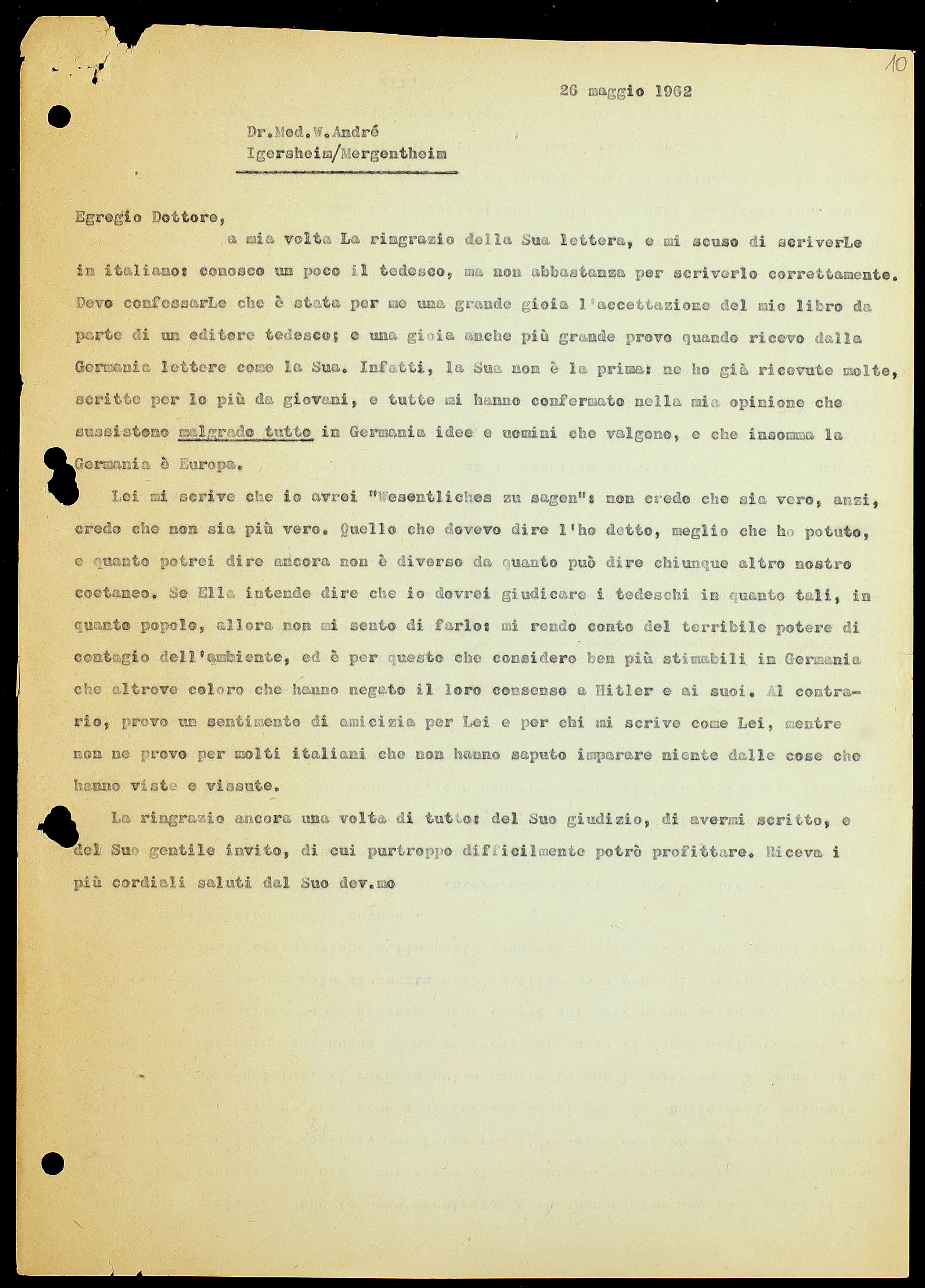
Levi thanks André for his letter and says he feels friendship for all those who write to him from Germany.
26 maggio 1962
Dr. Med.W. André Igersheim/Mergentheim
Egregio dottore,
A mia volta La ringrazio della Sua lettera, e mi scuso di scriverLe in italiano: conosco un poco il tedesco, ma non abbastanza per scriverlo correttamente. Devo confessarLe che è stata per me una grande gioia l’accettazione del mio libro da parte di un editore tedesco; e una gioia anche più grande provo quando ricevo dalla Germania lettere come la Sua. Infatti, la Sua non è la prima: ne ho già ricevute molte, scritte per lo più da giovani, e tutte mi hanno confermato nella mia opinione che sussistono malgrado tuttoin Germania idee e uomini che valgono, e che insomma la Germania è Europa.[1]
Lei mi scrive che io avrei “Wesentliches zu sagen”:[2] non credo che sia vero, anzi, credo che non sia più vero. Quello che dovevo dire l’ho detto, meglio che ho potuto, e quanto potrei dire ancora non è diverso da quanto può dire chiunque altro nostro coetaneo. Se Ella intende dire che io dovrei giudicare i tedeschi in quanto tali, in quanto popolo, allora non mi sento di farlo: mi rendo conto del terribile potere di contagio dell’ambiente,[3] ed è per questo che considero ben più stimabili in Germania che altrove coloro che hanno negato il loro consenso a Hitler e ai suoi.[4] Al contrario, provo un sentimento di amicizia per Lei e per chi mi scrive come Lei, mentre non ne provo per molti italiani che non hanno saputo imparare niente dalle cose che hanno viste e vissute.
La ringrazio ancora una volta di tutto: del suo giudizio, di avermi scritto, e del Suo gentile invito, di cui purtroppo difficilmente potrò profittare. Riceva i più cordiali saluti dal Suo dev.mo
26 maggio 1962
Dr. Med.W. André Igersheim/Mergentheim
Egregio dottore,
A mia volta La ringrazio della Sua lettera, e mi scuso di scriverLe in italiano: conosco un poco il tedesco, ma non abbastanza per scriverlo correttamente. Devo confessarLe che è stata per me una grande gioia l’accettazione del mio libro da parte di un editore tedesco; e una gioia anche più grande provo quando ricevo dalla Germania lettere come la Sua. Infatti, la Sua non è la prima: ne ho già ricevute molte, scritte per lo più da giovani, e tutte mi hanno confermato nella mia opinione che sussistono malgrado tuttoin Germania idee e uomini che valgono, e che insomma la Germania è Europa.[1]
Lei mi scrive che io avrei “Wesentliches zu sagen”:[2] non credo che sia vero, anzi, credo che non sia più vero. Quello che dovevo dire l’ho detto, meglio che ho potuto, e quanto potrei dire ancora non è diverso da quanto può dire chiunque altro nostro coetaneo. Se Ella intende dire che io dovrei giudicare i tedeschi in quanto tali, in quanto popolo, allora non mi sento di farlo: mi rendo conto del terribile potere di contagio dell’ambiente,[3] ed è per questo che considero ben più stimabili in Germania che altrove coloro che hanno negato il loro consenso a Hitler e ai suoi.[4] Al contrario, provo un sentimento di amicizia per Lei e per chi mi scrive come Lei, mentre non ne provo per molti italiani che non hanno saputo imparare niente dalle cose che hanno viste e vissute.
La ringrazio ancora una volta di tutto: del suo giudizio, di avermi scritto, e del Suo gentile invito, di cui purtroppo difficilmente potrò profittare. Riceva i più cordiali saluti dal Suo dev.mo
May 26, 1962
Dr. Med. W. André
Igersheim/Mergentheim
Dear Doctor,
I, in turn, thank you for your letter and I apologize for writing to you in Italian: I know some German but not enough to write it correctly. I must confess that it gave me great joy when my book was accepted by a German editor; and I feel even greater joy when I receive letters like yours from Germany. In fact, your letter is not the first: I have already received many, for the most part written by young people, and they all confirm my opinion that, despite everything, worthy ideas and people exist in Germany, and that, in short, Germany is Europe.[1]
You write to me that I supposedly have “something essential to say”:[2] I do not believe this is true; actually, I do not believe it is true anymore. What I had to say, I have said, to the best of my ability, and anything more I could say is no different from what anyone else our age could say. If what you mean is that I should judge the Germans as such, as a people, well I do not feel I should: I realize the terrible power of contagion that environment can have,[3] and this is why I consider those in Germany who denied their consensus to Hitler and his men much worthier of respect than those who did so elsewhere.[4] On the contrary, I feel friendship for you and for those like you who write to me, whereas I do not feel it for many Italians who have not been able to learn anything from the things they witnessed and experienced.
I thank you once again for everything: for your opinion, for having written to me, and for your kind invitation, which unfortunately I will most likely be unable to accept. I send my warmest regards. Your very devoted
26 maggio 1962
Dr. Med.W. André Igersheim/Mergentheim
Egregio dottore,
A mia volta La ringrazio della Sua lettera, e mi scuso di scriverLe in italiano: conosco un poco il tedesco, ma non abbastanza per scriverlo correttamente. Devo confessarLe che è stata per me una grande gioia l’accettazione del mio libro da parte di un editore tedesco; e una gioia anche più grande provo quando ricevo dalla Germania lettere come la Sua. Infatti, la Sua non è la prima: ne ho già ricevute molte, scritte per lo più da giovani, e tutte mi hanno confermato nella mia opinione che sussistono malgrado tuttoin Germania idee e uomini che valgono, e che insomma la Germania è Europa.[1]
Lei mi scrive che io avrei “Wesentliches zu sagen”:[2] non credo che sia vero, anzi, credo che non sia più vero. Quello che dovevo dire l’ho detto, meglio che ho potuto, e quanto potrei dire ancora non è diverso da quanto può dire chiunque altro nostro coetaneo. Se Ella intende dire che io dovrei giudicare i tedeschi in quanto tali, in quanto popolo, allora non mi sento di farlo: mi rendo conto del terribile potere di contagio dell’ambiente,[3] ed è per questo che considero ben più stimabili in Germania che altrove coloro che hanno negato il loro consenso a Hitler e ai suoi.[4] Al contrario, provo un sentimento di amicizia per Lei e per chi mi scrive come Lei, mentre non ne provo per molti italiani che non hanno saputo imparare niente dalle cose che hanno viste e vissute.
La ringrazio ancora una volta di tutto: del suo giudizio, di avermi scritto, e del Suo gentile invito, di cui purtroppo difficilmente potrò profittare. Riceva i più cordiali saluti dal Suo dev.mo
26 maggio 1962
Dr. Med.W. André Igersheim/Mergentheim
Egregio dottore,
A mia volta La ringrazio della Sua lettera, e mi scuso di scriverLe in italiano: conosco un poco il tedesco, ma non abbastanza per scriverlo correttamente. Devo confessarLe che è stata per me una grande gioia l’accettazione del mio libro da parte di un editore tedesco; e una gioia anche più grande provo quando ricevo dalla Germania lettere come la Sua. Infatti, la Sua non è la prima: ne ho già ricevute molte, scritte per lo più da giovani, e tutte mi hanno confermato nella mia opinione che sussistono malgrado tuttoin Germania idee e uomini che valgono, e che insomma la Germania è Europa.[1]
Lei mi scrive che io avrei “Wesentliches zu sagen”:[2] non credo che sia vero, anzi, credo che non sia più vero. Quello che dovevo dire l’ho detto, meglio che ho potuto, e quanto potrei dire ancora non è diverso da quanto può dire chiunque altro nostro coetaneo. Se Ella intende dire che io dovrei giudicare i tedeschi in quanto tali, in quanto popolo, allora non mi sento di farlo: mi rendo conto del terribile potere di contagio dell’ambiente,[3] ed è per questo che considero ben più stimabili in Germania che altrove coloro che hanno negato il loro consenso a Hitler e ai suoi.[4] Al contrario, provo un sentimento di amicizia per Lei e per chi mi scrive come Lei, mentre non ne provo per molti italiani che non hanno saputo imparare niente dalle cose che hanno viste e vissute.
La ringrazio ancora una volta di tutto: del suo giudizio, di avermi scritto, e del Suo gentile invito, di cui purtroppo difficilmente potrò profittare. Riceva i più cordiali saluti dal Suo dev.mo
May 26, 1962
Dr. Med. W. André
Igersheim/Mergentheim
Dear Doctor,
I, in turn, thank you for your letter and I apologize for writing to you in Italian: I know some German but not enough to write it correctly. I must confess that it gave me great joy when my book was accepted by a German editor; and I feel even greater joy when I receive letters like yours from Germany. In fact, your letter is not the first: I have already received many, for the most part written by young people, and they all confirm my opinion that, despite everything, worthy ideas and people exist in Germany, and that, in short, Germany is Europe.[1]
You write to me that I supposedly have “something essential to say”:[2] I do not believe this is true; actually, I do not believe it is true anymore. What I had to say, I have said, to the best of my ability, and anything more I could say is no different from what anyone else our age could say. If what you mean is that I should judge the Germans as such, as a people, well I do not feel I should: I realize the terrible power of contagion that environment can have,[3] and this is why I consider those in Germany who denied their consensus to Hitler and his men much worthier of respect than those who did so elsewhere.[4] On the contrary, I feel friendship for you and for those like you who write to me, whereas I do not feel it for many Italians who have not been able to learn anything from the things they witnessed and experienced.
I thank you once again for everything: for your opinion, for having written to me, and for your kind invitation, which unfortunately I will most likely be unable to accept. I send my warmest regards. Your very devoted
Info
Notes
Tag
Sender: Primo Levi
Addressee: Wolfram André
Date of Drafting: 1962-06-26
Place of Writing: Turin
Description:carbon copy on onionskin paper of typewritten letter.
Archive: Archivio privato di Primo Levi, Turin
Series: Complesso di fondi Primo Levi, Fondo Primo Levi, Corrispondenza, Corrispondenti particolari, fasc. 20, sottofasc. 1, f.10
Folio: 1, front only
DOI: https://doi.org/10.15160/ms8n-xh74
1This is what Primo Levi wrote in a letter to Heinz Riedt on May 13, 1960; it later became the preface to the German edition of If This Is a Man: “I have never harbored any hatred toward the German people, and, if I had, I would be cured of it now that I have come to know you. I cannot understand, I cannot bear to see a man judged not for who he is but for the group he happens to belong to. On the contrary, I am aware, since I got to know Thomas Mann, since I learned a little German (and I learned it in the Lager!), that in Germany there is something of value, that Germany, asleep today, is pregnant, is a nursery. It is, at the same time, a danger and a hope for Europe.” Cf. P. Levi, CW II, pp. 1150-51.
3At this point in time, Levi had already focused on the topic of the “contagion of evil” in the essay he wrote in 1961, Testimonianza per Eichmann [“Testimony for Eichmann”]: “Reread the terrible page in Höss’ diary in which he speaks of the Sonderkommando, of the squad that was responsible for the gas chamber and the crematory ovens, and you will understand what the contagion of evil is. But the contagion isn’t one-way. To have thought of constructing a nation, in fact a world, on these bases was not only an abomination, it was beastly madness. It was madness to dream of a people of masters, adorned with all the virtues of the Germanic Olympus and served by a flock of famished and dehumanized slaves” (OC II, p. 1315). He returned to the topic once again in 1963, in The Truce: “Since—and this is the tremendous privilege of our generation and of my people—no one could ever grasp better than us the incurable nature of the offense, which spreads like an infection. It is foolish to think that it can be abolished by human justice. It is an inexhaustible source of evil: it breaks the body and soul of those who are drowned, extinguishes them and makes them abject; rises again as infamy in the oppressors, is perpetuated as hatred in the survivors, and springs up in a thousand ways, against the very will of all, as a thirst for revenge, as moral breakdown, as negation, as weariness, as resignation.” (CW I, pp. 216-17). Levi wrote once again about the “contagion of evil” in 1976, in the preface to The Night of the Girondists by Presser (CW II, p. 1222), and developed a more complete conceptual elaboration in the chapter “The Gray Zone” in The Drowned and the Saved, in 1986.
4Until that moment, one sure source that had provided Levi with information regarding the German resistance was L. Poliakov, Il nazismo e lo sterminio degli ebrei [“Nazism and the extermination of the Jews”], Turin: Einaudi, 1955, chapter IX, par. “La Germania: reazioni individuali e complicità collettiva” [“Germany: individual reactions and collective complicity”], pp. 366-74. An Italian translation of The White Rose by Inge Scholl also became available in 1959, published by La Nuova Italia. Turin’s newspaper La Stampa had been publishing news and in-depth information about dissent and resistance in Nazi Germany since the late 1940s. A long article entitled “Non tutti i tedeschi furono hitleriani” [“Not all Germans were Hitlerians”], written by the author Sandro di Feo, was published on page three on September 21, 1948. The subtitle read: “La resistenza in Germania - Il circolo di Kreisau - Ignobili trovate di Goebbels - Una rivolta di studenti - Himmler a colloquio con un capo congiurato” [“The resistance in Germany – The Kreisau circle – Goebbels’ despicable expedients – A student revolt – Himmler talks with one of the head conspirators”]. On the front page on December 3, 1961, Alessandro Galante dedicated an editorial – “Resistenza e ‘buon senso’”[“Resistance and ‘common sense’”] - to the “silent resistance” (der lautlose Widerstand). The topic of German resistance emerged in other correspondence during that period, such as in letters by Gertrud Mertens (cf. letter 154 and biography) and the married couple L. (cf. letter 149).