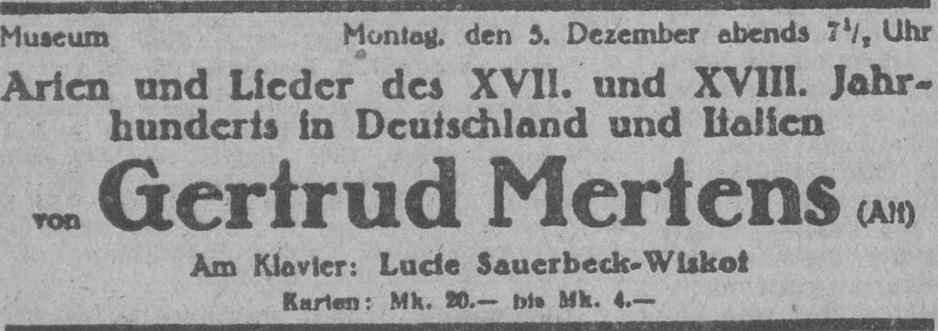
“17th- and 18th-century arias and songs in Germany and Italy by Gertrud Mertens (contralto)” Advertising box from the Münchner Neueste Nachrichten, December 3, 1921. Source: digiPress – The Newspaper Portal of the Bavarian State Library.
From Wrocław to Munich, in the name of ancient music (1883-1941)
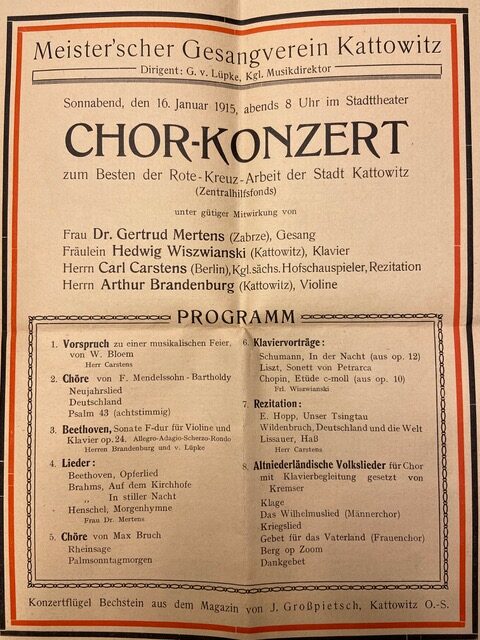
Poster for a concert by Gertrud Mertens in Katowice, 1915. Source: Archivio Hotel Tivoli Merano
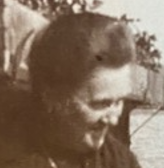
Gertrud Elisabeth Körber-Mertens was born in Wrocław (Prussia) on June 28, 1883, the eldest child of Elisabeth Broackhaus and Willibald Körber (27/05/1854 - 1/06/1920). The son of the lichenologist Wilhelm Körber (1818-1885), Willibald Körber was a high school professor in Wrocław and a scholar of classical philology. Elisabeth Broackhaus’ family was involved in the world of publishing (her father was the manager of the W.G. Korn bookstore in Wrocław). On May 26, 1888 their second child, Rudolf, was born; following in the footsteps of his paternal grandfather, Rudolf dedicated himself to botanical studies. He lost his life in March 1915 as a soldier in the Deutsches Heer during World War I.
Right from an early age, Gertrud Körber revealed a remarkable aptitude for music, which became the focus of her education and future professional life. She began studying piano with Max Auerbach (1872-1965) when she was six; in 1893, she became a student at the prestigious “Santa Maria Magdalena” lower secondary school in Wrocław. She continued her musical studies in Berlin, where, between 1900 and 1903, she attended courses in singing, piano, and composition at the Universität der Künste (University of the Arts). One of her professors was the Austrian singer Anna Schultzen von Asten (1848-1903), a further confirmation of the high level of her musical education.
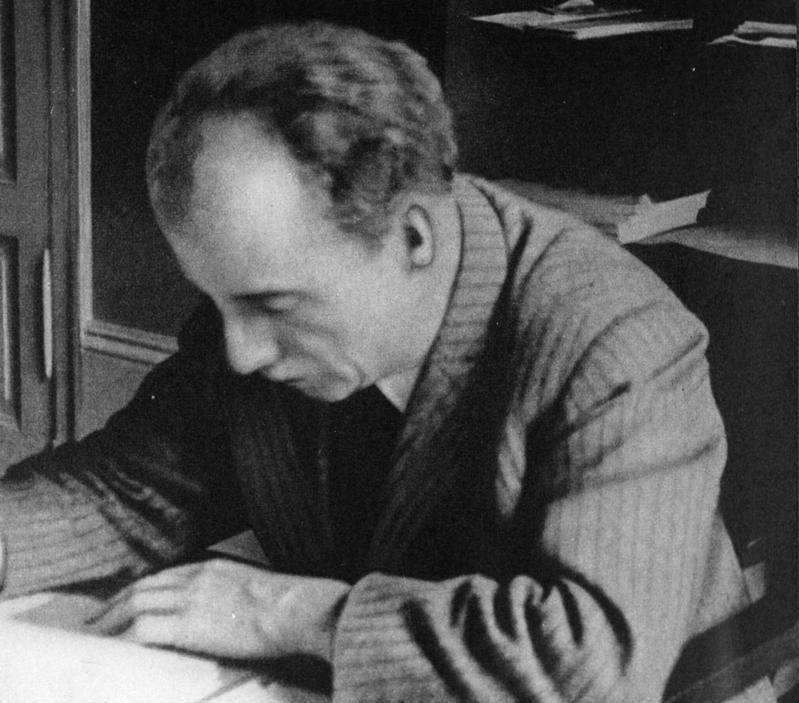
After receiving her degree, Gertrud Körber returned to Wrocław, where she began to frequent the city’s artistic and musical milieu. She met her future husband, Viktor Emmanuel Mertens (09/03/1875 - 12/07/1974), through her friend Johann Freiherr von Mikulicz-Radecki (1850-1905), an Austrian doctor and musicologist. Mertens, who was from Riga, was a surgeon; after completing his studies in Germany (Königsberg and Berlin), he moved to Wrocław in 1901 to work at the university hospital, where Mikulicz-Radecki was the chief physician of the surgical ward. Viktor and Gertrud married in 1907 and moved to Hindenburg (today, Zabrze, near Katowice), where Gertrud taught music and Viktor was the chief physician of the hospital. Then, in 1918, they moved to Munich; their apartment was located at Schönfeldstraße 10, in one of the most central neighborhoods of the city.
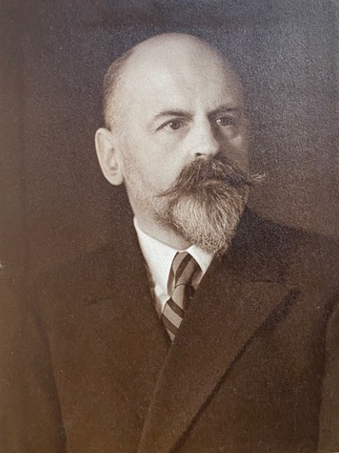
Viktor Mertens. Source: Archivio Hotel Tivoli Merano
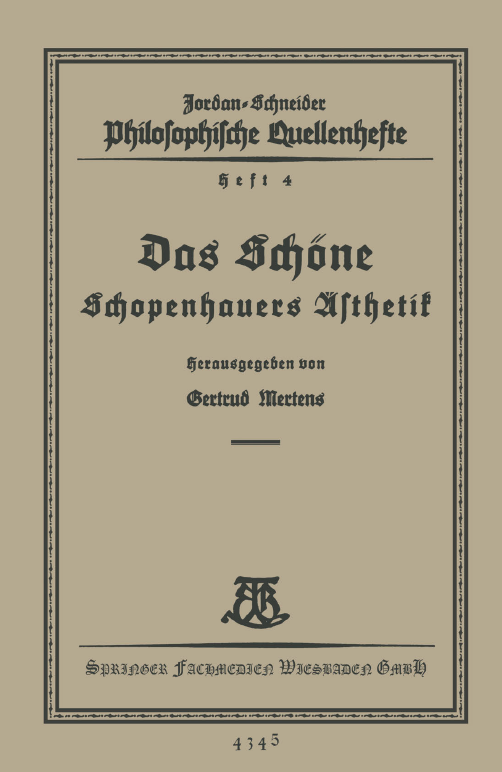
During the 1920s and ‘30s, the two consolidated their respective careers, establishing themselves as key exponents of Munich’s upper middle class and its intellectual circles, in particular the one that revolved around the Catholic magazine Hochland (founded in Munich in 1903 by Carl Muth). Viktor became the editor of the Münchener medizinische Wochenschrift (“Munich Medical Weekly Magazine”) and, thanks to his groundbreaking research, he became a world-class leader in cancer studies. Gertrud was a protagonist in the artistic-musical world, in Bavaria and Europe. She forged professional ties and became friends with people such as the musician Anna Barbara Speckner (1902-1995), the Greek philosopher and musicologist Thrasybulos Georgiades (1907-1977), the German actor and translator Sigismund von Radecki (1891-1970), the composer Carl Orff (1895-1982), the previously-mentioned author and editor Carl Muth (1867-1944), the author Theodor Haecker (1879-1945), and the scholar Katharina Kippenberg (1876-1947). Her name appeared in the local news both as a performer and in musicological literature, where she stood out as an expert in medieval and Renaissance music. This specialized interest – which reveals her father’s cultural legacy – also took her to Italy. In 1927, she edited Das Schöne: Schopenhauers Ästhetik ("Beauty: Schopenhauer’s aesthetics,” Vieweg und Teubner Verlag), a collection of essays by the German philosopher – who was one of her grandfather Gustav’s favorite authors – and wrote the book’s introduction. During the 1930s, she became an assistant of the renowned music theoretician Hans Kayser (1891-1964), with whom she planned to found the Thimus-Institut, a music institute based in Basel and named for Albert von Thimus (1806-1878). Mertens was to become the head of the ancient music department but the project was never completed.
Cover of the volume Das Schöne from 1927
Beatrice Dohme: the “rebellious” violinist
The Mertens had no children. Nonetheless, during the 1920s they became the guardians of the violinist Beatrice Dohme (1908-1986), the daughter of an important American pharmaceutical entrepreneur, Alfred Robert Louis Dohme (1867-1952). Beatrice was a rebellious spirit and her parents enrolled her in a strict private school run by nuns in Munich, but the girl soon escaped without a trace. Her music teacher Gertrud Mertens – whom she affectionately called “Frau Mimi” – took Beatrice under her wing and brought about a reconciliation between the girl and her family. The Mertens considered Beatrice a daughter and raised her as such; she lived with them in their apartment and dedicated herself to musical studies.
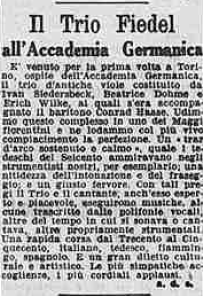
Detail from the 1930 Munich city directory. Listed at Schönfeldstraße 10, apartment 2, are Viktor E. Mertens, physician; Gertrud [Mertens], concert singer; and Beatrice Dohme, violinist. Source: Adressbuch für München und Umgebung (1930), p. 817.«La Stampa» Turin, 26 April 1942. Source: Archivio Storico La Stampa.
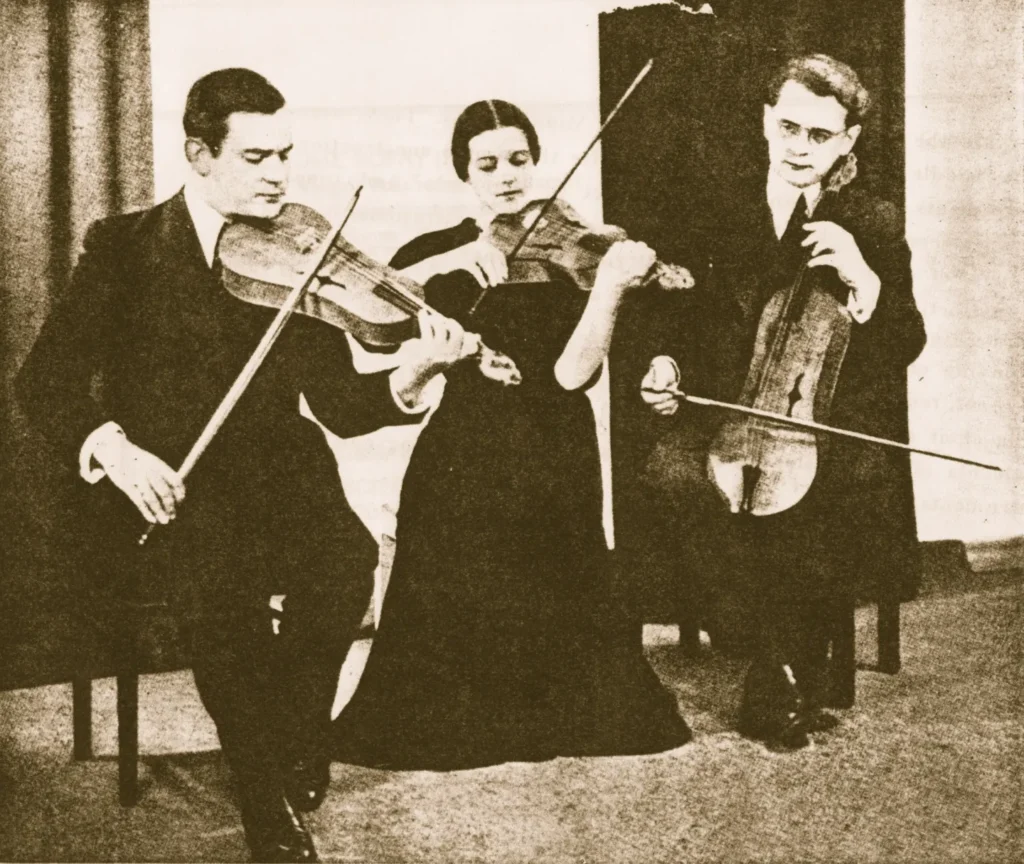
During the 1930s and 1940s, Beatrice Dohme emerged as a violinist of growing international reputation. With the Fiedel Trio – a group that also included Franz Sidersbeck, her future husband – she undertook long tours throughout the continent (including Italy), performing medieval and Renaissance music. The trio’s growing fame eventually attracted the attention of the Ministry of Culture of the Third Reich, which sponsored its activities for propaganda purposes during the war years.
From 1943 until the end of the war, Beatrice Dohme and her husband participated in various conspiratorial activities, hiding information for the Allies in the form of coded messages in the musical scores of the Fiedel Trio. Their collaboration with the Ministry of Culture not only provided an effective cover, it also let them extend their activities in the Resistance to the occupied territories – activity which consisted primarily in tracking down and hiding American pilots who had been shot down.
After the end of the war, Beatrice Dohme returned to the United States and continued her career as a violinist. In the 1970s, she was living in Merano (Italy), where she had moved to care for the Mertens, now elderly and in poor health. She died in 1986.
The Fiedel Trio: (from left) Franz Siedersbeck, Beatrice Dohme, and Erich Wilke. Courtesy of the Peck family.
Wednesdays at the Mertens and the creation of the White Rose (1942)
I met Scholl at the home of Dr. Mertens, at a soirée to which she had personally invited me. There were various young doctors and students present, as well as a number of older people who belonged to her circle. She read a short piece about religious renewal [religiöse Erneuerung] which sparked the dissent of the young people because it was, to a certain extent, unilateral and rather distant from reality. During the course of the discussion, heated disputes arose between the “North and South” factions, whose main representatives were Scholl (South) and a certain Dr. Ellermann [Heinrich Ellermann (1905-1991), author and editor]; I tried to build a bridge between the two positions. Both of them struck me as highly intelligent and we agreed to meet again.
Kurt Huber (1893-1943). Source: Wikimedia Commons/German Federal Archives
This is what Professor Kurt Huber wrote in his reply brief dated April 19, 1943, the day of the trial that would end with an accusation of subversion against him for having written and published anti-Nazi pamphlets for the Weiße Rose ("White Rose”). On July 13, he was executed by guillotine. The student and former Wehrmacht soldier Alexander Schmorell (1917-1943) was on the executioner’s block alongside him. A few months earlier, on February 22, three other young members of the group, Hans Scholl (1918-1943), Sophie Scholl (1921-1943), and Christoph Probst (1919-1943) were executed the same way.
In his reply brief, Huber referred to the literary soirée that was held on Wednesday, June 17, 1942 at the Mertens’ apartment at Schönfeldstraße 10. That is where the professor of philosophy and musicology at Munich’s “Ludwig Maximilian” University first encountered the medical student Hans Scholl, who, together with Schmorell, was the driving force behind the “White Rose.” It was a decisive moment in the history of the famous Resistance group that printed and distributed six anti-Nazi pamphlets in Munich between the summer of 1942 and February 1943.
During that period, the Mertens home, along with the studio of the architect Manfred Eickemeyer, was one of the main gathering places of Munich’s intellectual middle class. Artists, intellectuals, doctors, and scholars regularly met at Schönfeldstraße 10 to attend the cultural events that Gertrud Mertens organized, confirmation of her influence and renown in an intellectual circle that was extensive and, as we will see, politically inclined.
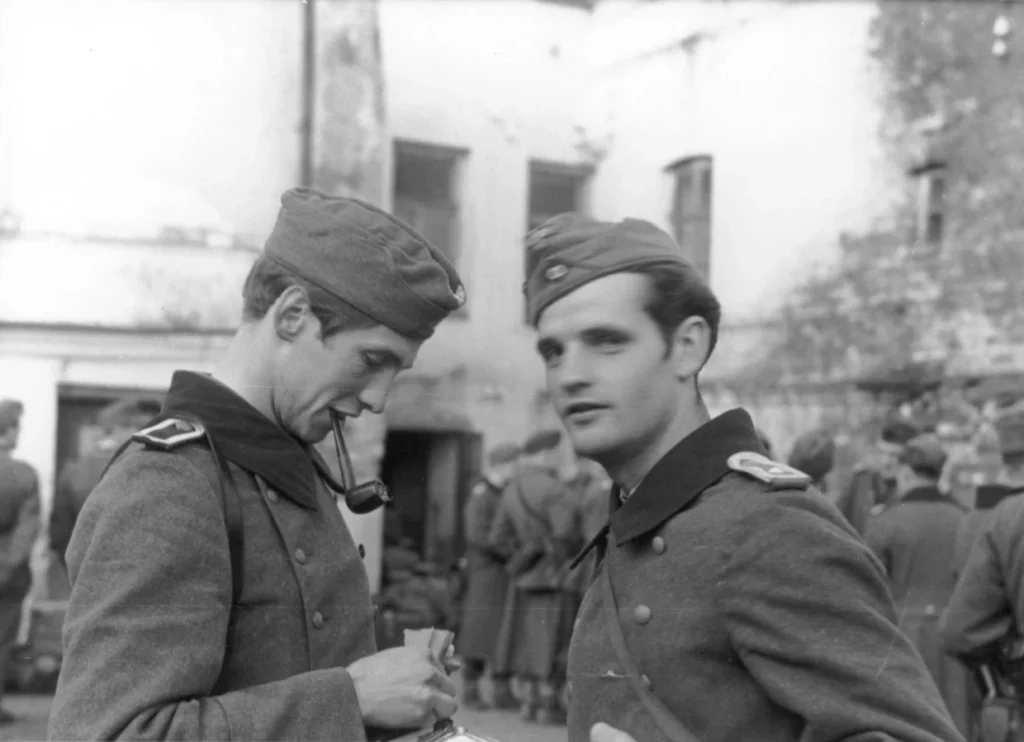
The get-together on June 17 was not the first. A literary evening at the Mertens home with the “White Rose” activists had already been held on the previous June 3 (also a Wednesday), at the behest of Gertrud and the medical student and musician Otmar Hammerstein (1917-2003), a friend of Beatrice Dohme. In fact, it was on that “Wednesday” that Scholl and Schmorell entered the apartment for the first time; the occasion was a reading by the eclectic Sigismund von Radecki. Guests included long-standing friends, such as Anna Barbara Speckner and her husband Thrasybulos Georgiades, as well as a close-knit group of young people, for the most part medical students who were not members of the Mertens’ usual circle but had been invited that evening by Hammerstein. The next day, one of them, Alexander Schmorell, reconstructed the events in detail in a letter to his friend Angelika Knopp:
IYesterday evening Radecki read out loud. Hans [Scholl] had asked him to. Unfortunately, it didn’t exactly go as we expected, at least on a formal level, I mean. We didn’t have a suitable space so Hammerstein offered us the apartment of Professor Mertens. Hans gladly accepted the invitation. But instead of limiting herself to putting her home at our disposal and maybe joining us to listen, Mrs. Mertens immediately felt she was the mother of the evening, and more: the primordial mother no less, the creator of a new philosophical-literary “circle” …
A program was immediately announced … And guess who else had been invited! (She invited some acquaintances on her own initiative! Demonstrating very little tact). Naturally, Mr. Amann [the sculptor Helmut Ammann (1907-2001)] with his entourage (his wife and Wolfgang Jakob [medical student]), from whose direction we constantly heard giggles and comments such as “marvelous, marvelous!” etc. Miss Speckner [Anna Barbara Speckner] sat next to them and spent the whole evening knitting (something that is very appropriate for her, a bit less so for a reading and Radecki)… Plus, on that side there were also Hammerstein, a Greek [Thrasybulos G. Georgiades], a certain Mr. Jäger [Herr Jäger, medical student]; on our side there were Christel [Christoph Probst], Furtwängler [Hubert Furtwängler, medical student, soldier, and a friend of Scholl and Schmorell’s], Sammiller [Raimund Sammüller, a friend of Scholl and Schmorell’s], Traute [Traute Lafrenz, a doctor and friend of Scholl’s], and Hans’ sister [Sophie Scholl]; Hans, too, of course. I was sitting in a corner, behind Furtwängler’s big armchair, so I was almost completely hidden
But let’s get to the actual reading.
First, he read two reflections, two sketches: The Child[Radecki, Ein Kind der Großstadt, 1929] and one that was a bit lighter, The Street [Radecki, Die Stimme der Straße, 1937]. In The Child he showed how deeply he can delve into a topic – in this case, children – and his ability to grasp and recognize so many essential facets. The Street reveals his splendid sense of observation and his descriptions cast a beautiful and profound light on what he observes.
Then he read the episode of Captain Kopejkin from Dead Souls[chapter 10 of the novel published in 1842 by Nikolai Gogol]. You are familiar with it and his reading was magnificent: in this, he is an extraordinary maestro. After a brief pause, during which we smoked abundantly in the living room – where smoking is normally prohibited – during the second part he read poetry, translations from Old French, and in particular many from Russian. I found the translations very good, excellent. One of the poems was his.
As soon as it was over, he disappeared almost on the run, followed by half of us. Hans came back home with us and we chatted and drank wine until midnight. He told us a lot of things about his life: he has been an actor, he has met many people who interested us, too, important men… When we parted ways, he thanked us for the pleasant evening; he sincerely liked everything. Originally, we wanted to have the get-together at my place but various things didn’t work out. For a while now, Hammerstein has been talking about a circle he would like to found. But if it’s going to be like yesterday, he has lost us. Either he comes here and abides by our program (which consists solely in a total absence of any program) or he’ll have to find himself some other people, other Amanns.
(From left) Alexander Schmorell and Hans Scholl, soldiers in 1942. Source: Wikimedia Commons.
Schmorell’s description gives us an outline of the personality of Gertrud Mertens, who at the time was fifty-eight years old. Not only an enthusiastic and hospitable hostess – “a tiny woman, extremely vivacious and inquisitive” – but also a scrupulous weaver of the intellectual relations that were taking form in her apartment. On the evening of June 3, Mertens agreed to host the Radecki conference devised by Hans Scholl and Otmar Hammerstein, but – and this is what irritated Schmorell – she made sure to invite her own circle, too, which was closer to her in age and, as mentioned above, culturally anchored to the so-called Hochlandkreis. The descriptions of that evening – today, a crucial passage in the historiographical literature about the White Rose – report the rift that was created among the guests. Although they shared the same Christian and cultural heritage (for the most part Catholic and Protestant, with the exception of Schmorell, who was Orthodox) and an aversion to Hitler’s regime that was typical of certain associations (such as Guardini’s Quickborn), in Schmorell and his friends’ opinion, Mertens’ group – and this explains her attempt to steer the debate – seemed unwilling to transform the evening’s rigid literary and philosophical “program” into an occasion for a freer and more productive political discussion. In fact, this latter aspect was the true objective of the “Scholls’ circle,” as Mertens would come to call them. Primarily as a result of the military experience of a number of them on the eastern front, for a while they had been contemplating the idea of dissident activity that was much more incisive than the cautious, wait-and-see spiritual resistance promoted by the “Hochland circle.”
This is the context underlying the soirée on June 17, which was attended by the same guests – except for Schmorell, who refused to participate, and with the addition of Katharina Schüddekopf (1916-1992), one of Kurt Huber’s PhD students. Organized once again by the Mertens-Hammerstein duo, the program included a talk by Professor Huber. Once again, Mertens attempted to dictate the line of the debate, reading a political and spiritual text she had written on the topic of “religious renewal.” Nonetheless, the discussion inevitably took a political turn: “What is to be done?” was the question that soon dominated the discussion. The editor Ellermann (in his reply brief in 1943, Huber placed him among the exponents of the “North” front, or rather the supporters of strictly internal resistance), took a position against the idea of active resistance, encouraging the younger guests to take advantage of their studies to expand and strengthen their conscience. Hans Scholl (the “South” front, i.e., the young people eager to take action), rebutted sarcastically: “Shall we rent an island in the Aegean sea and take ideological courses?” That is when he found himself in agreement with Huber, who did not hesitate to support the student’s enthusiasm: “We must act, and right away, already today.”
The understanding that developed between Hans Scholl and Kurt Huber on June 17 at the Mertens home marked the beginning of the events that initiated with the writing and printing of the six White Rose pamphlets during the summer-fall of 1942 and culminated with the arrest of the Scholl brothers in the entrance hall of the University of Munich the following year in February. The “bridge” Huber built between the two positions, North-internal resistance and South-external resistance, took form in the non-violent and ethical character of the White Rose’s actions. Many of the people present at these two encounters, including the hosts, were interrogated by the Gestapo. Katharina Schüddekopf and Traute Lafrenz (1919-2023) were sentenced to one year in prison for having been “aware of anti-Nazi propaganda but not reporting it” (Propagandaabsichten gewußt, das aber nicht angezeigt). Thanks to Viktor’s renown, the Mertens were able to avoid the accusation of conspiracy.
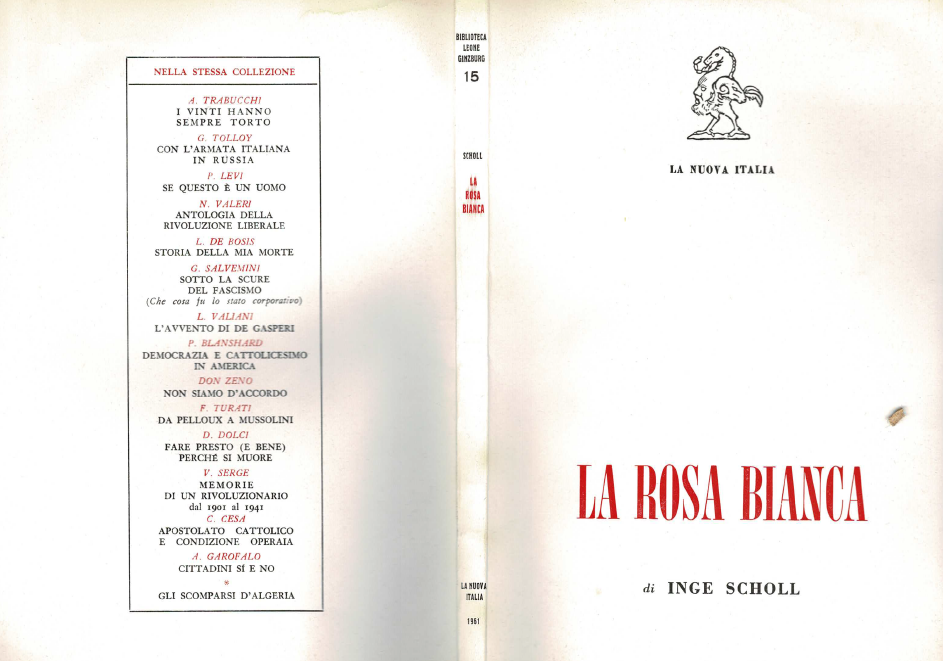
Cover and back cover of The White Rose by Inge Scholl, sister of Sophie and Hans. The volume was first published in Germany in 1952. It was translated into Italian by the publisher La Nuova Italia in 1959, and subsequently reprinted in April 1961. The book appeared in the series Biblioteca Leone Ginzburg, the same series in which De Silva (acquired by La Nuova Italia in 1948) had published If This Is a Man in 1947.
The “Clairvoyant” from Lake Starnberg (1943-1973)
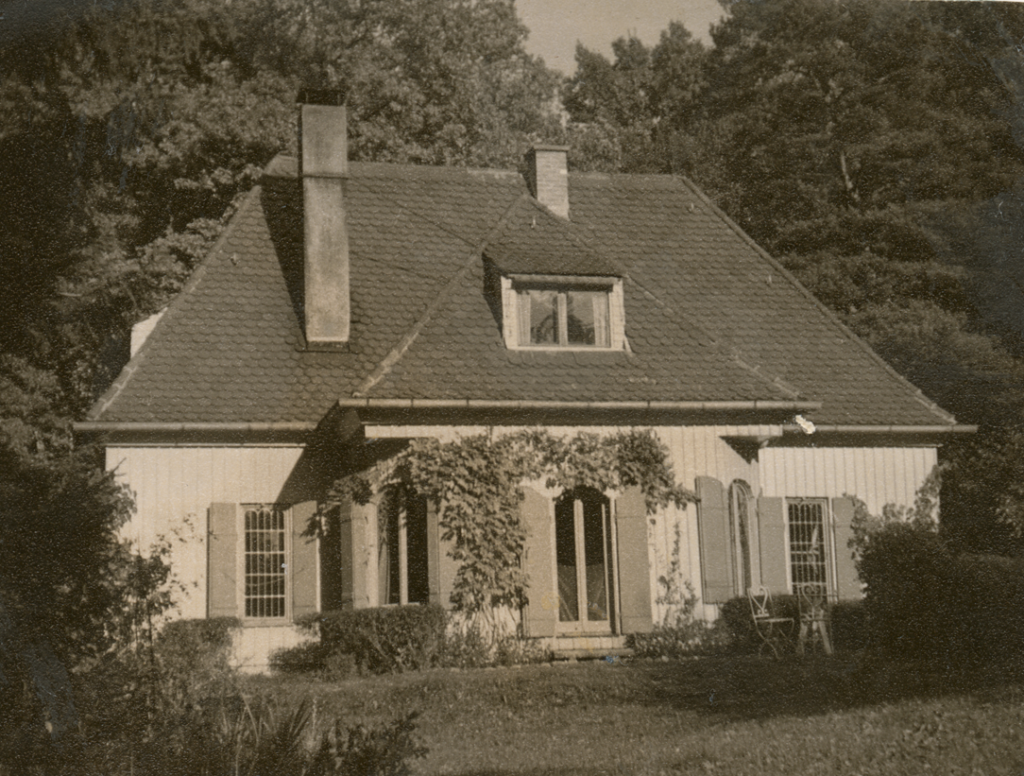
As the war and the bombing raids intensified, the Mertens, with the help of their daughter Beatrice Dohme, left Munich and rented a house on the banks of Lake Starnberg at Assenbuch 5-1/2 (today, Assenbucherstraße 77, Berg). In 1945, the Mertens purchased a house on the Way of the Cross (Kreuzweg) on Lake Starnberg, at Maxhöhe 11-1/2 (since 1965, known as Himbselweg 14, Berg). It was there that in December 1961, at 78 years of age, Gertrud Mertens read and was struck by Ist das ein Mensch? (published in November), and wrote to Primo Levi.
Gertrud Mertens' house in 1961. Source: Deutsches Literaturarchiv Marbach.
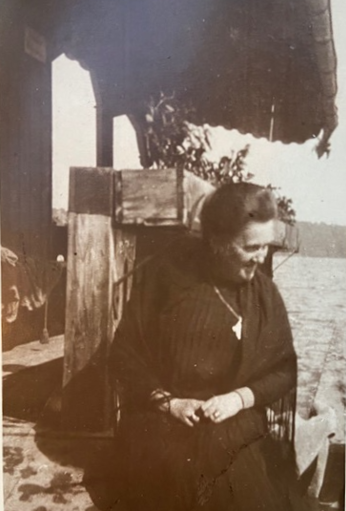
Over the course of the next twenty years, Gertrud Mertens continued to cultivate her philosophical-musical interests, organize cultural soirées, and foster relations with important intellectuals of the time. For example, during this period she corresponded with the Catholic author Gertrud von Le Fort (1876-1971) and frequented the Jesuit theologist Eric Przywara (1889-1972). Reminiscences by Alberto Pescetto, an expert in Slavic studies who was a regular guest at Haus Mertens, have provided us with a rare portrait of Gertrud – whom he affectionately called Madame “la Grande Gnosis” or the Mystic of the North – during the final years of her life:
The Mystic of the North is almost blind [...], ah how can I describe the person! Elderly, stately, and yet small in stature, with large gold and silver pectoral crosses like the Patriarch Jeremiah, stupendous, adorable, and with an inexhaustible discourse [...]. After twelve operations, she only reads Origen and, at 82 years of age, is writing a treatise on "Metaphysics in History".
Gertrud Mertens in the 1970s Source: Archivio Hotel Tivoli Merano.
Gertrud Mertens died on 19 August 1973 in Merano, where she is buried alongside her husband, Viktor Mertens, and Beatrice Dohme.
References and bibliography
Although the bibliography on the White Rose has grown considerably, information on Gertrud Mertens remains sparse and fragmentary.
Biographical information is drawn from: E. H. Müller (ed.), Deutsches Musiker-Lexicon, Wilhelm Limpert-Verlag, Dresden 1929, p. 538; Dr. Baer, Willibald Körber in «Der Wanderer im Riesengebirge: Organ des Riesengebirgs Vereins», 1/08/1921, pp. 51–52; R. Körber, Beiträge zur Blattanatomie der Gattung Hevea, W. G. Korn, Breslau 1911, p. 67; J. K. Ries, In memoriam V. E. Mertens, in «MMW. Münchener medizinische Wochenschrift», vol. 116, no. 48 (1974), pp. 2137–2138; Hans Kayser Archive (https://ead.nb.admin.ch/html/kayser_B.html); Sophie Drinker Institute Bremen, Friedel Collection, Folder VII; N. Hammerstein, Aus dem Freundeskreis der „Weißen Rose” Otmar Hammerstein – Eine biographische Erkundung, Wallstein Verlag, Göttingen 2014, pp. 64–65; P. Ghezzi, La Rosa Bianca. La resistenza al nazismo in nome della libertà, San Paolo, Milan 1994, p. 152; W. Huber, Die Weisse Rose. Kurt Hubers letzte Tage, Herbert Utz Verlag, Munich 2018, pp. 35–36; A. Schmorell and C. Probst, Gesammelte Briefe, ed. C. Moll, Lukas Verlag, Berlin 2011, pp. 476–477; F. Pescetto, Il pistolero della parola. La stravagante vita di Alberto Pescetto, Fogli di Via Libri, Genoa 2019 (with thanks to Federico Pescetto for sharing documents).
For significance of Viktor Mertens’ oncological research during the Nazi regime, see R. N. Proctor, The Nazi War on Tobacco: Ideology, Evidence, and Possible Cancer Consequences, in «Bulletin of the History of Medicine», 3/1997, pp. 445–447.
For information on Beatrice Dohme’s life, see the account An American Heroine by Gloria Peck, granddaughter of Beatrice Dohme. The text is available at: https://ninedecadesofliving.wordpress.com/2015/09/11/an-american-heroine-episode-one/. The great-grandchildren of Beatrice Dohme, Louisa and Neil Peck, are gratefully acknowledged for sharing this information. See also F. Dohme Cockey, The Dohme Family 1244-1986, G+G Printers, Phoenix 1987, pp. 253-256.
Correspondence of Gertrud Mertens with Gertrud von Le Fort and Katharina Kippenberg is held at the Deutsches Literaturarchiv, Marbach.
The following research on the life of Gertrud Mertens would not have been possible without the generous support of many German and Italian archivists and scholars. The LeviNeT team wishes to thank:
Alexandre Bischofberger (Sophie Drinker Institut)
Carl Defranceschi (Hotel Tivoli, Merano, Italy)
Judith Ennemoser (Stadtfriedhof - Municipal Cemetery, Merano, Italy)
Christian Freundorfer (Stadtarchiv München)
Anna Haas (Bayerische Staatsbibliothek)
Karen Käßner-Franz (Stadtarchiv München)
Hildegard Kronawitter (Weiße Rose Stiftung, München)
My best friend, Alberto Pescetto, who has just spent two months with us, wanted to take the letter with him when he left. But now everything is delayed, so I entrust it to the kindness of Anita Rho, who will help you read it.
The conclusion of the letter Gertrud Mertens wrote to Primo Levi shows how capillary her network of contacts was in the panorama of European intellectuals. The reference to Anita Rho, an important translator from German who Levi met at De Silva in 1947, is proof of a direct channel of communication between the two correspondents. This final passage of the letter reveals that Anita Rho was one of the many intellectuals who were regular guests at the Mertens home on Lake Starnberg. This detail allows us to surmise that besides the letter, Levi also received a description of the uncommon Mrs. Mertens. Even though the correspondence with Gertrud Mertens only numbers one letter, what she wrote in early December 1961 represents not only one of the first documented reactions after the publication in Germany of Ist das ein Mensch?, it was also one of the most sophisticated theoretical elaborations of German “guilt” Levi received during that period. Mertens’ letter is, in fact, similar to a short treatise, six pages written in longhand; it deals with topics such as the philosophy of history, the relationship between the human being and the Revelation, the “banalization” of Prometheus, and, obviously, the historical and moral tragedy of the Third Reich. With regard to this latter aspect, Mertens’ letter offers extremely interesting interpretive food for thought. The first part of her letter is dedicated to the topic of Blindheit, or rather, the blindness of the German people in the face of the horrors of the Nazi regime. Mertens declares she was aware of these horrors, giving the impression that, at the time, she was spurred to “pass these monstrous ‘truths’ on to others.” To this regard, the present biography brings to light a kind of discretion when she shares with Levi her involvement in the actions of the White Rose.
Ah, dear Mr. Levi, if only one could “understand” it oneself! Everything that was “reality”? (we ourselves, in one of the many resistance groups, passed hard by the gallows)Ah, dear Mr. Levi, if only one could “understand” it oneself! Everything that was “reality”? (we ourselves, in one of the many resistance groups, passed hard by the gallows).
As proof of Mertens’ intellectual stature, these first lines present an interesting overlapping of cultural and philosophical cross references. In fact, she combines the verses of Matthew 13 with the ethical-political analyses of The Question of German Guilt by Karl Jaspers. A pairing - between theology and philosophy, transcendence and immanence - that defines the thematic structure of the entire letter Mertens wrote. Far from being a display of erudition, the biblical-philosophical convergence helps, above all, to build a bridge with the author of If This Is a Man. In the chapter “The Drowned and the Saved,” Levi himself had inserted a very well-known evangelical adage: “To he who has, it will be given; from he who has not, it will be taken away.” Present in all three Synoptic Gospels (Matthew 13:10-13 and 25:29; Mark 4:24-25; Luke 8:16-18 and 19:11-26), this quote becomes the expression of the “fierce law” in history and life. In the notes of the scholastic edition of Se questo è un uomo (If This Is a Man), published in 1973, Levi does not indicate the exact provenance of the quote. But Mertens, a deeply Catholic intellectual, did not fail to grasp the cogent parallelism between the use of that verse within the context of Auschwitz testimony and the unusual meaning the verse acquires in Matthew 13:10-15.
The disciples came to him and asked, “Why do you speak to the people in parables?” He replied, “Because the knowledge of the secrets of the kingdom of heaven has been given to you, but not to them. Whoever has will be given more, and they will have an abundance. Whoever does not have, even what they have will be taken from them. This is why I speak to them in parables: Though seeing, they do not see; though hearing, they do not hear or understand. In them is fulfilled the prophecy of Isaiah: You will be ever hearing but never understanding; you will be ever seeing but never perceiving. For this people’s heart has become calloused; they hardly hear with their ears, and they have closed their eyes. Otherwise, they might see with their eyes, hear with their ears, understand with their hearts and turn, and I would heal them.
The “desperate” report about the concentration camp at Maly Trostenets that she probably heard during one of her literary evenings in 1942 thus became the “negative parabola” which revealed to the world the “truth” about an evil that most people refused to see. Because, and this is the thesis Mertens develops throughout the rest of her letter, the concentration camp was not only proof of the criminal face of Nazism, it was also the epiphany of the radical evil that dwells in the psychological depths of the human soul. Mertens’ letter reveals a nuance of that Gospel quote in “The Drowned and the Saved” which, until then, had never been mentioned in studies regarding Primo Levi. Her perceptive remark reveals a Catholic sensitivity to the topic of the Shoah which the author of Ist das ein Mensch? would encounter on several occasions during the course of his correspondence with German readers.