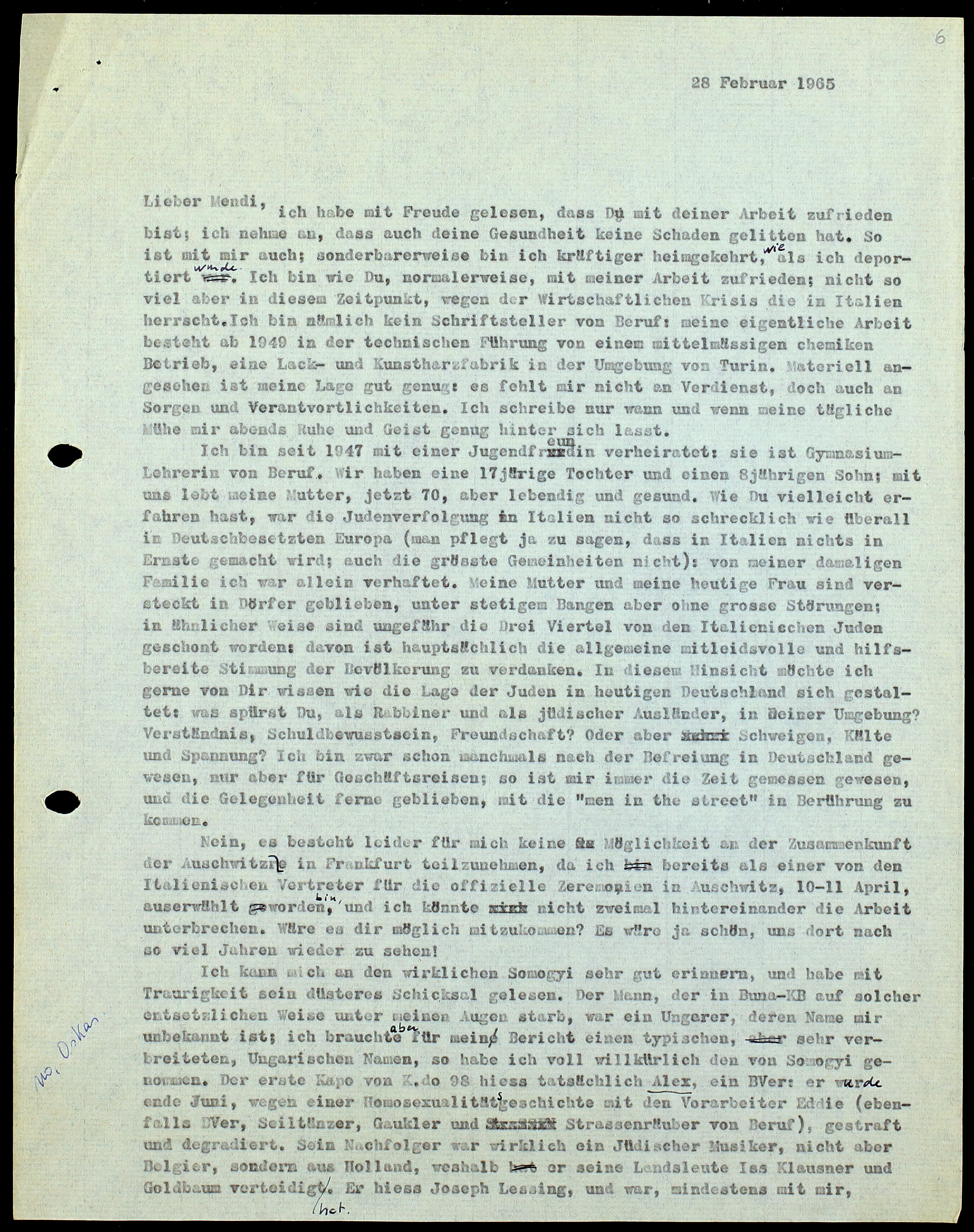
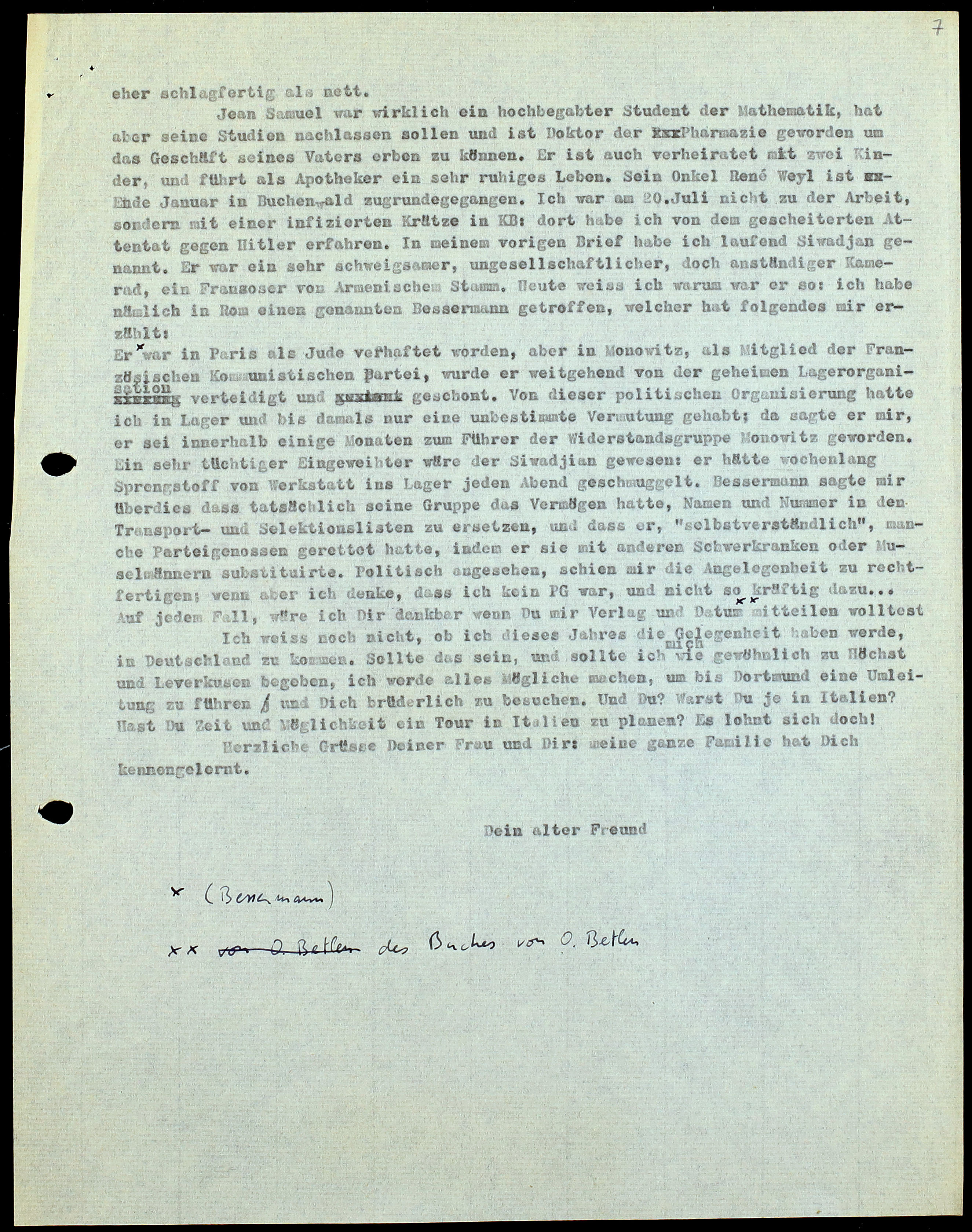
In this letter, Levi talks about himself and his family, and also continues to share memories about the Lager and information about the fate of their companions. He informs Davidovic that he will not be able to attend the reunion of Auschwitz survivors in Frankfurt.
ich habe mit Freude gelesen, dass Du mit deiner Arbeit zufrieden bist; ich nehme an, dass auch deine Gesundheit keine Schaden gelitten hat. So ist mit mir auch; sonderbarerweise bin ich kräftiger heimgekehrt, wie als ich deportiert wurde.[1]Ich bin wie Du, normalerweise, mit meiner Arbeit zufrieden; nicht so viel aber in diesem Zeitpunkt, wegen der Wirtschaftlichen Krisis die in Italien herrscht. Ich bin nämlich kein Schriftsteller von Beruf: meine eigentliche Arbeit besteht ab 1949 in der technischen Führung von einem mittelmässigen chemiken Betrieb, eine Lack- und Kunstharzfabrik in der Umgebung von Turin. Materiell angesehen ist meine Lage gut genug: es fehlt mir nicht an Verdienst, doch auch an Sorgen und Verantvortlichkeiten. Ich schreibe nur wann und wenn meine tägliche Mühemir abends Ruhe und Geist genug hinter sich lasst.
Ich bin seit 1947 mit einer Jugendfreundin[2] verheiratet: sie ist Gymnasium-Lehrerin von Beruf. Wir haben eine 17järige Tochter und einen 8jährigen Sohn; mit uns lebt meine Mutter, jetzt 70, aber lebendig und gesund. Wie Du vielleicht erfahren hast, war die Judenverfolgung in Italien nicht so schrecklich wie überall in Deutschbesetzten Europa (man pflegt ja zu sagen, dass in Italien nichts in Ernste gemacht wird; auch die grösste Gemeinheiten nicht)[3]: von meiner damaligen Familie ich war allein verhaftet. Meine Mutter und meine heutige Frau sind versteckt in Dörfer geblieben, unter stetigem Bangen aber ohne grosse Störungen; in ähnlicher Weise sind ungefähr die Drei Viertel von den Italienischen Juden geschont worden: davon ist hauptsächlich die allgemeine mitleidsvolle und hilfsbereite Stimmung der Bevölkerung zu verdanken. In diesen Hinsicht möchte ich gerne von Dir wissen wie die Lage der Juden in heutigen Deutschland sich gestaltet: was spürst du, als Rabbiner und als jüdischer Ausländer, in deiner Umgebung?Verständnis, Schuldbewusstsein, Freundschaft? Oder aber Schweigen, Kälte und Spannung? Ich bin zwar schon manchmals nach der Befreiung in Deutschland gewesen, nur aber für Geschäftsreisen; so ist mir immer die Zeit gemessen gewesen, und die Gelegenheit ferne geblieben, mit die «men in the street» in Berührung zu kommen.[4]
Nein, es besteht leider für mich keine Möglichkeit an der Zusammenkunft der Auschwitzer[5] in Frankfurt teilzunehmen, da ich bereits als einer von den Italienischen Vertreter für die offizielle Zeremonien in Auschwitz, 10-11 April, auserwählt worden bin,[6] und ich könnte nicht zweimal hintereinander die Arbeit unterbrechen. Wäre es dir möglich mitzukommen? Es wäre ja schön, uns dort nach so viel Jahren wieder zu sehen!
Ich kann mich an den wirklichen Somogyi sehr gut erinnern, und habe mit Traurigkeit sein düsteres Schicksal gelesen. Der Mann, der in Buna-KB auf solcher entsetzlichen Weise unter meinen Augen starb, war ein Ungerer, deren Name mir unbekannt ist; ich brauchte aber[7] für mein Bericht einen typischen, sehr verbreiteten, Ungarischen Namen, so habe ich voll willkürlich den von Somogyi genommen.[8] Der erste Kapo von Kommando 98 hiess tatsächlich Alex,[9] ein Berufsverbrecher: er wurde[10] ende Juni, wegen einer Homosexualitätsgeschichtemit den Vorarbeiter Eddie (ebenfalls Berufsverbrecher, Seiltänzer, Gaukler und Strassenräuber von Beruf), gestraft und degradiert.[11] Sein Nachfolger war wirklich ein Jüdischer Musiker, nicht aber Belgier, sondern aus Holland, weshalb er seine Landsleute Iss Klausner[12] und Goldbaum[13] verteidigt hat.[14] Er hiess Joseph Lessing, und war, mindestens mit mir, eher schlagfertig als nett.[15]
Jean Samuel war wirklich ein hochbegabter Student der Mathematik, hat aber seine Studien nachlassen sollen und ist Doktor der Pharmazie geworden um das Geschäft seines Vaters erben zu können. Er ist auch verheiratet mit zwei Kinder, und führt als Apotheker ein sehr ruhiges Leben. Sein Onkel René Weyl ist Ende Januar in Buchenwald zugrundegegangen. Ich war am 20. Juli nicht zu der Arbeit, sondern mit einer infizierten Krätze in KB: dort habe ich von dem gescheiterten Attentat gegen Hitler erfahren. In meinem vorigen Brief habe ich laufend Siwadjan genannt. Er war ein sehr schweigsamer, ungesellschaftlicher, doch anständiger Kamerad, ein Franzoser von Armenischen Stamm. Heute weiss ich warum war er so: ich habe nämlich in Rom einen genannten Bessermann getroffen, welcher hat folgendes mir erzählt:
Er[16] war in Paris als Jude verhaftet worden, aber in Monowitz, als Mitglied der Französischen Kommunistischen Partei, wurde er weitgehend von der geheimen Legerorganisation verteidigt und geschont. Von dieser politischen Organisierung hatte ich in Lager und bis damals nur eine unbestimmte Vermutung gehabt; da sagte er mir, er sei innerhalb einige Monaten zum Führer der Widerstandsgruppe Monowitz geworden. Ein sehr tüchtiger Eingeweihter wäre der Siwadjian gewesen: er hätte wochenlang Sprengstoff von Werkstatt ins Lager jeden Abend geschmuggelt. Bessermann sagte mir überdies dass tatsächlich seine Gruppe das Vermögen hatte, Namen und Nummer in den Transport- und Selektionslisten zu ersetzen, und dass er, «selbstverständlich», manche Parteigenossen gerettet hatte, indem er sie mit anderen Schwerkranken oder Muselmännern substituirte. Politisch angesehen, schien mir die Angelegenheit zu rechtfertigen: wenn aber ich denke, dass ich kein Parteigenosse war, und nicht so kräftig dazu… Auf jedem Fall, wäre ich Dir dankbar wenn Du mir Verlag und Datum des Buches von O. Betlen[17] mitteilen wolltest[18]
Ich weiss noch nicht, ob ich dieses Jahres die Gelegenheit haben werde, in Deutschland zu kommen. Sollte das sein, und sollte ich mich[19] wie gewöhnlich zu Höchst und Leverkusen begeben, ich werde alles Mögliche machen, um bis Dortmund eine Umleitung zu führen und Dich brüderlich zu besuchen. Und Du? Warst Du je in Italien? Hast Du Zeit und Möglichkeit ein Tour in Italien zu planen? Es lohnt sich doch!
Herzliche Grüsse Deiner Frau und Dir: meine ganze Familie hat Dich kennengelernt.
Dein alter Freund
28 febbraio 1965
Caro Mendi,
leggo con piacere che sei soddisfatto del tuo lavoro; immagino che anche la tua salute non abbia risentito di nulla. È stato così anche per me; stranamente sono tornato a casa più forte di quando sono stato deportato.[1] Anch’io, in linea di massima, sono soddisfatto del mio lavoro; un po’ meno in questo periodo a causa della crisi economica che imperversain Italia. In realtà non sono uno scrittore di professione; dal 1949 il mio vero lavoro consiste nella direzione tecnica di un’azienda chimica di medie dimensioni, una fabbrica di vernici e resine sintetiche nei dintorni di Torino. Dal punto di vista materiale la mia condizione è abbastanza buona: non mi mancano i guadagni, ma nemmeno le preoccupazioni e le responsabilità. Scrivo soltanto se e quando, a sera, le fatiche quotidiane mi lasciano tranquillità e lucidità sufficienti.
Dal 1947 sono sposato con un’amica d’infanzia[2] che insegna al liceo. Abbiamo una figlia di diciassette anni e un figlio di otto; con noi vive anche mia madre, che ora ha settant’anni ma è ancora piena di energie e insalute. Come forse saprai, la persecuzione degli ebrei in Italia non è stata così terribile come nel resto dell’Europa occupata dai tedeschi (si usa dire che in Italia nulla viene fatto sul serio, nemmeno le peggiori infamie)[3]: della mia famiglia di allora, sono stato l’unico a essere arrestato. Mia madre e la mia attuale moglie sono rimaste nascoste in campagna, vivendo in continua apprensione ma senza subire gravi conseguenze; allo stesso modo si è salvato circa l’ottanta per cento degli ebrei italiani, e di ciò bisogna ringraziare soprattutto l’atteggiamento generalmente compassionevole e solidale della popolazione. A questo proposito, mi piacerebbe molto sapere da te qual è oggi la condizione degli ebrei in Germania: cosa avverti intorno a te, come rabbino e come ebreo straniero? Comprensione, consapevolezza della colpa, amicizia? O piuttosto silenzio, freddezza e tensione? Dopo la liberazione sono stato in Germania diverse volte, ma solo per viaggi di lavoro, sempre con il tempo contato, e non ho mai avuto l’occasione di entrare in contatto con la “gente comune”.[4]
Purtroppo no, non ho alcuna possibilità di partecipare all’incontro dei compagni di Auschwitz[5] a Francoforte, perché sarò già[6] tra i rappresentanti italiani alle cerimonie ufficiali ad Auschwitz il 10 e l’11 aprile, e non posso assentarmi due volte dal lavoro in così breve tempo. E tu riusciresti a venire? Sarebbe davvero bello rivederci laggiù dopo tutti questi anni.
Mi ricordo benissimo del vero Somogyi e ho letto con tristezza del suo tragico destino. L’uomo che morì sotto i miei occhi nell’infermeria di Buna in quel modo atroce era un ungherese di cui non conoscevo il nome; per il mio racconto avevo però bisogno[7] di un nome ungherese tipico e molto diffuso, e così ho scelto del tutto arbitrariamente quello di Somogyi.[8] Il primo Kapo del Kommando 98 si chiamava davvero Alex,[9] un triangolo verde alla fine di giugno fu[10] punito e degradato per una vicenda di omosessualità che coinvolgeva anche il caposquadraEddie (anche lui un criminale, di mestiere funambolo, saltimbanco e borseggiatore).[11] Il suo successore fu davvero un musicista ebreo, non belga ma olandese, motivo per cui i suoi connazionali Iss Klausner[12] e Goldbaum[13]li difendeva[14] Si chiamava Joseph Lessing e, almeno con me, era più manesco che gentile.[15]
Jean Samuelera davvero uno studente di matematica di straordinario talento, ma aveva dovuto interrompere gli studi e laurearsi in farmacia per poter rilevare l’attività del padre. Anche lui è sposato, ha due figli e vive una vita molto tranquilla svolgendo il suo mestiere. Suo zio René Weyl è morto a Buchenwald, alla fine di gennaio. Il 20 luglio io non ero al lavoro, ma ricoverato al Ka-Be con una scabbia complicata da un’infezione; ed è lì che sono venuto a sapere del fallito attentato contro Hitler. Nella mia lettera precedente ho nominato di sfuggitaSiwadjan. Era un compagno molto taciturno e poco socievole, ma perbene; un francese di origine armena. Oggi so perché fosse così. A Roma, infatti, ho infatti incontrato un certo Bessermann, che mi ha raccontato quanto segue.
Bessermann[16] era stato arrestato a Parigi in quanto ebreo, ma, come membro del partito comunista francese, una volta a Monowitz era stato ampiamente protetto e favorito dall’organizzazione clandestina di resistenza del campo. Fino ad allora, io avevo avuto solo una vaga ideadell’esistenza di questa organizzazione politica nel Lager;mentre lui, mi ha detto, era diventato nel giro di pochi mesi il capo del gruppo. Siwadjan era uno dei membri più capaci: ogni sera, per settimane, aveva fatto entrare di nascostonel campo un po’ diesplosivo proveniente dalla fabbrica. Bessermann mi ha anche raccontato che il suo gruppo aveva effettivamente il potere di sostituire nomi e numeri sulle liste dei trasporti e delle selezioni e che, «naturalmente», aveva salvato parecchi compagni di partito, rimpiazzandoli con altri gravemente malati o con dei Muselmänner. Dal punto di vista politico, la cosa mi sembrògiustificabile; ma se penso che io non ero iscritto al partito e in più non ero neppure tanto robusto… In ogni caso ti sarei grato se potessi indicarmi l’editore e la data[17] del libro di O. Betlen.[18]
Non so ancora se quest’anno avrò occasione di venire in Germania. Se dovesse accadere, e se, come al solito, dovessi passare[19] da Höchst e da Leverkusen, farò tutto il possibile per fare una deviazione fino a Dortmund e venirti a trovare da fratello a fratello. E tu? Sei mai stato in Italia? Hai tempo e possibilità di programmare un viaggio da queste parti? Ne vale la pena, credimi!
Cari saluti a te e a tua moglie: tutta la mia famiglia ormai ti conosce.
Il tuo vecchio amico
February 28, 1965
Dear Mendi,
I was pleased to read that you are satisfied with your work; I assume your health has not suffered either. The same goes for me; strangely enough, I returned home stronger thanwhen I was deported.[1]Like you, I am usually satisfied with my work; not so much at the moment, however, due to the general economic crisis in Italy. I am, after all, not a professional writer: since 1949, my actual job has been the technical management of a medium-sized chemical plant—a paint and synthetic resin factory in the Turin area. From a material standpoint, my situation is good enough: I have no shortage of income, nor of worries and responsibilities either. I write only when my daily labors leave me with enough peace and mental clarity in the evenings.
I have been married to a childhood friend[2]since 1947: she is a high school teacher by profession. We have a 17-year-old daughterand an 8-year-old son; my mother, now 70 but still lively and healthy, lives with us. As you may have heard, the persecution of Jews in Italy was not as terrible as it was throughout German-occupied Europe (people tend to say that nothing is taken seriously or done in earnest here in Italy—not even the most heinous acts):[3] of my family at the time, I was the only one arrested. My mother and my now wife remained in hiding in villages, living in constant fear but without major disturbances; in a similar way, about three-quarters of Italian Jews were spared: this is mainly due to the general atmosphere of compassion and willingness to help among the population. In this regard, I would like to ask you about the situation of Jews in Germany today: what do you pick up on, as a rabbi and as a Jewish foreigner, in your surroundings?Understanding, a sense of guilt, friendship? Or rather silence, coldness, and tension? Although I have been to Germany several times since liberation, it has only been for business trips; thus, my time has always been limited, and I have never had the opportunity to come into contact with the average, ordinary “men in the street.”[4]
No, unfortunately, there is no way for me to attend the Auschwitz survivors’[5]gathering in Frankfurt, since I have already been chosen to be one of the Italian representatives for the official ceremonies in Auschwitz on April 10–11,[6]and I cannot take back-to-back time off of work. Would it be possible for you to come along then? It would be so nice to see each other there again after so many years!
I remember the real Somogyivery well, and I read about his grim fate with sadness. The man who died in such a horrific manner before my eyes at Buna-KB was a Hungarian whose name I do not know; however,[7]I needed a typical, very common Hungarian name for my report, so I chose Somogyi’s name entirely at random.[8] The first Kapo of Kommando 98 was actually named Alex,[9]a career criminal: he was[10]punished and demoted at the end of June because of a homosexuality scandal involving the foreman Eddie (also a BV, a tightrope walker, juggler, and highway robber by trade).[11] His successor was indeed a Jewish musician, but not Belgian—he was from the Netherlands, which is why he defended his compatriots Iss Klausner[12] and[13]Goldbaum.[14]His name was Joseph Lessing, and—at least with me—he was more quick-witted than friendly.[15]
Jean Samuel really was a highly gifted mathematics student, but he was expected to put his studies on hold and became a Doctor of Pharmacy so that he could inherit his father’s business. He is married with two children and leads a very quiet life as a pharmacist. His uncle, René Weyl, perished in Buchenwald at the end of January. On July 20, I was not at work; instead, I was at the infirmary with an infected case of scabies: that’s where I learned about the failed assassination attempt on Hitler. In my previous letter, I mentioned Sivadjan several times. He was a very taciturn, unsociable, yet decent comrade—a Frenchman of Armenian descent. I now know why he was that way: I met a man named Bessermann in Rome, who told me the following:
He[16]had been arrested in Paris as a Jew, but in Monowitz, as a member of the French Communist Party, he was largely defended and spared by the secret camp organization. Until then, I had only had a vague suspicion of this political organization in the camp; then he told me that within a few months he had become the leader of the Monowitz resistance group. Sivadjian would have been a very capable insider: for weeks, he had smuggled explosives from the workshop into the camp every evening. Bessermann also told me that his group actually had the ability to replace names and numbers on the transport and selection lists, and that he had, “of course,” saved some party comrades by substituting them for other seriously ill prisoners or Muslims. From a political standpoint, the matter seemed justified to me; but when I consider that I was not a Party member, and not strong enough for such a task… In any case, I would be grateful if you would let me know[17] the publisher and date of the book by O. Betlen.[18]
I do not yet know whether I will have the opportunity to visit Germany this year. Should that be the case, and should I[19]travel to Höchst and Leverkusen as usual, I shall do everything possible to make a detour to Dortmund and pay you a brotherly visit. And you? Have you ever been to Italy? Do you have the time and opportunity to plan a trip to Italy? It is worth it!
Warm regards to you and your wife: my whole family has gotten to know you.
Your old friend
28 Februar 1965
Lieber Mendi,
ich habe mit Freude gelesen, dass Du mit deiner Arbeit zufrieden bist; ich nehme an, dass auch deine Gesundheit keine Schaden gelitten hat. So ist mit mir auch; sonderbarerweise bin ich kräftiger heimgekehrt, wie als ich deportiert wurde.[1]Ich bin wie Du, normalerweise, mit meiner Arbeit zufrieden; nicht so viel aber in diesem Zeitpunkt, wegen der Wirtschaftlichen Krisis die in Italien herrscht. Ich bin nämlich kein Schriftsteller von Beruf: meine eigentliche Arbeit besteht ab 1949 in der technischen Führung von einem mittelmässigen chemiken Betrieb, eine Lack- und Kunstharzfabrik in der Umgebung von Turin. Materiell angesehen ist meine Lage gut genug: es fehlt mir nicht an Verdienst, doch auch an Sorgen und Verantvortlichkeiten. Ich schreibe nur wann und wenn meine tägliche Mühemir abends Ruhe und Geist genug hinter sich lasst.
Ich bin seit 1947 mit einer Jugendfreundin[2] verheiratet: sie ist Gymnasium-Lehrerin von Beruf. Wir haben eine 17järige Tochter und einen 8jährigen Sohn; mit uns lebt meine Mutter, jetzt 70, aber lebendig und gesund. Wie Du vielleicht erfahren hast, war die Judenverfolgung in Italien nicht so schrecklich wie überall in Deutschbesetzten Europa (man pflegt ja zu sagen, dass in Italien nichts in Ernste gemacht wird; auch die grösste Gemeinheiten nicht)[3]: von meiner damaligen Familie ich war allein verhaftet. Meine Mutter und meine heutige Frau sind versteckt in Dörfer geblieben, unter stetigem Bangen aber ohne grosse Störungen; in ähnlicher Weise sind ungefähr die Drei Viertel von den Italienischen Juden geschont worden: davon ist hauptsächlich die allgemeine mitleidsvolle und hilfsbereite Stimmung der Bevölkerung zu verdanken. In diesen Hinsicht möchte ich gerne von Dir wissen wie die Lage der Juden in heutigen Deutschland sich gestaltet: was spürst du, als Rabbiner und als jüdischer Ausländer, in deiner Umgebung?Verständnis, Schuldbewusstsein, Freundschaft? Oder aber Schweigen, Kälte und Spannung? Ich bin zwar schon manchmals nach der Befreiung in Deutschland gewesen, nur aber für Geschäftsreisen; so ist mir immer die Zeit gemessen gewesen, und die Gelegenheit ferne geblieben, mit die «men in the street» in Berührung zu kommen.[4]
Nein, es besteht leider für mich keine Möglichkeit an der Zusammenkunft der Auschwitzer[5] in Frankfurt teilzunehmen, da ich bereits als einer von den Italienischen Vertreter für die offizielle Zeremonien in Auschwitz, 10-11 April, auserwählt worden bin,[6] und ich könnte nicht zweimal hintereinander die Arbeit unterbrechen. Wäre es dir möglich mitzukommen? Es wäre ja schön, uns dort nach so viel Jahren wieder zu sehen!
Ich kann mich an den wirklichen Somogyi sehr gut erinnern, und habe mit Traurigkeit sein düsteres Schicksal gelesen. Der Mann, der in Buna-KB auf solcher entsetzlichen Weise unter meinen Augen starb, war ein Ungerer, deren Name mir unbekannt ist; ich brauchte aber[7] für mein Bericht einen typischen, sehr verbreiteten, Ungarischen Namen, so habe ich voll willkürlich den von Somogyi genommen.[8] Der erste Kapo von Kommando 98 hiess tatsächlich Alex,[9] ein Berufsverbrecher: er wurde[10] ende Juni, wegen einer Homosexualitätsgeschichtemit den Vorarbeiter Eddie (ebenfalls Berufsverbrecher, Seiltänzer, Gaukler und Strassenräuber von Beruf), gestraft und degradiert.[11] Sein Nachfolger war wirklich ein Jüdischer Musiker, nicht aber Belgier, sondern aus Holland, weshalb er seine Landsleute Iss Klausner[12] und Goldbaum[13] verteidigt hat.[14] Er hiess Joseph Lessing, und war, mindestens mit mir, eher schlagfertig als nett.[15]
Jean Samuel war wirklich ein hochbegabter Student der Mathematik, hat aber seine Studien nachlassen sollen und ist Doktor der Pharmazie geworden um das Geschäft seines Vaters erben zu können. Er ist auch verheiratet mit zwei Kinder, und führt als Apotheker ein sehr ruhiges Leben. Sein Onkel René Weyl ist Ende Januar in Buchenwald zugrundegegangen. Ich war am 20. Juli nicht zu der Arbeit, sondern mit einer infizierten Krätze in KB: dort habe ich von dem gescheiterten Attentat gegen Hitler erfahren. In meinem vorigen Brief habe ich laufend Siwadjan genannt. Er war ein sehr schweigsamer, ungesellschaftlicher, doch anständiger Kamerad, ein Franzoser von Armenischen Stamm. Heute weiss ich warum war er so: ich habe nämlich in Rom einen genannten Bessermann getroffen, welcher hat folgendes mir erzählt:
Er[16] war in Paris als Jude verhaftet worden, aber in Monowitz, als Mitglied der Französischen Kommunistischen Partei, wurde er weitgehend von der geheimen Legerorganisation verteidigt und geschont. Von dieser politischen Organisierung hatte ich in Lager und bis damals nur eine unbestimmte Vermutung gehabt; da sagte er mir, er sei innerhalb einige Monaten zum Führer der Widerstandsgruppe Monowitz geworden. Ein sehr tüchtiger Eingeweihter wäre der Siwadjian gewesen: er hätte wochenlang Sprengstoff von Werkstatt ins Lager jeden Abend geschmuggelt. Bessermann sagte mir überdies dass tatsächlich seine Gruppe das Vermögen hatte, Namen und Nummer in den Transport- und Selektionslisten zu ersetzen, und dass er, «selbstverständlich», manche Parteigenossen gerettet hatte, indem er sie mit anderen Schwerkranken oder Muselmännern substituirte. Politisch angesehen, schien mir die Angelegenheit zu rechtfertigen: wenn aber ich denke, dass ich kein Parteigenosse war, und nicht so kräftig dazu… Auf jedem Fall, wäre ich Dir dankbar wenn Du mir Verlag und Datum des Buches von O. Betlen[17] mitteilen wolltest[18]
Ich weiss noch nicht, ob ich dieses Jahres die Gelegenheit haben werde, in Deutschland zu kommen. Sollte das sein, und sollte ich mich[19] wie gewöhnlich zu Höchst und Leverkusen begeben, ich werde alles Mögliche machen, um bis Dortmund eine Umleitung zu führen und Dich brüderlich zu besuchen. Und Du? Warst Du je in Italien? Hast Du Zeit und Möglichkeit ein Tour in Italien zu planen? Es lohnt sich doch!
Herzliche Grüsse Deiner Frau und Dir: meine ganze Familie hat Dich kennengelernt.
Dein alter Freund
28 febbraio 1965
Caro Mendi,
leggo con piacere che sei soddisfatto del tuo lavoro; immagino che anche la tua salute non abbia risentito di nulla. È stato così anche per me; stranamente sono tornato a casa più forte di quando sono stato deportato.[1] Anch’io, in linea di massima, sono soddisfatto del mio lavoro; un po’ meno in questo periodo a causa della crisi economica che imperversain Italia. In realtà non sono uno scrittore di professione; dal 1949 il mio vero lavoro consiste nella direzione tecnica di un’azienda chimica di medie dimensioni, una fabbrica di vernici e resine sintetiche nei dintorni di Torino. Dal punto di vista materiale la mia condizione è abbastanza buona: non mi mancano i guadagni, ma nemmeno le preoccupazioni e le responsabilità. Scrivo soltanto se e quando, a sera, le fatiche quotidiane mi lasciano tranquillità e lucidità sufficienti.
Dal 1947 sono sposato con un’amica d’infanzia[2] che insegna al liceo. Abbiamo una figlia di diciassette anni e un figlio di otto; con noi vive anche mia madre, che ora ha settant’anni ma è ancora piena di energie e insalute. Come forse saprai, la persecuzione degli ebrei in Italia non è stata così terribile come nel resto dell’Europa occupata dai tedeschi (si usa dire che in Italia nulla viene fatto sul serio, nemmeno le peggiori infamie)[3]: della mia famiglia di allora, sono stato l’unico a essere arrestato. Mia madre e la mia attuale moglie sono rimaste nascoste in campagna, vivendo in continua apprensione ma senza subire gravi conseguenze; allo stesso modo si è salvato circa l’ottanta per cento degli ebrei italiani, e di ciò bisogna ringraziare soprattutto l’atteggiamento generalmente compassionevole e solidale della popolazione. A questo proposito, mi piacerebbe molto sapere da te qual è oggi la condizione degli ebrei in Germania: cosa avverti intorno a te, come rabbino e come ebreo straniero? Comprensione, consapevolezza della colpa, amicizia? O piuttosto silenzio, freddezza e tensione? Dopo la liberazione sono stato in Germania diverse volte, ma solo per viaggi di lavoro, sempre con il tempo contato, e non ho mai avuto l’occasione di entrare in contatto con la “gente comune”.[4]
Purtroppo no, non ho alcuna possibilità di partecipare all’incontro dei compagni di Auschwitz[5] a Francoforte, perché sarò già[6] tra i rappresentanti italiani alle cerimonie ufficiali ad Auschwitz il 10 e l’11 aprile, e non posso assentarmi due volte dal lavoro in così breve tempo. E tu riusciresti a venire? Sarebbe davvero bello rivederci laggiù dopo tutti questi anni.
Mi ricordo benissimo del vero Somogyi e ho letto con tristezza del suo tragico destino. L’uomo che morì sotto i miei occhi nell’infermeria di Buna in quel modo atroce era un ungherese di cui non conoscevo il nome; per il mio racconto avevo però bisogno[7] di un nome ungherese tipico e molto diffuso, e così ho scelto del tutto arbitrariamente quello di Somogyi.[8] Il primo Kapo del Kommando 98 si chiamava davvero Alex,[9] un triangolo verde alla fine di giugno fu[10] punito e degradato per una vicenda di omosessualità che coinvolgeva anche il caposquadraEddie (anche lui un criminale, di mestiere funambolo, saltimbanco e borseggiatore).[11] Il suo successore fu davvero un musicista ebreo, non belga ma olandese, motivo per cui i suoi connazionali Iss Klausner[12] e Goldbaum[13]li difendeva[14] Si chiamava Joseph Lessing e, almeno con me, era più manesco che gentile.[15]
Jean Samuelera davvero uno studente di matematica di straordinario talento, ma aveva dovuto interrompere gli studi e laurearsi in farmacia per poter rilevare l’attività del padre. Anche lui è sposato, ha due figli e vive una vita molto tranquilla svolgendo il suo mestiere. Suo zio René Weyl è morto a Buchenwald, alla fine di gennaio. Il 20 luglio io non ero al lavoro, ma ricoverato al Ka-Be con una scabbia complicata da un’infezione; ed è lì che sono venuto a sapere del fallito attentato contro Hitler. Nella mia lettera precedente ho nominato di sfuggitaSiwadjan. Era un compagno molto taciturno e poco socievole, ma perbene; un francese di origine armena. Oggi so perché fosse così. A Roma, infatti, ho infatti incontrato un certo Bessermann, che mi ha raccontato quanto segue.
Bessermann[16] era stato arrestato a Parigi in quanto ebreo, ma, come membro del partito comunista francese, una volta a Monowitz era stato ampiamente protetto e favorito dall’organizzazione clandestina di resistenza del campo. Fino ad allora, io avevo avuto solo una vaga ideadell’esistenza di questa organizzazione politica nel Lager;mentre lui, mi ha detto, era diventato nel giro di pochi mesi il capo del gruppo. Siwadjan era uno dei membri più capaci: ogni sera, per settimane, aveva fatto entrare di nascostonel campo un po’ diesplosivo proveniente dalla fabbrica. Bessermann mi ha anche raccontato che il suo gruppo aveva effettivamente il potere di sostituire nomi e numeri sulle liste dei trasporti e delle selezioni e che, «naturalmente», aveva salvato parecchi compagni di partito, rimpiazzandoli con altri gravemente malati o con dei Muselmänner. Dal punto di vista politico, la cosa mi sembrògiustificabile; ma se penso che io non ero iscritto al partito e in più non ero neppure tanto robusto… In ogni caso ti sarei grato se potessi indicarmi l’editore e la data[17] del libro di O. Betlen.[18]
Non so ancora se quest’anno avrò occasione di venire in Germania. Se dovesse accadere, e se, come al solito, dovessi passare[19] da Höchst e da Leverkusen, farò tutto il possibile per fare una deviazione fino a Dortmund e venirti a trovare da fratello a fratello. E tu? Sei mai stato in Italia? Hai tempo e possibilità di programmare un viaggio da queste parti? Ne vale la pena, credimi!
Cari saluti a te e a tua moglie: tutta la mia famiglia ormai ti conosce.
Il tuo vecchio amico
February 28, 1965
Dear Mendi,
I was pleased to read that you are satisfied with your work; I assume your health has not suffered either. The same goes for me; strangely enough, I returned home stronger thanwhen I was deported.[1]Like you, I am usually satisfied with my work; not so much at the moment, however, due to the general economic crisis in Italy. I am, after all, not a professional writer: since 1949, my actual job has been the technical management of a medium-sized chemical plant—a paint and synthetic resin factory in the Turin area. From a material standpoint, my situation is good enough: I have no shortage of income, nor of worries and responsibilities either. I write only when my daily labors leave me with enough peace and mental clarity in the evenings.
I have been married to a childhood friend[2]since 1947: she is a high school teacher by profession. We have a 17-year-old daughterand an 8-year-old son; my mother, now 70 but still lively and healthy, lives with us. As you may have heard, the persecution of Jews in Italy was not as terrible as it was throughout German-occupied Europe (people tend to say that nothing is taken seriously or done in earnest here in Italy—not even the most heinous acts):[3] of my family at the time, I was the only one arrested. My mother and my now wife remained in hiding in villages, living in constant fear but without major disturbances; in a similar way, about three-quarters of Italian Jews were spared: this is mainly due to the general atmosphere of compassion and willingness to help among the population. In this regard, I would like to ask you about the situation of Jews in Germany today: what do you pick up on, as a rabbi and as a Jewish foreigner, in your surroundings?Understanding, a sense of guilt, friendship? Or rather silence, coldness, and tension? Although I have been to Germany several times since liberation, it has only been for business trips; thus, my time has always been limited, and I have never had the opportunity to come into contact with the average, ordinary “men in the street.”[4]
No, unfortunately, there is no way for me to attend the Auschwitz survivors’[5]gathering in Frankfurt, since I have already been chosen to be one of the Italian representatives for the official ceremonies in Auschwitz on April 10–11,[6]and I cannot take back-to-back time off of work. Would it be possible for you to come along then? It would be so nice to see each other there again after so many years!
I remember the real Somogyivery well, and I read about his grim fate with sadness. The man who died in such a horrific manner before my eyes at Buna-KB was a Hungarian whose name I do not know; however,[7]I needed a typical, very common Hungarian name for my report, so I chose Somogyi’s name entirely at random.[8] The first Kapo of Kommando 98 was actually named Alex,[9]a career criminal: he was[10]punished and demoted at the end of June because of a homosexuality scandal involving the foreman Eddie (also a BV, a tightrope walker, juggler, and highway robber by trade).[11] His successor was indeed a Jewish musician, but not Belgian—he was from the Netherlands, which is why he defended his compatriots Iss Klausner[12] and[13]Goldbaum.[14]His name was Joseph Lessing, and—at least with me—he was more quick-witted than friendly.[15]
Jean Samuel really was a highly gifted mathematics student, but he was expected to put his studies on hold and became a Doctor of Pharmacy so that he could inherit his father’s business. He is married with two children and leads a very quiet life as a pharmacist. His uncle, René Weyl, perished in Buchenwald at the end of January. On July 20, I was not at work; instead, I was at the infirmary with an infected case of scabies: that’s where I learned about the failed assassination attempt on Hitler. In my previous letter, I mentioned Sivadjan several times. He was a very taciturn, unsociable, yet decent comrade—a Frenchman of Armenian descent. I now know why he was that way: I met a man named Bessermann in Rome, who told me the following:
He[16]had been arrested in Paris as a Jew, but in Monowitz, as a member of the French Communist Party, he was largely defended and spared by the secret camp organization. Until then, I had only had a vague suspicion of this political organization in the camp; then he told me that within a few months he had become the leader of the Monowitz resistance group. Sivadjian would have been a very capable insider: for weeks, he had smuggled explosives from the workshop into the camp every evening. Bessermann also told me that his group actually had the ability to replace names and numbers on the transport and selection lists, and that he had, “of course,” saved some party comrades by substituting them for other seriously ill prisoners or Muslims. From a political standpoint, the matter seemed justified to me; but when I consider that I was not a Party member, and not strong enough for such a task… In any case, I would be grateful if you would let me know[17] the publisher and date of the book by O. Betlen.[18]
I do not yet know whether I will have the opportunity to visit Germany this year. Should that be the case, and should I[19]travel to Höchst and Leverkusen as usual, I shall do everything possible to make a detour to Dortmund and pay you a brotherly visit. And you? Have you ever been to Italy? Do you have the time and opportunity to plan a trip to Italy? It is worth it!
Warm regards to you and your wife: my whole family has gotten to know you.
Your old friend
Info
Notes
Tag
Sender: Primo Levi
Addressee: Emil Davidovič
Date of Drafting: 1965-02-28
Place of Writing: Turin
Description:carbon copy on onionskin paper of a typewritten letter with handwritten insertions in blue ballpoint pen and black fountain pen.
1Levi adds “wie” by hand in black fountain pen above the line and corrects “war” to “würde.”
2“Jugendfreundin” (“childhood friend”) is corrected by typewriter above the line.
3At this point in time, Levi had already expressed this opinion about anti-Jewish persecution in Italy on other occasions. One example is the beginning of his speech Deportazione e sterminio di ebrei [“Deportation and extermination of Jews”], which he gave in Bologna in March 1961 on the occasion of the celebrations for the centenary of the unity of Italy (now in OC II, pp. 1328-34). This is his memory of the introduction of the Racial Laws in 1938, when he was a university student: “Right from the start, those new laws seemed like a stupid imitation of the analogous and much harsher German laws; but a general skepticism dominated and I, too, had been infected.” In November of that same year, Einaudi published the book Storia degli ebrei italiani sotto il fascismo (The Jews in Fascist Italy: A History)by Renzo De Felice, a pioneering study in which the Racial Laws of 1938 are presented as the moment which formalized the break between the Fascist government and the Italian people (R. De Felice, Storia degli ebrei italiani sotto il fascismo, Turin: Einaudi, 1961, pp. 309-26). Levi returned to the topic of Italians’ skepticism of Fascist antisemitism in The Periodic Table, publishedin Italy in 1975, and above all, in his novel If Not Now, When?, first published in Italy in 1982 (CW II, pp. 1834-36). For an overview, cf. A. Cavaglion, “Primo Levi, il 1938, il fascismo e la storia d’Italia,” in Belfagor 6/2008, pp. 719-23. Similar considerations are also made in the conclusion of his letter to Mr. and Mrs. L.
4At this point in time, Levi had already corresponded with 17 German readers of Ist das ein Mensch?.
5Levi corrects “Auschwitzre” to “Auschwitzer” by hand with a transposition mark in black fountain pen.
6In black fountain pen, Levi corrects by hand “ich bin bereits als einer von den Italienischen Vertreter für die offizielle Zeremonien in Auschwitz, 10-11 April, auserwählt geworden,” moving “bin” to the end of the sentence and eliminating the “ge” in “geworden.” Levi provided a personal account of his trip to Auschwitz in 1965 in the appendix to the Italian school edition of If This Is a Man in 1976: “I didn’t have a strong feeling upon visiting the Central Camp: the Polish government has transformed it into a kind of national monument […] And yet when I entered the Birkenau Lager, which I had never seen as a prisoner, I felt a violent anguish. Here nothing is changed” (CW I, p.178). For more information, cf. I. Thomson, Primo Levi. A Life, cit., pp. 380-81.
7Here, Levi adds “aber” (“however”) by hand in black fountain pen, removing it from the following sentence, which read “aber sehr verbreiteten” (“but very common”).
8This explanation allows us to correct what was asserted in S. Luzzatto, Primo Levi e i suoi compagni, cit., p. 23: “Levi received some information from Emil Davidovič [that Pal Somogys had survived Auschwitz - Authors Note] which he then kept to himself.” Luzzatto’s book does not make reference to this reply of Levi’s, only to the previous letter from Davidovic dated February 12.
9“Alex” is underlined by hand in black fountain pen. On the inner margin of the sheet, alongside the name, “no, Oskar” is written by hand in blue ballpoint pen. In fact, in the list Levi sent to Samuel in 1961, he wrote “OSCAR, the Kapò, whom I call ‘Alex’ in the book.” Jean Samuel, who had been his “assistant” at Auschwitz, provided a brief portrait of him: “He was an ‘Aryan’ German, a common criminal who had been condemned to death for homicide but whose sentence was commuted to life imprisonment, an obtuse brute who was proud of his racial superiority, who made us pay dearly for it.” Cf. J. Samuel and J. Dreyfus, Mi chiamava Pikolo, cit., pp. 26-27 and 154.
10Levi corrects “war” (“was”) to “wurde” by hand in black fountain pen.
11The vice Kapo Eddie, or Eddy, is the protagonist of “The Juggler,” published in the culture section on page three of La Stampa on April 2, 1978 and later included in the short story collection Lilith in 1981 (now in CW II, pp. 1355-59). Levi describes him as an anomalous “green triangle,” compassionate and non-violent in his own way. The short story’s ending confirms what Davidovic wrote in this letter: “I don’t know what happened to Eddy in the end. [...] we saw him again one evening, standing in the alley between the barbed wire and the electrified fence; hanging around his neck was a sign with Urning written on it, that is, ‘Pederast,’ but he didn’t seem distressed or worried.” A portrait of Eddy that is similar to Levi’s can also be found in Mi chiamava Pikolo, cit., pp. 36-7.
12As “Iss Clausner,” he appears in the chapters “Chemistry Examination” and “Kraus” in If This Is a Man. “ISIDOR (ISS) Klausner, physicist, Dutch, intelligent but almost crazed by hunger”: this is Levi’s recollection in 1961 (cf. Mi chiamava Pikolo, cit., p. 153). In a report in 1945, he wrote: “Dutch registration number 169xxx student of physics (his wife lived in Zurich) born about 1920.” Cf. P. Levi, Auschwitz Testimonies, cit., p. 46. Born in Berlin in 1921 and a resident of Brussels, Klausner was arrested in 1943 in Cerbère, France as he was trying to flee to England. In December, he was deported to Auschwitz, identification number 169845. In his file, available in the digital Arolsen Archives, is written: “statistician, mathematician.” He was part of Kommando 98. He was able to survive and in 1950 he and his wife moved to Israel, where he lived for the rest of his life. He died in 2004. An interview of his is available in the archive of the USC Shoah Foundation.
13Levi had learned from Jean Samuel that Goldbaum died during the days following the evacuation from Auschwitz. Until he wrote this letter, Levi only had meager information about him: “German, Schallingenieur,” or rather, an “audio engineer” (cf. Mi chiamava Pikolo, cit., p. 153). Nonetheless, what he wrote to Davidovic reveals a precise knowledge of Goldbaum’s life: born in Kulmsee, in West Prussia (today Chełmża, in Poland), he later moved to Amsterdam, where he was arrested on June 20, 1943, as results in the documentation conserved in the digital Arolsen Archives. In 1967, the name Gerhard Goldbaum returned to Levi’s attention through his correspondence with Ferdinand Meyer, to be published on this website. Cf. M. Mengoni, I sommersi e i salvati di Primo Levi. Storia di un libro (Francoforte 1959-Torino 1986), Macerata: Quodlibet, 2021, pp. 76-88 and 103-104. In 1975, Levi recalled his former prisoner companion in the short story “Vanadium” in The Periodic Table (CW II, p. 932). The character-person Gerhard Goldbaum was reconstructed in G. Cordibella, “Il laboratorio della Buna negli specchi della scrittura: il personaggio di Gerhard Goldbaum”, in «Esemplari umani». I personaggi nell’opera di Primo Levi, edited by G. Cordibella and M. Mengoni, Oxford: Peter Lang, 2024, pp. 61-76.
14Levi moves “hat” to the end of the phrase by hand in black fountain pen; before, it was typed after “weshalb.”
15Joseph Lessing, born in Rotterdam in 1908, replaced Alex/Oscar as Kapo in August 1944. In the deposition for the Eichmann trial that he prepared in 1960, Levi wrote: “Our squad leader was a Dutch Jew, JOSEF LESSING, an orchestral musician by profession; he had between twenty and sixty men under his orders and, as the one in charge of work squad No. 98, he proved himself to be not only harsh but malevolent.” (cf. P. Levi with L. De Benedetti, Auschwitz Testimonies 1945-1986, ed. F. Scarpa e D. Scarpa, trans. J. Woolf, Polity, Cambridge-Medford 2018, cit., p. 85). Jean Samuel gave an almost identical judgment: “he soon proved to be worse than Oscar” (cf. Mi chiamava Pikolo, cit., p. 31). Levi mentions the former Kapo of Kommando 98 once again in the short story “A ‘Mystery’ in the Lager” from 1986: “He was a vulgar man but not particularly violent, well fed, foolishly proud of the more or less clean striped pajamas to which his function entitled him, and very partial to his Dutch subjects” (CW III, p. 2315). Lessing died in 1976; his life is reconstructed in S. Luzzatto, Primo Levi e i suoi compagni, cit., pp. 77-91.
16After “Er” an “x” has been written by hand as a superscript in black fountain pen, referring to a handwritten insertion on the lower margin: “x (Besserman).”
17After “Datum,” two “x’s” have been written by hand as a superscript in black fountain pen, referring to a handwritten insertion on the lower margin of the sheet: the words “xx von O. Betlen” (“by O. Betlen”) crossed out with a horizontal line and followed by “des Buches von O. Betlen” (“the book by O. Betlen”).
18Motivated by what Davidovic wrote about Oszkár Betlen’s book in the preceding letter (n. 20), Levi shares what he learned in March 1960 about Joseph Sivadjian from Alfred Besserman, a member of the clandestine resistance at Monowitz. He would recount it in the article “A Secret Defense Committee in Auschwitz,” published in Ha Keillah / La Comunità in April 1979 (CW II, pp. 1276- 77), and it appeared once again in the episode recounted in the chapter “Shame” in The Drowned and the Saved (CW III, p. 2461). Sivadjian was born in 1898 in Constantinople into an Armenian family. He studied pharmaceutical chemistry in France, where he was arrested in 1944. He survived the Lager, returned to Paris, and resumed his profession as a chemist at the Pasteur Institute. The lives of Besserman and Sivadjian are reconstructed in S. Luzzatto, Primo Levi e i suoi compagni, cit., pp. 100-107. Cf., the Insight Le «nuove svastiche» del 1959-60 e l’effetto-Besserman.