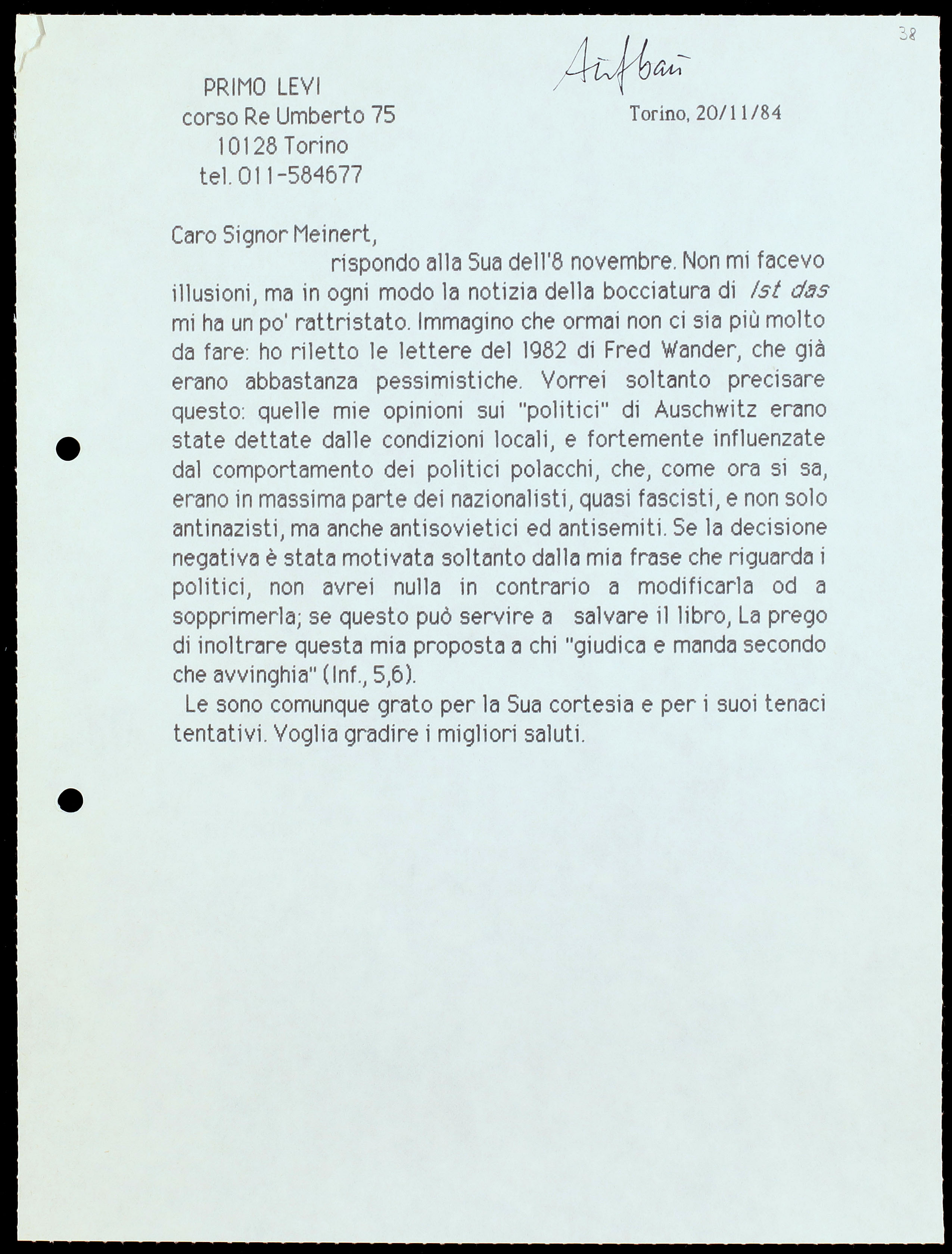
Levi is disappointed over the rejection of Ist das ein Mensch? and explains the reasons for his opinion of the political prisoners at Auschwitz. He says he is willing to edit the passages that sparked his criticism and asks that this possibility be called to the revisors’ attention.
PRIMO LEVI corso Re Umberto 75 10128 Torino
tel. 011-584677
Torino, 20/11/84
Caro Signor Meinert,[1]
rispondo alla Sua dell’8 novembre. Non mi facevo illusioni, ma in ogni modo la notizia della bocciatura di Ist das mi ha un po’ rattristato. Immagino che ormai non ci sia più molto da fare: ho riletto le lettere del 1982 di Fred Wander,[2] che già erano abbastanza pessimistiche. Vorrei soltanto precisare questo: quelle mie opinioni sui «politici» di Auschwitz erano state dettate dalle condizioni locali, e fortemente influenzate dal comportamento dei politici polacchi, che, come ora si sa, erano in massima parte dei nazionalisti, quasi fascisti, e non solo antinazisti, ma anche antisovietici ed antisemiti.[3] Se la decisione negativa è stata motivata soltanto dalla mia frase che riguarda i politici, non avrei nulla in contrario a modificarla od a sopprimerla;[4] se questo può servire a salvare il libro, La prego di inoltrare questa mia proposta a chi «giudica e manda secondo che avvinghia» (Inf., 5,6).
Le sono comunque grato per la Sua cortesia e per i suoi tenaci tentativi. Voglia gradire i migliori saluti.
PRIMO LEVI corso Re Umberto 75 10128 Torino
tel. 011-584677
Torino, 20/11/84
Caro Signor Meinert,[1]
rispondo alla Sua dell’8 novembre. Non mi facevo illusioni, ma in ogni modo la notizia della bocciatura di Ist das mi ha un po’ rattristato. Immagino che ormai non ci sia più molto da fare: ho riletto le lettere del 1982 di Fred Wander,[2] che già erano abbastanza pessimistiche. Vorrei soltanto precisare questo: quelle mie opinioni sui «politici» di Auschwitz erano state dettate dalle condizioni locali, e fortemente influenzate dal comportamento dei politici polacchi, che, come ora si sa, erano in massima parte dei nazionalisti, quasi fascisti, e non solo antinazisti, ma anche antisovietici ed antisemiti.[3] Se la decisione negativa è stata motivata soltanto dalla mia frase che riguarda i politici, non avrei nulla in contrario a modificarla od a sopprimerla;[4] se questo può servire a salvare il libro, La prego di inoltrare questa mia proposta a chi «giudica e manda secondo che avvinghia» (Inf., 5,6).
Le sono comunque grato per la Sua cortesia e per i suoi tenaci tentativi. Voglia gradire i migliori saluti.
PRIMO LEVI corso Re Umberto 75 10128 Torino
tel. 011-584677
Turin, November 20, 1984
Dear Mr. Meinert,[1]
I write to reply to your letter dated November 8. I had no illusions but, in any case, the news that Ist das has been rejected has saddened me a bit. I imagine that, by now, there is not much that can be done: I have reread the letters dated 1982 from Fred Wander,[2] which were already fairly pessimistic. I would only like to clarify this: those opinions of mine regarding the “politicians” at Auschwitz were dictated by local conditions and greatly influenced by the behavior of the Polish politicians, who, as we now know, were for the most part nationalists, almost fascists, and not only anti-nazis, but also anti-soviets and antisemites.[3] If the negative decision was only motivated by my sentence about the politicians, I would have nothing against changing or deleting it;[4] if this can help save the book. Please forward this proposal of mine to he who “judges, and sends according as he girds him” (Inferno Canto V, 6).
I am, in any case, grateful to you for your courtesy and your resolute attempts. Please accept my best regards.
PRIMO LEVI corso Re Umberto 75 10128 Torino
tel. 011-584677
Torino, 20/11/84
Caro Signor Meinert,[1]
rispondo alla Sua dell’8 novembre. Non mi facevo illusioni, ma in ogni modo la notizia della bocciatura di Ist das mi ha un po’ rattristato. Immagino che ormai non ci sia più molto da fare: ho riletto le lettere del 1982 di Fred Wander,[2] che già erano abbastanza pessimistiche. Vorrei soltanto precisare questo: quelle mie opinioni sui «politici» di Auschwitz erano state dettate dalle condizioni locali, e fortemente influenzate dal comportamento dei politici polacchi, che, come ora si sa, erano in massima parte dei nazionalisti, quasi fascisti, e non solo antinazisti, ma anche antisovietici ed antisemiti.[3] Se la decisione negativa è stata motivata soltanto dalla mia frase che riguarda i politici, non avrei nulla in contrario a modificarla od a sopprimerla;[4] se questo può servire a salvare il libro, La prego di inoltrare questa mia proposta a chi «giudica e manda secondo che avvinghia» (Inf., 5,6).
Le sono comunque grato per la Sua cortesia e per i suoi tenaci tentativi. Voglia gradire i migliori saluti.
PRIMO LEVI corso Re Umberto 75 10128 Torino
tel. 011-584677
Torino, 20/11/84
Caro Signor Meinert,[1]
rispondo alla Sua dell’8 novembre. Non mi facevo illusioni, ma in ogni modo la notizia della bocciatura di Ist das mi ha un po’ rattristato. Immagino che ormai non ci sia più molto da fare: ho riletto le lettere del 1982 di Fred Wander,[2] che già erano abbastanza pessimistiche. Vorrei soltanto precisare questo: quelle mie opinioni sui «politici» di Auschwitz erano state dettate dalle condizioni locali, e fortemente influenzate dal comportamento dei politici polacchi, che, come ora si sa, erano in massima parte dei nazionalisti, quasi fascisti, e non solo antinazisti, ma anche antisovietici ed antisemiti.[3] Se la decisione negativa è stata motivata soltanto dalla mia frase che riguarda i politici, non avrei nulla in contrario a modificarla od a sopprimerla;[4] se questo può servire a salvare il libro, La prego di inoltrare questa mia proposta a chi «giudica e manda secondo che avvinghia» (Inf., 5,6).
Le sono comunque grato per la Sua cortesia e per i suoi tenaci tentativi. Voglia gradire i migliori saluti.
PRIMO LEVI corso Re Umberto 75 10128 Torino
tel. 011-584677
Turin, November 20, 1984
Dear Mr. Meinert,[1]
I write to reply to your letter dated November 8. I had no illusions but, in any case, the news that Ist das has been rejected has saddened me a bit. I imagine that, by now, there is not much that can be done: I have reread the letters dated 1982 from Fred Wander,[2] which were already fairly pessimistic. I would only like to clarify this: those opinions of mine regarding the “politicians” at Auschwitz were dictated by local conditions and greatly influenced by the behavior of the Polish politicians, who, as we now know, were for the most part nationalists, almost fascists, and not only anti-nazis, but also anti-soviets and antisemites.[3] If the negative decision was only motivated by my sentence about the politicians, I would have nothing against changing or deleting it;[4] if this can help save the book. Please forward this proposal of mine to he who “judges, and sends according as he girds him” (Inferno Canto V, 6).
I am, in any case, grateful to you for your courtesy and your resolute attempts. Please accept my best regards.
Info
Notes
Tag
Sender: Primo Levi
Addressee: Joachim Meinert
Date of Drafting: 1984-11-20
Place of Writing: Turin
Description: copy of a letter printed with a PC. In the upper margin of the sheet, to the right, Levi notes by hand in black ballpoint pen: “Aufbau.”
1
This letter was published for the first time, and in German translation, in J. Meinert, Geschichte eines Verbots. Warum Primo Levis Hauptwerk in der DDR nicht erscheinen durfte (“The story of a ban. Why Primo Levi’s major work could not be published in the DDR”), in Sinn und Form, 2/2000, p. 161. Cf. the biography of Joachim Meinert.
3
About the same time as this letter was written, Levi’s impression may have received further confirmation when he read the book published by Hermann Langbein in 1980 …nicht wie die Schafe zur Schlachtbank. Widerstand in den nationalsozialistischen Konzentrationslagern 1938-1945 (Against All Hope: Resistance in the Nazi Concentration Camps 1938-1945) (Cf. letters 45 and 50). A long paragraph is dedicated to the Polish political prisoners, above all at Auschwitz (Die Polen), which states: “The evaluation of the Poles in the concentration camps is influenced by several factors: their pronounced national feelings – a legacy of their harsh history; the traditional aversion of many Poles to the Russians, particularly Ukrainians, an antipathy that had received fresh sustenance from the partition of Poland by Hitler and Stalin in September 1939; and an antisemitism that was more pronounced among Poles than in other national groups” (Against All Hope: Resistance in the Nazi Concentration Camps 1938-1956, New York: The Continuum Publishing Company, 1996, p. 146). Cf. H. Langbein, …nicht wie die Schafe zur Schlachtbank. Widerstand in den nationalsozialistischen Konzentrationslagern 1938-1945, Frankfurt: Fischer Verlag, 1980, p. 154.