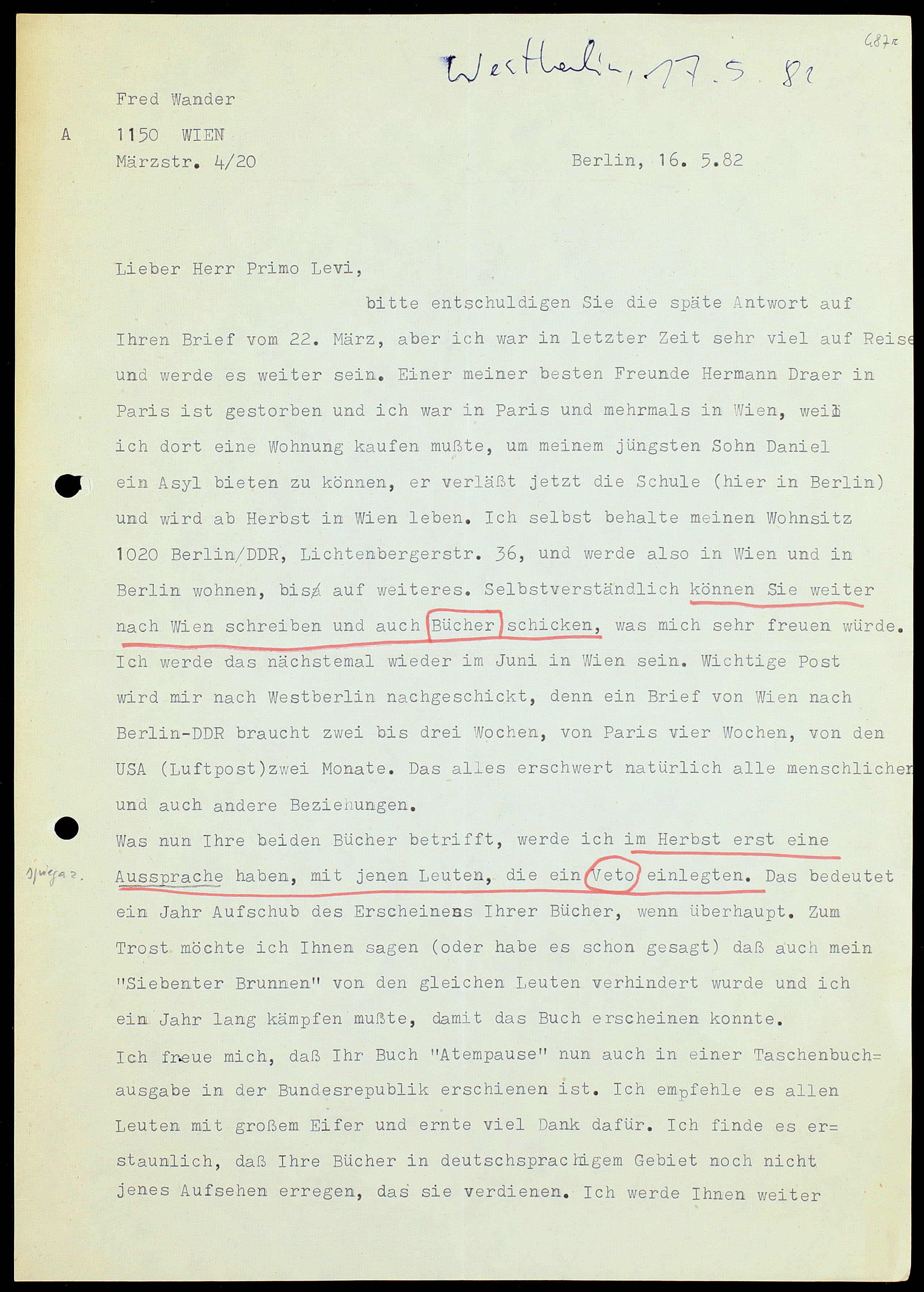
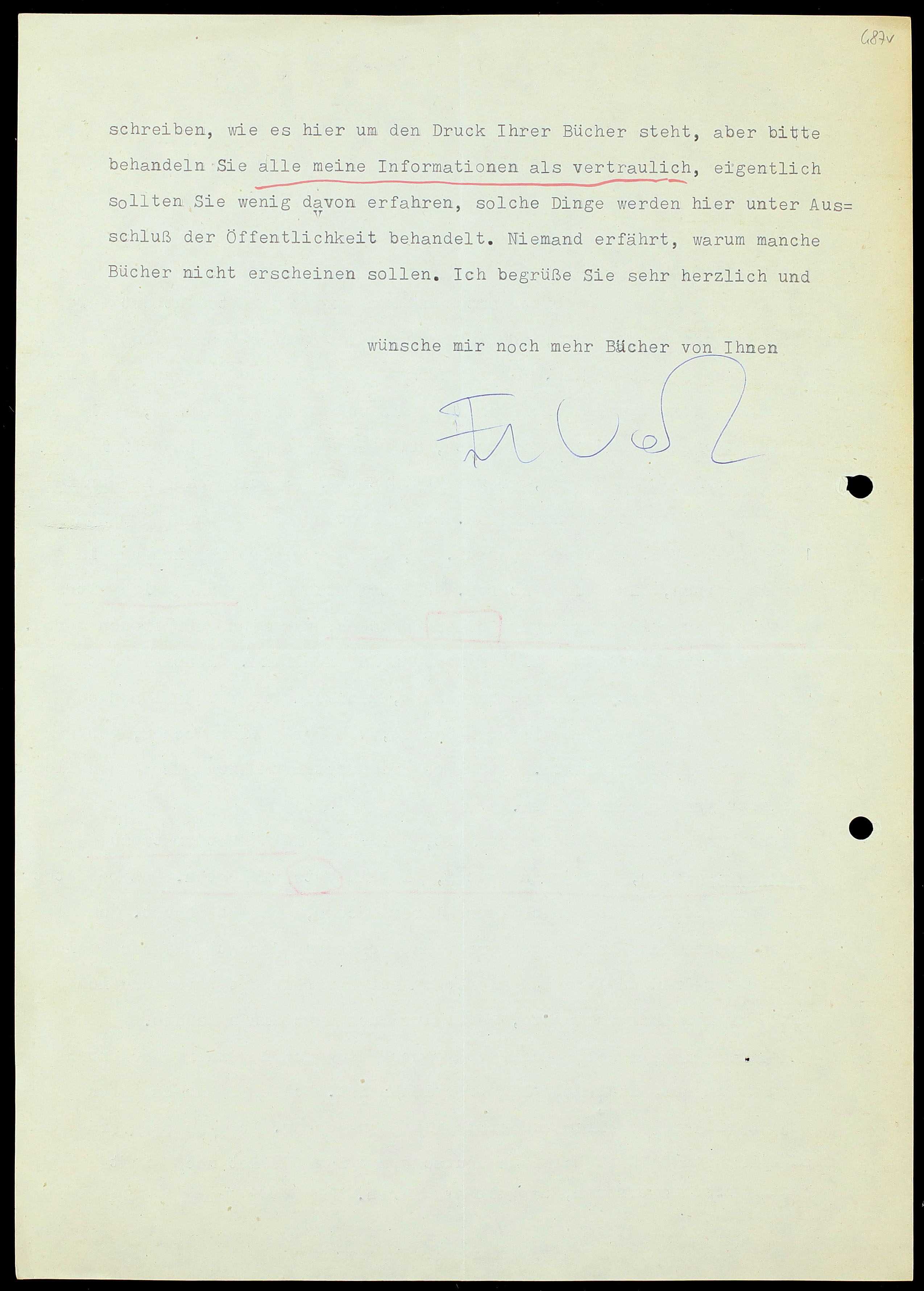
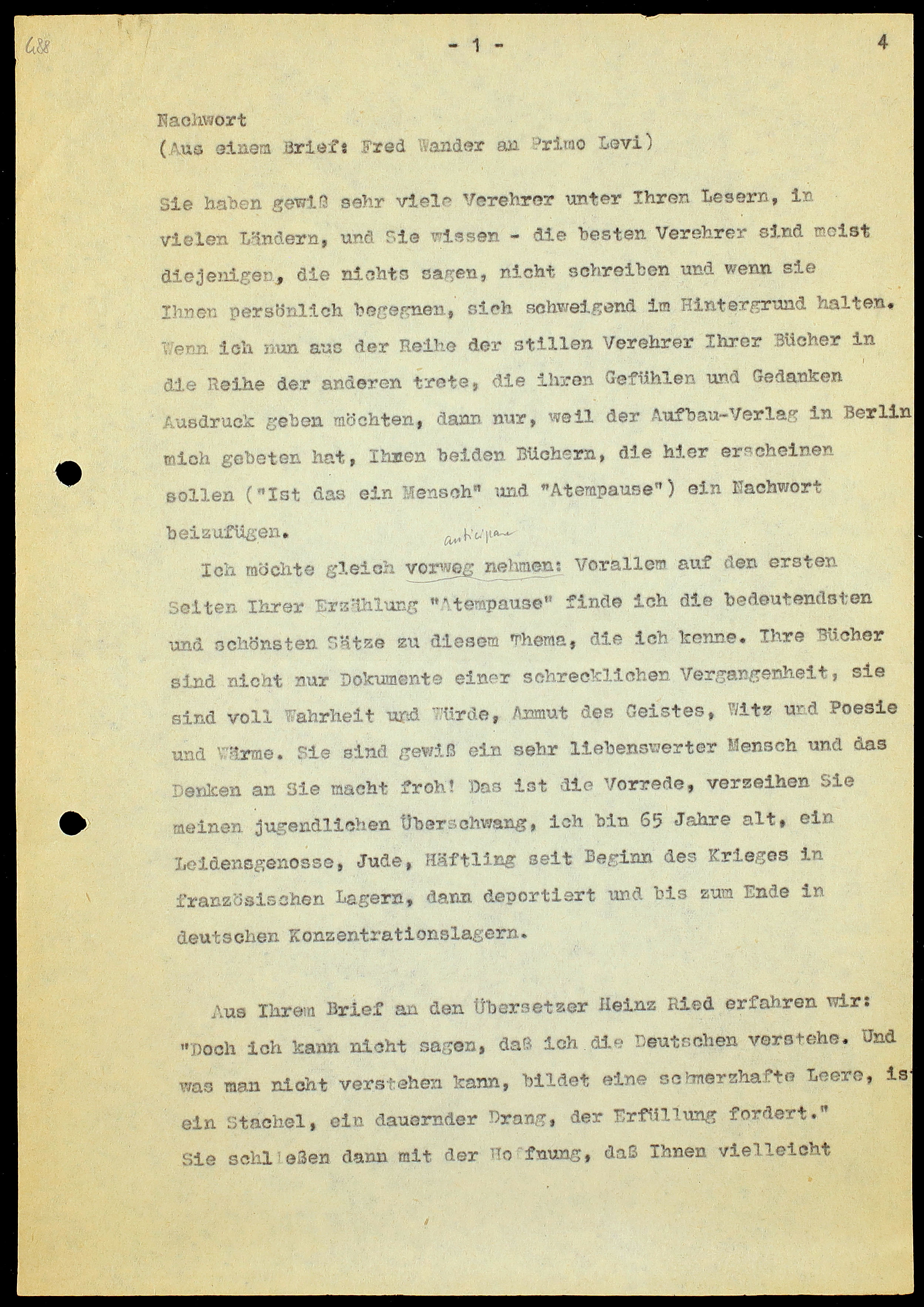
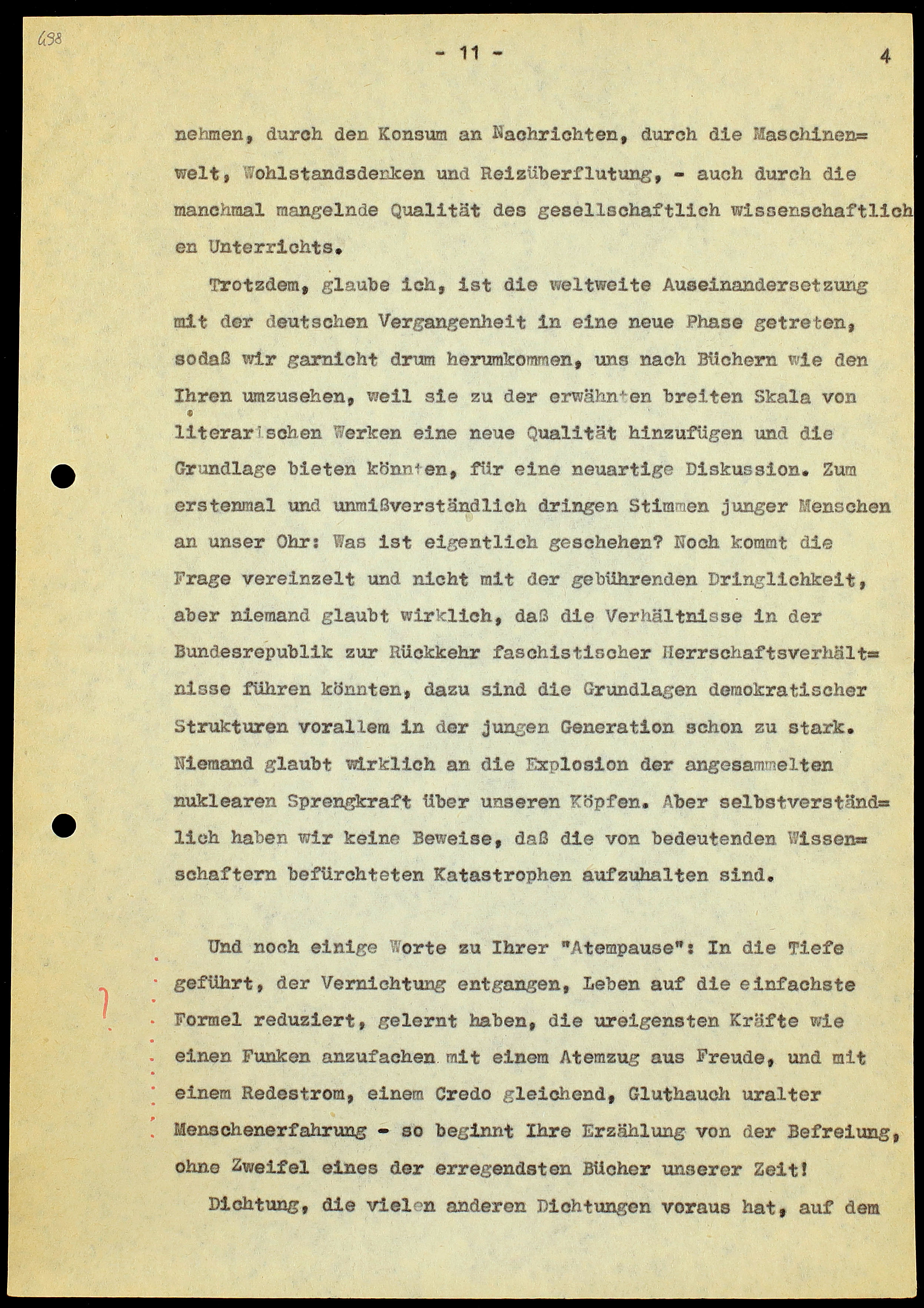
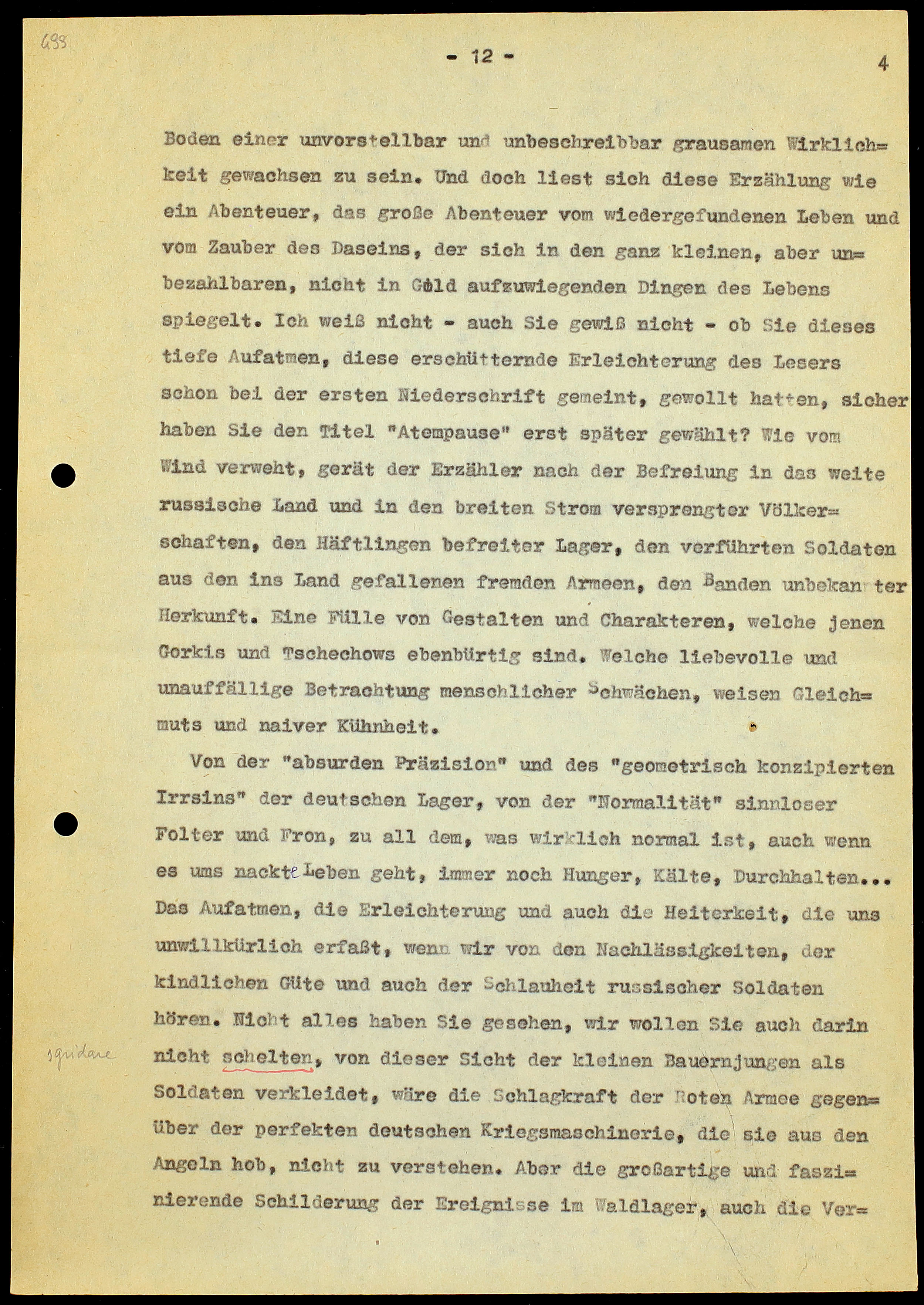
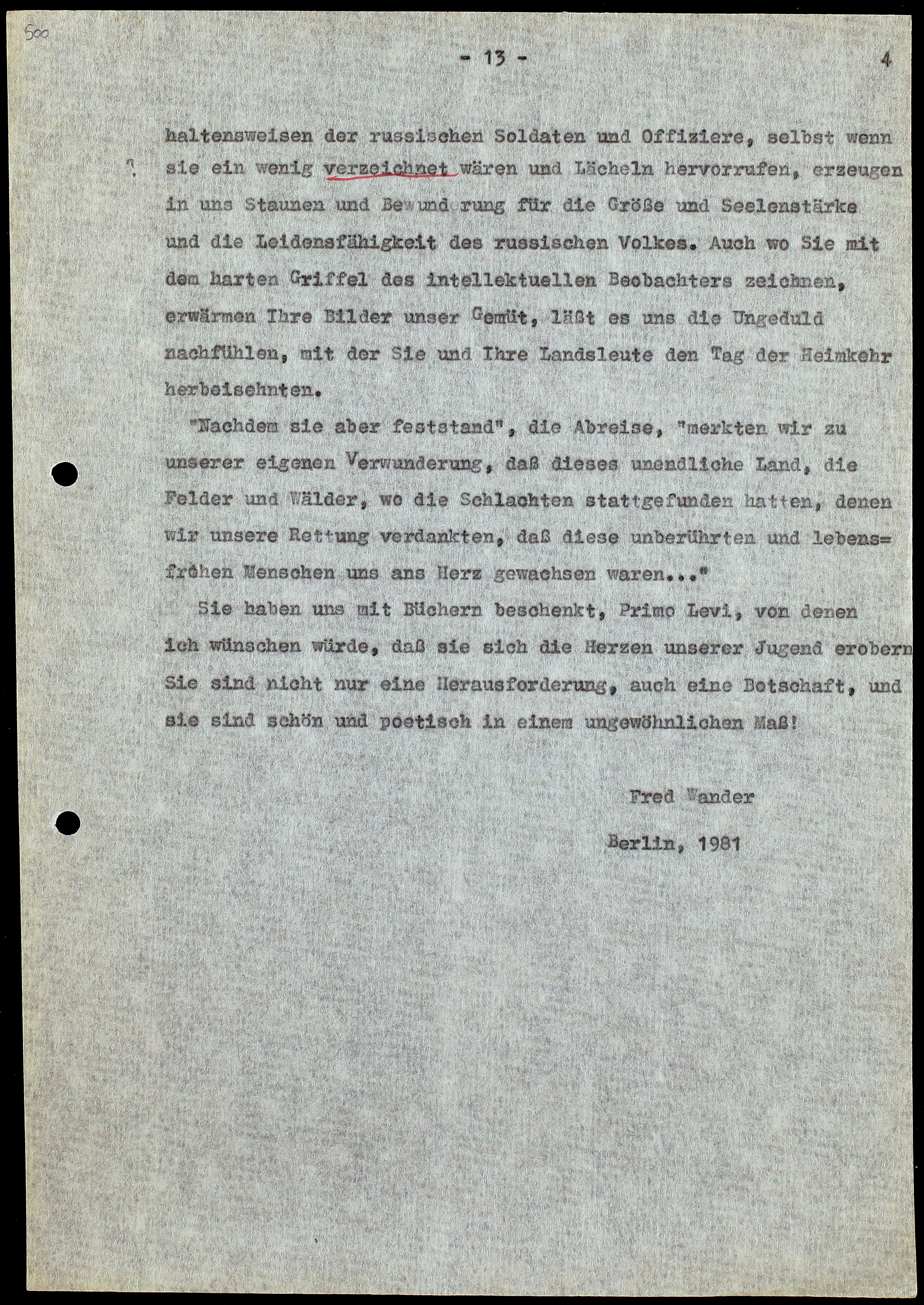
Wander annuncia che avrà un incontro in autunno con i membri del Comitato che ha bocciato il libro, ma raccomanda a Levi di intendere l’informazione come strettamente confidenziale. In allegato si legge la postfazione dello scrittore austriaco ai libri di Levi.
bitte entschuldigen Sie die späte Antwort auf Ihren Brief vom 22. März, aber ich war in letzter Zeit sehr viel auf Reise und werde es weiter sein. Einer meiner besten Freunde Hermann Draer[2] in Paris ist gestorben und ich war in Paris und mehrmals in Wien, weil ich dort eine Wohnung kaufen mußte, um meinem jüngsten Sohn Daniel ein Asyl bieten zu können, er verläßt jetzt die Schule (hier in Berlin) und wird ab Herbst in Wien leben. Ich selbst behalte meinen Wohnsitz 1020 Berlin/DDR, Lichtenbergerstr. 36, und werde also in Wien und in Berlin wohnen, bis auf weiteres. Selbstverständlich können Sie weiter nach Wien schreiben und auch Bücher schicken,[3] was mich sehr freuen würde.
Ich werde das nächstemal wieder im Juni in Wien sein. Wichtige Post wird mir nach Westberlin nachgeschickt, denn ein Brief von Wien nach Berlin-DDR braucht zwei bis drei Wochen, von Paris vier Wochen, von den USA (Luftpost) zwei Monate. Das alles erschwert natürlich alle menschlichen und auch andere Beziehungen.
Was nun Ihre beiden Bücher betrifft, werde ich im Herbst erst eine Aussprache haben, mit jenen Leuten, die ein Veto einlegten.[4] Das bedeutet ein Jahr Aufschub des Erscheinens Ihrer Bücher, wenn überhaupt. Zum Trost möchte ich Ihnen sagen (oder habe es schon gesagt) daß auch mein Siebenter Brunnen von den gleichen Leuten verhindert wurde und ich ein Jahr lang kämpfen mußte, damit das Buch erscheinen konnte.[5]
Ich freue mich, daß Ihr Buch Atempause nun auch in einer Taschenbuchausgabe in der Bundesrepublik erschienen ist. Ich empfehle es allen Leuten mit großem Eifer und ernte viel Dank dafür. Ich finde es erstaunlich, daß Ihre Bücher in deutschsprachigem Gebiet noch nicht jenes Aufsehen erregen, das sie verdienen. Ich werde Ihnen weiter schreiben, wie es hier um den Druck Ihrer Bücher steht, aber bitte behandeln Sie alle meine Informationen als vertraulich, eigentlich sollten Sie wenig davon erfahren, solche Dinge werden hier unter Ausschluß der Öffentlichkeit behandelt. Niemand erfährt, warum manche Bücher nicht erscheinen sollen. Ich begrüße Sie sehr herzlich und
wünsche mir noch mehr Bücher von Ihnen
Fred Wander
Nachwort[6]
(Aus einem Brief: Fred Wander an Primo Levi)
Sie haben gewiß sehr viele Verehrer unter Ihren Lesern, in vielen Ländern, und Sie wissen – die besten Verehrer sind meist diejenigen, die nichts sagen, nicht schreiben und wenn sie Ihnen persönlich begegnen, sich schweigend im Hintergrund halten.
Wenn ich nun aus der Reihe der stillen Verehrer Ihrer Bücher in die Reihe der anderen trete, die ihren Gefühlen und Gedanken Ausdruck geben möchten, dann nur, weil der Aufbau-Verlag in Berlin mich gebeten hat, Ihnen beiden Büchern, die hier erscheinen sollen (Ist das ein Mensch und Atempause) ein Nachwort beizufügen.
Ich möchte gleich vorweg nehmen:[7] Vorallem auf den ersten Seiten Ihrer Erzählung Atempause finde ich die bedeutendsten und schönsten Sätze zu diesem Thema, die ich kenne. Ihre Bücher sind nicht nur Dokumente einer schrecklichen Vergangenheit, sie sind voll Wahrheit und Würde, Anmut des Geistes, Witz und Poesie und Wärme. Sie sind gewiß ein sehr liebenswerter Mensch und das Denken an Sie macht froh! Das ist die Vorrede, verzeihen Sie meinen jugendlichen Überschwang, ich bin 65 Jahre alt, ein Leidensgenosse, Jude, Häftling seit Beginn des Krieges in französischen Lagern, dann deportiert und bis zum Ende in deutschen Konzentrationslagern.
Aus Ihren Brief an den Übersetzer Heinz Riedt erfahren wir:
„Doch ich kann nicht sagen, daß ich die Deutschen verstehe. Und was man nicht verstehen kann, bildet eine schmerzhafte Leere, ist ein Stachel, ein dauernder Drang, der Erfüllung fordert.“[8]
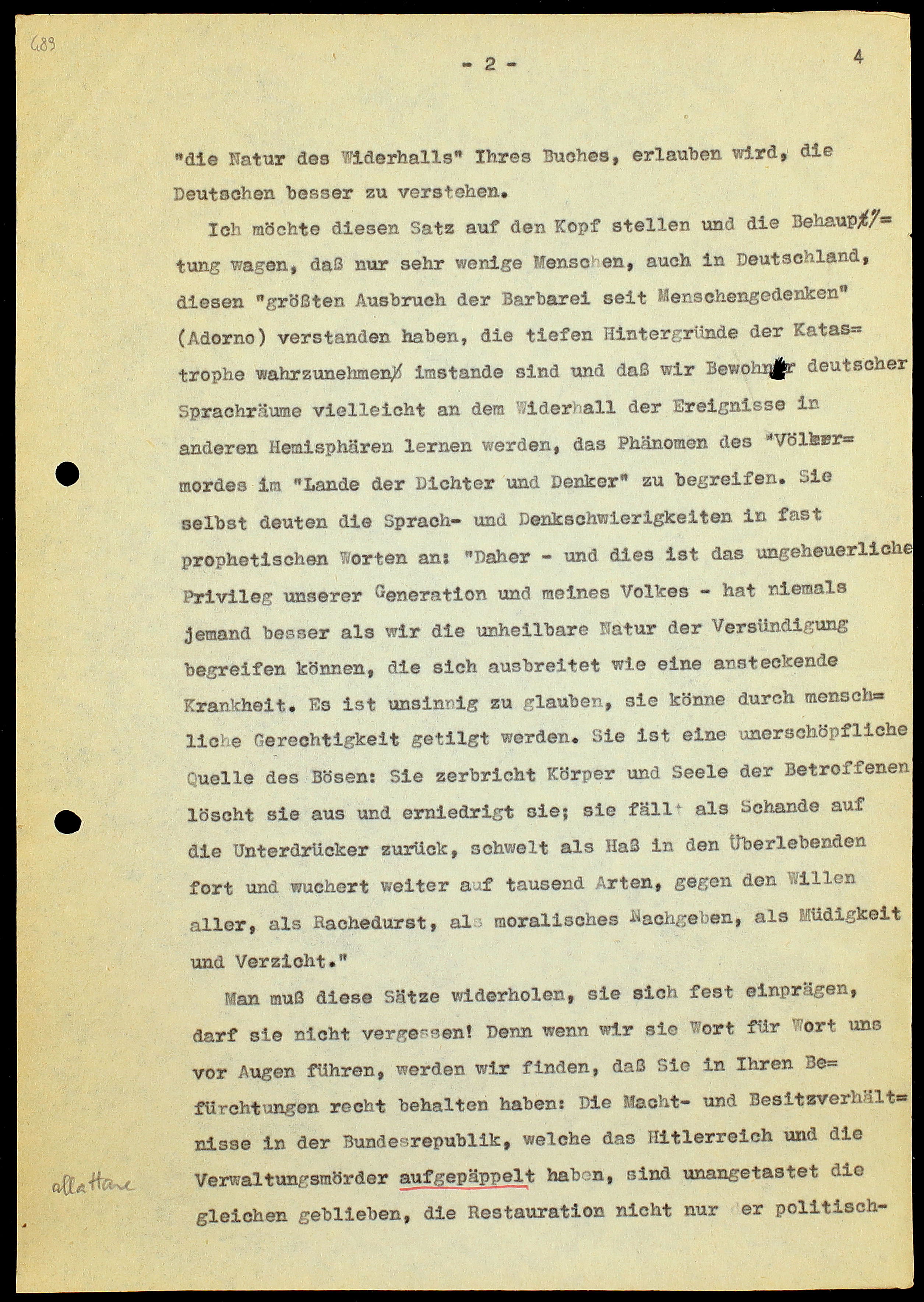
Sie schließen dann mit der Hoffnung, daß Ihnen vielleicht „die Natur des Widerhalls“ Ihres Buches, erlauben wird, die Deutschen besser zu verstehen.
Ich möchte diesen Satz auf den Kopf stellen und die Behauptung wagen, daß nur sehr wenige Menschen, auch in Deutschland, diesen „größten Ausbruch der Barbarei seit Menschengedenken“ (Adorno)[9] verstanden haben, die tiefen Hintergründe der Katastrophe wahrzunehmen imstande sind und daß wir Bewohner deutscher Sprachräume vielleicht an dem Widerhall der Ereignisse in anderen Hemisphären lernen werden, das Phänomen des Völkermordes im „Lande der Dichter und Denker“ zu begreifen. Sie selbst deuten die Sprach- und Denkschwierigkeiten in fast prophetischen Worten an: „Daher – und dies ist das ungeheuerliche Privileg unserer Generation und meines Volkes – hat niemals jemand besser als wir die unheilbare Natur der Versündigung begreifen können, die sich ausbreitet wie eine ansteckende Krankheit. Es ist unsinnig zu glauben, sie könne durch menschliche Gerechtigkeit getilgt werden. Sie ist eine unerschöpfliche Quelle des Bösen: Sie zerbricht Körper und Seele der Betroffenen löscht sie aus und erniedrigt sie; sie fällt als Schande auf die Unterdrücker zurück, schwelt als Haß in den Überlebenden fort und wuchert weiter auf tausend Arten, gegen den Willen aller, als Rachedurst, als moralisches Nachgeben, als Müdigkeit und Verzicht“.[10]
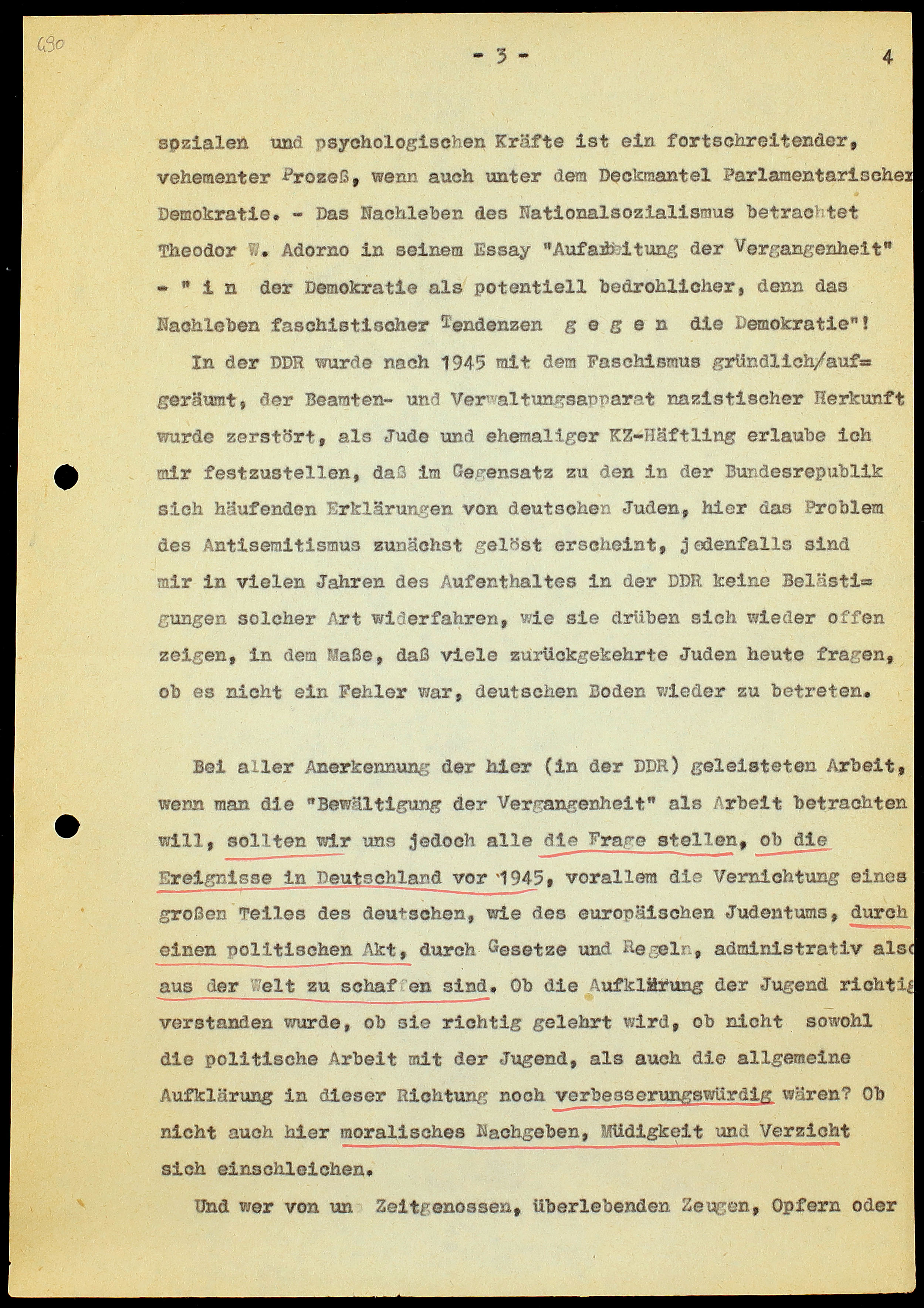
Man muß diese Sätze widerholen, sie sich fest einprägen, darf sie nicht vergessen! Denn wenn wir sie Wort für Wort uns vor Augen führen, werden wir finden, daß Sie in Ihren Befürchtungen recht behalten haben: Die Macht- und Besitzverhältnisse in der Bundesrepublik, welche das Hitlerreich und die Verwaltungsmörder aufgepäppelt[11] haben, sind unangetastet die gleichen geblieben, die Restauration nicht nur der politisch-sozialen und psychologischen Kräfte ist ein fortschreitender, vehementer Prozeß, wenn auch unter dem Deckmantel Parlamentarischer Demokratie. – Das Nachleben des Nationalsozialismus betrachtet Theodor W. Adorno in seinem Essay Aufarbeitung der Vergangenheit
– „in der Demokratie als potentiell bedrohlicher, denn das Nachleben faschistischer Tendenzen gegen die Demokratie“![12]
In der DDR wurde nach 1945 mit dem Faschismus gründlich/aufgeräumt, der Beamten- und Verwaltungsapparat nazistischer Herkunft wurde zerstört, als Jude und ehemaliger KZ-Häftling erlaube ich mir festzustellen, daß im Gegensatz zu den in der Bundesrepublik sich häufenden Erklärungen von deutschen Juden, hier das Problem des Antisemitismus zunächst gelöst erscheint, jedenfalls sind mir in vielen Jahren des Aufenthaltes in der DDR keine Belästigungen solcher Art widerfahren, wie sie drüben sich wieder offen zeigen, in dem Maße, daß viele zurückgekehrte Juden heute fragen, ob es nicht ein Fehler war, deutschen Boden wieder zu betreten.
Bei aller Anerkennung der hier (in der DDR) geleisteten Arbeit, wenn man die „Bewältigung der Vergangenheit“ als Arbeit betrachten will, sollten wir uns jedoch alle die Frage stellen, ob die Ereignisse in Deutschland vor 1945,[13] vorallem die Vernichtung eines großen Teiles des deutschen, wie des europäischen Judentuns, durch einen politischen Akt, durch Gesetze und Regeln, administrativ also aus der Welt zu schaffen sind.[14] Ob die Aufklärung der Jugend richtig verstanden wurde, ob sie richtig gelehrt wird, ob nicht sowohl die politische Arbeit mit der Jugend, als auch die allgemeine Aufklärung in dieser Richtung noch verbesserungswürdig wären? Ob nicht auch hier moralisches Nachgeben, Müdigkeit und Verzicht sich einschleichen.[15]
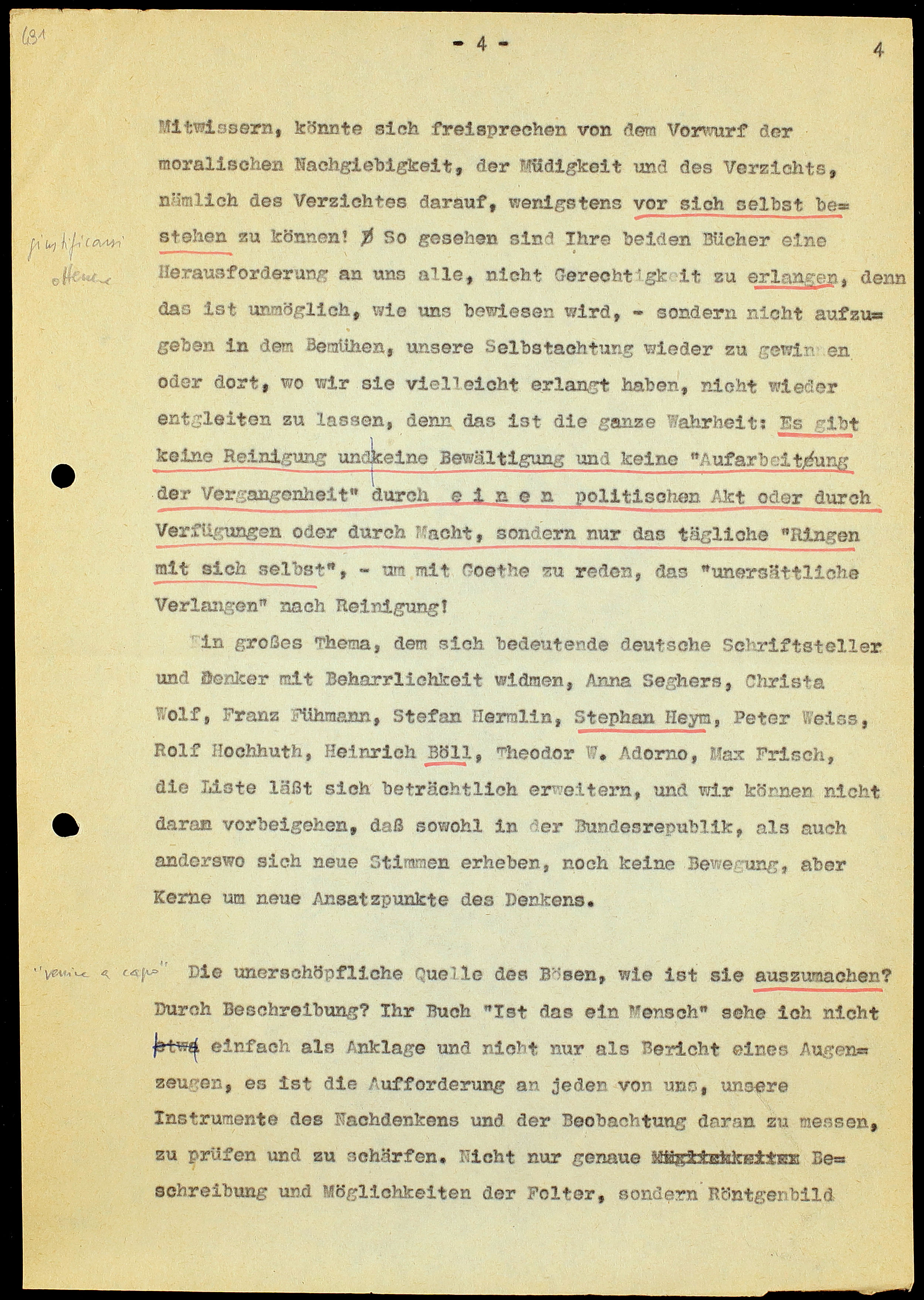
Und wer von uns Zeitgenossen, überlebenden Zeugen, Opfern oder Mitwissern, könnte sich freisprechen von dem Vorwurf der moralischen Nachgiebigkeit, der Müdigkeit und des Verzichts, nämlich des Verzichtes darauf, wenigstens vor sich selbst bestehen[16] zu können! So gesehen sind Ihre beiden Bücher eine Herausforderung an uns alle, nicht Gerechtigkeit zu erlangen,[17] denn das ist unmöglich, wie uns bewiesen wird, – sondern nicht aufzugeben in dem Bemühen, unsere Selbstachtung wieder zu gewinnen oder dort, wo wir sie vielleicht erlangt haben, nicht wieder entgleiten zu lassen, denn das ist die ganze Wahrheit: Es gibt keine Reinigung und keine Bewältigung und keine „Aufarbeitung der Vergangenheit“ durch einen politischen Akt oder durch Verfügungen oder durch Macht, sondern nur das tägliche „Ringen mit sich selbst“,[18] – um mit Goethe zu reden, das „unersättliche Verlangen“ nach Reinigung!
Ein großes Thema, dem sich bedeutende deutsche Schriftsteller und Denker mit Beharrlichkeit widmen, Anna Seghers, Christa Wolf, Franz Fühmann, Stefan Hermlin, Stephan Heym, Peter Weiss, Rolf Hochhuth, Heinrich Böll,[19]Theodor V. Adorno, Max Frisch, die Liste läßt sich beträchtlich erweitern, und wir können nicht daran vorbeigehen, daß sowohl in der Bundesrepublik, als auch anderswo sich neue Stimmen erheben, noch keine Bewegung, aber Kerne um neue Ansatzpunkte des Denkens.
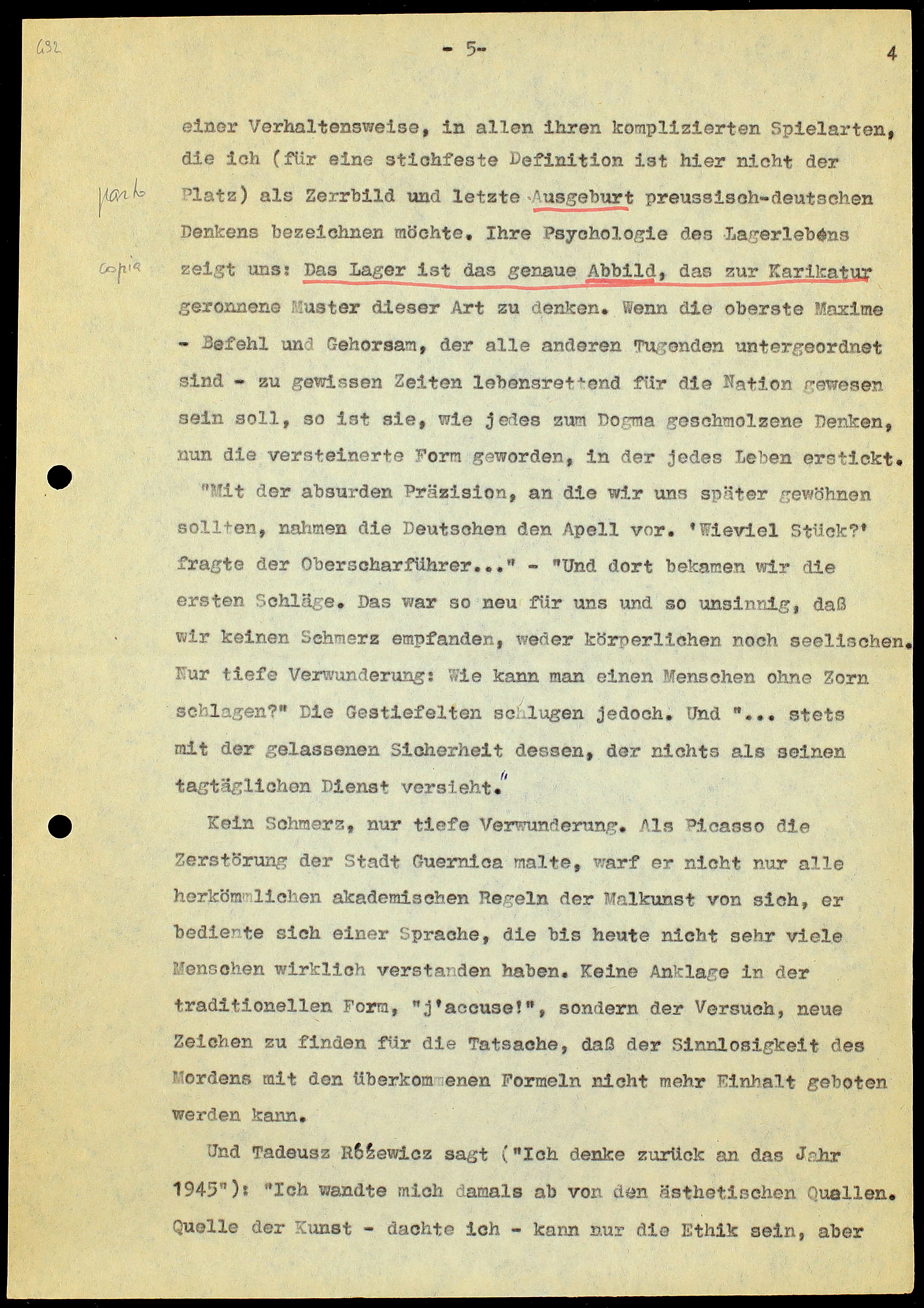
Die unerschöpfliche Quelle des Bösen, wie ist sie auszumachen?[20] Durch Beschreibung? Ihr Buch Ist das ein Mensch sehe ich nicht einfach als Anklage und nicht nur als Bericht eines Augenzeugen, es ist die Aufforderung an jeden von uns, unsere Instrumente des Nachdenkens und der Beobachtung daran zu messen, zu prüfen und zu schärfen. Nicht nur genaue Beschreibung und Möglichkeiten der Folter, sondern Röntgenbild einer Verhaltensweise, in allen ihren komplizierten Spielarten, die ich (für eine stichfeste Definition ist hier nicht der Platz) als Zerrbild und letzte Ausgeburt[21] preussisch-deutschen Denkens bezeichnen möchte. Ihre Psychologie des Lagerlebens zeigt uns: Das Lager ist das genaue Abbild, das zur Karikatur[22] geronnene Muster dieser Art zu denken. Wenn die oberste Maxime – Befehl und Gehorsam, der alle anderen Tugenden untergeordnet sind – zu gewissen Zeiten lebensrettend für die Nation gewesen sein soll, so ist sie, wie jedes zum Dogma geschmolzene Denken, nun die versteinerte Form geworden, in der jedes Leben erstickt.
„Mit der absurden Präzision, an die wir uns später gewöhnen sollten, nahmen die Deutschen den Apell vor. ‚Wieviel Stück?‘ fragte der Oberscharführer…“– „Und dort bekamen wir die ersten Schläge. Das war so neu für uns und so unsinnig, daß wir keinen Schmerz empfanden, weder körperlichen noch seelischen. Nur tiefe Verwunderung: Wie kann man einen Menschen ohne Zorn schlagen?“ Die Gestiefelten schlugen jedoch. Und „… stets mit der gelassenen Sicherheit dessen, der nichts als seinen tagtäglichen Dienst versieht.“[23]
Kein Schmerz, nur tiefe Verwunderung. Als Picasso die Zerstörung der Stadt Guernica malte, warf er nicht nur alle herkömmlichen akademischen Regeln der Malkunst von sich, er bediente sich einer Sprache, die bis heute nicht sehr viele Menschen wirklich verstanden haben. Keine Anklage in der traditionellen Form, „j’accuse!“, sondern der Versuch, neue Zeichen zu finden für die Tatsache, daß der Sinnlosigkeit des Mordens mit den überkommenen Formeln nicht mehr Einhalt geboten werden kann.
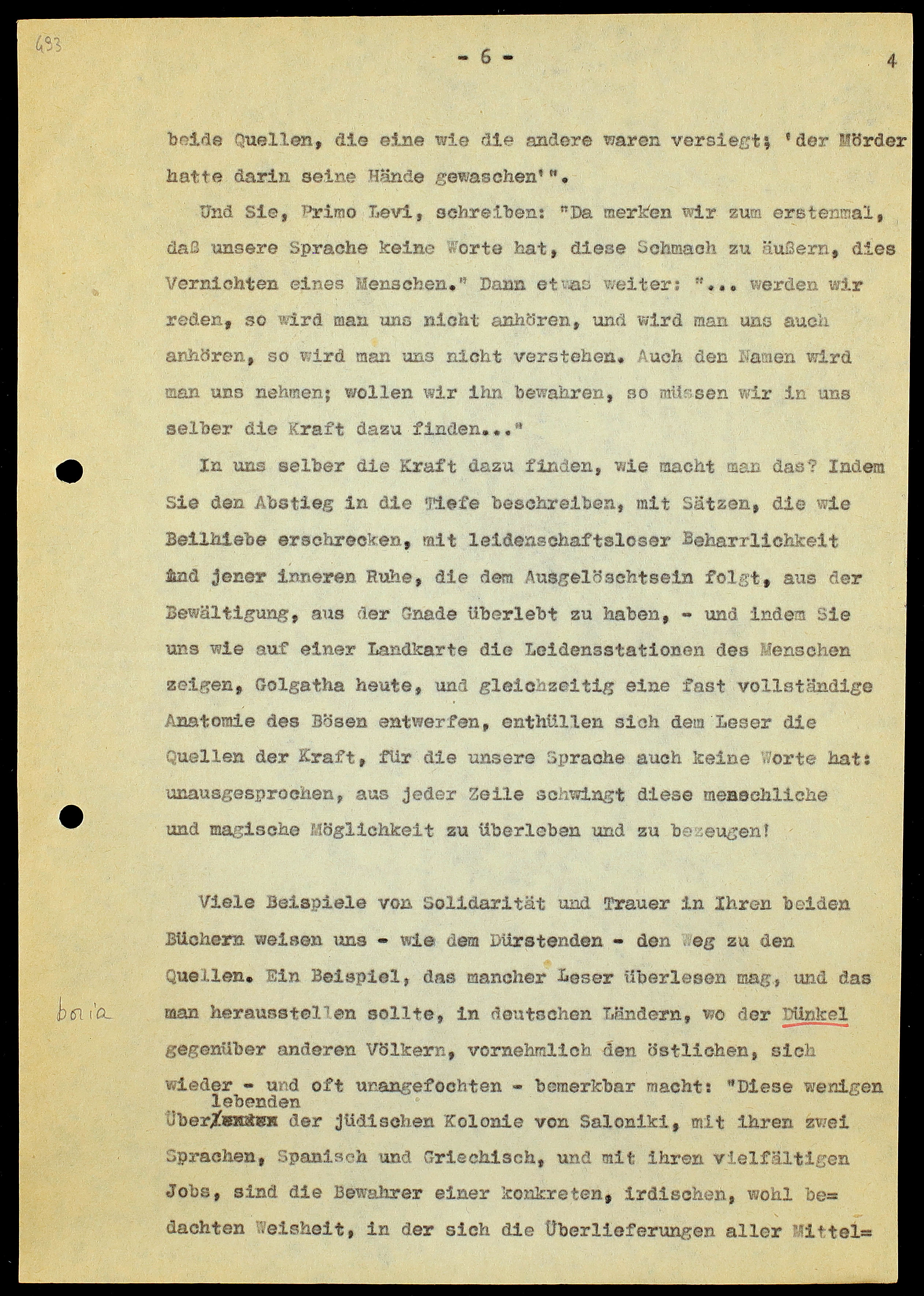
Und Tadeusz Różewicz sagt (Ich denke zurück an das Jahr 1945): „Ich wandte mich damals ab von den ästhetischen Quellen. Quelle der Kunst – dachte ich – kann nur die Ethik sein, aber beide Quellen, die eine wie die andere waren versiegt; ‚der Mörder hatte darin seine Hände gewaschen.‘“[24]
Und Sie, Primo Levi, schreiben: „Da merken wir zum erstenmal, daß unsere Sprache keine Worte hat, diese Schmach zu äußern, dies Vernichten eines Menschen.“ Dann etwas weiter: „… werden wir reden, so wird man uns nicht anhören, und wird man uns auch anhören, so wird man uns nicht verstehen. Auch den Namen wird man uns nehmen; wollen wir ihn bewahren, so müssen wir in uns selber die Kraft dazu finden…“[25]
In uns selber die Kraft dazu finden, wie macht man das? Indem Sie den Abstieg in die Tiefe beschreiben, mit Sätzen, die wie Beilhiebe erschrecken, mit leidenschaftsloser Beharrlichkeit und jener inneren Ruhe, die dem Ausgelöschtsein folgt, aus der Bewältigung, aus der Gnade überlebt zu haben, – und indem Sie uns wie auf einer Landkarte die Leidensstationen des Menschen zeigen, Golgatha heute, und gleichzeitig eine fast vollständige Anatomie des Bösen entwerfen, enthüllen sich den Leser die quellen der Kraft, für die unsere Sprache auch keine Worte hat: unausgesprochen, aus jeder Zeile schwingt diese menschliche und magische Möglichkeit zu überleben und zu bezeugen!
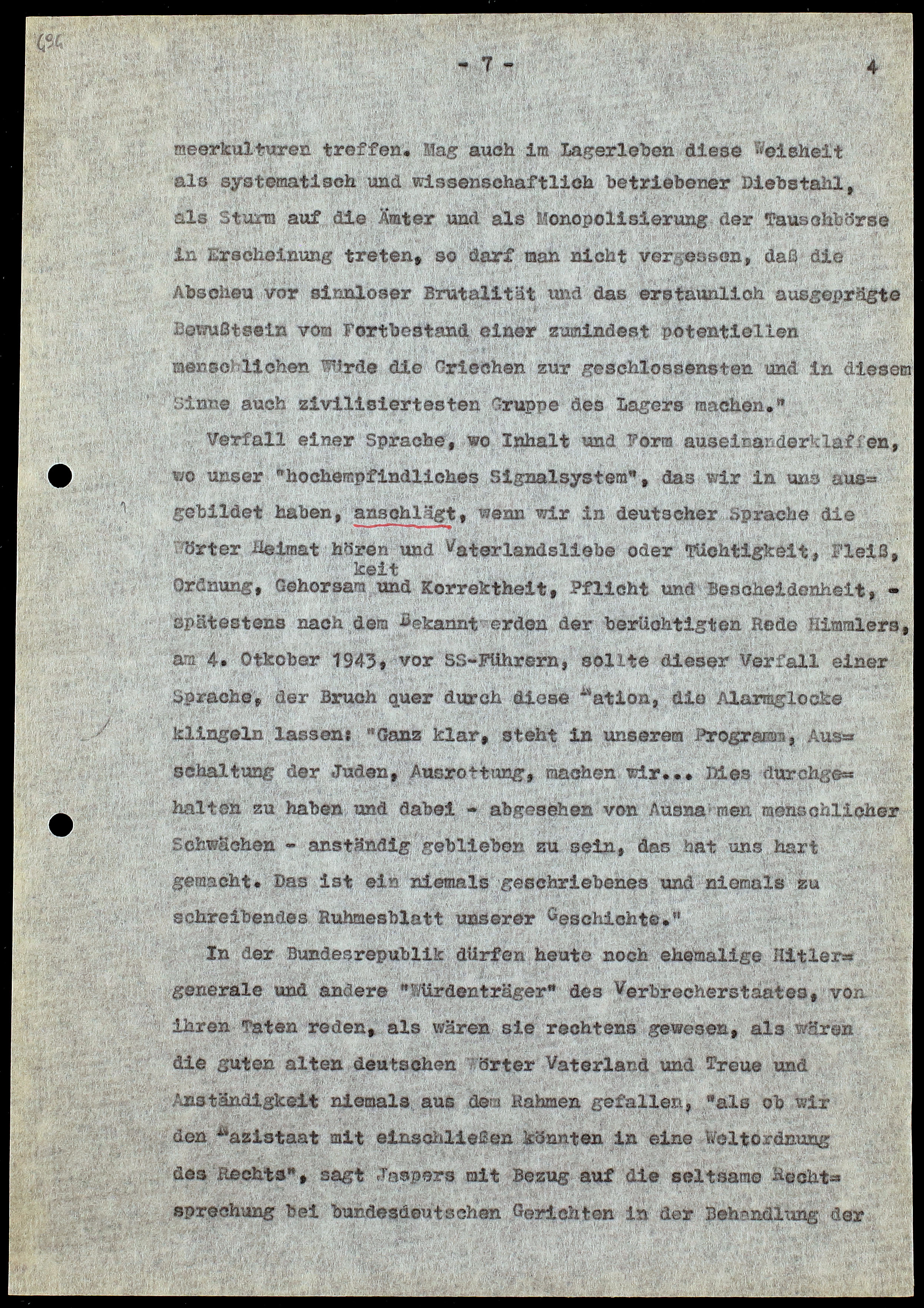
Viele Beispiele von Solidarität und Trauer in Ihren beiden Büchern weisen uns – wie dem Dürstenden – den Weg zu den Quellen. Ein Beispiel, das mancher Leser überlesen mag, und das man herausstellen sollte, in deutschen Ländern, wo der Dünkel[26] gegenüber anderen Völkern, vornehmlich den östlichen, sich wieder – und oft unangefochten – bemerkbar macht: „Diese wenigen Überlebenden der jüdischen Kolonie von Saloniki, mit ihren zwei Sprachen, Spanisch und Griechisch, und mit ihren vielfältigen Jobs, sind die Bewahrer einer konkreten, irdischen, wohl bedachten Weisheit, in der sich die Überlieferungen aller Mittelmeerkulturen treffen. Mag auch im Lagerleben diese Weisheit als systematisch und wissenschaftlich betriebener Diebstahl, als Sturm auf die Ämter und als Monopolisierung der Tauschbörse in Erscheinung treten, so darf man nicht vergessen, daß die Abscheu vor sinnloser Brutalität und das erstaunlich ausgeprägte Bewußtsein vom Fortbestand einer zumindest potentiellen menschlichen Würde die Griechen zur geschlossensten und in diesem Sinne such zivilisiertesten Gruppe des Lagers machen.“[27]
Verfall einer Sprache, wo Inhalt und Form auseinanderklaffen, wo unser „hochempfindliches Signalsystem“, das wir in uns ausgebildet haben, anschlägt,[28] wenn wir in deutscher Sprache die Wörter Heimat hören und Vaterlandsliebe oder Tüchtigkeit, Fleiß, Ordnung, Gehorsamkeit und Korrektheit, Pflicht und Bescheidenheit, – spätestens nach den Bekanntwerden der berüchtigten Rede Himmlers, an 4. Oktober 1943, vor SS-Führern, sollte dieser Verfall einer Sprache, der Bruch quer durch diese Nation, die Alarmglocke klingeln lassen: “Ganz klar, steht in unserem Programm, Ausschaltung der Juden, Ausrottung, machen wir… Dies durchgehalten zu haben und dabei – abgesehen von Ausnahmen menschlicher Schwächen – anständig geblieben zu sein, das hat uns hart gemacht. Das ist ein niemals geschriebenes und niemals zu schreibendes Ruhmesblatt unserer Geschichte.“
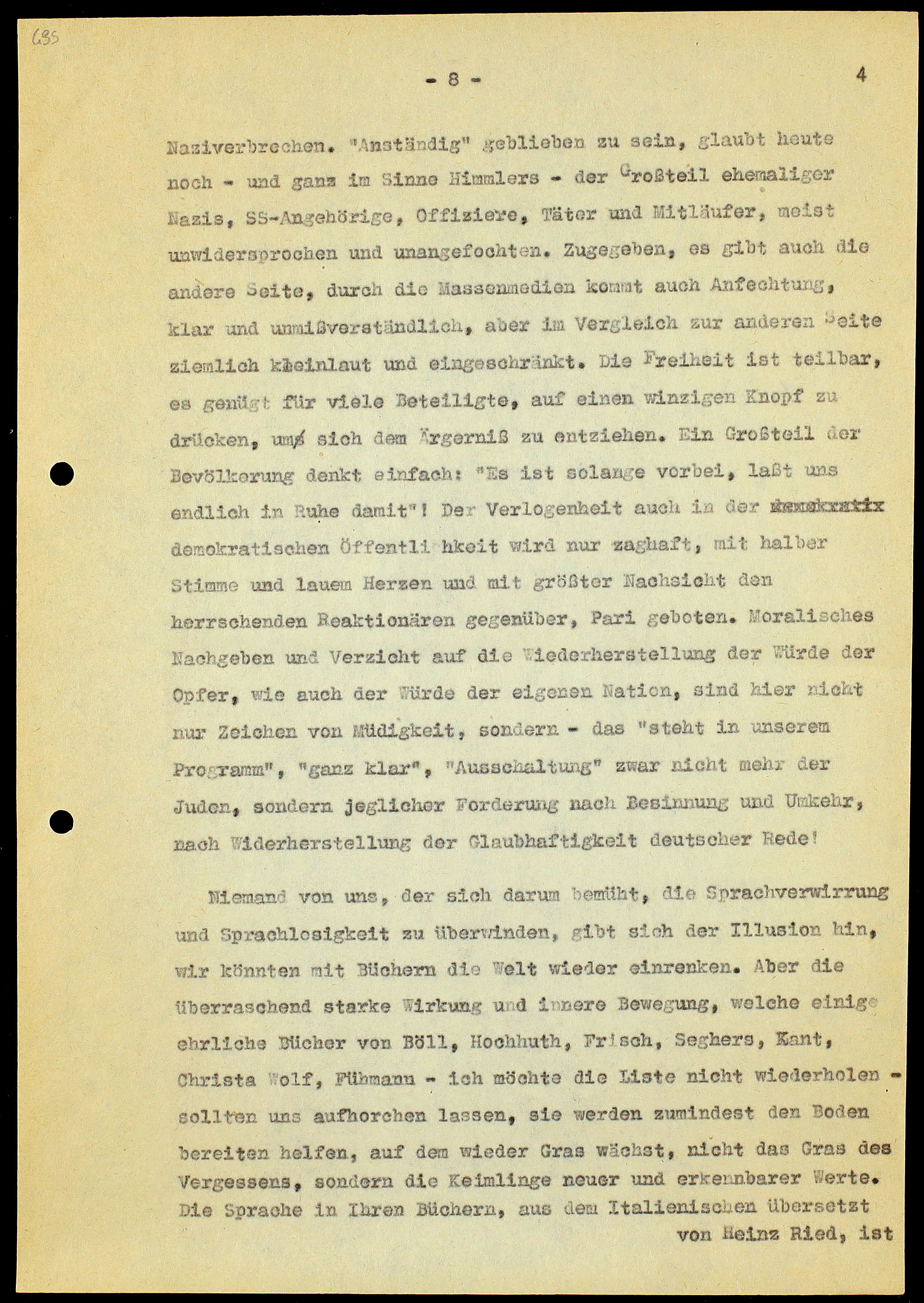
In der Bundesrepublik dürfen heute noch ehemalige Hitlergenerale und andere „Würdenträger“ des Verbrecherstaates, von Ihren Taten reden, als wären sie rechtens gewesen, als wären die guten alten deutschen Wörter Vaterland und Treue und Anständigkeit niemals aus dem Rahmen gefallen, „als ob wir den Nazistaat mit einschließen könnten in eine Weltordnung des Rechts“, sagt Jaspers mit Bezug auf die seltsame Rechtsprechung bei bundesdeutschen Gerichten in der Behandlung der Naziverbrechen. „Anständig“ geblieben zu sein, glaubt heute noch – und ganz im Sinne Himmlers – der Großteil ehemaliger Nazis, SS-Angehörige, Offiziere, Täter und Mitläufer, meist unwidersprochen und unangefochten. Zugegeben, es gibt auch die andere Seite, durch die Massenmedien kommt auch Anfechtung, klar und unmißverständlich, aber im Vergleich zur anderen Seite ziemlich kleinlaut und eingeschränkt. Die Freiheit ist teilbar, es genügt für viele Beteiligte, auf einen winzigen Knopf zu drücken, um sich dem Ärgerniß zu entziehen. Ein Großteil der Bevölkerung denkt einfach: „Es ist solange vorbei, laßt uns endlich in Ruhe damit“! Der Verlogenheit auch in der demokratischen Öffentlichkeit wird nur zaghaft, mit halber Stimme und lauem Herzen und mit größter Nachsicht den herrschenden Reaktionären gegenüber, Pari geboten. Moralisches Nachgeben und Verzicht auf die Wiederherstellung der Würde der Opfer, wie auch der Würde der eigenen Nation, sind hier nicht nur Zeichen von Müdigkeit, sondern – das „steht in unseren Programm“, „ganz klar“, „Ausschaltung“ zwar nicht mehr der Juden, sondern jeglicher Forderung nach Besinnung und Umkehr, nach Widerherstellung der Glaubhaftigkeit deutscher Rede!
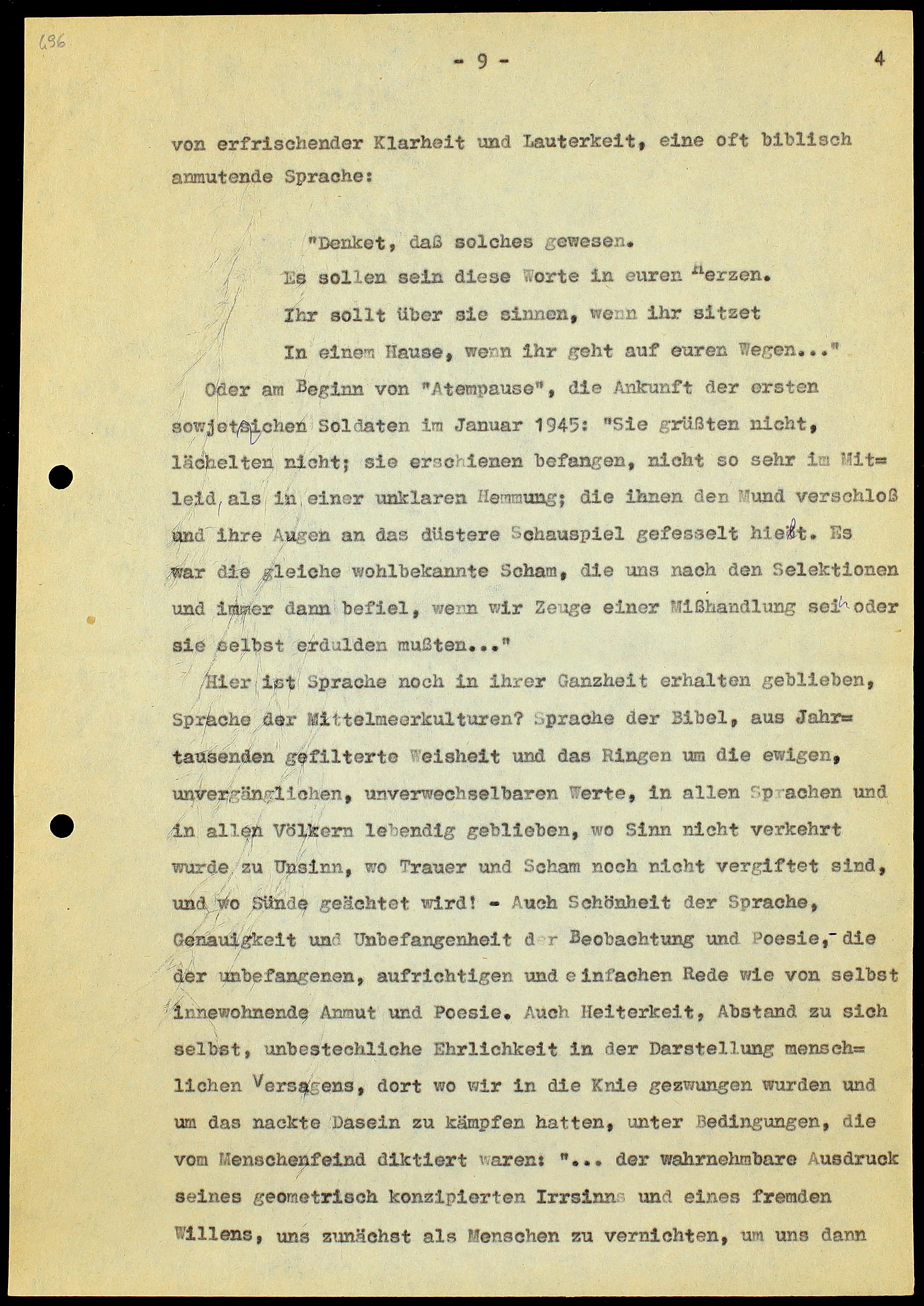
Niemand von uns, der sich darum bemüht, die Sprachverwirrung und Sprachlosigkeit zu überwinden, gibt sich der Illusion hin, wir könnten mit Büchern die Welt wieder einrenken. Aber die überraschend starke Wirkung und innere Bewegung, welche einige ehrliche Bücher von Böll, Hochhuth, Frisch, Seghers, Kant, Christa Wolf, Fühmann – ich möchte die Liste nicht wiederholen – sollten uns aufhorchen lassen, sie werden zumindest den Boden bereiten helfen, auf dem wieder Gras wächst, nicht das Gras des Vergessens, sondern die Keimlinge neuer und erkennbarer Werte. Die Sprache in Ihren Büchern, aus dem Italienischen übersetzt von Heinz Riedt, ist von erfrischender Klarheit und Lauterkeit, eine oft biblisch anmutende Sprache:
„Denket, daß solches gewesen.
Es sollen sein diese Worte in euren Herzen.
Ihr sollt über sie sinnen, wenn ihr sitzet
In einem Hause, wenn ihr geht auf euren Wegen…“[29]
Oder am Beginn von Atempause, die Ankunft der ersten sowjetischen Soldaten im Januar 1945: „Sie grüßten nicht, lächelten nicht; sie erschienen befangen, nicht so sehr im Mitleid, als in einer unklaren Hemmung; die ihnen den Mund verschloß und ihre Augen an das düstere Schauspiel gefesselt hielt. Es war die gleiche wohlbekannte Scham, die uns nach den Selektionen und immer dann befiel, wenn wir Zeuge einer Mißhandlung sein oder sie selbst erdulden mußten…“[30]
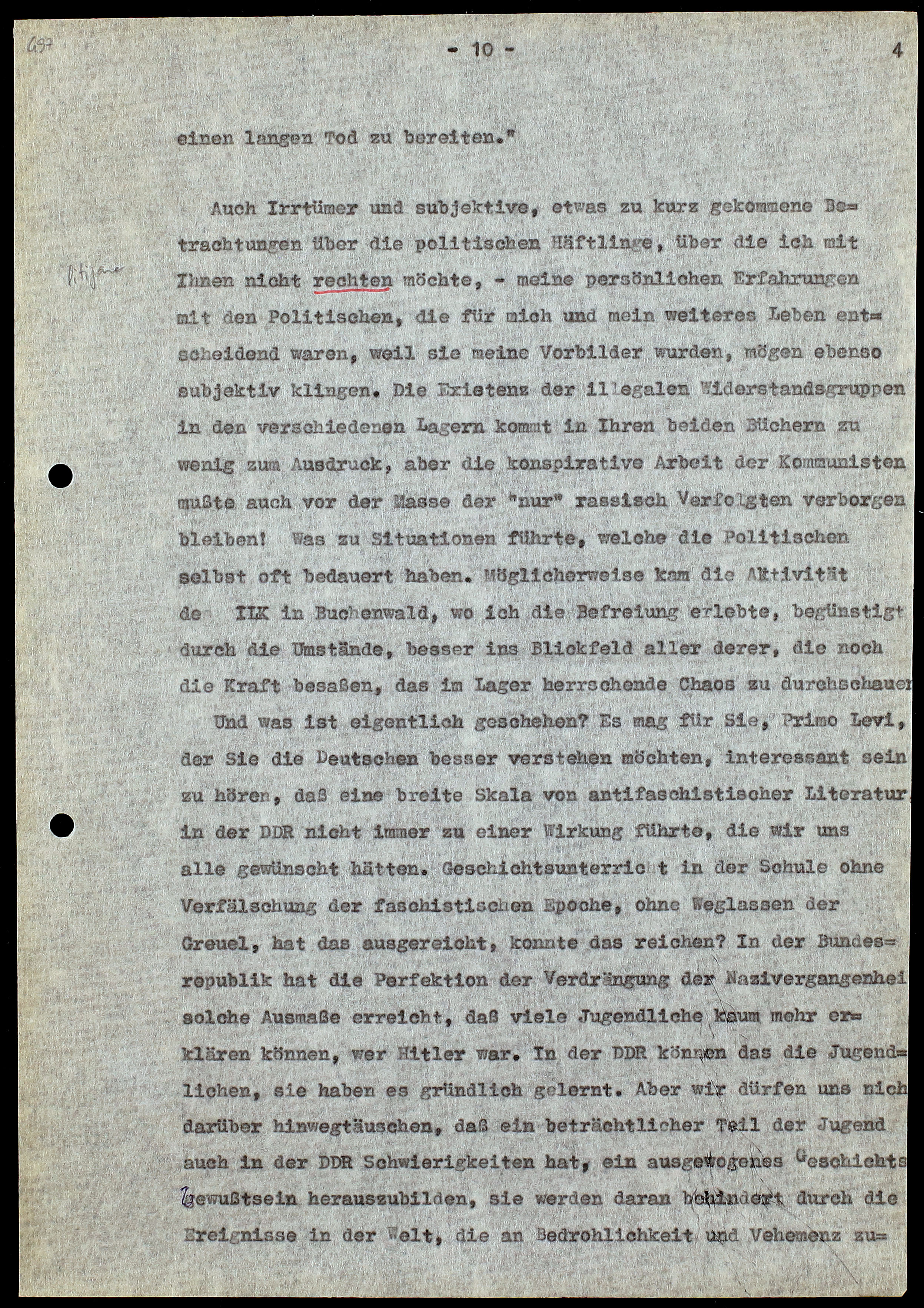
Hier ist Sprache noch in ihrer Ganzheit erhalten geblieben, Sprache der Mittelmeerkulturen? Sprache der Bibel, aus Jahrtausenden gefilterte Weisheit und das Ringen um die ewigen, unvergänglichen, unverwechselbaren Werte, in allen Sprachen und in allen Völkern lebendig geblieben, wo Sinn nicht verkehrt wurde, zu Unsinn, wo Trauer und Scham noch nicht vergiftet sind, und wo Sünde geächtet wird! – Auch Schönheit der Sprache, Genauigkeit und Unbefangenheit der Beobachtung und Poesie, – die der unbefangenen, aufrichtigen und einfachen Rede wie von selbst innewohnende, Anmut und Poesie. Auch Heiterkeit, Abstand zu sich selbst, unbestechliche Ehrlichkeit in der Darstellung menschlichen Versagens, dort wo wir in die Knie gezwungen wurden und um das nackte Dasein zu kämpfen hatten, unter Bedingungen, die vom Menschenfeind diktiert waren: „… der wahrnehmbare Ausdruck seines geometrisch konzipierten Irrsinns und eines fremden Willens, uns zunächst als Menschen zu vernichten, um uns dann einen langen Tod zu bereiten.“[31]
Auch Irrtümer und subjektive, etwas zu kurz gekommene Betrachtungen über die politischen Häftlinge, über die ich mit Ihnen nicht rechten[32]möchte, – meine persönlichen Erfahrungen mit den Politischen, die für mich und mein weiteres Leben entscheidend waren, weil sie meine Vorbilder wurden, mögen ebenso subjektiv klingen. Die Existenz der illegalen Widerstandsgruppen in den verschiedenen Lagern kommt in Ihren beiden Büchern zu wenig zum Ausdruck, aber die konspirative Arbeit der Kommunisten mußte auch vor der Masse der “nur” rassisch Verfolgten verborgen bleibend! Was zu Situationen führte, welche die Politischen selbst oft bedauert haben. Möglicherweise kam die Aktivität des ILK in Buchenwald, wo ich die Befreiung erlebte, begünstigt durch die Umstände, besser ins Blickfeld aller derer, die noch die Kraft besaßen, das im Lager herrschende Chaos zu durchschauen.
Und was ist eigentlich geschehen? Es mag für Sie, Primo Levi, der Sie die Deutschen besser verstehen möchten, interessant sein zu hören, daß eine breite Skala von antifaschistischer Literatur in der DDR nicht immer zu einer Wirkung führte, die wir uns alle gewünscht hätten. Geschichtsunterricht in der Schule ohne Verfälschung der faschistischen Epoche, ohne Weglassen der Greuel, hat das ausgereicht, konnte das reichen? In der Bundesrepublik hat die Perfektion der Verdrängung den Nazivergangenheit solche Ausmaße erreicht, daß viele Jugendliche kaum mehr erklären können, wer Hitler war. In der DDR können das die Jugendlichen, sie haben es gründlich gelernt. Aber wir dürfen uns nicht darüber hinwegtäuschen, daß ein beträchtlicher Teil der Jugend auch in der DDR Schwierigkeiten hat, ein ausgewogenes Geschichtsbewußtsein herauszubilden, sie werden daran behindert durch die Ereignisse in der Welt, die an Bedrohlichkeit und Vehemenz zunehmen, durch den Konsum an Nachrichten, durch die Maschinenwelt, Wohlstandsdenken und Reizüberflutung, – auch durch die manchmal mangelnde Qualität des gesellschaftlich wissenschaftlich en Unterrichts.
Trotzdem, glaube ich, ist die weltweite Auseinandersetzung mit der deutschen Vergangenheit in eine neue Phase getreten, sodaß wir garnicht drum herumkommen, uns nach Büchern wie den Ihren umzusehen, weil sie zu der erwähnten breiten Skala von literarischen Werken eine neue Qualität hinzufügen und die Grundlage bieten könnten, für eine neuartige Diskussion. Zum erstenmal und unmißverständlich dringen Stimmen junger Menschen an unser Ohr: Was ist eigentlich geschehen? Noch kommt die Frage vereinzelt und nicht mit der gebührenden Dringlichkeit, aber niemand glaubt wirklich, daß die Verhältnisse in der Bundesrepublik zur Rückkehr faschistischer Herrschaftsverhältnisse führen könnten, dazu sind die Grundlagen demokratischer Strukturen vorallem in der jungen Generation schon zu stark. Niemand glaubt wirklich an die Explosion der angesammelten nuklearen Sprengkraft über unseren Köpfen. Aber selbstverständlich haben wir keine Beweise, daß die von bedeutenden Wissenschaftern befürchteten Katastrophen aufzuhalten sind.
Und noch einige Worte zu Ihrer Atempause: In die Tiefe geführt, der Vernichtung entgangen, Leben auf die einfachste Formel reduziert, gelernt haben, die ureigensten Kräfte wie einen Funken anzufachen mit einem Atemzug aus Freude, und mit einem Redestrom, einem Credo gleichend, Gluthauch uralter Menschenerfahrung – so beginnt Ihre Erzählung von der Befreiung,[33] ohne Zweifel eines der erregendsten Bücher unserer Zeit!
Dichtung, die vielen anderen Dichtungen voraus hat, auf dem Boden einer unvorstellbar und unbeschreibbar grausamen Wirklichkeit gewachsen zu sein. Und doch liest sich diese Erzählung wie ein Abenteuer, das große Abenteuer vom wiedergefundenen Leben und vom Zauber des Daseins, der sich in den ganz kleinen, aber unbezahlbaren, nicht in Gold aufzuwiegenden Dingen des Lebens spiegelt. Ich weiß nicht – auch Sie gewiß nicht – ob sie dieses tiefe Aufatmen, diese erschütternde Erleichterung des Lesers schon bei der ersten Niederschrift gemeint, gewollt hatten, sicher haben Sie den Titel Atempause erst später gewählt? Wie vom Wind verweht, gerät der Erzähler nach der Befreiung in das weite russische Land und in den breiten Strom versprengter Völkerschaften, den Häftlingen befreiter Lager, den verführten Soldaten aus den ins Land gefallenen fremden Armeen, den Banden unbekannter Herkunft. Eine Fülle von Gestalten und Charakteren, welche jenen Gorkis und Tschechows ebenbürtig sind. Welche liebevolle und unauffällige Betrachtung menschlicher Schwächen, weisen Gleichmuts und naiver Kühnheit.
Von der „absurden Präzision“ und des „geometrisch konzipierten Irrsinns“ der deutschen Lager, von der „Normalität“ sinnloser Folter und Fron, zu all dem, was wirklich normal ist, auch wenn es ums nackte Leben geht, immer noch Hunger, Kälte, Durchhalten…
Das Aufatmen, die Erleichterung und auch die Heiterkeit, die uns unwillkürlich erfaßt, wenn wir von den Nachlässigkeiten, der kindlichen Güte und auch der Schlauheit russischer Soldaten hören. Nicht alles haben Sie gesehen, wir wollen Sie auch darin nicht schelten,[34]von dieser Sicht der kleinen Bauernjungen als Soldaten verkleidet, wäre die Schlagkraft der Roten Armee gegenüber der perfekten deutschen Kriegsmaschinerie, die sie aus den Angeln hob, nicht zu verstehen. Aber die großartige und faszinierende Schilderung der Ereignisse im Waldlager, auch die Verhaltensweisen der russischen Soldaten und Offiziere, selbst wenn sie ein wenig verzeichnet[35] wären und Lächeln hervorrufen, erzeugen in uns Staunen und Bewunderung für die Größe und Seelenstärke und die Leidensfähigkeit des russischen Volkes. Auch wo Sie mit der harten Griffel des intellektuellen Beobachters zeichnen, erwärmen Ihre Bilder unser Gemüt, läßt es uns die Ungeduld nachfühlen, mit der Sie und Ihre Landsleute den Tag der Heimkehr herbeisehnten.
„Nachdem sie aber feststand“, die Abreise, „merkten wir zu unserer eigenen Verwunderung, daß dieses unendliche Land, die Felder und Wälder, wo die Schlachten stattgefunden hatten, denen win unsere Rettung verdankten, daß diese unberührten und lebensfrohen Menschen uns ans Herz gewachsen waren…“[36]
Sie haben uns mit Büchern beschenkt, Primo Levi, von denen ich wünschen würde, daß sie sich die Herzen unserer Jugend erobern. Sie sind nicht nur eine Herausforderung, auch eine Botschaft, und sie sind schön und poetisch in einem ungewöhnlichen Maß!
Fred Wander
Berlin, 1981
Fred Wander A 1150 WIEN Märzstr. 4/20
Berlino, 16 maggio 82[1]
Caro Signor Primo Levi,
mi perdoni se rispondo così tardi alla sua lettera del 22 marzo, ma ultimamente sono stato molto in viaggio e continuerò a esserlo. Uno dei miei amici più cari, Hermann Draer,[2] è morto a Parigi; sono stato quindi a Parigi e più volte a Vienna, perché ho dovuto acquistare un appartamento per offrire un rifugio a mio figlio minore Daniel, che sta per finire la scuola (qui a Berlino) e dall’autunno vivrà a Vienna. Io, invece, manterrò la mia residenza nella DDR, 1020 Berlino, Lichtenbergerstraße 36), e quindi continuerò a vivere tra Vienna e Berlino, fino a nuovo ordine. Naturalmente può continuare a scrivermi a Vienna e anche a mandarmi dei libri,[3] cosa che mi farebbe molto piacere.
La prossima volta sarò di nuovo a Vienna nel mese di giugno. La posta importante mi viene inoltrata a Berlino Ovest, perché una lettera da Vienna a Berlino Est impiega dalle due alle tre settimane, da Parigi quattro settimane e dagli Stati Uniti (per via aerea) due mesi. Tutto ciò complica naturalmente i rapporti, umani e di altro tipo.
Per quanto riguarda i Suoi due libri, potrò avere un colloquio con le persone che hanno posto il veto[4] soltanto in autunno. Ciò comporta che la pubblicazione subirà un rinvio di un anno, sempre che avvenga. Per confortarla vorrei dirle (o forse gliel’ho già detto) che anche il mio Il settimo pozzo era stato bloccato dalle stesse persone e che ho dovuto lottare per un anno intero prima che potesse vedere la luce. [5]
Sono felice che La tregua sia finalmente uscito nella Repubblica Federale anche in edizione tascabile. Lo raccomando con grande entusiasmo a tutti, raccogliendo molta gratitudine. Trovo sconcertante che nell’area di lingua tedesca i Suoi libri non abbiano ancora suscitato l’attenzione che meriterebbero. Continuerò a tenerLa informata sulla pubblicazione dei Suoi libri qui da noi, ma La prego di considerare riservate tutte le informazioni che le do. In realtà, di queste vicende Lei dovrebbe sapere ben poco: qui simili questioni vengono trattate a porte chiuse. Nessuno viene a sapere perché certi libri non debbano andare in stampa. La saluto con grande cordialità e
mi auguro di leggere ancora molti Suoi libri.
Fred Wander
Postfazione[6]
(Da una lettera di Fred Wander a Primo Levi)
Lei ha certamente moltissimi ammiratori tra i Suoi lettori, in molti Paesi, e sa che i migliori sono per lo più quelli che non dicono nulla, non scrivono nulla e, quando hanno occasione di incontrarLa di persona, rimangono silenziosamente sullo sfondo.
Se ora esco dalla schiera di chi ammira in silenzio i Suoi libri per unirmi a quella di chi desidera dare voce ai propri sentimenti e ai propri pensieri, è soltanto perché l’Aufbau-Verlag di Berlino mi ha chiesto di scrivere una postfazione ai Suoi due libri che dovrebbero essere pubblicati qui, Se questo è un uomo e La tregua.
Ci tengo a dirle subito una cosa:[7] soprattutto le prime pagine della Tregua contengono, a mio avviso, quanto di più importante e più bello sia mai stato scritto su questo tema. I Suoi libri non sono soltanto documenti di un passato terribile; sono pieni di verità e dignità, di grazia, di umorismo, di poesia e calore umano. Lei dev’essere certamente una persona molto amabile, e pensare a Lei allarga il cuore. Questa era la premessa; mi perdoni lo slancio giovanile: ho sessantacinque anni, sono un Suo compagno di sofferenza, ebreo, internato fin dall’inizio della guerra nei campi francesi e poi deportato nei campi di concentramento tedeschi, dove sono rimasto fino alla fine.
Da una Sua lettera al traduttore Heinz Riedt apprendiamo:
«Ma non posso dire di capire i tedeschi: ora, qualcosa che non si può capire costituisce un vuoto doloroso, una puntura, uno stimolo permanente che chiede di essere soddisfatto».[8]
Lei conclude poi esprimendo la speranza che forse «la natura di questa eco» suscitata dal Suo libro Le permetterà di capire meglio i tedeschi.
Vorrei ribaltare questa affermazione e azzardare una tesi opposta: soltanto pochissime persone, anche in Germania, hanno davvero compreso questa «più grande esplosione di barbarie a memoria d’uomo» (Adorno),[9] sono cioè in grado di cogliere le cause profonde della catastrofe. Noi abitanti degli spazi di lingua tedesca forse impareremo proprio dall’eco che queste vicende hanno suscitato in altri continenti a comprendere il fenomeno dello sterminio nella «terra dei poeti e dei pensatori». Lei stesso allude, con parole quasi profetiche, alle difficoltà di linguaggio e di pensiero: «Poiché, ed è questo il tremendo privilegio della nostra generazione e del mio popolo, nessuno mai ha potuto meglio di noi cogliere la natura insanabile dell’offesa, che dilaga come un contagio. È stolto pensare che la giustizia umana la estingua. Essa è una inesauribile fonte di male: spezza il corpo e l’anima dei sommersi, li spegne e li rende abietti; risale come infamia sugli oppressori, si perpetua come odio nei superstiti, e pullula in mille modi, contro la stessa volontà di tutti, come sete di vendetta, come cedimento morale, come negazione, come stanchezza, come rinuncia».[10]
Bisogna rileggere queste parole, imprimersele bene nella memoria, non dimenticarle! Se le meditiamo una per una, ci accorgiamo che i Suoi timori si sono rivelati fondati: nella Repubblica Federale, i rapporti di potere e di proprietà che avevano foraggiato[11] il Reich hitleriano e sostenuto i burocrati assassini sono rimasti sostanzialmente immutati; la restaurazione delle strutture politiche, sociali e psicologiche procede in modo continuo e veemente, sia pure sotto il velo della democrazia parlamentare. – Theodor W. Adorno, nel saggio Che cosa significa elaborazione del passato, considera «la sopravvivenza del nazionalsocialismo nella democrazia come potenzialmente più minacciosa della sopravvivenza di tendenze fasciste contro la democrazia»![12]
Nella Repubblica Democratica Tedesca, dopo il 1945 si è fatta piazza pulita del fascismo in modo radicale; l’apparato burocratico e amministrativo di origine nazista è stato smantellato. Come ebreo ed ex deportato nei campi di concentramento, mi permetto di affermare che, a differenza delle sempre più frequenti dichiarazioni pronunciate dagli ebrei tedeschi nella Repubblica Federale, qui il problema dell’antisemitismo per il momento sembra risolto. In ogni caso, nei molti anni trascorsi nella DDR non ho mai subito molestie di questo genere, mentre a Ovest tornano ormai a manifestarsi apertamente, al punto che molti ebrei rientrati in Germania oggi si domandano se non sia stato un errore rimettere piede sul suolo tedesco.
Pur riconoscendo il lavoro fatto qui, nella DDR, se davvero si vuole considerare il «superamento del passato» un lavoro, dovremmo comunque chiederci tutti se gli avvenimenti che si sono verificati in Germania prima del 1945,[13] e soprattutto lo sterminio di gran parte dell’ebraismo tedesco ed europeo, possano essere eliminati dal mondo con un atto politico, attraverso leggi e regolamenti, cioè per via amministrativa.[14] Dovremmo domandarci se l’educazione delle giovani generazioni sia stata davvero compresa nel modo giusto e impartita correttamente; e se non vi sia ancora spazio per migliorare in tal senso tanto il lavoro politico con i giovani quanto l’opera di sensibilizzazione; e se non si stiano insinuando anche qui il cedimento morale, la stanchezza e una tendenza alla rinuncia.[15]
E chi di noi contemporanei, testimoni sopravvissuti, vittime o persone che semplicemente sapevano, potrebbe davvero assolversi dall’accusa di cedimento morale, di stanchezza e di rinuncia, è cioè dall’aver rinunciato a rispondere di sé[16] davanti alla propria coscienza? Sotto questa luce, i Suoi due libri rappresentano una sfida rivolta a tutti noi. Non la sfida di ottenere giustizia,[17] perché questo è impossibile e la storia ce lo dimostra, bensì quella di non desistere nello sforzo di riconquistare il rispetto di noi stessi oppure, laddove forse lo abbiamo ottenuto, di non lasciarcelo sfuggire di nuovo. La verità è tutta qui: non esistono purificazione, superamento o «elaborazione del passato» che si possano realizzate mediante un atto politico, i decreti o il potere. Esiste soltanto la lotta quotidiana con sé stessi;[18] per dirla con Goethe, l’«insaziabile desiderio» di purificazione!
Un grande tema, questo, al quale si dedicano con ostinazione importanti scrittori e pensatori di lingua tedesca: Anna Seghers, Christa Wolf, Franz Fühmann, Stefan Hermlin, Stephan Heym, Peter Weiss, Rolf Hochhuth, Heinrich Böll,[19]Theodor V. Adorno, Max Frisch. L’elenco potrebbe allungarsi molto, e non possiamo ignorare che tanto nella Repubblica Federale quanto altrove si levano nuove voci: non ancora un movimento, ma nuclei nei quali stanno prendendo forma nuovi modi di pensare.
Come individuare la fonte inesauribile del male?[20] Attraverso una sua raffigurazione? Io non considero Se questo è un uomo semplicemente un atto d’accusa, né solo il resoconto di un testimone oculare. È un invito rivolto a ciascuno di noi a misurare, mettere alla prova, affilare su queste pagine i nostri strumenti di riflessione e di osservazione. Non vi troviamo soltanto la descrizione esatta delle forme e delle possibilità della tortura, ma la radiografia di un comportamento in tutte le sue molteplici varianti: un comportamento che vorrei definire (benché non sia questa la sede per tentarne una definizione inoppugnabile) come la deformazione e l’estrema degenerazione [21] del pensiero prussiano-tedesco. La Sua psicologia della vita nel Lager ci mostra che il Lager ne è l’esatta riproduzione, il modello rappreso in caricatura[22] di quel modo di pensare. Se la massima suprema – ordine e obbedienza, cui tutte le altre virtù sono subordinate – può essere stata in certi periodi un salvavita della nazione, ora, come ogni pensiero fuso in dogma, è diventata la forma pietrificata in cui ogni vita soffoca.
«Con la assurda precisione a cui avremmo più tardi dovuto abituarci, i tedeschi fecero l’appello. Alla fine, “Wie viel Stück?” domandò il maresciallo… Qui ricevemmo i primi colpi: e la cosa fu così nuova e insensata che non provammo dolore, nel corpo né nell’anima. Soltanto uno stupore profondo: come si può percuotere un uomo senza collera?» E gli stivaloni invece picchiavano. «Sempre con la pacata sicurezza di chi non fa che il suo ufficio di ogni giorno».[23]
Nessun dolore, soltanto uno stupore profondo. Quando Picasso dipinse la distruzione della città di Guernica, non si limitò a respingere tutte le convenzionali regole accademiche della pittura: si servì di un linguaggio che ancora oggi ben pochi hanno compreso davvero. Nessun atto di denuncia nella forma tradizionale del «J’accuse!», bensì il tentativo di trovare segni nuovi per esprimere il fatto che alla follia dell’uccidere non si può più porre freno ricorrendo alle formule tramandate.
E Tadeusz Różewicz scrive Ripenso all’anno 1945: «Allora mi allontanai dalle fonti dell’estetica. Fonte dell’arte – pensavo – può essere soltanto l’etica; ma entrambe le fonti, l’una come l’altra, si erano prosciugate: “l’assassino ci si era lavato le mani”».[24]
E Lei, Primo Levi, scrive: «Allora per la prima volta ci siamo accorti che la nostra lingua manca di parole per esprimere questa offesa, la demolizione di un uomo». E poi: «…se parleremo, non ci ascolteranno, e se ci ascoltassero, non ci capirebbero. Ci toglieranno anche il nome: e se vorremo conservarlo, dovremo trovare in noi la forza di farlo…».[25]
Trovare in noi stessi la forza di farlo: ma come? Descrivendo la discesa negli abissi con frasi che atterriscono come colpi d’ascia, con sobria tenacia e con quella quiete interiore che segue all’annientamento e nasce dall’aver superato tutto e dalla grazia di essere sopravvissuti; mostrandoci, come su una carta geografica, le stazioni del soffrire umano, il Golgota dei nostri giorni; e tracciando al tempo stesso un’anatomia quasi completa del male. Si rivelano così al lettore le sorgenti di una forza per la quale la nostra lingua non ha parole: inespressa, da ogni riga irradia questa possibilità umana e miracolosa di sopravvivere e di testimoniare!
I numerosi esempi di solidarietà e di dolore presenti nei Suoi due libri ci indicano, come agli assetati, la via verso le sorgenti. Eccone uno che qualche lettore potrebbe non cogliere e che andrebbe invece messo in risalto nei Paesi di lingua tedesca, dove la protervia[26] nei confronti degli altri popoli, soprattutto di quelli orientali, torna a farsi sentire, spesso senza incontrare nessuna opposizione: «Questi pochi superstiti della colonia ebraica di Salonicco, dal duplice linguaggio, spagnolo ed ellenico, e dalle molteplici attività, sono i depositari di una concreta, terrena, consapevole saggezza in cui confluiscono le tradizioni di tutte le civiltà mediterranee. Che questa saggezza si risolva in campo con la pratica sistematica e scientifica del furto e dell’assalto alle cariche, e con il monopolio della Borsa dei baratti, non deve far dimenticare che la loro ripugnanza dalla brutalità gratuita, la loro stupefacente coscienza del sussistere di una almeno potenziale dignità umana, facevano dei greci in Lager il nucleo nazionale più coerente, e, sotto questi aspetti, più civile».[27]
Il degrado di una lingua, laddove tra contenuto e forma si crea una frattura, si manifesta[28] quando scatta il «sensibilissimo sistema di allerta» che abbiamo sviluppato dentro di noi, non appena sentiamo pronunciare in tedesco parole come patria e amor di patria, o efficienza, operosità, ordine, obbedienza e correttezza, dovere e modestia. Almeno dopo che fu reso noto il famigerato discorso pronunciato da Himmler il 4 ottobre 1943 davanti ai capi delle SS, quel degrado della lingua, quella frattura che attraversava l’intera nazione avrebbe dovuto far suonare l’allarme: «È del tutto chiaro: nel nostro programma figurano l’eliminazione degli ebrei, lo sterminio; e noi lo attuiamo… Essere riusciti a portare a termine tutto questo e, salvo eccezioni dovute all’umana debolezza, essere rimasti persone perbene, questo ci ha resi duri. È una pagina gloriosa della nostra storia che non è stata né dovrà mai essere scritta».
Nella Repubblica Federale ancora oggi gli ex generali di Hitler e altri «dignitari» dello Stato criminale possono parlare delle proprie azioni come se fossero state legittime, come se le buone vecchie parole tedesche patria, fedeltà e rispettabilità non fossero mai deragliate; «come se potessimo includere lo Stato nazista in un ordinamento giuridico universale» afferma Jaspers riferendosi alla singolare prassi giudiziaria dei tribunali della Germania federale nel giudicare i crimini nazisti. Ancora oggi gran parte degli ex nazisti, SS, ufficiali, esecutori e gregari continuano a dirsi convinti di essere rimasti persone “perbene” – e proprio nel senso inteso da Himmler –, il più delle volte senza essere contraddetti né contestati. Certo, la realtà ha due facce: attraverso i mezzi di comunicazione di massa si levano anche voci critiche, chiare e inequivocabili; ma, rispetto all’altra parte, sono piuttosto sommesse e limitate. La libertà è divisibile: a molti basta premere un minuscolo pulsante per sottrarsi a ciò che li infastidisce. Una larga parte della popolazione pensa semplicemente: «È passato così tanto tempo, lasciateci finalmente in pace!». Alla menzogna che pervade anche l’opinione pubblica democratica si oppone soltanto una resistenza esitante, a mezza voce, tiepida e con massima indulgenza verso i reazionari al potere. Il cedimento morale e la rinuncia a restituire dignità alle vittime, ma anche alla propria nazione, non sono qui soltanto segni di stanchezza. È questo che «figura nel nostro programma», «del tutto chiaramente»: l’«eliminazione» non più degli ebrei, certo, ma quella di ogni richiesta di riflessione e di ravvedimento, di ripristino della credibilità della parola tedesca!
Nessuno di noi che si sforzi di superare la confusione del linguaggio e l’afasia si illude di poter rimettere il mondo sui suoi cardini con i libri. Ma la forza sorprendente e il profondo sommovimento che sanno suscitare nella loro onestà alcuni libri di Böll, Hochhuth, Frisch, Seghers, Kant, Christa Wolf, Fühmann – non vorrei riprendere ancora una volta l’elenco – dovrebbero indurci a riflettere. Queste opere contribuiranno almeno a preparare il terreno su cui crescerà di nuovo l’erba: non l’erba dell’oblio, ma i germogli di valori nuovi e riconoscibili. La lingua dei Suoi libri, che Heinz Riedt ha tradotto dall’italiano, colpisce per la sua limpidezza e la sua schiettezza, ed è una lingua che spesso richiama quella della Bibbia:
«Meditate che questo è stato:
Vi comando queste parole.
Scolpitele nel vostro cuore
Stando in casa andando per via»[29]
Oppure, all’inizio della Tregua, quando arrivano i primi soldati sovietici nel gennaio 1945: «Non salutavano, non sorridevano; apparivano oppressi, oltre che da pietà, da un confuso ritegno, che sigillava le loro bocche, e avvinceva i loro occhi allo scenario funereo. Era la stessa vergogna a noi ben nota, quella che ci sommergeva dopo le selezioni, ed ogni volta che ci toccava assistere o sottostare a un oltraggio».[30]
Qui la lingua conserva ancora intatta la propria integrità. È la lingua delle civiltà mediterranee? La lingua della Bibbia? Una sapienza filtrata da millenni e la lotta per quei valori eterni, imperituri e inconfondibili che continuano a vivere in tutte le lingue e in tutti i popoli, là dove il senso non è stato capovolto nell’insensato, dove il dolore e la vergogna non sono ancora stati avvelenati e dove il peccato viene messo al bando! E ancora c’è bellezza, precisione e limpidezza dello sguardo e poesia – o meglio grazia e poesia – che abita spontaneamente la parola semplice, onesta, limpida. E poi serenità, capacità di prendere le distanze da sé stessi, onestà incorruttibile con cui viene rappresentato il fallimento umano, quando siamo stati costretti in ginocchio a lottare per la nuda sopravvivenza, in condizioni dettate da chi era nemico dell’uomo: «l’espressione sensibile della sua follia geometrica, della volontà altrui di annullarci prima come uomini, per poi ucciderci lentamente».
Vi sono anche errori e giudizi soggettivi, forse un po’ troppo riduttivi, sui prigionieri politici, sui quali non desidero polemizzare[31] con Lei. Le mie esperienze personali con i politici, decisive per la mia vita perché in loro ho trovato i miei modelli, potranno sembrare altrettanto soggettive. L’esistenza dei gruppi clandestini di resistenza attivi nei vari Lager trova, a mio avviso, troppo poco spazio nei Suoi libri; ma il lavoro cospirativo dei comunisti doveva necessariamente rimanere nascosto anche alla massa di chi era stato deportato «solo» per motivi razziali. Ne sono derivate situazioni che gli stessi deportati politici hanno spesso avuto motivo di deplorare. È possibile che l’attività del Comitato internazionale del Lager (ILK) a Buchenwald, dove io ho assistito alla liberazione, favorita anche dalle circostanze, sia entrata meglio nel campo visivo di quanti conservavano ancora la forza di orientarsi nel caos del Lager.
E che cosa è successo in realtà? Per Lei, Primo Levi, che desidera comprendere meglio i tedeschi, potrebbe essere interessante sapere che l’ampio panorama della letteratura antifascista nella DDR non ha sempre prodotto gli effetti che tutti noi avremmo sperato. L’insegnamento della storia nelle scuole, senza le falsificazioni dell’epoca nazista e senza occultarne gli orrori, è bastato? Poteva bastare? Nella Repubblica Federale la rimozione del passato nazista ha raggiunto un tale grado di perfezione che molti giovani non sanno quasi più spiegare chi fosse Hitler. Nella DDR, invece, i giovani lo sanno fare: loro lo hanno imparato a dovere. Ma non dobbiamo illuderci. Anche qui una parte considerevole della gioventù fatica a sviluppare una coscienza storica equilibrata. A ostacolarla concorrono gli eventi del mondo, sempre più minacciosi e incalzanti, il flusso continuo di notizie, la civiltà delle macchine, la mentalità del benessere, il sovraccarico di stimoli e, a volte, anche la qualità non sempre soddisfacente dell’insegnamento delle discipline storico-sociali.
Eppure credo che il dibattito internazionale sul passato tedesco sia entrato in una nuova fase. Per questo non possiamo fare a meno di tornare a libri come i Suoi, perché aggiungono una qualità nuova a quel vasto panorama di opere letterarie citato prima e potrebbero costituire il punto di partenza di una discussione nuova. Per la prima volta ci giungono, chiare e inequivocabili, le voci dei giovani che domandano: «Che cosa è successo in realtà?». Per ora questa domanda si leva ancora isolata e non con tutta l’urgenza che meriterebbe; e tuttavia nessuno crede davvero che nella Repubblica Federale possano tornare forme di regime fascista: le strutture democratiche, soprattutto fra le giovani generazioni, sono ormai troppo solide. Nessuno crede davvero nemmeno che l’immensa potenza nucleare accumulata sulle nostre teste finirà per esplodere. Ma, naturalmente, non abbiamo alcuna prova che le catastrofi paventate dai più autorevoli scienziati possano davvero essere evitate.
E ancora qualche parola sulla Tregua. Essere stati condotti negli abissi, essere scampati all’annientamento, aver ridotto la vita alla sua formula più elementare, aver imparato ad attizzare le forze più intime come una scintilla con un soffio di gioia, e poi un fiume di parole simile a un credo, alito incandescente di un’antichissima esperienza umana: così comincia il Suo racconto della liberazione,[32] senza dubbio uno dei libri più emozionanti del nostro tempo!
Un’opera letteraria che ha, rispetto a molte altre, il privilegio di essere cresciuta sul terreno di una realtà inconcepibilmente e indescrivibilmente crudele. Eppure questo racconto si legge come un’avventura: la grande avventura della vita ritrovata e dell’incanto dell’esistenza, che si riflette nelle cose piccolissime della vita, inestimabili, non barattabili con tutto l’oro del mondo. Non so – e certamente non lo sa neppure Lei – se questo profondo respiro di sollievo, questo senso di liberazione sconvolgente che suscita nel lettore Lei lo avesse inteso e voluto fin dalla prima stesura. Avrà scelto soltanto in seguito il titolo, che in tedesco suona come “Pausa per respirare”? Dopo la liberazione il narratore viene trascinato, come sospinto dal vento, nell’immensità della terra russa e nel vasto flusso di popoli dispersi: i prigionieri dei campi liberati, i soldati traviati degli eserciti stranieri che avevano invaso il Paese, le bande di origine sconosciuta. Una moltitudine di figure e di caratteri paragonabili a quelli di Gor’kij e Čechov. Quanta partecipe e discreta attenzione per le debolezze umane, per la saggia imperturbabilità e per l’ingenua audacia.
Dall’«assurda precisione» e dalla «follia geometrica» dei Lager tedeschi, dalla “normalità” della tortura insensata e del lavoro coatto, si torna a tutto ciò che è veramente normale, anche quando è ancora in gioco la nuda sopravvivenza: la fame, il freddo, la necessità di resistere. Il respiro di sollievo, la liberazione e anche la serenità che ci prendono istintivamente quando leggiamo della trascuratezza, della bontà infantile e anche dell’astuzia dei soldati russi. Lei non ha visto tutto, e non intendiamo certo rimproverarLa[33] per questo: dalla sola immagine di quei giovani contadini travestiti da soldati non si riuscirebbe a comprendere la forza d’urto dell’Armata Rossa, che riuscì a scardinare la perfetta macchina bellica tedesca. Ma la grandiosa e affascinante descrizione degli avvenimenti nell’acquartieramento nel bosco, e anche dei comportamenti dei soldati e degli ufficiali russi, quand’anche fossero leggermente deformati[34] e suscitassero un sorriso, genera in noi stupore e ammirazione per la grandezza, la forza d’animo e la capacità di sopportare il dolore del popolo russo. Anche là dove disegna con il duro stilo dell’osservatore intellettuale, le Sue immagini ci scaldano l’anima e ci consentono di condividere l’impazienza con cui Lei e i Suoi connazionali anelavate al giorno del ritorno a casa.
«Quando la partenza fu certa, ci accorgemmo, con nostra stessa meraviglia, che quella terra sterminata, quei campi e quei boschi che avevano visto la battaglia a cui dovevamo la salvezza, quegli orizzonti intatti e primordiali, quella gente vigorosa e amante della vita, ci stavano nel cuore».[35]
Lei, Primo Levi, ci ha fatto dono di libri che vorrei conquistassero il cuore dei nostri giovani. Non sono soltanto una sfida, ma anche un messaggio, e hanno una bellezza e una forza poetica davvero fuori del comune!
Fred Wander
Berlino, 1981
Fred Wander A 1150 VIENNA Märzstr. 4/20
Berlin, May 16, 1982[1]
Dear Mr. Primo Levi,
Please excuse the late reply to your letter of March 22, but I have been traveling a great deal lately and will continue to do so. One of my best friends in Paris, Hermann Draer,[2] passed away, so I was in Paris and in Vienna several times because I had to buy an apartment there to provide a safe haven for my youngest son, Daniel, who is now finishing school (here in Berlin) and will be living in Vienna starting this fall. I myself am keeping my residence at 1020 Berlin/DDR, Lichtenbergerstr. 36, and will therefore be living in both Vienna and Berlin until further notice. Of course, you can continue to write to me in Vienna and also send books,[3] which would give me great pleasure.
I will be back in Vienna again in June. Important mail is forwarded to me in West Berlin, because a letter from Vienna to DDR Berlin takes two to three weeks, from Paris four weeks, and from the U.S. (airmail) two months. All of this, of course, complicates all personal and other relationships.
As for your two books, I will only be able to have a meeting in the fall with the people who vetoed them.[4] This means a one-year delay, if they are even published at all. Should it be any consolation, I would like to tell you (or perhaps have already) that my The Seventh Well was also blocked by the same people, and I had to fight for a full year to get it published.[5]
I am delighted that your book The Truce has now also been published in paperback in West Germany. I recommend it to everyone with great enthusiasm, and they always thank me for doing so. I find it astonishing that your books have not yet caused the stir they deserve in German-speaking countries. I will continue to write to you about the status of your books’ publication here, but please treat all my information as confidential; in fact, you should know very little about it, as such matters are handled behind closed doors here. No one finds out why certain books are not to be published. I send you my warmest regards and
look forward to even more books from you
Fred Wander
Afterword[6]
(From a letter: Fred Wander to Primo Levi)
You surely must have a great deal of admirers among your readers, in many countries, and you know that the best admirers are usually those who say nothing, write nothing, and, when they meet you in person, silently stay in the background.
If I have now chosen to step forward from the ranks of your books’ silent admirers to join the ranks of those who express their feelings and thoughts through words, it is only because the Berlin-based publisher Aufbauverlag has asked me to write an afterword for your two books (If This is a Man and The Truce) that are to be published here.
I would like to say right up front[7] that, especially in the opening pages of your story The Truce, I find the most significant and beautiful sentences that I have ever read on this subject. Not only do your books document a terrible past, they are also full of truth and human dignity, they are also full of spiritual grace, wit, poetry, and warmth. You must certainly be a very endearing person, and thinking of you brings one joy. This is merely an introduction; please forgive my youthful exuberance; I am 65 years old, a fellow survivor, Jewish, imprisoned in French camps from the start of the war, then deported and held in German concentration camps until the end.
From your letter to German translator Heinz Riedt, we learn:
“Yet I cannot say that I understand the Germans. And what one cannot understand creates a painful void; it is a thorn, a constant urge demanding to be fulfilled.”[8]
You then conclude with the hope that perhaps “the resonance” of your book will allow you to understand the Germans better.
I would like to turn this statement on its head and venture the claim that very few people, even in Germany, have understood this “greatest outbreak of barbarism in living memory” (Adorno),[9] are capable of perceiving the deep underlying causes of the catastrophe, and that we, the inhabitants of German-speaking regions, may perhaps learn from the reverberations of events elsewhere to comprehend the phenomenon of genocide in the “land of poets and thinkers.” You yourself allude to the difficulties of language and thought in almost prophetic words: “Since—and this is the tremendous privilege of our generation and of my people—no one could ever grasp better than us the incurable nature of the offense, which spreads like an infection, it is foolish to think that it can be abolished by human justice. It is an inexhaustible source of evil: it breaks the body and soul of those who are drowned, extinguishes them and makes them abject; rises again as infamy in the oppressors, is perpetuated as hatred in the survivors, and springs up in a thousand ways, against the very will of all, as a thirst for revenge, as moral breakdown, as negation, as weariness, as resignation.”[10]
We must repeat these sentences, commit them to memory, and never forget them! For if we hold them before our eyes, word for word, we will find that your fears were justified: The power structures and distribution of wealth in the Federal Republic of Germany—which pampered[11] Hitler’s regime and administrative murderers—have remained unchanged; the restoration of not only political, social, and psychological forces is an ongoing, vehement process, albeit under the guise of parliamentary democracy. – In his essay The Meaning of Working Through the Past, Theodor W. Adorno views the lingering influence of National Socialism “in a democracy as a potentially greater threat than the lingering influence of fascist tendencies against democracy”![12]
In the DDR, fascism was thoroughly eradicated after 1945; the civil service and administrative apparatus of Nazi origin was dismantled. As a Jew and a former concentration camp prisoner, I take the liberty of noting that, in contrast to the increasingly frequent statements by German Jews in the Federal Republic, the problem of anti-Semitism here appears to have been resolved for the time being; at any rate, during my many years living in the DDR, I never experienced any harassment of the kind that is once again openly manifesting itself over there—to such an extent that many Jews who have returned are now asking whether it was a mistake to set foot on German soil again.
While fully acknowledging the work accomplished here (in the DDR)—if one wishes to regard “coming to terms with the past” as work—we should nevertheless all ask ourselves whether the events in Germany prior to 1945,[13] above all the extermination of a large portion of both the German and European Jewish communities, can be eradicated through a political act, through laws and regulations—that is, administratively.[14] Has the education of young people been properly understood? Is it being taught correctly? Is there not still room for improvement in both political work with young people and general education in this regard? Have moral compromise, fatigue, and resignation not crept in here as well?[15]
And who among us contemporaries, surviving eyewitnesses, victims, or those privy to the truth could absolve oneself of the accusation of moral complacency, weariness, and resignation—namely, the resignation from being able to at least stand firm before ourselves![16] Seen in this light, your two books challenge us all not to seek to attain justice,[17] for that is impossible, as we are shown, but rather not to give up in our efforts to regain our self-respect, or, where we may have attained it, not to let it slip away again, for this is the whole truth: There is no purification, no coming to terms, and no “coming to terms with the past” through a political act, through decrees, or through power, but only the daily “struggle with oneself,”[18]—to use Goethe’s words, the “insatiable longing” for purification!
This is a major theme, to which prominent German writers and thinkers have tenaciously devoted themselves: Anna Seghers, Christa Wolf, Franz Fühmann, Stefan Hermlin, Stephan Heym, Peter Weiss, Rolf Hochhuth, Heinrich Böll,[19]Theodor V. Adorno, Max Frisch.—the list could be extended considerably—and we cannot ignore the fact that, both in the Federal Republic and elsewhere, new voices are rising; not yet a movement, but seeds of new approaches to thought.
The inexhaustible source of evil—how can it be identified?[20] Through description? I do not view your book If This is a Man simply as an indictment or merely as an eyewitness account; it is a call to each of us to measure, examine, and sharpen our tools of reflection and observation against it. Not merely a precise description of the methods of torture, but an X-ray of a mode of behavior, in all its complex variations, which I would like to describe (there is no room here for a watertight definition) as a distorted image and the ultimate offspring[21] of Prussian-German thought. Your psychology of camp life shows us: The camp is the exact reflection, the pattern of this way of thinking that has solidified into a caricature.[22] If the supreme maxim of command and obedience, to which all other virtues are subordinated, is said to have saved lives at certain times, then, like any way of thinking fused into dogma, it has now become the petrified form in which every life suffocates.
“With the absurd precision to which we later had to accustom ourselves, the Germans held the roll call. At the end the officer asked ‘Wieviel Stück?’… Here we received the first blows: and the thing was so new and senseless that we felt no pain, in either body or spirit. Only a profound amazement: how can one strike a man without anger?” Yet the men in boots struck. And “They had the calm assurance of people merely doing their normal, everyday duty.” [23]
No pain, only deep astonishment. When Picasso painted the destruction of the city of Guernica, he not only cast aside all conventional academic rules of painting, but also employed a language that even today very few people have truly understood. Not an accusation in the traditional form, “j’accuse!,” but an attempt to find new symbols for the fact that the senselessness of murder can no longer be halted with traditional formulas.
And Tadeusz Różewicz says (in “I think back to the year 1945”): “I turned away from aesthetic sources back then. The source of art—I thought—can only be ethics, but both sources, one as well as the other, had dried up; ‘the murderer had washed his hands of it.’”[24]
And you, Primo Levi, write: “Then for the first time we become aware that our language lacks words to express this offense, the demolition of a man.” Then, a little further on: if we speak, they will not listen to us, and if they listened, they would not understand. They will take away even our name: and if we want to keep it, we will have to find in ourselves the strength to do so…”[25]
Finding the strength within ourselves—how does one do that? By describing the descent into the depths, with sentences that strike fear like blows of an axe, with dispassionate perseverance and the inner calm that follows annihilation, born of having overcome it, of the grace of having survived—and by showing us, as if on a map, the stations of human suffering, a present-day Golgotha, while at the same time sketching an almost complete anatomy of evil, the sources of strength for which even our language has no words are revealed to the reader: unspoken, this human and magical possibility of surviving and bearing witness resonates from every line!
Many examples of solidarity and mourning in your two books point us—like the thirsty—toward the springs. One example that some readers might overlook, and which should be highlighted, especially in German-speaking countries where arrogance[26] toward other peoples, particularly those from the East, is once again making itself felt, often unchallenged: “These few survivors from the Jewish colony of Salonika, with their two languages, Spanish and Greek, and their numerous activities, are the repositories of a concrete, worldly, conscious wisdom, in which the traditions of all the Mediterranean civilizations converge. In the camp this wisdom has been transformed into the systematic and scientific practice of theft and seizure of posts of authority, and into a monopoly on the barter Market. But this should not let us forget that their aversion to gratuitous brutality, their amazing consciousness of the survival of at least the potential of human dignity, made the Greeks the most coherent national group in the Lager and, in this respect, the most civilized.”[27]
The decay of a language, where content and form diverge, where the “highly sensitive signaling system” we have developed within is triggered[28] when we hear the German words “Heimat” and “love of the fatherland,” or “competence,” “diligence,” “order,” “obedience,” and “correctness,” “duty,” and “modesty”—most recently, following Himmler’s infamous speech to SS leaders on October 4, 1943—this decay of language, this rift running right through this nation, should set off alarm bells: “It is quite clear: our program calls for the elimination of the Jews, their extermination—and that is what we are doing… To have carried this through and, in doing so—apart from exceptions due to human weakness—to have remained decent, that has toughened us. This is a glorious chapter in our history that has never been written and will never be written.”
In the Federal Republic of Germany today, Hitler’s former generals and other “dignitaries” of that criminal state are still allowed to speak of their deeds as if they had been lawful, as if the good old German words “fatherland,” “loyalty,” and “decency” had never strayed from the norm, “as if we could incorporate the Nazi state into a world order based on the rule of law,” says Jaspers, referring to the strange jurisprudence of German federal courts in their handling of Nazi crimes. Even today—and entirely in keeping with Himmler’s spirit—the majority of former Nazis, SS members, officers, perpetrators, and followers still believe they have remained “decent,” mostly unchallenged and uncontested. Admittedly, there is also another side; the mass media do convey criticism—clear and unambiguous—but compared to the first side, it is rather meek and limited. Freedom is divisible; for many involved, it is enough to press a tiny button to escape the annoyance. A large part of the population simply thinks: “It’s over now, so let’s finally be done with it!” The hypocrisy, even within the democratic public sphere, is confronted only timidly—in a half-hearted voice, with lukewarm conviction, and with the utmost leniency toward the ruling reactionaries. Moral capitulation and the refusal to restore the dignity of the victims—as well as the dignity of our own nation—are not merely signs of weariness here, but rather—as “it says in our program,” “quite clearly”—the “elimination,” not of Jews this time, but of any demand for reflection and repentance, for the restoration of the credibility of German discourse!
None of us who strive to overcome linguistic confusion and speechlessness harbor the illusion that we could set the world right again with books. But the surprisingly powerful impact and inner stirrings evoked by some forthright books by Böll, Hochhuth, Frisch, Seghers, Kant, Christa Wolf, Fühmann—I do not wish to repeat the list—should make us sit up and take notice; they will at least help prepare the ground on which grass grows again—not the grass of oblivion, but the sprouts of new and recognizable values. The language in your books, translated from Italian by Heinz Riedt, is refreshingly clear and sincere—a language that often has a biblical quality:
“Ponder that this happened:
I consign these words to you.
Carve them into your hearts
At home or on the street…”[29]
Or at the beginning of The Truce, the arrival of the first Soviet soldiers in January 1945: “They didn’t greet us, they didn’t smile; they appeared oppressed, not only by pity but by a confused restraint, which sealed their mouths, and riveted their eyes to the mournful scene. It was a shame well-known to us, the shame that inundated us after the selections and every time we had to witness or submit to an outrage…”[30]
Here, language has been preserved in its entirety. Is it the language of Mediterranean cultures? The language of the Bible, wisdom filtered through millennia and the struggle for eternal, imperishable, unmistakable values, which have remained alive in all languages and among all peoples where meaning has not been perverted into nonsense, where grief and shame are not yet poisoned, and where sin is ostracized! – Also the beauty of language, the precision and impartiality of observation and poetry, – the grace and poetry inherent in unbiased, sincere, and simple speech. Also cheerfulness, detachment from the self, incorruptible honesty in the portrayal of human failure, where we were brought to our knees and had to fight for our bare existence, under conditions dictated by the enemy of humanity: the perceptible expression of its geometric madness, of the resolution of others to annihilate us first as men, in order to kill us slowly afterward.”
Even errors and subjective, somewhat incomplete observations about political prisoners—about which I do not wish to argue with you,[31] as my personal experiences with political prisoners were decisive for me and the rest of my life because they became my role models—may sound just as subjective. The existence of illegal resistance groups in the various camps is not sufficiently reflected in your two books, but the conspiratorial work of the communists had to remain hidden even from the masses of those “merely” persecuted on racial grounds! This led to situations that the political prisoners themselves have often regretted. It is possible that the activities of the ILK in Buchenwald—where I experienced liberation—came into sharper focus for all those who still had the strength to see through the chaos reigning in the camp, thanks to the circumstances.
And what actually did happen? It may be of interest to you, Primo Levi, who wish to understand the Germans better, to hear that a wide range of anti-fascist literature in the DDR did not always have the effect we all would have wished for. History lessons in school that did not distort the fascist era and did not omit the atrocities—was that enough? Could that have been enough? In the Federal Republic, the perfection of repression has reached such proportions that many young people can barely explain who Hitler was. In the DDR, young people can do so; they have learned it thoroughly. But we must not delude ourselves into thinking that a considerable portion of the youth in the DDR, too, finds it difficult to develop a balanced historical consciousness; they are hindered in this by world events that are growing in menace and intensity, by their consumption of news, by the machine-driven world, the pursuit of affluence, and sensory overload—as well as by the sometimes poor quality of social studies and science education.
Nevertheless, I believe that the global examination of Germany’s past has entered a new phase, so that we simply cannot avoid looking for books like yours, because they add a new dimension to the broad range of literary works already mentioned, and could provide the foundation for a new kind of discussion. For the first time, and in no uncertain terms, the voices of young people are reaching our ears: What actually happened? The question is still being asked only sporadically and without the urgency it deserves, but no one truly believes that conditions in the Federal Republic could lead to a return to fascist rule; the foundations of democratic structures, especially among the younger generation, are already too strong for that. No one truly believes that the accumulated nuclear explosive power will detonate above our heads. But, of course, we have no proof that the catastrophes feared by leading scientists can be prevented, either.
And a few more words about your book The Truce: Led into the depths, having escaped annihilation, life reduced to its simplest form, having learned to kindle one’s very own inner forces like a spark with a breath of joy, and with a torrent of speech akin to a credo, a breath of embers from ancient human experience—thus begins your tale of liberation,[32] without a doubt one of the most thrilling books of our time!
This is a work of literature that stands head and shoulders above many others, having grown out of an unimaginably and indescribably cruel reality. And yet this narrative reads like an adventure—the great adventure of life rediscovered, and of the magic of existence reflected in the tiny yet priceless things in life that no amount of gold could ever equal. I do not know—and I am sure neither do you—whether you intended or sought to evoke this deep sigh of relief, this overwhelming sense of relief in the reader, even in the first draft; surely you chose only later the title, which in German means also “a pause to catch one’s breath”? As if swept away by the wind, after his liberation the narrator finds himself in the vast Russian countryside and swept up in the broad current of scattered peoples—the prisoners from liberated camps, the strayed soldiers from the foreign armies that had invaded the country, and gangs of unknown origin. A wealth of figures and characters on par with those of Gorky and Chekhov. What a loving and unobtrusive observation of human weaknesses, sage equanimity, and naïve boldness.
From the “absurd precision” and the “geometrically conceived madness” of the German camps, from the “normality” of senseless torture and forced labor, to everything that is truly normal—even when it comes to the bare fact of survival—still hunger, cold, perseverance… The sigh of relief, the sense of ease, and even the cheerfulness that involuntarily overtakes us when we hear of the carelessness, the childlike kindness, and also the shrewdness of Russian soldiers. You have not seen everything, and we do not want to reproach[33] you, for without this perspective of the young peasant boys disguised as soldiers, the Red Army’s effectiveness against the perfect German war machine—which it tore apart—would be impossible to understand. But the magnificent and fascinating account of the events in the forest camp—including the behavior of the Russian soldiers and officers, even if it is somewhat exaggerated[34] and elicits a smile—instills in us a sense of wonder and admiration for the Russian people’s greatness, fortitude, and capacity for suffering. Even when you sketch with the sharp pen of the intellectual observer, your images warm our hearts, allowing us to empathize with the impatient longing you and your compatriots felt for the day of your return home.
“When departure was certain, we realized, with the same wonder, that that boundless land, those fields and woods that had seen the battle to which we owed our salvation, those untouched and primordial horizons, that vigorous and life-loving people, were in our hearts, had penetrated us, and would long remain there…”[35]
You have given us books, Primo Levi, that I hope will capture the hearts of our youth. They are not only a challenge but also a message, and they are extraordinarily beautiful and poetic!
Fred Wander
Berlin, 1981
Fred Wander A 1150 WIEN Märzstr. 4/20
Berlin, 16. 5.82[1]
Lieber Herr Primo Levi,
bitte entschuldigen Sie die späte Antwort auf Ihren Brief vom 22. März, aber ich war in letzter Zeit sehr viel auf Reise und werde es weiter sein. Einer meiner besten Freunde Hermann Draer[2] in Paris ist gestorben und ich war in Paris und mehrmals in Wien, weil ich dort eine Wohnung kaufen mußte, um meinem jüngsten Sohn Daniel ein Asyl bieten zu können, er verläßt jetzt die Schule (hier in Berlin) und wird ab Herbst in Wien leben. Ich selbst behalte meinen Wohnsitz 1020 Berlin/DDR, Lichtenbergerstr. 36, und werde also in Wien und in Berlin wohnen, bis auf weiteres. Selbstverständlich können Sie weiter nach Wien schreiben und auch Bücher schicken,[3] was mich sehr freuen würde.
Ich werde das nächstemal wieder im Juni in Wien sein. Wichtige Post wird mir nach Westberlin nachgeschickt, denn ein Brief von Wien nach Berlin-DDR braucht zwei bis drei Wochen, von Paris vier Wochen, von den USA (Luftpost) zwei Monate. Das alles erschwert natürlich alle menschlichen und auch andere Beziehungen.
Was nun Ihre beiden Bücher betrifft, werde ich im Herbst erst eine Aussprache haben, mit jenen Leuten, die ein Veto einlegten.[4] Das bedeutet ein Jahr Aufschub des Erscheinens Ihrer Bücher, wenn überhaupt. Zum Trost möchte ich Ihnen sagen (oder habe es schon gesagt) daß auch mein Siebenter Brunnen von den gleichen Leuten verhindert wurde und ich ein Jahr lang kämpfen mußte, damit das Buch erscheinen konnte.[5]
Ich freue mich, daß Ihr Buch Atempause nun auch in einer Taschenbuchausgabe in der Bundesrepublik erschienen ist. Ich empfehle es allen Leuten mit großem Eifer und ernte viel Dank dafür. Ich finde es erstaunlich, daß Ihre Bücher in deutschsprachigem Gebiet noch nicht jenes Aufsehen erregen, das sie verdienen. Ich werde Ihnen weiter schreiben, wie es hier um den Druck Ihrer Bücher steht, aber bitte behandeln Sie alle meine Informationen als vertraulich, eigentlich sollten Sie wenig davon erfahren, solche Dinge werden hier unter Ausschluß der Öffentlichkeit behandelt. Niemand erfährt, warum manche Bücher nicht erscheinen sollen. Ich begrüße Sie sehr herzlich und
wünsche mir noch mehr Bücher von Ihnen
Fred Wander
Nachwort[6]
(Aus einem Brief: Fred Wander an Primo Levi)
Sie haben gewiß sehr viele Verehrer unter Ihren Lesern, in vielen Ländern, und Sie wissen – die besten Verehrer sind meist diejenigen, die nichts sagen, nicht schreiben und wenn sie Ihnen persönlich begegnen, sich schweigend im Hintergrund halten.
Wenn ich nun aus der Reihe der stillen Verehrer Ihrer Bücher in die Reihe der anderen trete, die ihren Gefühlen und Gedanken Ausdruck geben möchten, dann nur, weil der Aufbau-Verlag in Berlin mich gebeten hat, Ihnen beiden Büchern, die hier erscheinen sollen (Ist das ein Mensch und Atempause) ein Nachwort beizufügen.
Ich möchte gleich vorweg nehmen:[7] Vorallem auf den ersten Seiten Ihrer Erzählung Atempause finde ich die bedeutendsten und schönsten Sätze zu diesem Thema, die ich kenne. Ihre Bücher sind nicht nur Dokumente einer schrecklichen Vergangenheit, sie sind voll Wahrheit und Würde, Anmut des Geistes, Witz und Poesie und Wärme. Sie sind gewiß ein sehr liebenswerter Mensch und das Denken an Sie macht froh! Das ist die Vorrede, verzeihen Sie meinen jugendlichen Überschwang, ich bin 65 Jahre alt, ein Leidensgenosse, Jude, Häftling seit Beginn des Krieges in französischen Lagern, dann deportiert und bis zum Ende in deutschen Konzentrationslagern.
Aus Ihren Brief an den Übersetzer Heinz Riedt erfahren wir:
„Doch ich kann nicht sagen, daß ich die Deutschen verstehe. Und was man nicht verstehen kann, bildet eine schmerzhafte Leere, ist ein Stachel, ein dauernder Drang, der Erfüllung fordert.“[8]
Sie schließen dann mit der Hoffnung, daß Ihnen vielleicht „die Natur des Widerhalls“ Ihres Buches, erlauben wird, die Deutschen besser zu verstehen.
Ich möchte diesen Satz auf den Kopf stellen und die Behauptung wagen, daß nur sehr wenige Menschen, auch in Deutschland, diesen „größten Ausbruch der Barbarei seit Menschengedenken“ (Adorno)[9] verstanden haben, die tiefen Hintergründe der Katastrophe wahrzunehmen imstande sind und daß wir Bewohner deutscher Sprachräume vielleicht an dem Widerhall der Ereignisse in anderen Hemisphären lernen werden, das Phänomen des Völkermordes im „Lande der Dichter und Denker“ zu begreifen. Sie selbst deuten die Sprach- und Denkschwierigkeiten in fast prophetischen Worten an: „Daher – und dies ist das ungeheuerliche Privileg unserer Generation und meines Volkes – hat niemals jemand besser als wir die unheilbare Natur der Versündigung begreifen können, die sich ausbreitet wie eine ansteckende Krankheit. Es ist unsinnig zu glauben, sie könne durch menschliche Gerechtigkeit getilgt werden. Sie ist eine unerschöpfliche Quelle des Bösen: Sie zerbricht Körper und Seele der Betroffenen löscht sie aus und erniedrigt sie; sie fällt als Schande auf die Unterdrücker zurück, schwelt als Haß in den Überlebenden fort und wuchert weiter auf tausend Arten, gegen den Willen aller, als Rachedurst, als moralisches Nachgeben, als Müdigkeit und Verzicht“.[10]
Man muß diese Sätze widerholen, sie sich fest einprägen, darf sie nicht vergessen! Denn wenn wir sie Wort für Wort uns vor Augen führen, werden wir finden, daß Sie in Ihren Befürchtungen recht behalten haben: Die Macht- und Besitzverhältnisse in der Bundesrepublik, welche das Hitlerreich und die Verwaltungsmörder aufgepäppelt[11] haben, sind unangetastet die gleichen geblieben, die Restauration nicht nur der politisch-sozialen und psychologischen Kräfte ist ein fortschreitender, vehementer Prozeß, wenn auch unter dem Deckmantel Parlamentarischer Demokratie. – Das Nachleben des Nationalsozialismus betrachtet Theodor W. Adorno in seinem Essay Aufarbeitung der Vergangenheit
– „in der Demokratie als potentiell bedrohlicher, denn das Nachleben faschistischer Tendenzen gegen die Demokratie“![12]
In der DDR wurde nach 1945 mit dem Faschismus gründlich/aufgeräumt, der Beamten- und Verwaltungsapparat nazistischer Herkunft wurde zerstört, als Jude und ehemaliger KZ-Häftling erlaube ich mir festzustellen, daß im Gegensatz zu den in der Bundesrepublik sich häufenden Erklärungen von deutschen Juden, hier das Problem des Antisemitismus zunächst gelöst erscheint, jedenfalls sind mir in vielen Jahren des Aufenthaltes in der DDR keine Belästigungen solcher Art widerfahren, wie sie drüben sich wieder offen zeigen, in dem Maße, daß viele zurückgekehrte Juden heute fragen, ob es nicht ein Fehler war, deutschen Boden wieder zu betreten.
Bei aller Anerkennung der hier (in der DDR) geleisteten Arbeit, wenn man die „Bewältigung der Vergangenheit“ als Arbeit betrachten will, sollten wir uns jedoch alle die Frage stellen, ob die Ereignisse in Deutschland vor 1945,[13] vorallem die Vernichtung eines großen Teiles des deutschen, wie des europäischen Judentuns, durch einen politischen Akt, durch Gesetze und Regeln, administrativ also aus der Welt zu schaffen sind.[14] Ob die Aufklärung der Jugend richtig verstanden wurde, ob sie richtig gelehrt wird, ob nicht sowohl die politische Arbeit mit der Jugend, als auch die allgemeine Aufklärung in dieser Richtung noch verbesserungswürdig wären? Ob nicht auch hier moralisches Nachgeben, Müdigkeit und Verzicht sich einschleichen.[15]
Und wer von uns Zeitgenossen, überlebenden Zeugen, Opfern oder Mitwissern, könnte sich freisprechen von dem Vorwurf der moralischen Nachgiebigkeit, der Müdigkeit und des Verzichts, nämlich des Verzichtes darauf, wenigstens vor sich selbst bestehen[16] zu können! So gesehen sind Ihre beiden Bücher eine Herausforderung an uns alle, nicht Gerechtigkeit zu erlangen,[17] denn das ist unmöglich, wie uns bewiesen wird, – sondern nicht aufzugeben in dem Bemühen, unsere Selbstachtung wieder zu gewinnen oder dort, wo wir sie vielleicht erlangt haben, nicht wieder entgleiten zu lassen, denn das ist die ganze Wahrheit: Es gibt keine Reinigung und keine Bewältigung und keine „Aufarbeitung der Vergangenheit“ durch einen politischen Akt oder durch Verfügungen oder durch Macht, sondern nur das tägliche „Ringen mit sich selbst“,[18] – um mit Goethe zu reden, das „unersättliche Verlangen“ nach Reinigung!
Ein großes Thema, dem sich bedeutende deutsche Schriftsteller und Denker mit Beharrlichkeit widmen, Anna Seghers, Christa Wolf, Franz Fühmann, Stefan Hermlin, Stephan Heym, Peter Weiss, Rolf Hochhuth, Heinrich Böll,[19]Theodor V. Adorno, Max Frisch, die Liste läßt sich beträchtlich erweitern, und wir können nicht daran vorbeigehen, daß sowohl in der Bundesrepublik, als auch anderswo sich neue Stimmen erheben, noch keine Bewegung, aber Kerne um neue Ansatzpunkte des Denkens.
Die unerschöpfliche Quelle des Bösen, wie ist sie auszumachen?[20] Durch Beschreibung? Ihr Buch Ist das ein Mensch sehe ich nicht einfach als Anklage und nicht nur als Bericht eines Augenzeugen, es ist die Aufforderung an jeden von uns, unsere Instrumente des Nachdenkens und der Beobachtung daran zu messen, zu prüfen und zu schärfen. Nicht nur genaue Beschreibung und Möglichkeiten der Folter, sondern Röntgenbild einer Verhaltensweise, in allen ihren komplizierten Spielarten, die ich (für eine stichfeste Definition ist hier nicht der Platz) als Zerrbild und letzte Ausgeburt[21] preussisch-deutschen Denkens bezeichnen möchte. Ihre Psychologie des Lagerlebens zeigt uns: Das Lager ist das genaue Abbild, das zur Karikatur[22] geronnene Muster dieser Art zu denken. Wenn die oberste Maxime – Befehl und Gehorsam, der alle anderen Tugenden untergeordnet sind – zu gewissen Zeiten lebensrettend für die Nation gewesen sein soll, so ist sie, wie jedes zum Dogma geschmolzene Denken, nun die versteinerte Form geworden, in der jedes Leben erstickt.
„Mit der absurden Präzision, an die wir uns später gewöhnen sollten, nahmen die Deutschen den Apell vor. ‚Wieviel Stück?‘ fragte der Oberscharführer…“– „Und dort bekamen wir die ersten Schläge. Das war so neu für uns und so unsinnig, daß wir keinen Schmerz empfanden, weder körperlichen noch seelischen. Nur tiefe Verwunderung: Wie kann man einen Menschen ohne Zorn schlagen?“ Die Gestiefelten schlugen jedoch. Und „… stets mit der gelassenen Sicherheit dessen, der nichts als seinen tagtäglichen Dienst versieht.“[23]
Kein Schmerz, nur tiefe Verwunderung. Als Picasso die Zerstörung der Stadt Guernica malte, warf er nicht nur alle herkömmlichen akademischen Regeln der Malkunst von sich, er bediente sich einer Sprache, die bis heute nicht sehr viele Menschen wirklich verstanden haben. Keine Anklage in der traditionellen Form, „j’accuse!“, sondern der Versuch, neue Zeichen zu finden für die Tatsache, daß der Sinnlosigkeit des Mordens mit den überkommenen Formeln nicht mehr Einhalt geboten werden kann.
Und Tadeusz Różewicz sagt (Ich denke zurück an das Jahr 1945): „Ich wandte mich damals ab von den ästhetischen Quellen. Quelle der Kunst – dachte ich – kann nur die Ethik sein, aber beide Quellen, die eine wie die andere waren versiegt; ‚der Mörder hatte darin seine Hände gewaschen.‘“[24]
Und Sie, Primo Levi, schreiben: „Da merken wir zum erstenmal, daß unsere Sprache keine Worte hat, diese Schmach zu äußern, dies Vernichten eines Menschen.“ Dann etwas weiter: „… werden wir reden, so wird man uns nicht anhören, und wird man uns auch anhören, so wird man uns nicht verstehen. Auch den Namen wird man uns nehmen; wollen wir ihn bewahren, so müssen wir in uns selber die Kraft dazu finden…“[25]
In uns selber die Kraft dazu finden, wie macht man das? Indem Sie den Abstieg in die Tiefe beschreiben, mit Sätzen, die wie Beilhiebe erschrecken, mit leidenschaftsloser Beharrlichkeit und jener inneren Ruhe, die dem Ausgelöschtsein folgt, aus der Bewältigung, aus der Gnade überlebt zu haben, – und indem Sie uns wie auf einer Landkarte die Leidensstationen des Menschen zeigen, Golgatha heute, und gleichzeitig eine fast vollständige Anatomie des Bösen entwerfen, enthüllen sich den Leser die quellen der Kraft, für die unsere Sprache auch keine Worte hat: unausgesprochen, aus jeder Zeile schwingt diese menschliche und magische Möglichkeit zu überleben und zu bezeugen!
Viele Beispiele von Solidarität und Trauer in Ihren beiden Büchern weisen uns – wie dem Dürstenden – den Weg zu den Quellen. Ein Beispiel, das mancher Leser überlesen mag, und das man herausstellen sollte, in deutschen Ländern, wo der Dünkel[26] gegenüber anderen Völkern, vornehmlich den östlichen, sich wieder – und oft unangefochten – bemerkbar macht: „Diese wenigen Überlebenden der jüdischen Kolonie von Saloniki, mit ihren zwei Sprachen, Spanisch und Griechisch, und mit ihren vielfältigen Jobs, sind die Bewahrer einer konkreten, irdischen, wohl bedachten Weisheit, in der sich die Überlieferungen aller Mittelmeerkulturen treffen. Mag auch im Lagerleben diese Weisheit als systematisch und wissenschaftlich betriebener Diebstahl, als Sturm auf die Ämter und als Monopolisierung der Tauschbörse in Erscheinung treten, so darf man nicht vergessen, daß die Abscheu vor sinnloser Brutalität und das erstaunlich ausgeprägte Bewußtsein vom Fortbestand einer zumindest potentiellen menschlichen Würde die Griechen zur geschlossensten und in diesem Sinne such zivilisiertesten Gruppe des Lagers machen.“[27]
Verfall einer Sprache, wo Inhalt und Form auseinanderklaffen, wo unser „hochempfindliches Signalsystem“, das wir in uns ausgebildet haben, anschlägt,[28] wenn wir in deutscher Sprache die Wörter Heimat hören und Vaterlandsliebe oder Tüchtigkeit, Fleiß, Ordnung, Gehorsamkeit und Korrektheit, Pflicht und Bescheidenheit, – spätestens nach den Bekanntwerden der berüchtigten Rede Himmlers, an 4. Oktober 1943, vor SS-Führern, sollte dieser Verfall einer Sprache, der Bruch quer durch diese Nation, die Alarmglocke klingeln lassen: “Ganz klar, steht in unserem Programm, Ausschaltung der Juden, Ausrottung, machen wir… Dies durchgehalten zu haben und dabei – abgesehen von Ausnahmen menschlicher Schwächen – anständig geblieben zu sein, das hat uns hart gemacht. Das ist ein niemals geschriebenes und niemals zu schreibendes Ruhmesblatt unserer Geschichte.“
In der Bundesrepublik dürfen heute noch ehemalige Hitlergenerale und andere „Würdenträger“ des Verbrecherstaates, von Ihren Taten reden, als wären sie rechtens gewesen, als wären die guten alten deutschen Wörter Vaterland und Treue und Anständigkeit niemals aus dem Rahmen gefallen, „als ob wir den Nazistaat mit einschließen könnten in eine Weltordnung des Rechts“, sagt Jaspers mit Bezug auf die seltsame Rechtsprechung bei bundesdeutschen Gerichten in der Behandlung der Naziverbrechen. „Anständig“ geblieben zu sein, glaubt heute noch – und ganz im Sinne Himmlers – der Großteil ehemaliger Nazis, SS-Angehörige, Offiziere, Täter und Mitläufer, meist unwidersprochen und unangefochten. Zugegeben, es gibt auch die andere Seite, durch die Massenmedien kommt auch Anfechtung, klar und unmißverständlich, aber im Vergleich zur anderen Seite ziemlich kleinlaut und eingeschränkt. Die Freiheit ist teilbar, es genügt für viele Beteiligte, auf einen winzigen Knopf zu drücken, um sich dem Ärgerniß zu entziehen. Ein Großteil der Bevölkerung denkt einfach: „Es ist solange vorbei, laßt uns endlich in Ruhe damit“! Der Verlogenheit auch in der demokratischen Öffentlichkeit wird nur zaghaft, mit halber Stimme und lauem Herzen und mit größter Nachsicht den herrschenden Reaktionären gegenüber, Pari geboten. Moralisches Nachgeben und Verzicht auf die Wiederherstellung der Würde der Opfer, wie auch der Würde der eigenen Nation, sind hier nicht nur Zeichen von Müdigkeit, sondern – das „steht in unseren Programm“, „ganz klar“, „Ausschaltung“ zwar nicht mehr der Juden, sondern jeglicher Forderung nach Besinnung und Umkehr, nach Widerherstellung der Glaubhaftigkeit deutscher Rede!
Niemand von uns, der sich darum bemüht, die Sprachverwirrung und Sprachlosigkeit zu überwinden, gibt sich der Illusion hin, wir könnten mit Büchern die Welt wieder einrenken. Aber die überraschend starke Wirkung und innere Bewegung, welche einige ehrliche Bücher von Böll, Hochhuth, Frisch, Seghers, Kant, Christa Wolf, Fühmann – ich möchte die Liste nicht wiederholen – sollten uns aufhorchen lassen, sie werden zumindest den Boden bereiten helfen, auf dem wieder Gras wächst, nicht das Gras des Vergessens, sondern die Keimlinge neuer und erkennbarer Werte. Die Sprache in Ihren Büchern, aus dem Italienischen übersetzt von Heinz Riedt, ist von erfrischender Klarheit und Lauterkeit, eine oft biblisch anmutende Sprache:
„Denket, daß solches gewesen.
Es sollen sein diese Worte in euren Herzen.
Ihr sollt über sie sinnen, wenn ihr sitzet
In einem Hause, wenn ihr geht auf euren Wegen…“[29]
Oder am Beginn von Atempause, die Ankunft der ersten sowjetischen Soldaten im Januar 1945: „Sie grüßten nicht, lächelten nicht; sie erschienen befangen, nicht so sehr im Mitleid, als in einer unklaren Hemmung; die ihnen den Mund verschloß und ihre Augen an das düstere Schauspiel gefesselt hielt. Es war die gleiche wohlbekannte Scham, die uns nach den Selektionen und immer dann befiel, wenn wir Zeuge einer Mißhandlung sein oder sie selbst erdulden mußten…“[30]
Hier ist Sprache noch in ihrer Ganzheit erhalten geblieben, Sprache der Mittelmeerkulturen? Sprache der Bibel, aus Jahrtausenden gefilterte Weisheit und das Ringen um die ewigen, unvergänglichen, unverwechselbaren Werte, in allen Sprachen und in allen Völkern lebendig geblieben, wo Sinn nicht verkehrt wurde, zu Unsinn, wo Trauer und Scham noch nicht vergiftet sind, und wo Sünde geächtet wird! – Auch Schönheit der Sprache, Genauigkeit und Unbefangenheit der Beobachtung und Poesie, – die der unbefangenen, aufrichtigen und einfachen Rede wie von selbst innewohnende, Anmut und Poesie. Auch Heiterkeit, Abstand zu sich selbst, unbestechliche Ehrlichkeit in der Darstellung menschlichen Versagens, dort wo wir in die Knie gezwungen wurden und um das nackte Dasein zu kämpfen hatten, unter Bedingungen, die vom Menschenfeind diktiert waren: „… der wahrnehmbare Ausdruck seines geometrisch konzipierten Irrsinns und eines fremden Willens, uns zunächst als Menschen zu vernichten, um uns dann einen langen Tod zu bereiten.“[31]
Auch Irrtümer und subjektive, etwas zu kurz gekommene Betrachtungen über die politischen Häftlinge, über die ich mit Ihnen nicht rechten[32]möchte, – meine persönlichen Erfahrungen mit den Politischen, die für mich und mein weiteres Leben entscheidend waren, weil sie meine Vorbilder wurden, mögen ebenso subjektiv klingen. Die Existenz der illegalen Widerstandsgruppen in den verschiedenen Lagern kommt in Ihren beiden Büchern zu wenig zum Ausdruck, aber die konspirative Arbeit der Kommunisten mußte auch vor der Masse der “nur” rassisch Verfolgten verborgen bleibend! Was zu Situationen führte, welche die Politischen selbst oft bedauert haben. Möglicherweise kam die Aktivität des ILK in Buchenwald, wo ich die Befreiung erlebte, begünstigt durch die Umstände, besser ins Blickfeld aller derer, die noch die Kraft besaßen, das im Lager herrschende Chaos zu durchschauen.
Und was ist eigentlich geschehen? Es mag für Sie, Primo Levi, der Sie die Deutschen besser verstehen möchten, interessant sein zu hören, daß eine breite Skala von antifaschistischer Literatur in der DDR nicht immer zu einer Wirkung führte, die wir uns alle gewünscht hätten. Geschichtsunterricht in der Schule ohne Verfälschung der faschistischen Epoche, ohne Weglassen der Greuel, hat das ausgereicht, konnte das reichen? In der Bundesrepublik hat die Perfektion der Verdrängung den Nazivergangenheit solche Ausmaße erreicht, daß viele Jugendliche kaum mehr erklären können, wer Hitler war. In der DDR können das die Jugendlichen, sie haben es gründlich gelernt. Aber wir dürfen uns nicht darüber hinwegtäuschen, daß ein beträchtlicher Teil der Jugend auch in der DDR Schwierigkeiten hat, ein ausgewogenes Geschichtsbewußtsein herauszubilden, sie werden daran behindert durch die Ereignisse in der Welt, die an Bedrohlichkeit und Vehemenz zunehmen, durch den Konsum an Nachrichten, durch die Maschinenwelt, Wohlstandsdenken und Reizüberflutung, – auch durch die manchmal mangelnde Qualität des gesellschaftlich wissenschaftlich en Unterrichts.
Trotzdem, glaube ich, ist die weltweite Auseinandersetzung mit der deutschen Vergangenheit in eine neue Phase getreten, sodaß wir garnicht drum herumkommen, uns nach Büchern wie den Ihren umzusehen, weil sie zu der erwähnten breiten Skala von literarischen Werken eine neue Qualität hinzufügen und die Grundlage bieten könnten, für eine neuartige Diskussion. Zum erstenmal und unmißverständlich dringen Stimmen junger Menschen an unser Ohr: Was ist eigentlich geschehen? Noch kommt die Frage vereinzelt und nicht mit der gebührenden Dringlichkeit, aber niemand glaubt wirklich, daß die Verhältnisse in der Bundesrepublik zur Rückkehr faschistischer Herrschaftsverhältnisse führen könnten, dazu sind die Grundlagen demokratischer Strukturen vorallem in der jungen Generation schon zu stark. Niemand glaubt wirklich an die Explosion der angesammelten nuklearen Sprengkraft über unseren Köpfen. Aber selbstverständlich haben wir keine Beweise, daß die von bedeutenden Wissenschaftern befürchteten Katastrophen aufzuhalten sind.
Und noch einige Worte zu Ihrer Atempause: In die Tiefe geführt, der Vernichtung entgangen, Leben auf die einfachste Formel reduziert, gelernt haben, die ureigensten Kräfte wie einen Funken anzufachen mit einem Atemzug aus Freude, und mit einem Redestrom, einem Credo gleichend, Gluthauch uralter Menschenerfahrung – so beginnt Ihre Erzählung von der Befreiung,[33] ohne Zweifel eines der erregendsten Bücher unserer Zeit!
Dichtung, die vielen anderen Dichtungen voraus hat, auf dem Boden einer unvorstellbar und unbeschreibbar grausamen Wirklichkeit gewachsen zu sein. Und doch liest sich diese Erzählung wie ein Abenteuer, das große Abenteuer vom wiedergefundenen Leben und vom Zauber des Daseins, der sich in den ganz kleinen, aber unbezahlbaren, nicht in Gold aufzuwiegenden Dingen des Lebens spiegelt. Ich weiß nicht – auch Sie gewiß nicht – ob sie dieses tiefe Aufatmen, diese erschütternde Erleichterung des Lesers schon bei der ersten Niederschrift gemeint, gewollt hatten, sicher haben Sie den Titel Atempause erst später gewählt? Wie vom Wind verweht, gerät der Erzähler nach der Befreiung in das weite russische Land und in den breiten Strom versprengter Völkerschaften, den Häftlingen befreiter Lager, den verführten Soldaten aus den ins Land gefallenen fremden Armeen, den Banden unbekannter Herkunft. Eine Fülle von Gestalten und Charakteren, welche jenen Gorkis und Tschechows ebenbürtig sind. Welche liebevolle und unauffällige Betrachtung menschlicher Schwächen, weisen Gleichmuts und naiver Kühnheit.
Von der „absurden Präzision“ und des „geometrisch konzipierten Irrsinns“ der deutschen Lager, von der „Normalität“ sinnloser Folter und Fron, zu all dem, was wirklich normal ist, auch wenn es ums nackte Leben geht, immer noch Hunger, Kälte, Durchhalten…
Das Aufatmen, die Erleichterung und auch die Heiterkeit, die uns unwillkürlich erfaßt, wenn wir von den Nachlässigkeiten, der kindlichen Güte und auch der Schlauheit russischer Soldaten hören. Nicht alles haben Sie gesehen, wir wollen Sie auch darin nicht schelten,[34]von dieser Sicht der kleinen Bauernjungen als Soldaten verkleidet, wäre die Schlagkraft der Roten Armee gegenüber der perfekten deutschen Kriegsmaschinerie, die sie aus den Angeln hob, nicht zu verstehen. Aber die großartige und faszinierende Schilderung der Ereignisse im Waldlager, auch die Verhaltensweisen der russischen Soldaten und Offiziere, selbst wenn sie ein wenig verzeichnet[35] wären und Lächeln hervorrufen, erzeugen in uns Staunen und Bewunderung für die Größe und Seelenstärke und die Leidensfähigkeit des russischen Volkes. Auch wo Sie mit der harten Griffel des intellektuellen Beobachters zeichnen, erwärmen Ihre Bilder unser Gemüt, läßt es uns die Ungeduld nachfühlen, mit der Sie und Ihre Landsleute den Tag der Heimkehr herbeisehnten.
„Nachdem sie aber feststand“, die Abreise, „merkten wir zu unserer eigenen Verwunderung, daß dieses unendliche Land, die Felder und Wälder, wo die Schlachten stattgefunden hatten, denen win unsere Rettung verdankten, daß diese unberührten und lebensfrohen Menschen uns ans Herz gewachsen waren…“[36]
Sie haben uns mit Büchern beschenkt, Primo Levi, von denen ich wünschen würde, daß sie sich die Herzen unserer Jugend erobern. Sie sind nicht nur eine Herausforderung, auch eine Botschaft, und sie sind schön und poetisch in einem ungewöhnlichen Maß!
Fred Wander
Berlin, 1981
Fred Wander A 1150 WIEN Märzstr. 4/20
Berlino, 16 maggio 82[1]
Caro Signor Primo Levi,
mi perdoni se rispondo così tardi alla sua lettera del 22 marzo, ma ultimamente sono stato molto in viaggio e continuerò a esserlo. Uno dei miei amici più cari, Hermann Draer,[2] è morto a Parigi; sono stato quindi a Parigi e più volte a Vienna, perché ho dovuto acquistare un appartamento per offrire un rifugio a mio figlio minore Daniel, che sta per finire la scuola (qui a Berlino) e dall’autunno vivrà a Vienna. Io, invece, manterrò la mia residenza nella DDR, 1020 Berlino, Lichtenbergerstraße 36), e quindi continuerò a vivere tra Vienna e Berlino, fino a nuovo ordine. Naturalmente può continuare a scrivermi a Vienna e anche a mandarmi dei libri,[3] cosa che mi farebbe molto piacere.
La prossima volta sarò di nuovo a Vienna nel mese di giugno. La posta importante mi viene inoltrata a Berlino Ovest, perché una lettera da Vienna a Berlino Est impiega dalle due alle tre settimane, da Parigi quattro settimane e dagli Stati Uniti (per via aerea) due mesi. Tutto ciò complica naturalmente i rapporti, umani e di altro tipo.
Per quanto riguarda i Suoi due libri, potrò avere un colloquio con le persone che hanno posto il veto[4] soltanto in autunno. Ciò comporta che la pubblicazione subirà un rinvio di un anno, sempre che avvenga. Per confortarla vorrei dirle (o forse gliel’ho già detto) che anche il mio Il settimo pozzo era stato bloccato dalle stesse persone e che ho dovuto lottare per un anno intero prima che potesse vedere la luce. [5]
Sono felice che La tregua sia finalmente uscito nella Repubblica Federale anche in edizione tascabile. Lo raccomando con grande entusiasmo a tutti, raccogliendo molta gratitudine. Trovo sconcertante che nell’area di lingua tedesca i Suoi libri non abbiano ancora suscitato l’attenzione che meriterebbero. Continuerò a tenerLa informata sulla pubblicazione dei Suoi libri qui da noi, ma La prego di considerare riservate tutte le informazioni che le do. In realtà, di queste vicende Lei dovrebbe sapere ben poco: qui simili questioni vengono trattate a porte chiuse. Nessuno viene a sapere perché certi libri non debbano andare in stampa. La saluto con grande cordialità e
mi auguro di leggere ancora molti Suoi libri.
Fred Wander
Postfazione[6]
(Da una lettera di Fred Wander a Primo Levi)
Lei ha certamente moltissimi ammiratori tra i Suoi lettori, in molti Paesi, e sa che i migliori sono per lo più quelli che non dicono nulla, non scrivono nulla e, quando hanno occasione di incontrarLa di persona, rimangono silenziosamente sullo sfondo.
Se ora esco dalla schiera di chi ammira in silenzio i Suoi libri per unirmi a quella di chi desidera dare voce ai propri sentimenti e ai propri pensieri, è soltanto perché l’Aufbau-Verlag di Berlino mi ha chiesto di scrivere una postfazione ai Suoi due libri che dovrebbero essere pubblicati qui, Se questo è un uomo e La tregua.
Ci tengo a dirle subito una cosa:[7] soprattutto le prime pagine della Tregua contengono, a mio avviso, quanto di più importante e più bello sia mai stato scritto su questo tema. I Suoi libri non sono soltanto documenti di un passato terribile; sono pieni di verità e dignità, di grazia, di umorismo, di poesia e calore umano. Lei dev’essere certamente una persona molto amabile, e pensare a Lei allarga il cuore. Questa era la premessa; mi perdoni lo slancio giovanile: ho sessantacinque anni, sono un Suo compagno di sofferenza, ebreo, internato fin dall’inizio della guerra nei campi francesi e poi deportato nei campi di concentramento tedeschi, dove sono rimasto fino alla fine.
Da una Sua lettera al traduttore Heinz Riedt apprendiamo:
«Ma non posso dire di capire i tedeschi: ora, qualcosa che non si può capire costituisce un vuoto doloroso, una puntura, uno stimolo permanente che chiede di essere soddisfatto».[8]
Lei conclude poi esprimendo la speranza che forse «la natura di questa eco» suscitata dal Suo libro Le permetterà di capire meglio i tedeschi.
Vorrei ribaltare questa affermazione e azzardare una tesi opposta: soltanto pochissime persone, anche in Germania, hanno davvero compreso questa «più grande esplosione di barbarie a memoria d’uomo» (Adorno),[9] sono cioè in grado di cogliere le cause profonde della catastrofe. Noi abitanti degli spazi di lingua tedesca forse impareremo proprio dall’eco che queste vicende hanno suscitato in altri continenti a comprendere il fenomeno dello sterminio nella «terra dei poeti e dei pensatori». Lei stesso allude, con parole quasi profetiche, alle difficoltà di linguaggio e di pensiero: «Poiché, ed è questo il tremendo privilegio della nostra generazione e del mio popolo, nessuno mai ha potuto meglio di noi cogliere la natura insanabile dell’offesa, che dilaga come un contagio. È stolto pensare che la giustizia umana la estingua. Essa è una inesauribile fonte di male: spezza il corpo e l’anima dei sommersi, li spegne e li rende abietti; risale come infamia sugli oppressori, si perpetua come odio nei superstiti, e pullula in mille modi, contro la stessa volontà di tutti, come sete di vendetta, come cedimento morale, come negazione, come stanchezza, come rinuncia».[10]
Bisogna rileggere queste parole, imprimersele bene nella memoria, non dimenticarle! Se le meditiamo una per una, ci accorgiamo che i Suoi timori si sono rivelati fondati: nella Repubblica Federale, i rapporti di potere e di proprietà che avevano foraggiato[11] il Reich hitleriano e sostenuto i burocrati assassini sono rimasti sostanzialmente immutati; la restaurazione delle strutture politiche, sociali e psicologiche procede in modo continuo e veemente, sia pure sotto il velo della democrazia parlamentare. – Theodor W. Adorno, nel saggio Che cosa significa elaborazione del passato, considera «la sopravvivenza del nazionalsocialismo nella democrazia come potenzialmente più minacciosa della sopravvivenza di tendenze fasciste contro la democrazia»![12]
Nella Repubblica Democratica Tedesca, dopo il 1945 si è fatta piazza pulita del fascismo in modo radicale; l’apparato burocratico e amministrativo di origine nazista è stato smantellato. Come ebreo ed ex deportato nei campi di concentramento, mi permetto di affermare che, a differenza delle sempre più frequenti dichiarazioni pronunciate dagli ebrei tedeschi nella Repubblica Federale, qui il problema dell’antisemitismo per il momento sembra risolto. In ogni caso, nei molti anni trascorsi nella DDR non ho mai subito molestie di questo genere, mentre a Ovest tornano ormai a manifestarsi apertamente, al punto che molti ebrei rientrati in Germania oggi si domandano se non sia stato un errore rimettere piede sul suolo tedesco.
Pur riconoscendo il lavoro fatto qui, nella DDR, se davvero si vuole considerare il «superamento del passato» un lavoro, dovremmo comunque chiederci tutti se gli avvenimenti che si sono verificati in Germania prima del 1945,[13] e soprattutto lo sterminio di gran parte dell’ebraismo tedesco ed europeo, possano essere eliminati dal mondo con un atto politico, attraverso leggi e regolamenti, cioè per via amministrativa.[14] Dovremmo domandarci se l’educazione delle giovani generazioni sia stata davvero compresa nel modo giusto e impartita correttamente; e se non vi sia ancora spazio per migliorare in tal senso tanto il lavoro politico con i giovani quanto l’opera di sensibilizzazione; e se non si stiano insinuando anche qui il cedimento morale, la stanchezza e una tendenza alla rinuncia.[15]
E chi di noi contemporanei, testimoni sopravvissuti, vittime o persone che semplicemente sapevano, potrebbe davvero assolversi dall’accusa di cedimento morale, di stanchezza e di rinuncia, è cioè dall’aver rinunciato a rispondere di sé[16] davanti alla propria coscienza? Sotto questa luce, i Suoi due libri rappresentano una sfida rivolta a tutti noi. Non la sfida di ottenere giustizia,[17] perché questo è impossibile e la storia ce lo dimostra, bensì quella di non desistere nello sforzo di riconquistare il rispetto di noi stessi oppure, laddove forse lo abbiamo ottenuto, di non lasciarcelo sfuggire di nuovo. La verità è tutta qui: non esistono purificazione, superamento o «elaborazione del passato» che si possano realizzate mediante un atto politico, i decreti o il potere. Esiste soltanto la lotta quotidiana con sé stessi;[18] per dirla con Goethe, l’«insaziabile desiderio» di purificazione!
Un grande tema, questo, al quale si dedicano con ostinazione importanti scrittori e pensatori di lingua tedesca: Anna Seghers, Christa Wolf, Franz Fühmann, Stefan Hermlin, Stephan Heym, Peter Weiss, Rolf Hochhuth, Heinrich Böll,[19]Theodor V. Adorno, Max Frisch. L’elenco potrebbe allungarsi molto, e non possiamo ignorare che tanto nella Repubblica Federale quanto altrove si levano nuove voci: non ancora un movimento, ma nuclei nei quali stanno prendendo forma nuovi modi di pensare.
Come individuare la fonte inesauribile del male?[20] Attraverso una sua raffigurazione? Io non considero Se questo è un uomo semplicemente un atto d’accusa, né solo il resoconto di un testimone oculare. È un invito rivolto a ciascuno di noi a misurare, mettere alla prova, affilare su queste pagine i nostri strumenti di riflessione e di osservazione. Non vi troviamo soltanto la descrizione esatta delle forme e delle possibilità della tortura, ma la radiografia di un comportamento in tutte le sue molteplici varianti: un comportamento che vorrei definire (benché non sia questa la sede per tentarne una definizione inoppugnabile) come la deformazione e l’estrema degenerazione [21] del pensiero prussiano-tedesco. La Sua psicologia della vita nel Lager ci mostra che il Lager ne è l’esatta riproduzione, il modello rappreso in caricatura[22] di quel modo di pensare. Se la massima suprema – ordine e obbedienza, cui tutte le altre virtù sono subordinate – può essere stata in certi periodi un salvavita della nazione, ora, come ogni pensiero fuso in dogma, è diventata la forma pietrificata in cui ogni vita soffoca.
«Con la assurda precisione a cui avremmo più tardi dovuto abituarci, i tedeschi fecero l’appello. Alla fine, “Wie viel Stück?” domandò il maresciallo… Qui ricevemmo i primi colpi: e la cosa fu così nuova e insensata che non provammo dolore, nel corpo né nell’anima. Soltanto uno stupore profondo: come si può percuotere un uomo senza collera?» E gli stivaloni invece picchiavano. «Sempre con la pacata sicurezza di chi non fa che il suo ufficio di ogni giorno».[23]
Nessun dolore, soltanto uno stupore profondo. Quando Picasso dipinse la distruzione della città di Guernica, non si limitò a respingere tutte le convenzionali regole accademiche della pittura: si servì di un linguaggio che ancora oggi ben pochi hanno compreso davvero. Nessun atto di denuncia nella forma tradizionale del «J’accuse!», bensì il tentativo di trovare segni nuovi per esprimere il fatto che alla follia dell’uccidere non si può più porre freno ricorrendo alle formule tramandate.
E Tadeusz Różewicz scrive Ripenso all’anno 1945: «Allora mi allontanai dalle fonti dell’estetica. Fonte dell’arte – pensavo – può essere soltanto l’etica; ma entrambe le fonti, l’una come l’altra, si erano prosciugate: “l’assassino ci si era lavato le mani”».[24]
E Lei, Primo Levi, scrive: «Allora per la prima volta ci siamo accorti che la nostra lingua manca di parole per esprimere questa offesa, la demolizione di un uomo». E poi: «…se parleremo, non ci ascolteranno, e se ci ascoltassero, non ci capirebbero. Ci toglieranno anche il nome: e se vorremo conservarlo, dovremo trovare in noi la forza di farlo…».[25]
Trovare in noi stessi la forza di farlo: ma come? Descrivendo la discesa negli abissi con frasi che atterriscono come colpi d’ascia, con sobria tenacia e con quella quiete interiore che segue all’annientamento e nasce dall’aver superato tutto e dalla grazia di essere sopravvissuti; mostrandoci, come su una carta geografica, le stazioni del soffrire umano, il Golgota dei nostri giorni; e tracciando al tempo stesso un’anatomia quasi completa del male. Si rivelano così al lettore le sorgenti di una forza per la quale la nostra lingua non ha parole: inespressa, da ogni riga irradia questa possibilità umana e miracolosa di sopravvivere e di testimoniare!
I numerosi esempi di solidarietà e di dolore presenti nei Suoi due libri ci indicano, come agli assetati, la via verso le sorgenti. Eccone uno che qualche lettore potrebbe non cogliere e che andrebbe invece messo in risalto nei Paesi di lingua tedesca, dove la protervia[26] nei confronti degli altri popoli, soprattutto di quelli orientali, torna a farsi sentire, spesso senza incontrare nessuna opposizione: «Questi pochi superstiti della colonia ebraica di Salonicco, dal duplice linguaggio, spagnolo ed ellenico, e dalle molteplici attività, sono i depositari di una concreta, terrena, consapevole saggezza in cui confluiscono le tradizioni di tutte le civiltà mediterranee. Che questa saggezza si risolva in campo con la pratica sistematica e scientifica del furto e dell’assalto alle cariche, e con il monopolio della Borsa dei baratti, non deve far dimenticare che la loro ripugnanza dalla brutalità gratuita, la loro stupefacente coscienza del sussistere di una almeno potenziale dignità umana, facevano dei greci in Lager il nucleo nazionale più coerente, e, sotto questi aspetti, più civile».[27]
Il degrado di una lingua, laddove tra contenuto e forma si crea una frattura, si manifesta[28] quando scatta il «sensibilissimo sistema di allerta» che abbiamo sviluppato dentro di noi, non appena sentiamo pronunciare in tedesco parole come patria e amor di patria, o efficienza, operosità, ordine, obbedienza e correttezza, dovere e modestia. Almeno dopo che fu reso noto il famigerato discorso pronunciato da Himmler il 4 ottobre 1943 davanti ai capi delle SS, quel degrado della lingua, quella frattura che attraversava l’intera nazione avrebbe dovuto far suonare l’allarme: «È del tutto chiaro: nel nostro programma figurano l’eliminazione degli ebrei, lo sterminio; e noi lo attuiamo… Essere riusciti a portare a termine tutto questo e, salvo eccezioni dovute all’umana debolezza, essere rimasti persone perbene, questo ci ha resi duri. È una pagina gloriosa della nostra storia che non è stata né dovrà mai essere scritta».
Nella Repubblica Federale ancora oggi gli ex generali di Hitler e altri «dignitari» dello Stato criminale possono parlare delle proprie azioni come se fossero state legittime, come se le buone vecchie parole tedesche patria, fedeltà e rispettabilità non fossero mai deragliate; «come se potessimo includere lo Stato nazista in un ordinamento giuridico universale» afferma Jaspers riferendosi alla singolare prassi giudiziaria dei tribunali della Germania federale nel giudicare i crimini nazisti. Ancora oggi gran parte degli ex nazisti, SS, ufficiali, esecutori e gregari continuano a dirsi convinti di essere rimasti persone “perbene” – e proprio nel senso inteso da Himmler –, il più delle volte senza essere contraddetti né contestati. Certo, la realtà ha due facce: attraverso i mezzi di comunicazione di massa si levano anche voci critiche, chiare e inequivocabili; ma, rispetto all’altra parte, sono piuttosto sommesse e limitate. La libertà è divisibile: a molti basta premere un minuscolo pulsante per sottrarsi a ciò che li infastidisce. Una larga parte della popolazione pensa semplicemente: «È passato così tanto tempo, lasciateci finalmente in pace!». Alla menzogna che pervade anche l’opinione pubblica democratica si oppone soltanto una resistenza esitante, a mezza voce, tiepida e con massima indulgenza verso i reazionari al potere. Il cedimento morale e la rinuncia a restituire dignità alle vittime, ma anche alla propria nazione, non sono qui soltanto segni di stanchezza. È questo che «figura nel nostro programma», «del tutto chiaramente»: l’«eliminazione» non più degli ebrei, certo, ma quella di ogni richiesta di riflessione e di ravvedimento, di ripristino della credibilità della parola tedesca!
Nessuno di noi che si sforzi di superare la confusione del linguaggio e l’afasia si illude di poter rimettere il mondo sui suoi cardini con i libri. Ma la forza sorprendente e il profondo sommovimento che sanno suscitare nella loro onestà alcuni libri di Böll, Hochhuth, Frisch, Seghers, Kant, Christa Wolf, Fühmann – non vorrei riprendere ancora una volta l’elenco – dovrebbero indurci a riflettere. Queste opere contribuiranno almeno a preparare il terreno su cui crescerà di nuovo l’erba: non l’erba dell’oblio, ma i germogli di valori nuovi e riconoscibili. La lingua dei Suoi libri, che Heinz Riedt ha tradotto dall’italiano, colpisce per la sua limpidezza e la sua schiettezza, ed è una lingua che spesso richiama quella della Bibbia:
«Meditate che questo è stato:
Vi comando queste parole.
Scolpitele nel vostro cuore
Stando in casa andando per via»[29]
Oppure, all’inizio della Tregua, quando arrivano i primi soldati sovietici nel gennaio 1945: «Non salutavano, non sorridevano; apparivano oppressi, oltre che da pietà, da un confuso ritegno, che sigillava le loro bocche, e avvinceva i loro occhi allo scenario funereo. Era la stessa vergogna a noi ben nota, quella che ci sommergeva dopo le selezioni, ed ogni volta che ci toccava assistere o sottostare a un oltraggio».[30]
Qui la lingua conserva ancora intatta la propria integrità. È la lingua delle civiltà mediterranee? La lingua della Bibbia? Una sapienza filtrata da millenni e la lotta per quei valori eterni, imperituri e inconfondibili che continuano a vivere in tutte le lingue e in tutti i popoli, là dove il senso non è stato capovolto nell’insensato, dove il dolore e la vergogna non sono ancora stati avvelenati e dove il peccato viene messo al bando! E ancora c’è bellezza, precisione e limpidezza dello sguardo e poesia – o meglio grazia e poesia – che abita spontaneamente la parola semplice, onesta, limpida. E poi serenità, capacità di prendere le distanze da sé stessi, onestà incorruttibile con cui viene rappresentato il fallimento umano, quando siamo stati costretti in ginocchio a lottare per la nuda sopravvivenza, in condizioni dettate da chi era nemico dell’uomo: «l’espressione sensibile della sua follia geometrica, della volontà altrui di annullarci prima come uomini, per poi ucciderci lentamente».
Vi sono anche errori e giudizi soggettivi, forse un po’ troppo riduttivi, sui prigionieri politici, sui quali non desidero polemizzare[31] con Lei. Le mie esperienze personali con i politici, decisive per la mia vita perché in loro ho trovato i miei modelli, potranno sembrare altrettanto soggettive. L’esistenza dei gruppi clandestini di resistenza attivi nei vari Lager trova, a mio avviso, troppo poco spazio nei Suoi libri; ma il lavoro cospirativo dei comunisti doveva necessariamente rimanere nascosto anche alla massa di chi era stato deportato «solo» per motivi razziali. Ne sono derivate situazioni che gli stessi deportati politici hanno spesso avuto motivo di deplorare. È possibile che l’attività del Comitato internazionale del Lager (ILK) a Buchenwald, dove io ho assistito alla liberazione, favorita anche dalle circostanze, sia entrata meglio nel campo visivo di quanti conservavano ancora la forza di orientarsi nel caos del Lager.
E che cosa è successo in realtà? Per Lei, Primo Levi, che desidera comprendere meglio i tedeschi, potrebbe essere interessante sapere che l’ampio panorama della letteratura antifascista nella DDR non ha sempre prodotto gli effetti che tutti noi avremmo sperato. L’insegnamento della storia nelle scuole, senza le falsificazioni dell’epoca nazista e senza occultarne gli orrori, è bastato? Poteva bastare? Nella Repubblica Federale la rimozione del passato nazista ha raggiunto un tale grado di perfezione che molti giovani non sanno quasi più spiegare chi fosse Hitler. Nella DDR, invece, i giovani lo sanno fare: loro lo hanno imparato a dovere. Ma non dobbiamo illuderci. Anche qui una parte considerevole della gioventù fatica a sviluppare una coscienza storica equilibrata. A ostacolarla concorrono gli eventi del mondo, sempre più minacciosi e incalzanti, il flusso continuo di notizie, la civiltà delle macchine, la mentalità del benessere, il sovraccarico di stimoli e, a volte, anche la qualità non sempre soddisfacente dell’insegnamento delle discipline storico-sociali.
Eppure credo che il dibattito internazionale sul passato tedesco sia entrato in una nuova fase. Per questo non possiamo fare a meno di tornare a libri come i Suoi, perché aggiungono una qualità nuova a quel vasto panorama di opere letterarie citato prima e potrebbero costituire il punto di partenza di una discussione nuova. Per la prima volta ci giungono, chiare e inequivocabili, le voci dei giovani che domandano: «Che cosa è successo in realtà?». Per ora questa domanda si leva ancora isolata e non con tutta l’urgenza che meriterebbe; e tuttavia nessuno crede davvero che nella Repubblica Federale possano tornare forme di regime fascista: le strutture democratiche, soprattutto fra le giovani generazioni, sono ormai troppo solide. Nessuno crede davvero nemmeno che l’immensa potenza nucleare accumulata sulle nostre teste finirà per esplodere. Ma, naturalmente, non abbiamo alcuna prova che le catastrofi paventate dai più autorevoli scienziati possano davvero essere evitate.
E ancora qualche parola sulla Tregua. Essere stati condotti negli abissi, essere scampati all’annientamento, aver ridotto la vita alla sua formula più elementare, aver imparato ad attizzare le forze più intime come una scintilla con un soffio di gioia, e poi un fiume di parole simile a un credo, alito incandescente di un’antichissima esperienza umana: così comincia il Suo racconto della liberazione,[32] senza dubbio uno dei libri più emozionanti del nostro tempo!
Un’opera letteraria che ha, rispetto a molte altre, il privilegio di essere cresciuta sul terreno di una realtà inconcepibilmente e indescrivibilmente crudele. Eppure questo racconto si legge come un’avventura: la grande avventura della vita ritrovata e dell’incanto dell’esistenza, che si riflette nelle cose piccolissime della vita, inestimabili, non barattabili con tutto l’oro del mondo. Non so – e certamente non lo sa neppure Lei – se questo profondo respiro di sollievo, questo senso di liberazione sconvolgente che suscita nel lettore Lei lo avesse inteso e voluto fin dalla prima stesura. Avrà scelto soltanto in seguito il titolo, che in tedesco suona come “Pausa per respirare”? Dopo la liberazione il narratore viene trascinato, come sospinto dal vento, nell’immensità della terra russa e nel vasto flusso di popoli dispersi: i prigionieri dei campi liberati, i soldati traviati degli eserciti stranieri che avevano invaso il Paese, le bande di origine sconosciuta. Una moltitudine di figure e di caratteri paragonabili a quelli di Gor’kij e Čechov. Quanta partecipe e discreta attenzione per le debolezze umane, per la saggia imperturbabilità e per l’ingenua audacia.
Dall’«assurda precisione» e dalla «follia geometrica» dei Lager tedeschi, dalla “normalità” della tortura insensata e del lavoro coatto, si torna a tutto ciò che è veramente normale, anche quando è ancora in gioco la nuda sopravvivenza: la fame, il freddo, la necessità di resistere. Il respiro di sollievo, la liberazione e anche la serenità che ci prendono istintivamente quando leggiamo della trascuratezza, della bontà infantile e anche dell’astuzia dei soldati russi. Lei non ha visto tutto, e non intendiamo certo rimproverarLa[33] per questo: dalla sola immagine di quei giovani contadini travestiti da soldati non si riuscirebbe a comprendere la forza d’urto dell’Armata Rossa, che riuscì a scardinare la perfetta macchina bellica tedesca. Ma la grandiosa e affascinante descrizione degli avvenimenti nell’acquartieramento nel bosco, e anche dei comportamenti dei soldati e degli ufficiali russi, quand’anche fossero leggermente deformati[34] e suscitassero un sorriso, genera in noi stupore e ammirazione per la grandezza, la forza d’animo e la capacità di sopportare il dolore del popolo russo. Anche là dove disegna con il duro stilo dell’osservatore intellettuale, le Sue immagini ci scaldano l’anima e ci consentono di condividere l’impazienza con cui Lei e i Suoi connazionali anelavate al giorno del ritorno a casa.
«Quando la partenza fu certa, ci accorgemmo, con nostra stessa meraviglia, che quella terra sterminata, quei campi e quei boschi che avevano visto la battaglia a cui dovevamo la salvezza, quegli orizzonti intatti e primordiali, quella gente vigorosa e amante della vita, ci stavano nel cuore».[35]
Lei, Primo Levi, ci ha fatto dono di libri che vorrei conquistassero il cuore dei nostri giovani. Non sono soltanto una sfida, ma anche un messaggio, e hanno una bellezza e una forza poetica davvero fuori del comune!
Fred Wander
Berlino, 1981
Fred Wander A 1150 VIENNA Märzstr. 4/20
Berlin, May 16, 1982[1]
Dear Mr. Primo Levi,
Please excuse the late reply to your letter of March 22, but I have been traveling a great deal lately and will continue to do so. One of my best friends in Paris, Hermann Draer,[2] passed away, so I was in Paris and in Vienna several times because I had to buy an apartment there to provide a safe haven for my youngest son, Daniel, who is now finishing school (here in Berlin) and will be living in Vienna starting this fall. I myself am keeping my residence at 1020 Berlin/DDR, Lichtenbergerstr. 36, and will therefore be living in both Vienna and Berlin until further notice. Of course, you can continue to write to me in Vienna and also send books,[3] which would give me great pleasure.
I will be back in Vienna again in June. Important mail is forwarded to me in West Berlin, because a letter from Vienna to DDR Berlin takes two to three weeks, from Paris four weeks, and from the U.S. (airmail) two months. All of this, of course, complicates all personal and other relationships.
As for your two books, I will only be able to have a meeting in the fall with the people who vetoed them.[4] This means a one-year delay, if they are even published at all. Should it be any consolation, I would like to tell you (or perhaps have already) that my The Seventh Well was also blocked by the same people, and I had to fight for a full year to get it published.[5]
I am delighted that your book The Truce has now also been published in paperback in West Germany. I recommend it to everyone with great enthusiasm, and they always thank me for doing so. I find it astonishing that your books have not yet caused the stir they deserve in German-speaking countries. I will continue to write to you about the status of your books’ publication here, but please treat all my information as confidential; in fact, you should know very little about it, as such matters are handled behind closed doors here. No one finds out why certain books are not to be published. I send you my warmest regards and
look forward to even more books from you
Fred Wander
Afterword[6]
(From a letter: Fred Wander to Primo Levi)
You surely must have a great deal of admirers among your readers, in many countries, and you know that the best admirers are usually those who say nothing, write nothing, and, when they meet you in person, silently stay in the background.
If I have now chosen to step forward from the ranks of your books’ silent admirers to join the ranks of those who express their feelings and thoughts through words, it is only because the Berlin-based publisher Aufbauverlag has asked me to write an afterword for your two books (If This is a Man and The Truce) that are to be published here.
I would like to say right up front[7] that, especially in the opening pages of your story The Truce, I find the most significant and beautiful sentences that I have ever read on this subject. Not only do your books document a terrible past, they are also full of truth and human dignity, they are also full of spiritual grace, wit, poetry, and warmth. You must certainly be a very endearing person, and thinking of you brings one joy. This is merely an introduction; please forgive my youthful exuberance; I am 65 years old, a fellow survivor, Jewish, imprisoned in French camps from the start of the war, then deported and held in German concentration camps until the end.
From your letter to German translator Heinz Riedt, we learn:
“Yet I cannot say that I understand the Germans. And what one cannot understand creates a painful void; it is a thorn, a constant urge demanding to be fulfilled.”[8]
You then conclude with the hope that perhaps “the resonance” of your book will allow you to understand the Germans better.
I would like to turn this statement on its head and venture the claim that very few people, even in Germany, have understood this “greatest outbreak of barbarism in living memory” (Adorno),[9] are capable of perceiving the deep underlying causes of the catastrophe, and that we, the inhabitants of German-speaking regions, may perhaps learn from the reverberations of events elsewhere to comprehend the phenomenon of genocide in the “land of poets and thinkers.” You yourself allude to the difficulties of language and thought in almost prophetic words: “Since—and this is the tremendous privilege of our generation and of my people—no one could ever grasp better than us the incurable nature of the offense, which spreads like an infection, it is foolish to think that it can be abolished by human justice. It is an inexhaustible source of evil: it breaks the body and soul of those who are drowned, extinguishes them and makes them abject; rises again as infamy in the oppressors, is perpetuated as hatred in the survivors, and springs up in a thousand ways, against the very will of all, as a thirst for revenge, as moral breakdown, as negation, as weariness, as resignation.”[10]
We must repeat these sentences, commit them to memory, and never forget them! For if we hold them before our eyes, word for word, we will find that your fears were justified: The power structures and distribution of wealth in the Federal Republic of Germany—which pampered[11] Hitler’s regime and administrative murderers—have remained unchanged; the restoration of not only political, social, and psychological forces is an ongoing, vehement process, albeit under the guise of parliamentary democracy. – In his essay The Meaning of Working Through the Past, Theodor W. Adorno views the lingering influence of National Socialism “in a democracy as a potentially greater threat than the lingering influence of fascist tendencies against democracy”![12]
In the DDR, fascism was thoroughly eradicated after 1945; the civil service and administrative apparatus of Nazi origin was dismantled. As a Jew and a former concentration camp prisoner, I take the liberty of noting that, in contrast to the increasingly frequent statements by German Jews in the Federal Republic, the problem of anti-Semitism here appears to have been resolved for the time being; at any rate, during my many years living in the DDR, I never experienced any harassment of the kind that is once again openly manifesting itself over there—to such an extent that many Jews who have returned are now asking whether it was a mistake to set foot on German soil again.
While fully acknowledging the work accomplished here (in the DDR)—if one wishes to regard “coming to terms with the past” as work—we should nevertheless all ask ourselves whether the events in Germany prior to 1945,[13] above all the extermination of a large portion of both the German and European Jewish communities, can be eradicated through a political act, through laws and regulations—that is, administratively.[14] Has the education of young people been properly understood? Is it being taught correctly? Is there not still room for improvement in both political work with young people and general education in this regard? Have moral compromise, fatigue, and resignation not crept in here as well?[15]
And who among us contemporaries, surviving eyewitnesses, victims, or those privy to the truth could absolve oneself of the accusation of moral complacency, weariness, and resignation—namely, the resignation from being able to at least stand firm before ourselves![16] Seen in this light, your two books challenge us all not to seek to attain justice,[17] for that is impossible, as we are shown, but rather not to give up in our efforts to regain our self-respect, or, where we may have attained it, not to let it slip away again, for this is the whole truth: There is no purification, no coming to terms, and no “coming to terms with the past” through a political act, through decrees, or through power, but only the daily “struggle with oneself,”[18]—to use Goethe’s words, the “insatiable longing” for purification!
This is a major theme, to which prominent German writers and thinkers have tenaciously devoted themselves: Anna Seghers, Christa Wolf, Franz Fühmann, Stefan Hermlin, Stephan Heym, Peter Weiss, Rolf Hochhuth, Heinrich Böll,[19]Theodor V. Adorno, Max Frisch.—the list could be extended considerably—and we cannot ignore the fact that, both in the Federal Republic and elsewhere, new voices are rising; not yet a movement, but seeds of new approaches to thought.
The inexhaustible source of evil—how can it be identified?[20] Through description? I do not view your book If This is a Man simply as an indictment or merely as an eyewitness account; it is a call to each of us to measure, examine, and sharpen our tools of reflection and observation against it. Not merely a precise description of the methods of torture, but an X-ray of a mode of behavior, in all its complex variations, which I would like to describe (there is no room here for a watertight definition) as a distorted image and the ultimate offspring[21] of Prussian-German thought. Your psychology of camp life shows us: The camp is the exact reflection, the pattern of this way of thinking that has solidified into a caricature.[22] If the supreme maxim of command and obedience, to which all other virtues are subordinated, is said to have saved lives at certain times, then, like any way of thinking fused into dogma, it has now become the petrified form in which every life suffocates.
“With the absurd precision to which we later had to accustom ourselves, the Germans held the roll call. At the end the officer asked ‘Wieviel Stück?’… Here we received the first blows: and the thing was so new and senseless that we felt no pain, in either body or spirit. Only a profound amazement: how can one strike a man without anger?” Yet the men in boots struck. And “They had the calm assurance of people merely doing their normal, everyday duty.” [23]
No pain, only deep astonishment. When Picasso painted the destruction of the city of Guernica, he not only cast aside all conventional academic rules of painting, but also employed a language that even today very few people have truly understood. Not an accusation in the traditional form, “j’accuse!,” but an attempt to find new symbols for the fact that the senselessness of murder can no longer be halted with traditional formulas.
And Tadeusz Różewicz says (in “I think back to the year 1945”): “I turned away from aesthetic sources back then. The source of art—I thought—can only be ethics, but both sources, one as well as the other, had dried up; ‘the murderer had washed his hands of it.’”[24]
And you, Primo Levi, write: “Then for the first time we become aware that our language lacks words to express this offense, the demolition of a man.” Then, a little further on: if we speak, they will not listen to us, and if they listened, they would not understand. They will take away even our name: and if we want to keep it, we will have to find in ourselves the strength to do so…”[25]
Finding the strength within ourselves—how does one do that? By describing the descent into the depths, with sentences that strike fear like blows of an axe, with dispassionate perseverance and the inner calm that follows annihilation, born of having overcome it, of the grace of having survived—and by showing us, as if on a map, the stations of human suffering, a present-day Golgotha, while at the same time sketching an almost complete anatomy of evil, the sources of strength for which even our language has no words are revealed to the reader: unspoken, this human and magical possibility of surviving and bearing witness resonates from every line!
Many examples of solidarity and mourning in your two books point us—like the thirsty—toward the springs. One example that some readers might overlook, and which should be highlighted, especially in German-speaking countries where arrogance[26] toward other peoples, particularly those from the East, is once again making itself felt, often unchallenged: “These few survivors from the Jewish colony of Salonika, with their two languages, Spanish and Greek, and their numerous activities, are the repositories of a concrete, worldly, conscious wisdom, in which the traditions of all the Mediterranean civilizations converge. In the camp this wisdom has been transformed into the systematic and scientific practice of theft and seizure of posts of authority, and into a monopoly on the barter Market. But this should not let us forget that their aversion to gratuitous brutality, their amazing consciousness of the survival of at least the potential of human dignity, made the Greeks the most coherent national group in the Lager and, in this respect, the most civilized.”[27]
The decay of a language, where content and form diverge, where the “highly sensitive signaling system” we have developed within is triggered[28] when we hear the German words “Heimat” and “love of the fatherland,” or “competence,” “diligence,” “order,” “obedience,” and “correctness,” “duty,” and “modesty”—most recently, following Himmler’s infamous speech to SS leaders on October 4, 1943—this decay of language, this rift running right through this nation, should set off alarm bells: “It is quite clear: our program calls for the elimination of the Jews, their extermination—and that is what we are doing… To have carried this through and, in doing so—apart from exceptions due to human weakness—to have remained decent, that has toughened us. This is a glorious chapter in our history that has never been written and will never be written.”
In the Federal Republic of Germany today, Hitler’s former generals and other “dignitaries” of that criminal state are still allowed to speak of their deeds as if they had been lawful, as if the good old German words “fatherland,” “loyalty,” and “decency” had never strayed from the norm, “as if we could incorporate the Nazi state into a world order based on the rule of law,” says Jaspers, referring to the strange jurisprudence of German federal courts in their handling of Nazi crimes. Even today—and entirely in keeping with Himmler’s spirit—the majority of former Nazis, SS members, officers, perpetrators, and followers still believe they have remained “decent,” mostly unchallenged and uncontested. Admittedly, there is also another side; the mass media do convey criticism—clear and unambiguous—but compared to the first side, it is rather meek and limited. Freedom is divisible; for many involved, it is enough to press a tiny button to escape the annoyance. A large part of the population simply thinks: “It’s over now, so let’s finally be done with it!” The hypocrisy, even within the democratic public sphere, is confronted only timidly—in a half-hearted voice, with lukewarm conviction, and with the utmost leniency toward the ruling reactionaries. Moral capitulation and the refusal to restore the dignity of the victims—as well as the dignity of our own nation—are not merely signs of weariness here, but rather—as “it says in our program,” “quite clearly”—the “elimination,” not of Jews this time, but of any demand for reflection and repentance, for the restoration of the credibility of German discourse!
None of us who strive to overcome linguistic confusion and speechlessness harbor the illusion that we could set the world right again with books. But the surprisingly powerful impact and inner stirrings evoked by some forthright books by Böll, Hochhuth, Frisch, Seghers, Kant, Christa Wolf, Fühmann—I do not wish to repeat the list—should make us sit up and take notice; they will at least help prepare the ground on which grass grows again—not the grass of oblivion, but the sprouts of new and recognizable values. The language in your books, translated from Italian by Heinz Riedt, is refreshingly clear and sincere—a language that often has a biblical quality:
“Ponder that this happened:
I consign these words to you.
Carve them into your hearts
At home or on the street…”[29]
Or at the beginning of The Truce, the arrival of the first Soviet soldiers in January 1945: “They didn’t greet us, they didn’t smile; they appeared oppressed, not only by pity but by a confused restraint, which sealed their mouths, and riveted their eyes to the mournful scene. It was a shame well-known to us, the shame that inundated us after the selections and every time we had to witness or submit to an outrage…”[30]
Here, language has been preserved in its entirety. Is it the language of Mediterranean cultures? The language of the Bible, wisdom filtered through millennia and the struggle for eternal, imperishable, unmistakable values, which have remained alive in all languages and among all peoples where meaning has not been perverted into nonsense, where grief and shame are not yet poisoned, and where sin is ostracized! – Also the beauty of language, the precision and impartiality of observation and poetry, – the grace and poetry inherent in unbiased, sincere, and simple speech. Also cheerfulness, detachment from the self, incorruptible honesty in the portrayal of human failure, where we were brought to our knees and had to fight for our bare existence, under conditions dictated by the enemy of humanity: the perceptible expression of its geometric madness, of the resolution of others to annihilate us first as men, in order to kill us slowly afterward.”
Even errors and subjective, somewhat incomplete observations about political prisoners—about which I do not wish to argue with you,[31] as my personal experiences with political prisoners were decisive for me and the rest of my life because they became my role models—may sound just as subjective. The existence of illegal resistance groups in the various camps is not sufficiently reflected in your two books, but the conspiratorial work of the communists had to remain hidden even from the masses of those “merely” persecuted on racial grounds! This led to situations that the political prisoners themselves have often regretted. It is possible that the activities of the ILK in Buchenwald—where I experienced liberation—came into sharper focus for all those who still had the strength to see through the chaos reigning in the camp, thanks to the circumstances.
And what actually did happen? It may be of interest to you, Primo Levi, who wish to understand the Germans better, to hear that a wide range of anti-fascist literature in the DDR did not always have the effect we all would have wished for. History lessons in school that did not distort the fascist era and did not omit the atrocities—was that enough? Could that have been enough? In the Federal Republic, the perfection of repression has reached such proportions that many young people can barely explain who Hitler was. In the DDR, young people can do so; they have learned it thoroughly. But we must not delude ourselves into thinking that a considerable portion of the youth in the DDR, too, finds it difficult to develop a balanced historical consciousness; they are hindered in this by world events that are growing in menace and intensity, by their consumption of news, by the machine-driven world, the pursuit of affluence, and sensory overload—as well as by the sometimes poor quality of social studies and science education.
Nevertheless, I believe that the global examination of Germany’s past has entered a new phase, so that we simply cannot avoid looking for books like yours, because they add a new dimension to the broad range of literary works already mentioned, and could provide the foundation for a new kind of discussion. For the first time, and in no uncertain terms, the voices of young people are reaching our ears: What actually happened? The question is still being asked only sporadically and without the urgency it deserves, but no one truly believes that conditions in the Federal Republic could lead to a return to fascist rule; the foundations of democratic structures, especially among the younger generation, are already too strong for that. No one truly believes that the accumulated nuclear explosive power will detonate above our heads. But, of course, we have no proof that the catastrophes feared by leading scientists can be prevented, either.
And a few more words about your book The Truce: Led into the depths, having escaped annihilation, life reduced to its simplest form, having learned to kindle one’s very own inner forces like a spark with a breath of joy, and with a torrent of speech akin to a credo, a breath of embers from ancient human experience—thus begins your tale of liberation,[32] without a doubt one of the most thrilling books of our time!
This is a work of literature that stands head and shoulders above many others, having grown out of an unimaginably and indescribably cruel reality. And yet this narrative reads like an adventure—the great adventure of life rediscovered, and of the magic of existence reflected in the tiny yet priceless things in life that no amount of gold could ever equal. I do not know—and I am sure neither do you—whether you intended or sought to evoke this deep sigh of relief, this overwhelming sense of relief in the reader, even in the first draft; surely you chose only later the title, which in German means also “a pause to catch one’s breath”? As if swept away by the wind, after his liberation the narrator finds himself in the vast Russian countryside and swept up in the broad current of scattered peoples—the prisoners from liberated camps, the strayed soldiers from the foreign armies that had invaded the country, and gangs of unknown origin. A wealth of figures and characters on par with those of Gorky and Chekhov. What a loving and unobtrusive observation of human weaknesses, sage equanimity, and naïve boldness.
From the “absurd precision” and the “geometrically conceived madness” of the German camps, from the “normality” of senseless torture and forced labor, to everything that is truly normal—even when it comes to the bare fact of survival—still hunger, cold, perseverance… The sigh of relief, the sense of ease, and even the cheerfulness that involuntarily overtakes us when we hear of the carelessness, the childlike kindness, and also the shrewdness of Russian soldiers. You have not seen everything, and we do not want to reproach[33] you, for without this perspective of the young peasant boys disguised as soldiers, the Red Army’s effectiveness against the perfect German war machine—which it tore apart—would be impossible to understand. But the magnificent and fascinating account of the events in the forest camp—including the behavior of the Russian soldiers and officers, even if it is somewhat exaggerated[34] and elicits a smile—instills in us a sense of wonder and admiration for the Russian people’s greatness, fortitude, and capacity for suffering. Even when you sketch with the sharp pen of the intellectual observer, your images warm our hearts, allowing us to empathize with the impatient longing you and your compatriots felt for the day of your return home.
“When departure was certain, we realized, with the same wonder, that that boundless land, those fields and woods that had seen the battle to which we owed our salvation, those untouched and primordial horizons, that vigorous and life-loving people, were in our hearts, had penetrated us, and would long remain there…”[35]
You have given us books, Primo Levi, that I hope will capture the hearts of our youth. They are not only a challenge but also a message, and they are extraordinarily beautiful and poetic!
Fred Wander
Berlin, 1981
Info
Note
Tag
Mittente: Fred Wander
Destinatario: Primo Levi
Data di stesura: 1982-05-16
Luogo di stesura: Berlino Est
Descrizione del documento: lettera ds. su foglio bianco con firma ms. a biro blu, sottolineature a pennarellino rosa e inserti ms. a matita e biro blu.
Allegati: copia carbone di documento ds. con inserti ms. a pennarellino rosa e matita. Su tutti e tredici i fogli è riportato sia il numero di pagina progressivo («– 1 –») in alto al centro, sia, in alto a destra, il numero «4».
Archivio: Archivio privato di Primo Levi, Torino
Segnatura: Corrispondenza, Corrispondenza generale, fascicolo 13, sottofascicolo 21, f. 487r/v.
Fogli: 1, recto e verso, 13, solo recto
DOI:
1
Sul margine superiore del foglio, sopra la data dattiloscritta, Wander annota a biro blu: «Westberlin, 17.5.82».
2
Hermann-Joseph Draer, detto «André», (1920 Luckenwalde-1982 Paris) apparteneva a una famiglia ebraica originaria della Polonia, fuggita in Germania dopo l’invasione russa di quei territori durante la Prima guerra mondiale, e poi a Parigi come rifugiati. In Francia Draer entra in contatto con un gruppo della Jeunesses communistes e fa parte del battaglione «L’Indomptable», unità M.O.I., con cui partecipa ad alcune azioni di resistenza clandestina; poi si rifugia con la famiglia nella zona dell’Ardèche, dove verrà salvato dalla deportazione da Gaston Nogier, morto nel ‘44 e poi insignito del riconoscimento di “Giusto tra le nazioni” nel 2011. Cfr. Hermann Draer, Français de Drôme et d’Ardèche, consultabile qui: http://hermann-draer.net.
3«können Sie weiter nach Wien schreiben und auch Bücher schicken» (“può continuare a scrivermi a Vienna e anche a mandarmi dei libri”) è sottolineato ms. a pennarellino rosa, e «Bücher» (“libri”) è riquadrata con lo stesso pennarellino.
4«im Herbst erst eine Aussprache haben, mit jenen Leuten, die ein Veto einlegten» (“potrò avere un colloquio con le persone che hanno posto il vetosoltanto in autunno”) è sottolineato ms. a pennarellino rosa; «Veto» è riquadrata.
6
Il dattiloscritto della postfazione è conservato nell’Archivio Privato di Levi insieme al carteggio Wander. Non è stato possibile ricostruire se fosse allegato a una delle lettere, o se arrivò a Levi per altre vie: in mancanza di indicazioni si pubblica qui in coda al carteggio. Una versione leggermente rielaborata dello stesso testo fu pubblicata con il titolo Brief an Primo Levi in «Sammlung. Jahrbuch für antifaschistische Literatur und Kunst», Röderberg, Frankfurt a.M., 1982, pp. 21-27. La principale modifica riguarda il secondo paragrafo, da «Wenn ich nun aus der Reihe… ein Nachwort beizufügen», sostituito nella versione in rivista da un nuovo paragrafo: «Ihre Bücher habe ich erst durch den Aufbau-Verlag kennengelernt, der sie mir zuschickte. Schade, niemand hat mir geflüstert, daß man diese Bücher lesen müsse. Ich bin heute naiv und töricht genug, allen meinen Freunden und Bekannten damit in den Ohren zu liegen: diese beide Bücher müßt ihr lesen! Ich habe kürzlich mehrere Städte in der BRD bereist und mit vielen Leuten gesprochen, keiner kannte Primo Levi. Das alles finde ich sehr traurig, kann mich selbst aber nicht davon ausnehmen, geschlafen zu haben. Wir schlafen auch noch weiter und versäumen so manches Gute!», (“Ho conosciuto i suoi libri solo tramite la casa editrice Aufbau, che me li ha mandati. Peccato che nessuno mi avesse sussurrato che questi libri andavano letti. Oggi sono abbastanza ingenuo e avventato da ronzare nelle orecchie di tutti i miei amici e conoscenti: leggete questi due libri! Da poco ho fatto dei viaggi in diverse città della Germania Ovest e parlato con molte persone; Primo Levi nessuno lo conosceva. Tutto questo è sconfortante, ma devo ammettere che io stesso dormivo e me l’ero perso. Continuiamo a così ci perdiamo molte cose buone.”), p. 21. Una fotocopia dell’articolo è conservato presso l’archivio di Levi nella sezione Ritagli stampa, con segnatura: fasc. 66, sottofasc. 1, 60.
7
Levi sottolinea «Vorweg nehmen» a matita e scrive sopra il rigo «anticipare».
8
Primo Levi, Ist das ein Mensch?, Fischer 1961, p. 9.
9
Theodor W. Adorno, Erziehung zur Mündigkeit, p. 121.
10
Primo Levi, Atempause, Wegner 1964; OC I, p. 310.
11
«aufgepäppelt» è sottolineato ms. a pennarellino rosa. Sul margine interno del foglio Levi scrive a matita, «allattare».
12
Il saggio, compreso nella raccolta Erziehung zur Mündigkeit (Was bedeutet: Aufarbeitung der Vergangenheit, p. 10) è il testo di una conferenza tenuta al Consiglio di coordinamento tedesco delle società per la cooperazione cristiano-ebraica nell’autunno del 1959.
13
«sollten wir» e «die Frage stellen, ob die Ereignisse in Deutschland vor 1945» sono sottolineati ms. a pennarellino rosa.
14«durch einen politischen Akt» e «aus der Welt zu schaffen sind» (“con un atto politico” e “eliminati dal mondo”) sono sottolineati a pennarellino rosa.
15«verbesserungswürdig» (“spazio per migliorare”) e «moralisches Nachgeben, Müdigkeit und Verzicht» (“il cedimento morale, la stanchezza e una tendenza alla rinuncia”) sono sottolineati a pennarellino rosa.
16«vor sich selbst bestehen» (“rispondere di sè”) è sottolineato a pennarellino rosso. Levi annota sul margine interno del foglio a matita: «giustificarsi».
17
«erlangen» è sottolineato a pennarellino rosa. Levi annota sul margine interno del foglio a matita: «ottenere».
18Tutta la frase, da «Es gibt keine Reinigung» a «„Ringen mit sich selbst“» (“Non esistono purificazione … con sè stessi”) è sottolineata a pennarellino rosa.
19
«Stephan Heym» e «Böll» sono sottolineati a pennarellino rosa.
20
«auszumachen» è sottolineato a pennarellino rosa. Levi annota sul margine interno del foglio «“venire a capo”».
21
«Ausgeburt» è sottolineato a pennarellino rosa. Levi annota sul margine interno del foglio «parto».
22 «Das Lager ist das genaue Abbild, das zur Karikatur» (“Lager ne è l’esatta riproduzione, il modello rappreso in caricatura”) è sottolineato a pennarellino rosa. «Abbild» (“riproduzione”) è sottolineato con un doppio tratto. Levi annota sul margine interno del foglio «copia».
23
Primo Levi, Ist das ein Mensch?, Fischer 1961, p. 15; OC I, p. 144-46.
24
Wander fa riferimento al testo autobiografico di Tadeusz Różewicz, apparso in tedesco come Lyrik als Aktion in «Akzente Heft. Zeitschrift für Dichtung», 14, 1 Februar 1967, pp. 4-8.
25
Primo Levi, Ist das ein Mensch?, Fischer 1961, p. 26; OC I, p.153.
26«Dünkel» (“protervia”) è sottolineato a pennarellino rosa. Levi annota sul margine interno del foglio «boria».
27
Primo Levi, Ist das ein Mensch?, Fischer 1961, p. 83; OC I, p. 200.
28«anschlägt» (“manifesta”) è sottolineato a pennarellino rosa. Levi annota sul margine interno del foglio un punto interrogativo.
29
Primo Levi, Ist das ein Mensch?, Fischer 1961, p. 11; OC I, p. 139.
30
Primo Levi, Atempause, Wegner 1964; OC I, p. 310.
31
Primo Levi, Ist das ein Mensch?, Fischer 1961, p. 52; OC I, p. 174.
32«rechten» (“polemizzare”) è sottolineato a pennarellino rosa. Levi annota a matita sul margine interno del foglio «litigare».
33
In corrispondenza di questo paragrafo si vedono sul margine interno del foglio una riga verticale di puntini a pennarellino rosa e un punto interrogativo.
34«schelten» (“rimproverarLa”) è sottolineato a pennarellino rosa. Levi annota a matita sul margine interno del foglio «sgridare».
35«verzeichnet» (“deformati”) è sottolineato a pennarellino rosa. Levi annota sul margine interno del foglio a matita un punto interrogativo.
36
Primo Levi, Atempause, Wegner 1964; OC I, p. 447.