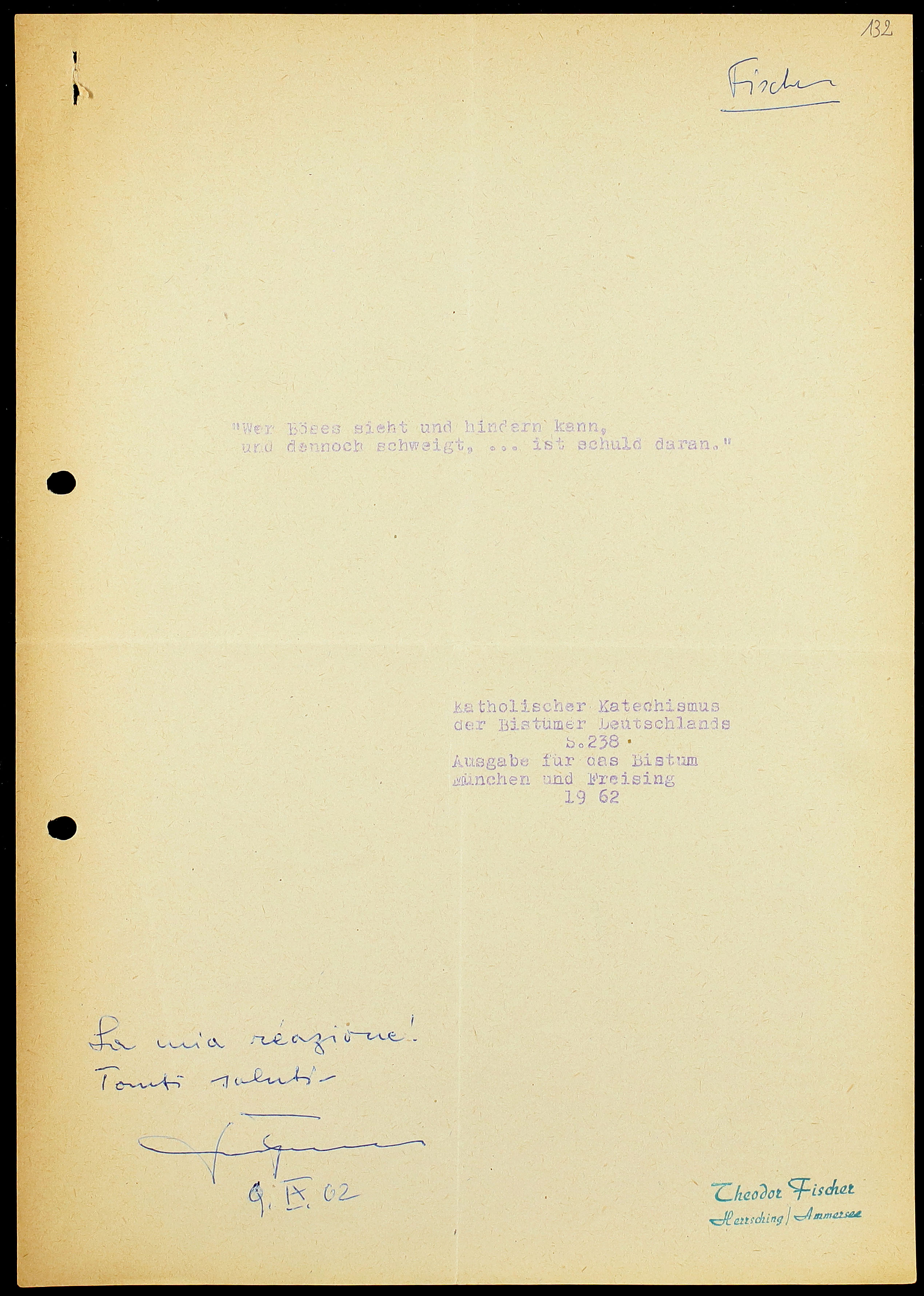
Fischer invia a Levi due allegati; si tratta di due documenti da lui scritti e inviati rispettivamente alle istituzioni bavaresi e all’arcidiocesi di Monaco.
„Wer Böees sieht und hindern kann,und dennoch schweigt, … ist schuld daran.”
Katholischer Katechismus der Bistümer Deutschlands S.238
Ausgabe für oas Bistum München und Freising 1962
La mia reazione!
Tanti saluti.
T Fischer
9.IX.62
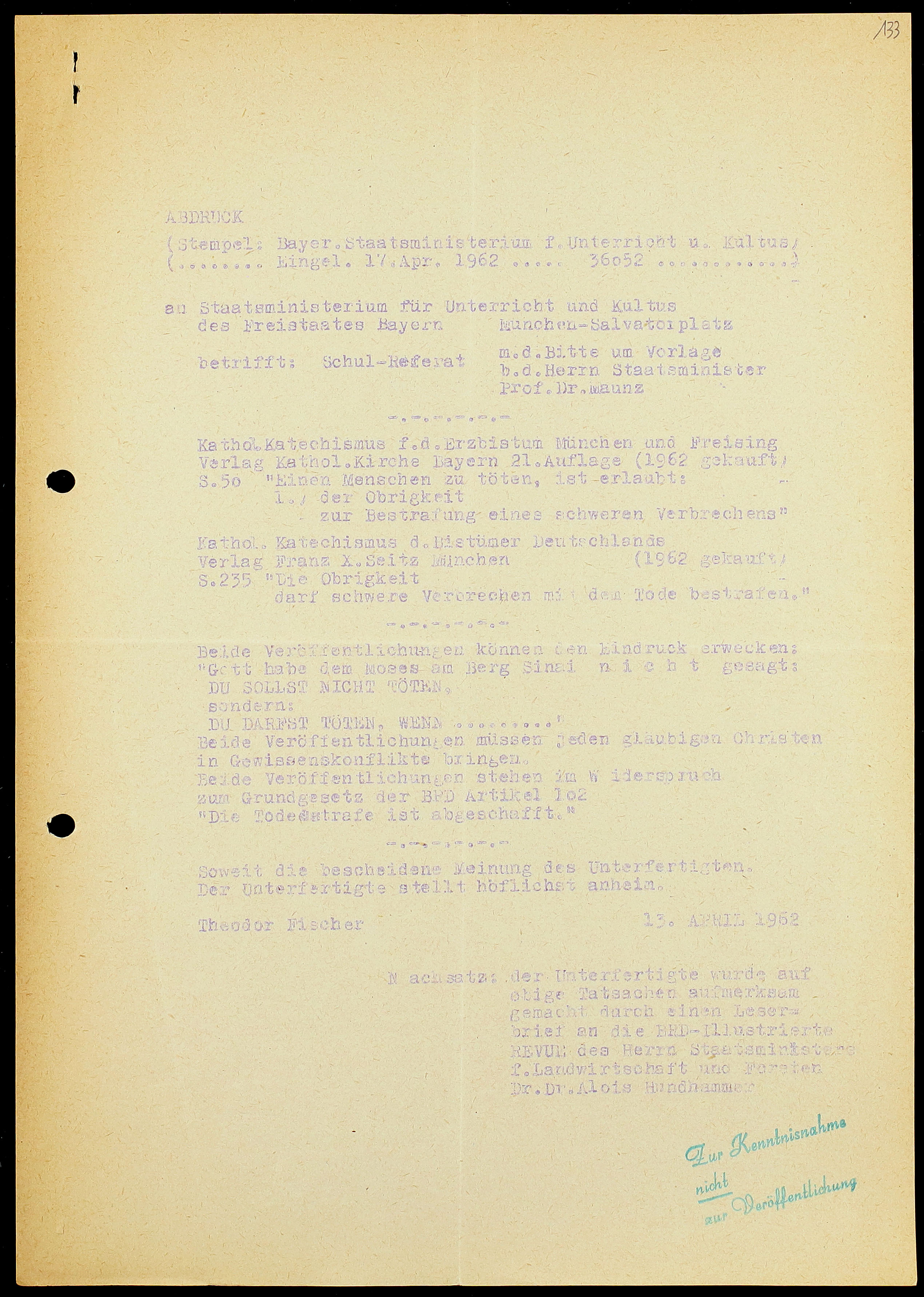
ABDRUCK
(Stampel:Bayer. Staatsministerium für Unterricht und Kultus/
………… Eingel. 17. April 1962……….. 36052……………
an Staatsministerium für Unterricht und Kultus
des Freistaates Bayern München-Salvatorplatz
betrifft: Schul-Referat m.d. Bitte um Vorlage
b.d Herrn Staatsminister Prof. Dr. Maunz
-.-.-.-.-.-
Kathol. Katechismus f.d. Erzbistum München und Freising[1] Verlag Kathol. Kirche Bayern 21-Auflage (1962 gekauft)
S.50 „Einen Menschen zu töten, ist erlaubt:
1./ der Obrigkeit
zur Bestrafung eines schweren Verbrechens” Kathol.Katechismus d. Bistümer Deutschlands
Verlag Franz X. Seitz München(1962 gekauft/
S. 235 „Die, Obrigkeit
darf schwere Verbrechen mit dem Tode bestrafen.”[2]
-.-.-.-.-.-
Beide Veröffentlichungen können den Eindruck erwecken: „Gott habe dem Moses am Berg Sinai nicht gesagt: DU SOLLST NICHT TÖTEN,
sondern:
DU DARFST TÖTEN, WENN…”
Beide Veröffentlichungen müssen jeden gläubigen Christen in Gewissenskonflikte bringen.
Beide Veröffentlichungen stehen in Widerspruch zum Grundgesetz der BRD Artikel 102
„Die Todesstrafe ist abgeschafft.”
-.-.-.-.-.-
Soweit die bescheidene Meinung des Unterfertigten.
Der Unterfertigte stellt höflichst anheim.
Theodor Fischer
13. APRIL 1962
Nachsatz: der Unterfertigte wurde auf
obige Tatsachen aufmerksam
gemacht durch einen Leserbrief
an die BRD-illustrierte REVUE des Herr Staatsministere für Landwirtschaft und Fareten Dr.Dr.Alois Hundhammer
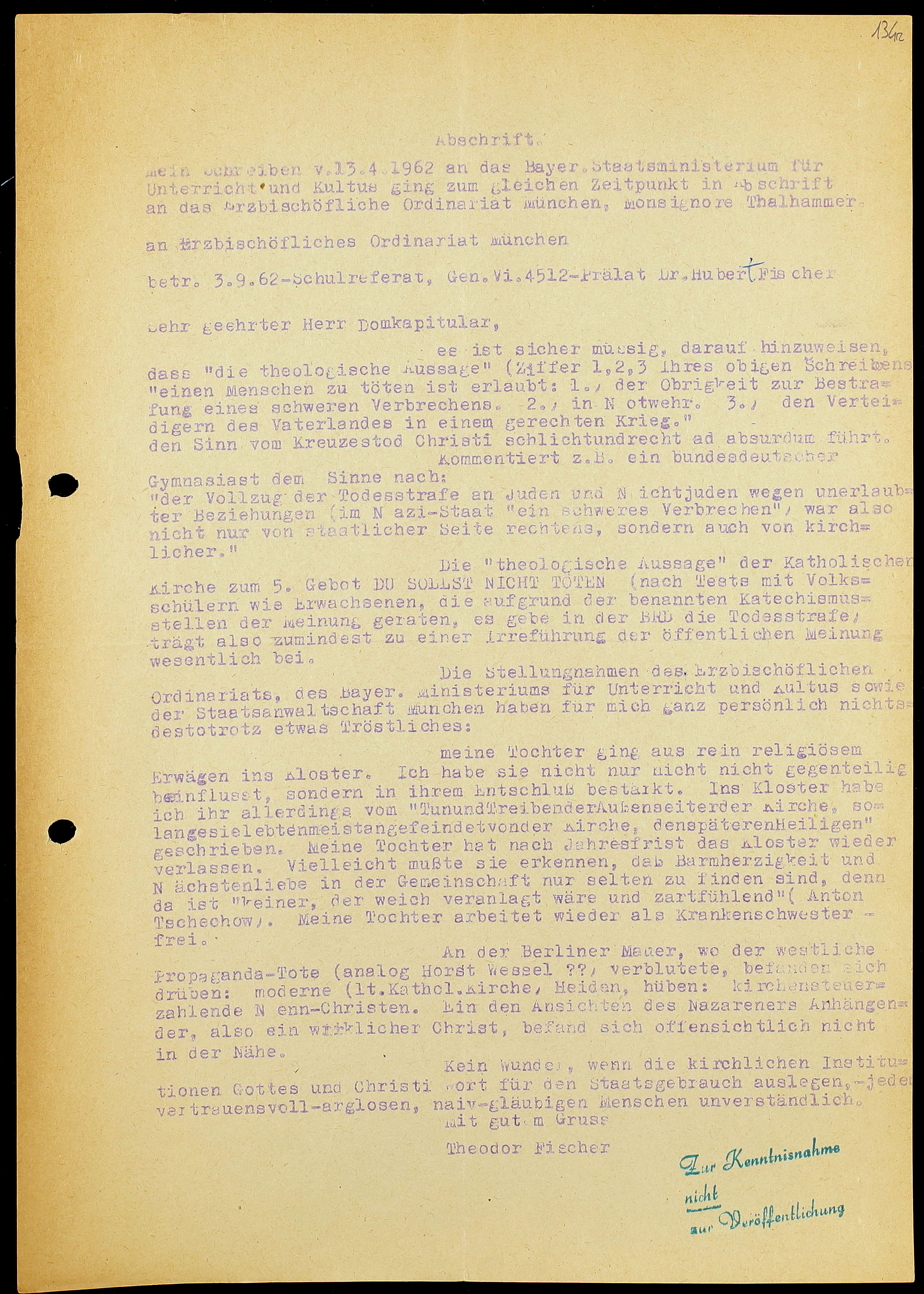
Abschrift.
Mein schreiben von 13.4.1962 an das Bayer. Staatsministerium für Unterricht und Kultus ging zum gleichen Zeitpunkt in Abschrift an das Erzbischöfliche Ordinariat München, Monsignore Thalhammer an Erzbischöfliches Ordinariat München.
betr. 3.9.62 – Schulreferat, Gen. Vi. 4512 – Prälat Dr. Hubert Fischer[3]
Sehr geehrter Herr Domkapitular,
es ist sicher müssig, darauf hinzuweisen, dass „die theologische Aussage” (Ziffer 1,2,3 Ihres obigen Schreibens „einen Menschen zu töten ist erlaubt: 1. der Obrigkeit zur Bestrafung eines schweren Verbrechens. 2. in Notwehr. 3. den Verteidigern des Vaterlandes in einem gerechten Krieg.”
den Sinn vom Kreuzestod Christi schlichtundrecht ad absurdum führt.
Kommentiert z.B. ein bundesdeutscher Gymnasiast dem Sinne nach:
„der Vollzug der Todesstrafe an Juden und Nichtjuden wegen unerlaubter Beziehungen (im Nazi-Staat „ein schweres Verbrechen”, war also nicht nur von staatlicher Seite rechtens, sondern auch von kirchlicher.”
Die „theologische Aussage” der Katholischen Kirche zum 5. Gebot DU SOLLST NICHT TOTEN (nach Tests mit Volksschülern wie Erwachsenen, die aufgrund der benannten Katechismusstellen der Meinung geraten, es gebe in der BRD die Todesstrafe, trägt also zumindest zu einer Irreführung der öffentlichen Meinung wesentlich bei.
Die Stellungnahmen des Erzbischöflichen Ordinariats, des Bayerische Ministeriums für Unterricht und Kultus sowie der Staatsanwaltschaft München haben für mich ganz persönlich nichtsdestotrotz etwas Tröstliches:
meine Tochter ging aus rein religiösem Erwägen ins Kloster. Ich habe sie nicht nur nicht gegenteilig beeinflusst, sondern in ihrem Entschluss bestärkt. Ins Kloster habe ich ihr allerdings vom „TunundTreibenderAußenseiterder Kirche, soangesielebtenmeistangefeindetvonder Kirche, denspäterenHeiligen” geschrieben. Meine Tochter hat nach Jahresfrist das Kloster wieder verlassen.Vielleicht mußte sie erkennen, daß Barmherzigkeit und Nächstenliebe in der Gemeinschaft nur selten zu finden sind, denn da ist „keiner, der weich veranlagt wäre und zartfühlend”! (Anton Tschechow). Meine Tochter arbeitet wieder als Krankenschwester-frei.
An der Berliner Mauer, wo der westliche Propaganda-Tote (analog Horst Wessel??, verblutete, befanden eich drüben: moderne (italienische Katholische Kirche, Heiden, hüben: kirchensteuerzahlende Nenn-Christen. Ein den Ansichten des Nazareners Anhängender, also ein wirklicher Christ, befand sich offensichtlich nicht in der Nähe.
Kein Wunder, wenn die kirchlichen Institutionen Gottes und Christi Wort für den Staatsgebrauch auslegen, -jeden vertrauensvoll-arglosen, naiv-gläubigen Menschen unverständlich.
Mit gutem Gruss
Theodor Fischer
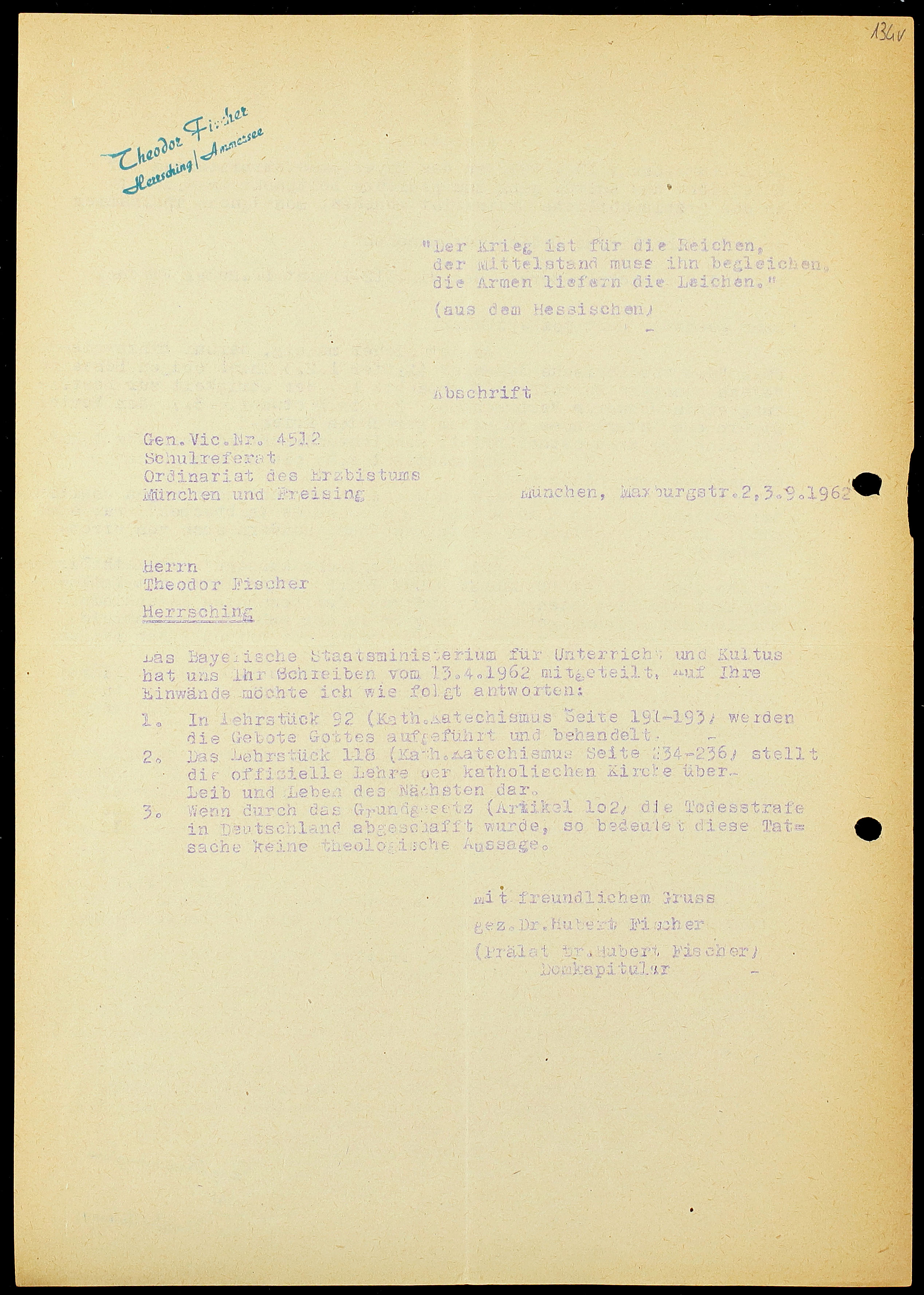
„Der Krieg ist für die Reichen,
der Mittelstand muss ihn begleichen.
die Armen liefern die Leichen.”
(aus dem Hessischen)[4]
Abschrift
Gen. Vic. Nr. 4512
Schulreferat Ordinariat des Erzbistums München und Freising München, Maxburggstr. 2,3.9.1962
Herrn
Theodor Fischer
Herrsching
Das Bayerische Staatsministerium für Unterricht, und Kultushat uns Ihr schreiben vom 13.4.1962 mitgeteilt, auf Ihre Einwände möchte ich wie folgt antworten:
1. In Lehrstück 92 (Kath.Katechismus Seite 191-193, werden die Gebote Gottes aufgeführt und behandelt.[5]
2. Das Lehrstück 118 (Kath.Katechismus Seite 234-236 stellt die offizielle Lehre der katholischen Kirche über Leib und Leben des Nächsten dar.[6]
3. Wenn durch das Grundgesetz(Artikel 102) die Todesstrafe in Deutschland abgeschafft wurde,[7] so bedeutet diese Tatsache keine theologische Aussage.
Mit freundlichem Gruss
gez.Dr.Hubert Fischer
(Prälat br. Hubert, Fischer:)
Domkapitular
«Chi vede il male e può impedirlo e tuttavia tace, è in colpa»
Catechismo cattolico
della Germania settentrionale p. 238
Edizione per la diocesi di Monaco e Frisinga 1962
La mia reazione!
Tanti saluti.
T Fischer
RIPRODUZIONE
(Timbro: Ministero dell’Istruzione e della Cultura Bavarese
………… Presentato il 17 aprile 1962……….. 36052……………
al Ministero dell’Istruzione e della Cultura dello Stato Libero di Baviera Monaco-Salvatorplatz
Oggetto: Dipartimento scolastico
con preghiera di sottoporre alla c.a. del Signor Ministro dello Stato
Prof. Dott. Maunz
-.-.-.-.-.-
Catechismo cattolico delle diocesi tedeschedi Monaco di Baviera e Frisinga[1] Editore Kathol. Kirche Bayern 21a edizione (acquistato nel 1962)
p. 50 «Uccidere un essere umano è consentito:
1./ alle autorità per punire un grave crimine»
Catechismo cattolico delle diocesi tedesche Editore Franz X. Seitz München(acquistato nel 1962) p. 235 «Le autorità possono punire i crimini gravi con la morte.»[2]
-.-.-.-.-.-
Entrambe le pubblicazioni possono indurre a pensare che «Dio non abbia detto a Mosè sul Monte Sinai: NON UCCIDERE, bensì PUOI UCCIDERE, SE… Entrambe le pubblicazioni devono porre ogni cristiano credente in conflitto con la propria coscienza. Entrambe le pubblicazioni sono in contraddizione con l’articolo 102 della Legge fondamentale della Repubblica Federale Tedesca: «La pena di morte è abolita.»
-.-.-.-.-.-
Tanto si segnala come modesta opinione del sottoscritto. Il sottoscritto si rimette rispettosamente al Suo giudizio.
Theodor Fischer
13 aprile 1962
Post scriptum: il sottoscritto è stato reso edotto delle circostanze sopra descritte dalla lettera di un lettore alla rivista illustrata della RFT REVUE, indirizzata al Ministro dell’Agricoltura e delle Foreste Dr. Alois Hundhammer
Copia
La mia lettera del 13 aprile 1962 al Ministero dell’Istruzione e della Cultura della Baviera è stata inviata in copia anche all’Ordinariato Arcivescovile di Monaco Monsignore Thalhammer.
Oggetto: 3.9.62 – Dipartimento scolastico, Gen. Vi. 4512 – Prelato Dott. Hubert Fischer[3]
Stimatissimo Reverendo Canonico,
è certamente superfluo sottolineare che «l’affermazione teologica» (punti 1, 2, 3 della Sua lettera sopra citata) «uccidere un essere umano è consentito: 1. alle autorità per punire un grave crimine. 2. per legittima difesa. 3. ai difensori della patria in una guerra giusta» è né più né meno una reductio ad absurdum del significato della morte di Cristo sulla croce.
Ad esempio, uno studente liceale tedesco potrebbe interpretarla così:
«L’esecuzione della pena capitale nei confronti di ebrei e non ebrei per relazioni illegittime (considerate nel regime nazista “un crimine grave”) era quindi lecita non solo dal punto di vista dello Stato, ma anche da quello della Chiesa».
La «dichiarazione teologica» della Chiesa cattolica sul quinto comandamento NON UCCIDERE (secondo test condotti su scolari e adulti che, sulla base dei passi del catechismo citati, ritengono che nella RFT esista la pena di morte) contribuisce quanto meno in misura significativa alla disinformazione dell’opinione pubblica.
Tuttavia, le dichiarazioni dell’Ordinariato arcivescovile, del Ministero dell’Istruzione e della Cultura Bavarese e della Procura di Monaco hanno per me personalmente qualcosa di confortante.
Mia figlia è entrata in convento per motivi puramente religiosi. Non solo non mi sono mai opposto, ma l’ho addirittura incoraggiata nella sua decisione. Le ho però scritto del «comportamento e dell’operato degli outsider della Chiesa, spesso osteggiati, finché erano in vita, dalla Chiesa stessa, per poi essere proclamati santi». Dopo un anno mia figlia ha lasciato il convento. Forse ha dovuto constatare che la misericordia e l’amore per il prossimo sono qualità che raramente si trovano all’interno della comunità, perché là «non c’è nessuno che sia di indole mite e sensibile»! (Anton Čechov). Mia figlia oggi lavora di nuovo come infermiera – da donna libera
Sotto il Muro di Berlino, dove il morto della propaganda occidentale (alla Horst Wessel???) morì dissanguato, c’erano, di là, la moderna Chiesa cattolica italiana, i pagani; di qua, sedicenti cristiani che pagano la tassa ecclesiastica. Nei paraggi, evidentemente, non c’era un vero seguace delle idee del Nazareno, cioè un vero cristiano.
Non c’è da stupirsi se le istituzioni ecclesiastiche interpretano la parola di Dio e di Cristo per uso statale, incomprensibile a ogni essere umano fiducioso, privo di malizia, credente in modo genuino.
Cordiali saluti
Theodor Fischer
«La guerra è per i ricchi, a pagarla è la classe media, i poveri forniscono i cadaveri.» (dalla tradizione assiana)[4]
Copia
Gen. Vic. Nr. 4512
Ufficio scolastico Ordinariato dell’arcidiocesi di Monaco e Frisinga Monaco, Maxburggstr. 2,3 settembre 1962
al Signor Theodor Fischer
Herrsching
Il Ministero dell’Istruzione e della Cultura Bavarese, ci ha trasmesso la Sua lettera del 14 aprile 1962, e ai Suoi rilievi desidero rispondere come segue:
1. Nel capitolo 92 (Catechismo cattolico, pagg. 191-193), sono elencati e trattati i Comandamenti di Dio.[5]
2. Il capitolo 118 (Catechismo cattolico, pagg.134-236) espone la dottrina ufficiale della Chiesa cattolica in merito al corpo e alla vita del prossimo.[6]
3. Se la Legge fondamentale (art. 102) ha abolito la pena di morte in Germania,[7] tale fatto non ha alcun significato teologico.
“Whoever sees evil and can prevent it, yet remains silent… is guilty of it.”
Catholic Catechism of the Dioceses of Germany p. 238
Edition for the Diocese of Munich and Freising 1962
My reaction!
Best regards,
T. Fischer
September 9, 1962
REPRINT
(Stamp: Bavarian State Ministry of Education
………… Received April 17, 1962……….. 36052……………
To: State Ministry of Education of the Free State of Bavaria Munich-Salvatorplatz
Re: School Department please forward to the attention of the State Minister Prof. Dr. Maunz
-.-.-.-.-.-
Catholic Catechism for the ArchdioceseofMunich and Freising[1] Publisher: Catholic Church of Bavaria, 21st edition (purchased 1962)
p. 50 “It is permissible to kill a person:
by verdict of the authorities to punish a serious crime.”
Catholic Catechism of the Dioceses of Germany Publisher: Franz X. Seitz Munich (purchased 1962)
p. 235 “The authorities may punish serious crimes with death.”[2]
-.-.-.-.-.-
Both publications may give the impression that “God did not say to Moses on Mount Sinai: THOU SHALT NOT KILL, but rather: YOU MAY KILL IF…” Both publications must cause every devout Christian to experience an inner moral conflict. Both publications contradict Article 102 of the Basic Law of the Federal Republic of Germany “The death penalty is abolished.”
-.-.-.-.-.-
This is the humble opinion of the undersigned. The undersigned respectfully submits.
Theodor Fischer
APRIL 13, 1962
Postscript: The undersigned was made aware of the aforementioned facts by a letter to the editor of the illustrated magazine REVUE by the German Minister of State for Agriculture and Food Dr. Dr. Alois Hundhammer
Transcript.
My letter of April 13, 1962, to the Bavarian State Ministry of Education was sent at the same time in carbon copy to the Archiepiscopal Ordinariate in Munich, Monsignor Thalhammer at the Archiepiscopal Ordinariate in Munich.
Re: September 3, 1962—School Department, Vicar General 4512—Prelate Dr. Hubert Fischer[3]
Esteemed Mr. Canon,
It is certainly futile to point out that the “theological statement” (points 1, 2, and 3 of your above letter) “it is permissible to kill a person: 1. by verdict of the authorities to punish a serious crime. 2. in self-defense. 3. by the defenders of the Fatherland in a just war” reduces the meaning of Christ’s death on the cross to utter absurdity.
It might lead, for example, to a German high school student surmising as follows:
“The execution of Jews and non-Jews for illicit relationships (a ‘serious crime’ in the Nazi state) was lawful not only on the part of the state, but also on the part of the church.”
The “theological statement” of the Catholic Church on the fifth commandment, THOU SHALT NOT KILL (according to tests with elementary school students and adults who, based on the aforementioned passages from the catechism, believe that the death penalty exists in the Federal Republic of Germany), thus significantly contributes to misleading public opinion.
Nevertheless, statements issued by theArchdiocese, the Bavarian Ministry of Education, and the Munich Public Prosecutor’s Officeare personally comforting to me:
My daughter entered the convent purely for religious reasons. Not only did I not influence her otherwise, I encouraged her in her decision. However, I wrote to her in the convent about the “deeds and activities of the outsiders of the church, who were mostly treated with hostility by the church during their lifetimes, the later saints.” My daughter left the convent after a year. Perhaps she had to realize that mercy and charity are rarely found in that community, because there is “no one who is soft-hearted and sensitive”!(Anton Chekhov). My daughter is now working as a nurse again—freelance.
At the Berlin Wall, where the man killed by Western propaganda (analogous to Horst Wessel??) bled to death, on the other side there were: the modern Italian Catholic Church, pagans; on this side there were: nominal Christians who pay church tax. Obviously not a single follower of the Nazarene’s views, i.e., a true Christian, was nearby.
No wonder, then, that when ecclesiastical institutions interpret the word of God and Christ for the use of the state, it strikes every trusting, unsuspecting, naively believing person as incomprehensible.
With best regards,
Theodor Fischer
“The rich decide to wage war, middle classes pay money galore, and corpses are supplied by the poor.” (Hessian proverb)[4]
Transcript
Vicar General No. 4512 Schools Department Ordinariate of the Archdiocese Munich and Freising Munich, Maxburggstr. 2, September 3, 1962
Mr. Theodor Fischer
Herrsching
The Bavarian State Ministry of Educationforwarded your letter dated April 13, 1962, to us. I would like to respond to your objections as follows:
1. In Lesson 92 (Catholic Catechism, pages 191–193), God’s commandments are listed and discussed.[5]
2. Lesson 118 (Catholic Catechism,pages 134–236) presents the official teaching of the Catholic Church on the body and life of one’s neighbor.[6]
3. Although the death penalty was abolished in Germany by the Basic Law (Article 102),[7]this fact does not constitute a theological statement.
With kind regards, signed, Dr. Hubert Fischer (Prelate Hubert Fischer) Canon
„Wer Böees sieht und hindern kann,und dennoch schweigt, … ist schuld daran.”
Katholischer Katechismus der Bistümer Deutschlands S.238
Ausgabe für oas Bistum München und Freising 1962
La mia reazione!
Tanti saluti.
T Fischer
9.IX.62
ABDRUCK
(Stampel:Bayer. Staatsministerium für Unterricht und Kultus/
………… Eingel. 17. April 1962……….. 36052……………
an Staatsministerium für Unterricht und Kultus
des Freistaates Bayern München-Salvatorplatz
betrifft: Schul-Referat m.d. Bitte um Vorlage
b.d Herrn Staatsminister Prof. Dr. Maunz
-.-.-.-.-.-
Kathol. Katechismus f.d. Erzbistum München und Freising[1] Verlag Kathol. Kirche Bayern 21-Auflage (1962 gekauft)
S.50 „Einen Menschen zu töten, ist erlaubt:
1./ der Obrigkeit
zur Bestrafung eines schweren Verbrechens” Kathol.Katechismus d. Bistümer Deutschlands
Verlag Franz X. Seitz München(1962 gekauft/
S. 235 „Die, Obrigkeit
darf schwere Verbrechen mit dem Tode bestrafen.”[2]
-.-.-.-.-.-
Beide Veröffentlichungen können den Eindruck erwecken: „Gott habe dem Moses am Berg Sinai nicht gesagt: DU SOLLST NICHT TÖTEN,
sondern:
DU DARFST TÖTEN, WENN…”
Beide Veröffentlichungen müssen jeden gläubigen Christen in Gewissenskonflikte bringen.
Beide Veröffentlichungen stehen in Widerspruch zum Grundgesetz der BRD Artikel 102
„Die Todesstrafe ist abgeschafft.”
-.-.-.-.-.-
Soweit die bescheidene Meinung des Unterfertigten.
Der Unterfertigte stellt höflichst anheim.
Theodor Fischer
13. APRIL 1962
Nachsatz: der Unterfertigte wurde auf
obige Tatsachen aufmerksam
gemacht durch einen Leserbrief
an die BRD-illustrierte REVUE des Herr Staatsministere für Landwirtschaft und Fareten Dr.Dr.Alois Hundhammer
Abschrift.
Mein schreiben von 13.4.1962 an das Bayer. Staatsministerium für Unterricht und Kultus ging zum gleichen Zeitpunkt in Abschrift an das Erzbischöfliche Ordinariat München, Monsignore Thalhammer an Erzbischöfliches Ordinariat München.
betr. 3.9.62 – Schulreferat, Gen. Vi. 4512 – Prälat Dr. Hubert Fischer[3]
Sehr geehrter Herr Domkapitular,
es ist sicher müssig, darauf hinzuweisen, dass „die theologische Aussage” (Ziffer 1,2,3 Ihres obigen Schreibens „einen Menschen zu töten ist erlaubt: 1. der Obrigkeit zur Bestrafung eines schweren Verbrechens. 2. in Notwehr. 3. den Verteidigern des Vaterlandes in einem gerechten Krieg.”
den Sinn vom Kreuzestod Christi schlichtundrecht ad absurdum führt.
Kommentiert z.B. ein bundesdeutscher Gymnasiast dem Sinne nach:
„der Vollzug der Todesstrafe an Juden und Nichtjuden wegen unerlaubter Beziehungen (im Nazi-Staat „ein schweres Verbrechen”, war also nicht nur von staatlicher Seite rechtens, sondern auch von kirchlicher.”
Die „theologische Aussage” der Katholischen Kirche zum 5. Gebot DU SOLLST NICHT TOTEN (nach Tests mit Volksschülern wie Erwachsenen, die aufgrund der benannten Katechismusstellen der Meinung geraten, es gebe in der BRD die Todesstrafe, trägt also zumindest zu einer Irreführung der öffentlichen Meinung wesentlich bei.
Die Stellungnahmen des Erzbischöflichen Ordinariats, des Bayerische Ministeriums für Unterricht und Kultus sowie der Staatsanwaltschaft München haben für mich ganz persönlich nichtsdestotrotz etwas Tröstliches:
meine Tochter ging aus rein religiösem Erwägen ins Kloster. Ich habe sie nicht nur nicht gegenteilig beeinflusst, sondern in ihrem Entschluss bestärkt. Ins Kloster habe ich ihr allerdings vom „TunundTreibenderAußenseiterder Kirche, soangesielebtenmeistangefeindetvonder Kirche, denspäterenHeiligen” geschrieben. Meine Tochter hat nach Jahresfrist das Kloster wieder verlassen.Vielleicht mußte sie erkennen, daß Barmherzigkeit und Nächstenliebe in der Gemeinschaft nur selten zu finden sind, denn da ist „keiner, der weich veranlagt wäre und zartfühlend”! (Anton Tschechow). Meine Tochter arbeitet wieder als Krankenschwester-frei.
An der Berliner Mauer, wo der westliche Propaganda-Tote (analog Horst Wessel??, verblutete, befanden eich drüben: moderne (italienische Katholische Kirche, Heiden, hüben: kirchensteuerzahlende Nenn-Christen. Ein den Ansichten des Nazareners Anhängender, also ein wirklicher Christ, befand sich offensichtlich nicht in der Nähe.
Kein Wunder, wenn die kirchlichen Institutionen Gottes und Christi Wort für den Staatsgebrauch auslegen, -jeden vertrauensvoll-arglosen, naiv-gläubigen Menschen unverständlich.
Mit gutem Gruss
Theodor Fischer
„Der Krieg ist für die Reichen,
der Mittelstand muss ihn begleichen.
die Armen liefern die Leichen.”
(aus dem Hessischen)[4]
Abschrift
Gen. Vic. Nr. 4512
Schulreferat Ordinariat des Erzbistums München und Freising München, Maxburggstr. 2,3.9.1962
Herrn
Theodor Fischer
Herrsching
Das Bayerische Staatsministerium für Unterricht, und Kultushat uns Ihr schreiben vom 13.4.1962 mitgeteilt, auf Ihre Einwände möchte ich wie folgt antworten:
1. In Lehrstück 92 (Kath.Katechismus Seite 191-193, werden die Gebote Gottes aufgeführt und behandelt.[5]
2. Das Lehrstück 118 (Kath.Katechismus Seite 234-236 stellt die offizielle Lehre der katholischen Kirche über Leib und Leben des Nächsten dar.[6]
3. Wenn durch das Grundgesetz(Artikel 102) die Todesstrafe in Deutschland abgeschafft wurde,[7] so bedeutet diese Tatsache keine theologische Aussage.
Mit freundlichem Gruss
gez.Dr.Hubert Fischer
(Prälat br. Hubert, Fischer:)
Domkapitular
«Chi vede il male e può impedirlo e tuttavia tace, è in colpa»
Catechismo cattolico
della Germania settentrionale p. 238
Edizione per la diocesi di Monaco e Frisinga 1962
La mia reazione!
Tanti saluti.
T Fischer
RIPRODUZIONE
(Timbro: Ministero dell’Istruzione e della Cultura Bavarese
………… Presentato il 17 aprile 1962……….. 36052……………
al Ministero dell’Istruzione e della Cultura dello Stato Libero di Baviera Monaco-Salvatorplatz
Oggetto: Dipartimento scolastico
con preghiera di sottoporre alla c.a. del Signor Ministro dello Stato
Prof. Dott. Maunz
-.-.-.-.-.-
Catechismo cattolico delle diocesi tedeschedi Monaco di Baviera e Frisinga[1] Editore Kathol. Kirche Bayern 21a edizione (acquistato nel 1962)
p. 50 «Uccidere un essere umano è consentito:
1./ alle autorità per punire un grave crimine»
Catechismo cattolico delle diocesi tedesche Editore Franz X. Seitz München(acquistato nel 1962) p. 235 «Le autorità possono punire i crimini gravi con la morte.»[2]
-.-.-.-.-.-
Entrambe le pubblicazioni possono indurre a pensare che «Dio non abbia detto a Mosè sul Monte Sinai: NON UCCIDERE, bensì PUOI UCCIDERE, SE… Entrambe le pubblicazioni devono porre ogni cristiano credente in conflitto con la propria coscienza. Entrambe le pubblicazioni sono in contraddizione con l’articolo 102 della Legge fondamentale della Repubblica Federale Tedesca: «La pena di morte è abolita.»
-.-.-.-.-.-
Tanto si segnala come modesta opinione del sottoscritto. Il sottoscritto si rimette rispettosamente al Suo giudizio.
Theodor Fischer
13 aprile 1962
Post scriptum: il sottoscritto è stato reso edotto delle circostanze sopra descritte dalla lettera di un lettore alla rivista illustrata della RFT REVUE, indirizzata al Ministro dell’Agricoltura e delle Foreste Dr. Alois Hundhammer
Copia
La mia lettera del 13 aprile 1962 al Ministero dell’Istruzione e della Cultura della Baviera è stata inviata in copia anche all’Ordinariato Arcivescovile di Monaco Monsignore Thalhammer.
Oggetto: 3.9.62 – Dipartimento scolastico, Gen. Vi. 4512 – Prelato Dott. Hubert Fischer[3]
Stimatissimo Reverendo Canonico,
è certamente superfluo sottolineare che «l’affermazione teologica» (punti 1, 2, 3 della Sua lettera sopra citata) «uccidere un essere umano è consentito: 1. alle autorità per punire un grave crimine. 2. per legittima difesa. 3. ai difensori della patria in una guerra giusta» è né più né meno una reductio ad absurdum del significato della morte di Cristo sulla croce.
Ad esempio, uno studente liceale tedesco potrebbe interpretarla così:
«L’esecuzione della pena capitale nei confronti di ebrei e non ebrei per relazioni illegittime (considerate nel regime nazista “un crimine grave”) era quindi lecita non solo dal punto di vista dello Stato, ma anche da quello della Chiesa».
La «dichiarazione teologica» della Chiesa cattolica sul quinto comandamento NON UCCIDERE (secondo test condotti su scolari e adulti che, sulla base dei passi del catechismo citati, ritengono che nella RFT esista la pena di morte) contribuisce quanto meno in misura significativa alla disinformazione dell’opinione pubblica.
Tuttavia, le dichiarazioni dell’Ordinariato arcivescovile, del Ministero dell’Istruzione e della Cultura Bavarese e della Procura di Monaco hanno per me personalmente qualcosa di confortante.
Mia figlia è entrata in convento per motivi puramente religiosi. Non solo non mi sono mai opposto, ma l’ho addirittura incoraggiata nella sua decisione. Le ho però scritto del «comportamento e dell’operato degli outsider della Chiesa, spesso osteggiati, finché erano in vita, dalla Chiesa stessa, per poi essere proclamati santi». Dopo un anno mia figlia ha lasciato il convento. Forse ha dovuto constatare che la misericordia e l’amore per il prossimo sono qualità che raramente si trovano all’interno della comunità, perché là «non c’è nessuno che sia di indole mite e sensibile»! (Anton Čechov). Mia figlia oggi lavora di nuovo come infermiera – da donna libera
Sotto il Muro di Berlino, dove il morto della propaganda occidentale (alla Horst Wessel???) morì dissanguato, c’erano, di là, la moderna Chiesa cattolica italiana, i pagani; di qua, sedicenti cristiani che pagano la tassa ecclesiastica. Nei paraggi, evidentemente, non c’era un vero seguace delle idee del Nazareno, cioè un vero cristiano.
Non c’è da stupirsi se le istituzioni ecclesiastiche interpretano la parola di Dio e di Cristo per uso statale, incomprensibile a ogni essere umano fiducioso, privo di malizia, credente in modo genuino.
Cordiali saluti
Theodor Fischer
«La guerra è per i ricchi, a pagarla è la classe media, i poveri forniscono i cadaveri.» (dalla tradizione assiana)[4]
Copia
Gen. Vic. Nr. 4512
Ufficio scolastico Ordinariato dell’arcidiocesi di Monaco e Frisinga Monaco, Maxburggstr. 2,3 settembre 1962
al Signor Theodor Fischer
Herrsching
Il Ministero dell’Istruzione e della Cultura Bavarese, ci ha trasmesso la Sua lettera del 14 aprile 1962, e ai Suoi rilievi desidero rispondere come segue:
1. Nel capitolo 92 (Catechismo cattolico, pagg. 191-193), sono elencati e trattati i Comandamenti di Dio.[5]
2. Il capitolo 118 (Catechismo cattolico, pagg.134-236) espone la dottrina ufficiale della Chiesa cattolica in merito al corpo e alla vita del prossimo.[6]
3. Se la Legge fondamentale (art. 102) ha abolito la pena di morte in Germania,[7] tale fatto non ha alcun significato teologico.
“Whoever sees evil and can prevent it, yet remains silent… is guilty of it.”
Catholic Catechism of the Dioceses of Germany p. 238
Edition for the Diocese of Munich and Freising 1962
My reaction!
Best regards,
T. Fischer
September 9, 1962
REPRINT
(Stamp: Bavarian State Ministry of Education
………… Received April 17, 1962……….. 36052……………
To: State Ministry of Education of the Free State of Bavaria Munich-Salvatorplatz
Re: School Department please forward to the attention of the State Minister Prof. Dr. Maunz
-.-.-.-.-.-
Catholic Catechism for the ArchdioceseofMunich and Freising[1] Publisher: Catholic Church of Bavaria, 21st edition (purchased 1962)
p. 50 “It is permissible to kill a person:
by verdict of the authorities to punish a serious crime.”
Catholic Catechism of the Dioceses of Germany Publisher: Franz X. Seitz Munich (purchased 1962)
p. 235 “The authorities may punish serious crimes with death.”[2]
-.-.-.-.-.-
Both publications may give the impression that “God did not say to Moses on Mount Sinai: THOU SHALT NOT KILL, but rather: YOU MAY KILL IF…” Both publications must cause every devout Christian to experience an inner moral conflict. Both publications contradict Article 102 of the Basic Law of the Federal Republic of Germany “The death penalty is abolished.”
-.-.-.-.-.-
This is the humble opinion of the undersigned. The undersigned respectfully submits.
Theodor Fischer
APRIL 13, 1962
Postscript: The undersigned was made aware of the aforementioned facts by a letter to the editor of the illustrated magazine REVUE by the German Minister of State for Agriculture and Food Dr. Dr. Alois Hundhammer
Transcript.
My letter of April 13, 1962, to the Bavarian State Ministry of Education was sent at the same time in carbon copy to the Archiepiscopal Ordinariate in Munich, Monsignor Thalhammer at the Archiepiscopal Ordinariate in Munich.
Re: September 3, 1962—School Department, Vicar General 4512—Prelate Dr. Hubert Fischer[3]
Esteemed Mr. Canon,
It is certainly futile to point out that the “theological statement” (points 1, 2, and 3 of your above letter) “it is permissible to kill a person: 1. by verdict of the authorities to punish a serious crime. 2. in self-defense. 3. by the defenders of the Fatherland in a just war” reduces the meaning of Christ’s death on the cross to utter absurdity.
It might lead, for example, to a German high school student surmising as follows:
“The execution of Jews and non-Jews for illicit relationships (a ‘serious crime’ in the Nazi state) was lawful not only on the part of the state, but also on the part of the church.”
The “theological statement” of the Catholic Church on the fifth commandment, THOU SHALT NOT KILL (according to tests with elementary school students and adults who, based on the aforementioned passages from the catechism, believe that the death penalty exists in the Federal Republic of Germany), thus significantly contributes to misleading public opinion.
Nevertheless, statements issued by theArchdiocese, the Bavarian Ministry of Education, and the Munich Public Prosecutor’s Officeare personally comforting to me:
My daughter entered the convent purely for religious reasons. Not only did I not influence her otherwise, I encouraged her in her decision. However, I wrote to her in the convent about the “deeds and activities of the outsiders of the church, who were mostly treated with hostility by the church during their lifetimes, the later saints.” My daughter left the convent after a year. Perhaps she had to realize that mercy and charity are rarely found in that community, because there is “no one who is soft-hearted and sensitive”!(Anton Chekhov). My daughter is now working as a nurse again—freelance.
At the Berlin Wall, where the man killed by Western propaganda (analogous to Horst Wessel??) bled to death, on the other side there were: the modern Italian Catholic Church, pagans; on this side there were: nominal Christians who pay church tax. Obviously not a single follower of the Nazarene’s views, i.e., a true Christian, was nearby.
No wonder, then, that when ecclesiastical institutions interpret the word of God and Christ for the use of the state, it strikes every trusting, unsuspecting, naively believing person as incomprehensible.
With best regards,
Theodor Fischer
“The rich decide to wage war, middle classes pay money galore, and corpses are supplied by the poor.” (Hessian proverb)[4]
Transcript
Vicar General No. 4512 Schools Department Ordinariate of the Archdiocese Munich and Freising Munich, Maxburggstr. 2, September 3, 1962
Mr. Theodor Fischer
Herrsching
The Bavarian State Ministry of Educationforwarded your letter dated April 13, 1962, to us. I would like to respond to your objections as follows:
1. In Lesson 92 (Catholic Catechism, pages 191–193), God’s commandments are listed and discussed.[5]
2. Lesson 118 (Catholic Catechism,pages 134–236) presents the official teaching of the Catholic Church on the body and life of one’s neighbor.[6]
3. Although the death penalty was abolished in Germany by the Basic Law (Article 102),[7]this fact does not constitute a theological statement.
With kind regards, signed, Dr. Hubert Fischer (Prelate Hubert Fischer) Canon
Info
Note
Tag
Mittente: Theodor Fischer
Destinatario: Primo Levi
Data di stesura: 1962-09-09
Luogo di stesura: Monaco
Descrizione del documento: lettera ms. a biro blu con epigrafi ds., firma e data ms. (f.132). Sul margine superiore dx. del foglio è ms. a biro blu da Levi: «Fischer»; sul margine esterno, in basso a destra, è presente un timbro a inchiostro verde: «Theodor Fischer | Herrsching | Ammersee».
Archivio: Archivio privato di Primo Levi, Torino
Segnatura: Complesso di fondi Primo Levi, Fondo Primo Levi, Corrispondenza, Corrispondenti particolari, Fasc. 20, sottofasc. 1, doc., ff. 132 (lettera), 133, 134r (All.1), 134v (All.2).
Fogli: 2, solo recto; 1, recto e verso
DOI: https://doi.org/10.15160/zvat-0m43
1Si tratta del Catechismo cattolico per l’Arcidiocesi di Monaco e Frisinga.
2
Dal Lehrstück 118 Il corpo e la vita del prossimo (Leib und Leben des Nächsten): «Pecca contro la vita del prossimo [...] chi lo colpisce o lo ferisce ingiustamente, danneggia la sua salute o mette in pericolo la sua vita e i suoi beni [...]. Chiunque uccide ingiustamente una persona commette un peccato che grida al cielo. Dio disse a Caino: “il sangue di tuo fratello Abele grida a me dal suolo” (Genesi 4, 10). Dio non vuole che siamo indifesi contro attacchi ingiusti. Pertanto, a tutti è consentito difendere se stessi e gli altri in modo legittimi, anche ferendo o uccidendo l’aggressore, se necessario. Le autorità possono punire i crimini gravi con la morte. In una guerra giusta, ai soldati è consentito uccidere i soldati nemici in combattimento [...]. Possiamo uccidere gli animali se necessario o utile. Tuttavia, non dobbiamo causare loro dolore inutile. Chiunque torturi volontariamente un animale commette un peccato. Dobbiamo rispettare tutti gli esseri viventi perché provengono dalla mano di Dio»
3
ds. «Huber» ed emendato ms. a biro blu, non è chiaro se da Levi o da Fischer.
4
Si tratta di un canto popolare del periodo della Prima guerra mondiale, ma di stampo antimilitarista e socialista; in particolare, sembra che questi versi provengano da un’iscrizione rinvenuta sul muro di una garitta vicino a Magonza tra il 1916 e il 1919.
5
Dal Lehrstück 92 I comandamenti di Dio (Die Gebote Gottes): «Nel suo amore paterno, Dio ha dato anche i Dieci Comandamenti [...]. Cristo ha confermato i Dieci Comandamenti. Ci ha esortato a seguirli; ce li ha spiegati e ci ha mostrato con il suo esempio come dovremmo osservarli [...].. Il comandamento dell’amore [“amerai il prossimo tuo come te stesso”] è il comandamento principale. Se osserviamo questo comandamento, osserveremo anche gli altri».
6
Dal Lehrstück 118 Il corpo e la vita del prossimo (Leib und Leben des Nächsten) «Le sette opere di misericordia corporale [Die sieben leiblichen Werke der Barmherzigkeit] sono: dare da mangiare agli affamati, dare da bere agli assetati, vestire gli ignudi, ospitare i forestieri, liberare i prigionieri, visitare gli ammalati e seppellire i morti»Vedi nota 1 Lettera 138.
7
L'abolizione della pena di morte venne sancità dalla promulgazione nel 1949 della Legge fondamentale della Repubblica Federale di Germania (Grundgesetz für die Bundesrepublik Deutschland).