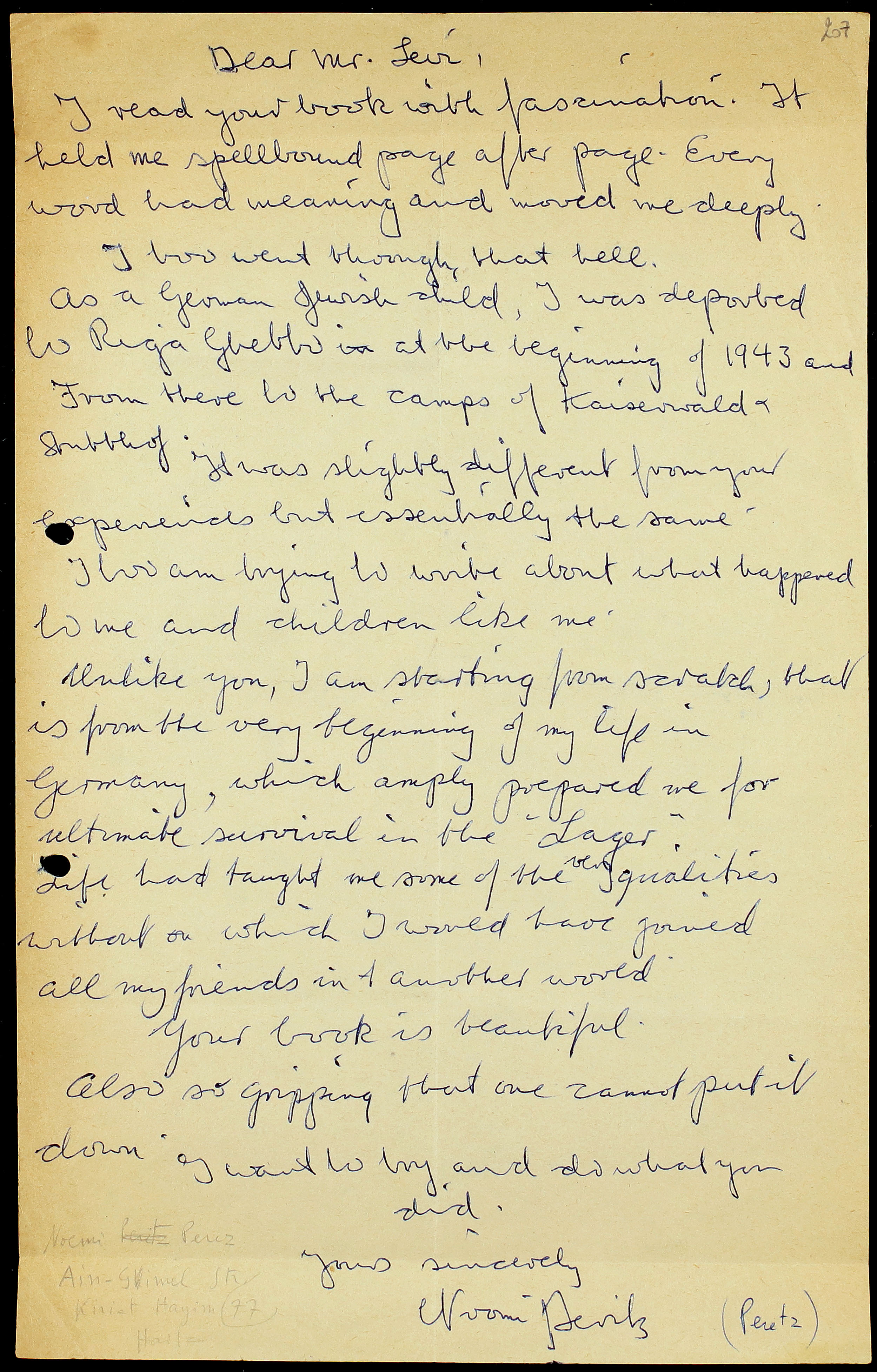
Noomi Peritz, ebrea tedesca corrispondente da Haifa (Israele), scrive di essere rimasta incantata dalle pagine di Ist das ein Mensch? e, da bambina, di aver subìto anche lei la deportazione nei campi di concentramento di Kaiserwald (Riga) e di Stutthof (Danzica).
Dear Mr. Levi,
I read your book with fascination. It held spellbound page after page. Every word had meaning and moved me deeply.
I too went through that hell.
As a German Jewish child, I was deported[1] to Riga Ghetto[2] at the beginning of 1943 and from there to the camps of Kaiserwald[3] – Stutthof.[4]
It was slightly different from your experiences but essentially the same.
I too am beginning to write about what happened to me and children like me.[5]
Unlike you, I am starting from scratch, that is from the very beginning of my life in Germany, which amply prepared me for ultimate survival in the “Lager”.
Life had taught me some of the very qualities without which I would have joined all my friends in another world.
Your book is beautiful.
Also so gripping that one cannot put it down.
I want to try and do what you did.
Yours sincerely
Noomi Peritz
Gentile Signor Levi,
ho letto affascinata il Suo libro. Mi ha tenuta avvinta pagina dopo pagina. Ogni parola aveva significato e mi ha toccato profondamente.
Anche io ho attraversato quell’inferno.
In quanto bambina ebrea tedesca, sono stata deportata[1] nel ghetto di Riga[2] all’inizio del 1943 e da lì nei campi di Kaiserwald[3]-Stutthof.[4]
È stato leggermente diverso dalle Sue esperienze ma essenzialmente la stessa cosa.
Anche io sto cominciando a scrivere di quello che è successo a me e a bambini come me.[5]
A differenza Sua, io sto cominciando da zero, cioè dall’inizio della mia vita in Germania, che mi ha ampliamente preparata alla sopravvivenza nel «Lager».
La vita mi ha insegnato alcune qualità senza le quali sarei finita anche io all’altro mondo come tutti i miei amici.
Il Suo libro è molto bello.
E anche così avvincente che non lo si può mettere giù.
Voglio provare a fare quello che ha fatto Lei.
Sua
Noomi Peritz
Dear Mr. Levi,
I read your book with fascination. It held spellbound page after page. Every word had meaning and moved me deeply.
I too went through that hell.
As a German Jewish child, I was deported[1] to Riga Ghetto[2] at the beginning of 1943 and from there to the camps of Kaiserwald[3] – Stutthof.[4]
It was slightly different from your experiences but essentially the same.
I too am beginning to write about what happened to me and children like me.[5]
Unlike you, I am starting from scratch, that is from the very beginning of my life in Germany, which amply prepared me for ultimate survival in the “Lager”.
Life had taught me some of the very qualities without which I would have joined all my friends in another world.
Your book is beautiful.
Also so gripping that one cannot put it down.
I want to try and do what you did.
Yours sincerely
Noomi Peritz
Dear Mr. Levi,
I read your book with fascination. It held spellbound page after page. Every word had meaning and moved me deeply.
I too went through that hell.
As a German Jewish child, I was deported[1] to Riga Ghetto[2] at the beginning of 1943 and from there to the camps of Kaiserwald[3] – Stutthof.[4]
It was slightly different from your experiences but essentially the same.
I too am beginning to write about what happened to me and children like me.[5]
Unlike you, I am starting from scratch, that is from the very beginning of my life in Germany, which amply prepared me for ultimate survival in the “Lager”.
Life had taught me some of the very qualities without which I would have joined all my friends in another world.
Your book is beautiful.
Also so gripping that one cannot put it down.
I want to try and do what you did.
Yours sincerely
Noomi Peritz
Gentile Signor Levi,
ho letto affascinata il Suo libro. Mi ha tenuta avvinta pagina dopo pagina. Ogni parola aveva significato e mi ha toccato profondamente.
Anche io ho attraversato quell’inferno.
In quanto bambina ebrea tedesca, sono stata deportata[1] nel ghetto di Riga[2] all’inizio del 1943 e da lì nei campi di Kaiserwald[3]-Stutthof.[4]
È stato leggermente diverso dalle Sue esperienze ma essenzialmente la stessa cosa.
Anche io sto cominciando a scrivere di quello che è successo a me e a bambini come me.[5]
A differenza Sua, io sto cominciando da zero, cioè dall’inizio della mia vita in Germania, che mi ha ampliamente preparata alla sopravvivenza nel «Lager».
La vita mi ha insegnato alcune qualità senza le quali sarei finita anche io all’altro mondo come tutti i miei amici.
Il Suo libro è molto bello.
E anche così avvincente che non lo si può mettere giù.
Voglio provare a fare quello che ha fatto Lei.
Sua
Noomi Peritz
Dear Mr. Levi,
I read your book with fascination. It held spellbound page after page. Every word had meaning and moved me deeply.
I too went through that hell.
As a German Jewish child, I was deported[1] to Riga Ghetto[2] at the beginning of 1943 and from there to the camps of Kaiserwald[3] – Stutthof.[4]
It was slightly different from your experiences but essentially the same.
I too am beginning to write about what happened to me and children like me.[5]
Unlike you, I am starting from scratch, that is from the very beginning of my life in Germany, which amply prepared me for ultimate survival in the “Lager”.
Life had taught me some of the very qualities without which I would have joined all my friends in another world.
Your book is beautiful.
Also so gripping that one cannot put it down.
I want to try and do what you did.
Yours sincerely
Noomi Peritz
Info
Note
Tag
Mittente: Noomi Blumenfeld-Peritz
Destinatario: Primo Levi
Data di stesura: 0000-01-01
Luogo di stesura: Haifa
Descrizione del documento:lettera ms. a stilografica blu. Sul margine inferiore del foglio, adiacenti alla firma della corrispondente, sono presenti due interventi ms. di Levi: a destra, a biro blu, annota: «(Peretz)», mentre a sinistra scrive a matita: «Noemi Peritz Perez | Ain Glimel Str | Kiriat Hayin 77 | Haifa.». Non è chiaro quale sia la lezione giusta del cognome della donna: Peritz – Peretz – Perez (mm206x325).
Archivio: Archivio privato di Primo Levi, Torino
Segnatura: Complesso di fondi Primo Levi, Fondo Primo Levi, Corrispondenza, Corrispondenti particolari, Fasc. 20, sottofasc. 1, doc. 074, f.207
Fogli: 1 solo recto
DOI: https://doi.org/10.15160/ffpf-en82
1Sull’esperienza di Noomi Peritz negli anni delle leggi razziali cfr. la sezione Carteggi della sua biografia.
2Il ghetto di Riga venne istituito il 25 ottobre del 1941. A causa dell’ingente numero di arrivi, la storia del ghetto di Riga fu segnata dal problema del sovraffovolamento. Frequenti furono per questo i massacri della popolazione da parte delle SS per “ridurre” il numero di abitanti. Tra questi, uno dei più cruenti fu l’Aktion Dünamünde del marzo 1942, quando circa 3800 persone, principalmente bambini e anziani, vennero fucilate nella foresta di Biķernieki. Il ghetto di Riga venne liquidato il 2 novembre del 1943. I suoi sopravvissuti furono in seguito trasferiti nel campo di concentramento di Kaiserwald. Cfr. G. Schneider, Journey Into Terror. Story of the Riga Ghetto ("Viaggio nel terrore. Storia del ghetto di Riga"), Praeger, Westport 2001.
3Il campo di concentramento di Riga-Kaiserwald venne istituito il 15 marzo del 1943. Al suo interno confluirono i sopravvissuti dei ghetti ebraici costruiti in Lettonia a seguito dell’occupazione nazista. Kaiserwald non fu utilizzato come campo di sterminio e la sua funzione fu quella di offre manodopera schiava alle aziende tedesche che avevano aperto i loro stabilimenti a Riga. Tra le maggiori realtà industriali che approfittarono del lavoro forzato degli internati, specialmente quello delle prigioniere, vi fu la AEG-Allgemeine Elektrizitäts-Gesellschaft. Il campo venne liberato dall’Armata Rossa il 13 ottobre 1944
4Il campo di concentramento di Stutthof (vicino a Danzica) venne istituito il 2 settembre del 1939. Tra il 1943 e il 1944, fu installata una camera a gas. I prigionieri di Kaiserwald furono trasferiti qui quando il campo venne evacuato a causa dell’avanzata russa nell’agosto del 1944. Fu liberato dall’Armata Rossa il 9 maggio del 1945.
5Al momento, non vi sono riscontri circa l’esistenza di una testimonianza scritta di Noomi Peritz.