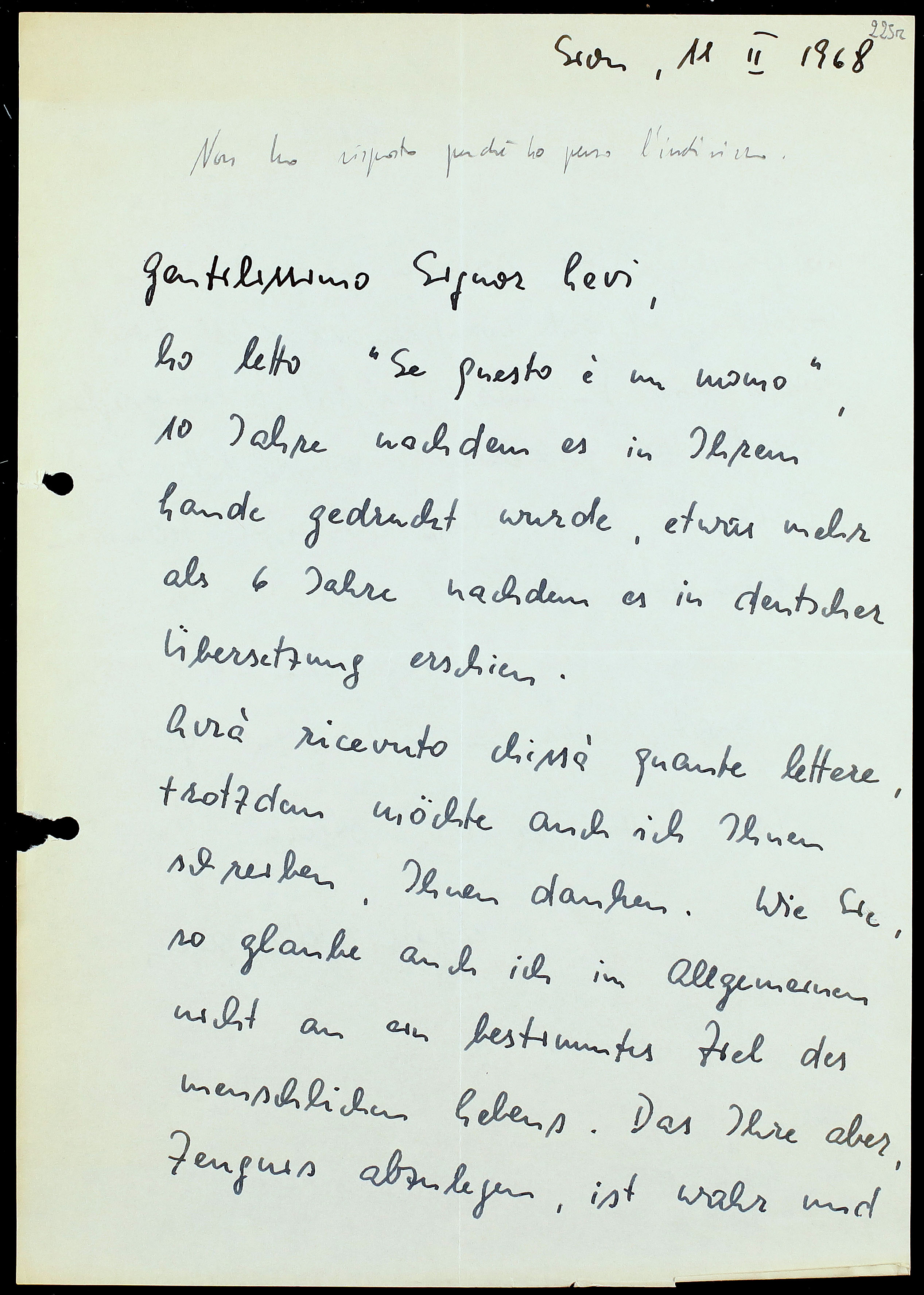
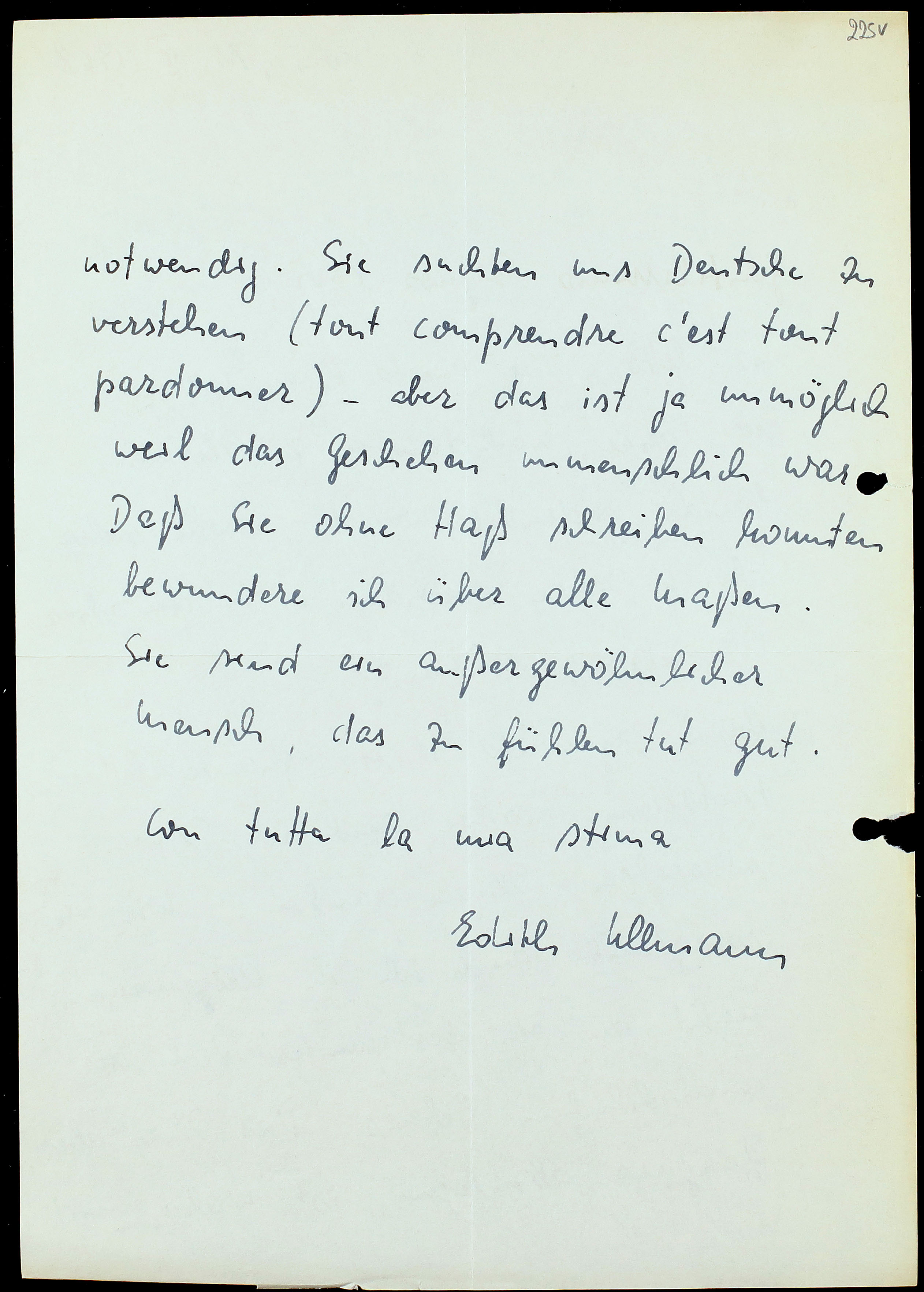
Edith Ulmann, corrispondente da Sion (Svizzera), con questa lettera in cui mescola lingua italiana e tedesca ringrazia Levi per la sua testimonianza.
Sion, 11.II.1968
Gentilissimo Signor Levi,
ho letto Se questo è un uomo, 10 Jahre nachdem es in Ihren hande gedruckt wurde, etwas mehr als 6 Jahre nachdem es in deutsches Übersetzung erschien.
Avrà ricevuto chissà quante lettere,[1] trotzdem möchte auch ich Ihnen schreiben, Ihnen danken. Wie Sie, so glaube auch ich im Allgemeinen nicht an ein bestimmtes Ziel des menschlichen Lebens. Das Ihre aber, Zeugnis abzulegen, is wahr und notwendig.[2] Sie suchten uns Deutsche zu verstehen (tout comprendre c’est tout pardonner) – aber das is ja unmöglich weil das Geschicken unmenschlich was.
Daß Sie ohne Haß schreiben konnten bewundere ich über alle Maßen.[3] Sie sind ein außergewöhnlicher Mensch, das zu fühlen tut gut.
Con tutta la mia stima
Edith Ullmann
Sion, 11 febbraio 1968
Gentilissimo Signor Levi,
ho letto Se questo è un uomo dieci anni dopo che era stato dato alle stampe per la prima volta dalle Sue mani, poco più di sei anni dopo l’uscita della traduzione tedesca.
Avrà ricevuto chissà quante lettere,[1] e tuttavia desidero anch’io scriverLe e ringraziarLa. Come Lei, anch’io credo, in generale, che la vita umana non abbia uno scopo prestabilito. Ma che il Suo sia stato quello di testimoniare, questo sì, è vero e necessario.[2] Lei ha cercato di capire noi tedeschi (tout comprendre c’est tout pardonner), ma è impossibile, perché quanto è accaduto era disumano.
Che Lei abbia saputo scrivere senza odio, è un fatto che ammiro sopra ogni cosa.[3] Lei è una persona straordinaria, e provare questo sentimento fa bene.
Con tutta la mia stima
Edith Ullmann
Sion, February 11, 1968
Dearest Mr. Levi,
I read If This Is a Man ten years after the first printed edition was in your hands, a little more than six years after it appeared in German translation.
You must have received countless letters,[1] but I would still like to write to you too, to thank you. Like you, I do not generally believe human life has any specific purpose. Yours, however, of bearing witness, is true and necessary.[2]You sought to understand us Germans (tout comprendre c’est tout pardonner)—but that is impossible because what happened was inhuman.
That you managed to write without hatred is something I admire beyond measure.[3]You are an extraordinary person, and it does one good to feel that.
With all my respect
Edith Ullmann
Sion, 11.II.1968
Gentilissimo Signor Levi,
ho letto Se questo è un uomo, 10 Jahre nachdem es in Ihren hande gedruckt wurde, etwas mehr als 6 Jahre nachdem es in deutsches Übersetzung erschien.
Avrà ricevuto chissà quante lettere,[1] trotzdem möchte auch ich Ihnen schreiben, Ihnen danken. Wie Sie, so glaube auch ich im Allgemeinen nicht an ein bestimmtes Ziel des menschlichen Lebens. Das Ihre aber, Zeugnis abzulegen, is wahr und notwendig.[2] Sie suchten uns Deutsche zu verstehen (tout comprendre c’est tout pardonner) – aber das is ja unmöglich weil das Geschicken unmenschlich was.
Daß Sie ohne Haß schreiben konnten bewundere ich über alle Maßen.[3] Sie sind ein außergewöhnlicher Mensch, das zu fühlen tut gut.
Con tutta la mia stima
Edith Ullmann
Sion, 11 febbraio 1968
Gentilissimo Signor Levi,
ho letto Se questo è un uomo dieci anni dopo che era stato dato alle stampe per la prima volta dalle Sue mani, poco più di sei anni dopo l’uscita della traduzione tedesca.
Avrà ricevuto chissà quante lettere,[1] e tuttavia desidero anch’io scriverLe e ringraziarLa. Come Lei, anch’io credo, in generale, che la vita umana non abbia uno scopo prestabilito. Ma che il Suo sia stato quello di testimoniare, questo sì, è vero e necessario.[2] Lei ha cercato di capire noi tedeschi (tout comprendre c’est tout pardonner), ma è impossibile, perché quanto è accaduto era disumano.
Che Lei abbia saputo scrivere senza odio, è un fatto che ammiro sopra ogni cosa.[3] Lei è una persona straordinaria, e provare questo sentimento fa bene.
Con tutta la mia stima
Edith Ullmann
Sion, February 11, 1968
Dearest Mr. Levi,
I read If This Is a Man ten years after the first printed edition was in your hands, a little more than six years after it appeared in German translation.
You must have received countless letters,[1] but I would still like to write to you too, to thank you. Like you, I do not generally believe human life has any specific purpose. Yours, however, of bearing witness, is true and necessary.[2]You sought to understand us Germans (tout comprendre c’est tout pardonner)—but that is impossible because what happened was inhuman.
That you managed to write without hatred is something I admire beyond measure.[3]You are an extraordinary person, and it does one good to feel that.
With all my respect
Edith Ullmann
Info
Note
Tag
Mittente: Edith Ullmann
Destinatario: Primo Levi
Data di stesura: 1968-02-11
Luogo di stesura: Sion
Descrizione del documento:lettera ms. a pennarellino nero su foglio bianco. Nel recto del foglio, in alto, è presente un inserto di Levi ms. a matita: «Non ho risposto perché ho perso l’indirizzo».
Archivio: Archivio privato di Primo Levi, Torino
Segnatura: Complesso di fondi Primo Levi, Fondo Primo Levi, Corrispondenza, Corrispondenti particolari, fasc. 20, sottofasc. 1, Fasc. 20, sottofasc.1, doc. 83, f. 225r/v
Fogli: 1 recto e verso
DOI: https://doi.org/10.15160/h8m3-9853
1Levi stesso era stupito da questo flusso di lettere, come emerge da una lettera a Heinz Riedt inviata in data 26 maggio 1962: «Da quando è uscito Ist das [ein Mensch?], ho ricevuto una dozzina di lettere da privati cittadini tedeschi. Per me è stata una sorpresa, perché è questa una cosa che in Italia non usa molto fare», cfr. Primo Levi, Il carteggio con Heinz Riedt, Einaudi, Torino 2024, p. 117.
2Il riferimento è a un passaggio della Prefazione di Ist das ein Mensch?, dove Levi scrive: «Io non credo che la vita dell’uomo abbia necessariamente uno scopo definito; ma se penso alla mia vita, ed agli scopi che finora mi sono prefissi, uno solo riconosco ben preciso e cosciente, ed è proprio questo, di portare testimonianza, di fare udire la mia voce al popolo tedesco» (OC II, p. 1326).
3Il rilievo di Ullmann è notevole: come è noto, nell’edizione tedesca la prefazione è costituita dalla lettera al traduttore Heinz Riedt, e dunque Ullmann non ha potuto leggere quanto Levi scrive nella prefazione italiana: «Questo mio libro, in fatto di particolari atroci, non aggiunge nulla a quanto è ormai noto ai lettori di tutto il mondo sull’inquietante argomento dei campi di distruzione. Esso non è stato scritto allo scopo di formulare nuovi capi di accusa; potrà piuttosto fornire documenti per uno studio pacato di alcuni aspetti dell’animo umano» (OC I, p. 137). Anche Gisela Buschmann e Kordula Bernreuther, altre corrispondenti tedesche di Levi, fanno un’osservazione simile: cfr. Lettera 106 e Lettera 110.