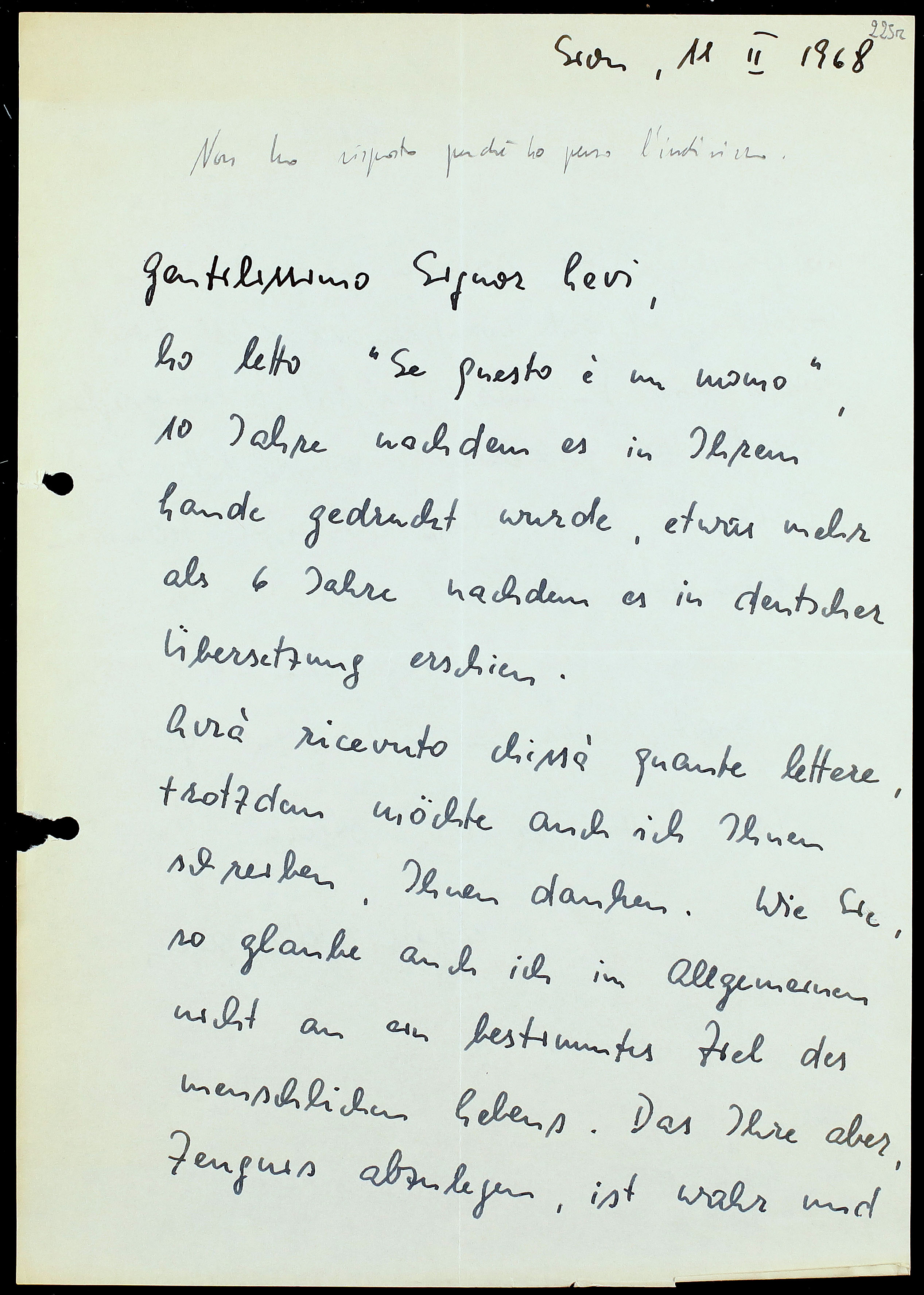
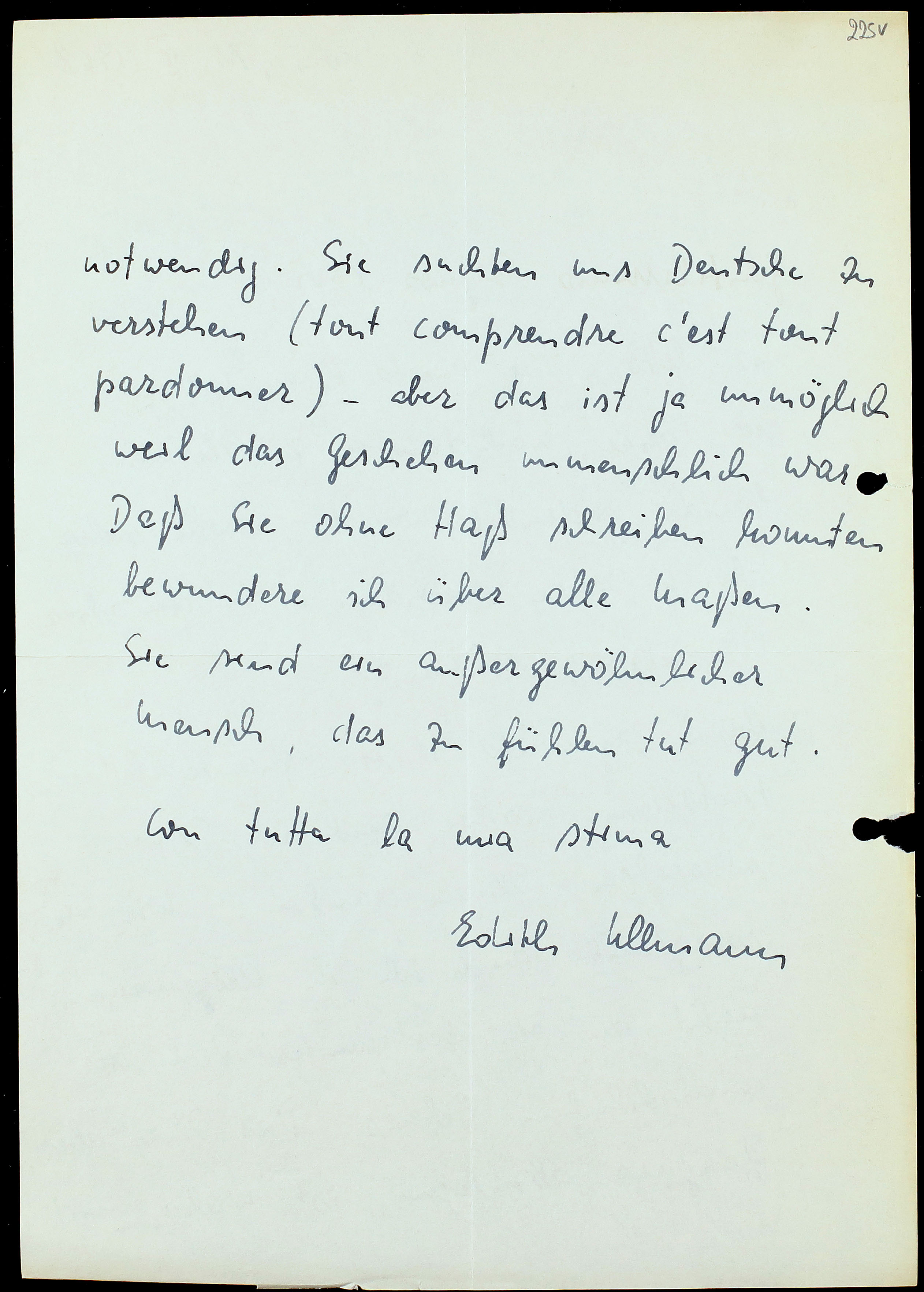
Edith Ulmann, a correspondent from Sion (Switzerland), combines Italian and German in this letter in which she thanks Levi for his testimony.
Sion, 11.II.1968
Gentilissimo Signor Levi,
ho letto Se questo è un uomo, 10 Jahre nachdem es in Ihren hande gedruckt wurde, etwas mehr als 6 Jahre nachdem es in deutsches Übersetzung erschien.
Avrà ricevuto chissà quante lettere,[1] trotzdem möchte auch ich Ihnen schreiben, Ihnen danken. Wie Sie, so glaube auch ich im Allgemeinen nicht an ein bestimmtes Ziel des menschlichen Lebens. Das Ihre aber, Zeugnis abzulegen, is wahr und notwendig.[2] Sie suchten uns Deutsche zu verstehen (tout comprendre c’est tout pardonner) – aber das is ja unmöglich weil das Geschicken unmenschlich was.
Daß Sie ohne Haß schreiben konnten bewundere ich über alle Maßen.[3] Sie sind ein außergewöhnlicher Mensch, das zu fühlen tut gut.
Con tutta la mia stima
Edith Ullmann
Sion, 11 febbraio 1968
Gentilissimo Signor Levi,
ho letto Se questo è un uomo dieci anni dopo che era stato dato alle stampe per la prima volta dalle Sue mani, poco più di sei anni dopo l’uscita della traduzione tedesca.
Avrà ricevuto chissà quante lettere,[1] e tuttavia desidero anch’io scriverLe e ringraziarLa. Come Lei, anch’io credo, in generale, che la vita umana non abbia uno scopo prestabilito. Ma che il Suo sia stato quello di testimoniare, questo sì, è vero e necessario.[2] Lei ha cercato di capire noi tedeschi (tout comprendre c’est tout pardonner), ma è impossibile, perché quanto è accaduto era disumano.
Che Lei abbia saputo scrivere senza odio, è un fatto che ammiro sopra ogni cosa.[3] Lei è una persona straordinaria, e provare questo sentimento fa bene.
Con tutta la mia stima
Edith Ullmann
Sion, February 11, 1968
Dearest Mr. Levi,
I read If This Is a Man ten years after the first printed edition was in your hands, a little more than six years after it appeared in German translation.
You must have received countless letters,[1] but I would still like to write to you too, to thank you. Like you, I do not generally believe human life has any specific purpose. Yours, however, of bearing witness, is true and necessary.[2]You sought to understand us Germans (tout comprendre c’est tout pardonner)—but that is impossible because what happened was inhuman.
That you managed to write without hatred is something I admire beyond measure.[3]You are an extraordinary person, and it does one good to feel that.
With all my respect
Edith Ullmann
Sion, 11.II.1968
Gentilissimo Signor Levi,
ho letto Se questo è un uomo, 10 Jahre nachdem es in Ihren hande gedruckt wurde, etwas mehr als 6 Jahre nachdem es in deutsches Übersetzung erschien.
Avrà ricevuto chissà quante lettere,[1] trotzdem möchte auch ich Ihnen schreiben, Ihnen danken. Wie Sie, so glaube auch ich im Allgemeinen nicht an ein bestimmtes Ziel des menschlichen Lebens. Das Ihre aber, Zeugnis abzulegen, is wahr und notwendig.[2] Sie suchten uns Deutsche zu verstehen (tout comprendre c’est tout pardonner) – aber das is ja unmöglich weil das Geschicken unmenschlich was.
Daß Sie ohne Haß schreiben konnten bewundere ich über alle Maßen.[3] Sie sind ein außergewöhnlicher Mensch, das zu fühlen tut gut.
Con tutta la mia stima
Edith Ullmann
Sion, 11 febbraio 1968
Gentilissimo Signor Levi,
ho letto Se questo è un uomo dieci anni dopo che era stato dato alle stampe per la prima volta dalle Sue mani, poco più di sei anni dopo l’uscita della traduzione tedesca.
Avrà ricevuto chissà quante lettere,[1] e tuttavia desidero anch’io scriverLe e ringraziarLa. Come Lei, anch’io credo, in generale, che la vita umana non abbia uno scopo prestabilito. Ma che il Suo sia stato quello di testimoniare, questo sì, è vero e necessario.[2] Lei ha cercato di capire noi tedeschi (tout comprendre c’est tout pardonner), ma è impossibile, perché quanto è accaduto era disumano.
Che Lei abbia saputo scrivere senza odio, è un fatto che ammiro sopra ogni cosa.[3] Lei è una persona straordinaria, e provare questo sentimento fa bene.
Con tutta la mia stima
Edith Ullmann
Sion, February 11, 1968
Dearest Mr. Levi,
I read If This Is a Man ten years after the first printed edition was in your hands, a little more than six years after it appeared in German translation.
You must have received countless letters,[1] but I would still like to write to you too, to thank you. Like you, I do not generally believe human life has any specific purpose. Yours, however, of bearing witness, is true and necessary.[2]You sought to understand us Germans (tout comprendre c’est tout pardonner)—but that is impossible because what happened was inhuman.
That you managed to write without hatred is something I admire beyond measure.[3]You are an extraordinary person, and it does one good to feel that.
With all my respect
Edith Ullmann
Info
Notes
Tag
Sender: Edith Ullmann
Addressee: Primo Levi
Date of Drafting: 1968-02-11
Place of Writing: Sion
Description:handwritten letter in black felt-tip pen on white paper. On the front of the sheet, above, is a handwritten insertion in pencil by Levi: “Non ho risposto perché ho perso l’indirizzo” (“I did not reply because I lost the address”).
Archive: Archivio privato di Primo Levi, Turin
Series: Complesso di fondi Primo Levi, Fondo Primo Levi, Corrispondenza, Corrispondenti particolari, fasc. 20, sottofasc. 1, Fasc. 20, sottofasc.1, doc. 83, f. 225r/v
Folio: 1, front and back
DOI: https://doi.org/10.15160/bg55-h614
1Levi himself was amazed by this flow of letters, as emerges in a letter he sent to Heinz Riedt on May 26, 1962: “Ever since Ist das [ein Mensch?] was published, I have received a dozen letters from German private citizens. It surprised me because it is not something that is often done in Italy,” cf. Primo Levi, Il carteggio con Heinz Riedt, Turin: Einaudi, 2024, p. 117.
2The reference is to a passage in the Preface to Ist das ein Mensch? in which Levi writes: “I don’t think a man’s life necessarily has a specific purpose, but if I think of my own life and the purposes I have set for myself, there is only one among them that I can identify consciously and precisely: to bear witness, to make my voice heard by the German people” (CW II, p. 1150).
3Ullmann’s comment is remarkable: as we know, the preface to the German edition is the letter Levi wrote to the book’s translator, Heinz Riedt, and thus Ullmann could not have read what Levi wrote in the preface to the Italian edition: “Hence, as an account of atrocities, this book of mine adds nothing to what readers throughout the world already know about the disturbing subject of the death camps. It was not written in order to formulate new accusations; it should be able, rather, to furnish documentation for a detached study of certain aspects of the human mind” (CW I, p. 5). Gisela Buschmann and Kordula Bernreuther, two other Germans who corresponded with Levi, make a similar observation: cf. Letter 106 and Letter 110.