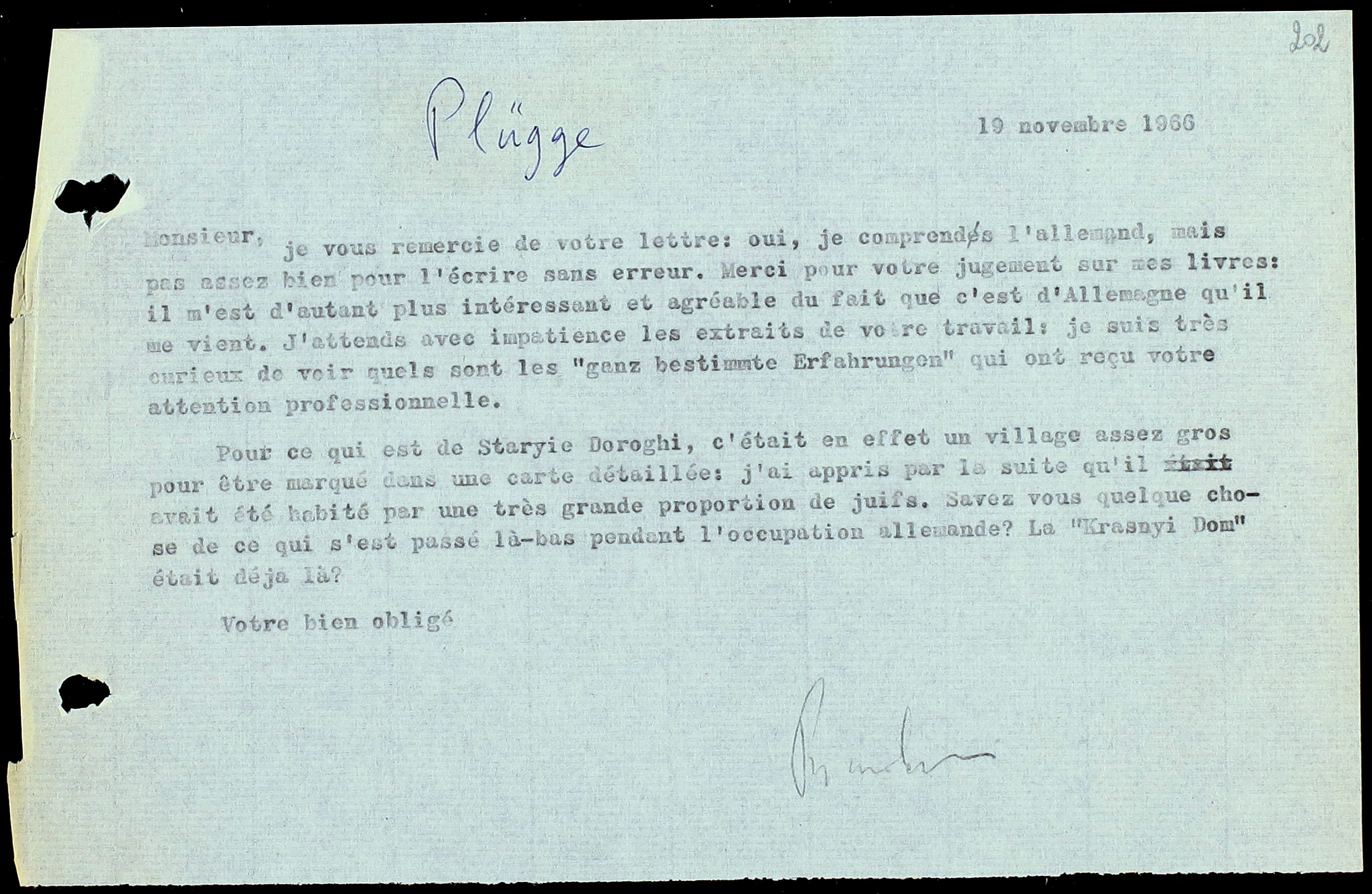
La ringrazio della Sua lettera: sĂŹ, capisco il tedesco, ma non cosĂŹ bene da scriverlo senza errori. Grazie per il giudizio sui mieilibri: lo reputo tanto piĂč interessante e gradevole per il fatto che mi arriva dalla Germania. Attendo con impazienza gli estratti del Suo saggio: sono assai curioso di vedere quali sono le âesperienze molto specificheâ che hanno ricevuto la Sua attenzione professionale.
Quanto a Staryie Doroghi, era infatti un paese abbastanza grande da essere segnato su una carta dettagliata: ho appreso in seguito che era abitato da unâaltissima percentuale di ebrei. Lei ha notizia di che cosâĂš successo lĂŹ durante lâoccupazione tedesca?[1] Câera giĂ la âKrasnyi Domâ?[2]
Con riconoscenza
Â
Primo Levi
November 19, 1960
Sir,
I thank you for your letter: yes, I understand German, but not well enough to write it without mistakes. Thank you for your opinion of mybooks: it is especially interesting and enjoyable for me because it comes to me from Germany. I am eagerly awaiting the excerpts of your work: I am very curious to see what the âganz bestimmte Erfahrungenâ are that have received your professional attention.
Regarding Staryie Doroghi, it was indeed a village large enough to be marked on a detailed map: I learned later that it had been inhabited by a very large percentage of Jews. Do you know anything about what happened there during the German occupation?[1]Was the âKrasnyi Domâ already there?[2]
        La ringrazio della Sua lettera: sĂŹ, capisco il tedesco, ma non cosĂŹ bene da scriverlo senza errori. Grazie per il giudizio sui mieilibri: lo reputo tanto piĂč interessante e gradevole per il fatto che mi arriva dalla Germania. Attendo con impazienza gli estratti del Suo saggio: sono assai curioso di vedere quali sono le âesperienze molto specificheâ che hanno ricevuto la Sua attenzione professionale.
Quanto a Staryie Doroghi, era infatti un paese abbastanza grande da essere segnato su una carta dettagliata: ho appreso in seguito che era abitato da unâaltissima percentuale di ebrei. Lei ha notizia di che cosâĂš successo lĂŹ durante lâoccupazione tedesca?[1] Câera giĂ la âKrasnyi Domâ?[2]
Con riconoscenza
Â
Primo Levi
November 19, 1960
Sir,
I thank you for your letter: yes, I understand German, but not well enough to write it without mistakes. Thank you for your opinion of mybooks: it is especially interesting and enjoyable for me because it comes to me from Germany. I am eagerly awaiting the excerpts of your work: I am very curious to see what the âganz bestimmte Erfahrungenâ are that have received your professional attention.
Regarding Staryie Doroghi, it was indeed a village large enough to be marked on a detailed map: I learned later that it had been inhabited by a very large percentage of Jews. Do you know anything about what happened there during the German occupation?[1]Was the âKrasnyi Domâ already there?[2]
Gratefully
Primo Levi
Info
Note
Tag
Mittente: Primo Levi
Destinatario: Herbert PlĂŒggeÂ
Data di stesura: 1966-11-19
Luogo di stesura: Torino
Descrizione del documento: copia di lettera ds. su carta velina con firma ms. a biro nera. Sul margine alto del foglio Levi ms. a biro blu: «PlĂŒgge» (mm218x140).
Archivio: Archivio privato di Primo Levi, Torino
Segnatura: Complesso di fondi Primo Levi, Fondo Primo Levi, Corrispondenza, Corrispondenti particolari, Fasc.020, sottofasc. 001, doc.070, f.202
Fogli: 1, solo recto
DOI:
1
Levi allude ai massacri dellâestate 1941 perpetrati contro la popolazione ebraica durante lâavanzata tedesca verso Mosca. Sulla vicenda si rimanda a Christopher Browning, Le origini della soluzione finale, il Saggiatore, Milano, 2012, in particolare capp. 7 e 8 (pp. 256-383), e Henning Pieper, Fegeleinâs horsemen and genocidal warfare, Palgrave Macmillan, Londra, 2015, in particolare pp. 69-121.
2
Il riferimento Ăš alla «Casa Rossa», lâimmenso edificio che accoglieva i millequattrocento italiani da rimpatriare, cfr. OC I, p. 413.