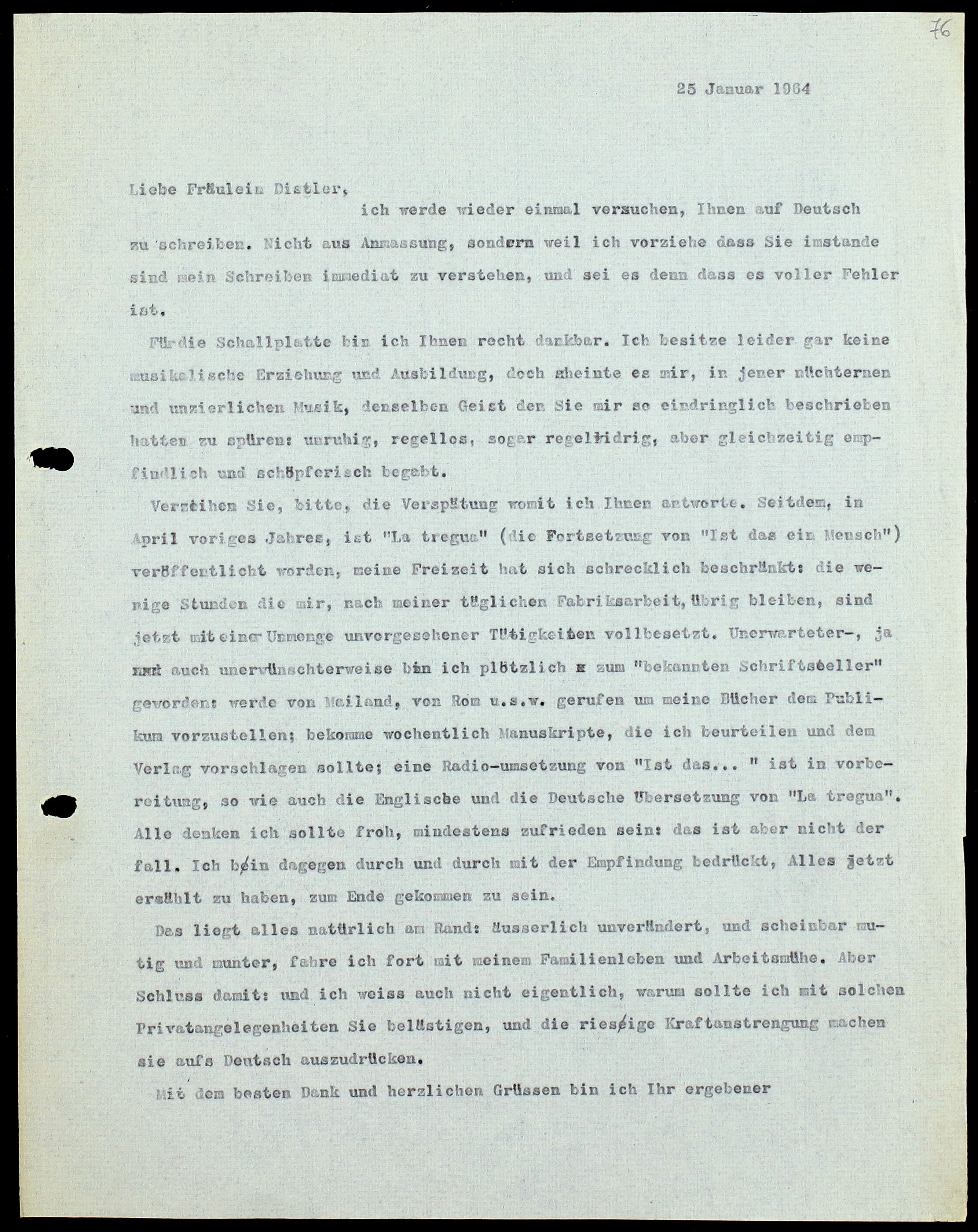
Levi ringrazia per il disco inviato, e condivide la sensazione di aver dato fondo al racconto delle sue esperienze con la pubblicazione de La tregua.
25 Januar 1964
Liebe Fräulein Distler,
ich werde wieder einmal versuchen, Ihnen auf Deutsch zu schreiben. Nicht aus Anmassung, sondern weil ich vorziehe dass Sie imstande sind mein Schreiben immediat zu verstehen, und sei es denn dass es voller Fehler ist.
Für die Schallplatte bin ich Ihnen recht dankbar. Ich besitze leider gar keine musikalische Erziehung und Ausbildung, doch scheinte[1] es mir, in jener nüchternen und unzierlichen Musik, denselben Geist den Sie mir so eindringlich beschrieben hatten zu spüren: unruhig, regellos, sogar regelwidrig, aber gleichzeitig empfindlich und schöpferisch begabt.
Verzeihen Sie, bitte, die Verspätung womit ich Ihnen antworte. Seitdem, in April voriges Jahres, ist La tregua (die Fortsetzung von Ist das ein Mensch) veröffentlicht worden, meine Freizeit hat sich schrecklich beschränkt: die wenige Stunden die mir, nach meiner täglichen Fabriksarbeit, übrig bleiben, sind jetzt mit einer Unmenge unvorgesehener Tätigkeiten vollbesetzt. Unerwarteter –, ja auch unerwünschterweise bin ich plötzlich zum „bekannten Schriftsteller” geworden: werde von Meilend, von Rom u.s.w. gerufen um meineBücher den Publikum vorzustellen;[2] bekomme wochentlich Manuskripte, die ich beurteilen und dem Verlag vorschlagen sollte; eine Radio-umsetzungvon „Ist das…” ist in vorbereitung,[3] so wie auch die Englische und die Deutsche Übersetzung von La tregua.[4] Alle denken ich sollte froh, mindestens zufrieden sein: das ist aber nicht der fall. Ich bin dagegen durch und durch mit der Empfindung bedrückt, Alles jetzt erzählt zu haben, zum Ende gekommen zu sein.[5]
Das liegt alles natürlich am Rand: äusserlich unverändert, und scheinbar mutig und munter, fahre ich fort mit meinem Familienleben und Arbeitsmühe. Aber Schluss damit: und ich weiss auch nicht eigentlich, warum sollte ich mit solchen Privatangelegenheiten Sie belästigen, und die riesige Kraftanstrengung machen sie aufs Deutsch auszudrücken.
Mit dem besten Dank und herzlichen Grüssen bin ich Ihr ergebener
25 gennaio 1964
Cara signorina Distler,
provo ancora una volta a scriverLe in tedesco. Non per presunzione, ma perché preferisco che Lei possa intendere subito la mia lettera, anche se piena di errori.
La ringrazio davvero molto per il disco. Purtroppo, non ho alcuna educazione musicale, eppure mi è sembrato[1] di riconoscere, in quella musica scarna e priva di ornamenti, lo stesso spirito che Lei mi aveva descritto con parole così pregnanti: inquieto, smanioso, persino refrattario alle regole, e insieme sensibile e dotato di forza creativa.
La prego di scusarmi per il ritardo della mia risposta. Da quando, nell’aprile scorso, è uscito La tregua (la continuazione di Se questo è un uomo), il mio tempo libero si è ridotto a nulla: le poche ore che mi restano dopo il lavoro in fabbrica sono occupate da una quantità di impegni imprevisti. All’improvviso, e anche mio malgrado, sono diventato uno “scrittore noto”: mi chiamano a Milano, a Roma e via dicendo, per presentare al pubblico i mieilibri;[2] ogni settimana ricevo manoscritti da valutare e proporre all’editore; è in preparazione un adattamento radiofonico di Se questo...,[3] e sono in corso le traduzioni inglese e tedesca de La tregua.[4] Tutti pensano che io debba esserne contento o almeno soddisfatto, ma non è così. Mi sento, al contrario, oppresso dalla sensazione di aver già detto tutto, di essere giunto alla fine.[5]
Tutto ciò resta, naturalmente, ai margini: all’esterno nulla è mutato, e in apparenza continuo a vivere allegro e impavido la mia vita in famiglia e i miei impegni lavorativi. Ma basta: non so nemmeno perché io debba importunarla con queste vicende private, e fare la fatica immensa di esprimerle in tedesco.
Con i migliori ringraziamenti e cordiali saluti, Suo devoto
January 25, 1964
Dear Ms. Distler,
I will try once again to write to you in German. Not out of presumption, but because I prefer that you be able to understand my letter immediately, even if it is full of mistakes.
I am very grateful to you for the record. Unfortunately, I have no musical education or training, but it seemed[1] to me that in that sober and unadorned music, I could sense the same spirit that you had described to me so vividly: restless, irregular, even transgressive, but at the same time sensitive and creatively gifted.
Please forgive the delay in my reply. Since The Truce (the sequel to If This is a Man) was published in April last year, my free time has been terribly limited: the few hours I have left after my daily factory work are now filled with a myriad of unforeseen activities. Unexpectedly—and, indeed, undesirably—I have suddenly become a “well-known writer”: I receive calls from Milan, Rome, etc., to present my books to the public;[2]every week I receive manuscripts that I am supposed to evaluate and recommend to the publisher; a radio adaptation of If This is…[3] is in preparation, as are the English and German translations of The Truce.[4]Everyone thinks I should be happy, or at least satisfied, but that is not the case. On the contrary, I am thoroughly depressed by the feeling that I have now said everything I have to say, that I have come to the end.[5]
Of course, all this is superficial: outwardly unchanged, and seemingly courageous and cheerful, I continue with my family life and work. But enough of that: I do not really know why I should pester you with such private matters and make the enormous effort to express them in German.
With many thanks and warm regards, I remain yours sincerely,
25 Januar 1964
Liebe Fräulein Distler,
ich werde wieder einmal versuchen, Ihnen auf Deutsch zu schreiben. Nicht aus Anmassung, sondern weil ich vorziehe dass Sie imstande sind mein Schreiben immediat zu verstehen, und sei es denn dass es voller Fehler ist.
Für die Schallplatte bin ich Ihnen recht dankbar. Ich besitze leider gar keine musikalische Erziehung und Ausbildung, doch scheinte[1] es mir, in jener nüchternen und unzierlichen Musik, denselben Geist den Sie mir so eindringlich beschrieben hatten zu spüren: unruhig, regellos, sogar regelwidrig, aber gleichzeitig empfindlich und schöpferisch begabt.
Verzeihen Sie, bitte, die Verspätung womit ich Ihnen antworte. Seitdem, in April voriges Jahres, ist La tregua (die Fortsetzung von Ist das ein Mensch) veröffentlicht worden, meine Freizeit hat sich schrecklich beschränkt: die wenige Stunden die mir, nach meiner täglichen Fabriksarbeit, übrig bleiben, sind jetzt mit einer Unmenge unvorgesehener Tätigkeiten vollbesetzt. Unerwarteter –, ja auch unerwünschterweise bin ich plötzlich zum „bekannten Schriftsteller” geworden: werde von Meilend, von Rom u.s.w. gerufen um meineBücher den Publikum vorzustellen;[2] bekomme wochentlich Manuskripte, die ich beurteilen und dem Verlag vorschlagen sollte; eine Radio-umsetzungvon „Ist das…” ist in vorbereitung,[3] so wie auch die Englische und die Deutsche Übersetzung von La tregua.[4] Alle denken ich sollte froh, mindestens zufrieden sein: das ist aber nicht der fall. Ich bin dagegen durch und durch mit der Empfindung bedrückt, Alles jetzt erzählt zu haben, zum Ende gekommen zu sein.[5]
Das liegt alles natürlich am Rand: äusserlich unverändert, und scheinbar mutig und munter, fahre ich fort mit meinem Familienleben und Arbeitsmühe. Aber Schluss damit: und ich weiss auch nicht eigentlich, warum sollte ich mit solchen Privatangelegenheiten Sie belästigen, und die riesige Kraftanstrengung machen sie aufs Deutsch auszudrücken.
Mit dem besten Dank und herzlichen Grüssen bin ich Ihr ergebener
25 gennaio 1964
Cara signorina Distler,
provo ancora una volta a scriverLe in tedesco. Non per presunzione, ma perché preferisco che Lei possa intendere subito la mia lettera, anche se piena di errori.
La ringrazio davvero molto per il disco. Purtroppo, non ho alcuna educazione musicale, eppure mi è sembrato[1] di riconoscere, in quella musica scarna e priva di ornamenti, lo stesso spirito che Lei mi aveva descritto con parole così pregnanti: inquieto, smanioso, persino refrattario alle regole, e insieme sensibile e dotato di forza creativa.
La prego di scusarmi per il ritardo della mia risposta. Da quando, nell’aprile scorso, è uscito La tregua (la continuazione di Se questo è un uomo), il mio tempo libero si è ridotto a nulla: le poche ore che mi restano dopo il lavoro in fabbrica sono occupate da una quantità di impegni imprevisti. All’improvviso, e anche mio malgrado, sono diventato uno “scrittore noto”: mi chiamano a Milano, a Roma e via dicendo, per presentare al pubblico i mieilibri;[2] ogni settimana ricevo manoscritti da valutare e proporre all’editore; è in preparazione un adattamento radiofonico di Se questo...,[3] e sono in corso le traduzioni inglese e tedesca de La tregua.[4] Tutti pensano che io debba esserne contento o almeno soddisfatto, ma non è così. Mi sento, al contrario, oppresso dalla sensazione di aver già detto tutto, di essere giunto alla fine.[5]
Tutto ciò resta, naturalmente, ai margini: all’esterno nulla è mutato, e in apparenza continuo a vivere allegro e impavido la mia vita in famiglia e i miei impegni lavorativi. Ma basta: non so nemmeno perché io debba importunarla con queste vicende private, e fare la fatica immensa di esprimerle in tedesco.
Con i migliori ringraziamenti e cordiali saluti, Suo devoto
January 25, 1964
Dear Ms. Distler,
I will try once again to write to you in German. Not out of presumption, but because I prefer that you be able to understand my letter immediately, even if it is full of mistakes.
I am very grateful to you for the record. Unfortunately, I have no musical education or training, but it seemed[1] to me that in that sober and unadorned music, I could sense the same spirit that you had described to me so vividly: restless, irregular, even transgressive, but at the same time sensitive and creatively gifted.
Please forgive the delay in my reply. Since The Truce (the sequel to If This is a Man) was published in April last year, my free time has been terribly limited: the few hours I have left after my daily factory work are now filled with a myriad of unforeseen activities. Unexpectedly—and, indeed, undesirably—I have suddenly become a “well-known writer”: I receive calls from Milan, Rome, etc., to present my books to the public;[2]every week I receive manuscripts that I am supposed to evaluate and recommend to the publisher; a radio adaptation of If This is…[3] is in preparation, as are the English and German translations of The Truce.[4]Everyone thinks I should be happy, or at least satisfied, but that is not the case. On the contrary, I am thoroughly depressed by the feeling that I have now said everything I have to say, that I have come to the end.[5]
Of course, all this is superficial: outwardly unchanged, and seemingly courageous and cheerful, I continue with my family life and work. But enough of that: I do not really know why I should pester you with such private matters and make the enormous effort to express them in German.
With many thanks and warm regards, I remain yours sincerely,
Info
Note
Tag
Mittente: Primo Levi
Destinatario: Brigitte Distler
Data di stesura: 1964-01-25
Luogo di stesura: Torino
Descrizione del documento: copia carbone su carta velina di lettera ds.
Archivio: Archivio privato di Primo Levi, Torino
Segnatura: Complesso di Fondi primo Levi, Fondo Primo Levi, Corrispondenza, Corrispondenti particolari, fasc. 20, sottofasc. 001, doc. 026, f. 76.
Fogli: 1, solo recto
DOI: https://doi.org/10.15160/td2j-j819
1
Forma scorretta del passato del verbo scheinen.
2A Roma, Levi aveva partecipato alla cerimonia del Premio Strega nel luglio 1963; era tra i finalisti con La tregua insieme a Natalia Ginzburg (poi vincitrice) e Tommaso Landolfi (Ian Thomson, Primo Levi. A Life [Primo Levi. Una vita], cit., pp. 369-370). Lo stesso anno, Levi vincerà poi la prima edizione del Premio Campiello.
3All’indomani della pubblicazione de La tregua nel marzo del 1963, Levi ricevette dal Canada una lettera che lo informava della preparazione di un adattamento radiofonico di Se questo è un uomo basato sulla traduzione inglese di Stuart Woolf. Le registrazioni sarebbero iniziate proprio nel gennaio del 1964; la messa in onda avverrà solo nel gennaio del 1965. Entusiasta dell’iniziativa, Levi propose a Radio Rai una sua versione, che uscirà il 24 aprile del 1964 (OC I, p. 1195-1197). Per una panoramica G. Episcopo, On Solid Air: Primo Levi and the Radio RAI (“In onda: Primo Levi e la Radio Rai”), in Interpreting Primo Levi: Interdisciplinary Perspectives (“Interpretando Primo Levi: prospettive interdisciplinari”), a cura di M. Vuohelainen, A. Chapman, Palgrave, New York 2016, pp. 203-218. Da una lettera a Heinz Riedt del 16 gennaio 1964 sappiamo che a metà mese Levi stava già lavorando al copione: «e finalmente, un lavoro che mi diverte molto: la Rai mi ha incaricato di stendere un copione radio di Se questo è un uomo, da trasmettersi in occasione delle manifestazioni per il Ventennale della Resistenza, in aprile». Cfr. P. Levi, Il carteggio con Heinz Riedt, cit., p. 153.
4Levi racconta i retroscena della pubblicazione de La tregua in Germania nel carteggio con Heinz Riedt (P. Levi, Il carteggio con Heinz Riedt, cit., pp. 139-156). Riedt, che aveva tradotto per Fischer Se questo è un uomo, non riuscì a spuntarla con l’editore Wagner, il quale affidò invece il secondo libro di Levi ai coniugi Robert e Barbara Picht. Nel carteggio con Riedt si fa breve menzione anche della traduzione inglese: «ho ricevuto dal sig. Picht un saggio di traduzione, è ormai già piú di un mese, e l’ho restituito corretto con la pignoleria a Lei ben nota. Da allora, non ho piú saputo nulla. La traduzione mi pare sostanzialmente buona, seppure sia chiara una certa tendenza a cavarsela “col minimo sforzo” nelle situazioni difficili: e ho potuto constatare che di tali situazioni la Tregua è ben ricca, soprattutto nei dialoghi semidialettali di Cesare. Sto rivedendo in questi giorni la traduzione inglese, fatta da quel mio amico Woolf di cui forse Le ho parlato: e sudo 4 camicie per gli stessi motivi» (p. 152). Levi sarà infine poco soddisfatto della versione tedesca, che uscirà nel 1964 con il titolo Atempause.
5In un'intervista con Pier Maria Paoletti apparsa su «Il Giorno» del 7 agosto 1963, Levi aveva già espresso pubblicamente questo stato d’animo. «Con l’esperienza dei Lager, allora, tutto finito?», chiedeva Paoletti, «Ah sí, neanche una parola. Piú niente. Quello che dovevo dire l’ho detto tutto. Completamente finito» (OC III, p. 11).