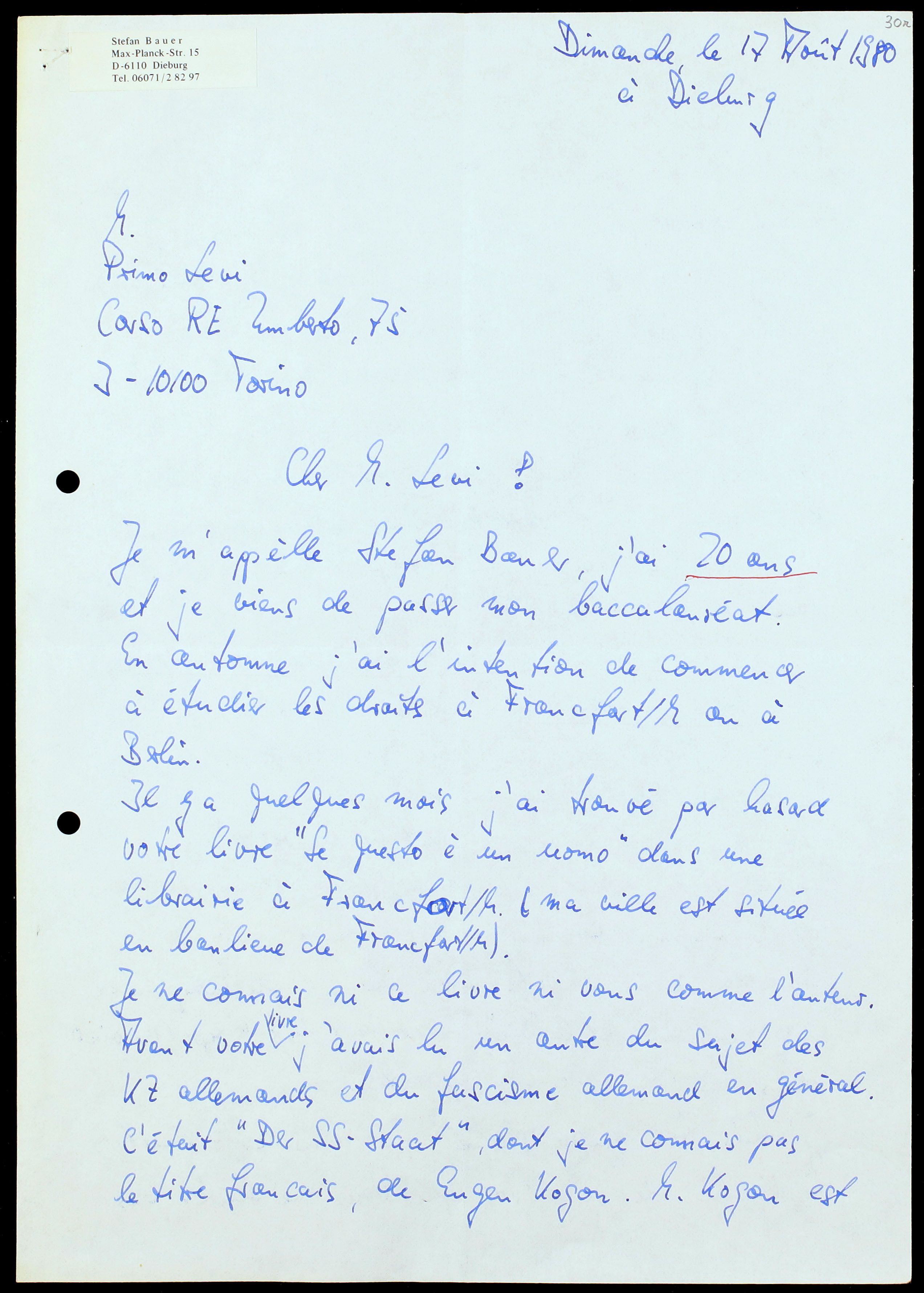
Stefan Bauer, giovane studente neodiplomato, scrive di essere rimasto assai impressionato dalla lettura di Se questo è un uomo e sottolinea la difficoltà, per i giovani tedeschi, di occuparsi del periodo nazista.
Dimanche le 17 Août 1980
à Dieburg
M.
Primo Levi
CORSO RE Umberto, 75
I – 10100 Torino
Cher M. Levi!
Je m’appèlle Stefan Bauer, j’ai 20 ans[1] et je viens de passer mon baccalauréat. En automne j’ai l’intention de commencer à étudier les droits à Francfort/M ou à Berlin.
Il y a quelques mois j’ai trouvé par hasard votre livre Se questo è un uomo dans une librairie à Francfort/M. (ma ville est située en banlieue de Francfort/M.).
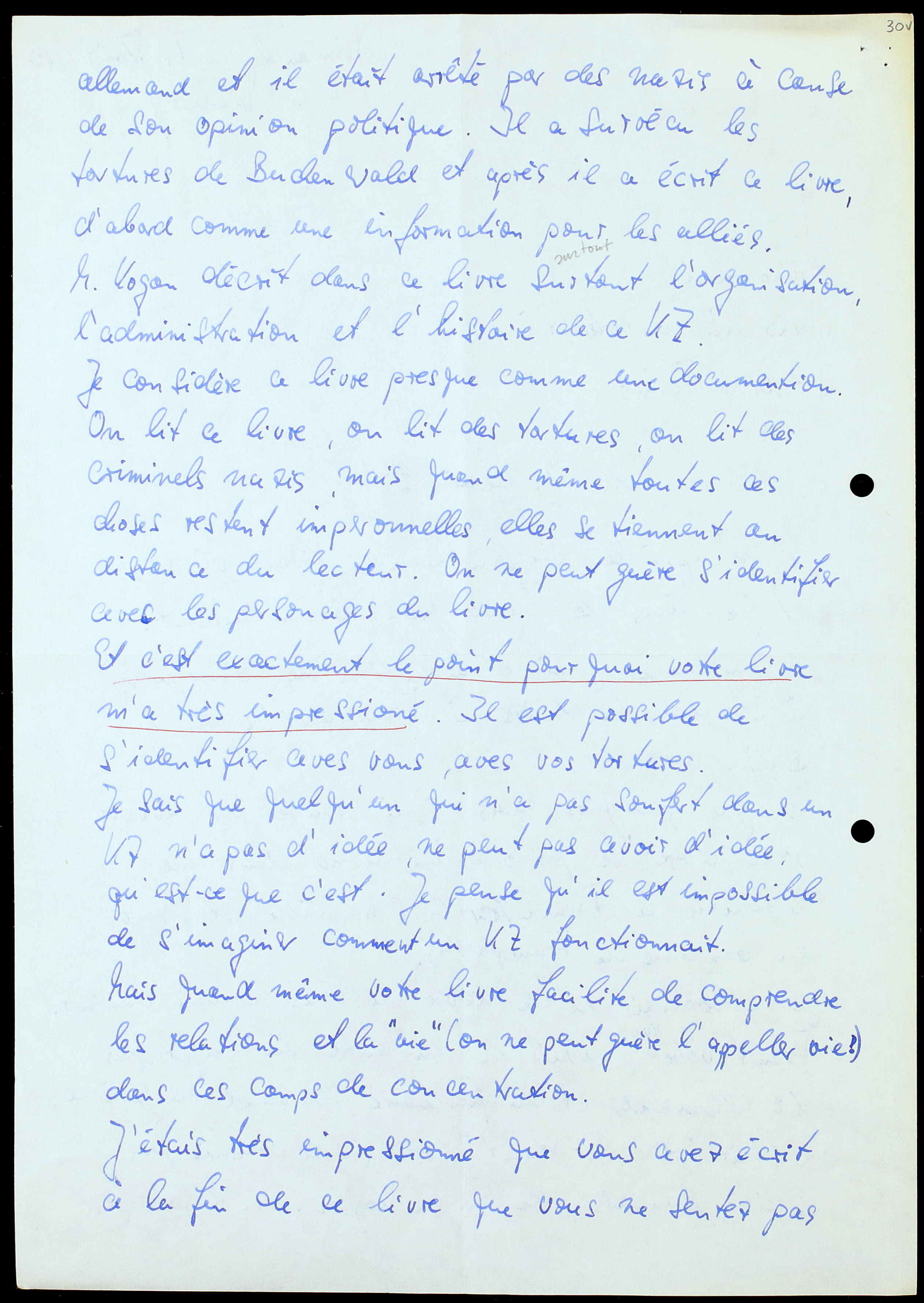
Je ne connais ni ce livre ni vous comme l’auteur. Avant votre livre j’avais lu un autre du sujet des KZ allemands et du fascisme allemand en général. C’était Der SS-Staat, dont je ne connais pas le titre francais, de Eugen Kogon.[2] M. Kogon est allemand et il était arrêté par des nazis à cause de son opinion politique. Il a survécu les tortures de Buchenwald et après il a écrit ce livre, d’abord comme une information pour les alliés. M. Kogon décrit dans ce livre surtout[3] l’organisation, l’administration et l’histoire de ce KZ.
Je considère ce livre presque comme une documentation. On lit ce livre, on lit des tortures, on lit des criminels nazis, mais quand même toutes ces choses restent impersonnelles, elles se tiennent au distance du lecteur. On ne peut guère s’identifier avec les personnages du livre.
Et c’est exactement le point pourquoi votre livre m’a très impressionné.[4] Il est possible de s’identifier avec vous, avec vos tortures. Je sais que quelqu’un qui n’a pas soufert dans un KZ n’a pas d’idée, ne peut pas avoir d’idée, qui est-ce que c’est. Je pense qu’il est impossible de s’imaginer comment un KZ fonctionnait.
Mais quand même votre livre facilite de comprendre les relations et la “vie” (on ne peut guère l’appeler vie?) dans ces camps de concentration.
J’étais très impressionné que vous avez écrit à la fin de ce livre que vous ne sentez pas la haîne envers les allemands. Je crois que c’était toujours très difficile pour vous.
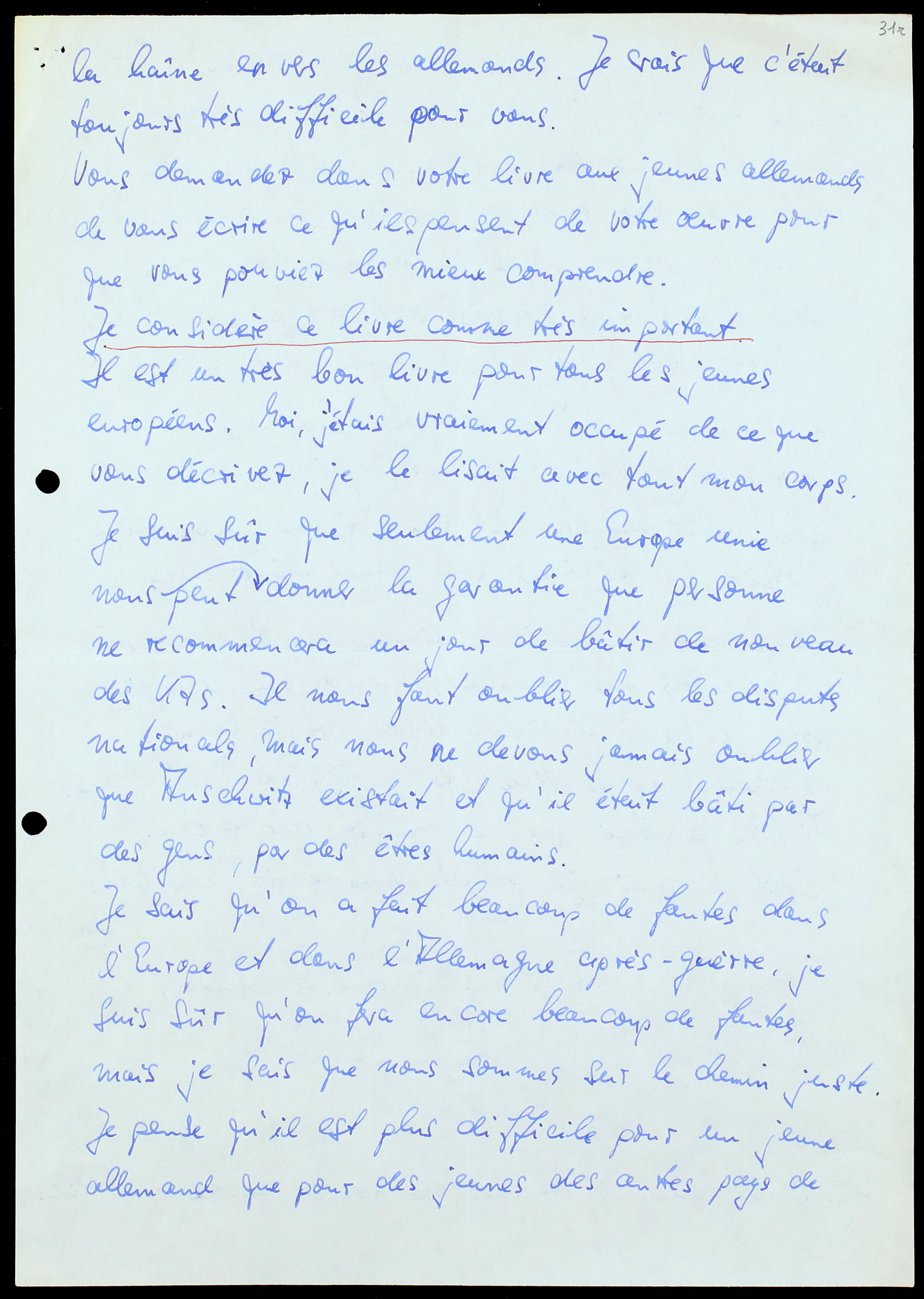
Vous demandez dans votre livre aux jeunes allemands de vous écrire ce qu’ils pensent de votre œuvre pour que vous pouviez les mieux comprendre.
Je considère ce livre comme très important.[5]
Il est un très bon livre pour tous les jeunes européens. Moi, j’étais vraiment occupé de ce que vous décrivez, je le lisait avec tout mon corps. Je suis sûr que seulement une Europe unie peut nous[6] donner la garantie que personne ne recommencera un jour de bâtir de nouveau des KZS. Il nous fait oublier tous les disputes nationals, mais nous ne devons jamais oublier que Auschwitz existait et qu’il était bâti par des gens, par des êtres humains.
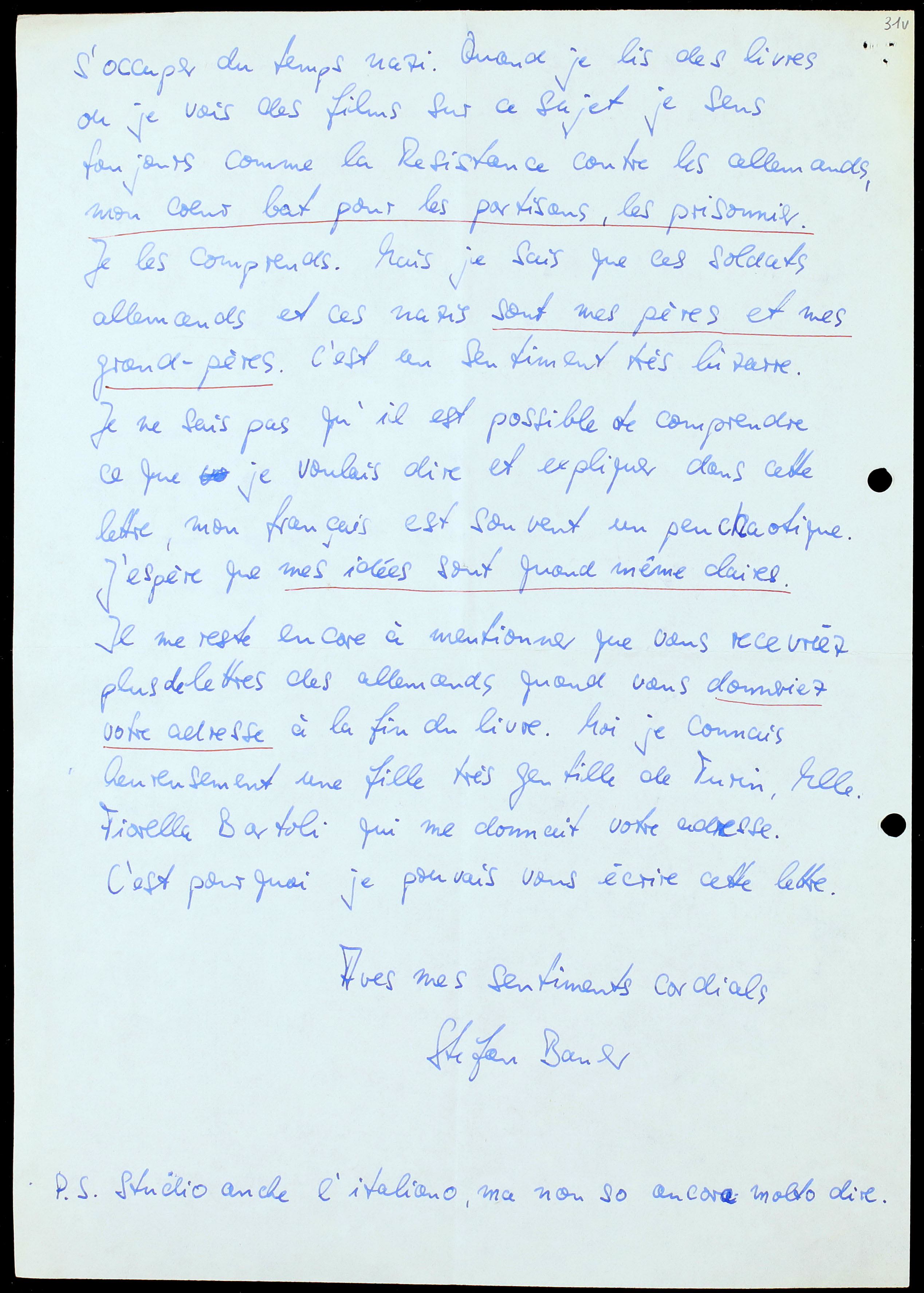
Je sais qu’on a fait beaucoup de fautes dans l’Europe et dans l’Allemagne après-guèrre, je suis sûr qu’on fera encore beaucoup de fautes, mais je sais que nous sommes sur le chemin juste. Je pense qu’il est plus difficile pour un jeune allemand que pour des jeunes des autres pays de s’occuper du temps nazi. Quand je lis des livres ou je vois des films sur ce sujet je sens toujours comme la Resistance contre les allemands, mon cœur bat pour les partisans, les prisonnier.[7] Je les comprends. Mais je sais que ces soldats allemands et ces nazis sont mes pères et mes grand-pères.[8] C’est un sentiment très bizarre. Je ne sais pas qu’il est possible de comprendre ce que je voulais dire et expliquer dans cette lettre, mon français est souvent un peu chaotique. J’espère que mes idées sont quand même claires.[9]
Il me reste encore à mentionner que vous recevriez plus de lettres des allemands quand vous donneriez votre adresse[10] à la fin du livre. Moi je connais heureusement une fille très gentille de Turin, Mlle. Fiorella Bartoli qui me donnait votre adresse. C’est pourquoi je pouvais vous écrire cette lettre.
Avec mes sentiments cordials
Stefan Bauer
Ps: studio anche l’italiano, ma non so ancora molto dire.
Domenica 17 agosto 1980 a Dieburg
Sig. Primo Levi CORSO RE Umberto, 75 I – 10100 Torino
Caro Sig. Levi!
Mi chiamo Stefan Bauer, ho 20 anni[1] e ho appena conseguito il diploma di maturità. In autunno ho intenzione di cominciare a studiare legge a Francoforte sul Meno o a Berlino.
Pochi mesi fa ho trovato per caso il Suo libro Se questo è un uomo in una libreria di Francoforte sul Meno (la mia cittadina si trova nell’area attorno a Francoforte).
Non conoscevoné il libro né Lei come autore. Prima del Suo, avevo letto un altro libro sul tema dei campi di concentramento tedeschi e del fascismo tedesco in generale. Era Lo stato-SS, di cui non conosco il titolo francese, di Eugen Kogon.[2] Il Sig. Kogon è tedesco e i nazisti l’hanno arrestato a causa del suo credo politico. È sopravvissuto alle torture di Buchenwald e poi ha scritto questo libro, in primo luogo come informazione per gli alleati. Nel libro, il Sig. Kogon descrive soprattutto[3] l’organizzazione, l’amministrazione e la storia dei campi di concentramento.
Questo libro lo considero quasi come un documento. Lo leggiamo, leggiamo delle torture, leggiamo dei criminali nazisti, eppure sono tutte cose che restano impersonali, si tengono a distanza dal lettore. Non possiamo identificarci con i personaggi del libro.
Ed è appunto per questo che il Suo libro mi ha impressionato molto.[4] Con Lei, con le Sue torture, è possibile identificarsi. So che chi non ha sofferto in un campo di concentramento non ha un’idea, non può avere un’idea, di che cos’è. Penso che sia impossibile immaginare come funzionava un campo di concentramento.
Ma fatto sta che il Suo libro aiuta a comprendere le relazioni e la «vita» (non possiamo chiamarla vita?) nei campi di concentramento.
Mi ha molto impressionato che alla fine del libro Lei ha scritto di non sentire l’odio verso i tedeschi. Credo sia stato sempre molto difficile per Lei.
Nel Suo libro chiede ai giovani tedeschi di scriverLe che cosa pensano della Sua opera, affinché Lei possa capirli meglio.
Considero questo libro molto importante.[5]
È un ottimo libro per tutti i giovani europei. Io ero davvero assorto in quello che descrive, lo leggevo con tutto il mio corpo. Sono certo che soltanto un’Europa unita possa darci[6] la garanzia che un giorno nessuno ricomincerà a costruire nuovi campi di concentramento. Ci fa dimenticare tutte le beghe nazionali, ma non dobbiamo mai dimenticare che Auschwitz esisteva e che l’hanno costruita delle persone, degli esseri umani.
So che sono stati commessi tanti errori nell’Europa e nella Germania postbelliche, sono certo che se ne faranno ancora tanti, ma so che siamo sulla strada giusta. Penso che occuparsi del tempo nazista sia più difficile per un giovane tedesco che per i giovani di altri paesi. Quando leggo libri o vedo film su questo argomento, m’immedesimo sempre nella Resistenza antitedesca, il mio cuore batte per i partigiani, i prigionieri.[7] Li capisco. Ma so che quei soldati tedeschi e quei nazisti sono i miei padri e i miei nonni.[8] È un sentimento stranissimo. Non so se è possibile comprendere che cosa volevo dire e spiegarlo in questa lettera, spesso il mio francese è piuttosto caotico. Spero che le mie idee siano comunque chiare.[9]
Ho ancora da dirLe che riceverebbe più lettere dai tedeschi se indicasse il Suo indirizzo[10] alla fine del libro. Io ho la fortuna di conoscere una ragazza molto gentile di Torino, la Signorina Fiorella Bartoli, che mi ha dato il Suo indirizzo. È così che ho potuto scriverLe questa lettera.
Con i miei cordiali sentimenti
Stefan Bauer
Ps: studio anche l’italiano, ma non so ancora molto dire.
Sunday, August 17, 1980 Dieburg
Mr. Primo Levi CORSO RE Umberto, 75 I – 10100 Torino
Dear Mr. Levi!
My name is Stefan Bauer, I am 20 years[1] old and I have just taken my baccalaureate exam[2]. In the autumn I plan to begin my study of law in Frankfurt am Main or Berlin.
A few months ago I found by chance your book Se questo è un uomo in a bookstore in Frankfurt (my town is just outside Frankfurt).
I did not know this book or you as an author. Before your book, I had read another one about the German concentration camps and German fascism in general. It was Des SS-Staat, whose French title I do not know, by Eugen Kogon.[2] Mr. Kogon is German and he was arrested by the Nazis because of his political opinion. He survived the tortures of Buchenwald and afterwards he wrote this book, primarily as information for the allies. In this book, Mr. Kogon mostly[3] describes the organization, the administration, and the history of this concentration camp.
I consider this book to be almost a documentary work. One reads this book, one reads about the torture, one reads about the Nazi criminals, but all these things still remain impersonal, they are kept at a distance from the reader. One can hardly identify with the characters in this book at all.
And this is exactly why your book impressed me very much.[4] It is possible to identify with you, with your tortures. I know that someone who did not suffer in a concentration camp has no idea, cannot have any idea, of what it is. I think that it is impossible to imagine how a concentration camp worked.
But all the same your book makes it easier to understand the relationships and the “life” (one can hardly call it a life?) in these concentration camps.
I was very impressed that you wrote at the end of this book that you do not feel hatred for the Germans. I think that it was always very difficult for you.
In your book you ask young Germans to write to you about what they think of your work so that you can understand them better.
I consider this book to be very important.[5]
It is a very good book for all young Europeans. As for me, I was really engaged in what you described. I read it with my entire body. I am sure that only a united Europe can give us[6] the guarantee that no one will start to build concentration camps again one day. It makes us forget all the national disputes, but we must never forget that Auschwitz existed and that it was built by people, by human beings.
I know that people made many mistakes in Europe and in Germany after the war, I am sure that people will make many mistakes again, but I know that we are on the right path. I think it is more difficult for a young German than for young people in other countries to concern themselves with the Nazi era. When I read books or see movies about this subject I always feel like the Resistance against the Germans, my heart beats for the partisans, the prisoners.[7] I understand them. But I know that these German soldiers and these Nazis are my fathers and my grandfathers.[8] It is a very strange feeling. I do not know if it is possible to understand what I wanted to say and explain in this letter, my French is often a little chaotic. I hope that my ideas are still clear.[9]
I would also like to mention that you would receive more letters from Germans if you gave your address[10] at the end of the book. Fortunately I know a very nice girl from Turin, Miss Fiorella Bartoli, who gave me your address. That is why I was able to write you this letter.
Cordially
Stefan Bauer
P.S.: I’m also studying Italian, but I still don’t know to say much.
Info
Note
Tag
Mittente: Stefan Bauer
Destinatario: Primo Levi
Data di stesura: 1980-08-17
Luogo di stesura: Dieburg
Descrizione del documento: lettera ms. a stilografica blu su foglio bianco con intestazione adesiva; il foglio presenta sottolineature ms. a biro rossa e a matita grigia di Levi.
Archivio: Archivio privato di Primo Levi, Torino
Segnatura: Complesso di Fondi primo Levi, Fondo Primo Levi, Corrispondenza, Corrispondenza generale, fasc. 011, sottofasc. 002, doc. 004, ff. 30r/v, 31r/v.
2Levi conosceva Der SS Staat di Eugen Kogon dal momento della sua pubblicazione nel 1947. In una lettera ad Heinz Riedt del 31 dicembre 1959, sostiene di aver perso la copia in suo possesso e gli chiede la cortesia di fargliene arrivare un’altra dalla Germania. A fine gennaio del 1960, riceverà la nuova copia. Preoccupato per l’insorgenza di movimenti neonazisti in Italia e in Europa, la sua intenzione in quel momento era di proporre a Einaudi la traduzione del volume di Kogon, a quell’altezza uno dei più importanti e documentati studi sul nazionalsocialismo. Cfr. P. Levi, Il carteggio con Heinz Riedt, a cura di M. Mengoni, Einaudi, Torino 2024, pp. 28-37. Come racconterà allo storico Paolo Sorcinelli in un’intervista del 1986, l’iniziativa non ebbe purtroppo il successo sperato (OC III, p. 674). Nell’appendice all’edizione scolastica di Se questo è un uomo del 1976, Levi aveva inoltre inserito una sua traduzione del paragrafo conclusivo di Der SS Staat (OC I, pp. 285-86).
3
Sopra «surtout», Levi ms. a matita «surtout».
4
La frase è sottolineata a biro rossa.
5
La frase è sottolineata a biro rossa.
6
Scritto «nous peut donner» e corretto con un segno di inversione.
7
«mon cœur bat pour les partisans, les prisonnier» è sottolineato a biro rossa.
8
«sont mes pères et mes grand-pères» è sottolineato a biro rossa.
9
«mes idées sont quand même claires» è sottolineato a biro rossa.
10
«donneriez votre adresse» è sottolineato a biro rossa.