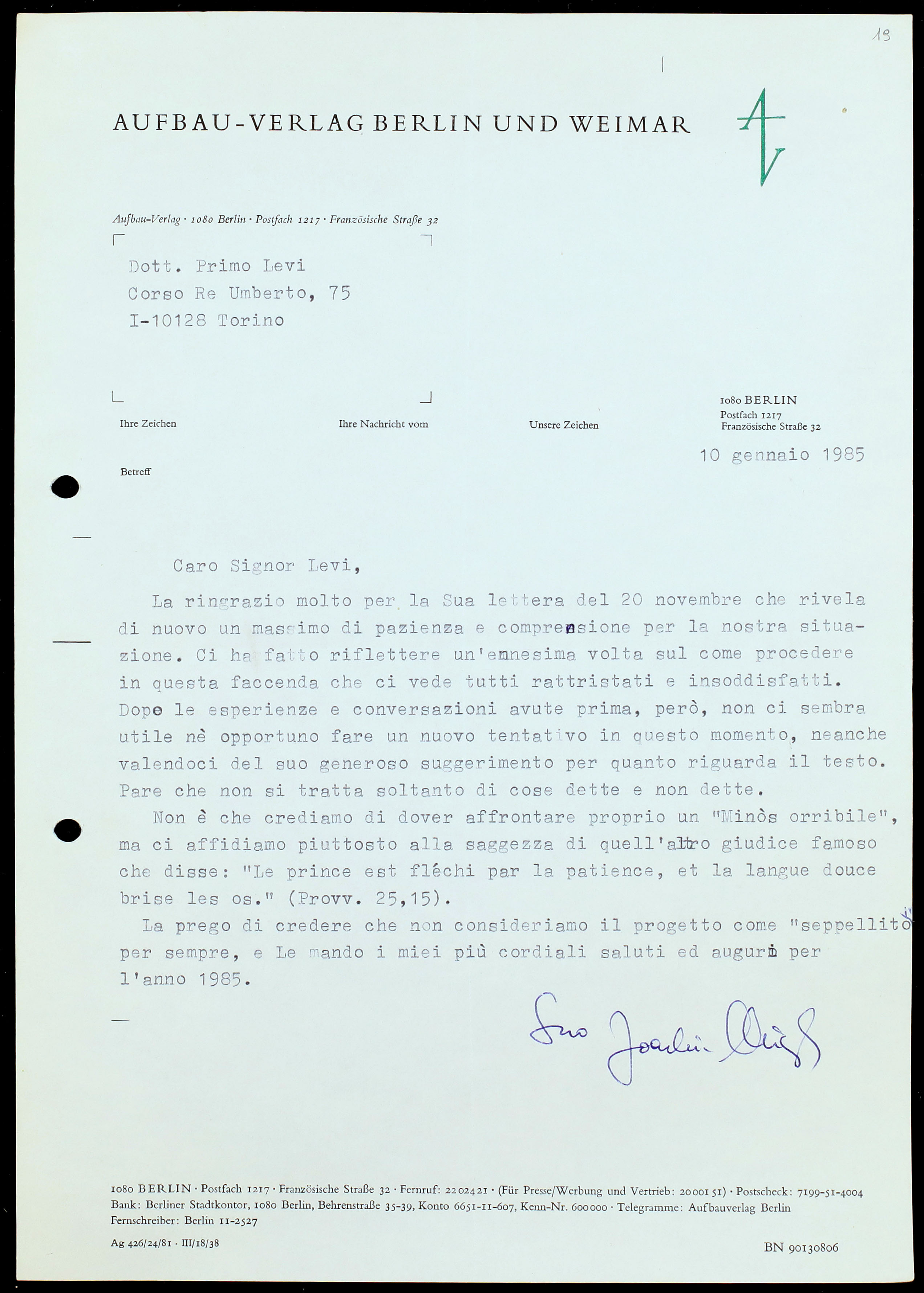
Meinert replies to Levi’s letter dated November 20 with a formal message, in his capacity as an editor at Aufbau, and informs him that, at least for the moment, they are unable to proceed with a second attempt to further the publication of If This Is a Man in the DDR .
La ringrazio molto per la Sua lettera del 20 novembre che rivela di nuovo un massimo di pazienza e comprensione per la nostra situazione. Ci ha fatto riflettere un’ennesima volta sul come procedere in questa faccenda che ci vede tutti rattristati e insoddisfatti.
Dopo le esperienze e conversazioni avute prima, però, non ci sembra utile né opportuno fare un nuovo tentativo in questo momento, neanche valendoci del suo generoso suggerimento per quanto riguarda il testo.[1]
Pare che non si tratta soltanto di cose dette e non dette.
Non è che crediamo di dover affrontare proprio un «Minòs orribile»[2], ma ci affidiamo piuttosto alla saggezza di quell’altro giudice famoso che disse: «Le prince est fléchi par la patience, et la langue douce brise les os.»[3] (Provv. 25,15).
La prego di credere che non consideriamo il progetto come «seppellito» per sempre, e Le mando i miei più cordiali saluti ed auguri per l’anno 1985.
10 gennaio 1985
Caro Signor Levi,
La ringrazio molto per la Sua lettera del 20 novembre che rivela di nuovo un massimo di pazienza e comprensione per la nostra situazione. Ci ha fatto riflettere un’ennesima volta sul come procedere in questa faccenda che ci vede tutti rattristati e insoddisfatti.
Dopo le esperienze e conversazioni avute prima, però, non ci sembra utile né opportuno fare un nuovo tentativo in questo momento, neanche valendoci del suo generoso suggerimento per quanto riguarda il testo.[1]
Pare che non si tratta soltanto di cose dette e non dette.
Non è che crediamo di dover affrontare proprio un «Minòs orribile»[2], ma ci affidiamo piuttosto alla saggezza di quell’altro giudice famoso che disse: «Le prince est fléchi par la patience, et la langue douce brise les os.»[3] (Provv. 25,15).
La prego di credere che non consideriamo il progetto come «seppellito» per sempre, e Le mando i miei più cordiali saluti ed auguri per l’anno 1985.
January 10, 1985
Dear Mr. Levi,
Thank you very much for your letter dated November 20, which once again reveals the highest patience and comprehension for our situation. It made us reflect for the nth time on how to proceed in this matter, which has saddened and dissatisfied all of us.
However, after our previous experiences and conversations, we find it neither useful nor opportune to make another attempt at this moment, not even if we avail ourselves of your generous offer regarding the text.[1]
It appears to be more than just a case of things said and unsaid.
We do not believe that we must face a “Minòs orribile,”[2] but, instead, we put our trust in the wisdom of that other famous judge who said: “Le prince est fléchi par la patience, et la langue douce brise les os”[3] (Prov. 25:15).
Please believe that we do not consider the project “buried” forever; I send you my most cordial greetings and best wishes for the year 1985.
10 gennaio 1985
Caro Signor Levi,
La ringrazio molto per la Sua lettera del 20 novembre che rivela di nuovo un massimo di pazienza e comprensione per la nostra situazione. Ci ha fatto riflettere un’ennesima volta sul come procedere in questa faccenda che ci vede tutti rattristati e insoddisfatti.
Dopo le esperienze e conversazioni avute prima, però, non ci sembra utile né opportuno fare un nuovo tentativo in questo momento, neanche valendoci del suo generoso suggerimento per quanto riguarda il testo.[1]
Pare che non si tratta soltanto di cose dette e non dette.
Non è che crediamo di dover affrontare proprio un «Minòs orribile»[2], ma ci affidiamo piuttosto alla saggezza di quell’altro giudice famoso che disse: «Le prince est fléchi par la patience, et la langue douce brise les os.»[3] (Provv. 25,15).
La prego di credere che non consideriamo il progetto come «seppellito» per sempre, e Le mando i miei più cordiali saluti ed auguri per l’anno 1985.
January 10, 1985
Dear Mr. Levi,
Thank you very much for your letter dated November 20, which once again reveals the highest patience and comprehension for our situation. It made us reflect for the nth time on how to proceed in this matter, which has saddened and dissatisfied all of us.
However, after our previous experiences and conversations, we find it neither useful nor opportune to make another attempt at this moment, not even if we avail ourselves of your generous offer regarding the text.[1]
It appears to be more than just a case of things said and unsaid.
We do not believe that we must face a “Minòs orribile,”[2] but, instead, we put our trust in the wisdom of that other famous judge who said: “Le prince est fléchi par la patience, et la langue douce brise les os”[3] (Prov. 25:15).
Please believe that we do not consider the project “buried” forever; I send you my most cordial greetings and best wishes for the year 1985.
Info
Notes
Tag
Sender: Joachim Meinert
Addressee: Primo Levi
Date of Drafting: 1985-01-10
Place of Writing: East Berlin
Description: typewritten letter on a sheet of letterhead paper. Besides the letterhead, the sheet also has a pre-printed section located between the address and the body of the letter: “Ihre Zeichen Ihre Nachricht vom Unsere Zeichen 108 BERLIN | Postfach 1217 | Französische Straße 32 | Betreff.” The sheet also has two alphanumerical codes: “87 RA Ag 426/47/70 20 4695” and one on the lower margin, to the right and just below the foot of the letter: “BN 90 130 806.”
Letterhead: AUFBAU-VERLAG BERLIN UND WEIMAR| Aufbau-Verlag 108 Berlin Postfach 1217 Französische Straße 32; at the foot of the page: 108 BERLIN • Postfach 1217• Französische Straße 32 • Fernruf: 225421 • (Für Presse/Werbung und Vertrieb: 2001 SI) • Postscheck: Berlin 4004 | Bank: Berliner Stadtkontor, 108 Berlin, Behrenstraße 35-39, Konto 6651-11-607, Kenn-Nr. 600000 • Telegramme: Aufbauverlag Berlin Fernschreiber; Berlin II-2527. The Aufbau logo is printed in green in the upper right-hand corner.
DOI: https://doi.org/10.15160/bjzk-5v09
1
In his letter dated November 20, Levi said he was willing to change the critical passages in If This Is a Man regarding the political prisoners, hoping that this might help “save” the book.
2Inferno V, 4: “There standeth Minos horribly, and snarls.” Dante’s Minos made its first appearance in the letter dated November 20, as an allusion to the revisors responsible for the rejection of If This Is a Man. Meinert probably did not know that this exact cryptoquote was the basis of the description of Dr. Pannwitz in If This Is a Man: “Pannwitz is tall, thin, blond; he has the eyes, the hair, and the nose that all Germans ought to have, and sits formidably behind an elaborate desk” (CW I, p. 100). Levi had revealed this source to his German translator Heinz Riedt, Cf. Il carteggio con Heinz Riedt, cit, p. 46 (Letter dated March 26, 1960).
3
It is not clear why Meinert quotes the text from the Biblical Proverbs in French; his version seems very similar to the 18th-century text by David Martin, who translates: “Le capitaine est fléchi par la patience, et la langue douce brise les os.”