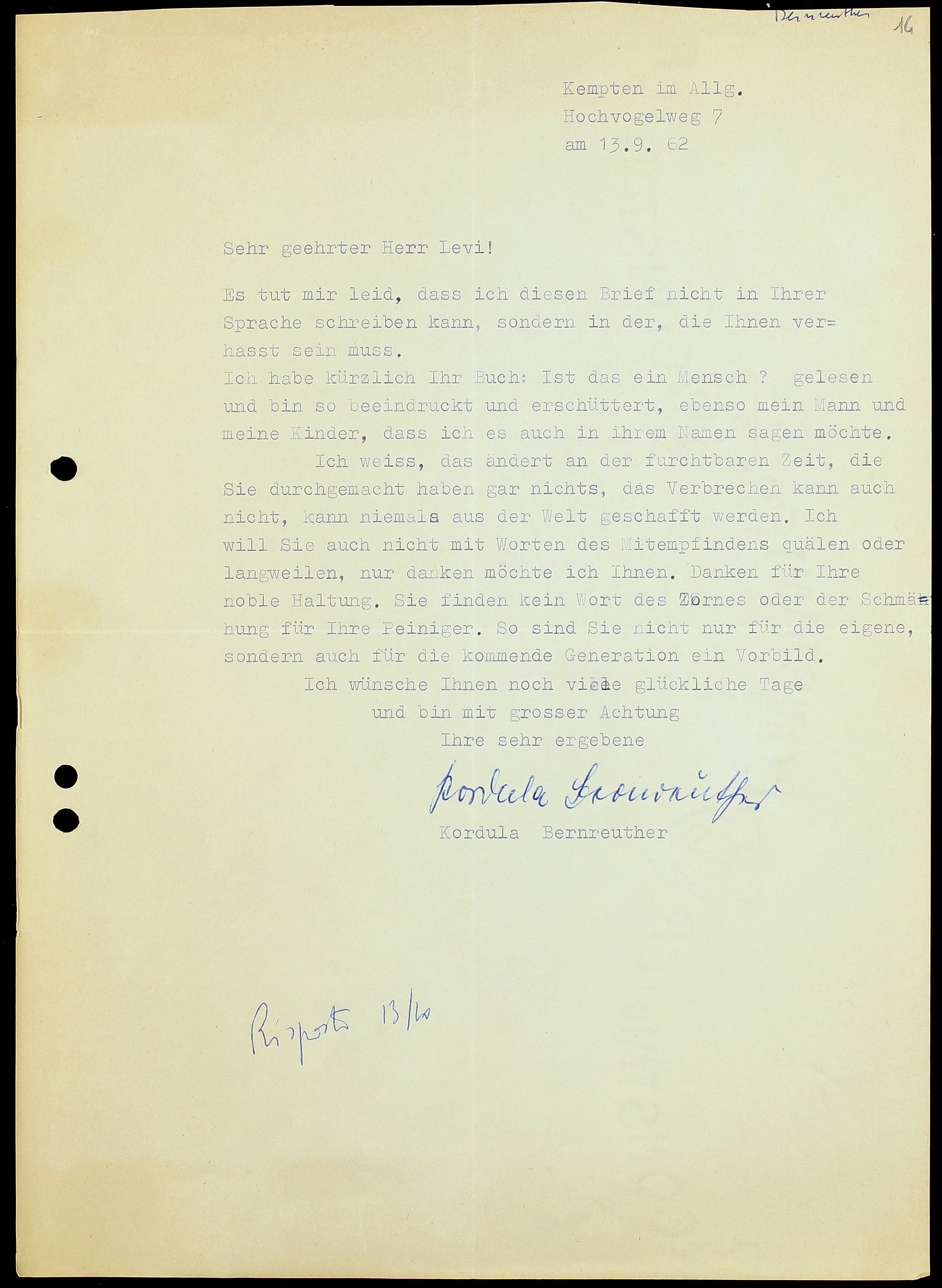
Kordula Bernreuther, a correspondent from Kempton (Bavaria), writes, on her behalf and that of her family, that she was “impressed and shaken” by her reading of Ist das ein Mensch?.
Kempten in Allg.
Hochvogelweg 7
Am 13.9.62
Sehr geehrter Herr Levi!
Es tut mir leid, dass ich diesen Brief nicht in Ihrer Sprache schreiben kann, sondern in der, die Ihnen verhasst sein muss.[1]
Ich habe kürzlich Ihr Buch: Ist das ein Mensch? gelesen und bin so beeindruckt und erschüttert, ebenso mein Mann und meineKinder, dass ich es auch in ihrem Namen sagen möchte.[2]
Ich weiss, das ändert an der furchtbaren Zeit, die Sie durchgemacht haben gar nichts, das Verbrechen kann auch nicht, kann niemals aus der Welt geschafft werden. Ich will Sie auch nicht mit Worten des Mitempfindens quälen oder langweilen, nur danken möchte ich Ihnen danken für Ihre noble Haltung. Sie finden kein Wort des Zornes oder der Schmähung für Ihre Peiniger.[3] So sind Sie nicht nur für die eigene, sondern auch für die kommende Generation ein Vorbild.
Ich wünsche Ihnen noch viele glückliche Tage und bin mit grosser Achtung ihre sehr ergebene
Kordula Bernreuther
Kempten in Allg.
Hochvogelweg 7
13.9.62
Egregio Signor Levi,
mi dispiace doverLe scrivere questa lettera non nella Sua lingua, ma in una che sicuramente Le sarà odiosa.[1]
Ho letto di recente il Suo libro Se questo è un uomo e ne sono rimasta profondamente colpita e sconvolta, così come mio marito e i mieifigli, e dunque è anche a nome loro che desidero scrivere.[2]
So bene che nulla potrà cambiare l’orrore del tempo che Lei ha vissuto, e che il crimine commesso non può – non potrà mai – essere cancellato dal mondo. Non desidero affliggerLa o annoiarLa con parole di compassione: quel che voglio è solo ringraziarLa. RingraziarLa per la Sua nobile statura morale. Nel Suo libro non c’è traccia d’ira o disprezzo verso i Suoi aguzzini.[3] Così, Lei rappresenta un esempio non solo per la Sua generazione, ma anche per quelle future.
Le auguro ancora molti giorni sereni e, con grande rispetto, Le porgo i miei più devoti saluti.
Kordula Bernreuther
Kempten in Allg. Hochvogelweg 7
September 13, 1962
Dear Mr. Levi!
I am sorry I cannot write this letter in your language, and instead can only use the one you must hate.[1]
I recently read your book If This is a Man, and was so impressed and shaken, as were my husbandand children, that I would like to say this on their behalf as well.[2]
I know this in no way changes anything about the terrible period you endured, nor can such crimes be erased from the world. Nor do I wish to bother or bore you with words of sympathy: I merely want to thank you. Thank you for your noble attitude. You express no words of anger or abuse for your tormentors.[3] This makes you a role model not only for your own generation, but for future generations as well.
I wish you many happy days to come and remain, with deep respect, most sincerely yours,
Kordula Bernreuther
Kempten in Allg.
Hochvogelweg 7
Am 13.9.62
Sehr geehrter Herr Levi!
Es tut mir leid, dass ich diesen Brief nicht in Ihrer Sprache schreiben kann, sondern in der, die Ihnen verhasst sein muss.[1]
Ich habe kürzlich Ihr Buch: Ist das ein Mensch? gelesen und bin so beeindruckt und erschüttert, ebenso mein Mann und meineKinder, dass ich es auch in ihrem Namen sagen möchte.[2]
Ich weiss, das ändert an der furchtbaren Zeit, die Sie durchgemacht haben gar nichts, das Verbrechen kann auch nicht, kann niemals aus der Welt geschafft werden. Ich will Sie auch nicht mit Worten des Mitempfindens quälen oder langweilen, nur danken möchte ich Ihnen danken für Ihre noble Haltung. Sie finden kein Wort des Zornes oder der Schmähung für Ihre Peiniger.[3] So sind Sie nicht nur für die eigene, sondern auch für die kommende Generation ein Vorbild.
Ich wünsche Ihnen noch viele glückliche Tage und bin mit grosser Achtung ihre sehr ergebene
Kordula Bernreuther
Kempten in Allg.
Hochvogelweg 7
13.9.62
Egregio Signor Levi,
mi dispiace doverLe scrivere questa lettera non nella Sua lingua, ma in una che sicuramente Le sarà odiosa.[1]
Ho letto di recente il Suo libro Se questo è un uomo e ne sono rimasta profondamente colpita e sconvolta, così come mio marito e i mieifigli, e dunque è anche a nome loro che desidero scrivere.[2]
So bene che nulla potrà cambiare l’orrore del tempo che Lei ha vissuto, e che il crimine commesso non può – non potrà mai – essere cancellato dal mondo. Non desidero affliggerLa o annoiarLa con parole di compassione: quel che voglio è solo ringraziarLa. RingraziarLa per la Sua nobile statura morale. Nel Suo libro non c’è traccia d’ira o disprezzo verso i Suoi aguzzini.[3] Così, Lei rappresenta un esempio non solo per la Sua generazione, ma anche per quelle future.
Le auguro ancora molti giorni sereni e, con grande rispetto, Le porgo i miei più devoti saluti.
Kordula Bernreuther
Kempten in Allg. Hochvogelweg 7
September 13, 1962
Dear Mr. Levi!
I am sorry I cannot write this letter in your language, and instead can only use the one you must hate.[1]
I recently read your book If This is a Man, and was so impressed and shaken, as were my husbandand children, that I would like to say this on their behalf as well.[2]
I know this in no way changes anything about the terrible period you endured, nor can such crimes be erased from the world. Nor do I wish to bother or bore you with words of sympathy: I merely want to thank you. Thank you for your noble attitude. You express no words of anger or abuse for your tormentors.[3] This makes you a role model not only for your own generation, but for future generations as well.
I wish you many happy days to come and remain, with deep respect, most sincerely yours,
Kordula Bernreuther
Info
Notes
Tag
Sender: Kordula Taube-Bernreuther
Addressee: Primo Levi
Date of Drafting: 1962-09-13
Description:typewritten letter on white paper with handwritten signature in blue ballpoint pen. The sheet’s margins have insertions handwritten in blue ballpoint pen by Levi: at the top on the righthand side is written: “Bernreuther,” on the bottom on the left: “Risposto | 13/10.”
Archive: Archivio privato di Primo Levi, Turin
Series: Complesso di fondi Primo Levi, Fondo Primo Levi, Corrispondenza, Corrispondenti particolari, fasc. 20, sottofasc. 1, doc. 6, f. 14.
Folio: 1, front only
DOI: https://doi.org/10.15160/9tj3-zh53
1Actually, Levi had ambivalent feelings about the German language; he made a distinction between the German of great European literature, his favorite authors (Thomas Mann, Heinrich Heine), and the chemistry books he had studied, and the “vulgar barracks German” (CW I, p. 96) of the oppressors.
2Her letter to Primo Levi and his subsequent reply were much discussed in her family. For insights, cf. the Biography.
3Bernreuther’s observation is very interesting because the preface to the German edition of If This Is a Man, which, as we know, is a letter Levi sent to the book’s translator Heinz Riedt, does not include what Levi wrote in the Italian preface: “[…] this book of mine adds nothing to what readers throughout the world already know about the disturbing subject of the death camps. It was not written in order to formulate new accusations; it should be able, rather, to furnish documentation for a detached study of certain aspects of the human mind” (CW I, p. 5). Gisela Buschmann and Edith Ullmann, too, make similar observations: cf. Letter 110 and Letter 169.