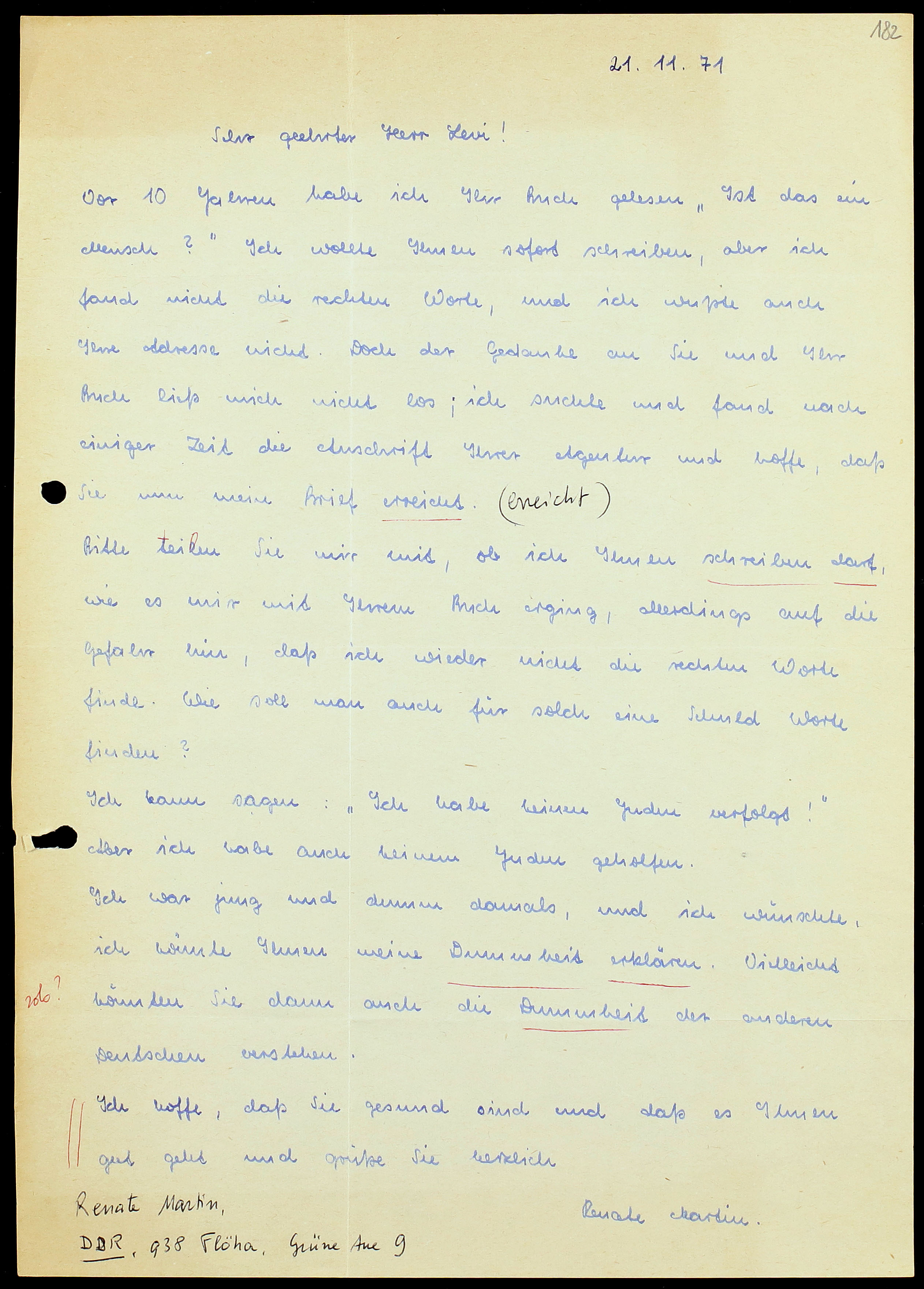
Renate Martin, a teacher in Flöha (East Germany), asks Levi in this short letter if she may write to him to try to explain the “foolishness” back then.
21.11.71
Sehr geehrter Herr Levi!
Vor 10 Jahren habe ich Ihr Buch gelesen Ist das ein Mensch?. Ich wollte Ihnen sofort schreiben, aber ich fand nicht die rechten Worte, und ich wusste auch Ihre Adresse nicht. Doch der Gedanke an Sie und Ihr Buch riß mich nicht los; ich suchte und fand nach einiger Zeit die Auschrift Ihren Agentur und hoffe, daß Sie nun mein Brief erreicht.[1]
Bitte teilen Sie mir mit, ob ich Ihnen schreiben darf,[2] wie es mir mit Ihrem Buch erging, allerdings auf die Gefahr mir, daß ich wieder nicht die rechten Worte finde. Wie soll man auch für solch eine Schuld Worte finden?
Ich kann sagen: „Ich habe keinen Juden erfolgt!” Aber ich habe auch keinen Juden geholfen. Ich war jung und dumm damals, und ich wünschte, ich könnte Ihnen meine Dummheit erklären.[3] Vielleicht könnten Sie dann auch die Dummheit[4] der anderen Deutschen verstehen.
Ich hoffe, daß Sie gesund sind und daß es Ihnen gut geht und grüße Sie herzlich[5]
Renate Martin
21.11.71
Stimatissimo Signor Levi!
dieci anni fa ho letto il Suo libro Se questo è un uomo. Avrei voluto scriverLe subito, ma non trovavo le parole giuste e in più non sapevo il Suo indirizzo. Eppure il pensiero di Lei e del Suo libro non mi ha più lasciata; ho cercato, e dopo un po’ ho trovato l’indirizzo della Sua agenzia, e spero che ora questa mia lettera La raggiunga.[1]
La prego di farmi sapere se posso scriverLe[2] per raccontarLe che effetto ha avuto su di me il Suo libro, anche se corro il rischio, ancora una volta, di non trovare le parole giuste. Com’è possibile, del resto, trovare parole per una colpa simile?
Posso dire: «Io non ho perseguitato nessun ebreo!» Ma non l’ho nemmeno aiutato. Ero giovane e stupida, a quei tempi, e vorrei tanto riuscire a spiegarLe la mia stupidità.[3] Forse, allora, potrebbe capire anche la stupidità[4] degli altri tedeschi.
Spero che Lei stia bene e che tutto Le vada per il meglio. Le invio i miei più cordiali saluti,[5]
Renate Martin
November 21, 1971
Dear Mr. Levi!
Ten years ago, I read your book If This is a Man.I wanted to write you immediately, but could not find the right words, and did not have your address. However, I could not stop thinking about you and your book; I searched for, and after some time found, the address of your agency, and now I hope this letter reaches[1] you.
Please let me know if I may write[2] to you about how your book affected me, even though I risk not finding the right words again. How can one find words for such guilt anyway?
I can say, “I didn’t persecute any Jews!” But neither did I help any. I was young and foolish back then, and I wish I could explain my foolishness to you. Perhaps then you could also understand[3] the foolishness[4] of the other Germans.
I hope you are in good health, that all is well with you, and I send my warm regards,[5]
Renate Martin
21.11.71
Sehr geehrter Herr Levi!
Vor 10 Jahren habe ich Ihr Buch gelesen Ist das ein Mensch?. Ich wollte Ihnen sofort schreiben, aber ich fand nicht die rechten Worte, und ich wusste auch Ihre Adresse nicht. Doch der Gedanke an Sie und Ihr Buch riß mich nicht los; ich suchte und fand nach einiger Zeit die Auschrift Ihren Agentur und hoffe, daß Sie nun mein Brief erreicht.[1]
Bitte teilen Sie mir mit, ob ich Ihnen schreiben darf,[2] wie es mir mit Ihrem Buch erging, allerdings auf die Gefahr mir, daß ich wieder nicht die rechten Worte finde. Wie soll man auch für solch eine Schuld Worte finden?
Ich kann sagen: „Ich habe keinen Juden erfolgt!” Aber ich habe auch keinen Juden geholfen. Ich war jung und dumm damals, und ich wünschte, ich könnte Ihnen meine Dummheit erklären.[3] Vielleicht könnten Sie dann auch die Dummheit[4] der anderen Deutschen verstehen.
Ich hoffe, daß Sie gesund sind und daß es Ihnen gut geht und grüße Sie herzlich[5]
Renate Martin
21.11.71
Stimatissimo Signor Levi!
dieci anni fa ho letto il Suo libro Se questo è un uomo. Avrei voluto scriverLe subito, ma non trovavo le parole giuste e in più non sapevo il Suo indirizzo. Eppure il pensiero di Lei e del Suo libro non mi ha più lasciata; ho cercato, e dopo un po’ ho trovato l’indirizzo della Sua agenzia, e spero che ora questa mia lettera La raggiunga.[1]
La prego di farmi sapere se posso scriverLe[2] per raccontarLe che effetto ha avuto su di me il Suo libro, anche se corro il rischio, ancora una volta, di non trovare le parole giuste. Com’è possibile, del resto, trovare parole per una colpa simile?
Posso dire: «Io non ho perseguitato nessun ebreo!» Ma non l’ho nemmeno aiutato. Ero giovane e stupida, a quei tempi, e vorrei tanto riuscire a spiegarLe la mia stupidità.[3] Forse, allora, potrebbe capire anche la stupidità[4] degli altri tedeschi.
Spero che Lei stia bene e che tutto Le vada per il meglio. Le invio i miei più cordiali saluti,[5]
Renate Martin
November 21, 1971
Dear Mr. Levi!
Ten years ago, I read your book If This is a Man.I wanted to write you immediately, but could not find the right words, and did not have your address. However, I could not stop thinking about you and your book; I searched for, and after some time found, the address of your agency, and now I hope this letter reaches[1] you.
Please let me know if I may write[2] to you about how your book affected me, even though I risk not finding the right words again. How can one find words for such guilt anyway?
I can say, “I didn’t persecute any Jews!” But neither did I help any. I was young and foolish back then, and I wish I could explain my foolishness to you. Perhaps then you could also understand[3] the foolishness[4] of the other Germans.
I hope you are in good health, that all is well with you, and I send my warm regards,[5]
Renate Martin
Info
Notes
Tag
Sender: Renate Windisch-Martin
Addressee: Primo Levi
Date of Drafting: 1971-11-21
Place of Writing: Flöha
Description:handwritten letter in blue fountain pen on white paper. The letter has handwritten insertions in black ballpoint pen and handwritten underlining in red ballpoint pen, all of which by Levi. In the lower margin of the sheet on the left-hand side, Levi notes in black ballpoint pen the address of the sender: “Renate Martin, | DDR, 938, Flöha | Grüne Aue 9.”
Archive: Archivio privato di Primo Levi, Turin
Series: Complesso di fondi Primo Levi, Fondo Primo Levi, Corrispondenza, Corrispondenti particolari, Fasc.020, sottofasc. 001, doc. 063, f. 182.
Folio: 1, front only
DOI: https://doi.org/10.15160/ckp7-ts27
1“erreicht” is underlined by hand in red ballpoint pen; next to it, “(erreicht)” is written in black ballpoint pen.
2“schreiben darf” is underlined by hand in red ballpoint pen.
3“Dummheit erklären” is underlined by hand in red ballpoint pen.
4“Dummheit”: is underlined by hand in red ballpoint pen. In the inner margin, Levi notes in red ballpoint pen: “solo?” (“only?”).
5The paragraph is marked with a handwritten sign in red ballpoint pen in the inner margin of the sheet.