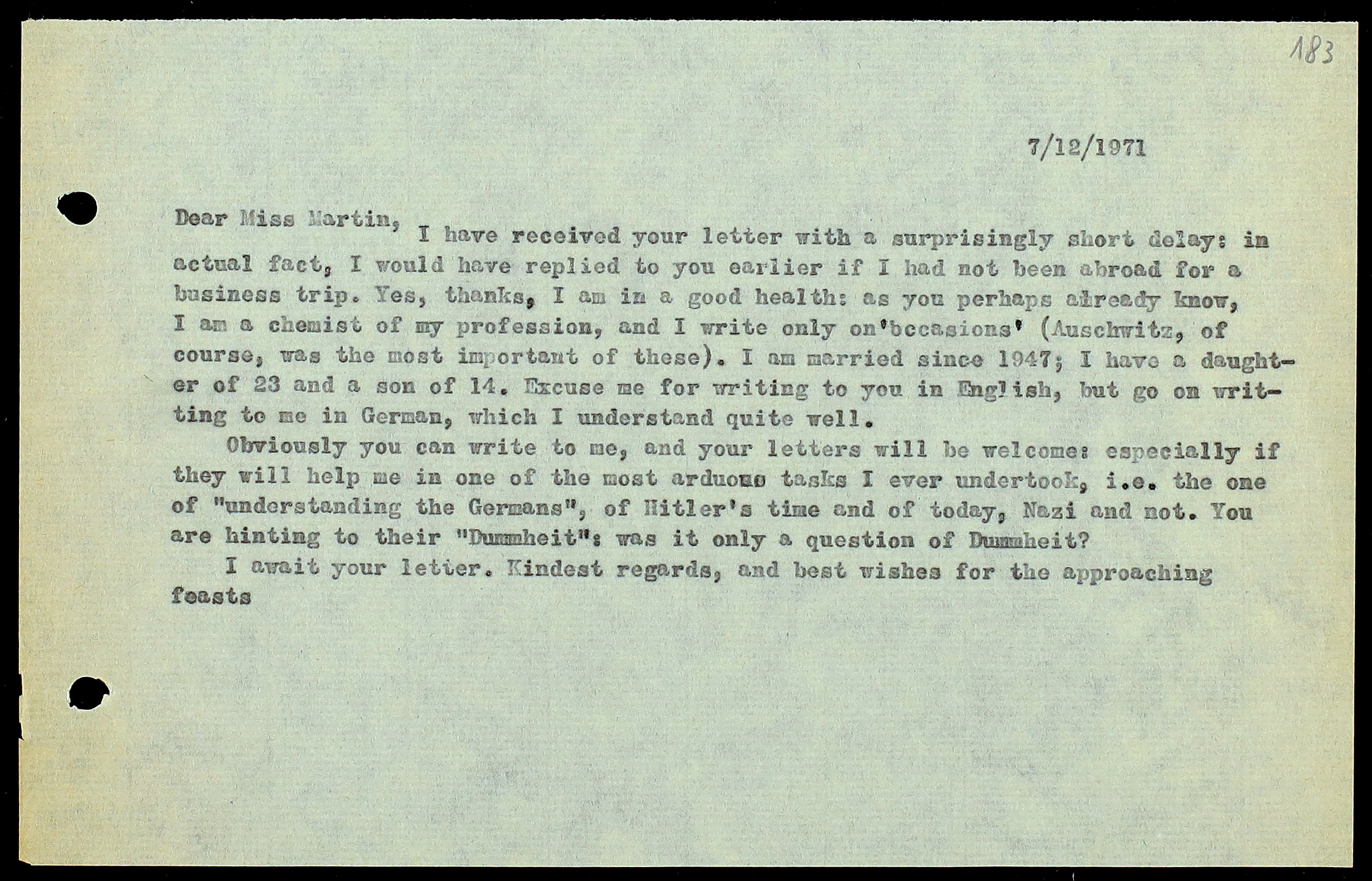
Levi replies enthusiastically to Martin’s request, in particular if her letters can help him in his attempt to understand the Germans.
7/12/1971
Dear Miss Martin,
I have received your letter with a surprisingly short delay: in actual fact, I would have replied to you earlier if I had not been abroad for a business trip. Yes, thanks, I am in a good health: as you perhaps already know, I am a chemist of my profession, and I write only on “occasions” (Auschwitz, of course, was the most important of these). I am married since 1947; I have a daughter of 23 and a son of 14. Excuse me for writing to you in English, but go on writing to me in German, which I understand quite well.
Obviously you can write to me, and your letters will be welcome: especially if they will help me in one of the most arduous tasks I ever undertook, i.e. the one of “understanding the Germans”, of Hitler’s time and of today, Nazi and not. You are hinting to their “Dummheit”:[1] was it only a question of Dummheit?
I await your letter. Kindest regards, and best wishes for the approaching feasts.
7/12/1971
Gentile Signorina Martin,
ho ricevuto la Sua lettera con un ritardo sorprendentemente breve: di fatto, le avrei risposto prima se non fossi stato all’estero per un viaggio di lavoro. Sì, grazie, sono in buona salute: come forse Lei già saprà, di professione sono chimico, e scrivo solo in certe «occasioni» (la più importante delle quali, ovviamente, è stata Auschwitz). Sono sposato dal 1947; ho una figlia di 23 anni e un figlio di 14. Mi scusi se le scrivo in inglese, ma Lei continui a scrivermi in tedesco. Lo capisco abbastanza bene.
Certo che può scrivermi, e le sue lettere saranno le benvenute: soprattutto se mi aiuteranno in uno dei compiti più ardui che mi sia mai assunto, ovvero «capire i tedeschi», dell’epoca di Hitler e di oggi, nazisti e no. Lei allude alla loro «Dummheit»:[1] era solo questione di Dummheit?
Attendo la Sua lettera. Cordiali saluti, e i miei migliori auguri per le feste imminenti.
7/12/1971
Dear Miss Martin,
I have received your letter with a surprisingly short delay: in actual fact, I would have replied to you earlier if I had not been abroad for a business trip. Yes, thanks, I am in a good health: as you perhaps already know, I am a chemist of my profession, and I write only on “occasions” (Auschwitz, of course, was the most important of these). I am married since 1947; I have a daughter of 23 and a son of 14. Excuse me for writing to you in English, but go on writing to me in German, which I understand quite well.
Obviously you can write to me, and your letters will be welcome: especially if they will help me in one of the most arduous tasks I ever undertook, i.e. the one of “understanding the Germans”, of Hitler’s time and of today, Nazi and not. You are hinting to their “Dummheit”:[1] was it only a question of Dummheit?
I await your letter. Kindest regards, and best wishes for the approaching feasts.
7/12/1971
Dear Miss Martin,
I have received your letter with a surprisingly short delay: in actual fact, I would have replied to you earlier if I had not been abroad for a business trip. Yes, thanks, I am in a good health: as you perhaps already know, I am a chemist of my profession, and I write only on “occasions” (Auschwitz, of course, was the most important of these). I am married since 1947; I have a daughter of 23 and a son of 14. Excuse me for writing to you in English, but go on writing to me in German, which I understand quite well.
Obviously you can write to me, and your letters will be welcome: especially if they will help me in one of the most arduous tasks I ever undertook, i.e. the one of “understanding the Germans”, of Hitler’s time and of today, Nazi and not. You are hinting to their “Dummheit”:[1] was it only a question of Dummheit?
I await your letter. Kindest regards, and best wishes for the approaching feasts.
7/12/1971
Gentile Signorina Martin,
ho ricevuto la Sua lettera con un ritardo sorprendentemente breve: di fatto, le avrei risposto prima se non fossi stato all’estero per un viaggio di lavoro. Sì, grazie, sono in buona salute: come forse Lei già saprà, di professione sono chimico, e scrivo solo in certe «occasioni» (la più importante delle quali, ovviamente, è stata Auschwitz). Sono sposato dal 1947; ho una figlia di 23 anni e un figlio di 14. Mi scusi se le scrivo in inglese, ma Lei continui a scrivermi in tedesco. Lo capisco abbastanza bene.
Certo che può scrivermi, e le sue lettere saranno le benvenute: soprattutto se mi aiuteranno in uno dei compiti più ardui che mi sia mai assunto, ovvero «capire i tedeschi», dell’epoca di Hitler e di oggi, nazisti e no. Lei allude alla loro «Dummheit»:[1] era solo questione di Dummheit?
Attendo la Sua lettera. Cordiali saluti, e i miei migliori auguri per le feste imminenti.
7/12/1971
Dear Miss Martin,
I have received your letter with a surprisingly short delay: in actual fact, I would have replied to you earlier if I had not been abroad for a business trip. Yes, thanks, I am in a good health: as you perhaps already know, I am a chemist of my profession, and I write only on “occasions” (Auschwitz, of course, was the most important of these). I am married since 1947; I have a daughter of 23 and a son of 14. Excuse me for writing to you in English, but go on writing to me in German, which I understand quite well.
Obviously you can write to me, and your letters will be welcome: especially if they will help me in one of the most arduous tasks I ever undertook, i.e. the one of “understanding the Germans”, of Hitler’s time and of today, Nazi and not. You are hinting to their “Dummheit”:[1] was it only a question of Dummheit?
I await your letter. Kindest regards, and best wishes for the approaching feasts.
Info
Notes
Tag
Sender: Primo Levi
Addressee: Renate Windisch-Martin
Date of Drafting: 1971-12-07
Place of Writing: Turin
Description:carbon copy on onionskin paper of typewritten letter.
Archive: Archivio privato di Primo Levi, Turin
Series: Complesso di fondi Primo Levi, Fondo Primo Levi, Corrispondenza, Corrispondenti particolari, Fasc.020, sottofasc.001, doc.064, f. 183.