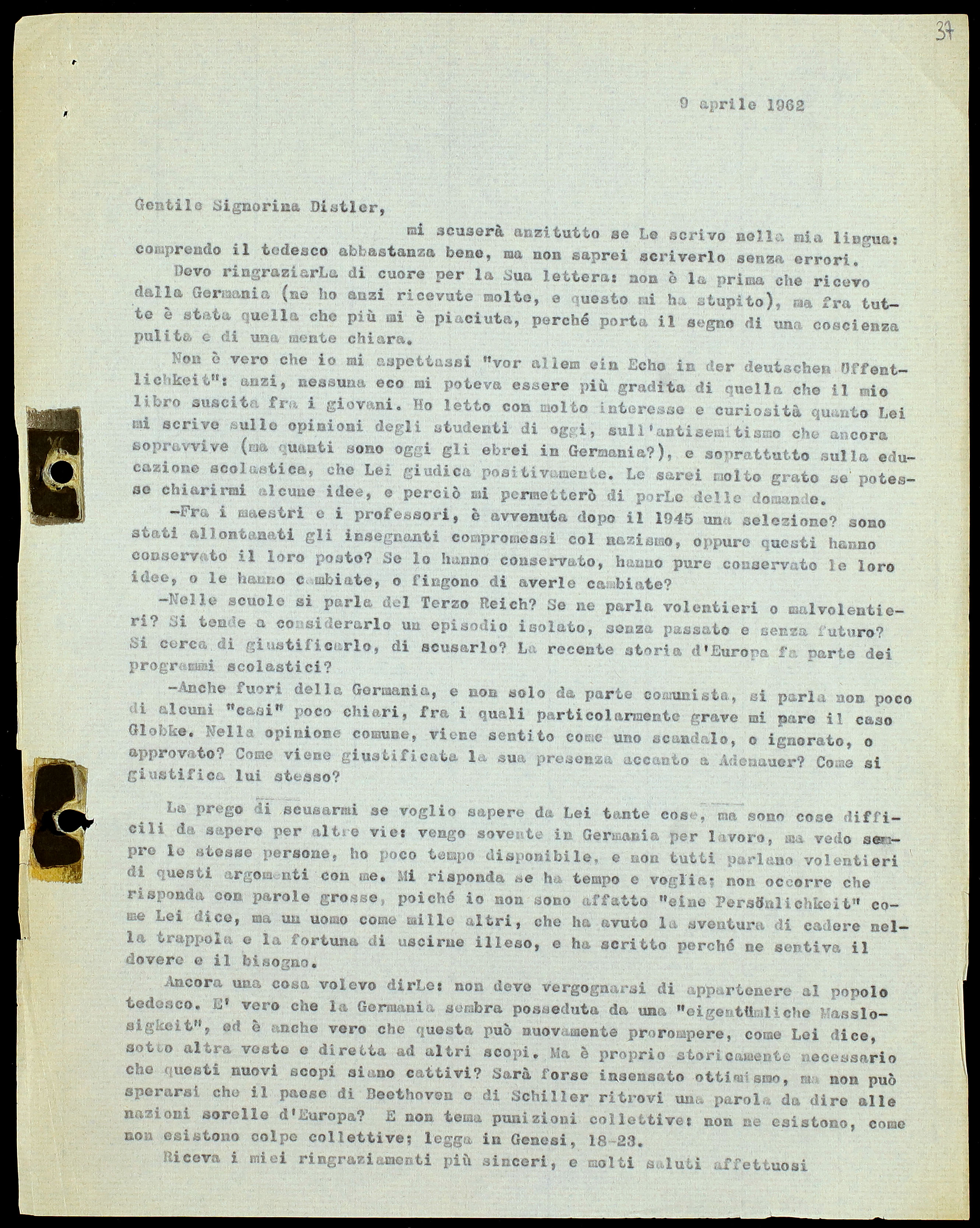
Struck and intrigued by Distler’s letter, Levi thanks her and emphasizes that, among the many letters he has received, this is one he most appreciates; he also asks a few questions.
9 aprile 1962
Gentile Signorina Distler,
mi scuserà anzitutto se Le scrivo nella mia lingua: comprendo il tedesco abbastanza bene, ma non saprei scriverlo senza errori.
Devo ringraziarLa di cuore per la Sua lettera: non è la prima che ricevo dalla Germania (ne ho anzi ricevute molte, e questo mi ha stupito), ma fra tutte è stata quella che più mi è piaciuta, perché porta il segno di una coscienza pulita e di una mente chiara.
Non è vero che io mi aspettassi «vor allem ein Echo in der deutschen Öffentlichkeit»:[1] anzi, nessuna eco mi poteva essere più gradita di quella che il mio libro suscita fra i giovani. Ho letto con molto interesse e curiosità quanto Lei mi scrive sulle opinioni degli studenti di oggi, sull’antisemitismo che ancora sopravvive (ma quanti sono oggi gli ebrei in Germania?), e soprattutto sulla educazione scolastica, che Lei giudica positivamente. Le sarei molto grato se potesse chiarirmi alcune idee, e perciò mi permetterò di porLe delle domande.
– Fra i maestri e i professori, è avvenuta dopo il 1945 una selezione? sono stati allontanati gli insegnanti compromessi col nazismo, oppure questi hanno conservato il loro posto? Se lo hanno conservato, hanno pure conservato le loro idee, o le hanno cambiate, o fingono di averle cambiate?
– Nelle scuole si parla del Terzo Reich? Se ne parla volentieri o malvolentieri? Si tende a considerarlo un episodio isolato, senza passato e senza futuro? Si cerca di giustificarlo, di scusarlo? La recente storia d’Europa fa parte dei programmi scolastici?
– Anche fuori della Germania, e non solo da parte comunista, si parla non poco di alcuni “casi” poco chiari, fra i quali particolarmente grave mi pare il caso Globke.[2] Nella opinione comune, viene sentito come uno scandalo, o ignorato, o approvato? Come viene giustificata la sua presenza accanto a Adenauer? Come si giustifica lui stesso?
La prego di scusarmi se voglio sapere da Lei tante cose, ma sono cose difficili da sapere per altre vie: vengo sovente in Germania per lavoro, ma vedo sempre le stesse persone, ho poco tempo disponibile, e non tutti parlano volentieri di questi argomenti con me.[3] Mi risponda se ha tempo e voglia; non occorre che risponda con parole grosse, poiché io non sono affatto «eine Persönlichkeit» come Lei dice, ma un uomo come mille altri, che ha avuto la sventura di cadere nella trappola e la fortuna di uscirne illeso, e ha scritto perché ne sentiva il dovere e il bisogno.
Ancora una cosa volevo dirle: non deve vergognarsi di appartenere al popolo tedesco. È vero che la Germania sembra posseduta da una «eigentümliche Masslosigkeit», ed è anche vero che questa può nuovamente prorompere, come Lei dice, sotto altra veste e diretta ad altri scopi. Ma è proprio storicamente necessario che questi nuovi scopi siano cattivi? Sarà forse insensato ottimismo, ma non può sperarsi che il paese di Beethoven o di Schiller ritrovi una parola da dire alle nazioni sorelle d’Europa?[4] E non tema punizioni collettive: non ne esistono, come non esistono colpe collettive; legga in Genesi, 18-23.[5]
Riceva i miei ringraziamenti più sinceri, e molti saluti affettuosi
9 aprile 1962
Gentile Signorina Distler,
mi scuserà anzitutto se Le scrivo nella mia lingua: comprendo il tedesco abbastanza bene, ma non saprei scriverlo senza errori.
Devo ringraziarLa di cuore per la Sua lettera: non è la prima che ricevo dalla Germania (ne ho anzi ricevute molte, e questo mi ha stupito), ma fra tutte è stata quella che più mi è piaciuta, perché porta il segno di una coscienza pulita e di una mente chiara.
Non è vero che io mi aspettassi «vor allem ein Echo in der deutschen Öffentlichkeit»:[1] anzi, nessuna eco mi poteva essere più gradita di quella che il mio libro suscita fra i giovani. Ho letto con molto interesse e curiosità quanto Lei mi scrive sulle opinioni degli studenti di oggi, sull’antisemitismo che ancora sopravvive (ma quanti sono oggi gli ebrei in Germania?), e soprattutto sulla educazione scolastica, che Lei giudica positivamente. Le sarei molto grato se potesse chiarirmi alcune idee, e perciò mi permetterò di porLe delle domande.
– Fra i maestri e i professori, è avvenuta dopo il 1945 una selezione? sono stati allontanati gli insegnanti compromessi col nazismo, oppure questi hanno conservato il loro posto? Se lo hanno conservato, hanno pure conservato le loro idee, o le hanno cambiate, o fingono di averle cambiate?
– Nelle scuole si parla del Terzo Reich? Se ne parla volentieri o malvolentieri? Si tende a considerarlo un episodio isolato, senza passato e senza futuro? Si cerca di giustificarlo, di scusarlo? La recente storia d’Europa fa parte dei programmi scolastici?
– Anche fuori della Germania, e non solo da parte comunista, si parla non poco di alcuni “casi” poco chiari, fra i quali particolarmente grave mi pare il caso Globke.[2] Nella opinione comune, viene sentito come uno scandalo, o ignorato, o approvato? Come viene giustificata la sua presenza accanto a Adenauer? Come si giustifica lui stesso?
La prego di scusarmi se voglio sapere da Lei tante cose, ma sono cose difficili da sapere per altre vie: vengo sovente in Germania per lavoro, ma vedo sempre le stesse persone, ho poco tempo disponibile, e non tutti parlano volentieri di questi argomenti con me.[3] Mi risponda se ha tempo e voglia; non occorre che risponda con parole grosse, poiché io non sono affatto «eine Persönlichkeit» come Lei dice, ma un uomo come mille altri, che ha avuto la sventura di cadere nella trappola e la fortuna di uscirne illeso, e ha scritto perché ne sentiva il dovere e il bisogno.
Ancora una cosa volevo dirle: non deve vergognarsi di appartenere al popolo tedesco. È vero che la Germania sembra posseduta da uno «eigentümliche Masslosigleit», ed è anche vero che questa può nuovamente prorompere, come Lei dice, sotto altra veste e diretta ad altri scopi. Ma è proprio storicamente necessario che questi nuovi scopi siano cattivi? Sarà forse insensato ottimismo, ma non può sperarsi che il paese di Beethoven o di Schiller ritrovi una parola da dire alle nazioni sorelle d’Europa?[4] E non tema punizioni collettive: non ne esistono, come non esistono colpe collettive; legga in Genesi, 18-23.[5]
Riceva i miei ringraziamenti più sinceri, e molti saluti affettuosi
April 9, 1962
Dear Miss Distler,
First of all, please forgive me for writing to you in my language: I understand German fairly well but am unable to write it without making errors.
I sincerely thank you for your letter: it is not the first one I receive from Germany (actually, I have received many and this amazes me), but of the many, it is the one I like best because it bears the mark of a clean conscience and a clear mind.
It is not true that I expected “an echo above all from the German public”:[1] on the contrary, no echo could give me more pleasure than the one my book sparks among young people. I read with great interest and curiosity what you write about the opinions of today’s students, about the anti-Semitism that still survives (but how many Jews are there in Germany today?), and above all, about school education, of which you have a good opinion. I would be very grateful if you could clarify a few things for me, and therefore I take the liberty of asking you some questions.
– After 1945, was there a selection among the teachers and professors? Were the teachers who had been involved with Nazism removed or did they keep their position? If they kept it, did they retain their ideas or did they change them, or did they pretend to change them?
– Is the Third Reich discussed at school? Do people discuss it willingly or reluctantly? Do they tend to consider it an isolated episode, without a past and without a future? Do people try to justify it, to excuse it? Is recent European history part of academic programs?
– Outside of Germany, too, and not only by the communists, much is said about a few unclear “cases,” including the Globke case,[2] which strikes me as one of the most serious. Does popular opinion consider it a scandal, or is it ignored, or approved of? How is his presence alongside Adenauer justified? How does he justify himself?
Please forgive me if I ask you so many questions but it is hard to know these things by other means: I often come to Germany on business but I always see the same people, I have little time at my disposal, and not everyone talks willingly about these topics with me.[3] Please answer me if you have time and feel like it; there is no need to reply using big words because I am absolutely not “a personage” as you say, but a man like a thousand others, who had the bad luck to fall into the trap and the good luck to come out of it unharmed, and who wrote because he felt the obligation and the need to do so.
I would like to tell you one more thing: you must not be ashamed of belonging to the German people. It is true that Germany seems possessed by a “peculiar lack of measure,” and it is also true that this could once again erupt, as you say, under other guises and aimed at other objectives. But is it truly historically necessary that these new objectives be evil? It might be foolish optimism, but can we not hope that the country of Beethoven or Schiller will once again find a word to say to the sister nations of Europe?[4] And you must not fear collective punishment: it does not exist, just like collective guilt does not exist: read Genesis 18:23.[5]
Please accept my most sincere thanks and warmest regards
9 aprile 1962
Gentile Signorina Distler,
mi scuserà anzitutto se Le scrivo nella mia lingua: comprendo il tedesco abbastanza bene, ma non saprei scriverlo senza errori.
Devo ringraziarLa di cuore per la Sua lettera: non è la prima che ricevo dalla Germania (ne ho anzi ricevute molte, e questo mi ha stupito), ma fra tutte è stata quella che più mi è piaciuta, perché porta il segno di una coscienza pulita e di una mente chiara.
Non è vero che io mi aspettassi «vor allem ein Echo in der deutschen Öffentlichkeit»:[1] anzi, nessuna eco mi poteva essere più gradita di quella che il mio libro suscita fra i giovani. Ho letto con molto interesse e curiosità quanto Lei mi scrive sulle opinioni degli studenti di oggi, sull’antisemitismo che ancora sopravvive (ma quanti sono oggi gli ebrei in Germania?), e soprattutto sulla educazione scolastica, che Lei giudica positivamente. Le sarei molto grato se potesse chiarirmi alcune idee, e perciò mi permetterò di porLe delle domande.
– Fra i maestri e i professori, è avvenuta dopo il 1945 una selezione? sono stati allontanati gli insegnanti compromessi col nazismo, oppure questi hanno conservato il loro posto? Se lo hanno conservato, hanno pure conservato le loro idee, o le hanno cambiate, o fingono di averle cambiate?
– Nelle scuole si parla del Terzo Reich? Se ne parla volentieri o malvolentieri? Si tende a considerarlo un episodio isolato, senza passato e senza futuro? Si cerca di giustificarlo, di scusarlo? La recente storia d’Europa fa parte dei programmi scolastici?
– Anche fuori della Germania, e non solo da parte comunista, si parla non poco di alcuni “casi” poco chiari, fra i quali particolarmente grave mi pare il caso Globke.[2] Nella opinione comune, viene sentito come uno scandalo, o ignorato, o approvato? Come viene giustificata la sua presenza accanto a Adenauer? Come si giustifica lui stesso?
La prego di scusarmi se voglio sapere da Lei tante cose, ma sono cose difficili da sapere per altre vie: vengo sovente in Germania per lavoro, ma vedo sempre le stesse persone, ho poco tempo disponibile, e non tutti parlano volentieri di questi argomenti con me.[3] Mi risponda se ha tempo e voglia; non occorre che risponda con parole grosse, poiché io non sono affatto «eine Persönlichkeit» come Lei dice, ma un uomo come mille altri, che ha avuto la sventura di cadere nella trappola e la fortuna di uscirne illeso, e ha scritto perché ne sentiva il dovere e il bisogno.
Ancora una cosa volevo dirle: non deve vergognarsi di appartenere al popolo tedesco. È vero che la Germania sembra posseduta da una «eigentümliche Masslosigkeit», ed è anche vero che questa può nuovamente prorompere, come Lei dice, sotto altra veste e diretta ad altri scopi. Ma è proprio storicamente necessario che questi nuovi scopi siano cattivi? Sarà forse insensato ottimismo, ma non può sperarsi che il paese di Beethoven o di Schiller ritrovi una parola da dire alle nazioni sorelle d’Europa?[4] E non tema punizioni collettive: non ne esistono, come non esistono colpe collettive; legga in Genesi, 18-23.[5]
Riceva i miei ringraziamenti più sinceri, e molti saluti affettuosi
9 aprile 1962
Gentile Signorina Distler,
mi scuserà anzitutto se Le scrivo nella mia lingua: comprendo il tedesco abbastanza bene, ma non saprei scriverlo senza errori.
Devo ringraziarLa di cuore per la Sua lettera: non è la prima che ricevo dalla Germania (ne ho anzi ricevute molte, e questo mi ha stupito), ma fra tutte è stata quella che più mi è piaciuta, perché porta il segno di una coscienza pulita e di una mente chiara.
Non è vero che io mi aspettassi «vor allem ein Echo in der deutschen Öffentlichkeit»:[1] anzi, nessuna eco mi poteva essere più gradita di quella che il mio libro suscita fra i giovani. Ho letto con molto interesse e curiosità quanto Lei mi scrive sulle opinioni degli studenti di oggi, sull’antisemitismo che ancora sopravvive (ma quanti sono oggi gli ebrei in Germania?), e soprattutto sulla educazione scolastica, che Lei giudica positivamente. Le sarei molto grato se potesse chiarirmi alcune idee, e perciò mi permetterò di porLe delle domande.
– Fra i maestri e i professori, è avvenuta dopo il 1945 una selezione? sono stati allontanati gli insegnanti compromessi col nazismo, oppure questi hanno conservato il loro posto? Se lo hanno conservato, hanno pure conservato le loro idee, o le hanno cambiate, o fingono di averle cambiate?
– Nelle scuole si parla del Terzo Reich? Se ne parla volentieri o malvolentieri? Si tende a considerarlo un episodio isolato, senza passato e senza futuro? Si cerca di giustificarlo, di scusarlo? La recente storia d’Europa fa parte dei programmi scolastici?
– Anche fuori della Germania, e non solo da parte comunista, si parla non poco di alcuni “casi” poco chiari, fra i quali particolarmente grave mi pare il caso Globke.[2] Nella opinione comune, viene sentito come uno scandalo, o ignorato, o approvato? Come viene giustificata la sua presenza accanto a Adenauer? Come si giustifica lui stesso?
La prego di scusarmi se voglio sapere da Lei tante cose, ma sono cose difficili da sapere per altre vie: vengo sovente in Germania per lavoro, ma vedo sempre le stesse persone, ho poco tempo disponibile, e non tutti parlano volentieri di questi argomenti con me.[3] Mi risponda se ha tempo e voglia; non occorre che risponda con parole grosse, poiché io non sono affatto «eine Persönlichkeit» come Lei dice, ma un uomo come mille altri, che ha avuto la sventura di cadere nella trappola e la fortuna di uscirne illeso, e ha scritto perché ne sentiva il dovere e il bisogno.
Ancora una cosa volevo dirle: non deve vergognarsi di appartenere al popolo tedesco. È vero che la Germania sembra posseduta da uno «eigentümliche Masslosigleit», ed è anche vero che questa può nuovamente prorompere, come Lei dice, sotto altra veste e diretta ad altri scopi. Ma è proprio storicamente necessario che questi nuovi scopi siano cattivi? Sarà forse insensato ottimismo, ma non può sperarsi che il paese di Beethoven o di Schiller ritrovi una parola da dire alle nazioni sorelle d’Europa?[4] E non tema punizioni collettive: non ne esistono, come non esistono colpe collettive; legga in Genesi, 18-23.[5]
Riceva i miei ringraziamenti più sinceri, e molti saluti affettuosi
April 9, 1962
Dear Miss Distler,
First of all, please forgive me for writing to you in my language: I understand German fairly well but am unable to write it without making errors.
I sincerely thank you for your letter: it is not the first one I receive from Germany (actually, I have received many and this amazes me), but of the many, it is the one I like best because it bears the mark of a clean conscience and a clear mind.
It is not true that I expected “an echo above all from the German public”:[1] on the contrary, no echo could give me more pleasure than the one my book sparks among young people. I read with great interest and curiosity what you write about the opinions of today’s students, about the anti-Semitism that still survives (but how many Jews are there in Germany today?), and above all, about school education, of which you have a good opinion. I would be very grateful if you could clarify a few things for me, and therefore I take the liberty of asking you some questions.
– After 1945, was there a selection among the teachers and professors? Were the teachers who had been involved with Nazism removed or did they keep their position? If they kept it, did they retain their ideas or did they change them, or did they pretend to change them?
– Is the Third Reich discussed at school? Do people discuss it willingly or reluctantly? Do they tend to consider it an isolated episode, without a past and without a future? Do people try to justify it, to excuse it? Is recent European history part of academic programs?
– Outside of Germany, too, and not only by the communists, much is said about a few unclear “cases,” including the Globke case,[2] which strikes me as one of the most serious. Does popular opinion consider it a scandal, or is it ignored, or approved of? How is his presence alongside Adenauer justified? How does he justify himself?
Please forgive me if I ask you so many questions but it is hard to know these things by other means: I often come to Germany on business but I always see the same people, I have little time at my disposal, and not everyone talks willingly about these topics with me.[3] Please answer me if you have time and feel like it; there is no need to reply using big words because I am absolutely not “a personage” as you say, but a man like a thousand others, who had the bad luck to fall into the trap and the good luck to come out of it unharmed, and who wrote because he felt the obligation and the need to do so.
I would like to tell you one more thing: you must not be ashamed of belonging to the German people. It is true that Germany seems possessed by a “peculiar lack of measure,” and it is also true that this could once again erupt, as you say, under other guises and aimed at other objectives. But is it truly historically necessary that these new objectives be evil? It might be foolish optimism, but can we not hope that the country of Beethoven or Schiller will once again find a word to say to the sister nations of Europe?[4] And you must not fear collective punishment: it does not exist, just like collective guilt does not exist: read Genesis 18:23.[5]
Please accept my most sincere thanks and warmest regards
Info
Notes
Tag
Sender: Primo Levi
Addressee: Brigitte Distler
Date of Drafting: 1962-04-09
Place of Writing: Turin
Description:carbon copy on onionskin paper of typed letter. In the inner margin, the sheet has marks from adhesive tape.
Archive: Archivio privato di Primo Levi, Turin
Series: Complesso di Fondi primo Levi, Fondo Primo Levi, Corrispondenza, Corrispondenti particolari, fasc. 20, sottofasc. 001, doc. 018, f. 37
Folio: 1, front only
DOI: ps://doi.org/10.15160/0jqc-gt77
1
Levi returns to a passage in Distler’s preceding letter, which he translates as follows: “an echo above all from the German public,” cf. Letter 115.
2
In the mid-1950s, the Hans Globke case erupted into German public view. Globke (1898-1973) was one of Adenauer’s undersecretaries and his Nazi past began emerging, at first through documents circulated by the DDR (and later in part by Reinhard Strecker, in his exhibit “Ungesühnte Nazijustiz,” cf. the biography of Brigitte Distler) and then, between 1959 and 1960, during the surge of the so-called “Swastika epidemic” (cf. the insight The "New Swastikas" in 1959-60 and the Besserman Effect). Globke had drafted a commentary on the Nuremberg Laws that provided a decisive contribution to their application and, moreover, his name appeared in documents between 1943 and 1945 regarding the administration of occupied countries, including Italy (cf. Anonymous, “Identificato nel dr. Globke il nazificatore dell’Italia,” [“Dr. Globke identified as Italy’s Nazifier”], l’Unità, September 18, 1960, pp. 1 and 8). In March 1962, Globke’s name appeared once again in the international press when Adolf Eichmann’s lawyer, Servatius, listed him as one of the new witnesses in the trial. As Hannah Arendt suggests, this might have been a move to persuade Germany to request the defendant’s extradition (cf. H. Arendt, Eichmann in Jerusalem. A Report on the Banality of Evil, cit. p. 19). He is also mentioned in these terms in Turin’s daily newspaper La Stampa on March 23, 1962, two weeks before this letter (“Eichmann in appello davanti ai giudici. Ha sulla coscienza sei milioni di morti” [“Eichmann appeals to the judges. He has six million deaths on his conscience”], p. 7). For an insight regarding the impact of the Globke case on German public opinion, and in particular among student groups, cf. the biography of Brigitte Distler. Levi mentions Hans Globke only once in his opus, in the foreword to Auschwitz by Léon Poliakov in 1969: “The plague is over, but Bormann and Dr. Mengele live undisturbed in South America; the Austrian and German courts provide increasing numbers of outrageous absolutions and half-absolutions; Globke enjoys a respectable pension after having been for many years Adenauer’s secretary” (CW II, p.1191).
3
The biographer Ian Thomson dedicates a chapter to Levi’s business trips to Germany between 1954 and the early ‘60s (I. Thomson, Primo Levi. A Life, cit., p. 272). We do not know exactly when these trips took place but we do know that the people with whom Levi conversed were amazed at his German: “I remained very curious about Germany: I encountered the other side of Germany, the Germany of afterward, democratic Germany, the one of young people. But I also found people my own age and, each time, we began conversations that I found very interesting and curious because the typical question they asked me was: ‘Why do you speak German and why do you speak it this way?’ I would reply, ‘Because I learned it in the Lager,’ after which the conversation took another direction” (OC III, p. 266).
4
“The excesses peculiar to the Germans;” Levi is referring to something Distler wrote in her previous letter. The idea that a “characteristic” trait in German behavior could also be aimed at the good returns in his correspondence with S., cf. Letter 168, n. 2.
5
Levi is referring to the episode of Sodom and Gomorrah, and in particular to the conversation between Abraham and God, cf. Genesis 18:23-26: “Then Abraham approached him and said: ‘Will you sweep away the righteous with the wicked? What if there are fifty righteous people in the city? Will you really sweep it away and not spare the place for the sake of the fifty righteous people in it? Far be it from you to do such a thing—to kill the righteous with the wicked, treating the righteous and the wicked alike. Far be it from you! Will not the Judge of all the earth do right?’ The Lord said, ‘If I find fifty righteous people in the city of Sodom, I will spare the whole place for their sake.’” Levi had already associated the Biblical story with the relationship between individual guilt and collective guilt in Nazi Germany in his essay “The Deported. Anniversary” (CW II, p. 1128).