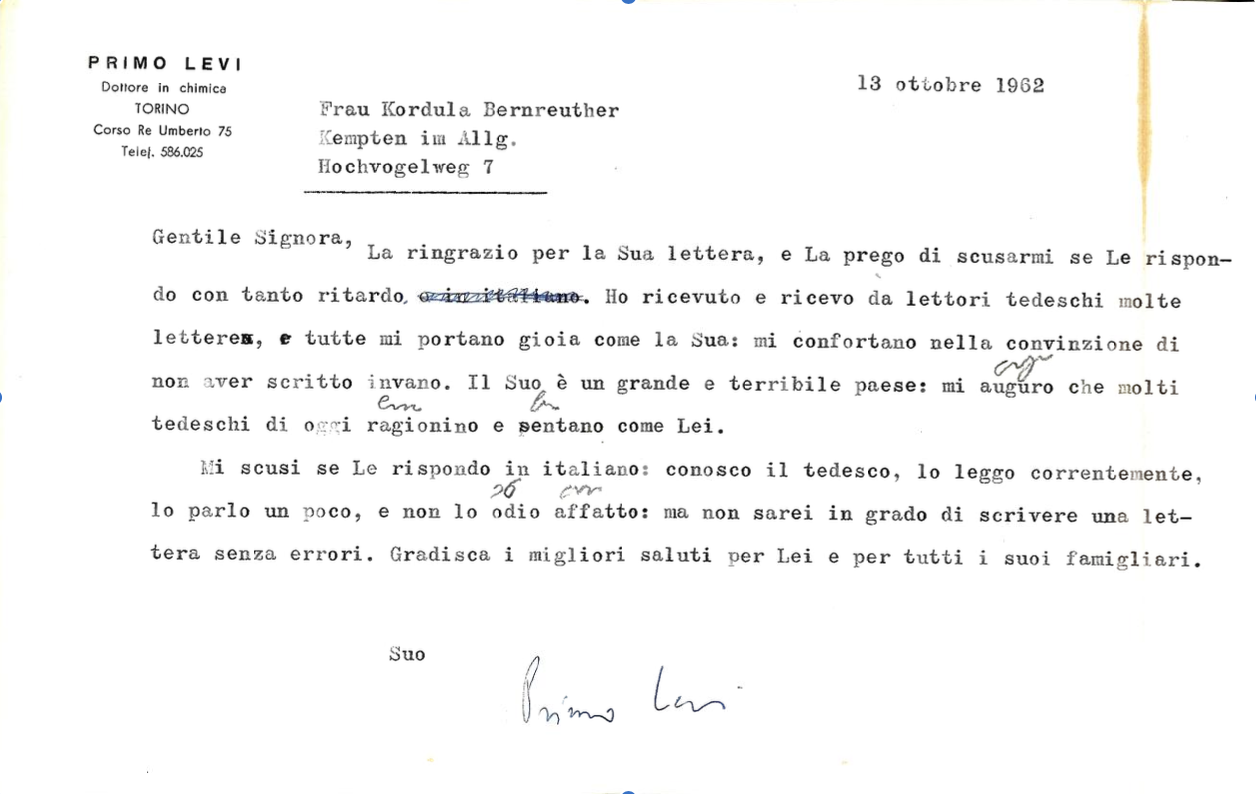
Levi thanks Bernreuther for her letter, asks her to forgive him for replying so late, and hopes that many Germans feel the same way she does.
13 ottobre 1962
Frau Kordula Bernreuther
Kempten im Allg.
Hochvogelweg 7
Gentile Signora,
La ringrazio per la Sua lettera, e La prego di scusarmi se Le rispondo con tanto ritardo.[1] Ho ricevuto e ricevo da lettori tedeschi molte lettere,[2] e tutte mi portano gioia come la Sua: mi confortano nella convinzione di non aver scritto invano. Il Suo è un grande e terribile paese: mi auguro[3] che molti tedeschi di oggi ragionino e sentano[4] come Lei.
Mi scusi se Le rispondo in italiano: conosco il tedesco, lo leggo correttamente, lo parlo poco, e non lo odio affatto:[5] ma non sarei in grado di scrivere una lettera senza errori.
Gradisca i migliori saluti per Lei e per tutti i suoi famigliari.
Suo
Primo Levi
13 ottobre 1962
Frau Kordula Bernreuther
Kempten im Allg.
Hochvogelweg 7
Gentile Signora,
La ringrazio per la Sua lettera, e La prego di scusarmi se Le rispondo con tanto ritardo.[1] Ho ricevuto e ricevo da lettori tedeschi molte lettere,[2] e tutte mi portano gioia come la Sua: mi confortano nella convinzione di non aver scritto invano. Il Suo è un grande e terribile paese: mi auguro[3] che molti tedeschi di oggi ragionino e sentano[4] come Lei.
Mi scusi se Le rispondo in italiano: conosco il tedesco, lo leggo correttamente, lo parlo poco, e non lo odio affatto:[5] ma non sarei in grado di scrivere una lettera senza errori.
Gradisca i migliori saluti per Lei e per tutti i suoi famigliari.
Suo
Primo Levi
October 13, 1962
Frau Kordula Bernreuther Kempten im Allg. Hochvogelweg 7
Dear Madam,
I thank you for your letter and I ask you to forgive me for replying so late, and in Italian.[1] I have received and still receive many letters from German readers,[2] and they all give me joy, as does yours: I am comforted in the certainty that I did not write in vain. Yours is a great and terrible country: I hope[3] that many of today’s Germans reason and feel[4] the same way you do.
Forgive me if I am replying in Italian: I know German, I read it correctly, I speak it a little, and I do not hate it at all:[5]but I would be unable to write a letter without mistakes.
Please accept my best wishes to you and all your family. Yours,
Primo Levi
13 ottobre 1962
Frau Kordula Bernreuther
Kempten im Allg.
Hochvogelweg 7
Gentile Signora,
La ringrazio per la Sua lettera, e La prego di scusarmi se Le rispondo con tanto ritardo.[1] Ho ricevuto e ricevo da lettori tedeschi molte lettere,[2] e tutte mi portano gioia come la Sua: mi confortano nella convinzione di non aver scritto invano. Il Suo è un grande e terribile paese: mi auguro[3] che molti tedeschi di oggi ragionino e sentano[4] come Lei.
Mi scusi se Le rispondo in italiano: conosco il tedesco, lo leggo correttamente, lo parlo poco, e non lo odio affatto:[5] ma non sarei in grado di scrivere una lettera senza errori.
Gradisca i migliori saluti per Lei e per tutti i suoi famigliari.
Suo
Primo Levi
13 ottobre 1962
Frau Kordula Bernreuther
Kempten im Allg.
Hochvogelweg 7
Gentile Signora,
La ringrazio per la Sua lettera, e La prego di scusarmi se Le rispondo con tanto ritardo.[1] Ho ricevuto e ricevo da lettori tedeschi molte lettere,[2] e tutte mi portano gioia come la Sua: mi confortano nella convinzione di non aver scritto invano. Il Suo è un grande e terribile paese: mi auguro[3] che molti tedeschi di oggi ragionino e sentano[4] come Lei.
Mi scusi se Le rispondo in italiano: conosco il tedesco, lo leggo correttamente, lo parlo poco, e non lo odio affatto:[5] ma non sarei in grado di scrivere una lettera senza errori.
Gradisca i migliori saluti per Lei e per tutti i suoi famigliari.
Suo
Primo Levi
October 13, 1962
Frau Kordula Bernreuther Kempten im Allg. Hochvogelweg 7
Dear Madam,
I thank you for your letter and I ask you to forgive me for replying so late, and in Italian.[1] I have received and still receive many letters from German readers,[2] and they all give me joy, as does yours: I am comforted in the certainty that I did not write in vain. Yours is a great and terrible country: I hope[3] that many of today’s Germans reason and feel[4] the same way you do.
Forgive me if I am replying in Italian: I know German, I read it correctly, I speak it a little, and I do not hate it at all:[5]but I would be unable to write a letter without mistakes.
Please accept my best wishes to you and all your family. Yours,
Primo Levi
Info
Notes
Tag
Sender: Primo Levi
Addressee: Kordula Taube-Bernreuther
Date of Drafting: 1962-10-13
Place of Writing: Turin
Description:typewritten letter on letterhead paper with handwritten signature in blue ballpoint pen; insertions have been handwritten in pencil.
Archive: Archivio privato di Primo Levi, Turin
Folio: 1, front only
Letterhead: PRIMO LEVI
Dottore in chimica
TORINO
Corso Re Umberto 75
Telef. 586.025
DOI: https://doi.org/10.15160/mecz-rc42
1“e in Italiano” (“and in Italian”) follows, crossed out by hand in blue ballpoint pen, probably by Levi.
2To the best of our knowledge, when Levi sent this letter fourteen correspondents-readers had written to him.
3Above “auguro” (“hope”), a handwritten note in pencil is illegible.
4Above “ragionino” (“reason”) and “sentano” (“feel”), handwritten notes in pencil are illegible.
5Above “odio affatto” (“hate it at all”), a handwritten note in pencil is illegible.