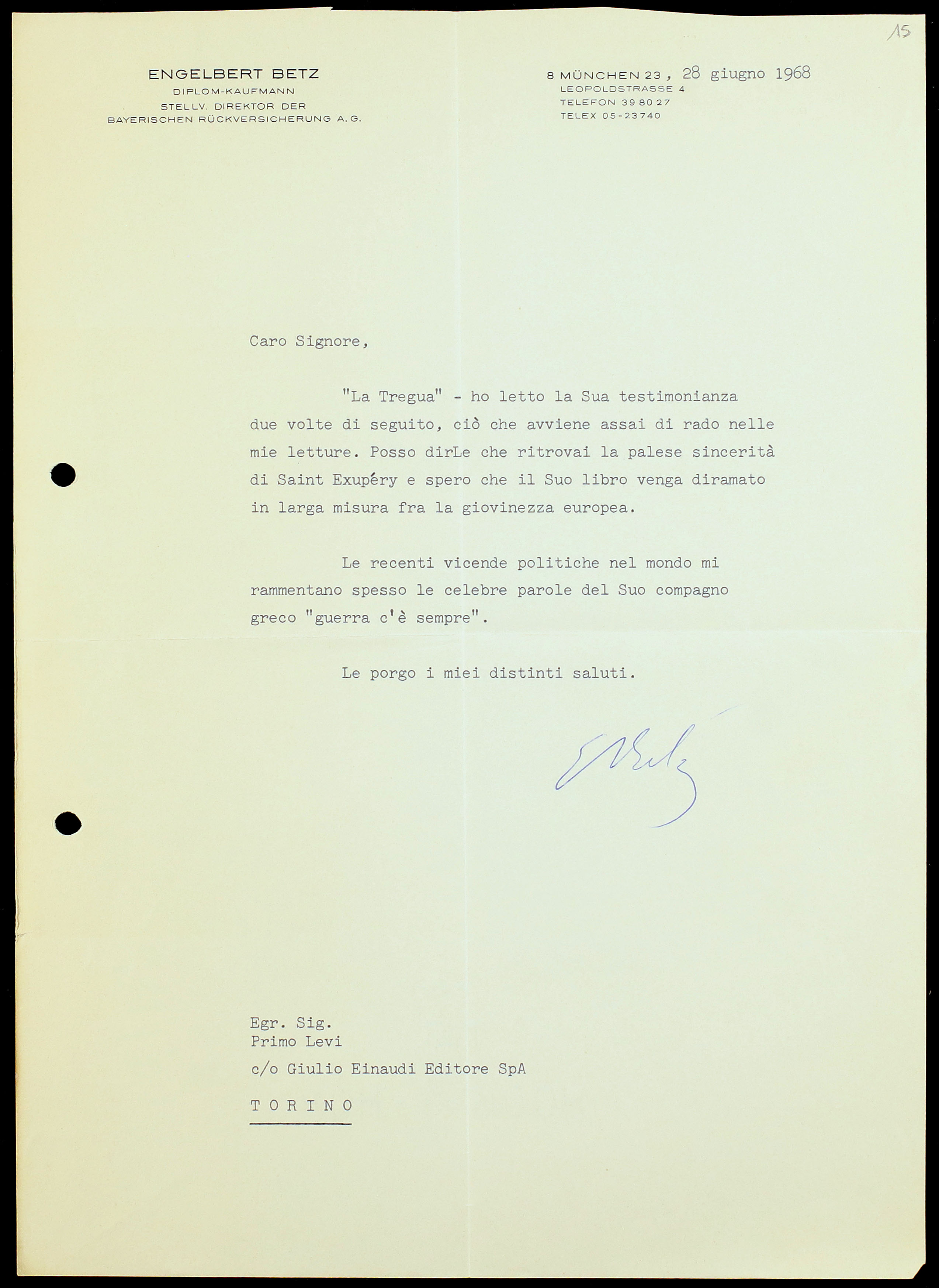
Engelbert Betz, an executive at an insurance company in Munich, writes that he read The Truce two times in a row, something he rarely does.
28 giugno 1968
Caro Signore,
La Tregua– ho letto la Sua testimonianza due volte di seguito, ciò che avviene assai di rado nelle mie letture. Posso dirLe che ritrovai la palese sincerità di Saint Exupéry[1]e spero che il Suo libro venga diramato in larga misura fra la giovinezza europea.
Le recenti vicende politiche nel mondo mi rammentano spesso le celebre parole del Suo compagno greco “guerra c’è sempre”.[2]
Le porgo i miei distinti saluti.
E. Betz
28 giugno 1968
Caro Signore,
La Tregua– ho letto la Sua testimonianza due volte di seguito, ciò che avviene assai di rado nelle mie letture. Posso dirLe che ritrovai la palese sincerità di Saint Exupéry[1]e spero che il Suo libro venga diramato in larga misura fra la giovinezza europea.
Le recenti vicende politiche nel mondo mi rammentano spesso le celebre parole del Suo compagno greco “guerra c’è sempre”.[2]
Le porgo i miei distinti saluti.
E. Betz
June 28, 1968
Dear Sir,
The Truce – I read your testimony two times in a row, something that happens very rarely when I read. I can tell you that I found the same clear sincerity as Saint Exupéry[1] and I hope your book will be widely circulated among Europe’s young people.
The recent political events in the world often remind me of the famous words of your Greek companion, “there is always war.”[2]
With my best regards.
E. Betz
28 giugno 1968
Caro Signore,
La Tregua– ho letto la Sua testimonianza due volte di seguito, ciò che avviene assai di rado nelle mie letture. Posso dirLe che ritrovai la palese sincerità di Saint Exupéry[1]e spero che il Suo libro venga diramato in larga misura fra la giovinezza europea.
Le recenti vicende politiche nel mondo mi rammentano spesso le celebre parole del Suo compagno greco “guerra c’è sempre”.[2]
Le porgo i miei distinti saluti.
E. Betz
28 giugno 1968
Caro Signore,
La Tregua– ho letto la Sua testimonianza due volte di seguito, ciò che avviene assai di rado nelle mie letture. Posso dirLe che ritrovai la palese sincerità di Saint Exupéry[1]e spero che il Suo libro venga diramato in larga misura fra la giovinezza europea.
Le recenti vicende politiche nel mondo mi rammentano spesso le celebre parole del Suo compagno greco “guerra c’è sempre”.[2]
Le porgo i miei distinti saluti.
E. Betz
June 28, 1968
Dear Sir,
The Truce – I read your testimony two times in a row, something that happens very rarely when I read. I can tell you that I found the same clear sincerity as Saint Exupéry[1] and I hope your book will be widely circulated among Europe’s young people.
The recent political events in the world often remind me of the famous words of your Greek companion, “there is always war.”[2]
With my best regards.
E. Betz
Info
Notes
Tag
Sender: Engelbert M. Betz
Addressee: Primo Levi
Date of Drafting: 1968-06-28
Place of Writing: Munich
Description:typewritten letter on letterhead paper with handwritten signature in blue ballpoint pen. At the bottom of the letter, “Egr. Sig.| Primo Levi| c/o Giulio Einaudi Editore SpA| TORINO” is typewritten.
Archive: Archivio privato di Primo Levi, Turin
Series: Complesso di fondi Primo Levi, Fondo Primo Levi, Corrispondenza, Corrispondenti particolari, fasc. 20, sottofasc. 1, doc. 7, f. 15
Folio: 1, front only
Letterhead:ENGELBERT BETZDIPLOM-KAUFMANNSTELLV. DIREKTOR DERBAYERISCHEN RÜCKVERSICHERUNG A.G.8 MÜNCHEN 23LEOPOLDSTRASSE 4TELEFON 398027TELEX 05-23740
2CW I, p. 251: “The Lager had come to us both: I had perceived it as a monstrous distortion, an ugly anomaly of my history and the history of the world, he as a sad confirmation of well-known things. ‘There is always war,’ [Es ist immer Krieg], man is a wolf toward man: an old story.” Besides the escalation of the war in Vietnam, the first half of 1968 was also marked by various political and social events of international significance: the beginning of the Prague Spring (January), the assassination of Martin Luther King (April 4), May ’68 in France, and the assassination of Robert F. Kennedy (June 5).