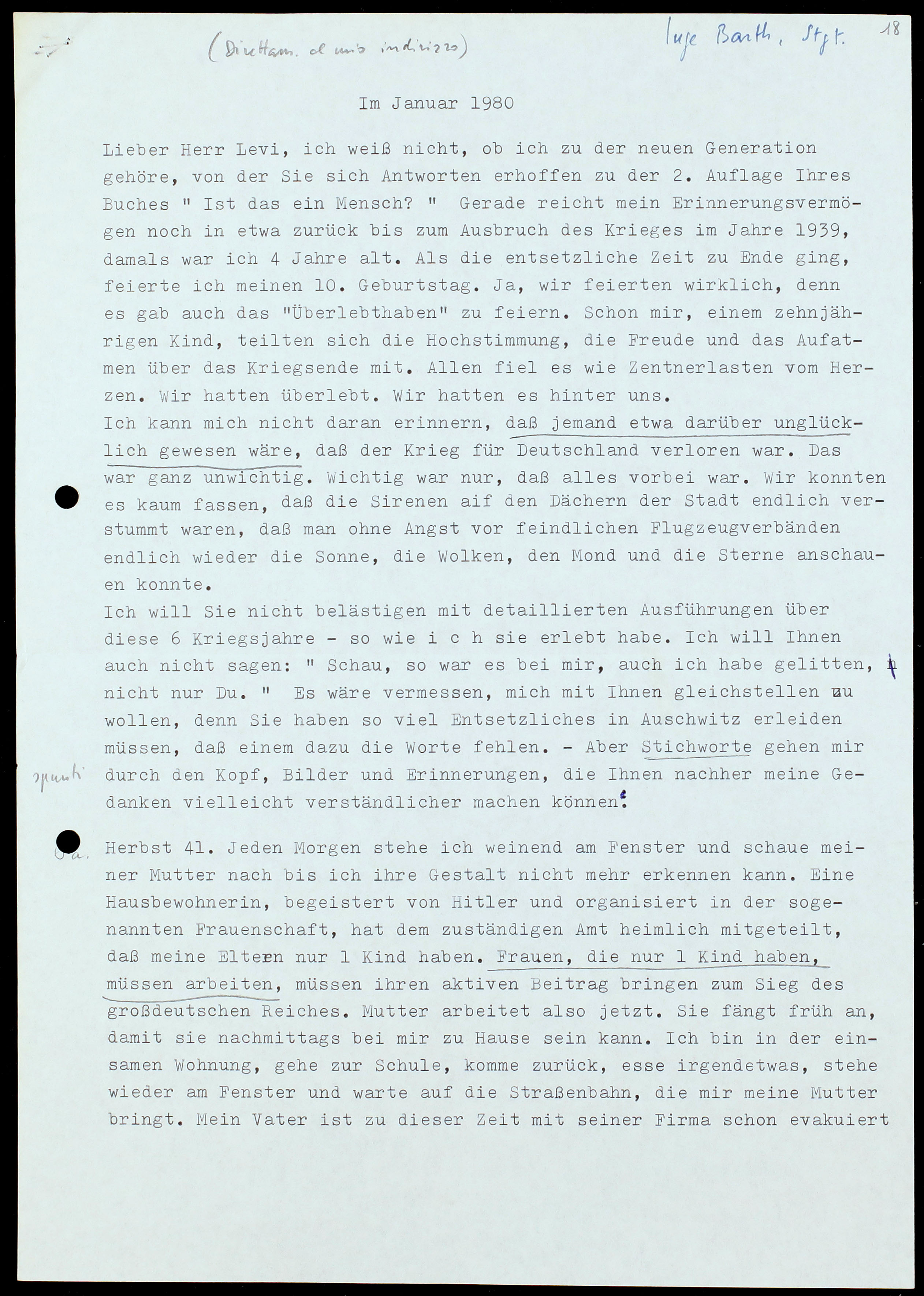
Inge Barth, an elementary schoolteacher from Stuttgart, describes her childhood spent between bunkers and air raids, and shares with Levi the questions that came to mind as she read Ist das ein Mensch?.
Im Januar 1980
Lieber Herr Levi, ich weiß nicht, ob ich zu der neuen Generation gehöre, von der Sie sich Antworten erhoffen zu der 2. Auflage Ihres Buches Ist das ein Mensch?Gerade reicht mein Erinnerungsvermögen noch in etwa zurück bis zum Ausbruch des Krieges im Jahre 1939, damals war ich 4 Jahre alt. Als die entsetzliche Zeit zu Ende ging, feierte ich meinen 10. Geburtstag. Ja, wir feierten wirklich, denn es gab auch das “Überlebthaben” zu feiern. Schon mir, einem zehnjährigen Kind, teilten sich die Hochstimmung, die Freude und das Aufatmen über das Kriegsende mit. Allen fiel es wie Zentnerlasten vom Herzen. Wir hatten überlebt. Wir hatten es hinter uns.
Ich kann mich nicht daran erinnern, daß jemand etwa darüber unglücklich gewesen wäre,[1] daß der Krieg für Deutschland verloren war. Das war ganz unwichtig. Wichtig war nur, daß alles vorbei war. Wir konnten es kaum fassen, daß die Sirenen aif den Dächern der Stadt endlich verstummt waren, daß man ohne Angst vor feindlichen Flugzeugverbänden endlich wieder die Sonne, die Wolken, den Mond und die Sterne anschauen konnte.
Ich will Sie nicht belästigen mit detaillierten Ausführungen über diese 6 Kriegsjahre – so wie ich sie erlebt habe. Ich will Ihnen auch nicht sagen: „Schau, so war es bei mir, auch ich habe gelitten, nicht nur Du.” Es wäre vermessen, mich mit Ihnen gleichstellen zu wollen, denn Sie haben so viel Entsetzliches in Auschwitz erleiden müssen, daß einem dazu die Worte fehlen. – Aber Stichworte[2] gehen mir durch den Kopf, Bilder und Erinnerungen, die Ihnen nachher meine Gedanken vielleicht verständlicher machen können!
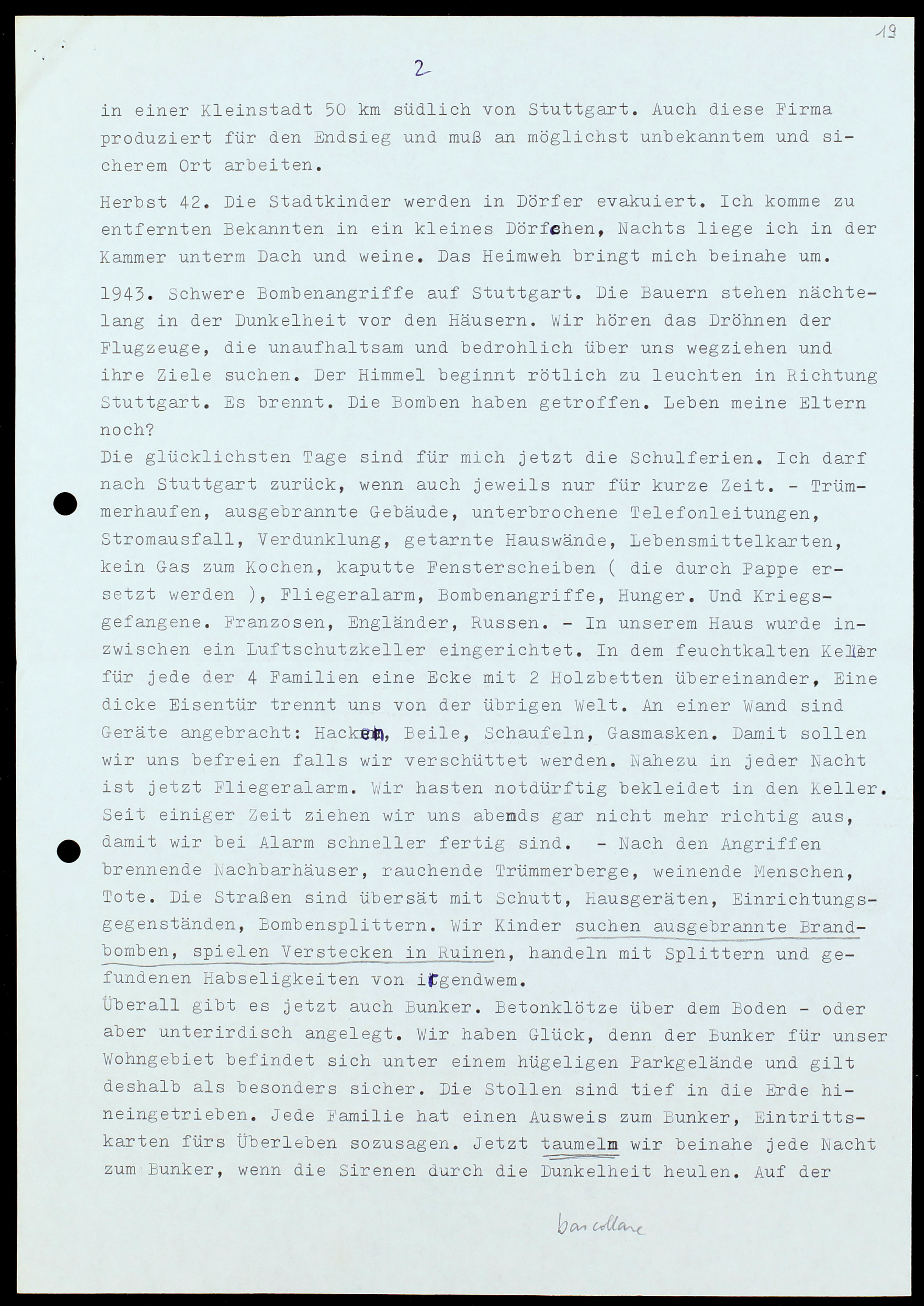
Herbst 41. Jeden Morgen stehe ich weinend am Fenster und schaue meiner Mutter nach bis ich ihre Gestalt nicht mehr erkennen kann. Eine Hausbewohnerin, begeistert von Hitler und organisiert in der sogenannten Frauenschaft, hat dem zuständigen Amt heimlich mitgeteilt, daß meine Eltern nur 1 Kind haben. Frauen, die nur 1 Kind haben, müssen arbeiten,[3] müssen ihren aktiven Beitrag bringen zum Sieg des großdeutschen Reiches. Mutter arbeitet also jetzt. Sie fängt früh an, damit sie nachmittags bei mir zu Hause sein kann. Ich bin in der einsamen Wohnung, gehe zur Schule, komme zurück, esse irgendetwas, stehe wieder am Fenster und warte auf die Straßenbahn, die mir meine Mutter bringt. Mein Vater ist zu dieser Zeit mit seiner Firma schon evakuiert in einer Kleinstadt 50 km südlich von Stuttgart. Auch diese Firma produziert für den Endsieg und muß an möglichst unbekanntem und sicherem Ort arbeiten.[4]
Herbst 42. Die Stadtkinder werden in Dörfer evakuiert. Ich komme zu entfernten Bekannten in ein kleines Dörfchen, Nachts liege ich in der Kammer unterm Dach und weine. Das Heimweh bringt mich beinahe um.
1943. Schwere Bombenangriffe auf Stuttgart. Die Bauern stehen nächtelang in der Dunkelheit vor den Häusern. Wir hören das Dröhnen der Flugzeuge, die unaufhaltsam und bedrohlich über uns wegziehen und ihre Ziele suchen. Der Himmel beginnt rötlich zu leuchten in Richtung Stuttgart. Es brennt. Die Bomben haben getroffen. Leben meine Eltern noch?[5]
Die glücklichsten Tage sind für mich jetzt die Schulferien. Ich darf nach Stuttgart zurück, wenn auch jeweils nur für kurze Zeit. – Trümmerhaufen, ausgebrannte Gebäude, unterbrochene Telefonleitungen, Stromausfall, Verdunklung, getarnte Hauswände,[6] Lebensmittelkarten, kein Gas zum Kochen, kaputte Fensterscheiben (die durch Pappe ersetzt werden), Fliegeralarm, Bombenangriffe, Hunger. Und Kriegsgefangene. Franzosen, Engländer, Russen. – In unserem Haus wurde inzwischen ein Luftschutzkeller eingerichtet. In dem feuchtkalten Keller für jede der 4 Familien eine Ecke mit 2 Holzbetten übereinander. Eine dicke Eisentür trennt uns von der übrigen Welt. An einer Wand sind Geräte angebracht: Hacken, Beile, Schaufeln, Gasmasken. Damit sollen wir uns befreien falls wir verschüttet werden. Nahezu in jeder Nacht ist jetzt Fliegeralarm. Wir hasten notdürftig bekleidet in den Keller. Seit einiger Zeit ziehen wir uns abends gar nicht mehr richtig aus, damit wir bei Alarm schneller fertig sind. – Nach den Angriffen brennende Nachbarhäuser, rauchende Trümmerberge, weinende Menschen, Tote. Die Straßen sind übersät mit Schutt, Hausgeräten, Einrichtungsgegenständen, Bombensplittern. Wir Kinder suchen ausgebrannte Brandbomben, spielen Verstecken in Ruinen,[7]handeln mit Splittern und gefundenen Habseligkeiten von irgendwem.
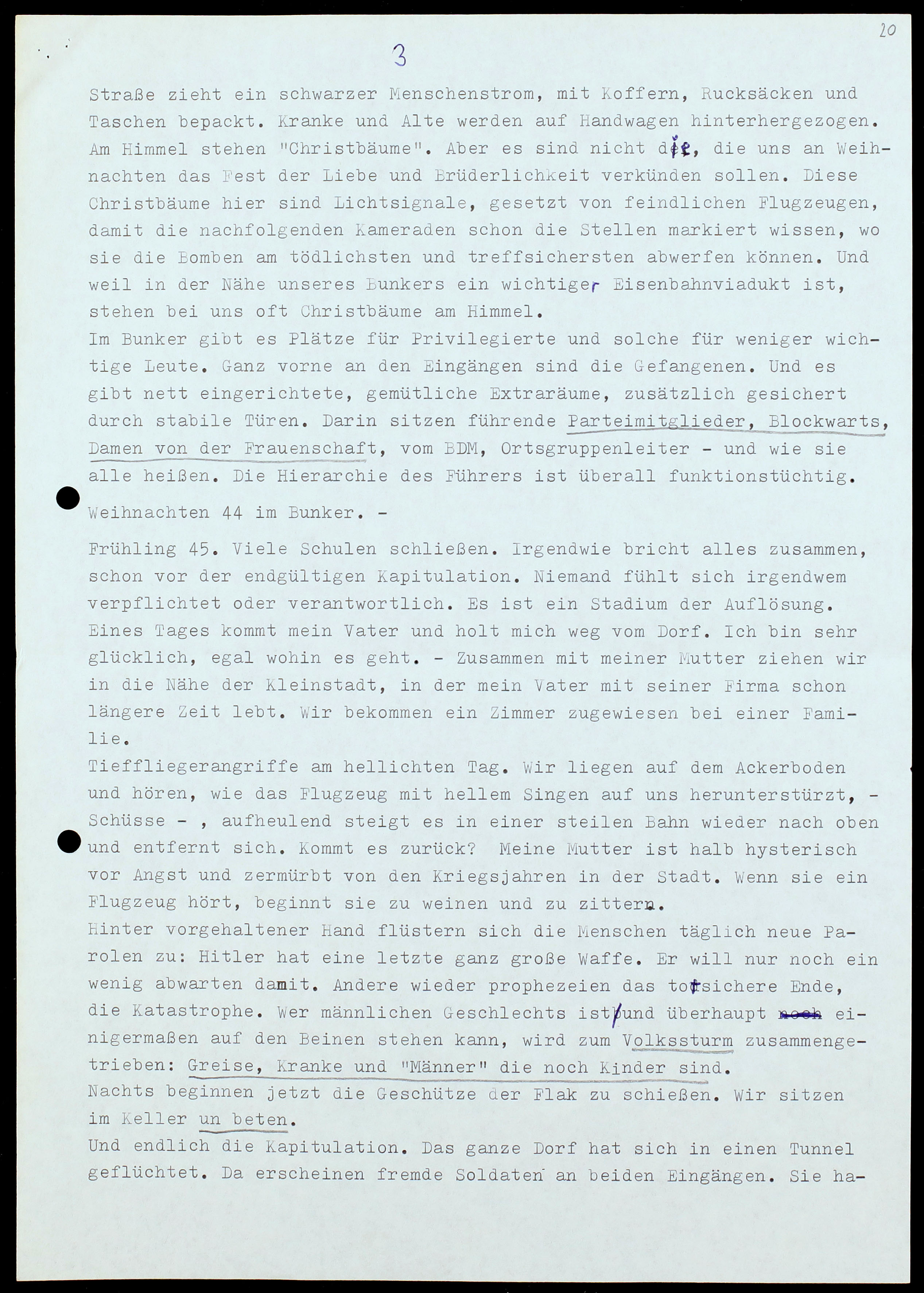
Überall gibt es jetzt auch Bunker. Betonklötze über dem Boden – oder aber unterirdisch angelegt. Wir haben Glück, denn der Bunker für unser Wohngebiet befindet sich unter einem hügeligen Parkgelände und gilt deshalb als besonders sicher. Die Stollen sind tief in die Erde hineingetrieben. Jede Familie hat einen Ausweis zum Bunker, Eintrittskarten fürs Überleben sozusagen. Jetzt taumeln[8] wir beinahe jede Nacht zum Bunker, wenn die Sirenen durch die Dunkelheit heulen. Auf der Straße zieht ein schwarzer Menschenstrom, mit Koffern, Rucksäcken und Taschen bepackt. Kranke und Alte werden auf Handwagen hinterhergezogen. Am Himmel stehen „Christbäume”. Aber es sind nicht die, die uns an Weihnachten das Fest der Liebe und Brüderlichkeit verkünden sollen. Diese Christbäume hier sind Lichtsignale, gesetzt von feindlichen Flugzeugen, damit die nachfolgenden Kameraden schon die Stellen markiert wissen, wo sie die Bomben am tödlichsten und treffsichersten abwerfen können. Und weil in der Nähe unseres Bunkers ein wichtiger Eisenbahnviadukt ist, stehen bei uns oft Christbäume am Himmel.[9]
Im Bunker gibt es Plätze für Privilegierte und solche für weniger wichtige Leute. Ganz vorne an den Eingängen sind die Gefangenen. Und es gibt nett eingerichtete, gemütliche Extraräume, zusätzlich gesichert durch stabile Türen. Darin sitzen führende Parteimitglieder, Blockwarts, Damen von der Frauenschaft,[10] vom BDM, Ortsgruppenleiter – und wie sie alle heißen. Die Hierarchie des Führers ist überall funktionstüchtig.[11]
Weihnachten 44 im Bunker. –
Frühling 45. Viele Schulen schließen. Irgendwie bricht alles zusammen, schon vor der endgültigen Kapitulation. Niemand fühlt sich irgendwem verpflichtet oder verantwortlich. Es ist ein Stadium der Auflösung. Eines Tages kommt mein Vater und holt mich weg vom Dorf. Ich bin sehr glücklich, egal wohin es geht. – Zusammen mit meiner Mutter ziehen wir in die Nähe der Kleinstadt, in der mein Vater mit seiner Firma schon längere Zeit lebt. Wir bekommen ein Zimmer zugewiesen bei einer Familie.
Tieffliegerangriffe am hellichten Tag. Wir liegen auf dem Ackerboden und hören, wie das Flugzeug mit hellem Singen auf uns herunterstürzt, – Schüsse –, aufheulend steigt es in einer steilen Bahn wieder nach oben und entfernt sich. Kommt es zurück? Meine Mutter ist halb hysterisch vor Angst und zermürbt von den Kriegsjahren in der Stadt. Wenn sie ein Flugzeug hört, beginnt sie zu weinen und zu zittern.[12]
Hinter vorgehaltener Hand flüstern sich die Menschen täglich neue Parolen zu: Hitler hat eine letzte ganz große Waffe. Er will nur noch ein wenig abwarten damit.[13] Andere wieder prophezeien das totsichere Ende, die Katastrophe. Wer männlichen Geschlechts ist und überhaupt[14] einigermaßen auf den Beinen stehen kann, wird zum Volkssturm[15]zusammengetrieben: Greise, Kranke und „Männer” die noch Kinder sind.[16]
Nachts beginnen jetzt die Geschütze der Flak zu schießen. Wir sitzen im Keller un beten.[17]
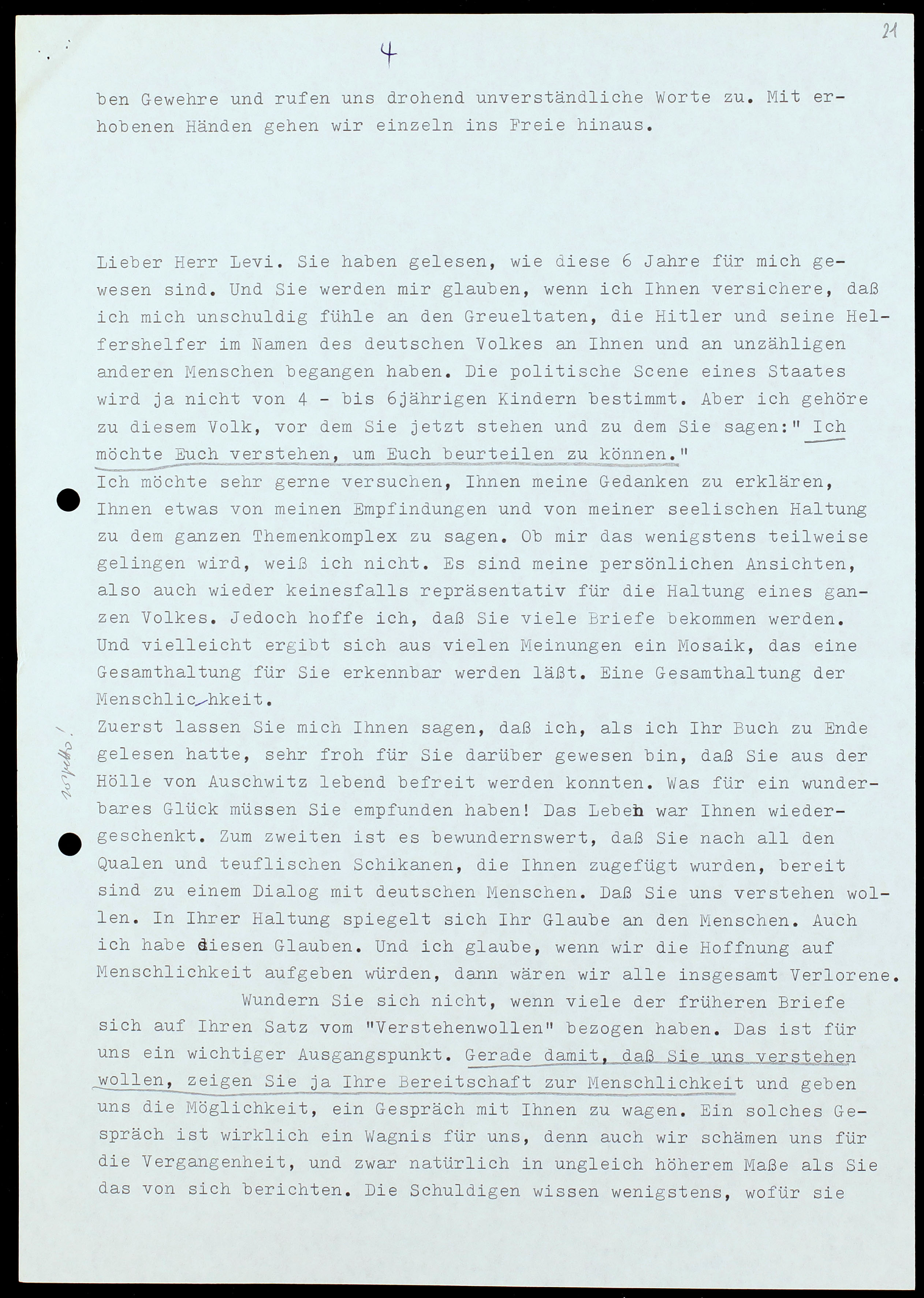
Und endlich die Kapitulation. Das ganze Dorf hat sich in einen Tunnel geflüchtet. Da erscheinen fremde Soldaten an beiden Eingängen. Sie haben Gewehre und rufen uns drohend unverständliche Worte zu. Mit erhobenen Händen gehen wir einzeln ins Freie hinaus.
Lieber Herr Levi. Sie haben gelesen, wie diese 6 Jahre für mich gewesen sind. Und Sie werden mir glauben, wenn ich Ihnen versichere, daß ich mich unschuldig fühle an den Greueltaten, die Hitler und seine Helfershelfer im Namen des deutschen Volkes an Ihnen und an unzähligen anderen Menschen begangen haben. Die politische Scene eines Staates wird ja nicht von 4 – bis 6 jährigen Kindern bestimmt. Aber ich gehöre zu diesem Volk, vor dem Sie jetzt stehen und zu dem Sie sagen: „Ich möchte Euch verstehen, um Euch beurteilen zu können.”[18]
Ich möchte sehr gerne versuchen, Ihnen meine Gedanken zu erklären, Ihnen etwas von meinen Empfindungen und von meiner seelischen Haltung zu dem ganzen Themenkomplex zu sagen. Ob mir das wenigstens teilweise gelingen wird, weiß ich nicht. Es sind meine persönlichen Ansichten, also auch wieder keinesfalls repräsentativ für die Haltung eines ganzen Volkes. Jedoch hoffe ich, daß Sie viele Briefe bekommen werden.[19] Und vielleicht ergibt sich aus vielen Meinungen ein Mosaik, das eine Gesamthaltung für Sie erkennbar werden läßt. Eine Gesamthaltung der Menschlichkeit.
Zuerst lassen Sie mich Ihnen sagen, daß ich, als ich Ihr Buch zu Ende gelesen hatte, sehr froh für Sie darüber gewesen bin, daß Sie aus der Hölle von Auschwitz lebend befreit werden konnten.[20]Was für ein wunderbares Glück müssen Sie empfunden haben! Das Leben war Ihnen wiedergeschenkt. Zum zweiten ist es bewundernswert, daß Sie nach all den Qualen und teuflischen Schikanen, die Ihnen zugefügt wurden, bereit sind zu einem Dialog mit deutschen Menschen. Daß Sie uns verstehen wollen. In Ihrer Haltung spiegelt sich Ihr Glaube an den Menschen. Auch ich habe diesen Glauben. Und ich glaube, wenn wir die Hoffnung auf Menschlichkeit aufgeben würden, dann wären wir alle insgesamt Verlorene.
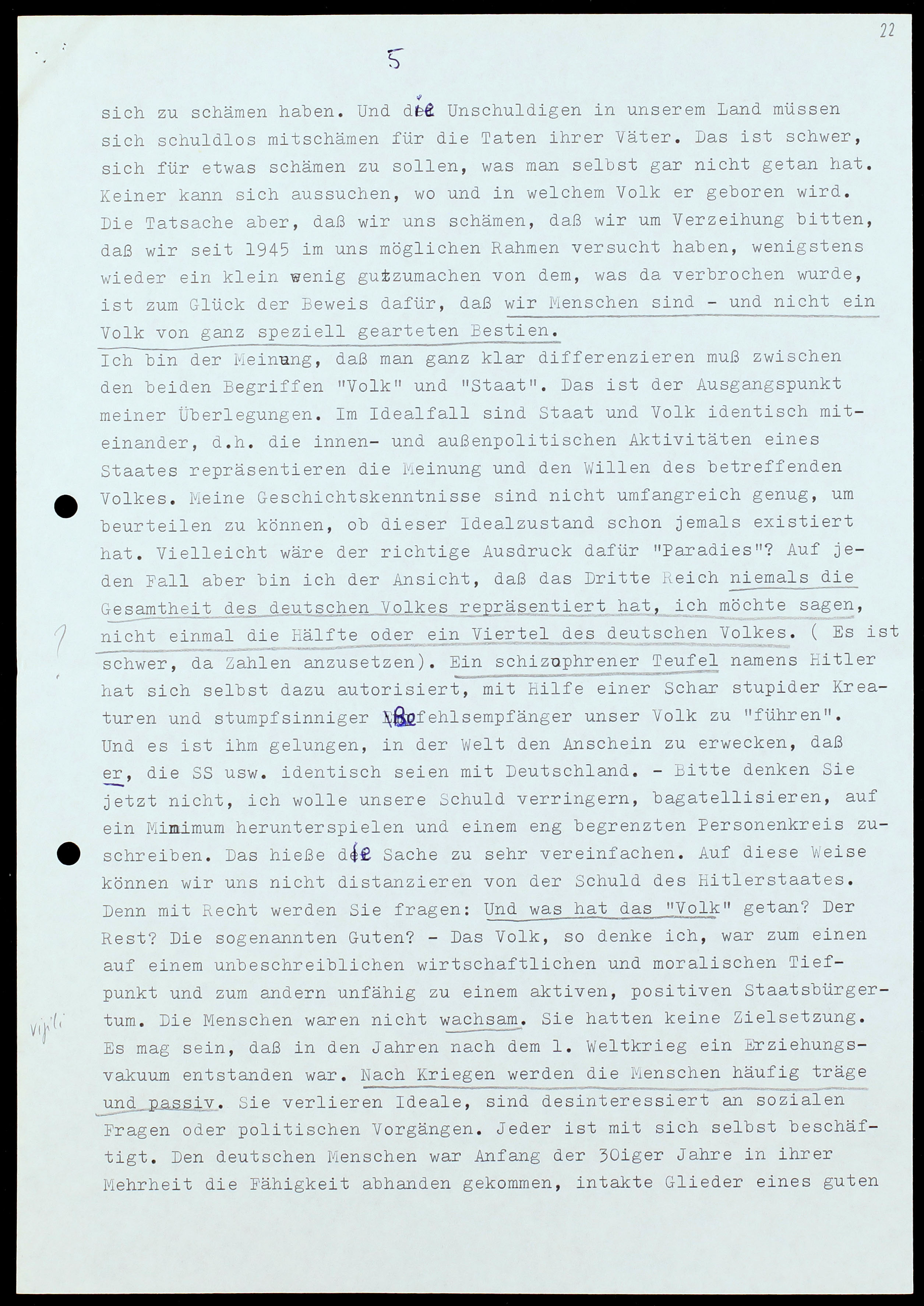
Wundern Sie sich nicht, wenn viele der früheren Briefe sich auf Ihren Satz vom „Verstehenwollen” bezogen haben. Das ist für uns ein wichtiger Ausgangspunkt. Gerade damit, daß Sie uns verstehen wollen, zeigen Sie ja Ihre Bereitschaft zur Menschlichkeit[21] und geben uns die Möglichkeit, ein Gespräch mit Ihnen zu wagen. Ein solches Gespräch ist wirklich ein Wagnis für uns, denn auch wir schämen uns für die Vergangenheit, und zwar natürlich in ungleich höherem Maße als Sie das von sich berichten. Die Schuldigen wissen wenigstens, wofür sie sich zu schämen haben. Und die Unschuldigen in unserem Land müssen sich schuldlos mitschämen für die Taten ihrer Väter. Das ist schwer, sich für etwas schämen zu sollen, was man selbst gar nicht getan hat.
Keiner kann sich aussuchen, wo und in welchem Volk er geboren wird. Die Tatsache aber, daß wir uns schämen, daß wir um Verzeihung bitten, daß wir seit 1945 im uns möglichen Rahmen versucht haben, wenigstens wieder ein klein wenig gutzumachen von dem, was da verbrochen wurde, ist zum Glück der Beweis dafür, daß wir Menschen sind – und nicht ein Volk von ganz speziell gearteten Bestien.[22]
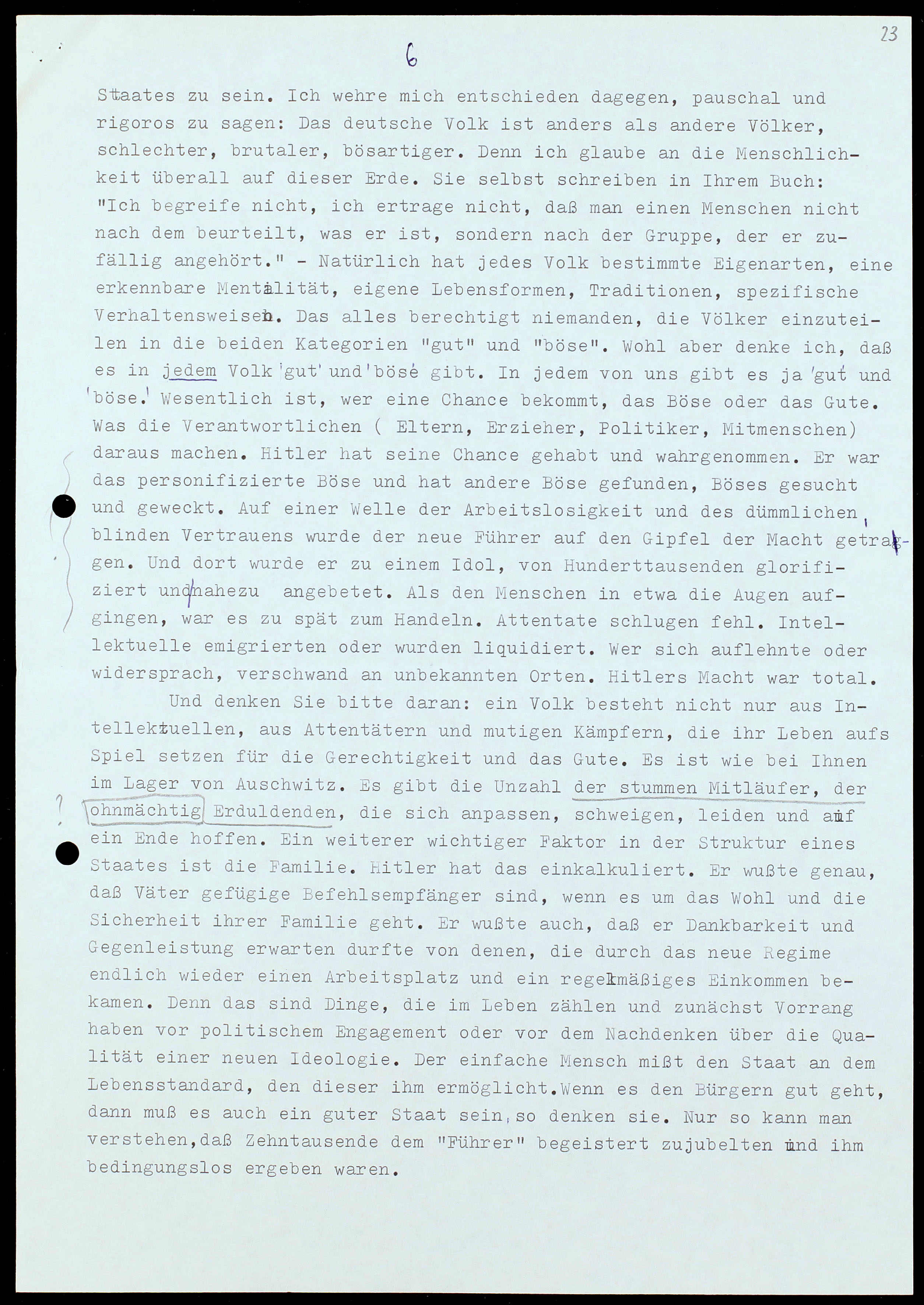
Ich bin der Meinung, daß man ganz klar differenzieren muß zwischen den beiden Begriffen „Volk” und „Staat”. Das ist der Ausgangspunkt meiner Überlegungen. Im Idealfall sind Staat und Volk identisch miteinander, d.h. die innen – und außenpolitischen Aktivitäten eines Staates repräsentieren die Meinung und den Willen des betreffenden Volkes. Meine Geschichtskenntnisse sind nicht umfangreich genug, um beurteilen zu können, ob dieser Idealzustand schon jemals existiert hat. Vielleicht wäre der richtige Ausdruck dafür „Paradies”? Auf jeden Fall aber bin ich der Ansicht, daß das Dritte Reich niemals die Gesamtheit des deutschen Volkes repräsentiert hat, ich möchte sagen, nicht einmal die Hälfte oder ein Viertel des deutschen Volkes.[23](Es ist schwer, da Zahlen anzusetzen). Ein schizophrener Teufel[24] namens Hitler hat sich selbst dazu autorisiert, mit Hilfe einer Schar stupider Kreaturen und stumpfsinniger Befehlsempfänger unser Volk zu „führen”. Und es ist ihm gelungen, in der Welt den Anschein zu erwecken, daß er,[25] die SS usw. identisch seien mit Deutschland. – Bitte denken Sie jetzt nicht, ich wolle unsere Schuld verringern, bagatellisieren, auf ein Minimum herunterspielen und einem eng begrenzten Personenkreis zuschreiben. Das hieße die Sache zu sehr vereinfachen. Auf diese Weise können wir uns nicht distanzieren von der Schuld des Hitlerstaates. Denn mit Recht werden Sie fragen: Und was hat das „Volk”[26] getan? Der Rest? Die sogenannten Guten? – Das Volk, so denke ich, war zum einen auf einem unbeschreiblichen wirtschaftlichen und moralischen Tiefpunkt und zum andern unfähig zu einem aktiven, positiven Staatsbürgertum. Die Menschen waren nicht wachsam.[27] Sie hatten keine Zielsetzung. Es mag sein, daß in den Jahren nach dem 1. Weltkrieg ein Erziehungsvakuum entstanden war. Nach Kriegen werden die Menschen häufig träge und passiv.[28] Sie verlieren Ideale, sind desinteressiert an sozialen Fragen oder politischen Vorgängen. Jeder ist mit sich selbst beschäftigt. Den deutschen Menschen war Anfang der 30iger Jahre in ihrer Mehrheit die Fähigkeit abhanden gekommen, intakte Glieder eines guten Staates zu sein. Ich wehre mich entschieden dagegen, pauschal und rigoros zu sagen: Das deutsche Volk ist anders als andere Völker, schlechter, brutaler, bösartiger. Denn ich glaube an die Menschlichkeit überall auf dieser Erde. Sie selbst schreiben in Ihrem Buch:
„Ich begreife nicht, ich ertrage nicht, daß man einen Menschen nicht nach dem beurteilt, was er ist, sondern nach der Gruppe, der er zufällig angehört.” – Natürlich hat jedes Volk bestimmte Eigenarten, eine erkennbare Mentalität, eigene Lebensformen, Traditionen, spezifische Verhaltensweisen. Das alles berechtigt niemanden, die Völker einzuteilen in die beiden Kategorien „gut” und „böse”. Wohl aber denke ich, daß es in jedem[29] Volk ‘gut’ und ‘böse’ gibt. In jedem von uns gibt es ja ‘gut’ und ‘böse’. Wesentlich ist, wer eine Chance bekommt, das Böse oder das Gute.
Was die Verantwortlichen (Eltern, Erzieher, Politiker, Mitmenschen) daraus machen. Hitler hat seine Chance gehabt und wahrgenommen. Er war das personifizierte Böse und hat andere Böse gefunden, Böses gesucht und geweckt. Auf einer Welle der Arbeitslosigkeit und des dümmlichen, blinden Vertrauens wurde der neue Führer auf den Gipfel der Macht getragen. Und dort wurde er zu einem Idol, von Hunderttausenden glorifiziert und hahezu angebetet. Als den Menschen in etwa die Augen aufgingen, war es zu spät zum Handeln.[30] Attentate schlugen fehl. Intellektuelle emigrierten oder wurden liquidiert. Wer sich auflehnte oder widersprach, verschwand an unbekannten Orten. Hitlers Macht war total.
Und denken Sie bitte daran: ein Volk besteht nicht nur aus Intellektuellen, aus Attentätern und mutigen Kämpfern, die ihr Leben aufs Spiel setzen für die Gerechtigkeit und das Gute. Es ist wie bei Ihnen im Lager von Auschwitz. Es gibt die Unzahl der stummen Mitläufer, der ohnmächtig Erduldenden,[31] die sich anpassen, schweigen, leiden und auf ein Ende hoffen. Ein weiterer wichtiger Faktor in der Struktur eines Staates ist die Familie. Hitler hat das einkalkuliert. Er wußte genau, daß Väter gefügige Befehlsempfänger sind, wenn es um das Wohl und die Sicherheit ihrer Familie geht. Er wußte auch, daß er Dankbarkeit und Gegenleistung erwarten durfte von denen, die durch das neue Regime endlich wieder einen Arbeitsplatz und ein regelmäßiges Einkommen bekamen. Denn das sind Dinge, die im Leben zählen und zunächst Vorrang haben vor politischem Engagement oder vor dem Nachdenken über die Qualität einer neuen Ideologie. Der einfache Mensch mißt den Staat an dem Lebensstandard, den dieser ihm ermöglicht. Wenn es den Bürgern gut geht, dann muß es auch ein guter Staat sein, so denken sie. Nur so kann man verstehen, daß Zehntausende dem „Führer” begeistert zujubelten und ihm bedingungslos ergeben waren.
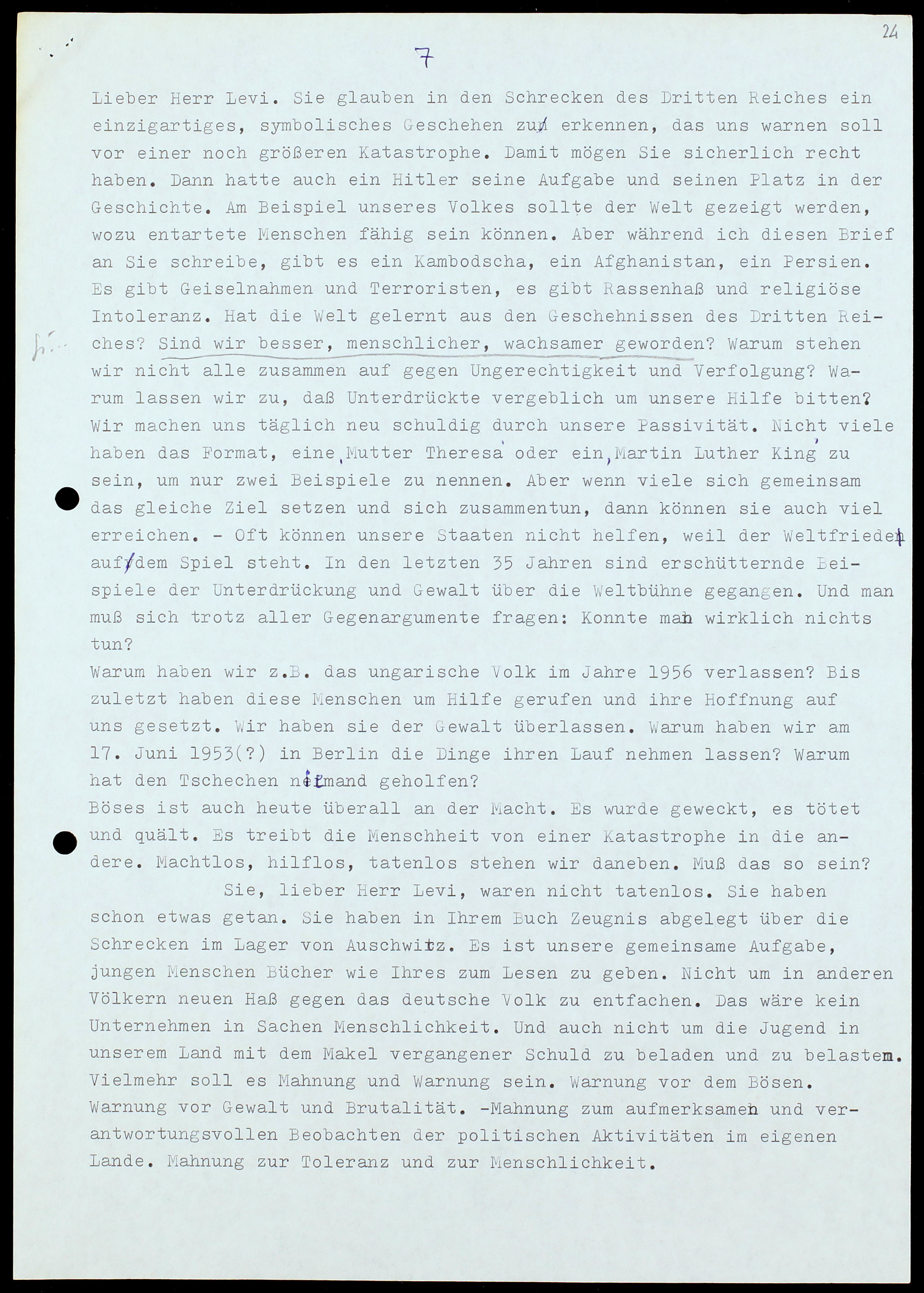
Lieber Herr Levi. Sie glauben in den Schrecken des Dritten Reiches ein einzigartiges, symbolisches Geschehen zu erkennen, das uns warnen soll vor einer noch größeren Katastrophe. Damit mögen Sie sicherlich recht haben. Dann hatte auch ein Hitler seine Aufgabe und seinen Platz in der Geschichte. Am Beispiel unseres Volkes sollte der Welt gezeigt werden, wozu entartete Menschen fähig sein können. Aber während ich diesen Brief an Sie schreibe, gibt es ein Kambodscha, ein Afghanistan, ein Persien. Es gibt Geiselnahmen und Terroristen, es gibt Rassenhaß und religiöse Intoleranz. Hat die Welt gelernt aus den Geschehnissen des Dritten Reiches? Sind wir besser, menschlicher, wachsamer geworden?[32]Warum stehen wir nicht alle zusammen auf gegen Ungerechtigkeit und Verfolgung? Warum lassen wir zu, daß Unterdrückte vergeblich um unsere Hilfe bitten? Wir machen uns täglich neu schuldig durch unsere Passivität. Nicht viele haben das Format, eine, Mutter Theresa oder ein, Martin Luther King zu sein, um nur zwei Beispiele zu nennen. Aber wenn viele sich gemeinsam das gleiche Ziel setzen und sich zusammentun, dann können sie auch viel erreichen. – Oft können unsere Staaten nicht helfen, weil der Weltfriede auf dem Spiel steht. In den letzten 35 Jahren sind erschütternde Beispiele der Unterdrückung und Gewalt über die Weltbühne gegangen. Und man muß sich trotz aller Gegenargumente fragen: Konnte man wirklich nichts tun?
Warum haben wir z.B. das ungarische Volk im Jahre 1956 verlassen? Bis zuletzt haben diese Menschen um Hilfe gerufen und ihre Hoffnung auf uns gesetzt. Wir haben sie der Gewalt überlassen. Warum haben wir am 17. Juni 1953 (?) in Berlin die Dinge ihren Lauf nehmen lassen? Warum hat den Tschechen niemand geholfen?[33]
Böses ist auch heute überall an der Macht. Es wurde geweckt, es tötet und quält. Es treibt die Menschheit von einer Katastrophe in die andere. Machtlos, hilflos, tatenlos stehen wir daneben. Muß das so sein?
Sie, lieber Herr Levi, waren nicht tatenlos. Sie haben schon etwas getan. Sie haben in Ihrem Buch Zeugnis abgelegt über die Schrecken im Lager von Auschwitz. Es ist unsere gemeinsame Aufgabe, jungen Menschen Bücher wie Ihres zum Lesen zu geben. Nicht um in anderen Völkern neuen Haß gegen das deutsche Volk zu entfachen. Das wäre kein Unternehmen in Sachen Menschlichkeit. Und auch nicht um die Jugend in unserem Land mit dem Makel vergangener Schuld zu beladen und zu belasten. Vielmehr soll es Mahnung und Warnung sein. Warnung vor dem Bösen. Warnung vor Gewalt und Brutalität. – Mahnung zum aufmerksamen und verantwortungsvollen Beobachten der politischen Aktivitäten im eigenen Lande. Mahnung zur Toleranz und zur Menschlichkeit.
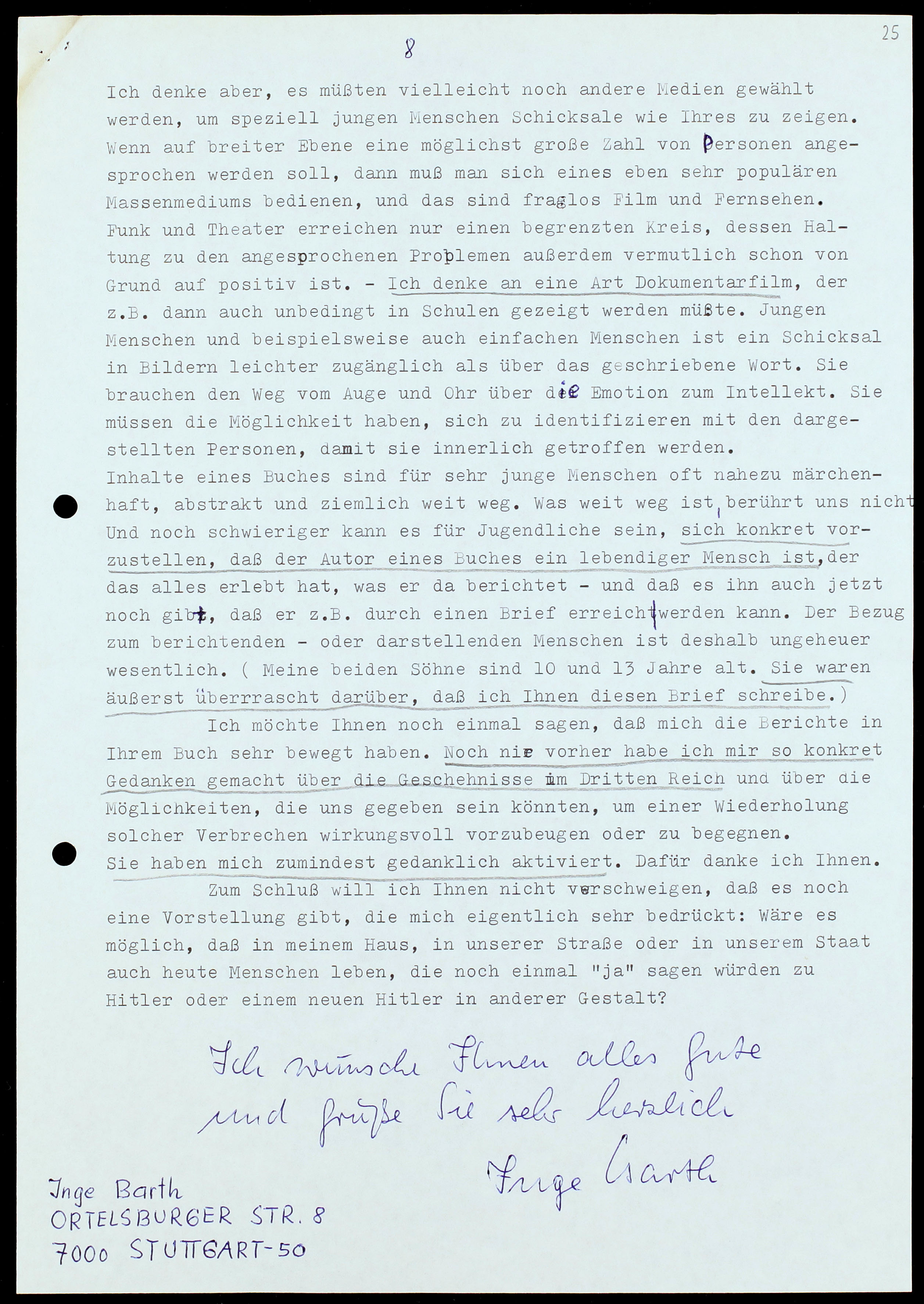
Ich denke aber, es müßten vielleicht noch andere Medien gewählt werden, um speziell jungen Menschen Schicksale wie Ihres zu zeigen. Wenn auf breiter Ebene eine möglichst große Zahl von Personen angesprochen werden soll, dann muß man sich eines eben sehr populären Massenmediums bedienen, und das sind fraglos Film und Fernsehen. Funk und Theater erreichen nur einen begrenzten Kreis, dessen Haltung zu den angesprochenen Problemen außerdem vermutlich schon von Grund auf positiv ist. – Ich denke an eine Art Dokumentarfilm,[34]der z.B. dann auch unbedingt in Schulen gezeigt werden müßte.[35] Jungen Menschen und beispielsweise auch einfachen Menschen ist ein Schicksal in Bildern leichter zugänglich als über das geschriebene Wort. Sie brauchen den Weg vom Auge und Ohr über die Emotion zum Intellekt. Sie müssen die Möglichkeit haben, sich zu identifizieren mit den dargestellten Personen, damit sie innerlich getroffen werden.
Inhalte eines Buches sind für sehr junge Menschen oft nahezu märchenhaft, abstrakt und ziemlich weit weg. Was weit weg ist, berührt uns nicht und noch schwieriger kann es für Jugendliche sein, sich konkret vorzustellen, daß der Autor eines Buches ein lebendiger Mensch ist,[36]der das alles erlebt hat, was er da berichtet – und daß es ihn auch jetzt noch gibt, daß er z.B. durch einen Brief erreicht werden kann. Der Bezug zum berichtenden – oder darstellenden Menschen ist deshalb ungeheuer wesentlich. (Meine beiden Söhne sind 10 und 13 Jahre alt. Sie waren äußerst überrrascht darüber, daß ich Ihnen diesen Brief schreibe.)[37]
Ich möchte Ihnen noch einmal sagen, daß mich die Berichte in Ihrem Buch sehr bewegt haben. Noch nie vorher habe ich mir so konkret Gedanken gemacht über die Geschehnisse im Dritten Reich und über die Möglichkeiten, die uns gegeben sein könnten, um einer Wiederholung solcher Verbrechen wirkungsvoll vorzubeugen oder zu begegnen. Sie haben mich zumindest gedanklich aktiviert.[38] Dafür danke ich Ihnen.
Zum Schluß will ich Ihnen nicht verschweigen, daß es noch eine Vorstellung gibt, die mich eigentlich sehr bedrückt: Wäre es möglich, daß in meinem Haus, in unserer Straße oder in unserem Staat auch heute Menschen leben, die noch einmal „ja” sagen würden zu Hitler oder einem neuen Hitler in anderer Gestalt?
Ich wünsche Ihnen alles gute und grüße Sie sehr ehrlich
Inge Barth[39]
Gennaio 1980
Caro Signor Levi, non so se posso considerarmi parte di quella nuova generazione da cui Lei si attende delle risposte a seguito della seconda edizione del Suo libro Se questo è un uomo. I miei ricordi risalgono, seppure vagamente, all’inizio della guerra nel 1939: allora avevo quattro anni. Quando terminò quell’epoca terribile, festeggiavo il mio decimo compleanno. E sì, festeggiammo davvero, perché c’era da festeggiare innanzitutto l’«essere sopravvissuti». Anch’io, una bambina di dieci anni, condividevo l’euforia, la gioia, il sollievo per la fine della guerra. Tutti sentivano il cuore libero da un peso enorme. Eravamo sopravvissuti. Ce l’avevamo fatta.
Non ricordo nessuno che fosse infelice[1]perché la Germania aveva perso la guerra. Questo era del tutto irrilevante. L’unica cosa che davvero contava era questa: che fosse finita. Non riuscivamo quasi a credere che le sirene sui tetti della città avessero finalmente smesso di ululare, che si potesse tornare a guardare il cielo, il sole, le nuvole, la luna, le stelle senza paura degli aerei nemici.
Non intendo annoiarLa con un resoconto dettagliato dei sei anni di guerra così come li ho vissuti. E non voglio nemmeno dire: «Vedi, è stato così anche per me. Anch’io ho sofferto, non solo tu». Sarebbe presuntuoso da parte mia mettermi sul Suo stesso piano, perché ad Auschwitz Lei ha vissuto così tanto orrore, impossibile da dire. Eppure, certi passaggi[2] io li ho bene in mente, insieme a immagini e ricordi che, forse, La aiuteranno a capire meglio i pensieri che esporrò più avanti.
Autunno del ‘41. Ogni mattina me ne sto davanti alla finestra in lacrime e guardo mia madre allontanarsi, finché non distinguo più la sua figura. Una vicina, appassionata seguace di Hitler e attiva nella cosiddetta Frauenschaft, la Lega delle donne nazionalsocialiste, di nascosto ha segnalato all’ufficio competente che i miei genitori hanno una sola figlia. Le donne con un solo figlio devono lavorare[3] e contribuire in prima persona alla vittoria del Grande Reich Germanico. Così ora mia madre lavora. Attacca la mattina presto, in modo che nel pomeriggio possa stare a casa con me. Io rimango da sola nell’appartamento vuoto, vado a scuola, torno, mangio qualcosa, mi metto di nuovo alla finestra e aspetto che il tram mi riporti mia madre. Mio padre, a quel tempo, è già stato dislocato con la sua azienda in una piccola città a 50 km a sud di Stoccarda. Anche quella azienda produce per la vittoria finale, e deve farlo in un luogo il più possibile sconosciuto e sicuro.[4]
Autunno del ‘42. I bambini delle città vengono evacuati nei paesi. Mi mandano da lontani conoscenti che vivono in un paesino, di notte me ne sto nella mia piccola stanza in soffitta e piango. La nostalgia di casa per poco non mi uccide.
1943. Pesanti bombardamenti su Stoccarda. I contadini trascorrono intere notti in piedi nel buio davanti alle case. Sentiamo il rombo degli aerei che incessantemente passano minacciosi sopra di noi in cerca dei loro obiettivi. Il cielo comincia a tingersi di rosso in direzione di Stoccarda. La città è in fiamme. Le bombe hanno colpito. I miei saranno ancora vivi?[5]
Adesso i giorni più felici per me sono quelli delle vacanze scolastiche. Posso tornare a Stoccarda, anche se per poco. Cumuli di macerie, edifici incendiati, linee telefoniche interrotte, blackout, oscuramento, facciate mimetizzate,[6] tessere alimentari, niente gas per cucinare, vetri delle finestre rotti (li sostituiscono con pezzi di cartone), allarmi aerei, bombardamenti, fame. E prigionieri di guerra. Francesi, inglesi, russi. Intanto nel nostro edificio è stato allestito un rifugio antiaereo. In quella cantina umida e fredda ciascuna delle quattro famiglie ha un angolo con due letti a castello di legno. Una pesante porta di ferro ci separa dal resto del mondo. A una parete sono appesi degli attrezzi: picconi, accette, pale, maschere antigas. Dovremmo usarli per liberarci se rimanessimo sepolti sotto le macerie. Ora, quasi ogni notte suonano le sirene dell’allarme antiaereo. Vestiti alla meno peggio, ci precipitiamo giù in cantina. È un bel po’ che la sera, ormai, non ci spogliamo più, così appena suona l’allarme siamo già pronti per scappare. Dopo i bombardamenti, tutt’intorno palazzi in fiamme, montagne di macerie fumanti, gente che piange, i morti. Le strade sono ricoperte di macerie, utensili, mobilia, frammenti di bombe. Noi bambini andiamo in cerca di resti di bombe incendiarie, giochiamo a nascondino tra le rovine,[7] barattiamo schegge e quelle poche cose trovate in giro e appartenute a chissà chi.
Adesso ci sono anche bunker dappertutto. Blocchi di cemento sopra e sotto terra. Abbiamo fortuna: quello del nostro quartiere è interrato sotto la collina di un parco, quindi è considerato particolarmente sicuro. Le gallerie sono scavate in profondità. Ogni famiglia ha un documento da esibire per accedere: un biglietto d’ingresso per la sopravvivenza. Quasi ogni notte, quando le sirene ululano nel buio, ci trasciniamo barcollando[8] per raggiungere il bunker. In strada, una fiumana nera di persone cariche di valigie, zaini, borse. Vecchi e malati vengono trasportati con i carretti. In cielo compaiono gli «alberi di Natale». Ma non quelli che dovrebbero annunciare a Natale la festa dell’amore e della fratellanza. Questi sono i segnali luminosi lanciati dagli aerei nemici per marcare i punti dove i prossimi potranno sganciare le bombe e colpire in modo infallibile e micidiale. E dato che vicino al nostro bunker c’è un viadotto ferroviario strategico, gli alberi di Natale brillano spesso nel cielo sopra di noi.[9]
Nel bunker ci sono posti riservati ai privilegiati e altri per i meno importanti. I prigionieri stanno proprio davanti agli ingressi. Ci sono anche dei locali extra, accoglienti, ben arredati, con porte robuste e rinforzate. È lì che stanno i funzionari del partito, i sorveglianti di quartiere, le donne della Lega delle nazionalsocialiste[10]e della Lega delle ragazze tedesche, i capi di sezione o come altro si chiamano: la gerarchia del Führer è in piena efficienza ovunque.[11]
Natale del ‘44 nel Bunker. –
Primavera del ‘45. Molte scuole chiudono. Tutto sembra collassare già prima della capitolazione. Nessuno si sente più responsabile di nulla. È uno degli stadi della dissoluzione. Un giorno arriva mio padre e mi porta via dal paese. Io sono al settimo cielo, non m’importa dove andremo. Insieme a mia madre ci trasferiamo nelle vicinanze della piccola città dove mio padre si era già sistemato da tempo con la sua ditta. Ci viene assegnata una camera presso una famiglia.
Attacchi di cacciabombardieri in pieno giorno. Ce ne stiamo sdraiati a terra nei campi e sentiamo l’aereo piombarci addosso con un canto acuto, gli spari, poi riprende quota e si allontana. Tornerà? Mia madre, per la paura, ha quasi una crisi isterica, è stremata dagli anni di guerra vissuti in città. Ogni volta che sente un aereo, scoppia a piangere e trema.[12]
Ogni giorno la gente si sussurra all’orecchio nuove voci: Hitler avrebbe un’ultima arma potentissima. Sta solo aspettando il momento giusto.[13] Altri prevedono la fine imminente, la catastrofe. Chiunque sia maschio e ancora[14] in grado di reggersi in piedi viene arruolato nel Volkssturm:[15] vecchi, malati e «uomini» che sono ancora bambini.[16]
Adesso, di notte, cominciano a sparare i cannoni contraerei. Noi restiamo in cantina a pregare.[17]E finalmente arriva il giorno della capitolazione. Tutto il paese si rifugia in una galleria. Poi compaiono soldati stranieri ai due ingressi. Sono armati di fucile e ci minacciano urlando parole incomprensibili. Usciamo uno per uno con le mani alzate.
Caro Signor Levi, ha appena letto cosa sono stati per me quei sei anni. E mi crederà se le assicuro che mi sento innocente rispetto agli orrori che Hitler e i suoi complici hanno commesso in nome del popolo tedesco contro di Lei e contro innumerevoli altri esseri umani. La politica di uno stato non è certo determinata da bambini di quattro o sei anni. Eppure faccio parte di questo popolo al quale Lei oggi si rivolge e dice: «Voglio capirvi, per potervi giudicare».[18]
Vorrei tanto tentare di spiegarLe i miei pensieri, raccontarLe qualcosa delle mie emozioni e della mia disposizione d’animo rispetto a questo immenso complesso di questioni. Non so se ci riuscirò, anche solo in parte. Le mie sono opinioni personali, non pretendo certo di rappresentare un intero popolo. Spero tuttavia che Lei riceva molte lettere.[19] E che da questa pluralità di voci possa comporsi un mosaico che le consenta di individuare un’attitudine comune. Un’attitudine comune all’umanità intera.
Per prima cosa mi lasci dire che, quando ho terminato la lettura del Suo libro, mi ha fatto molto piacere per Lei sapere che è riuscito a sopravvivere all’inferno di Auschwitz.[20] Che gioia indicibile deve aver provato! Ha ricevuto in dono la vita per la seconda volta. Ed è ammirevole che dopo tutte le torture e le diaboliche angherie subite, Lei sia disposto a dialogare con noi tedeschi. Che voglia capirci. Questo è segno della sua fede nell’essere umano. Una fede che io condivido. E credo che, se mai dovessimo rinunciare alla speranza nella dignità umana, saremmo tutti quanti perduti.
Non si stupisca se molte delle lettere che ha ricevuto si sono soffermate sulla frase in cui Lei dice di «voler capire». Questo per noi è un punto di partenza fondamentale. Perché proprio quel volere dimostra la Sua apertura nei confronti dell’umanità[21] e offre a noi la possibilità di azzardare un dialogo con Lei. Sì, questo dialogo è per noi un vero e proprio azzardo, perché anche noi ci vergogniamo del nostro passato, e in modo ben più doloroso di quanto Lei naturalmente immaginerà. I colpevoli, almeno, sanno di cosa vergognarsi. Mentre gli innocenti, nel nostro Paese, devono vergognarsi senza avere nessuna colpa per i crimini di cui si sono macchiati i loro padri. È difficile dover provare vergogna per qualcosa che non si è commesso. Nessuno può scegliere dove e in quale popolo nascere. Ma il fatto stesso che ci vergogniamo e chiediamo perdono, e che dal 1945 stiamo cercando, nei limiti del possibile, di rimediare almeno in parte a quei crimini, è per fortuna la dimostrazione che siamo esseri umani, e non un popolo che appartiene a una specie tutta particolare di bestie feroci.[22]
A mio avviso è fondamentale fare una netta distinzione tra i concetti di «popolo» e di «Stato». È da qui che prendono spunto le mie riflessioni. Idealmente, Stato e popolo coincidono: la politica interna e la politica estera di uno stato riflettono il pensiero e la volontà del suo popolo. La mia conoscenza della storia non è abbastanza approfondita per poter giudicare se questa condizione ideale sia mai esistita davvero; o forse sarebbe più corretto definirla «paradiso»? In ogni caso, sono convinta che il Terzo Reichnon abbia mai rappresentato l’intero popolo tedesco, anzi, direi nemmeno la metà se non addirittura un quarto.[23] (Quantificare in numeri è difficile). Un demonio schizofrenico[24] di nome Hitler, sostenuto da un manipolo di burattini ottusi e servili, si è autoproclamato «guida» del popolo. Ed è riuscito a far credere al mondo che lui,[25] le SS e via dicendo fossero la Germania. La prego, non pensi che io voglia minimizzare la nostra colpa, edulcorarla, sminuirla, attribuendola a un gruppuscolo di persone. Sarebbe una semplificazione eccessiva. Così facendo non potremmo mai prendere le distanze dalle colpe del regime hitleriano. Perché allora, giustamente, Lei chiederebbe: E cos’ha fatto il «popolo»?[26] Il resto della gente? I cosiddetti buoni? Io penso che il popolo, da un lato, si trovasse in una condizione di miseria economica e morale senza precedenti e, dall’altro, fosse incapace di esercitare una cittadinanza attiva e consapevole. La gente non era vigile.[27] Non aveva obiettivi. Forse negli anni che seguirono la Prima guerra mondiale si era creato un vuoto educativo. Dopo le guerre, capita spesso di cadere nel torpore e nella passività.[28] Si perdono gli ideali, ci si disinteressa alle questioni sociali e alla politica. Ciascuno pensa solo a se stesso. All’inizio degli anni Trenta, i tedeschi avevano per lo più perso la capacità di essere cittadini moralmente integri di uno stato buono. Mi rifiuto con fermezza di dire, facendo di ogni erba un fascio: il popolo tedesco è diverso, è peggiore degli altri popoli, è più crudele e malvagio. Perché io credo nell’umanità di ogni angolo del pianeta. Lei stesso scrive nel Suo libro:
«Non comprendo, non sopporto che si giudichi un uomo non per quello che è, ma per il gruppo a cui gli accade di appartenere». Naturalmente ogni popolo ha tratti specifici, una mentalità, delle tradizioni, delle consuetudini proprie. Ma nessuno ha il diritto di dividere i popoli in «buoni» e «cattivi». Penso, piuttosto, che in ogni[29] popolo ci sia del «buono» e del «cattivo». Come del resto in ciascuno di noi. L’importante è quale di queste due componenti ha modo di manifestarsi.
Tutto dipende da chi educa (genitori, insegnanti, politici, compagni di strada). Hitler ha avuto la sua occasione, e l’ha colta. Era il male fatto persona e si è circondato di altri individui malvagi, ha cercato il male e lo ha risvegliato. Cavalcando l’onda della disoccupazione e della fiducia cieca e ottusa, il nuovo «Führer» ha raggiunto le vette del potere. E lì è diventato un idolo, glorificato e quasi adorato da centinaia di migliaia di persone. Quando la gente ha cominciato ad aprire gli occhi, era troppo tardi per agire.[30] Gli attentati non andavano a segno. Gli intellettuali emigravano o venivano liquidati. Contestatori e ribelli sparivano in luoghi sconosciuti. Il potere di Hitler era assoluto.
E tenga presente questo: un popolo non è fatto solo di intellettuali, attentatori, strenui combattenti pronti a sacrificare la loro vita per il bene e la giustizia. Le cose vanno come nel Suo lager ad Auschwitz. Esistono migliaia di gregari che se ne stanno in silenzio, di gente che subisce impotente,[31]che si adatta, tace, soffre e spera nella fine. Un altro fattore importante nella struttura di uno stato è la famiglia. Hitler lo sapeva. Sapeva perfettamente che i padri di famiglia sarebbero stati docili esecutori, se erano in gioco la sicurezza e il bene dei loro cari. Sapeva anche che poteva contare sulla gratitudine e sulla contropartita di coloro che, grazie al nuovo regime, avrebbero avuto di nuovo un lavoro e uno stipendio. Perché sono queste le cose che contano nella vita e che hanno un peso maggiore dell’impegno politico o del giudizio critico sulla qualità di una nuova ideologia. Il metro con cui la gente comune misura la bontà dello stato è il tenore di vita che riesce a garantirle: se i cittadini stanno bene, significa che lo stato è buono. Solo questo può spiegare l’entusiasmo cieco di decine di migliaia di persone per il “Führer” e la loro dedizione assoluta.
Caro Signor Levi, Lei vede nell’orrore del Terzo Reich un evento unico e simbolico, un monito contro una catastrofe ancora più grande. E potrebbe avere ragione. In tal caso anche un Hitler avrebbe avuto un suo posto e un suo compito nella storia. Forse attraverso il nostro popolo il mondo doveva constatare di cosa può essere capace l’umanità degenerata. Ma mentre Le scrivo questa lettera, ci sono una Cambogia, un Afghanistan, una Persia. Ci sono ostaggi e terroristi, odio razziale e intolleranza religiosa. Il mondo ha davvero imparato qualcosa dalle vicende del Terzo Reich? Siamo forse diventati migliori, più umani, più attenti?[32] Perché tutti insieme non insorgiamo contro le ingiustizie e le persecuzioni? Perché permettiamo che gli oppressi implorino invano il nostro aiuto? Ogni giorno, con la nostra passività, ci rendiamo di nuovo colpevoli. Certo non tutti hanno la stoffa di unaMadre Teresa o di un Martin Luther King, solo per fare due esempi. Ma se siamo in tanti a porci un obiettivo comune e unire le forze, allora possiamo ottenere molto. Spesso i nostri governi non sono in condizione di intervenire e portare aiuto, perché è in gioco la pace mondiale. Negli ultimi trentacinque anni abbiamo avuto esempi sconvolgenti di violenza e oppressione su scala internazionale. E nonostante ogni contro argomentazione dobbiamo domandarci: davvero non si poteva fare niente?
Perché, ad esempio, nel 1956 abbiamo lasciato da solo il popolo ungherese? Che pure ha invocato aiuto fino all’ultimo, riponendo in noi le sue speranze. E noi l’abbiamo abbandonato alla violenza. Perché il 17 giugno 1953(?) a Berlino non siamo intervenuti? Perché nessuno è andato in soccorso del popolo ceco?[33]
Il male è ancora al potere ovunque. È stato risvegliato, uccide, tortura. Trascina l’umanità da una catastrofe all’altra. E noi restiamo a guardare. Impotenti, inermi, con le mani in mano. Ma dev’essere per forza così?
Lei, caro Signor Levi, non è rimasto con le mani in mano. Lei qualcosa ha fatto. Lei, con il Suo libro, ha dato testimonianza degli orrori compiuti nel lager di Auschwitz. Ora spetta a noi fare in modo che libri come il Suo arrivino ai giovani. Non per fomentare in altri popoli nuovo odio contro il popolo tedesco: quello non sarebbe un contributo all’umanità. E nemmeno per opprimere le nuove generazioni del nostro Paese caricandole del peso di una colpa passata. Piuttosto per lanciare un monito e un’esortazione. Un monito contro il male, contro la violenza, contro la brutalità. Un’esortazione a tenere gli occhi aperti sulle vicende politiche del Paese in cui si vive e a osservarle con una mano sulla coscienza. Un’esortazione alla tolleranza e ai sentimenti di umanità.
Credo però che si dovrebbero trovare anche altri mezzi per raccontare, soprattutto ai giovani, i destini come il Suo. Se si vuole raggiungere un pubblico il più possibile ampio, allora bisogna ricorrere ai mass media più popolari quali sono, senza dubbio, il cinema e la televisione. La radio e il teatro parlano solo a una cerchia ristretta di persone, per altro già sensibile, si presume, ai temi in questione. Penso a un documentario,[34]ad esempio, da proiettare obbligatoriamente nelle scuole.[35] Ai giovani, ma anche alla gente comune, un destino raccontato per immagini arriva meglio che se raccontato attraverso la parola scritta: per tutti loro il messaggio è più efficace se parte dall’occhio e dall’orecchio e raggiunge l’intelletto passando dalle emozioni. Per poterne essere intimamente toccati, devono potersi identificare con i personaggi rappresentati.
Per i più giovani, i contenuti di un libro hanno spesso un che di fantastico, sono astratti, lontani. E se una cosa è lontana, non può toccare da vicino. A maggior ragione chi è giovane può avere più difficoltà a immaginare concretamente che l’autore di un libro sia una persona reale,[36]un essere che ha vissuto sulla propria pelle le vicende che narra, è ancora in vita e si può addirittura raggiungere, ad esempio, con una lettera. Per questa ragione è d’importanza vitale che ci sia un rapporto con chi racconta o interpreta. (I miei due figli hanno dieci e tredici anni ed erano stupiti che io potessi scriverLe questa lettera.)[37]
Ci tengo a dirLe ancora una volta che quanto racconta nel Suo libro mi ha colpita profondamente. Non mi era mai capitato di riflettere con tanta concretezza sulle vicende del Terzo Reich, e di chiedermi cosa potremmo fare per evitare o fronteggiare nel modo più incisivo il ripetersi di simili atrocità. Lei mi ha almeno spinta a pensare.[38] E di questo La ringrazio.
Per finire, vorrei ancora confidarLe un pensiero che mi opprime: e se nel palazzo in cui abito, nella strada o nello Stato in cui viviamo ci fossero ancora oggi persone pronte a dire di nuovo «sì» a Hitler? O a un nuovo Hitler in una nuova veste?
Le auguro ogni bene e La saluto cordialmente.
Inge Barth[39]
January 1980
Dear Mr. Levi, I do not know if I belong to the new generation you hope to hear from regarding the second edition of your book If This is a Man. My memory only goes back to the outbreak of war in 1939, when I was four years old. When that terrible time came to an end, I celebrated my tenth birthday. And celebrate we did, because we also had our own “survival” to celebrate. Even I, a ten-year-old child, shared in the elation, joy, and relief at the war’s end. It was as if a heavy burden had been lifted from everyone’s hearts. We had survived. We had made it.
I cannot remember anyone being unhappy[1] that Germany had lost the war. That was completely irrelevant. The only thing that mattered was that it was all over. We could hardly believe that the sirens on the city’s rooftops had finally fallen silent, that we could finally admire the sun, the clouds, the moon, and the stars again without fear of enemy aircraft formations overhead.
I don’t want to bore you with detailed accounts of those six years of war as I experienced them. Nor do I want to say to you: “Look, that’s how it was for me, too, I also suffered, it wasn’t just you.” It would be presumptuous of me to put myself on a par with you, because you endured so many horrors in Auschwitz that words fail me. But a few passages[2] are running through my mind, images and memories that may help you understand my thoughts better later on!
Autumn 1941. Every morning I stand at the window crying, and I watch my mother until I can no longer see her figure. In our building, a fellow tenant who is a Hitler fan and participant in the National Socialists’ so-called Frauenschaft (Women’s League), has secretly informed the relevant authorities that my parents only have one child. Women who only have one child must work,[3] they must actively contribute to the Greater Germanic Reich’s victory. So now my mother works. She starts early so that she can be at home with me in the afternoon. I sit in the lonely apartment, go to school, come home, eat something, stand at the window again, and wait for the tram to bring my mother home. My father has already been moved, along with the company he works for, to a small town fifty km south of Stuttgart. The company, too, is producing goods for the final victory, and therefore has to work from a location kept as unknown and safe as possible.[4]
Autumn ’42. The city’s children are evacuated to villages. I go to stay with distant acquaintances in a small village. At night, I lie in the attic and cry. Homesickness nearly does me in.
1943. Heavy bombing raids on Stuttgart. The farmers stand outside their houses in the dark night after night. We hear the roar of the planes as they fly incessantly and menacingly overhead, searching for their targets. The sky begins to glow red in the direction of Stuttgart. It is on fire. The bombs have hit. Are my parents still alive?[5]
The happiest days for me are now school holidays. I am allowed to return to Stuttgart, albeit only for a short time.—Piles of rubble, burned-down buildings, broken telephone lines, power outages, blackouts, camouflaged house walls,[6] food ration cards, no gas for cooking, broken window panes (replaced with cardboard), air raid sirens, bombings, hunger. And prisoners of war. Frenchmen, Englishmen, Russians.—An air-raid shelter has now been set up in our house. In the damp, cold basement, each of the four families has a corner with two wooden beds stacked on top of each other. A thick iron door separates us from the rest of the world. Tools are attached to one wall: picks, axes, shovels, gas masks. These are to be used to free ourselves if we are buried. There is an air raid alarm almost every night now. We rush to the cellar, dressed in makeshift clothing. For some time now, we have not been changing out of our clothes in the evening so that we can be ready more quickly when the alarm sounds. After the attacks, burning houses throughout the neighborhood, smoking mountains of rubble, crying people, dead bodies. The streets are littered with debris, household appliances, furniture, and bomb fragments. We children search for burned-out incendiary bombs, play hide-and-seek in the ruins,[7] and trade fragments and things we find that belong to who-knows-whom.
Now there are bunkers everywhere. Concrete blocks above ground—or built underground. We are lucky because the bunker for our residential area is located under a hilly park and is therefore considered particularly safe. The tunnels are dug deep into the earth. Every family has an ID card for the bunker, tickets for survival, so to speak. Now we stagger[8] to the bunker almost every night when the sirens wail through the darkness. A black stream of people moves along the street, laden with suitcases, backpacks, and bags. The sick and elderly are pulled along on handcarts. There are “Christmas trees” in the sky. But they are not the ones that are supposed to herald the festival of love and brotherhood at Christmas. These Christmas trees here are light signals set by enemy aircraft so that the comrades following behind already know the locations where they can drop their bombs most lethally and accurately. And because there is an important railway viaduct near our bunker, we often see Christmas trees in the sky.[9]
In the bunker, there are places for the privileged and places for less important people. Right at the front, by the entrances, are the prisoners. And there are nicely furnished, cozy extra rooms, made more secure by sturdy doors. Those are for leading party members, block wardens, ladies from the Women’s League,[10] from the League of German Girls, local group leaders—and whatever else they are called. The Führer’s hierarchy reaches everywhere.[11]
Christmas 1944 in the bunker.—
Spring ’45. Many schools close. Somehow everything collapses, even before the final surrender. No one feels obligated or responsible to anyone. It is a stage of the dissolution. One day my father comes and takes me away from the village. I am ecstatic, regardless of where we are going.—Together with my mother, we move to the small town where my father has been living with his company for some time. We are pointed to a family with a room where we can stay.
Low-level air raids in broad daylight. We lie on the ground and hear the plane swooping down on us with a loud whine, shots ring out, and it roars back up in a steep climb and flies away. Will it come back? My mother is half hysterical with fear and worn down by the war years in the city. When she hears a plane, she starts crying and shaking.[12]
Behind closed doors, people whisper new rumors to each other every day: Hitler has one last big weapon. He just wants to wait a little longer to use it.[13] Others predict a certain end, utter catastrophe. Anyone who is male[14] and can stand on his own two feet is rounded up for the Volkssturm:[15]old men, sick men, and “men” who are still children.[16]
At night, the anti-aircraft guns begin to fire. We sit in the cellar and pray.[17] And finally, surrender. The whole village has taken refuge in a tunnel. Foreign soldiers appear at both entrances. They have guns and shout threatening, incomprehensible words at us. With our hands raised, one by one, we go outside.
Dear Mr. Levi. You have read what those six years were like for me. And you will believe me when I assure you that I feel innocent of the atrocities that Hitler and his accomplices committed against you and countless other people in the name of the German people. The policy of a state is not determined by four- to six-year-old children. But I belong to this people before whom you now stand and to whom you say: “I would like to understand you so that I can judge you.”[18]
I would very much like to try to explain my thoughts to you, to tell you something about my feelings and my emotional attitude toward all these inter-related issues. I do not know whether I will succeed, even in part. These are my personal views, so they are by no means representative of the attitude of an entire people. However, I hope that you will receive many letters.[19] And perhaps the many opinions will form a mosaic that will reveal an overall attitude to you. An overall attitude of humanity.
First, let me say that when I finished reading your book, I was very happy for you that you were able to be liberated, alive, from the hell of Auschwitz.[20] You must have felt such wonderful joy! Life was given back to you. Secondly, it is admirable that, after all the torment and diabolical harassment you were subjected to, you are willing to engage in dialogue with German people. That you want to understand us. Your attitude reflects your faith in humanity. I share this faith. And I believe that if we were to give up hope for humanity, we would all be lost.
Do not be surprised if many of the earlier letters referred to your statement about “wanting to understand.” This is an important starting point for us. Precisely because you want to understand us, you show your willingness to be humane[21] and give us the opportunity to venture into a conversation with you. Such a conversation is truly a risk for us, because we are ashamed of the past as well, and of course to a much greater extent than you report. At least the guilty know what they have to be ashamed of. And the innocent in our country must share in the shame for the deeds of their fathers, even though they are guiltless. It is difficult to be expected to feel shame for something one did not do oneself.
No one can choose where or into which people they are born. But the fact that we are ashamed, that we ask for forgiveness, that since 1945 we have tried, as far as possible, to make up at least a little for what was done, is fortunately proof that we are human beings—and not a people made up of a very particular kind of beast.[22]
I believe that a clear distinction must be made between the terms Volk and Staat (“people” and “state”). That is the starting point for my considerations. Ideally, the state and the people are identical, i.e., the domestic and foreign policy activities of a state represent the opinion and will of its people. My knowledge of history is not extensive enough to be able to judge whether this ideal state has ever existed. Perhaps the correct term for it would be “paradise”? In any case, I am of the opinion that the Third Reich never represented the entirety of the German people; I would say not even half or a quarter of the German people.[23](It is difficult to put a number on this.) A schizophrenic devil[24] named Hitler authorized himself to “lead” our people with the help of a bunch of stupid creatures and dull-witted order-takers. And he succeeded in giving the world the impression that he,[25] the SS etc. were identical to Germany.—Please do not think that I want to diminish our guilt, trivialize it, play it down, minimize it, or attribute it to a narrow circle of people. That would be oversimplifying the matter. If we go that way, we cannot distance ourselves from the guilt of Hitler’s state. For you will rightly ask: And what did the “people”[26] do? The rest? The so-called good people?—The people, I think, were on the one hand at an indescribable economic and moral low point, and on the other hand incapable of active, positive citizenship. People were not vigilant.[27] They had no goals. It may be that an educational vacuum had developed in the years after World War I. After wars, people often become sluggish and passive.[28] They lose their ideals and become disinterested in social issues and political processes. Everyone is preoccupied with themselves. At the beginning of the 1930s, the majority of Germans had lost the ability to be intact members of a good state. I strongly object to making sweeping and harsh statements such as: The German people are different from others, worse, more brutal, more malicious. For I believe in humanity everywhere on this earth. You yourself write in your book:
“I do not understand, I cannot bear that people are judged not by what they are, but by the group to which they happen to belong.” Of course, every people has certain characteristics, a recognizable mentality, its own ways of life, traditions, specific behaviors. None of this justifies dividing peoples into the two categories of “good” and “evil.” However, I do think that there is “good” and “evil” in every[29]people. After all, there is “good” and “evil” in each of us. What matters is who gets the chance to be evil or good.
What those responsible (parents, educators, politicians, fellow human beings) make of it. Hitler had his chance and took it. He was evil personified and found others who were evil, sought out evil and awakened it. On a wave of unemployment and stupid, blind trust, the new leader was carried to the pinnacle of power. And there he became an idol, glorified and almost worshipped by hundreds of thousands. By the time people began to open their eyes, it was too late to act.[30] Assassination attempts failed. Intellectuals emigrated or were liquidated. Those who rebelled or disagreed disappeared to unknown locations. Hitler’s power was total.
And please remember: a nation does not consist only of intellectuals, assassins, and courageous fighters who risk their lives for justice and goodness. It is like your fellows at the Auschwitz camp. There are countless silent followers, powerless sufferers,[31] who conform, remain silent, suffer, and hope for an end. Another important factor in the structure of a state is the family. Hitler took this into account. He knew full well that fathers are compliant recipients of orders when it comes to the welfare and safety of their families. He also knew that he could expect gratitude and reciprocity from those who finally got a job and a regular income again under the new regime. These are things that matter in life and take precedence over political engagement or reflection on the quality of a new ideology. Ordinary people measure the state by the standard of living it affords them. If citizens are doing well, then it must be a good state, they think. Only in this way can one understand why tens of thousands cheered the “Führer” on enthusiastically and were unconditionally loyal to him.
Dear Mr. Levi. You believe that the horrors of the Third Reich were a unique, symbolic event that should warn us of an even greater catastrophe. You may well be right. In that case, even Hitler had his role and his place in history. The example of our people was meant to show the world what degenerate people are capable of. But as I write this letter to you, there is Cambodia, Afghanistan, Persia. There are hostages and terrorists, there is racial hatred and religious intolerance. Has the world learned from the events of the Third Reich? Have we become better, more humane, more vigilant?[32] Why do we not all rise up together against injustice and persecution? Why do we allow the oppressed to ask for our help in vain? We make ourselves guilty every day through our passivity. Not many have the stature to be a Mother Theresa or a Martin Luther King, to name just two examples. But if many people set themselves the same goal and join forces, they can achieve a great deal. Often our countries cannot help because world peace is at stake. Over the past thirty-five years, shocking examples of oppression and violence have played out on the world stage. And despite all the counterarguments, we must ask ourselves: Was there really nothing that could be done?
Why did we abandon the Hungarian people in 1956, for example? Until the very end, these people cried out for help and placed their hope in us. We left them to the violence. Why did we let things take their course on June 17, 1953 (?) in Berlin? Why did no one help the Czechs?[33]
Evil is still in power everywhere today. It has been awakened, it kills and tortures. It drives humanity from one catastrophe to the next. Powerless, helpless, inactive, we stand idly by and watch. Must it be this way?
You, dear Mr. Levi, did not stand idly by. You have already done something. In your book, you have borne witness to the horrors of the Auschwitz camp. It is our shared responsibility to give young people books like yours to read. Not to stir up new hatred against the German people in other nations. That would not be a humanitarian endeavor. Nor is it to burden the youth of our country with the stigma of past guilt. Rather, it should serve as a reminder and a warning. A warning against evil. A warning against violence and brutality. A reminder to observe political activities in our own country attentively and responsibly. A reminder to be tolerant and humane.
However, I think that other media might need to be chosen in order to show young people in particular fates such as yours. If you want to reach as many people as possible on a broad level, then you have to use a very popular mass medium, and such are undoubtedly film and television. Radio and theater only reach a limited audience, whose attitude to the issues addressed is probably already fundamentally positive. I am thinking of a kind of documentary film,[34]that would then also have to be shown in schools, for example.[35] Young people and, for example, ordinary people find it easier to relate to a story told in pictures than in the written word. They need to travel from the eye and ear to the intellect via the emotions. They must have the opportunity to identify with the characters portrayed in order to be moved emotionally.
For very young people, the contents of a book are often almost fairy tale–like, abstract, and quite distant. What is distant does not touch us, and it can be even more difficult for young people to actually imagine that the author of a book is a living person,[36] who has experienced everything he or she reports—and that he or she still exists today, that he or she can be reached by letter, for example. The connection to the person reporting or portraying the events is therefore extremely important. (My two sons are 10 and 13 years old. They were extremely surprised that I am writing this letter to you.)[37]
I would like to tell you once again that the accounts in your book moved me deeply. Never before had I thought so concretely about what happened during the Third Reich and about the possibilities we might have to effectively prevent or counteract a repetition of such crimes. You have at least made me think.[38] For that, I thank you.
Finally, I do not want to hide from you that there is another idea that actually weighs heavily on me: Could it be possible that there are people living in my house, on our street, or in our state today who would once again say “yes” to Hitler or to a new Hitler in a different guise?
Inge Barth[39]
Im Januar 1980
Lieber Herr Levi, ich weiß nicht, ob ich zu der neuen Generation gehöre, von der Sie sich Antworten erhoffen zu der 2. Auflage Ihres Buches Ist das ein Mensch?Gerade reicht mein Erinnerungsvermögen noch in etwa zurück bis zum Ausbruch des Krieges im Jahre 1939, damals war ich 4 Jahre alt. Als die entsetzliche Zeit zu Ende ging, feierte ich meinen 10. Geburtstag. Ja, wir feierten wirklich, denn es gab auch das “Überlebthaben” zu feiern. Schon mir, einem zehnjährigen Kind, teilten sich die Hochstimmung, die Freude und das Aufatmen über das Kriegsende mit. Allen fiel es wie Zentnerlasten vom Herzen. Wir hatten überlebt. Wir hatten es hinter uns.
Ich kann mich nicht daran erinnern, daß jemand etwa darüber unglücklich gewesen wäre,[1] daß der Krieg für Deutschland verloren war. Das war ganz unwichtig. Wichtig war nur, daß alles vorbei war. Wir konnten es kaum fassen, daß die Sirenen aif den Dächern der Stadt endlich verstummt waren, daß man ohne Angst vor feindlichen Flugzeugverbänden endlich wieder die Sonne, die Wolken, den Mond und die Sterne anschauen konnte.
Ich will Sie nicht belästigen mit detaillierten Ausführungen über diese 6 Kriegsjahre – so wie ich sie erlebt habe. Ich will Ihnen auch nicht sagen: „Schau, so war es bei mir, auch ich habe gelitten, nicht nur Du.” Es wäre vermessen, mich mit Ihnen gleichstellen zu wollen, denn Sie haben so viel Entsetzliches in Auschwitz erleiden müssen, daß einem dazu die Worte fehlen. – Aber Stichworte[2] gehen mir durch den Kopf, Bilder und Erinnerungen, die Ihnen nachher meine Gedanken vielleicht verständlicher machen können!
Herbst 41. Jeden Morgen stehe ich weinend am Fenster und schaue meiner Mutter nach bis ich ihre Gestalt nicht mehr erkennen kann. Eine Hausbewohnerin, begeistert von Hitler und organisiert in der sogenannten Frauenschaft, hat dem zuständigen Amt heimlich mitgeteilt, daß meine Eltern nur 1 Kind haben. Frauen, die nur 1 Kind haben, müssen arbeiten,[3] müssen ihren aktiven Beitrag bringen zum Sieg des großdeutschen Reiches. Mutter arbeitet also jetzt. Sie fängt früh an, damit sie nachmittags bei mir zu Hause sein kann. Ich bin in der einsamen Wohnung, gehe zur Schule, komme zurück, esse irgendetwas, stehe wieder am Fenster und warte auf die Straßenbahn, die mir meine Mutter bringt. Mein Vater ist zu dieser Zeit mit seiner Firma schon evakuiert in einer Kleinstadt 50 km südlich von Stuttgart. Auch diese Firma produziert für den Endsieg und muß an möglichst unbekanntem und sicherem Ort arbeiten.[4]
Herbst 42. Die Stadtkinder werden in Dörfer evakuiert. Ich komme zu entfernten Bekannten in ein kleines Dörfchen, Nachts liege ich in der Kammer unterm Dach und weine. Das Heimweh bringt mich beinahe um.
1943. Schwere Bombenangriffe auf Stuttgart. Die Bauern stehen nächtelang in der Dunkelheit vor den Häusern. Wir hören das Dröhnen der Flugzeuge, die unaufhaltsam und bedrohlich über uns wegziehen und ihre Ziele suchen. Der Himmel beginnt rötlich zu leuchten in Richtung Stuttgart. Es brennt. Die Bomben haben getroffen. Leben meine Eltern noch?[5]
Die glücklichsten Tage sind für mich jetzt die Schulferien. Ich darf nach Stuttgart zurück, wenn auch jeweils nur für kurze Zeit. – Trümmerhaufen, ausgebrannte Gebäude, unterbrochene Telefonleitungen, Stromausfall, Verdunklung, getarnte Hauswände,[6] Lebensmittelkarten, kein Gas zum Kochen, kaputte Fensterscheiben (die durch Pappe ersetzt werden), Fliegeralarm, Bombenangriffe, Hunger. Und Kriegsgefangene. Franzosen, Engländer, Russen. – In unserem Haus wurde inzwischen ein Luftschutzkeller eingerichtet. In dem feuchtkalten Keller für jede der 4 Familien eine Ecke mit 2 Holzbetten übereinander. Eine dicke Eisentür trennt uns von der übrigen Welt. An einer Wand sind Geräte angebracht: Hacken, Beile, Schaufeln, Gasmasken. Damit sollen wir uns befreien falls wir verschüttet werden. Nahezu in jeder Nacht ist jetzt Fliegeralarm. Wir hasten notdürftig bekleidet in den Keller. Seit einiger Zeit ziehen wir uns abends gar nicht mehr richtig aus, damit wir bei Alarm schneller fertig sind. – Nach den Angriffen brennende Nachbarhäuser, rauchende Trümmerberge, weinende Menschen, Tote. Die Straßen sind übersät mit Schutt, Hausgeräten, Einrichtungsgegenständen, Bombensplittern. Wir Kinder suchen ausgebrannte Brandbomben, spielen Verstecken in Ruinen,[7]handeln mit Splittern und gefundenen Habseligkeiten von irgendwem.
Überall gibt es jetzt auch Bunker. Betonklötze über dem Boden – oder aber unterirdisch angelegt. Wir haben Glück, denn der Bunker für unser Wohngebiet befindet sich unter einem hügeligen Parkgelände und gilt deshalb als besonders sicher. Die Stollen sind tief in die Erde hineingetrieben. Jede Familie hat einen Ausweis zum Bunker, Eintrittskarten fürs Überleben sozusagen. Jetzt taumeln[8] wir beinahe jede Nacht zum Bunker, wenn die Sirenen durch die Dunkelheit heulen. Auf der Straße zieht ein schwarzer Menschenstrom, mit Koffern, Rucksäcken und Taschen bepackt. Kranke und Alte werden auf Handwagen hinterhergezogen. Am Himmel stehen „Christbäume”. Aber es sind nicht die, die uns an Weihnachten das Fest der Liebe und Brüderlichkeit verkünden sollen. Diese Christbäume hier sind Lichtsignale, gesetzt von feindlichen Flugzeugen, damit die nachfolgenden Kameraden schon die Stellen markiert wissen, wo sie die Bomben am tödlichsten und treffsichersten abwerfen können. Und weil in der Nähe unseres Bunkers ein wichtiger Eisenbahnviadukt ist, stehen bei uns oft Christbäume am Himmel.[9]
Im Bunker gibt es Plätze für Privilegierte und solche für weniger wichtige Leute. Ganz vorne an den Eingängen sind die Gefangenen. Und es gibt nett eingerichtete, gemütliche Extraräume, zusätzlich gesichert durch stabile Türen. Darin sitzen führende Parteimitglieder, Blockwarts, Damen von der Frauenschaft,[10] vom BDM, Ortsgruppenleiter – und wie sie alle heißen. Die Hierarchie des Führers ist überall funktionstüchtig.[11]
Weihnachten 44 im Bunker. –
Frühling 45. Viele Schulen schließen. Irgendwie bricht alles zusammen, schon vor der endgültigen Kapitulation. Niemand fühlt sich irgendwem verpflichtet oder verantwortlich. Es ist ein Stadium der Auflösung. Eines Tages kommt mein Vater und holt mich weg vom Dorf. Ich bin sehr glücklich, egal wohin es geht. – Zusammen mit meiner Mutter ziehen wir in die Nähe der Kleinstadt, in der mein Vater mit seiner Firma schon längere Zeit lebt. Wir bekommen ein Zimmer zugewiesen bei einer Familie.
Tieffliegerangriffe am hellichten Tag. Wir liegen auf dem Ackerboden und hören, wie das Flugzeug mit hellem Singen auf uns herunterstürzt, – Schüsse –, aufheulend steigt es in einer steilen Bahn wieder nach oben und entfernt sich. Kommt es zurück? Meine Mutter ist halb hysterisch vor Angst und zermürbt von den Kriegsjahren in der Stadt. Wenn sie ein Flugzeug hört, beginnt sie zu weinen und zu zittern.[12]
Hinter vorgehaltener Hand flüstern sich die Menschen täglich neue Parolen zu: Hitler hat eine letzte ganz große Waffe. Er will nur noch ein wenig abwarten damit.[13] Andere wieder prophezeien das totsichere Ende, die Katastrophe. Wer männlichen Geschlechts ist und überhaupt[14] einigermaßen auf den Beinen stehen kann, wird zum Volkssturm[15]zusammengetrieben: Greise, Kranke und „Männer” die noch Kinder sind.[16]
Nachts beginnen jetzt die Geschütze der Flak zu schießen. Wir sitzen im Keller un beten.[17]
Und endlich die Kapitulation. Das ganze Dorf hat sich in einen Tunnel geflüchtet. Da erscheinen fremde Soldaten an beiden Eingängen. Sie haben Gewehre und rufen uns drohend unverständliche Worte zu. Mit erhobenen Händen gehen wir einzeln ins Freie hinaus.
Lieber Herr Levi. Sie haben gelesen, wie diese 6 Jahre für mich gewesen sind. Und Sie werden mir glauben, wenn ich Ihnen versichere, daß ich mich unschuldig fühle an den Greueltaten, die Hitler und seine Helfershelfer im Namen des deutschen Volkes an Ihnen und an unzähligen anderen Menschen begangen haben. Die politische Scene eines Staates wird ja nicht von 4 – bis 6 jährigen Kindern bestimmt. Aber ich gehöre zu diesem Volk, vor dem Sie jetzt stehen und zu dem Sie sagen: „Ich möchte Euch verstehen, um Euch beurteilen zu können.”[18]
Ich möchte sehr gerne versuchen, Ihnen meine Gedanken zu erklären, Ihnen etwas von meinen Empfindungen und von meiner seelischen Haltung zu dem ganzen Themenkomplex zu sagen. Ob mir das wenigstens teilweise gelingen wird, weiß ich nicht. Es sind meine persönlichen Ansichten, also auch wieder keinesfalls repräsentativ für die Haltung eines ganzen Volkes. Jedoch hoffe ich, daß Sie viele Briefe bekommen werden.[19] Und vielleicht ergibt sich aus vielen Meinungen ein Mosaik, das eine Gesamthaltung für Sie erkennbar werden läßt. Eine Gesamthaltung der Menschlichkeit.
Zuerst lassen Sie mich Ihnen sagen, daß ich, als ich Ihr Buch zu Ende gelesen hatte, sehr froh für Sie darüber gewesen bin, daß Sie aus der Hölle von Auschwitz lebend befreit werden konnten.[20]Was für ein wunderbares Glück müssen Sie empfunden haben! Das Leben war Ihnen wiedergeschenkt. Zum zweiten ist es bewundernswert, daß Sie nach all den Qualen und teuflischen Schikanen, die Ihnen zugefügt wurden, bereit sind zu einem Dialog mit deutschen Menschen. Daß Sie uns verstehen wollen. In Ihrer Haltung spiegelt sich Ihr Glaube an den Menschen. Auch ich habe diesen Glauben. Und ich glaube, wenn wir die Hoffnung auf Menschlichkeit aufgeben würden, dann wären wir alle insgesamt Verlorene.
Wundern Sie sich nicht, wenn viele der früheren Briefe sich auf Ihren Satz vom „Verstehenwollen” bezogen haben. Das ist für uns ein wichtiger Ausgangspunkt. Gerade damit, daß Sie uns verstehen wollen, zeigen Sie ja Ihre Bereitschaft zur Menschlichkeit[21] und geben uns die Möglichkeit, ein Gespräch mit Ihnen zu wagen. Ein solches Gespräch ist wirklich ein Wagnis für uns, denn auch wir schämen uns für die Vergangenheit, und zwar natürlich in ungleich höherem Maße als Sie das von sich berichten. Die Schuldigen wissen wenigstens, wofür sie sich zu schämen haben. Und die Unschuldigen in unserem Land müssen sich schuldlos mitschämen für die Taten ihrer Väter. Das ist schwer, sich für etwas schämen zu sollen, was man selbst gar nicht getan hat.
Keiner kann sich aussuchen, wo und in welchem Volk er geboren wird. Die Tatsache aber, daß wir uns schämen, daß wir um Verzeihung bitten, daß wir seit 1945 im uns möglichen Rahmen versucht haben, wenigstens wieder ein klein wenig gutzumachen von dem, was da verbrochen wurde, ist zum Glück der Beweis dafür, daß wir Menschen sind – und nicht ein Volk von ganz speziell gearteten Bestien.[22]
Ich bin der Meinung, daß man ganz klar differenzieren muß zwischen den beiden Begriffen „Volk” und „Staat”. Das ist der Ausgangspunkt meiner Überlegungen. Im Idealfall sind Staat und Volk identisch miteinander, d.h. die innen – und außenpolitischen Aktivitäten eines Staates repräsentieren die Meinung und den Willen des betreffenden Volkes. Meine Geschichtskenntnisse sind nicht umfangreich genug, um beurteilen zu können, ob dieser Idealzustand schon jemals existiert hat. Vielleicht wäre der richtige Ausdruck dafür „Paradies”? Auf jeden Fall aber bin ich der Ansicht, daß das Dritte Reich niemals die Gesamtheit des deutschen Volkes repräsentiert hat, ich möchte sagen, nicht einmal die Hälfte oder ein Viertel des deutschen Volkes.[23](Es ist schwer, da Zahlen anzusetzen). Ein schizophrener Teufel[24] namens Hitler hat sich selbst dazu autorisiert, mit Hilfe einer Schar stupider Kreaturen und stumpfsinniger Befehlsempfänger unser Volk zu „führen”. Und es ist ihm gelungen, in der Welt den Anschein zu erwecken, daß er,[25] die SS usw. identisch seien mit Deutschland. – Bitte denken Sie jetzt nicht, ich wolle unsere Schuld verringern, bagatellisieren, auf ein Minimum herunterspielen und einem eng begrenzten Personenkreis zuschreiben. Das hieße die Sache zu sehr vereinfachen. Auf diese Weise können wir uns nicht distanzieren von der Schuld des Hitlerstaates. Denn mit Recht werden Sie fragen: Und was hat das „Volk”[26] getan? Der Rest? Die sogenannten Guten? – Das Volk, so denke ich, war zum einen auf einem unbeschreiblichen wirtschaftlichen und moralischen Tiefpunkt und zum andern unfähig zu einem aktiven, positiven Staatsbürgertum. Die Menschen waren nicht wachsam.[27] Sie hatten keine Zielsetzung. Es mag sein, daß in den Jahren nach dem 1. Weltkrieg ein Erziehungsvakuum entstanden war. Nach Kriegen werden die Menschen häufig träge und passiv.[28] Sie verlieren Ideale, sind desinteressiert an sozialen Fragen oder politischen Vorgängen. Jeder ist mit sich selbst beschäftigt. Den deutschen Menschen war Anfang der 30iger Jahre in ihrer Mehrheit die Fähigkeit abhanden gekommen, intakte Glieder eines guten Staates zu sein. Ich wehre mich entschieden dagegen, pauschal und rigoros zu sagen: Das deutsche Volk ist anders als andere Völker, schlechter, brutaler, bösartiger. Denn ich glaube an die Menschlichkeit überall auf dieser Erde. Sie selbst schreiben in Ihrem Buch:
„Ich begreife nicht, ich ertrage nicht, daß man einen Menschen nicht nach dem beurteilt, was er ist, sondern nach der Gruppe, der er zufällig angehört.” – Natürlich hat jedes Volk bestimmte Eigenarten, eine erkennbare Mentalität, eigene Lebensformen, Traditionen, spezifische Verhaltensweisen. Das alles berechtigt niemanden, die Völker einzuteilen in die beiden Kategorien „gut” und „böse”. Wohl aber denke ich, daß es in jedem[29] Volk ‘gut’ und ‘böse’ gibt. In jedem von uns gibt es ja ‘gut’ und ‘böse’. Wesentlich ist, wer eine Chance bekommt, das Böse oder das Gute.
Was die Verantwortlichen (Eltern, Erzieher, Politiker, Mitmenschen) daraus machen. Hitler hat seine Chance gehabt und wahrgenommen. Er war das personifizierte Böse und hat andere Böse gefunden, Böses gesucht und geweckt. Auf einer Welle der Arbeitslosigkeit und des dümmlichen, blinden Vertrauens wurde der neue Führer auf den Gipfel der Macht getragen. Und dort wurde er zu einem Idol, von Hunderttausenden glorifiziert und hahezu angebetet. Als den Menschen in etwa die Augen aufgingen, war es zu spät zum Handeln.[30] Attentate schlugen fehl. Intellektuelle emigrierten oder wurden liquidiert. Wer sich auflehnte oder widersprach, verschwand an unbekannten Orten. Hitlers Macht war total.
Und denken Sie bitte daran: ein Volk besteht nicht nur aus Intellektuellen, aus Attentätern und mutigen Kämpfern, die ihr Leben aufs Spiel setzen für die Gerechtigkeit und das Gute. Es ist wie bei Ihnen im Lager von Auschwitz. Es gibt die Unzahl der stummen Mitläufer, der ohnmächtig Erduldenden,[31] die sich anpassen, schweigen, leiden und auf ein Ende hoffen. Ein weiterer wichtiger Faktor in der Struktur eines Staates ist die Familie. Hitler hat das einkalkuliert. Er wußte genau, daß Väter gefügige Befehlsempfänger sind, wenn es um das Wohl und die Sicherheit ihrer Familie geht. Er wußte auch, daß er Dankbarkeit und Gegenleistung erwarten durfte von denen, die durch das neue Regime endlich wieder einen Arbeitsplatz und ein regelmäßiges Einkommen bekamen. Denn das sind Dinge, die im Leben zählen und zunächst Vorrang haben vor politischem Engagement oder vor dem Nachdenken über die Qualität einer neuen Ideologie. Der einfache Mensch mißt den Staat an dem Lebensstandard, den dieser ihm ermöglicht. Wenn es den Bürgern gut geht, dann muß es auch ein guter Staat sein, so denken sie. Nur so kann man verstehen, daß Zehntausende dem „Führer” begeistert zujubelten und ihm bedingungslos ergeben waren.
Lieber Herr Levi. Sie glauben in den Schrecken des Dritten Reiches ein einzigartiges, symbolisches Geschehen zu erkennen, das uns warnen soll vor einer noch größeren Katastrophe. Damit mögen Sie sicherlich recht haben. Dann hatte auch ein Hitler seine Aufgabe und seinen Platz in der Geschichte. Am Beispiel unseres Volkes sollte der Welt gezeigt werden, wozu entartete Menschen fähig sein können. Aber während ich diesen Brief an Sie schreibe, gibt es ein Kambodscha, ein Afghanistan, ein Persien. Es gibt Geiselnahmen und Terroristen, es gibt Rassenhaß und religiöse Intoleranz. Hat die Welt gelernt aus den Geschehnissen des Dritten Reiches? Sind wir besser, menschlicher, wachsamer geworden?[32]Warum stehen wir nicht alle zusammen auf gegen Ungerechtigkeit und Verfolgung? Warum lassen wir zu, daß Unterdrückte vergeblich um unsere Hilfe bitten? Wir machen uns täglich neu schuldig durch unsere Passivität. Nicht viele haben das Format, eine, Mutter Theresa oder ein, Martin Luther King zu sein, um nur zwei Beispiele zu nennen. Aber wenn viele sich gemeinsam das gleiche Ziel setzen und sich zusammentun, dann können sie auch viel erreichen. – Oft können unsere Staaten nicht helfen, weil der Weltfriede auf dem Spiel steht. In den letzten 35 Jahren sind erschütternde Beispiele der Unterdrückung und Gewalt über die Weltbühne gegangen. Und man muß sich trotz aller Gegenargumente fragen: Konnte man wirklich nichts tun?
Warum haben wir z.B. das ungarische Volk im Jahre 1956 verlassen? Bis zuletzt haben diese Menschen um Hilfe gerufen und ihre Hoffnung auf uns gesetzt. Wir haben sie der Gewalt überlassen. Warum haben wir am 17. Juni 1953 (?) in Berlin die Dinge ihren Lauf nehmen lassen? Warum hat den Tschechen niemand geholfen?[33]
Böses ist auch heute überall an der Macht. Es wurde geweckt, es tötet und quält. Es treibt die Menschheit von einer Katastrophe in die andere. Machtlos, hilflos, tatenlos stehen wir daneben. Muß das so sein?
Sie, lieber Herr Levi, waren nicht tatenlos. Sie haben schon etwas getan. Sie haben in Ihrem Buch Zeugnis abgelegt über die Schrecken im Lager von Auschwitz. Es ist unsere gemeinsame Aufgabe, jungen Menschen Bücher wie Ihres zum Lesen zu geben. Nicht um in anderen Völkern neuen Haß gegen das deutsche Volk zu entfachen. Das wäre kein Unternehmen in Sachen Menschlichkeit. Und auch nicht um die Jugend in unserem Land mit dem Makel vergangener Schuld zu beladen und zu belasten. Vielmehr soll es Mahnung und Warnung sein. Warnung vor dem Bösen. Warnung vor Gewalt und Brutalität. – Mahnung zum aufmerksamen und verantwortungsvollen Beobachten der politischen Aktivitäten im eigenen Lande. Mahnung zur Toleranz und zur Menschlichkeit.
Ich denke aber, es müßten vielleicht noch andere Medien gewählt werden, um speziell jungen Menschen Schicksale wie Ihres zu zeigen. Wenn auf breiter Ebene eine möglichst große Zahl von Personen angesprochen werden soll, dann muß man sich eines eben sehr populären Massenmediums bedienen, und das sind fraglos Film und Fernsehen. Funk und Theater erreichen nur einen begrenzten Kreis, dessen Haltung zu den angesprochenen Problemen außerdem vermutlich schon von Grund auf positiv ist. – Ich denke an eine Art Dokumentarfilm,[34]der z.B. dann auch unbedingt in Schulen gezeigt werden müßte.[35] Jungen Menschen und beispielsweise auch einfachen Menschen ist ein Schicksal in Bildern leichter zugänglich als über das geschriebene Wort. Sie brauchen den Weg vom Auge und Ohr über die Emotion zum Intellekt. Sie müssen die Möglichkeit haben, sich zu identifizieren mit den dargestellten Personen, damit sie innerlich getroffen werden.
Inhalte eines Buches sind für sehr junge Menschen oft nahezu märchenhaft, abstrakt und ziemlich weit weg. Was weit weg ist, berührt uns nicht und noch schwieriger kann es für Jugendliche sein, sich konkret vorzustellen, daß der Autor eines Buches ein lebendiger Mensch ist,[36]der das alles erlebt hat, was er da berichtet – und daß es ihn auch jetzt noch gibt, daß er z.B. durch einen Brief erreicht werden kann. Der Bezug zum berichtenden – oder darstellenden Menschen ist deshalb ungeheuer wesentlich. (Meine beiden Söhne sind 10 und 13 Jahre alt. Sie waren äußerst überrrascht darüber, daß ich Ihnen diesen Brief schreibe.)[37]
Ich möchte Ihnen noch einmal sagen, daß mich die Berichte in Ihrem Buch sehr bewegt haben. Noch nie vorher habe ich mir so konkret Gedanken gemacht über die Geschehnisse im Dritten Reich und über die Möglichkeiten, die uns gegeben sein könnten, um einer Wiederholung solcher Verbrechen wirkungsvoll vorzubeugen oder zu begegnen. Sie haben mich zumindest gedanklich aktiviert.[38] Dafür danke ich Ihnen.
Zum Schluß will ich Ihnen nicht verschweigen, daß es noch eine Vorstellung gibt, die mich eigentlich sehr bedrückt: Wäre es möglich, daß in meinem Haus, in unserer Straße oder in unserem Staat auch heute Menschen leben, die noch einmal „ja” sagen würden zu Hitler oder einem neuen Hitler in anderer Gestalt?
Ich wünsche Ihnen alles gute und grüße Sie sehr ehrlich
Inge Barth[39]
Gennaio 1980
Caro Signor Levi, non so se posso considerarmi parte di quella nuova generazione da cui Lei si attende delle risposte a seguito della seconda edizione del Suo libro Se questo è un uomo. I miei ricordi risalgono, seppure vagamente, all’inizio della guerra nel 1939: allora avevo quattro anni. Quando terminò quell’epoca terribile, festeggiavo il mio decimo compleanno. E sì, festeggiammo davvero, perché c’era da festeggiare innanzitutto l’«essere sopravvissuti». Anch’io, una bambina di dieci anni, condividevo l’euforia, la gioia, il sollievo per la fine della guerra. Tutti sentivano il cuore libero da un peso enorme. Eravamo sopravvissuti. Ce l’avevamo fatta.
Non ricordo nessuno che fosse infelice[1]perché la Germania aveva perso la guerra. Questo era del tutto irrilevante. L’unica cosa che davvero contava era questa: che fosse finita. Non riuscivamo quasi a credere che le sirene sui tetti della città avessero finalmente smesso di ululare, che si potesse tornare a guardare il cielo, il sole, le nuvole, la luna, le stelle senza paura degli aerei nemici.
Non intendo annoiarLa con un resoconto dettagliato dei sei anni di guerra così come li ho vissuti. E non voglio nemmeno dire: «Vedi, è stato così anche per me. Anch’io ho sofferto, non solo tu». Sarebbe presuntuoso da parte mia mettermi sul Suo stesso piano, perché ad Auschwitz Lei ha vissuto così tanto orrore, impossibile da dire. Eppure, certi passaggi[2] io li ho bene in mente, insieme a immagini e ricordi che, forse, La aiuteranno a capire meglio i pensieri che esporrò più avanti.
Autunno del ‘41. Ogni mattina me ne sto davanti alla finestra in lacrime e guardo mia madre allontanarsi, finché non distinguo più la sua figura. Una vicina, appassionata seguace di Hitler e attiva nella cosiddetta Frauenschaft, la Lega delle donne nazionalsocialiste, di nascosto ha segnalato all’ufficio competente che i miei genitori hanno una sola figlia. Le donne con un solo figlio devono lavorare[3] e contribuire in prima persona alla vittoria del Grande Reich Germanico. Così ora mia madre lavora. Attacca la mattina presto, in modo che nel pomeriggio possa stare a casa con me. Io rimango da sola nell’appartamento vuoto, vado a scuola, torno, mangio qualcosa, mi metto di nuovo alla finestra e aspetto che il tram mi riporti mia madre. Mio padre, a quel tempo, è già stato dislocato con la sua azienda in una piccola città a 50 km a sud di Stoccarda. Anche quella azienda produce per la vittoria finale, e deve farlo in un luogo il più possibile sconosciuto e sicuro.[4]
Autunno del ‘42. I bambini delle città vengono evacuati nei paesi. Mi mandano da lontani conoscenti che vivono in un paesino, di notte me ne sto nella mia piccola stanza in soffitta e piango. La nostalgia di casa per poco non mi uccide.
1943. Pesanti bombardamenti su Stoccarda. I contadini trascorrono intere notti in piedi nel buio davanti alle case. Sentiamo il rombo degli aerei che incessantemente passano minacciosi sopra di noi in cerca dei loro obiettivi. Il cielo comincia a tingersi di rosso in direzione di Stoccarda. La città è in fiamme. Le bombe hanno colpito. I miei saranno ancora vivi?[5]
Adesso i giorni più felici per me sono quelli delle vacanze scolastiche. Posso tornare a Stoccarda, anche se per poco. Cumuli di macerie, edifici incendiati, linee telefoniche interrotte, blackout, oscuramento, facciate mimetizzate,[6] tessere alimentari, niente gas per cucinare, vetri delle finestre rotti (li sostituiscono con pezzi di cartone), allarmi aerei, bombardamenti, fame. E prigionieri di guerra. Francesi, inglesi, russi. Intanto nel nostro edificio è stato allestito un rifugio antiaereo. In quella cantina umida e fredda ciascuna delle quattro famiglie ha un angolo con due letti a castello di legno. Una pesante porta di ferro ci separa dal resto del mondo. A una parete sono appesi degli attrezzi: picconi, accette, pale, maschere antigas. Dovremmo usarli per liberarci se rimanessimo sepolti sotto le macerie. Ora, quasi ogni notte suonano le sirene dell’allarme antiaereo. Vestiti alla meno peggio, ci precipitiamo giù in cantina. È un bel po’ che la sera, ormai, non ci spogliamo più, così appena suona l’allarme siamo già pronti per scappare. Dopo i bombardamenti, tutt’intorno palazzi in fiamme, montagne di macerie fumanti, gente che piange, i morti. Le strade sono ricoperte di macerie, utensili, mobilia, frammenti di bombe. Noi bambini andiamo in cerca di resti di bombe incendiarie, giochiamo a nascondino tra le rovine,[7] barattiamo schegge e quelle poche cose trovate in giro e appartenute a chissà chi.
Adesso ci sono anche bunker dappertutto. Blocchi di cemento sopra e sotto terra. Abbiamo fortuna: quello del nostro quartiere è interrato sotto la collina di un parco, quindi è considerato particolarmente sicuro. Le gallerie sono scavate in profondità. Ogni famiglia ha un documento da esibire per accedere: un biglietto d’ingresso per la sopravvivenza. Quasi ogni notte, quando le sirene ululano nel buio, ci trasciniamo barcollando[8] per raggiungere il bunker. In strada, una fiumana nera di persone cariche di valigie, zaini, borse. Vecchi e malati vengono trasportati con i carretti. In cielo compaiono gli «alberi di Natale». Ma non quelli che dovrebbero annunciare a Natale la festa dell’amore e della fratellanza. Questi sono i segnali luminosi lanciati dagli aerei nemici per marcare i punti dove i prossimi potranno sganciare le bombe e colpire in modo infallibile e micidiale. E dato che vicino al nostro bunker c’è un viadotto ferroviario strategico, gli alberi di Natale brillano spesso nel cielo sopra di noi.[9]
Nel bunker ci sono posti riservati ai privilegiati e altri per i meno importanti. I prigionieri stanno proprio davanti agli ingressi. Ci sono anche dei locali extra, accoglienti, ben arredati, con porte robuste e rinforzate. È lì che stanno i funzionari del partito, i sorveglianti di quartiere, le donne della Lega delle nazionalsocialiste[10]e della Lega delle ragazze tedesche, i capi di sezione o come altro si chiamano: la gerarchia del Führer è in piena efficienza ovunque.[11]
Natale del ‘44 nel Bunker. –
Primavera del ‘45. Molte scuole chiudono. Tutto sembra collassare già prima della capitolazione. Nessuno si sente più responsabile di nulla. È uno degli stadi della dissoluzione. Un giorno arriva mio padre e mi porta via dal paese. Io sono al settimo cielo, non m’importa dove andremo. Insieme a mia madre ci trasferiamo nelle vicinanze della piccola città dove mio padre si era già sistemato da tempo con la sua ditta. Ci viene assegnata una camera presso una famiglia.
Attacchi di cacciabombardieri in pieno giorno. Ce ne stiamo sdraiati a terra nei campi e sentiamo l’aereo piombarci addosso con un canto acuto, gli spari, poi riprende quota e si allontana. Tornerà? Mia madre, per la paura, ha quasi una crisi isterica, è stremata dagli anni di guerra vissuti in città. Ogni volta che sente un aereo, scoppia a piangere e trema.[12]
Ogni giorno la gente si sussurra all’orecchio nuove voci: Hitler avrebbe un’ultima arma potentissima. Sta solo aspettando il momento giusto.[13] Altri prevedono la fine imminente, la catastrofe. Chiunque sia maschio e ancora[14] in grado di reggersi in piedi viene arruolato nel Volkssturm:[15] vecchi, malati e «uomini» che sono ancora bambini.[16]
Adesso, di notte, cominciano a sparare i cannoni contraerei. Noi restiamo in cantina a pregare.[17]E finalmente arriva il giorno della capitolazione. Tutto il paese si rifugia in una galleria. Poi compaiono soldati stranieri ai due ingressi. Sono armati di fucile e ci minacciano urlando parole incomprensibili. Usciamo uno per uno con le mani alzate.
Caro Signor Levi, ha appena letto cosa sono stati per me quei sei anni. E mi crederà se le assicuro che mi sento innocente rispetto agli orrori che Hitler e i suoi complici hanno commesso in nome del popolo tedesco contro di Lei e contro innumerevoli altri esseri umani. La politica di uno stato non è certo determinata da bambini di quattro o sei anni. Eppure faccio parte di questo popolo al quale Lei oggi si rivolge e dice: «Voglio capirvi, per potervi giudicare».[18]
Vorrei tanto tentare di spiegarLe i miei pensieri, raccontarLe qualcosa delle mie emozioni e della mia disposizione d’animo rispetto a questo immenso complesso di questioni. Non so se ci riuscirò, anche solo in parte. Le mie sono opinioni personali, non pretendo certo di rappresentare un intero popolo. Spero tuttavia che Lei riceva molte lettere.[19] E che da questa pluralità di voci possa comporsi un mosaico che le consenta di individuare un’attitudine comune. Un’attitudine comune all’umanità intera.
Per prima cosa mi lasci dire che, quando ho terminato la lettura del Suo libro, mi ha fatto molto piacere per Lei sapere che è riuscito a sopravvivere all’inferno di Auschwitz.[20] Che gioia indicibile deve aver provato! Ha ricevuto in dono la vita per la seconda volta. Ed è ammirevole che dopo tutte le torture e le diaboliche angherie subite, Lei sia disposto a dialogare con noi tedeschi. Che voglia capirci. Questo è segno della sua fede nell’essere umano. Una fede che io condivido. E credo che, se mai dovessimo rinunciare alla speranza nella dignità umana, saremmo tutti quanti perduti.
Non si stupisca se molte delle lettere che ha ricevuto si sono soffermate sulla frase in cui Lei dice di «voler capire». Questo per noi è un punto di partenza fondamentale. Perché proprio quel volere dimostra la Sua apertura nei confronti dell’umanità[21] e offre a noi la possibilità di azzardare un dialogo con Lei. Sì, questo dialogo è per noi un vero e proprio azzardo, perché anche noi ci vergogniamo del nostro passato, e in modo ben più doloroso di quanto Lei naturalmente immaginerà. I colpevoli, almeno, sanno di cosa vergognarsi. Mentre gli innocenti, nel nostro Paese, devono vergognarsi senza avere nessuna colpa per i crimini di cui si sono macchiati i loro padri. È difficile dover provare vergogna per qualcosa che non si è commesso. Nessuno può scegliere dove e in quale popolo nascere. Ma il fatto stesso che ci vergogniamo e chiediamo perdono, e che dal 1945 stiamo cercando, nei limiti del possibile, di rimediare almeno in parte a quei crimini, è per fortuna la dimostrazione che siamo esseri umani, e non un popolo che appartiene a una specie tutta particolare di bestie feroci.[22]
A mio avviso è fondamentale fare una netta distinzione tra i concetti di «popolo» e di «Stato». È da qui che prendono spunto le mie riflessioni. Idealmente, Stato e popolo coincidono: la politica interna e la politica estera di uno stato riflettono il pensiero e la volontà del suo popolo. La mia conoscenza della storia non è abbastanza approfondita per poter giudicare se questa condizione ideale sia mai esistita davvero; o forse sarebbe più corretto definirla «paradiso»? In ogni caso, sono convinta che il Terzo Reichnon abbia mai rappresentato l’intero popolo tedesco, anzi, direi nemmeno la metà se non addirittura un quarto.[23] (Quantificare in numeri è difficile). Un demonio schizofrenico[24] di nome Hitler, sostenuto da un manipolo di burattini ottusi e servili, si è autoproclamato «guida» del popolo. Ed è riuscito a far credere al mondo che lui,[25] le SS e via dicendo fossero la Germania. La prego, non pensi che io voglia minimizzare la nostra colpa, edulcorarla, sminuirla, attribuendola a un gruppuscolo di persone. Sarebbe una semplificazione eccessiva. Così facendo non potremmo mai prendere le distanze dalle colpe del regime hitleriano. Perché allora, giustamente, Lei chiederebbe: E cos’ha fatto il «popolo»?[26] Il resto della gente? I cosiddetti buoni? Io penso che il popolo, da un lato, si trovasse in una condizione di miseria economica e morale senza precedenti e, dall’altro, fosse incapace di esercitare una cittadinanza attiva e consapevole. La gente non era vigile.[27] Non aveva obiettivi. Forse negli anni che seguirono la Prima guerra mondiale si era creato un vuoto educativo. Dopo le guerre, capita spesso di cadere nel torpore e nella passività.[28] Si perdono gli ideali, ci si disinteressa alle questioni sociali e alla politica. Ciascuno pensa solo a se stesso. All’inizio degli anni Trenta, i tedeschi avevano per lo più perso la capacità di essere cittadini moralmente integri di uno stato buono. Mi rifiuto con fermezza di dire, facendo di ogni erba un fascio: il popolo tedesco è diverso, è peggiore degli altri popoli, è più crudele e malvagio. Perché io credo nell’umanità di ogni angolo del pianeta. Lei stesso scrive nel Suo libro:
«Non comprendo, non sopporto che si giudichi un uomo non per quello che è, ma per il gruppo a cui gli accade di appartenere». Naturalmente ogni popolo ha tratti specifici, una mentalità, delle tradizioni, delle consuetudini proprie. Ma nessuno ha il diritto di dividere i popoli in «buoni» e «cattivi». Penso, piuttosto, che in ogni[29] popolo ci sia del «buono» e del «cattivo». Come del resto in ciascuno di noi. L’importante è quale di queste due componenti ha modo di manifestarsi.
Tutto dipende da chi educa (genitori, insegnanti, politici, compagni di strada). Hitler ha avuto la sua occasione, e l’ha colta. Era il male fatto persona e si è circondato di altri individui malvagi, ha cercato il male e lo ha risvegliato. Cavalcando l’onda della disoccupazione e della fiducia cieca e ottusa, il nuovo «Führer» ha raggiunto le vette del potere. E lì è diventato un idolo, glorificato e quasi adorato da centinaia di migliaia di persone. Quando la gente ha cominciato ad aprire gli occhi, era troppo tardi per agire.[30] Gli attentati non andavano a segno. Gli intellettuali emigravano o venivano liquidati. Contestatori e ribelli sparivano in luoghi sconosciuti. Il potere di Hitler era assoluto.
E tenga presente questo: un popolo non è fatto solo di intellettuali, attentatori, strenui combattenti pronti a sacrificare la loro vita per il bene e la giustizia. Le cose vanno come nel Suo lager ad Auschwitz. Esistono migliaia di gregari che se ne stanno in silenzio, di gente che subisce impotente,[31]che si adatta, tace, soffre e spera nella fine. Un altro fattore importante nella struttura di uno stato è la famiglia. Hitler lo sapeva. Sapeva perfettamente che i padri di famiglia sarebbero stati docili esecutori, se erano in gioco la sicurezza e il bene dei loro cari. Sapeva anche che poteva contare sulla gratitudine e sulla contropartita di coloro che, grazie al nuovo regime, avrebbero avuto di nuovo un lavoro e uno stipendio. Perché sono queste le cose che contano nella vita e che hanno un peso maggiore dell’impegno politico o del giudizio critico sulla qualità di una nuova ideologia. Il metro con cui la gente comune misura la bontà dello stato è il tenore di vita che riesce a garantirle: se i cittadini stanno bene, significa che lo stato è buono. Solo questo può spiegare l’entusiasmo cieco di decine di migliaia di persone per il “Führer” e la loro dedizione assoluta.
Caro Signor Levi, Lei vede nell’orrore del Terzo Reich un evento unico e simbolico, un monito contro una catastrofe ancora più grande. E potrebbe avere ragione. In tal caso anche un Hitler avrebbe avuto un suo posto e un suo compito nella storia. Forse attraverso il nostro popolo il mondo doveva constatare di cosa può essere capace l’umanità degenerata. Ma mentre Le scrivo questa lettera, ci sono una Cambogia, un Afghanistan, una Persia. Ci sono ostaggi e terroristi, odio razziale e intolleranza religiosa. Il mondo ha davvero imparato qualcosa dalle vicende del Terzo Reich? Siamo forse diventati migliori, più umani, più attenti?[32] Perché tutti insieme non insorgiamo contro le ingiustizie e le persecuzioni? Perché permettiamo che gli oppressi implorino invano il nostro aiuto? Ogni giorno, con la nostra passività, ci rendiamo di nuovo colpevoli. Certo non tutti hanno la stoffa di unaMadre Teresa o di un Martin Luther King, solo per fare due esempi. Ma se siamo in tanti a porci un obiettivo comune e unire le forze, allora possiamo ottenere molto. Spesso i nostri governi non sono in condizione di intervenire e portare aiuto, perché è in gioco la pace mondiale. Negli ultimi trentacinque anni abbiamo avuto esempi sconvolgenti di violenza e oppressione su scala internazionale. E nonostante ogni contro argomentazione dobbiamo domandarci: davvero non si poteva fare niente?
Perché, ad esempio, nel 1956 abbiamo lasciato da solo il popolo ungherese? Che pure ha invocato aiuto fino all’ultimo, riponendo in noi le sue speranze. E noi l’abbiamo abbandonato alla violenza. Perché il 17 giugno 1953(?) a Berlino non siamo intervenuti? Perché nessuno è andato in soccorso del popolo ceco?[33]
Il male è ancora al potere ovunque. È stato risvegliato, uccide, tortura. Trascina l’umanità da una catastrofe all’altra. E noi restiamo a guardare. Impotenti, inermi, con le mani in mano. Ma dev’essere per forza così?
Lei, caro Signor Levi, non è rimasto con le mani in mano. Lei qualcosa ha fatto. Lei, con il Suo libro, ha dato testimonianza degli orrori compiuti nel lager di Auschwitz. Ora spetta a noi fare in modo che libri come il Suo arrivino ai giovani. Non per fomentare in altri popoli nuovo odio contro il popolo tedesco: quello non sarebbe un contributo all’umanità. E nemmeno per opprimere le nuove generazioni del nostro Paese caricandole del peso di una colpa passata. Piuttosto per lanciare un monito e un’esortazione. Un monito contro il male, contro la violenza, contro la brutalità. Un’esortazione a tenere gli occhi aperti sulle vicende politiche del Paese in cui si vive e a osservarle con una mano sulla coscienza. Un’esortazione alla tolleranza e ai sentimenti di umanità.
Credo però che si dovrebbero trovare anche altri mezzi per raccontare, soprattutto ai giovani, i destini come il Suo. Se si vuole raggiungere un pubblico il più possibile ampio, allora bisogna ricorrere ai mass media più popolari quali sono, senza dubbio, il cinema e la televisione. La radio e il teatro parlano solo a una cerchia ristretta di persone, per altro già sensibile, si presume, ai temi in questione. Penso a un documentario,[34]ad esempio, da proiettare obbligatoriamente nelle scuole.[35] Ai giovani, ma anche alla gente comune, un destino raccontato per immagini arriva meglio che se raccontato attraverso la parola scritta: per tutti loro il messaggio è più efficace se parte dall’occhio e dall’orecchio e raggiunge l’intelletto passando dalle emozioni. Per poterne essere intimamente toccati, devono potersi identificare con i personaggi rappresentati.
Per i più giovani, i contenuti di un libro hanno spesso un che di fantastico, sono astratti, lontani. E se una cosa è lontana, non può toccare da vicino. A maggior ragione chi è giovane può avere più difficoltà a immaginare concretamente che l’autore di un libro sia una persona reale,[36]un essere che ha vissuto sulla propria pelle le vicende che narra, è ancora in vita e si può addirittura raggiungere, ad esempio, con una lettera. Per questa ragione è d’importanza vitale che ci sia un rapporto con chi racconta o interpreta. (I miei due figli hanno dieci e tredici anni ed erano stupiti che io potessi scriverLe questa lettera.)[37]
Ci tengo a dirLe ancora una volta che quanto racconta nel Suo libro mi ha colpita profondamente. Non mi era mai capitato di riflettere con tanta concretezza sulle vicende del Terzo Reich, e di chiedermi cosa potremmo fare per evitare o fronteggiare nel modo più incisivo il ripetersi di simili atrocità. Lei mi ha almeno spinta a pensare.[38] E di questo La ringrazio.
Per finire, vorrei ancora confidarLe un pensiero che mi opprime: e se nel palazzo in cui abito, nella strada o nello Stato in cui viviamo ci fossero ancora oggi persone pronte a dire di nuovo «sì» a Hitler? O a un nuovo Hitler in una nuova veste?
Le auguro ogni bene e La saluto cordialmente.
Inge Barth[39]
January 1980
Dear Mr. Levi, I do not know if I belong to the new generation you hope to hear from regarding the second edition of your book If This is a Man. My memory only goes back to the outbreak of war in 1939, when I was four years old. When that terrible time came to an end, I celebrated my tenth birthday. And celebrate we did, because we also had our own “survival” to celebrate. Even I, a ten-year-old child, shared in the elation, joy, and relief at the war’s end. It was as if a heavy burden had been lifted from everyone’s hearts. We had survived. We had made it.
I cannot remember anyone being unhappy[1] that Germany had lost the war. That was completely irrelevant. The only thing that mattered was that it was all over. We could hardly believe that the sirens on the city’s rooftops had finally fallen silent, that we could finally admire the sun, the clouds, the moon, and the stars again without fear of enemy aircraft formations overhead.
I don’t want to bore you with detailed accounts of those six years of war as I experienced them. Nor do I want to say to you: “Look, that’s how it was for me, too, I also suffered, it wasn’t just you.” It would be presumptuous of me to put myself on a par with you, because you endured so many horrors in Auschwitz that words fail me. But a few passages[2] are running through my mind, images and memories that may help you understand my thoughts better later on!
Autumn 1941. Every morning I stand at the window crying, and I watch my mother until I can no longer see her figure. In our building, a fellow tenant who is a Hitler fan and participant in the National Socialists’ so-called Frauenschaft (Women’s League), has secretly informed the relevant authorities that my parents only have one child. Women who only have one child must work,[3] they must actively contribute to the Greater Germanic Reich’s victory. So now my mother works. She starts early so that she can be at home with me in the afternoon. I sit in the lonely apartment, go to school, come home, eat something, stand at the window again, and wait for the tram to bring my mother home. My father has already been moved, along with the company he works for, to a small town fifty km south of Stuttgart. The company, too, is producing goods for the final victory, and therefore has to work from a location kept as unknown and safe as possible.[4]
Autumn ’42. The city’s children are evacuated to villages. I go to stay with distant acquaintances in a small village. At night, I lie in the attic and cry. Homesickness nearly does me in.
1943. Heavy bombing raids on Stuttgart. The farmers stand outside their houses in the dark night after night. We hear the roar of the planes as they fly incessantly and menacingly overhead, searching for their targets. The sky begins to glow red in the direction of Stuttgart. It is on fire. The bombs have hit. Are my parents still alive?[5]
The happiest days for me are now school holidays. I am allowed to return to Stuttgart, albeit only for a short time.—Piles of rubble, burned-down buildings, broken telephone lines, power outages, blackouts, camouflaged house walls,[6] food ration cards, no gas for cooking, broken window panes (replaced with cardboard), air raid sirens, bombings, hunger. And prisoners of war. Frenchmen, Englishmen, Russians.—An air-raid shelter has now been set up in our house. In the damp, cold basement, each of the four families has a corner with two wooden beds stacked on top of each other. A thick iron door separates us from the rest of the world. Tools are attached to one wall: picks, axes, shovels, gas masks. These are to be used to free ourselves if we are buried. There is an air raid alarm almost every night now. We rush to the cellar, dressed in makeshift clothing. For some time now, we have not been changing out of our clothes in the evening so that we can be ready more quickly when the alarm sounds. After the attacks, burning houses throughout the neighborhood, smoking mountains of rubble, crying people, dead bodies. The streets are littered with debris, household appliances, furniture, and bomb fragments. We children search for burned-out incendiary bombs, play hide-and-seek in the ruins,[7] and trade fragments and things we find that belong to who-knows-whom.
Now there are bunkers everywhere. Concrete blocks above ground—or built underground. We are lucky because the bunker for our residential area is located under a hilly park and is therefore considered particularly safe. The tunnels are dug deep into the earth. Every family has an ID card for the bunker, tickets for survival, so to speak. Now we stagger[8] to the bunker almost every night when the sirens wail through the darkness. A black stream of people moves along the street, laden with suitcases, backpacks, and bags. The sick and elderly are pulled along on handcarts. There are “Christmas trees” in the sky. But they are not the ones that are supposed to herald the festival of love and brotherhood at Christmas. These Christmas trees here are light signals set by enemy aircraft so that the comrades following behind already know the locations where they can drop their bombs most lethally and accurately. And because there is an important railway viaduct near our bunker, we often see Christmas trees in the sky.[9]
In the bunker, there are places for the privileged and places for less important people. Right at the front, by the entrances, are the prisoners. And there are nicely furnished, cozy extra rooms, made more secure by sturdy doors. Those are for leading party members, block wardens, ladies from the Women’s League,[10] from the League of German Girls, local group leaders—and whatever else they are called. The Führer’s hierarchy reaches everywhere.[11]
Christmas 1944 in the bunker.—
Spring ’45. Many schools close. Somehow everything collapses, even before the final surrender. No one feels obligated or responsible to anyone. It is a stage of the dissolution. One day my father comes and takes me away from the village. I am ecstatic, regardless of where we are going.—Together with my mother, we move to the small town where my father has been living with his company for some time. We are pointed to a family with a room where we can stay.
Low-level air raids in broad daylight. We lie on the ground and hear the plane swooping down on us with a loud whine, shots ring out, and it roars back up in a steep climb and flies away. Will it come back? My mother is half hysterical with fear and worn down by the war years in the city. When she hears a plane, she starts crying and shaking.[12]
Behind closed doors, people whisper new rumors to each other every day: Hitler has one last big weapon. He just wants to wait a little longer to use it.[13] Others predict a certain end, utter catastrophe. Anyone who is male[14] and can stand on his own two feet is rounded up for the Volkssturm:[15]old men, sick men, and “men” who are still children.[16]
At night, the anti-aircraft guns begin to fire. We sit in the cellar and pray.[17] And finally, surrender. The whole village has taken refuge in a tunnel. Foreign soldiers appear at both entrances. They have guns and shout threatening, incomprehensible words at us. With our hands raised, one by one, we go outside.
Dear Mr. Levi. You have read what those six years were like for me. And you will believe me when I assure you that I feel innocent of the atrocities that Hitler and his accomplices committed against you and countless other people in the name of the German people. The policy of a state is not determined by four- to six-year-old children. But I belong to this people before whom you now stand and to whom you say: “I would like to understand you so that I can judge you.”[18]
I would very much like to try to explain my thoughts to you, to tell you something about my feelings and my emotional attitude toward all these inter-related issues. I do not know whether I will succeed, even in part. These are my personal views, so they are by no means representative of the attitude of an entire people. However, I hope that you will receive many letters.[19] And perhaps the many opinions will form a mosaic that will reveal an overall attitude to you. An overall attitude of humanity.
First, let me say that when I finished reading your book, I was very happy for you that you were able to be liberated, alive, from the hell of Auschwitz.[20] You must have felt such wonderful joy! Life was given back to you. Secondly, it is admirable that, after all the torment and diabolical harassment you were subjected to, you are willing to engage in dialogue with German people. That you want to understand us. Your attitude reflects your faith in humanity. I share this faith. And I believe that if we were to give up hope for humanity, we would all be lost.
Do not be surprised if many of the earlier letters referred to your statement about “wanting to understand.” This is an important starting point for us. Precisely because you want to understand us, you show your willingness to be humane[21] and give us the opportunity to venture into a conversation with you. Such a conversation is truly a risk for us, because we are ashamed of the past as well, and of course to a much greater extent than you report. At least the guilty know what they have to be ashamed of. And the innocent in our country must share in the shame for the deeds of their fathers, even though they are guiltless. It is difficult to be expected to feel shame for something one did not do oneself.
No one can choose where or into which people they are born. But the fact that we are ashamed, that we ask for forgiveness, that since 1945 we have tried, as far as possible, to make up at least a little for what was done, is fortunately proof that we are human beings—and not a people made up of a very particular kind of beast.[22]
I believe that a clear distinction must be made between the terms Volk and Staat (“people” and “state”). That is the starting point for my considerations. Ideally, the state and the people are identical, i.e., the domestic and foreign policy activities of a state represent the opinion and will of its people. My knowledge of history is not extensive enough to be able to judge whether this ideal state has ever existed. Perhaps the correct term for it would be “paradise”? In any case, I am of the opinion that the Third Reich never represented the entirety of the German people; I would say not even half or a quarter of the German people.[23](It is difficult to put a number on this.) A schizophrenic devil[24] named Hitler authorized himself to “lead” our people with the help of a bunch of stupid creatures and dull-witted order-takers. And he succeeded in giving the world the impression that he,[25] the SS etc. were identical to Germany.—Please do not think that I want to diminish our guilt, trivialize it, play it down, minimize it, or attribute it to a narrow circle of people. That would be oversimplifying the matter. If we go that way, we cannot distance ourselves from the guilt of Hitler’s state. For you will rightly ask: And what did the “people”[26] do? The rest? The so-called good people?—The people, I think, were on the one hand at an indescribable economic and moral low point, and on the other hand incapable of active, positive citizenship. People were not vigilant.[27] They had no goals. It may be that an educational vacuum had developed in the years after World War I. After wars, people often become sluggish and passive.[28] They lose their ideals and become disinterested in social issues and political processes. Everyone is preoccupied with themselves. At the beginning of the 1930s, the majority of Germans had lost the ability to be intact members of a good state. I strongly object to making sweeping and harsh statements such as: The German people are different from others, worse, more brutal, more malicious. For I believe in humanity everywhere on this earth. You yourself write in your book:
“I do not understand, I cannot bear that people are judged not by what they are, but by the group to which they happen to belong.” Of course, every people has certain characteristics, a recognizable mentality, its own ways of life, traditions, specific behaviors. None of this justifies dividing peoples into the two categories of “good” and “evil.” However, I do think that there is “good” and “evil” in every[29]people. After all, there is “good” and “evil” in each of us. What matters is who gets the chance to be evil or good.
What those responsible (parents, educators, politicians, fellow human beings) make of it. Hitler had his chance and took it. He was evil personified and found others who were evil, sought out evil and awakened it. On a wave of unemployment and stupid, blind trust, the new leader was carried to the pinnacle of power. And there he became an idol, glorified and almost worshipped by hundreds of thousands. By the time people began to open their eyes, it was too late to act.[30] Assassination attempts failed. Intellectuals emigrated or were liquidated. Those who rebelled or disagreed disappeared to unknown locations. Hitler’s power was total.
And please remember: a nation does not consist only of intellectuals, assassins, and courageous fighters who risk their lives for justice and goodness. It is like your fellows at the Auschwitz camp. There are countless silent followers, powerless sufferers,[31] who conform, remain silent, suffer, and hope for an end. Another important factor in the structure of a state is the family. Hitler took this into account. He knew full well that fathers are compliant recipients of orders when it comes to the welfare and safety of their families. He also knew that he could expect gratitude and reciprocity from those who finally got a job and a regular income again under the new regime. These are things that matter in life and take precedence over political engagement or reflection on the quality of a new ideology. Ordinary people measure the state by the standard of living it affords them. If citizens are doing well, then it must be a good state, they think. Only in this way can one understand why tens of thousands cheered the “Führer” on enthusiastically and were unconditionally loyal to him.
Dear Mr. Levi. You believe that the horrors of the Third Reich were a unique, symbolic event that should warn us of an even greater catastrophe. You may well be right. In that case, even Hitler had his role and his place in history. The example of our people was meant to show the world what degenerate people are capable of. But as I write this letter to you, there is Cambodia, Afghanistan, Persia. There are hostages and terrorists, there is racial hatred and religious intolerance. Has the world learned from the events of the Third Reich? Have we become better, more humane, more vigilant?[32] Why do we not all rise up together against injustice and persecution? Why do we allow the oppressed to ask for our help in vain? We make ourselves guilty every day through our passivity. Not many have the stature to be a Mother Theresa or a Martin Luther King, to name just two examples. But if many people set themselves the same goal and join forces, they can achieve a great deal. Often our countries cannot help because world peace is at stake. Over the past thirty-five years, shocking examples of oppression and violence have played out on the world stage. And despite all the counterarguments, we must ask ourselves: Was there really nothing that could be done?
Why did we abandon the Hungarian people in 1956, for example? Until the very end, these people cried out for help and placed their hope in us. We left them to the violence. Why did we let things take their course on June 17, 1953 (?) in Berlin? Why did no one help the Czechs?[33]
Evil is still in power everywhere today. It has been awakened, it kills and tortures. It drives humanity from one catastrophe to the next. Powerless, helpless, inactive, we stand idly by and watch. Must it be this way?
You, dear Mr. Levi, did not stand idly by. You have already done something. In your book, you have borne witness to the horrors of the Auschwitz camp. It is our shared responsibility to give young people books like yours to read. Not to stir up new hatred against the German people in other nations. That would not be a humanitarian endeavor. Nor is it to burden the youth of our country with the stigma of past guilt. Rather, it should serve as a reminder and a warning. A warning against evil. A warning against violence and brutality. A reminder to observe political activities in our own country attentively and responsibly. A reminder to be tolerant and humane.
However, I think that other media might need to be chosen in order to show young people in particular fates such as yours. If you want to reach as many people as possible on a broad level, then you have to use a very popular mass medium, and such are undoubtedly film and television. Radio and theater only reach a limited audience, whose attitude to the issues addressed is probably already fundamentally positive. I am thinking of a kind of documentary film,[34]that would then also have to be shown in schools, for example.[35] Young people and, for example, ordinary people find it easier to relate to a story told in pictures than in the written word. They need to travel from the eye and ear to the intellect via the emotions. They must have the opportunity to identify with the characters portrayed in order to be moved emotionally.
For very young people, the contents of a book are often almost fairy tale–like, abstract, and quite distant. What is distant does not touch us, and it can be even more difficult for young people to actually imagine that the author of a book is a living person,[36] who has experienced everything he or she reports—and that he or she still exists today, that he or she can be reached by letter, for example. The connection to the person reporting or portraying the events is therefore extremely important. (My two sons are 10 and 13 years old. They were extremely surprised that I am writing this letter to you.)[37]
I would like to tell you once again that the accounts in your book moved me deeply. Never before had I thought so concretely about what happened during the Third Reich and about the possibilities we might have to effectively prevent or counteract a repetition of such crimes. You have at least made me think.[38] For that, I thank you.
Finally, I do not want to hide from you that there is another idea that actually weighs heavily on me: Could it be possible that there are people living in my house, on our street, or in our state today who would once again say “yes” to Hitler or to a new Hitler in a different guise?
Inge Barth[39]
Info
Notes
Tag
Sender: Inge Lederer-Barth
Addressee: Primo Levi
Date of Drafting: 1980-01-01
Place of Writing: Stuttgart
Description:Typewritten letter with handwritten corrections in blue ballpoint pen by Barth, and handwritten insertions and underlining in pencil by Levi. Handwritten signature in blue ballpoint pen. On sheets 19 and ff., in the upper center of the pages, progressive numbering is handwritten in blue ballpoint pen. In the upper margin of sheet 18, in the center, “Direttam. al mio indirizzo,” is handwritten in pencil by Levi; on the right-hand side, “Inge Barth, Stgt.” is handwritten in blue ballpoint pen. On sheet 25, in the lower left-hand portion, “Inge Barth / ORTELSBURGER STR. 8 / 7000 STUTTGART-50” is handwritten in blue ballpoint pen (probably by Barth herself).
Archive: Archivio privato di Primo Levi, Turin
Series: Complesso di Fondi Primo Levi, Fondo Primo Levi, Corrispondenza, Corrispondenza generale, fasc. 011, sottofasc. 002, doc. 001, ff. 18-25.
Folio: 8, front only
DOI: https://doi.org/10.15160/4tfe-4n77
1 “daß jemand…gewesen wäre” is underlined in pencil.
2“Stichworte” is underlined in pencil and accompanied by Levi’s handwritten translation, “spunti” (“passages”) in the inner margin of the sheet.
3The phrase “Frauen, die nur 1 Kind haben, müssen arbeiten” is underlined in pencil. Nazi politics encouraged women to have children and take care of their families, to the point that, between 1934 and 1938, special awards were introduced for mothers with many children. Barth’s phrase does not appear to refer to “women who only have one child must work.” However, it is certain that, already in 1939 and even more so starting in 1941, various norms obliged a number of categories of women to perform auxiliary wartime service, cf. Jill Stephenson, Women in Nazy Germany, London: Routledge, 2001, in particular chapters 2 and 3.
4There are no elements for pinpointing the place to which Barth refers – “a small town 50 km south of Stuttgart,” “a location kept as unknown and safe as possible.” Nonetheless, well-known industrial centers can be excluded, such as Sindelfingen, the headquarters of Mercedes-Benz. The cities that could correspond to the description, in distance and size, are Herrenberg, Nürtingen, and Rottenburg am Neckar.
5Barth refers to the bombing raids on Stuttgart that began in 1943. Stuttgart was an important center of the German war industry and for this reason it became one of the Allies’ major targets. In 1943, the heaviest attacks on Stuttgart by the Royal Air Force (RAF) took place during the months of March (314 bombers attacked the city, striking 118 houses and killing 112 people), April (462 planes dropped bombs on Stuttgart and outlying areas), October (343 planes), and November (178 aircraft). This data is provided by the National Archives of the United Kingdom.
6Barth refers to a type of camouflage for buildings that was used during World War II in an attempt to deceive enemy aircraft. Techniques varied from painting the facades to constructing actual scenographic sets. Regarding this topic, see Mirko Zardini and Jean-Louis Cohen, “Architecture in Uniform,” in Places Journal, May 2011, https://doi.org/10.22269/110509, last accessed January 30, 2026.
7«suchen ausgebrannte…in Ruinen» is underlined in pencil.
8“taumeln” is underlined in pencil and accompanied by Levi’s handwritten translation, “barcollare,” (“stagger”) in the lower margin of the sheet.
9During World War II, the term “Christbäume” was used by German civilians to describe the luminous markers launched by RAF recognition aircraft, the Pathfinders, to signal to approaching bombers which targets to strike. The target indicators, which were of various colors, created the optical illusion of a Christmas tree; cf. Donald Bennet, Pathfinder. Air Vice-Marshal, London: Sphere Books, 1972.
10“Parteimitglieder, Blockwarts, Damen von der Frauenschaft” is underlined in pencil.
11The women’s Nazi organizations Barth mentions reported to the party: the National Socialist Women’s League (Nationalsozialistische Frauenschaft) was an organism of Nazi women; the League of German Girls (Bund Deutscher Mädel) was the female equivalent of the Hitler Youth. Instead, the block wardens (Blockwarts) and the local group leaders (Ortsgruppenleiter) were local political positions: the former were responsible for urban blocks, while the latter were local party leaders.
12The topic of total war through the systematic bombing of German cities, with the inevitable civilian deaths this caused, was the object of wide-ranging and intense discussion among the ranks of the opposing side, as emerges in one of the famous radio talks held by Thomas Mann, who on March 28, 1944 declared “nei Paesi liberi la guerra totale, i bombardamenti di città tedesche dall’aria e la calamità ch’essi comportano per la popolazione civile sono un problema di coscienza pubblica. Né in Inghilterra né in America mancano voci che condannano con aperta franchezza [...] questo crudele sistema di guerra” [“In free countries, total war, the bombing of German cities from the air and the calamity this causes to the civilian population are a problem of public conscience. Neither in England nor in America are voices lacking that condemn with open frankness […] this cruel system of war”], cf. Thomas Mann, Moniti all’Europa, Milan: Mondadori, 2017, p. 284.
13Most likely, the reference is to the atomic bomb. Talk of a possible new and lethal weapon had been circulating for a few years, as demonstrated by a speech Thomas Mann gave to the Germans on October 30, 1943, in which he alludes to it: “la roboante promessa che certe nuove armi segrete trasformeranno la sconfitta in vittoria torna a stordire il cervello Tedesco” [“the resounding promise that certain new secret weapons will transform defeat into victory once again dazes the German brain”], cf. Thomas Mann, Moniti all’Europa, Milan: Mondadori, 2017, p. 275.
14“noch” follows, crossed out by hand in blue ballpoint pen.
15“Volkssturm” (People’s Storm) is underlined in pencil; this was a militia created in 1944 in an attempt to bolster the war effort.
16“Greise, Kranke…Kinder sind” is underlined in pencil. The People’s Militia (“Volkssturm”) was created by order of Hitler in late 1944 in an attempt to improve their chances of winning the conflict, although they had virtually lost at that point. The militia answered to the party and not to the army, and it mustered “men of every occupation and age,” according to a propaganda slogan of the time, cf. David K. Yelton, Hitler’s Volkssturm. The Nazi Militia and the Fall of Germany. 1944–1945, Lawrence: University Press of Kansas, 2002, in particular p. 91.
17“un beten” is underlined in pencil.
18 The entire quote is underlined in pencil.
19Inge Barth read the second edition in German of Ist das ein Mensch?, published in 1979. In the afterword to the new edition, Levi directly addressed his readers, hoping to receive answers from them and quoting a few passages from letters that had been sent to him in preceding years. He wrote that almost all of them were in response to his comment that he did not understand the Germans; this explains Barth’s reference and the one a few lines later about “wanting to understand.” Cf. Primo Levi, “Afterword to the New German Edition of If This Is a Man,” CW II, pp. 1329-31.
20Alongside the paragraph, in the inner margin of the sheet, Levi notes by hand in pencil “sospetto!” (“suspicious!”).
21“Gerade damit…zur Menschlichkeit” is underlined in pencil.
22“wir Menschen sind…gearteten Bestien” is underlined in pencil.
23“niemals die Gesamtheit…ein Viertel des deutschen Volkes” is underlined in pencil and has a question mark on the inner margin of the sheet. Actually, when Barth wrote the letter, it was known that Nazism had enjoyed broad popular consent. Moreover, starting in the early 1970s, Germany experienced a so-called “Hitler-wave” (“Hitlerwelle”), which referred to a highpoint in biographies about the Führer that also brought to light the enormous following the Nazi-fascist leader had enjoyed. Many historiographic studies had highlighted the topic, as well; for instance, Martin Broszat, Der Staat Hitlers (Hitler’s State), which was published as a paperback by Deutscher Taschenbuch Verlagin 1969.
24“Ein schizophrener Teufel” is underlined in pencil.
25“er” is underlined by hand in blue ballpoint pen.
26“Und was hat das ‘Volk’” is underlined in pencil.
27“wachsam” is underlined in pencil and accompanied by Levi’s handwritten translation, “vigili” (“vigilant”), in the inner margin of the sheet.
28“Nach Kriegen…und passiv” is underlined in pencil.
29“jedem” is underlined by hand in blue ballpoint pen.
30The passage “Hitler hat seine Chance… war es zu spät zum Handeln” is marked with a line and an exclamation point handwritten in pencil in the inner margin of the sheet.
31“der stummen Mitläufer, der ohnmächtig Erduldenden” is underlined in pencil; “ohnmächtig” is marked with a rectangle and a question mark in the inner margin of the sheet.
32This second question is underlined by Levi in pencil and accompanied by the note “sì…” in the inner margin of the sheet.
33The reference is to historical events that took place between 1953 and 1968. Barth is most likely referring to the political and press debate that arose during previous years with regard to possible aid to help the populations involved. The events in Hungary (and later in Czechoslovakia) spurred the United Nations to take a stance and condemn Soviet military intervention in those areas, as did the Holy See. However, the violent reaction of the USSR in both cases sparked heated debate and deep rifts within the communist parties in the West.
34“Ich denke an eine Art Dokumentarfilm” is underlined in pencil.
35When Levi received this letter from Barth, he had already participated in two documentaries, both of which were broadcast in 1974. In one, directed by the filmmaker Rolf Orthel for Dutch television, he made only a brief appearance. The other documentary, which was broadcast in three episodes on RAI television and was directed by Gianfranco Albano, was entirely dedicated to If This Is a Man. For this second documentary, Levi personally asked two of his French former companions at Monowitz, Jean Samuel and Charles Conreau, to participate with him and he wrote them a letter on November 22, 1973: “Italian TV has proposed that I collaborate on a program for secondary schools that will deal with my first book (If This Is a Man) […]. They asked me if it would be possible to also include some of the ‘characters’ […], and I took the liberty of giving them your name,” cf. Jean Samuel, Il m’appelait Pikolo. Un compagnon de Primo Levi raconte [“He Called Me Pikolo. A Companion of Primo Levi Tells His Story”], Paris: Robert Laffont, 2007, p. 180.
36“sich konkret vorzustellen…lebendiger Mensch ist” is underlined in pencil.
37“Sie waren äußerst…diesen Brief schreibe” is underlined in pencil.
38The passages “Noch nie vorher…im Dritten Reich” and “Sie haben mich zumindest gedanklich aktiviert” are underlined in pencil.
39“Ich wünsche Ihnen alles gute und grüße Sie sehr Ehrlich” is handwritten in blue ballpoint pen.