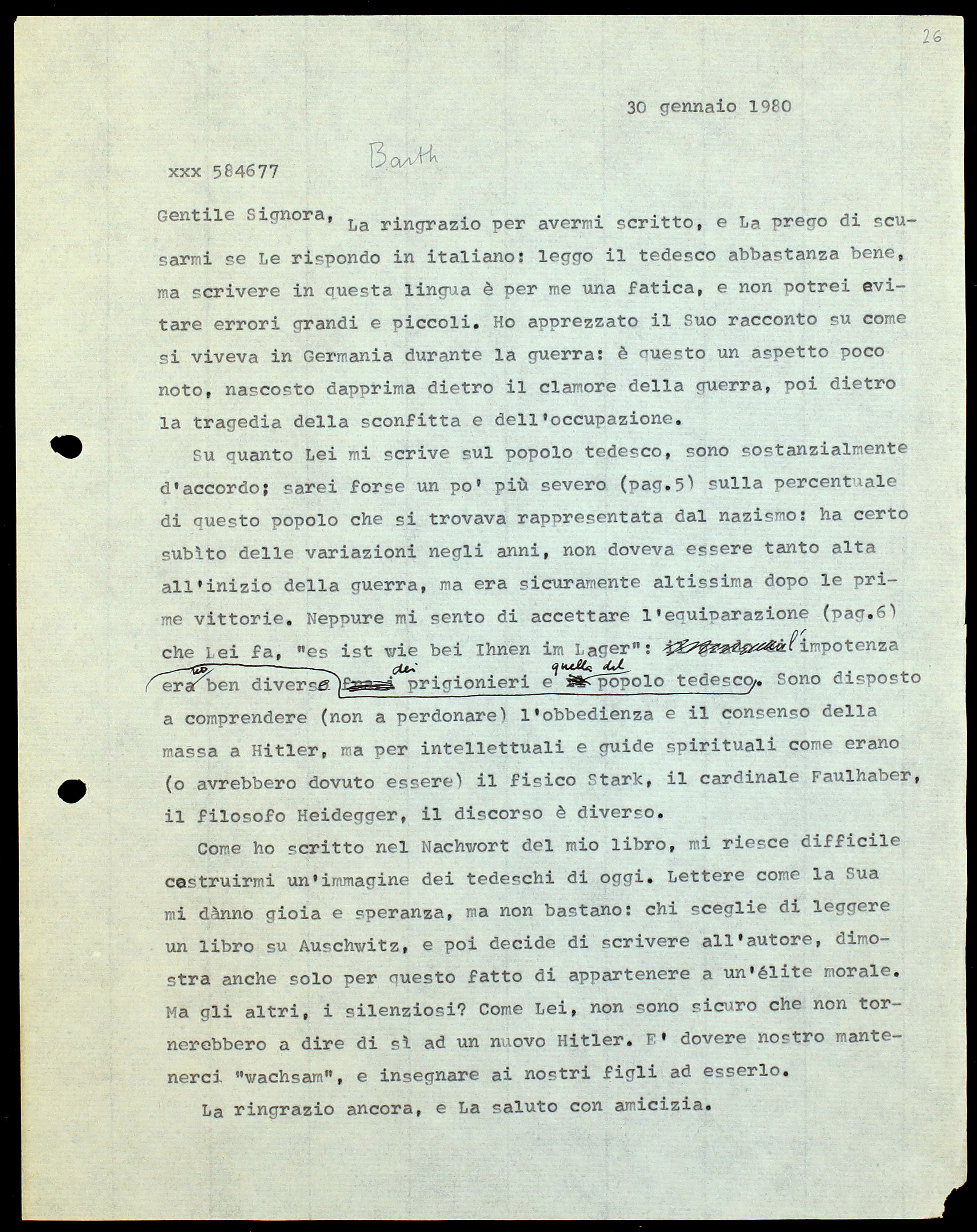
Levi thanks Barth and says he essentially agrees with her considerations. However, he makes a few observations, in particular concerning the comparison between the powerlessness of the prisoners and that of the German people.
30 gennaio 1980
xxx 584677
Gentile Signora,
La ringrazio per avermi scritto, e La prego di scusarmi se le rispondo in italiano: leggo il tedesco abbastanza bene, ma scrivere in questa lingua è per me una fatica, e non potrei evitare errori grandi e piccoli. Ho apprezzato il Suo racconto su come si viveva in Germania durante la guerra: è questo un aspetto poco noto, nascosto dapprima dietro il clamore della guerra, poi dietro la tragedia della sconfitta e dell’occupazione.
Su quanto Lei mi scrive sul popolo tedesco, sono sostanzialmente d’accordo: sarei forse un po’ più severo (pag. 5) sulla percentuale di questo popolo che si trovava rappresentata dal nazismo: ha certo subìto delle variazioni negli anni, non doveva essere tanto alta all’inizio della guerra, ma era sicuramente altissima dopo le prime vittorie. Neppure mi sento di accettare l’equiparazione (pag. 6) che Lei fa, “es ist wie bei Ihnen im Lager”:[1]l’impotenza dei prigionieri e quella del popolo tedesco erano ben diverse.[2] Sono disposto a comprendere (non a perdonare) l’obbedienza e il consenso della massa a Hitler, ma per intellettuali e guide spirituali come erano (o avrebbero dovuto essere) il fisico Stark, il cardinale Faulhaber, il filosofo Heidegger, il discorso è diverso.[3]
Come ho scritto nel Nachwort del mio libro, mi riesce difficile costruirmi un’immagine dei tedeschi di oggi. Lettere come la Sua mi dànno gioia e speranza, ma non bastano: chi sceglie di leggere un libro su Auschwitz, e poi decide di scrivere all’autore, dimostra anche solo per questo fatto di appartenere a un’élite morale. Ma gli altri, i silenziosi? Come Lei, non sono sicuro che non tornerebbero a dire di sì ad un nuovo Hitler. È dovere nostro mantenerci “wachsam”, e insegnare ai nostri figli ad esserlo.
La ringrazio ancora, e La saluto con amicizia.
30 gennaio 1980
xxx 584677
Gentile Signora,
La ringrazio per avermi scritto, e La prego di scusarmi se le rispondo in italiano: leggo il tedesco abbastanza bene, ma scrivere in questa lingua è per me una fatica, e non potrei evitare errori grandi e piccoli. Ho apprezzato il Suo racconto su come si viveva in Germania durante la guerra: è questo un aspetto poco noto, nascosto dapprima dietro il clamore della guerra, poi dietro la tragedia della sconfitta e dell’occupazione.
Su quanto Lei mi scrive sul popolo tedesco, sono sostanzialmente d’accordo: sarei forse un po’ più severo (pag. 5) sulla percentuale di questo popolo che si trovava rappresentata dal nazismo: ha certo subìto delle variazioni negli anni, non doveva essere tanto alta all’inizio della guerra, ma era sicuramente altissima dopo le prime vittorie. Neppure mi sento di accettare l’equiparazione (pag. 6) che Lei fa, “es ist wie bei Ihnen im Lager”:[1]l’impotenza dei prigionieri e quella del popolo tedesco erano ben diverse.[2] Sono disposto a comprendere (non a perdonare) l’obbedienza e il consenso della massa a Hitler, ma per intellettuali e guide spirituali come erano (o avrebbero dovuto essere) il fisico Stark, il cardinale Faulhaber, il filosofo Heidegger, il discorso è diverso.[3]
Come ho scritto nel Nachwort del mio libro, mi riesce difficile costruirmi un’immagine dei tedeschi di oggi. Lettere come la Sua mi dànno gioia e speranza, ma non bastano: chi sceglie di leggere un libro su Auschwitz, e poi decide di scrivere all’autore, dimostra anche solo per questo fatto di appartenere a un’élite morale. Ma gli altri, i silenziosi? Come Lei, non sono sicuro che non tornerebbero a dire di sì ad un nuovo Hitler. È dovere nostro mantenerci “wachsam”, e insegnare ai nostri figli ad esserlo.
La ringrazio ancora, e La saluto con amicizia.
January 30, 1980
xxx 584677
Dear Madam,
Thank you for having written to me, and please forgive me if I reply in Italian: I can read German fairly well but I have difficulty writing in this language and I would be unable to avoid making mistakes, large and small. I appreciated your description of how people lived in Germany during the war: this is a little-known aspect, hidden first behind the turmoil of the war, and then behind the tragedy of the defeat and occupation.
On the whole, I agree with what you write to me about the German people: I might perhaps be a bit harsher (page 5) concerning the percentage of those people who felt represented by Nazism: without a doubt it varied over the years, it probably was not so high at the onset of the war but it was certainly very high after the first victories. Nor can I accept the comparison (page 6) that you make, “es ist wie bei Ihnen im Lager”:[1] the powerlessness of the prisoners and that of the German people were very different.[2] I am willing to understand (not to forgive) the masses’ obedience and consent to Hitler, but it is a different matter for those who were (or should have been) the intellectuals and spiritual leaders: the physicist Stark, Cardinal Faulhaber, the philosopher Heidegger.[3]
As I wrote in the Nachwort of my book, I have difficulty creating for myself an image of today’s Germans. Letters like yours give me joy and hope but they are not enough: those who choose to read a book about Auschwitz, and then decide to write to the author, show they belong to a moral élite for this reason alone. But the others, the silent ones? Like you, I am not sure they would not say yes once again to a new Hitler. It is our duty to remain “wachsam,” and to teach our children to be so.
I thank you once again, and send you friendly greetings,
30 gennaio 1980
xxx 584677
Gentile Signora,
La ringrazio per avermi scritto, e La prego di scusarmi se le rispondo in italiano: leggo il tedesco abbastanza bene, ma scrivere in questa lingua è per me una fatica, e non potrei evitare errori grandi e piccoli. Ho apprezzato il Suo racconto su come si viveva in Germania durante la guerra: è questo un aspetto poco noto, nascosto dapprima dietro il clamore della guerra, poi dietro la tragedia della sconfitta e dell’occupazione.
Su quanto Lei mi scrive sul popolo tedesco, sono sostanzialmente d’accordo: sarei forse un po’ più severo (pag. 5) sulla percentuale di questo popolo che si trovava rappresentata dal nazismo: ha certo subìto delle variazioni negli anni, non doveva essere tanto alta all’inizio della guerra, ma era sicuramente altissima dopo le prime vittorie. Neppure mi sento di accettare l’equiparazione (pag. 6) che Lei fa, “es ist wie bei Ihnen im Lager”:[1]l’impotenza dei prigionieri e quella del popolo tedesco erano ben diverse.[2] Sono disposto a comprendere (non a perdonare) l’obbedienza e il consenso della massa a Hitler, ma per intellettuali e guide spirituali come erano (o avrebbero dovuto essere) il fisico Stark, il cardinale Faulhaber, il filosofo Heidegger, il discorso è diverso.[3]
Come ho scritto nel Nachwort del mio libro, mi riesce difficile costruirmi un’immagine dei tedeschi di oggi. Lettere come la Sua mi dànno gioia e speranza, ma non bastano: chi sceglie di leggere un libro su Auschwitz, e poi decide di scrivere all’autore, dimostra anche solo per questo fatto di appartenere a un’élite morale. Ma gli altri, i silenziosi? Come Lei, non sono sicuro che non tornerebbero a dire di sì ad un nuovo Hitler. È dovere nostro mantenerci “wachsam”, e insegnare ai nostri figli ad esserlo.
La ringrazio ancora, e La saluto con amicizia.
30 gennaio 1980
xxx 584677
Gentile Signora,
La ringrazio per avermi scritto, e La prego di scusarmi se le rispondo in italiano: leggo il tedesco abbastanza bene, ma scrivere in questa lingua è per me una fatica, e non potrei evitare errori grandi e piccoli. Ho apprezzato il Suo racconto su come si viveva in Germania durante la guerra: è questo un aspetto poco noto, nascosto dapprima dietro il clamore della guerra, poi dietro la tragedia della sconfitta e dell’occupazione.
Su quanto Lei mi scrive sul popolo tedesco, sono sostanzialmente d’accordo: sarei forse un po’ più severo (pag. 5) sulla percentuale di questo popolo che si trovava rappresentata dal nazismo: ha certo subìto delle variazioni negli anni, non doveva essere tanto alta all’inizio della guerra, ma era sicuramente altissima dopo le prime vittorie. Neppure mi sento di accettare l’equiparazione (pag. 6) che Lei fa, “es ist wie bei Ihnen im Lager”:[1]l’impotenza dei prigionieri e quella del popolo tedesco erano ben diverse.[2] Sono disposto a comprendere (non a perdonare) l’obbedienza e il consenso della massa a Hitler, ma per intellettuali e guide spirituali come erano (o avrebbero dovuto essere) il fisico Stark, il cardinale Faulhaber, il filosofo Heidegger, il discorso è diverso.[3]
Come ho scritto nel Nachwort del mio libro, mi riesce difficile costruirmi un’immagine dei tedeschi di oggi. Lettere come la Sua mi dànno gioia e speranza, ma non bastano: chi sceglie di leggere un libro su Auschwitz, e poi decide di scrivere all’autore, dimostra anche solo per questo fatto di appartenere a un’élite morale. Ma gli altri, i silenziosi? Come Lei, non sono sicuro che non tornerebbero a dire di sì ad un nuovo Hitler. È dovere nostro mantenerci “wachsam”, e insegnare ai nostri figli ad esserlo.
La ringrazio ancora, e La saluto con amicizia.
January 30, 1980
xxx 584677
Dear Madam,
Thank you for having written to me, and please forgive me if I reply in Italian: I can read German fairly well but I have difficulty writing in this language and I would be unable to avoid making mistakes, large and small. I appreciated your description of how people lived in Germany during the war: this is a little-known aspect, hidden first behind the turmoil of the war, and then behind the tragedy of the defeat and occupation.
On the whole, I agree with what you write to me about the German people: I might perhaps be a bit harsher (page 5) concerning the percentage of those people who felt represented by Nazism: without a doubt it varied over the years, it probably was not so high at the onset of the war but it was certainly very high after the first victories. Nor can I accept the comparison (page 6) that you make, “es ist wie bei Ihnen im Lager”:[1] the powerlessness of the prisoners and that of the German people were very different.[2] I am willing to understand (not to forgive) the masses’ obedience and consent to Hitler, but it is a different matter for those who were (or should have been) the intellectuals and spiritual leaders: the physicist Stark, Cardinal Faulhaber, the philosopher Heidegger.[3]
As I wrote in the Nachwort of my book, I have difficulty creating for myself an image of today’s Germans. Letters like yours give me joy and hope but they are not enough: those who choose to read a book about Auschwitz, and then decide to write to the author, show they belong to a moral élite for this reason alone. But the others, the silent ones? Like you, I am not sure they would not say yes once again to a new Hitler. It is our duty to remain “wachsam,” and to teach our children to be so.
I thank you once again, and send you friendly greetings,
Info
Notes
Tag
Sender: Primo Levi
Addressee: Inge Lederer-Barth
Date of Drafting: 1980-01-30
Place of Writing: Turin
Description:Copy of a typewritten letter on onionskin paper with handwritten corrections in black fountain pen. In the upper margin of the sheet, “Barth” is handwritten in pencil.
Archive: Archivio privato di Primo Levi, Turin
Series: Complesso di Fondi primo Levi, Fondo Primo Levi, Corrispondenza, Corrispondenza generale, fasc. 011, sottofasc. 002, doc.002, f. 26.
Folio: 1, front only
DOI: https://doi.org/10.15160/3j8d-v667
1This is how Barth expressed herself in her previous letter: “It is like your fellows at the Auschwitz camp. There are countless silent followers, powerless sufferers,” cf. Letter 101.
2Originally typewritten as follows: “il grado di impotenza era ben diverso fra i prigionieri e il popolo Tedesco” (“the degree of powerlessness was very different between the prisoners and the German people”); handwritten correction in black fountain pen.
3Levi had already used a similar phrase in his preface to the Italian edition of Auschwitz by Léon Poliakov, in which he wrote:” We cannot read without dispiriting surprise the abject, servile voices quoted here, of the Nobel Prize–winning physicist Johannes Stark, of the philosopher Heidegger, Sartre’s teacher, of Cardinal Faulhaber, the supreme Catholic authority in Germany,” cf. P. Levi, “Foreword to Léon Poliakov, Auschwitz,” CW II, p. 1191. The same passage returns in the chapter “The Intellectual at Auschwitz” in The Drowned and the Saved: “the chronicles of Nazi Germany are filled with cases […]: the philosopher Heidegger […]; the physicist Stark, a Nobel laureate; Cardinal Faulhaber, the supreme Catholic authority in Germany,” cf. CW III p. 2517.