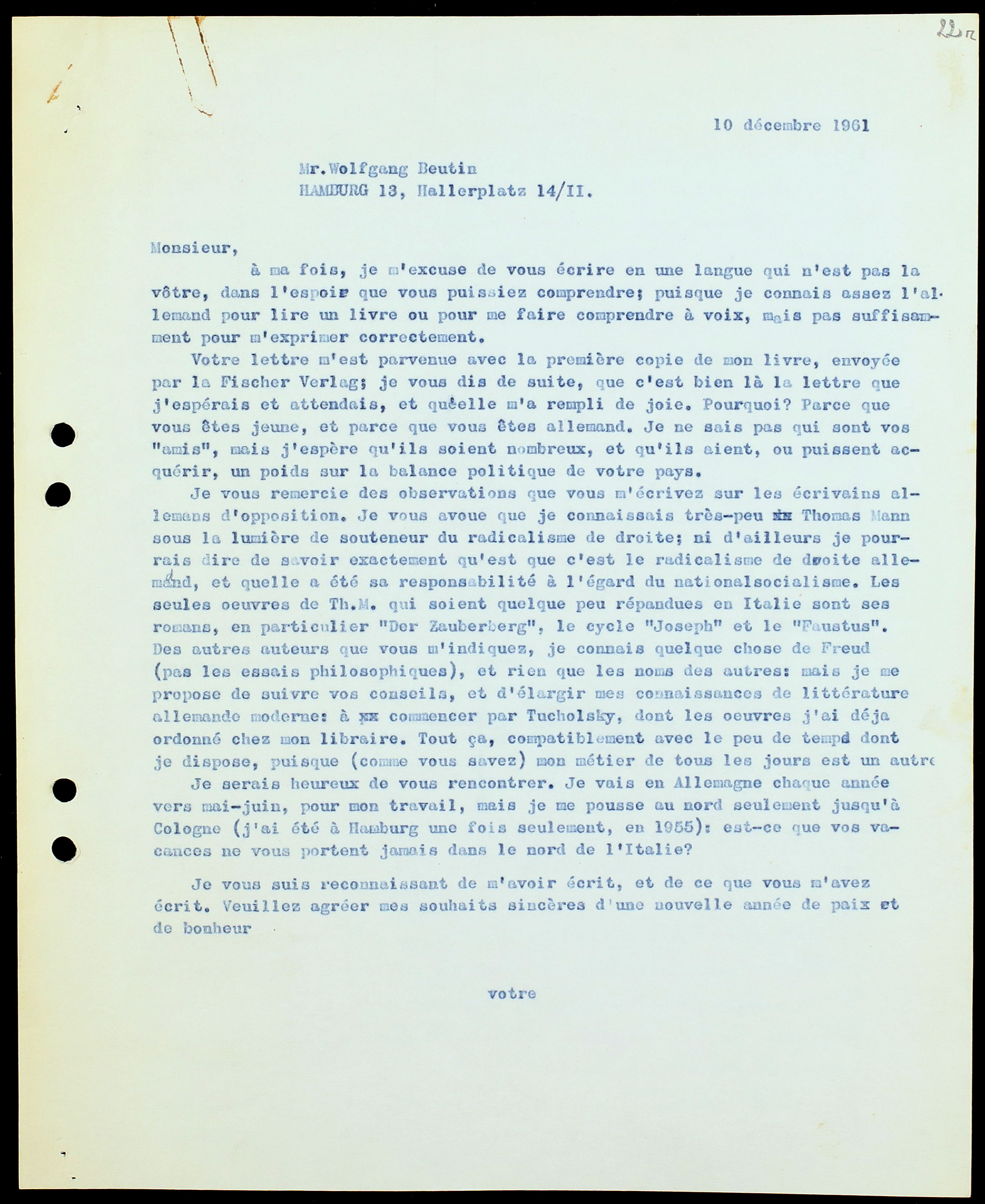
Levi warmly replies to Wolfgang Beutin: it is the letter he had long been hoping to receive. He thanks Beutin for his reading suggestions and proposes that they meet.
Mr. Wolfgang Beutin HAMBURG 13, Hellerplatz 14/11.
10 décembre 1961
Monsieur,
à ma fois, je m’excuse de vous écrire en une langue qui n’est pas la vôtre, dans l’espoir que vous puissiez comprendre; puisque je connais assez l’allemand pour lire un livre ou pour me faire comprendre à voix, mais pas suffisamment pour m’exprimer correctement.
Votre lettre m’est parvenue avec la première copie de mon livre, envoyée par la Fischer Verlag; je vous dis de suite, que c’est bien là la lettre que j’espérais et attendais, et qu’elle m’a rempli de joie. Pourquoi? Parce que vous êtes jeune, et parce que vous êtes allemand. Je ne sais pas qui sont vos “amis”, mais j’espère qu’ils soient nombreux, et qu’ils aient, ou puissent acquérir, un poids sur la balance politique de votre pays.
Je vous remercie des observations que vous m’écrivez sur les écrivains allemands d’opposition. Je vous avoue que je connaissais très-peu Thomas Mann sous la lumière de souteneur du radicalisme de droite; ni d’ailleurs je pourrais dire de savoir exactement qu’est que c’est le radicalisme de droite allemand, et quelle a été sa responsabilité à l’égard du nationalsocialisme. Les seules œuvres de Th. M. qui soient quelque peu répandues en Italie sont ses romans, en particulier Der Zauberberg, le cycle Joseph et le Faustus.[1] Des autres auteurs que vous m’indiquez, je connais quelque chose de Freud (pas les essais philosophiques), et rien que les noms des autres: mais je me propose de suivre vos conseils, et d’élargir mes connaissances de littérature allemande moderne: à commencer par Tucholsky, dont les oeuvres j’ai déja ordonné chez mon libraire. Tout ça, compatiblement avec le peu de temps dont je dispose, puisque (comme vous savez) mon métier de tous les jours est un autre.
Je serais heureux de vous rencontrer. Je vais en Allemagne chaque année vers mai-juin, pour mon travail, mais je me pousse au nord seulement jusqu’à Cologne (j’ai été à Hamburg une fois seulement, en 1955):[2] est-ce que vos vacances ne vous portent jamais dans le nord de l’Italie?
Je vous suis reconnaissant de m’avoir écrit, et de ce que vous m’avez écrit. Veuillez agréer mes souhaits sincères d’une nouvelle année de paix et de bonheur
votre
Primo Levi[3]
Sig. Wolfgang Beutin HAMBURG 13, Hellerplatz 14/11.
10 dicembre 1961
Signore,
a mia volta mi scuso di scriverLe in una lingua che non è la Sua, nella speranza che possa comprendere; il fatto è che so il tedesco abbastanza bene per leggere un libro o per farmi capire a voce, ma non per esprimermi correttamente.
La Sua lettera mi è arrivata insieme alla prima copia del mio libro, inviata da Fischer Verlag; Le dico subitoche è proprio la lettera che speravo e aspettavo di ricevere, e che mi ha riempito di gioia. Perché? Perché Lei è giovane, e perché è tedesco. Non so chi siano i Suoi “amici”, ma spero che siano numerosi e che abbiano, o possano acquisire, un peso sulla bilancia politica del Suo paese.
La ringrazio per le Sue osservazioni sugli scrittori tedeschi di opposizione. Le confesso che conoscevo pochissimo Thomas Mann come sostenitore del radicalismo di destra; peraltro non posso dire di sapere esattamente cosa sia il radicalismo di destra tedesco e quale sia la sua responsabilità riguardo al nazionalsocialismo. Di Th. M. le soleopere che hanno una qualche diffusione in Italia, sonoi romanzi, in particolare La montagna incantata, il ciclo di Giuseppe e il Doctor Faustus.[1] Degli autori che mi indica conosco qualcosa di Freud (non i saggi filosofici) e degli altri soltanto i nomi: ma mi propongo di seguire i Suoi consigli e di ampliare le mie conoscenze di letteratura tedesca contemporanea: a cominciare da Tucholsky, di cui ho già ordinato le opere dal mio libraio. Tutto ciò compatibilmente con il poco tempo di cui dispongo, poiché (come sa) il mio mestiere di tutti i giorni è un altro.
Sarei lieto di incontrarLa. Per il mio lavoro, vado in Germania tutti gli anni verso maggio-giugno, ma mi spingo a nord al massimo fino a Colonia (sono stato ad Amburgo solo una volta, nel 1955):[2] le Sue vacanze la portano mai nel Nord Italia?
Le sono riconoscente per avermi scritto, e per ciò che mi ha scritto. Accetti i miei auguri sinceri per un nuovo anno di pace e felicità.
Suo
Primo Levi[3]
Mr. Wolfgang Beutin HAMBURG 13, Hellerplatz 14/11.
December 10, 1961
Sir,
I apologize in turn for writing to you in a language that is not your own, in the hope that you will be able to understand; because I know German well enough to read a book or to make myself understood orally, but not enough to express myself correctly.
Your letter reached me with the first copy of my book, sent by the Fischer Verlag; I will tell you right away that this is exactly the letter I was hoping for and expecting, and that it filled me with joy. Why? Because you are young, and because you are German. I do not know who your “friends” are, but I hope that they are numerous, and that they have, or will be able to acquire, influence on the political balance in your country.
Thank you for your observations on German opposition writers. I admit that I knew Thomas Mann very little as a supporter of right-wing radicalism; nor could I say that I know exactly what German right-wing radicalism is, and what its responsibility for National Socialism was. The only works by Th. M. that are somewhat commonly found in Italy are his novels, particularly Der Zauberberg, the Joseph cycle, and Faustus.[1]Of the other authors you mention to me, I know something of Freud (not the philosophical essays), and only the names of the others: but I intend to follow your advice, and to expand my knowledge of modern German literature: starting with Tucholsky, whose works I have already ordered from my bookseller. All this, in keeping with the little time I have available, since (as you know) my everyday profession is a different one.
I would be happy to meet you. I go to Germany every year around May-June, for my work, but I make it only as far north as Cologne (I was in Hamburg only once, in 1955):[2] do you ever come to northern Italy on vacation?
I am grateful to you for writing to me, and for what you have written to me. Please accept my sincere wishes for peace and happiness in the new year.
yours
Primo Levi[3]
Mr. Wolfgang Beutin HAMBURG 13, Hellerplatz 14/11.
10 décembre 1961
Monsieur,
à ma fois, je m’excuse de vous écrire en une langue qui n’est pas la vôtre, dans l’espoir que vous puissiez comprendre; puisque je connais assez l’allemand pour lire un livre ou pour me faire comprendre à voix, mais pas suffisamment pour m’exprimer correctement.
Votre lettre m’est parvenue avec la première copie de mon livre, envoyée par la Fischer Verlag; je vous dis de suite, que c’est bien là la lettre que j’espérais et attendais, et qu’elle m’a rempli de joie. Pourquoi? Parce que vous êtes jeune, et parce que vous êtes allemand. Je ne sais pas qui sont vos “amis”, mais j’espère qu’ils soient nombreux, et qu’ils aient, ou puissent acquérir, un poids sur la balance politique de votre pays.
Je vous remercie des observations que vous m’écrivez sur les écrivains allemands d’opposition. Je vous avoue que je connaissais très-peu Thomas Mann sous la lumière de souteneur du radicalisme de droite; ni d’ailleurs je pourrais dire de savoir exactement qu’est que c’est le radicalisme de droite allemand, et quelle a été sa responsabilité à l’égard du nationalsocialisme. Les seules œuvres de Th. M. qui soient quelque peu répandues en Italie sont ses romans, en particulier Der Zauberberg, le cycle Joseph et le Faustus.[1] Des autres auteurs que vous m’indiquez, je connais quelque chose de Freud (pas les essais philosophiques), et rien que les noms des autres: mais je me propose de suivre vos conseils, et d’élargir mes connaissances de littérature allemande moderne: à commencer par Tucholsky, dont les oeuvres j’ai déja ordonné chez mon libraire. Tout ça, compatiblement avec le peu de temps dont je dispose, puisque (comme vous savez) mon métier de tous les jours est un autre.
Je serais heureux de vous rencontrer. Je vais en Allemagne chaque année vers mai-juin, pour mon travail, mais je me pousse au nord seulement jusqu’à Cologne (j’ai été à Hamburg une fois seulement, en 1955):[2] est-ce que vos vacances ne vous portent jamais dans le nord de l’Italie?
Je vous suis reconnaissant de m’avoir écrit, et de ce que vous m’avez écrit. Veuillez agréer mes souhaits sincères d’une nouvelle année de paix et de bonheur
votre
Primo Levi[3]
Sig. Wolfgang Beutin HAMBURG 13, Hellerplatz 14/11.
10 dicembre 1961
Signore,
a mia volta mi scuso di scriverLe in una lingua che non è la Sua, nella speranza che possa comprendere; il fatto è che so il tedesco abbastanza bene per leggere un libro o per farmi capire a voce, ma non per esprimermi correttamente.
La Sua lettera mi è arrivata insieme alla prima copia del mio libro, inviata da Fischer Verlag; Le dico subitoche è proprio la lettera che speravo e aspettavo di ricevere, e che mi ha riempito di gioia. Perché? Perché Lei è giovane, e perché è tedesco. Non so chi siano i Suoi “amici”, ma spero che siano numerosi e che abbiano, o possano acquisire, un peso sulla bilancia politica del Suo paese.
La ringrazio per le Sue osservazioni sugli scrittori tedeschi di opposizione. Le confesso che conoscevo pochissimo Thomas Mann come sostenitore del radicalismo di destra; peraltro non posso dire di sapere esattamente cosa sia il radicalismo di destra tedesco e quale sia la sua responsabilità riguardo al nazionalsocialismo. Di Th. M. le soleopere che hanno una qualche diffusione in Italia, sonoi romanzi, in particolare La montagna incantata, il ciclo di Giuseppe e il Doctor Faustus.[1] Degli autori che mi indica conosco qualcosa di Freud (non i saggi filosofici) e degli altri soltanto i nomi: ma mi propongo di seguire i Suoi consigli e di ampliare le mie conoscenze di letteratura tedesca contemporanea: a cominciare da Tucholsky, di cui ho già ordinato le opere dal mio libraio. Tutto ciò compatibilmente con il poco tempo di cui dispongo, poiché (come sa) il mio mestiere di tutti i giorni è un altro.
Sarei lieto di incontrarLa. Per il mio lavoro, vado in Germania tutti gli anni verso maggio-giugno, ma mi spingo a nord al massimo fino a Colonia (sono stato ad Amburgo solo una volta, nel 1955):[2] le Sue vacanze la portano mai nel Nord Italia?
Le sono riconoscente per avermi scritto, e per ciò che mi ha scritto. Accetti i miei auguri sinceri per un nuovo anno di pace e felicità.
Suo
Primo Levi[3]
Mr. Wolfgang Beutin HAMBURG 13, Hellerplatz 14/11.
December 10, 1961
Sir,
I apologize in turn for writing to you in a language that is not your own, in the hope that you will be able to understand; because I know German well enough to read a book or to make myself understood orally, but not enough to express myself correctly.
Your letter reached me with the first copy of my book, sent by the Fischer Verlag; I will tell you right away that this is exactly the letter I was hoping for and expecting, and that it filled me with joy. Why? Because you are young, and because you are German. I do not know who your “friends” are, but I hope that they are numerous, and that they have, or will be able to acquire, influence on the political balance in your country.
Thank you for your observations on German opposition writers. I admit that I knew Thomas Mann very little as a supporter of right-wing radicalism; nor could I say that I know exactly what German right-wing radicalism is, and what its responsibility for National Socialism was. The only works by Th. M. that are somewhat commonly found in Italy are his novels, particularly Der Zauberberg, the Joseph cycle, and Faustus.[1]Of the other authors you mention to me, I know something of Freud (not the philosophical essays), and only the names of the others: but I intend to follow your advice, and to expand my knowledge of modern German literature: starting with Tucholsky, whose works I have already ordered from my bookseller. All this, in keeping with the little time I have available, since (as you know) my everyday profession is a different one.
I would be happy to meet you. I go to Germany every year around May-June, for my work, but I make it only as far north as Cologne (I was in Hamburg only once, in 1955):[2] do you ever come to northern Italy on vacation?
I am grateful to you for writing to me, and for what you have written to me. Please accept my sincere wishes for peace and happiness in the new year.
yours
Primo Levi[3]
Info
Notes
Tag
Sender: Primo Levi
Addressee: Wolfgang Beutin
Date of Drafting: 1961-12-12
Place of Writing: Turin
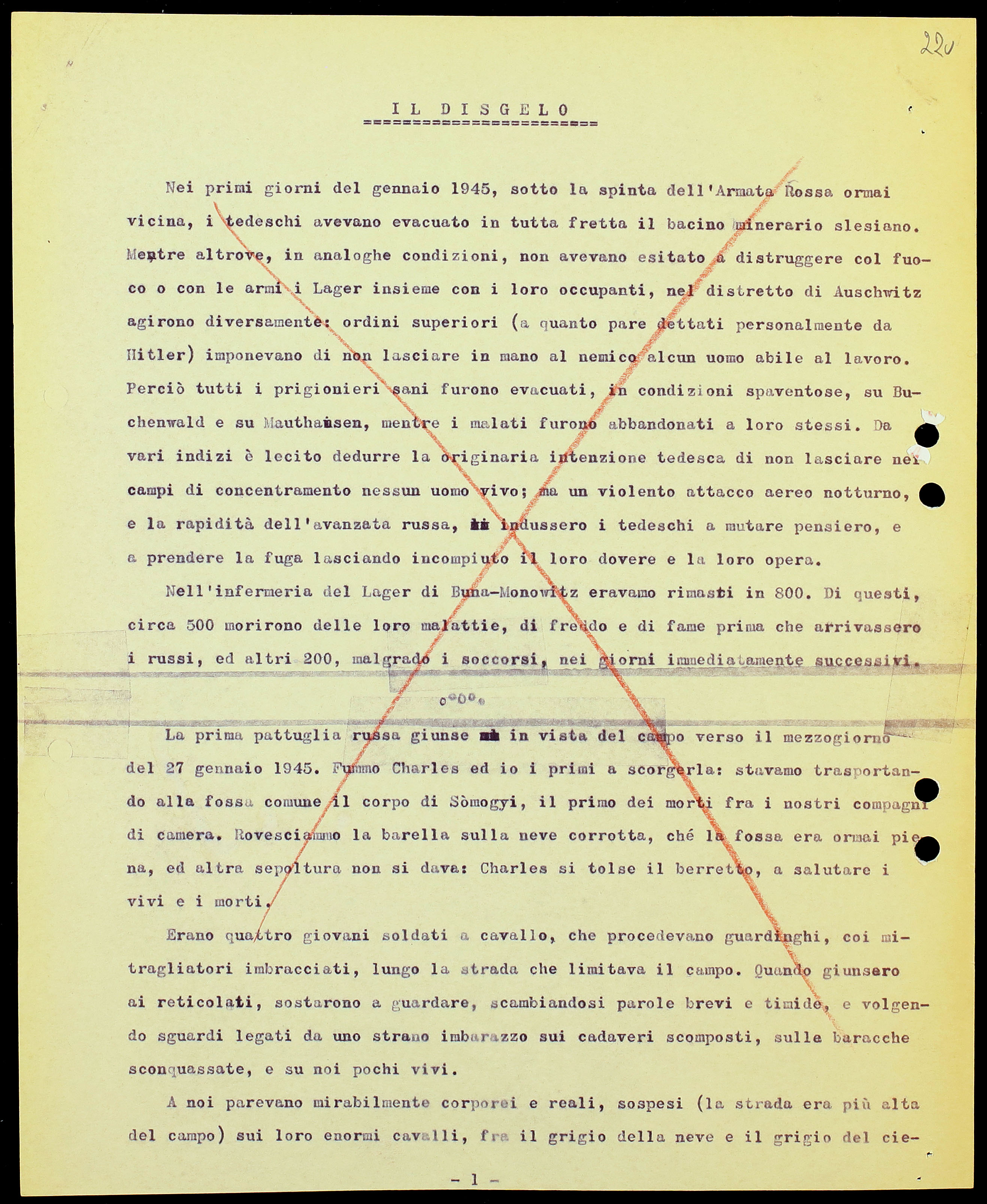
Description:Carbon copy of a document typewritten on recycled paper, on the back of which, bearing a handwritten “x” in red pencil, is a typed page with the beginning of the first chapter of LaTregua (The Truce): «IL DISGELO | Nei primi giorni del gennaio 1945, sotto la spinta dell’Armata Rossa ormai vicina, i tedeschi avevano evacuato in tutta fretta il bacino minerario slesiano. | Mentre altrove, in analoghe condizioni, non avevano esitato a distruggere col fuoco o con le armi i Lager insieme con i loro occupanti, nel distretto di Auschwitz agirono diversamente: ordini superiori (a quanto pare dettati personalmente da Hitler) imponevano di non lasciare in mano al nemico alcun uomo abile al lavoro. Perciò tutti i prigionieri sani furono evacuati, in condizioni spaventose, su Buchenwald e su Mauthausen, mentre i malati furono abbandonati a loro stessi. Da vari indizi è lecito dedurre la originaria intenzione tedesca di non lasciare nei campi di concentramento nessun uomo vivo; ma un violento attacco aereo notturno, e lo rapidità dell'avanzata russa, indussero i tedeschi a mutare pensiero, e a prendere la fuga lasciando incompiuto il loro dovere e la loro opera. | Nell’infermeria del Lager di Buna-Monowitz eravamo rimasti in 800. Di questi, circa 500 morirono delle loro malattie, di freddo e di fame prima che arrivassero i russi, ed altri 200, malgrado i soccorsi, nei giorni immediatamente successivi. | La prima pattuglia russa giunse in vista del campo verso il mezzogiorno del 27 gennaio 1945. Fummo Charles ed io i primi a scorgerla: stavano trasportando alla fossa comune il corpo di Somogyi, il primo dei morti fra i nostri compagni di camera. Rovesciano la barella sulla neve corrotta, ché la fosse era ormai piena, ed altra sepoltura non si dava: Charles si tolse il berretto, a salutare i vivi e i morti. | Erano quattro giovani soldati a cavallo, che procedevano guardinghi, coi mitragliatori imbracciati, lungo la strada che limitava il campo. Quando giunsero ai reticolati, sostarono a guardare, scambiandosi parole brevi e timide, e volgendo sguardi legati da uno strano imbarazzo sui cadaveri scomposti, sulle baracche sconquassate, e su noi pochi vivi. | A noi parevano mirabilmente corporei e reali, sospesi (le strada era più alto del campo) sui loro enormi cavalli, fra il grigio della neve e il grigio del cie-».
Archive: Archivio privato di Primo Levi, Turin
Series: Fasc. 20, sottofasc. 001, doc. 010, f. 22r
Folio: 1, front and back
DOI: https://doi.org/10.15160/stx4-qy49
1Levi had read The Magic Mountain (Der Zauberberg) several times as a boy, as he later recounts in The Periodic Table and as witnessed by his sister in an interview: “Growing up in Turin, my brother and I, were always very close. We even had our own secret language. I have a clear memory of both of us sitting on our father’s lap as he read to us, which is not surprising because we were constantly reading in ourhouse. In fact, there were times when we would sit at the table – our father reading his paper, us reading our children’s comics, while our poor mother ran about preparing the dinner. The house was full of books – I remember going to other children’s houses and wondering why they didn’t have as many books as we did. The Magic Mountain, by Thomas Mann, was one of our favourites, we would finish reading it and then start all over again.” Anna Maria Levi and Patrick Nathanson, Brotherly Love. Anna Maria Levi Recalls Growing Up with Writer and Auschwitz Survivor Primo Levi, Financial Times, April 15, 2016. Another youthful read of his was the tetralogy Joseph and his Brothers, as Levi recounted to Philip Roth: "I clearly remember why I loved Thomas Mann. At the time of Fascism, it was hard to find foreign books full of substance and thought: after The Magic Mountain, and shortly before the emigration that made Th. Mann unpopular with the Fascists and the Nazis, an Italian editor published his monumental Joseph and his Brothers in its entirety. My father, a voracious and eclectic but disorganized reader, brought the book home. I was immediately fascinated by it, and still today I consider it the height of literary output of this century. It nourishes its readers, it satiates them with admirable prodigality for every one of its 2,000 pages: it interweaves poetry, wisdom, and irony, in modulations that are always new.” ( Risposte a Philip Roth, OC, III, p. 1088; the interview, with a few cuts, including the reply quoted above, is published in English in Shop Talk: A Writer and His Colleagues and Their Work, 1986; reprint, Boston: Houghton Mifflin, 2001, pp. 1-17. Shop Talk does not include this passage, that has been translated here by Gail McDowell). The fourth volume of Joseph tetralogy was only published in 1948. Instead, there are no indications that would permit us to date his reading of Faust.
2Levi’s first business trip to Germany dates back to 1953, to Cuxhaven and in the company of Federico Accati, the owner and founder of SIVA. This trip was followed by at least four more to Leverkusen, the headquarters of the Bayer factories, between July 1954 and July 1956. Cf. Ian Thomson, Primo Levi, London, Hutchinson 2002, p. 272, Italian transl. by E. Gallitelli, Primo Levi. Una vita, Utet, Milan 2017, p. 376.
3In the original copy of the letter, printed as an appendix to Beutin’s essay Die Revolution tritt in die Literatur,under the signature is a handwritten insertion by Levi, perhaps in pen (but this is not clear from the print): “P.S. - Auriez-vous l’obligeance de m’écrire quel est l’éditeur alleman de l’autobiographie de Toller? J’ai parlé aujourd’hui avec l’éditeur Einaudi, et il aurait l’intention de demander des droits. Bien merci / P.L.” (“Would you be kind enough to write to me with the name of the German publisher of Toller’s autobiography? I talked about it today with the publisher Einaudi, and he would like to ask for the rights. Thank you / P.L.”)