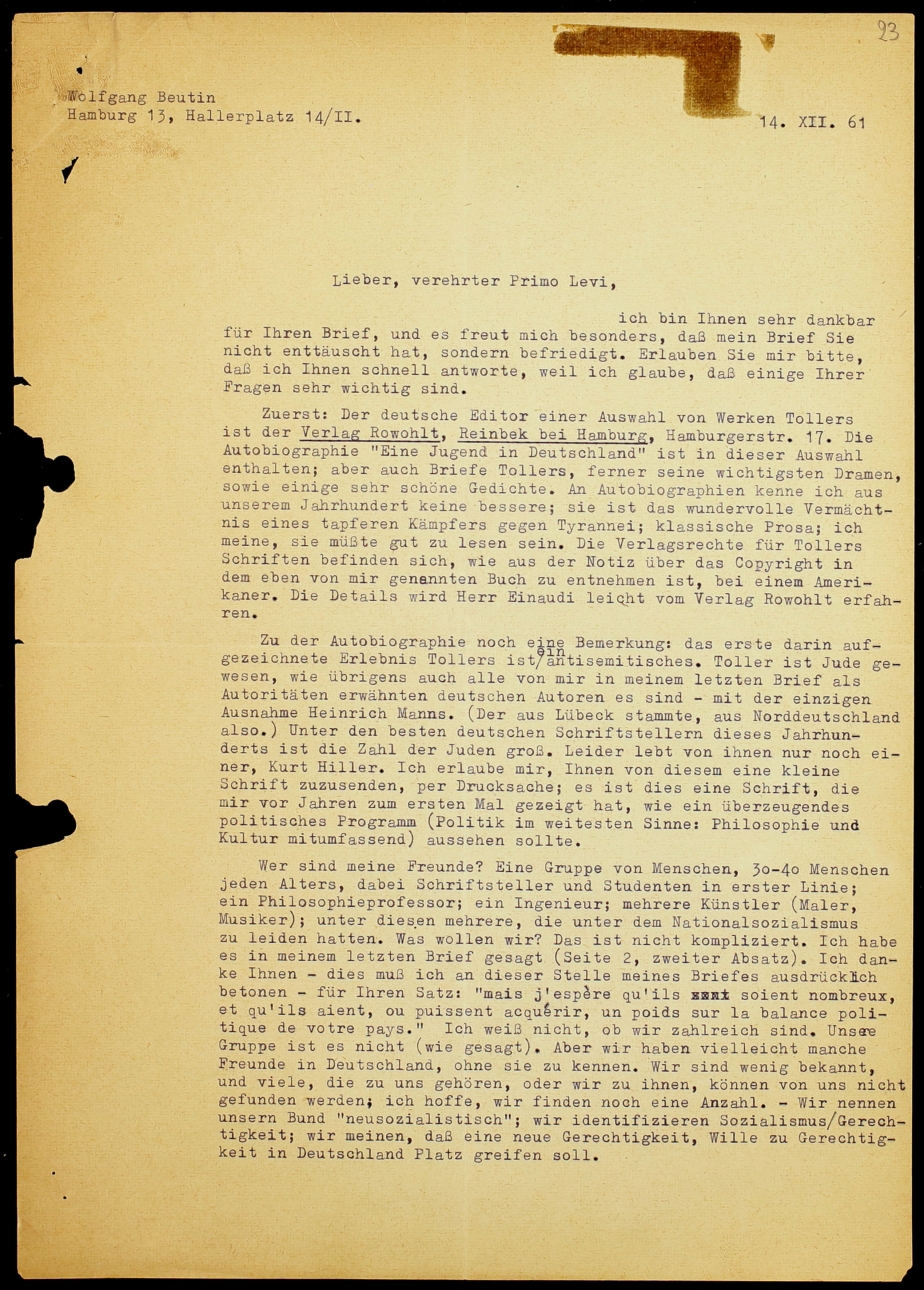
Beutin returns to the literary works by Ernst Toller and also discusses other German authors. He recounts Kurt Hiller’s political movement, to which he belongs (along with Hans J. Fröhlich), and his work at Norddeutscher Rundfunk.
Wolfgang Beutin Hamburg 13, Hallerplatz 14/II.
14.XII.61
Lieber, verehrter Primo Levi,
ich bin Ihnen sehr dankbar für Ihren Brief, und es freut mich besonders, daß mein Brief Sie nicht enttäuscht hat, sondern befriedigt. Erlauben Sie mir bitte, daß ich Ihnen schnell antworte, weil ich glaube, daß einige Ihrer Fragen sehr wichtig sind.
Zuerst: Der deutsche Editor einer Auswahl von Werken Tollers ist der Verlag Rowohlt, Reinbek bei Hamburg, Hamburgerstr. 17. Die Autobiographie Eine Jugend in Deutschland ist in dieser Auswahl enthalten; aber auch Briefe Tollers, ferner seine wichtigsten Dramen, sowie einige sehr schöne Gedichte. An Autobiographien kenne ich aus unserem Jahrhundert keine bessere; sie ist das wundervolle Vermächtnis eines tapferen Kämpfers gegen Tyrannei; klassische Prosa; ich meine, sie müßte gut zu lesen sein. Die Verlagsrechte für Tollers Schriften befinden sich, wie aus der Notiz über das Copyright in dem eben von mir genannten Buch zu entnehmen ist, bei einem Amerikaner. Die Details wird Herr Einaudi leicht vom Verlag Rowohlt erfahren.[1]
Zu der Autobiographie noch eine Bemerkung: das erste darin aufgezeichnete Erlebnis Tollers ist ein[2] antisemitisches. Toller ist Jude gewesen, wie übrigens auch alle von mir in meinem letzten Brief als Autoritäten erwähnten deutschen Autoren es sind – mit der einzigen Ausnahme Heinrich Manns. (Der aus Lübeck stammte, aus Norddeutschland also.) Unter den besten deutschen Schriftstellern dieses Jahrhunderts ist die Zahl der Juden groß. Leider lebt von ihnen nur noch einer, Kurt Hiller. Ich erlaube mir, Ihnen von diesem eine kleine Schrift zuzusenden, per Drucksache; es ist dies eine Schrift, die mir vor Jahren zum ersten Mal gezeigt hat, wie ein überzeugendes politisches Programm (Politik im weitesten Sinne: Philosophie und Kultur mitumfassend) aussehen sollte.
Wer sind meine Freunde? Eine Gruppe von Menschen, 30-40 Menschen jeden Alters, dabei Schriftsteller und Studenten in erster Linie; ein Philosophieprofessor; ein Ingenieur; mehrere Künstler (Maler, Musiker); unter diesen mehrere, die unter dem Nationalsozialismus zu leiden hatten. Was wollen wir? Das ist nicht kompliziert. Ich habe es in meinem letzten Brief gesagt (Seite 2, zweiter Absatz). Ich danke Ihnen – dies muß ich an dieser Stelle meines Briefes ausdrücklich betonen – für Ihren Satz: „mais j’espère qu’ils soient nombreux, et qu’ils aient, ou puissent acquérir, un poids sur la balance politique de votre pays.“ Ich weiß nicht, ob wir zahlreich sind. Unsere Gruppe ist es nicht (wie gesagt). Aber wir haben vielleicht manche Freunde in Deutschland, ohne sie zu kennen. Wir sind wenig bekannt, und viele, die zu uns gehören, oder wir zu ihnen, können von uns nicht gefunden werden; ich hoffe, wir finden noch eine Anzahl. – Wir nennen unsern Bund „neusozialistisch“; wir identifizieren Sozialismus/Gerechtigkeit; wir meinen, daß eine neue Gerechtigkeit, Wille zu Gerechtigkeit in Deutschland Platz greifen soll.
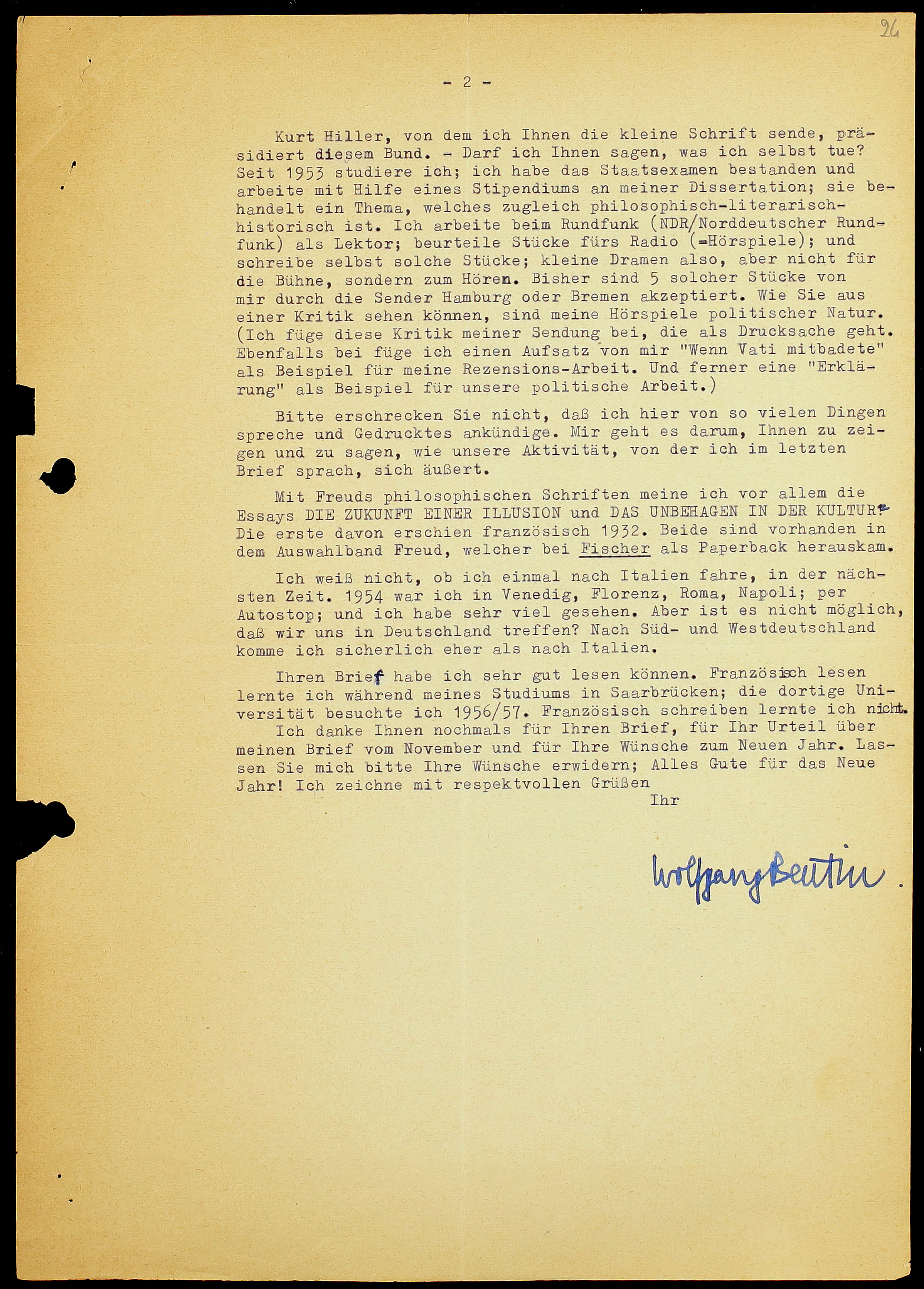
Kurt Hiller, von dem ich Ihnen die kleine Schrift sende,präsidiert diesem Bund. – Darf ich Ihnen sagen, was ich selbst tue? Seit 1953 studiere ich; ich habe das Staatsexamen bestanden und arbeite mit Hilfe eines Stipendiums an meiner Dissertation; sie behandelt ein Thema, welches zugleich philosophisch-literarisch-historisch ist. Ich arbeite beim Rundfunk (NDR/Norddeutscher Rundfunk) als Lektor; beurteile Stücke fürs Radio (=Hörspiele): und schreibe selbst solche Stücke; kleine Dramen also, aber nicht für die Bühne, sondern zum Hören. Bisher sind 5 solcher Stücke von mir durch die Sender Hamburg oder Bremen akzeptiert. Wie Sie aus einer Kritik sehen können, sind meine Hörspiele politischer Natur.[3] (Ich füge diese Kritik meiner Sendung bei, die als Drucksache geht. Ebenfalls bei füge ich einen Aufsatz von mir Wenn Vati mitbadete als Beispiel für meine Rezensions-Arbeit. Und ferner eine „Erklärung“ als Beispiel für unsere politische Arbeit.)[4]
Bitte erschrecken Sie nicht, daß ich hier von so vielen Dingen spreche und Gedrucktes ankündige. Mir geht es darum, Ihnen zu zeigen und zu sagen, wie unsere Aktivität, von der ich im letzten Brief sprach, sich äußert.
Mit Freuds philosophischen Schriften meine ich vor allem die Essays Die Zukunft einer Illusion und Das Unbehagen in der Kultur. Die erste davon erschien französisch 1932. Beide sind vorhanden in dem Auswahlband Freud, welcher bei Fischer als Paperback herauskam.
Ich weiß nicht, ob ich einmal nach Italien fahre, in der nächsten Zeit. 1954 war ich in Venedig, Florenz, Roma, Napoli; per Autostop; und ich habe sehr viel gesehen. Aber ist es nicht möglich, daß wir uns in Deutschland treffen? Nach Süd- und Westdeutschland komme ich sicherlich eher als nach Italien.
Ihren Brief habe ich sehr gut lesen können. Französisch lesen lernte ich während meines Studiums in Saarbrücken; die dortige Universität besuchte ich 1956/57. Französisch schreiben lernte ich nicht.
Ich danke Ihnen nochmals für Ihren Brief, für Ihr Urteil über meinen Brief von November und für Ihre Wünsche zum Neuen Jahr. Lassen Sie mich bitte Ihre Wünsche erwidern; Alles Gute für das Neue Jahr! Ich zeichne mit respektvollen Grüßen
Ihr
Wolfgang Beutin
Wolfgang Beutin Hamburg 13, Hallerplatz 14/II.
14.XII.61
Caro e stimato Primo Levi,
Le sono profondamente grato per la Sua lettera, e sono davvero lieto che la mia non L’abbia delusa, e al contrario Le abbia fatto piacere. Mi permetta di risponderLe rapidamente, poiché credo che alcune delle Sue domande siano di grande importanza.
Innanzitutto: l’editore tedesco delle opere scelte di Toller è la casa editrice Rowohlt, con sede a Reinbek, nei pressi di Amburgo, Hamburgerstr. 17. L’autobiografia Una giovinezza in Germania è inclusa in questa raccolta, che comprende inoltre alcune lettere di Toller, i suoi drammi più significativi e alcune splendide poesie. Tra le autobiografie del nostro secolo, non ne conosco una migliore; è il magnifico testamento di un coraggioso combattente contro la tirannia; scritto in una prosa classica, e intendo dire: che si legge con piacere. I diritti editoriali delle opere di Toller sono detenuti, come si evince dalla nota sul copyright nel volume, da un americano. Il signor Einaudi potrà facilmente ottenere i dettagli rivolgendosi alla casa editrice Rowohlt.
Ancora un’osservazione sull’autobiografia: il primo evento descritto da Toller è di natura antisemita.[1]Toller era ebreo, come del resto tutti gli autori tedeschi che ho citato nella mia precedente lettera come autorità – con l’unica eccezione di Heinrich Mann (originario di Lubecca, quindi della Germania settentrionale). Tra i migliori scrittori tedeschi di questo secolo, il numero degli ebrei è considerevole. Tra loro, purtroppo, oggi sopravvive solo Kurt Hiller. Mi permetto di inviarLe, come copia a stampa, un piccolo scritto di Hiller che, anni fa, mi rivelò per la prima volta quale forma potesse avere un programma politico convincente (politico in unsenso ampio, che include filosofia e cultura).
Chi sono i miei amici? Un gruppo di trenta, quaranta persone di tutte le età, composto principalmente da scrittori e studenti, ma anche da un professore di filosofia, un ingegnere, e diversi artisti (pittori, musicisti);tra loro, varie persone chehanno sofferto sotto il nazionalsocialismo. Qual è il nostro obiettivo? Nulla di complicato. L’ho spiegato nella mia precedente lettera (pagina 2, secondo paragrafo). La ringrazio – e ci tengo a sottolinearlo – per la Sua frase: «ma spero che siano numerosi e che abbiano, o possano acquisire, un peso sulla bilancia politica del Suo paese». Non so se siamo numerosi. Il nostro gruppo (come ho già detto) non lo è. Ma forse in Germania abbiamo amici che non conosciamo. Siamo poco noti, e molti di coloro che potrebbero stare dalla nostra parte (o noi dalla loro) non riusciamo nemmeno a raggiungerli. Speriamo di rintracciarne altri. La nostralega si definisce “neosocialista”; socialismo e giustizia per noi coincidono; crediamo che una nuova giustizia, una nuova volontà di giustizia, debba farsi strada in Germania.
Kurt Hiller, l’autore del breve scritto che Le invio,[2]presiede il nostro gruppo. Posso dirLe qualcosa di me? Ho iniziato l’Università nel 1953; oraho superato l’esame di Stato e, grazie a una borsa di studio, sto lavorando alla mia tesi di dottorato su un tema al contempo filosofico, letterario e storico. Lavoro come redattoreper la radio (NDR, Norddeutscher Rundfunk); valuto testi teatrali radiofonici (radiodrammi) e ne scrivo di miei; si tratta di brevi drammi destinati non al palcoscenico, ma all’ascolto. Finora cinque dei miei lavori sono stati accettati dalle emittenti di Amburgo e Brema. Come può vedere da una recensioneche allego, affrontano temi di natura politica.[3] Allego inoltre un pezzo intitolato Quando papà faceva il bagno con noi, come esempio del mio lavoro di recensore, e una Dichiarazione come esempio della nostra attività politica.
Non si spaventi se accenno a tanti argomenti e annuncio l’invio di materiale a stampa. Il mio intento è mostrarLe come si esprime l’attività di cui parlavo nella mia lettera precedente.[4]
Per quanto riguarda le opere filosofiche di Freudmi riferisco soprattutto ai saggi Il futuro di un’illusione e Il disagio della civiltà. Il primo è apparso in francese nel 1932. Entrambi sono inclusi nel volume delle opere scelte di Freud, pubblicato da Fischer in formato tascabile.
Non so se visiterò l’Italia a breve. Nel 1954 sono stato a Venezia, Firenze, Roma e Napoli; viaggiavo in autostop e ho visto moltissimo. E se invece ci incontrassimo in Germania? È più probabile che io venga nella Germania meridionale e occidentale piuttosto che in Italia.
Ho letto la Sua lettera senza nessuna difficoltà. Ho imparato a leggere il francese quando studiavo a Saarbrücken, dove ho frequentato l’università nel 1956/57. Mentre non ho imparato a scriverlo.
La ringrazio ancora una volta per la Sua lettera, per il giudizio sulla mia di novembre e per gliauguri di buon anno. Mi permetta di ricambiarli: buon Anno Nuovo! Le porgo i miei più rispettosi saluti,
Suo
Wolfgang Beutin
Wolfgang Beutin Hamburg 13, Hallerplatz 14/II.
12/14/1961
Dear, esteemed Primo Levi,
I am very grateful for your letter, and am particularly pleased that my letter did not disappoint, but rather satisfied you. Please allow me to answer quickly, because I believe that some of your questions are very important.
First: The German publisher of selected works by Toller is Verlag Rowohlt, Reinbek bei Hamburg, Hamburgerstr. 17. This includes his autobiography A Youth in Germany, as well as his letters, his most important dramas, and some very fine poems. I know of no better autobiography from our century; it is the wonderful legacy of a brave fighter against tyranny; classic prose; I think it should be a good read. Publication rights for Toller’s work, per the copyright notice in the book I just mentioned, are held by an American. Mr. Einaudi will easily find out all relevant details from Rowohlt.[1]
One more remark on Toller’s autobiography: the first experience he mentions is an[2] antisemitic one. Toller was Jewish, as were all the German authors I mentioned as authorities in my previous letter—with the sole exception of Heinrich Mann. (He was from Lübeck, in northern Germany.) Among the best German writers of this century, many are Jews. Unfortunately only one, Kurt Hiller, is still alive. I am taking the liberty of sending you another piece of printed matter he wrote; it is a text that, years ago, showed me for the first time what a convincing political program (politics in the broadest sense: encompassing philosophy and culture) should look like.
Who are my friends? A group of people, 30-40 people of all ages, primarily writers and students; a philosophy professor; an engineer; several artists (painters, musicians); including several who suffered under National Socialism. What do we want? It is not complicated. I said it in my last letter (page 2, second paragraph). I thank you—I cannot emphasize this enough, at this point in my letter—for your sentence: “I hope that they are numerous, and that they have, or will be able to acquire, influence on the political balance in your country.” I do not know if we are numerous. Our group (as mentioned) is not. But we may have some friends in Germany we have not yet met. We are little known, and many who belong to our group, or we to theirs, are not easy for us to find; I still hope we will find a number of them.—We call our association “neosocialist”; we identify with socialism/justice; we believe that a new justice, a will to justice, should take hold in Germany.
Kurt Hiller, whose short piece I am also sending,presides over this association.—And may I tell you what I myself do? I have been studying since 1953; I have passed the state exams and am working on my dissertation with the help of a scholarship; it deals with a topic that is simultaneously philosophical, literary, and historical. I work for the radio (NDR/Norddeutscher Rundfunk) as an editor; I evaluate theatrical works for radio (= radio plays), and I also write such plays—short dramatic works, in other words, not for the stage, but for the ear. So far, five such plays of mine have been accepted by the radio stations in Hamburg and Bremen. As you can see from one review, my radio plays are political in nature.[3] (I am enclosing the review of my radio-play production, since printed matter can be included as media mail. I am also enclosing an essay of mine, “When Daddy Swam with Us,” as an example of my work writing reviews. And, lastly, a “declaration” as an example of our political work.)[4]
Please do not be alarmed if I talk about and enclose so many things. My intention is to both show and tell you the many forms our activism, which I mentioned in my last letter, takes.
By Freud’s philosophical writings I am referring above all to his essays The Future of an Illusion and Civilization and Its Discontents. The former was published in French in 1932. Both are available in Freud’s selected works, a volume published by Fischer in paperback.
I do not know whether I will be going to Italy any time soon. In 1954 I visited Venice, Florence, Rome, Naples; I hitchhiked, and saw a lot. But might we not meet in Germany? I will certainly go to southern and western Germany rather sooner than I will to Italy.
I was able to read your letter quite well. I learned to read French during my studies in Saarbrücken; I attended the university there in 1956–57. I did not, however, learn to write in French.
Thank you once again for your letter, for your opinion of my letter from November, and for your wishes for the New Year. Please allow me to reciprocate: all the best for the New Year! With respectful regards,
Yours,
Wolfgang Beutin
Wolfgang Beutin Hamburg 13, Hallerplatz 14/II.
14.XII.61
Lieber, verehrter Primo Levi,
ich bin Ihnen sehr dankbar für Ihren Brief, und es freut mich besonders, daß mein Brief Sie nicht enttäuscht hat, sondern befriedigt. Erlauben Sie mir bitte, daß ich Ihnen schnell antworte, weil ich glaube, daß einige Ihrer Fragen sehr wichtig sind.
Zuerst: Der deutsche Editor einer Auswahl von Werken Tollers ist der Verlag Rowohlt, Reinbek bei Hamburg, Hamburgerstr. 17. Die Autobiographie Eine Jugend in Deutschland ist in dieser Auswahl enthalten; aber auch Briefe Tollers, ferner seine wichtigsten Dramen, sowie einige sehr schöne Gedichte. An Autobiographien kenne ich aus unserem Jahrhundert keine bessere; sie ist das wundervolle Vermächtnis eines tapferen Kämpfers gegen Tyrannei; klassische Prosa; ich meine, sie müßte gut zu lesen sein. Die Verlagsrechte für Tollers Schriften befinden sich, wie aus der Notiz über das Copyright in dem eben von mir genannten Buch zu entnehmen ist, bei einem Amerikaner. Die Details wird Herr Einaudi leicht vom Verlag Rowohlt erfahren.[1]
Zu der Autobiographie noch eine Bemerkung: das erste darin aufgezeichnete Erlebnis Tollers ist ein[2] antisemitisches. Toller ist Jude gewesen, wie übrigens auch alle von mir in meinem letzten Brief als Autoritäten erwähnten deutschen Autoren es sind – mit der einzigen Ausnahme Heinrich Manns. (Der aus Lübeck stammte, aus Norddeutschland also.) Unter den besten deutschen Schriftstellern dieses Jahrhunderts ist die Zahl der Juden groß. Leider lebt von ihnen nur noch einer, Kurt Hiller. Ich erlaube mir, Ihnen von diesem eine kleine Schrift zuzusenden, per Drucksache; es ist dies eine Schrift, die mir vor Jahren zum ersten Mal gezeigt hat, wie ein überzeugendes politisches Programm (Politik im weitesten Sinne: Philosophie und Kultur mitumfassend) aussehen sollte.
Wer sind meine Freunde? Eine Gruppe von Menschen, 30-40 Menschen jeden Alters, dabei Schriftsteller und Studenten in erster Linie; ein Philosophieprofessor; ein Ingenieur; mehrere Künstler (Maler, Musiker); unter diesen mehrere, die unter dem Nationalsozialismus zu leiden hatten. Was wollen wir? Das ist nicht kompliziert. Ich habe es in meinem letzten Brief gesagt (Seite 2, zweiter Absatz). Ich danke Ihnen – dies muß ich an dieser Stelle meines Briefes ausdrücklich betonen – für Ihren Satz: „mais j’espère qu’ils soient nombreux, et qu’ils aient, ou puissent acquérir, un poids sur la balance politique de votre pays.“ Ich weiß nicht, ob wir zahlreich sind. Unsere Gruppe ist es nicht (wie gesagt). Aber wir haben vielleicht manche Freunde in Deutschland, ohne sie zu kennen. Wir sind wenig bekannt, und viele, die zu uns gehören, oder wir zu ihnen, können von uns nicht gefunden werden; ich hoffe, wir finden noch eine Anzahl. – Wir nennen unsern Bund „neusozialistisch“; wir identifizieren Sozialismus/Gerechtigkeit; wir meinen, daß eine neue Gerechtigkeit, Wille zu Gerechtigkeit in Deutschland Platz greifen soll.
Kurt Hiller, von dem ich Ihnen die kleine Schrift sende,präsidiert diesem Bund. – Darf ich Ihnen sagen, was ich selbst tue? Seit 1953 studiere ich; ich habe das Staatsexamen bestanden und arbeite mit Hilfe eines Stipendiums an meiner Dissertation; sie behandelt ein Thema, welches zugleich philosophisch-literarisch-historisch ist. Ich arbeite beim Rundfunk (NDR/Norddeutscher Rundfunk) als Lektor; beurteile Stücke fürs Radio (=Hörspiele): und schreibe selbst solche Stücke; kleine Dramen also, aber nicht für die Bühne, sondern zum Hören. Bisher sind 5 solcher Stücke von mir durch die Sender Hamburg oder Bremen akzeptiert. Wie Sie aus einer Kritik sehen können, sind meine Hörspiele politischer Natur.[3] (Ich füge diese Kritik meiner Sendung bei, die als Drucksache geht. Ebenfalls bei füge ich einen Aufsatz von mir Wenn Vati mitbadete als Beispiel für meine Rezensions-Arbeit. Und ferner eine „Erklärung“ als Beispiel für unsere politische Arbeit.)[4]
Bitte erschrecken Sie nicht, daß ich hier von so vielen Dingen spreche und Gedrucktes ankündige. Mir geht es darum, Ihnen zu zeigen und zu sagen, wie unsere Aktivität, von der ich im letzten Brief sprach, sich äußert.
Mit Freuds philosophischen Schriften meine ich vor allem die Essays Die Zukunft einer Illusion und Das Unbehagen in der Kultur. Die erste davon erschien französisch 1932. Beide sind vorhanden in dem Auswahlband Freud, welcher bei Fischer als Paperback herauskam.
Ich weiß nicht, ob ich einmal nach Italien fahre, in der nächsten Zeit. 1954 war ich in Venedig, Florenz, Roma, Napoli; per Autostop; und ich habe sehr viel gesehen. Aber ist es nicht möglich, daß wir uns in Deutschland treffen? Nach Süd- und Westdeutschland komme ich sicherlich eher als nach Italien.
Ihren Brief habe ich sehr gut lesen können. Französisch lesen lernte ich während meines Studiums in Saarbrücken; die dortige Universität besuchte ich 1956/57. Französisch schreiben lernte ich nicht.
Ich danke Ihnen nochmals für Ihren Brief, für Ihr Urteil über meinen Brief von November und für Ihre Wünsche zum Neuen Jahr. Lassen Sie mich bitte Ihre Wünsche erwidern; Alles Gute für das Neue Jahr! Ich zeichne mit respektvollen Grüßen
Ihr
Wolfgang Beutin
Wolfgang Beutin Hamburg 13, Hallerplatz 14/II.
14.XII.61
Caro e stimato Primo Levi,
Le sono profondamente grato per la Sua lettera, e sono davvero lieto che la mia non L’abbia delusa, e al contrario Le abbia fatto piacere. Mi permetta di risponderLe rapidamente, poiché credo che alcune delle Sue domande siano di grande importanza.
Innanzitutto: l’editore tedesco delle opere scelte di Toller è la casa editrice Rowohlt, con sede a Reinbek, nei pressi di Amburgo, Hamburgerstr. 17. L’autobiografia Una giovinezza in Germania è inclusa in questa raccolta, che comprende inoltre alcune lettere di Toller, i suoi drammi più significativi e alcune splendide poesie. Tra le autobiografie del nostro secolo, non ne conosco una migliore; è il magnifico testamento di un coraggioso combattente contro la tirannia; scritto in una prosa classica, e intendo dire: che si legge con piacere. I diritti editoriali delle opere di Toller sono detenuti, come si evince dalla nota sul copyright nel volume, da un americano. Il signor Einaudi potrà facilmente ottenere i dettagli rivolgendosi alla casa editrice Rowohlt.
Ancora un’osservazione sull’autobiografia: il primo evento descritto da Toller è di natura antisemita.[1]Toller era ebreo, come del resto tutti gli autori tedeschi che ho citato nella mia precedente lettera come autorità – con l’unica eccezione di Heinrich Mann (originario di Lubecca, quindi della Germania settentrionale). Tra i migliori scrittori tedeschi di questo secolo, il numero degli ebrei è considerevole. Tra loro, purtroppo, oggi sopravvive solo Kurt Hiller. Mi permetto di inviarLe, come copia a stampa, un piccolo scritto di Hiller che, anni fa, mi rivelò per la prima volta quale forma potesse avere un programma politico convincente (politico in unsenso ampio, che include filosofia e cultura).
Chi sono i miei amici? Un gruppo di trenta, quaranta persone di tutte le età, composto principalmente da scrittori e studenti, ma anche da un professore di filosofia, un ingegnere, e diversi artisti (pittori, musicisti);tra loro, varie persone chehanno sofferto sotto il nazionalsocialismo. Qual è il nostro obiettivo? Nulla di complicato. L’ho spiegato nella mia precedente lettera (pagina 2, secondo paragrafo). La ringrazio – e ci tengo a sottolinearlo – per la Sua frase: «ma spero che siano numerosi e che abbiano, o possano acquisire, un peso sulla bilancia politica del Suo paese». Non so se siamo numerosi. Il nostro gruppo (come ho già detto) non lo è. Ma forse in Germania abbiamo amici che non conosciamo. Siamo poco noti, e molti di coloro che potrebbero stare dalla nostra parte (o noi dalla loro) non riusciamo nemmeno a raggiungerli. Speriamo di rintracciarne altri. La nostralega si definisce “neosocialista”; socialismo e giustizia per noi coincidono; crediamo che una nuova giustizia, una nuova volontà di giustizia, debba farsi strada in Germania.
Kurt Hiller, l’autore del breve scritto che Le invio,[2]presiede il nostro gruppo. Posso dirLe qualcosa di me? Ho iniziato l’Università nel 1953; oraho superato l’esame di Stato e, grazie a una borsa di studio, sto lavorando alla mia tesi di dottorato su un tema al contempo filosofico, letterario e storico. Lavoro come redattoreper la radio (NDR, Norddeutscher Rundfunk); valuto testi teatrali radiofonici (radiodrammi) e ne scrivo di miei; si tratta di brevi drammi destinati non al palcoscenico, ma all’ascolto. Finora cinque dei miei lavori sono stati accettati dalle emittenti di Amburgo e Brema. Come può vedere da una recensioneche allego, affrontano temi di natura politica.[3] Allego inoltre un pezzo intitolato Quando papà faceva il bagno con noi, come esempio del mio lavoro di recensore, e una Dichiarazione come esempio della nostra attività politica.
Non si spaventi se accenno a tanti argomenti e annuncio l’invio di materiale a stampa. Il mio intento è mostrarLe come si esprime l’attività di cui parlavo nella mia lettera precedente.[4]
Per quanto riguarda le opere filosofiche di Freudmi riferisco soprattutto ai saggi Il futuro di un’illusione e Il disagio della civiltà. Il primo è apparso in francese nel 1932. Entrambi sono inclusi nel volume delle opere scelte di Freud, pubblicato da Fischer in formato tascabile.
Non so se visiterò l’Italia a breve. Nel 1954 sono stato a Venezia, Firenze, Roma e Napoli; viaggiavo in autostop e ho visto moltissimo. E se invece ci incontrassimo in Germania? È più probabile che io venga nella Germania meridionale e occidentale piuttosto che in Italia.
Ho letto la Sua lettera senza nessuna difficoltà. Ho imparato a leggere il francese quando studiavo a Saarbrücken, dove ho frequentato l’università nel 1956/57. Mentre non ho imparato a scriverlo.
La ringrazio ancora una volta per la Sua lettera, per il giudizio sulla mia di novembre e per gliauguri di buon anno. Mi permetta di ricambiarli: buon Anno Nuovo! Le porgo i miei più rispettosi saluti,
Suo
Wolfgang Beutin
Wolfgang Beutin Hamburg 13, Hallerplatz 14/II.
12/14/1961
Dear, esteemed Primo Levi,
I am very grateful for your letter, and am particularly pleased that my letter did not disappoint, but rather satisfied you. Please allow me to answer quickly, because I believe that some of your questions are very important.
First: The German publisher of selected works by Toller is Verlag Rowohlt, Reinbek bei Hamburg, Hamburgerstr. 17. This includes his autobiography A Youth in Germany, as well as his letters, his most important dramas, and some very fine poems. I know of no better autobiography from our century; it is the wonderful legacy of a brave fighter against tyranny; classic prose; I think it should be a good read. Publication rights for Toller’s work, per the copyright notice in the book I just mentioned, are held by an American. Mr. Einaudi will easily find out all relevant details from Rowohlt.[1]
One more remark on Toller’s autobiography: the first experience he mentions is an[2] antisemitic one. Toller was Jewish, as were all the German authors I mentioned as authorities in my previous letter—with the sole exception of Heinrich Mann. (He was from Lübeck, in northern Germany.) Among the best German writers of this century, many are Jews. Unfortunately only one, Kurt Hiller, is still alive. I am taking the liberty of sending you another piece of printed matter he wrote; it is a text that, years ago, showed me for the first time what a convincing political program (politics in the broadest sense: encompassing philosophy and culture) should look like.
Who are my friends? A group of people, 30-40 people of all ages, primarily writers and students; a philosophy professor; an engineer; several artists (painters, musicians); including several who suffered under National Socialism. What do we want? It is not complicated. I said it in my last letter (page 2, second paragraph). I thank you—I cannot emphasize this enough, at this point in my letter—for your sentence: “I hope that they are numerous, and that they have, or will be able to acquire, influence on the political balance in your country.” I do not know if we are numerous. Our group (as mentioned) is not. But we may have some friends in Germany we have not yet met. We are little known, and many who belong to our group, or we to theirs, are not easy for us to find; I still hope we will find a number of them.—We call our association “neosocialist”; we identify with socialism/justice; we believe that a new justice, a will to justice, should take hold in Germany.
Kurt Hiller, whose short piece I am also sending,presides over this association.—And may I tell you what I myself do? I have been studying since 1953; I have passed the state exams and am working on my dissertation with the help of a scholarship; it deals with a topic that is simultaneously philosophical, literary, and historical. I work for the radio (NDR/Norddeutscher Rundfunk) as an editor; I evaluate theatrical works for radio (= radio plays), and I also write such plays—short dramatic works, in other words, not for the stage, but for the ear. So far, five such plays of mine have been accepted by the radio stations in Hamburg and Bremen. As you can see from one review, my radio plays are political in nature.[3] (I am enclosing the review of my radio-play production, since printed matter can be included as media mail. I am also enclosing an essay of mine, “When Daddy Swam with Us,” as an example of my work writing reviews. And, lastly, a “declaration” as an example of our political work.)[4]
Please do not be alarmed if I talk about and enclose so many things. My intention is to both show and tell you the many forms our activism, which I mentioned in my last letter, takes.
By Freud’s philosophical writings I am referring above all to his essays The Future of an Illusion and Civilization and Its Discontents. The former was published in French in 1932. Both are available in Freud’s selected works, a volume published by Fischer in paperback.
I do not know whether I will be going to Italy any time soon. In 1954 I visited Venice, Florence, Rome, Naples; I hitchhiked, and saw a lot. But might we not meet in Germany? I will certainly go to southern and western Germany rather sooner than I will to Italy.
I was able to read your letter quite well. I learned to read French during my studies in Saarbrücken; I attended the university there in 1956–57. I did not, however, learn to write in French.
Thank you once again for your letter, for your opinion of my letter from November, and for your wishes for the New Year. Please allow me to reciprocate: all the best for the New Year! With respectful regards,
Yours,
Wolfgang Beutin
Info
Notes
Tag
Sender: Wolfgang Beutin
Addressee: Primo Levi
Date of Drafting: 1961-12-14
Place of Writing: Hamburg
Description:typewritten letter with handwritten signature in blue fountain pen, on white paper with a stain in the upper right-hand corner. The second sheet of paper has progressive page numbering typewritten on the upper margin in the center of the paper. “- 2 –”.
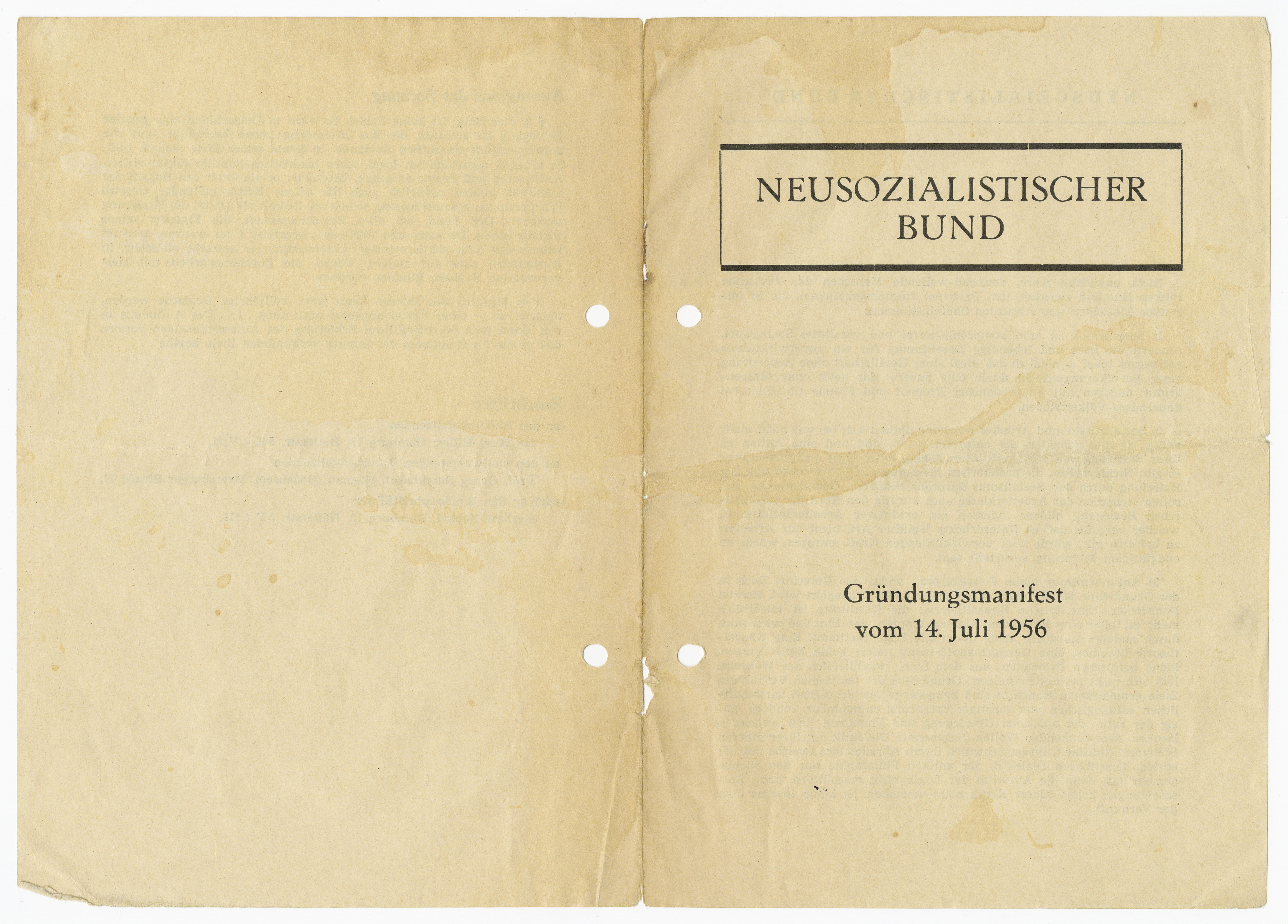
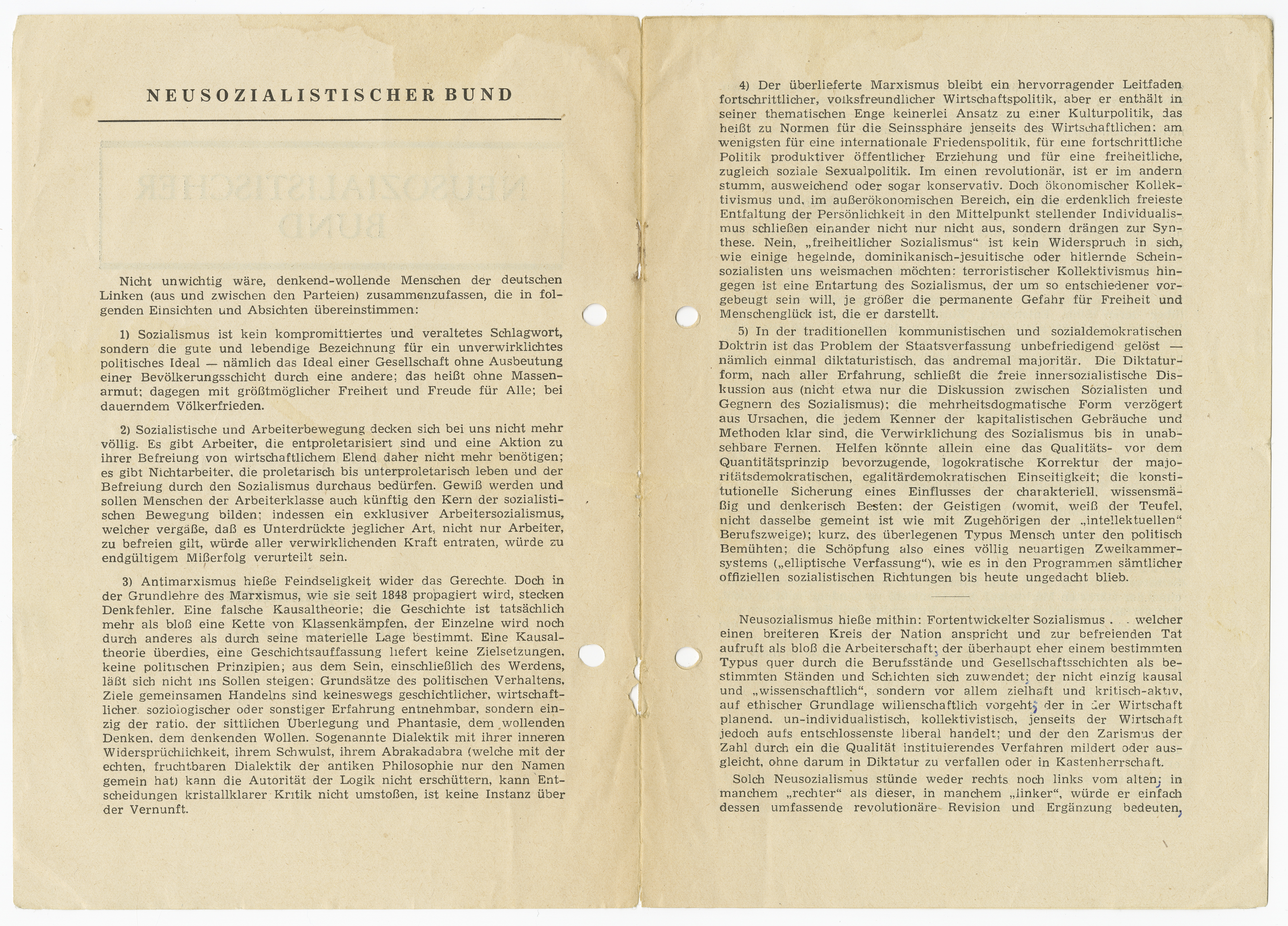
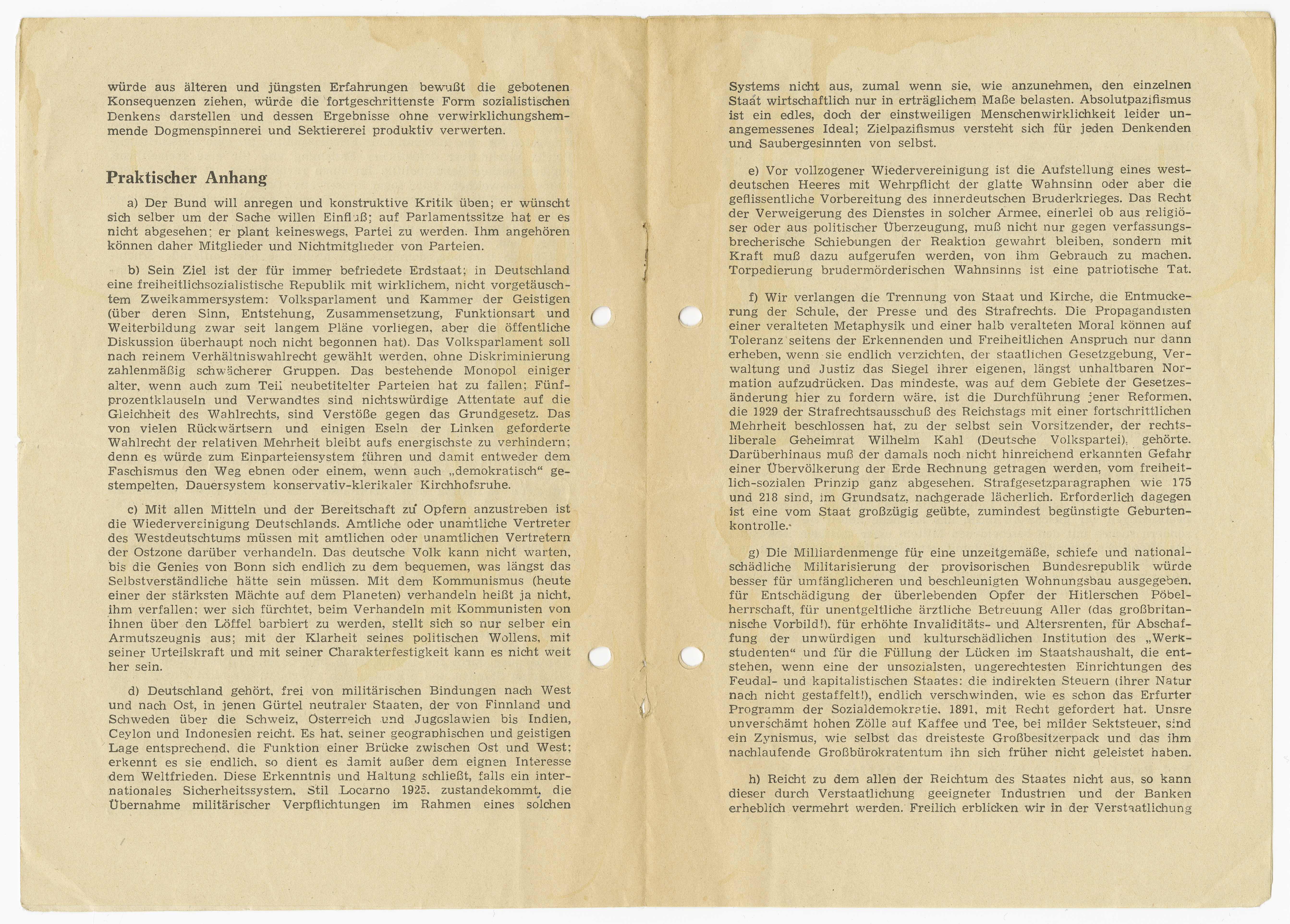
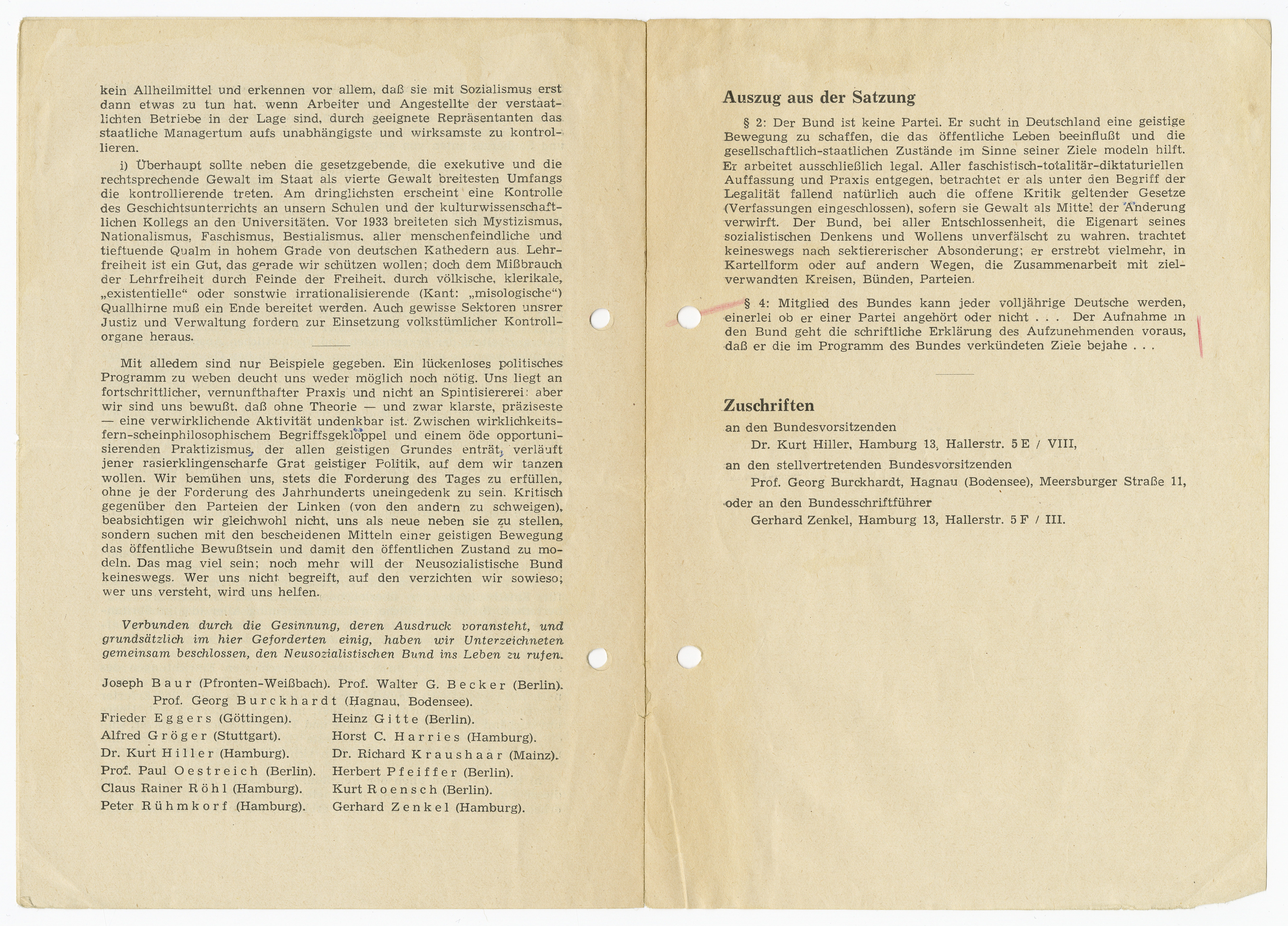
Enclosures: Copy of the political manifesto of the Neusozialistischer Bund (titled "Neusozialistischer Bund. Gründungsmanifest, vom 14. Juli 1956"), founded by Kurt Hiller in Hamburg. Bound printed booklet, 8 pages. Deutsches Literaturarchiv, Marbach.
Archive: Archivio privato di Primo Levi, Turin
Series: Fasc. 20, sottofasc. 001, doc. 011, f. 23-24
2Between the words “ist” and “antisemitisches,” an insertion has been typed above the line: “ein” (“an”).
3Wolfgang Beutin’s archive is held at the Bayerisches Staatsbibliothek in Munich; it is currently being reorganized, and therefore cannot be consulted. Cf. also the Biography of Wolfgang Beutin.
4The enclosures mentioned by Beutin have not been found: the note by Kurt Hiller; the review of Beutin’s radio transmission on the Hamburg radio station; Beutin’s article (Wenn Vati mitbadete), whose title is a quote from the autobiography of Rudolf Höß, Kommandant in Auschwitz. Autobiographische Aufzeichnungen des Rudolf Höß,dtv, Munich 1963.
A copy of the political declaration of the “Neusozialistischer Bund,” the neo-socialist league founded by Kurt Hiller, has been found at the Literaturarchiv in Marbach and it is attached here. Regarding Hiller and his clique in Hamburg, to which both Wolfgang Beutin and Hans Jürgen Fröhlich belonged, cf. again Beutin's Biography.