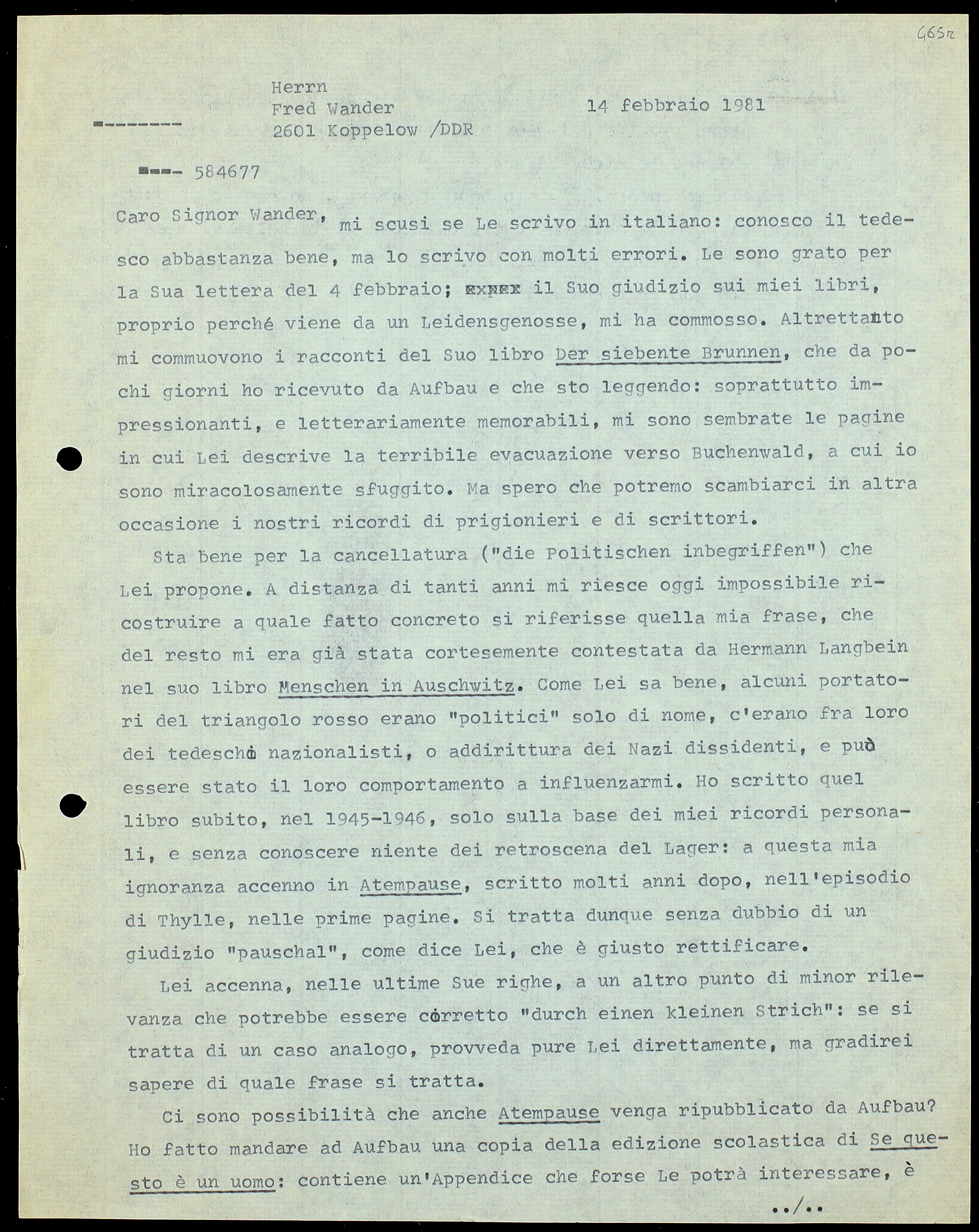
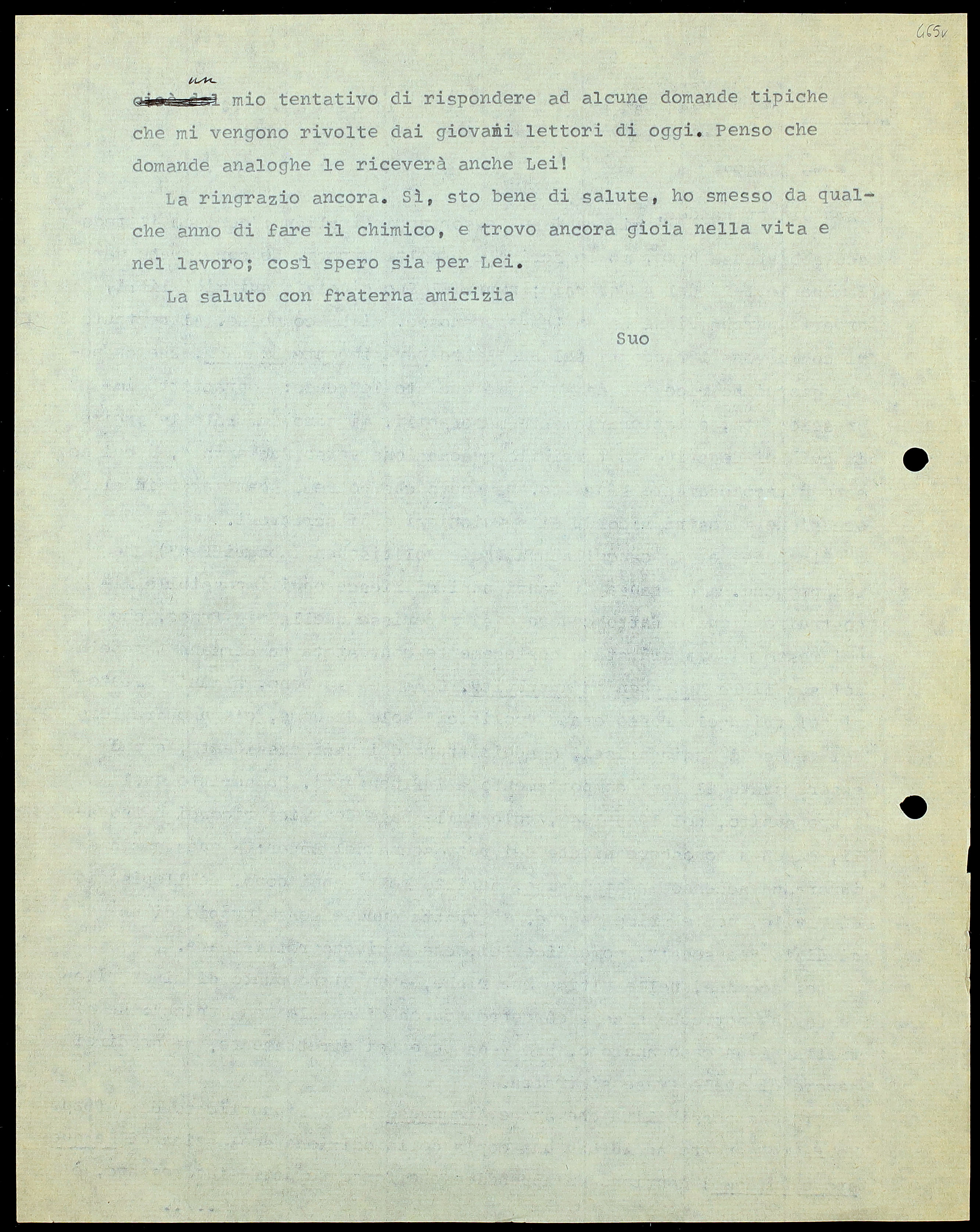
Levi has received from Aufbau a copy of Der siebente Brunnen (The Seventh Well) by Wander and is reading it. He accepts Wander’s remarks and understands their motivation; he also mentions that he received similar comments years before from Hermann Langbein in Menschen in Auschwitz.
mi scusi se le scrivo in italiano: conosco il tedesco abbastanza bene, ma lo scrivo con molti errori. Le sono grato per la sua lettera del 4 febbraio; il suo giudizio sui miei libri, proprio perché viene da un Leidensgenosse,[1] mi ha commosso. Altrettanto mi commuovono i racconti del suo libro Der siebente Brunnen, che da pochi giorni ho ricevuto da Aufbau e che sto leggendo: soprattutto impressionanti, e letterariamente memorabili, mi sono sembrate le pagine in cui lei descrive la terribile evacuazione verso Buchenwald, a cui io sono miracolosamente sfuggito.[2] Ma spero che potremo scambiarci in altra occasione i nostri ricordi di prigionieri e di scrittori.
Sta bene per la cancellatura («die Politischen inbegriffen»)[3] che Lei propone. A distanza di tanti anni mi riesce oggi impossibile ricostruire a quale fatto concreto si riferisse quella mia frase, che del resto mi era già stata cortesemente contestata da Hermann Langbein nel suo libro Menschen in Auschwitz.[4] Come Lei sa bene, alcuni portatori del triangolo rosso erano «politici» solo di nome, c’erano fra loro dei tedeschi nazionalisti, o addirittura dei Nazi dissidenti, e può essere stato il loro comportamento a influenzarmi. Ho scritto quel libro subito, nel 1945-1946, solo sulla base dei miei ricordi personali, e senza conoscere niente dei retroscena del Lager: a questa mia ignoranza accenno in Atempause, scritto molti anni dopo, nell’episodio di Thylle, nelle prime pagine.[5] Si tratta dunque senza dubbio di un giudizio “pauschal”,[6] come dice Lei, che è giusto rettificare.
Lei accenna, nelle ultime Sue righe, a un altro punto di minor rilevanza che potrebbe essere corretto «durch einen kleinen Strich»:[7] se si tratta di un caso analogo, provveda pure lei direttamente, ma gradirei sapere di quale frase si tratta.
Ci sono possibilità che anche Atempause venga ripubblicato da Aufbau?
Ho fatto mandare ad Aufbau una copia della edizione scolastica di Se questo è un uomo: contiene un’Appendice[8] che forse Le potrà interessare, è un[9] mio tentativo di rispondere ad alcune domande tipiche che mi vengono rivolte dai giovani lettori di oggi. Penso che domande analoghe le riceverà anche Lei!
La ringrazio ancora. Sì, sto bene di salute, ho smesso da qualche anno di fare il chimico, e trovo ancora gioia nella vita e nel lavoro; così spero sia per Lei.
La saluto con fraterna amicizia
Suo
Herrn
Fred Wander
2601 Koppelow /DDR
14 febbraio 1981
584677
Caro Signor Wander,
mi scusi se le scrivo in italiano: conosco il tedesco abbastanza bene, ma lo scrivo con molti errori. Le sono grato per la sua lettera del 4 febbraio; il suo giudizio sui miei libri, proprio perché viene da un Leidensgenosse,[1] mi ha commosso. Altrettanto mi commuovono i racconti del suo libro Der siebente Brunnen, che da pochi giorni ho ricevuto da Aufbau e che sto leggendo: soprattutto impressionanti, e letterariamente memorabili, mi sono sembrate le pagine in cui lei descrive la terribile evacuazione verso Buchenwald, a cui io sono miracolosamente sfuggito.[2] Ma spero che potremo scambiarci in altra occasione i nostri ricordi di prigionieri e di scrittori.
Sta bene per la cancellatura («die Politischen inbegriffen»)[3] che Lei propone. A distanza di tanti anni mi riesce oggi impossibile ricostruire a quale fatto concreto si riferisse quella mia frase, che del resto mi era già stata cortesemente contestata da Hermann Langbein nel suo libro Menschen in Auschwitz.[4] Come Lei sa bene, alcuni portatori del triangolo rosso erano «politici» solo di nome, c’erano fra loro dei tedeschi nazionalisti, o addirittura dei Nazi dissidenti, e può essere stato il loro comportamento a influenzarmi. Ho scritto quel libro subito, nel 1945-1946, solo sulla base dei miei ricordi personali, e senza conoscere niente dei retroscena del Lager: a questa mia ignoranza accenno in Atempause, scritto molti anni dopo, nell’episodio di Thylle, nelle prime pagine.[5] Si tratta dunque senza dubbio di un giudizio “pauschal”,[6] come dice Lei, che è giusto rettificare.
Lei accenna, nelle ultime Sue righe, a un altro punto di minor rilevanza che potrebbe essere corretto «durch einen kleinen Strich»:[7] se si tratta di un caso analogo, provveda pure lei direttamente, ma gradirei sapere di quale frase si tratta.
Ci sono possibilità che anche Atempause venga ripubblicato da Aufbau?
Ho fatto mandare ad Aufbau una copia della edizione scolastica di Se questo è un uomo: contiene un’Appendice[8] che forse Le potrà interessare, è un[9] mio tentativo di rispondere ad alcune domande tipiche che mi vengono rivolte dai giovani lettori di oggi. Penso che domande analoghe le riceverà anche Lei!
La ringrazio ancora. Sì, sto bene di salute, ho smesso da qualche anno di fare il chimico, e trovo ancora gioia nella vita e nel lavoro; così spero sia per Lei.
La saluto con fraterna amicizia
Suo
Mr.
Fred Wander
2601 Koppelow / DDR
February 14, 1981
584677
Dear Mr. Wander,
Please excuse me for writing you in Italian: I know German well enough, but my written German is full of mistakes. I am grateful for your letter of February 4; your assessment of my books moved me deeply, precisely because it comes from a fellow survivor.[1] I am equally moved by the stories in your book The Seventh Well, which I received a few days ago from Aufbau and am currently reading: I found the passages in which you describe the terrible evacuation to Buchenwald—which I miraculously escaped—to be particularly striking and, from a literary standpoint, unforgettable.[2] But I hope we will have other occasions to compare memories, as prisoners and as writers.
I agree to the deletion (“including the political prisoners”)[3] you propose. After so many years, it is now impossible for me to reconstruct exactly which specific event that phrase of mine referred to; incidentally, it had already been politely contested by Hermann Langbein in his book People in Auschwitz.[4] As you well know, some of those wearing the red triangle were “political prisoners” in name only; they included German nationalists and even dissident Nazis, and it may have been their behavior that influenced me. I wrote that book immediately afterwards, in 1945–1946, on the sole basis of my personal memories and without knowing anything about the inner workings of the camp: I allude to this ignorance of mine in The Truce, written many years later, in the episode about Old Thylle, on the first few pages.[5] So it is undoubtedly an overly “sweeping”[6] judgment, as you say, which it is right to rectify.
In your last few lines, you mention another minor point that could be corrected with “a small change”:[7] if it is a similar instance, do feel free to correct it yourself, but I would appreciate knowing which sentence you are referring to.
Is there any chance The Trucemight also be reissued by Aufbau?
I have had a copy of the school edition of If This Is a Man sent to Aufbau: it contains an Appendix[8] that might interest you—it is my[9] attempt to answer some typical questions I am asked by today’s young readers. I think you can expect to receive similar questions as well!
Thank you again. Yes, I am in good health; I stopped working as a chemist a few years ago, and I still find joy in life and work; I hope the same is true of you.
I send you my brotherly regards.
Yours,
Herrn
Fred Wander
2601 Koppelow /DDR
14 febbraio 1981
584677
Caro Signor Wander,
mi scusi se le scrivo in italiano: conosco il tedesco abbastanza bene, ma lo scrivo con molti errori. Le sono grato per la sua lettera del 4 febbraio; il suo giudizio sui miei libri, proprio perché viene da un Leidensgenosse,[1] mi ha commosso. Altrettanto mi commuovono i racconti del suo libro Der siebente Brunnen, che da pochi giorni ho ricevuto da Aufbau e che sto leggendo: soprattutto impressionanti, e letterariamente memorabili, mi sono sembrate le pagine in cui lei descrive la terribile evacuazione verso Buchenwald, a cui io sono miracolosamente sfuggito.[2] Ma spero che potremo scambiarci in altra occasione i nostri ricordi di prigionieri e di scrittori.
Sta bene per la cancellatura («die Politischen inbegriffen»)[3] che Lei propone. A distanza di tanti anni mi riesce oggi impossibile ricostruire a quale fatto concreto si riferisse quella mia frase, che del resto mi era già stata cortesemente contestata da Hermann Langbein nel suo libro Menschen in Auschwitz.[4] Come Lei sa bene, alcuni portatori del triangolo rosso erano «politici» solo di nome, c’erano fra loro dei tedeschi nazionalisti, o addirittura dei Nazi dissidenti, e può essere stato il loro comportamento a influenzarmi. Ho scritto quel libro subito, nel 1945-1946, solo sulla base dei miei ricordi personali, e senza conoscere niente dei retroscena del Lager: a questa mia ignoranza accenno in Atempause, scritto molti anni dopo, nell’episodio di Thylle, nelle prime pagine.[5] Si tratta dunque senza dubbio di un giudizio “pauschal”,[6] come dice Lei, che è giusto rettificare.
Lei accenna, nelle ultime Sue righe, a un altro punto di minor rilevanza che potrebbe essere corretto «durch einen kleinen Strich»:[7] se si tratta di un caso analogo, provveda pure lei direttamente, ma gradirei sapere di quale frase si tratta.
Ci sono possibilità che anche Atempause venga ripubblicato da Aufbau?
Ho fatto mandare ad Aufbau una copia della edizione scolastica di Se questo è un uomo: contiene un’Appendice[8] che forse Le potrà interessare, è un[9] mio tentativo di rispondere ad alcune domande tipiche che mi vengono rivolte dai giovani lettori di oggi. Penso che domande analoghe le riceverà anche Lei!
La ringrazio ancora. Sì, sto bene di salute, ho smesso da qualche anno di fare il chimico, e trovo ancora gioia nella vita e nel lavoro; così spero sia per Lei.
La saluto con fraterna amicizia
Suo
Herrn
Fred Wander
2601 Koppelow /DDR
14 febbraio 1981
584677
Caro Signor Wander,
mi scusi se le scrivo in italiano: conosco il tedesco abbastanza bene, ma lo scrivo con molti errori. Le sono grato per la sua lettera del 4 febbraio; il suo giudizio sui miei libri, proprio perché viene da un Leidensgenosse,[1] mi ha commosso. Altrettanto mi commuovono i racconti del suo libro Der siebente Brunnen, che da pochi giorni ho ricevuto da Aufbau e che sto leggendo: soprattutto impressionanti, e letterariamente memorabili, mi sono sembrate le pagine in cui lei descrive la terribile evacuazione verso Buchenwald, a cui io sono miracolosamente sfuggito.[2] Ma spero che potremo scambiarci in altra occasione i nostri ricordi di prigionieri e di scrittori.
Sta bene per la cancellatura («die Politischen inbegriffen»)[3] che Lei propone. A distanza di tanti anni mi riesce oggi impossibile ricostruire a quale fatto concreto si riferisse quella mia frase, che del resto mi era già stata cortesemente contestata da Hermann Langbein nel suo libro Menschen in Auschwitz.[4] Come Lei sa bene, alcuni portatori del triangolo rosso erano «politici» solo di nome, c’erano fra loro dei tedeschi nazionalisti, o addirittura dei Nazi dissidenti, e può essere stato il loro comportamento a influenzarmi. Ho scritto quel libro subito, nel 1945-1946, solo sulla base dei miei ricordi personali, e senza conoscere niente dei retroscena del Lager: a questa mia ignoranza accenno in Atempause, scritto molti anni dopo, nell’episodio di Thylle, nelle prime pagine.[5] Si tratta dunque senza dubbio di un giudizio “pauschal”,[6] come dice Lei, che è giusto rettificare.
Lei accenna, nelle ultime Sue righe, a un altro punto di minor rilevanza che potrebbe essere corretto «durch einen kleinen Strich»:[7] se si tratta di un caso analogo, provveda pure lei direttamente, ma gradirei sapere di quale frase si tratta.
Ci sono possibilità che anche Atempause venga ripubblicato da Aufbau?
Ho fatto mandare ad Aufbau una copia della edizione scolastica di Se questo è un uomo: contiene un’Appendice[8] che forse Le potrà interessare, è un[9] mio tentativo di rispondere ad alcune domande tipiche che mi vengono rivolte dai giovani lettori di oggi. Penso che domande analoghe le riceverà anche Lei!
La ringrazio ancora. Sì, sto bene di salute, ho smesso da qualche anno di fare il chimico, e trovo ancora gioia nella vita e nel lavoro; così spero sia per Lei.
La saluto con fraterna amicizia
Suo
Mr.
Fred Wander
2601 Koppelow / DDR
February 14, 1981
584677
Dear Mr. Wander,
Please excuse me for writing you in Italian: I know German well enough, but my written German is full of mistakes. I am grateful for your letter of February 4; your assessment of my books moved me deeply, precisely because it comes from a fellow survivor.[1] I am equally moved by the stories in your book The Seventh Well, which I received a few days ago from Aufbau and am currently reading: I found the passages in which you describe the terrible evacuation to Buchenwald—which I miraculously escaped—to be particularly striking and, from a literary standpoint, unforgettable.[2] But I hope we will have other occasions to compare memories, as prisoners and as writers.
I agree to the deletion (“including the political prisoners”)[3] you propose. After so many years, it is now impossible for me to reconstruct exactly which specific event that phrase of mine referred to; incidentally, it had already been politely contested by Hermann Langbein in his book People in Auschwitz.[4] As you well know, some of those wearing the red triangle were “political prisoners” in name only; they included German nationalists and even dissident Nazis, and it may have been their behavior that influenced me. I wrote that book immediately afterwards, in 1945–1946, on the sole basis of my personal memories and without knowing anything about the inner workings of the camp: I allude to this ignorance of mine in The Truce, written many years later, in the episode about Old Thylle, on the first few pages.[5] So it is undoubtedly an overly “sweeping”[6] judgment, as you say, which it is right to rectify.
In your last few lines, you mention another minor point that could be corrected with “a small change”:[7] if it is a similar instance, do feel free to correct it yourself, but I would appreciate knowing which sentence you are referring to.
Is there any chance The Trucemight also be reissued by Aufbau?
I have had a copy of the school edition of If This Is a Man sent to Aufbau: it contains an Appendix[8] that might interest you—it is my[9] attempt to answer some typical questions I am asked by today’s young readers. I think you can expect to receive similar questions as well!
Thank you again. Yes, I am in good health; I stopped working as a chemist a few years ago, and I still find joy in life and work; I hope the same is true of you.
I send you my brotherly regards.
Yours,
Info
Notes
Tag
Sender: Primo Levi
Addressee: Fred Wander
Date of Drafting: 1981-02-14
Place of Writing: Turin
Description: carbon copy on onionskin paper of a typewritten letter. At the bottom of sheet 465r is the sign “../..” to indicate that the letter continues on the back of the sheet. “584677” is written in the upper left-hand corner: this is Levi’s new telephone number, typewritten on the original sheet to correct the old number which was most likely part of the letterhead; a trace of it remains on the copy sheet.
Archive: Archivio privato di Primo Levi, Turin
Series: Corrispondenza, Corrispondenza generale, fascicolo 12, sottofascicolo 21, f. 465r/v.
Folio: 1, front and back
DOI:
1
“Fellow survivor.”
2Der siebente Brunnen (The Seventh Well) by Fred Wander was published in 1971 by Aufbau and is his best-known book (translated into English in 1976 by Marc Linder for International Publishers, New York. The pages to which Levi refers are probably in the chapters “Faces” and “Joschko and His Brothers,” pp. 127-42.
4
In the 1970s, Levi’s relationship with Hermann Langbein, which began on December 13, 1960 with an exchange of letters, took place especially in the pages of their respective books. In Menschenin Auschwitz, whose very title recalls If This Is a Man, Levi is one of the most frequently quoted authors. This is also where the above-mentioned criticism appears (at pp. 222-23 and p. 239): Levi was supposedly responsible for having mistakenly generalized German prisoners at Auschwitz as political prisoners. This accusation, which Levi took very seriously in his further reflections on Auschwitz that began in the 1970s – and which would lead, among other things, to his elaboration of the category of the gray zone – was recalled in the foreword to the Italian edition of the book (which Levi strongly desired and promoted): “This book is a rich anthology of complex human cases; it contains frequent reminders (one is rightly addressed to me) to reject easy stereotypes. At Auschwitz, not all ‘criminals’ marked with the green triangle behaved like criminals; not all ‘political detainees’ behaved like political prisoners; and not all Germans hoped for a German victory” (CW III, p. 2674).
5
The episode can be found in “The Thaw,” the opening chapter of The Truce, and it recounts the night between January 27 and 28, 1945. Thylle, as a political prisoner and old inhabitant of the Lager, had until then been considered a “dangerous enemy” by the narrator but he becomes an unexpected confidant during their first night of freedom. Regarding his own limited point of view inside the camp, Levi comments: “I had never had either the curiosity or the occasion to investigate the complex structures of the camp hierarchy. The shadowy edifice of evil powers lay entirely above us, and our gaze was turned to the ground,” (CW I, p. 218).
8
Cf. Letter 219, Primo Levi to Joachim Meinert, February 11, 1981. The Appendix to the Italian school edition of If This Is a Man (1976) is a long self-interview that Levi constructed by selecting and editing together the questions he was most frequently asked by students OC I, pp. 279-304.
9
Levi crosses out “cioè del” (“that is, of the”) and amends it by hand to “un” (“my”) in black ballpoint pen.