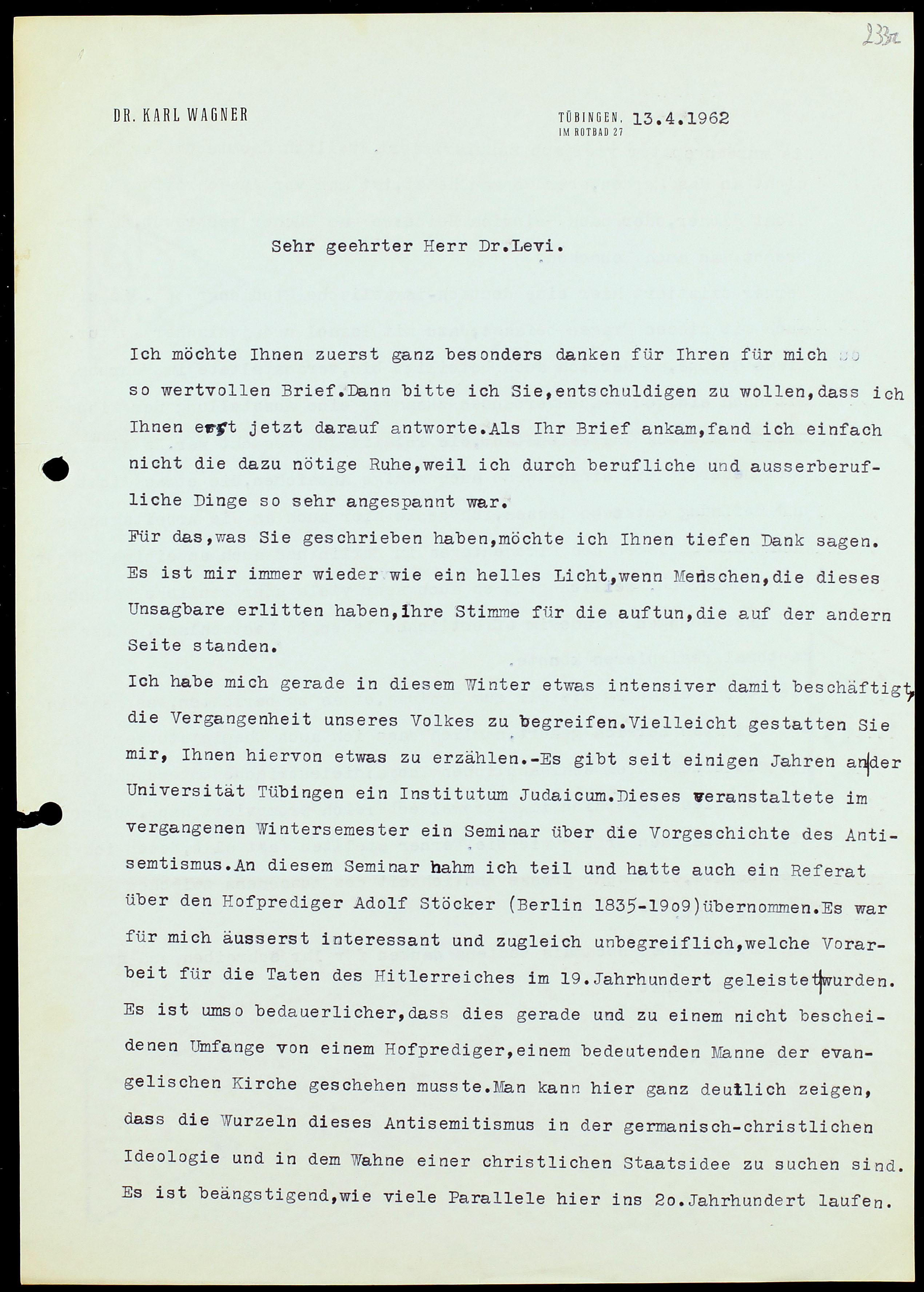
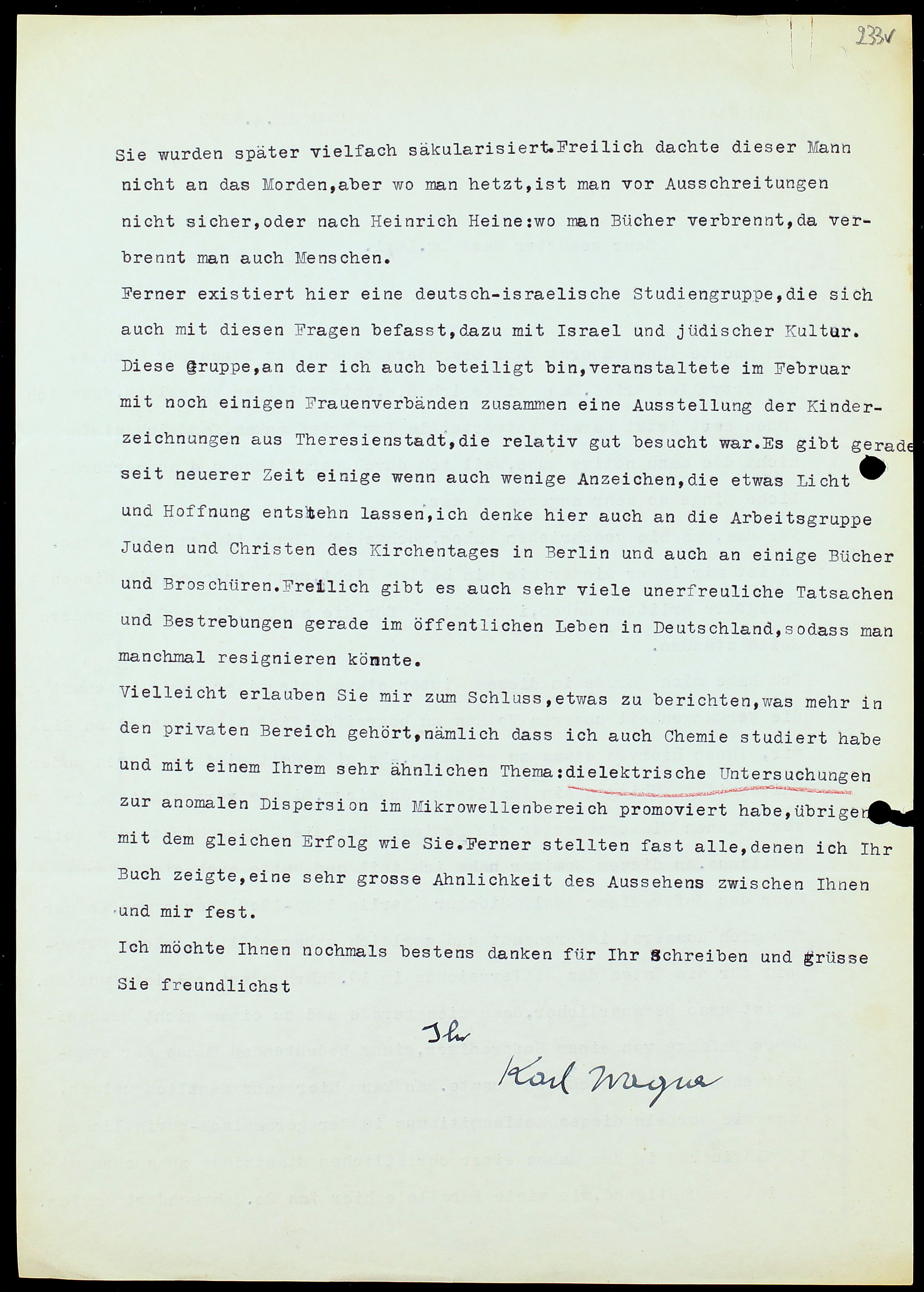
Wagner tells Levi about a seminar he attended on the origins of German antisemitism and informs Levi that he has presented a graduating thesis that is similar to his.
13. 4. 1962
Sehr geehrter Herr Dr.Levi.
Ich möchte Ihnen zuerst ganz besonders danken für Ihren für mich so wertvollen Brief. Dann bitte ich Sie, entschuldigen zu wollen, dass ich Ihnen erst jetzt darauf antworte. Als Ihr Brief ankam, fand ich einfach nicht die dazu nötige Ruhe, weil ich durch berufliche und ausserberufliche Dinge so sehr angespannt war.
Für das, was Sie geschrieben haben, möchte ich Ihnen tiefen Dank sagen. Es ist mir immer wieder wie ein helles Licht, wenn Menschen, die dieses Unsagbare erlitten haben, ihre Stimme für die auftun, die auf der andern Seite standen.
Ich habe mich gerade in diesem Winter etwas intensiver damit beschäftigt, die Vergangenheit unseres Volkes zu begreifen. Vielleicht gestatten Sie mir, Ihnen hiervon etwas zu erzählen. – Es gibt seit einigen Jahren an der Universität Tübingen ein Institutum Judaicum.[1] Dieses veranstaltete im vergangenen Wintersemester ein Seminar über die Vorgeschichte des Antisemtismus.[2] An diesem Seminar nahm ich teil und hatte auch ein Referat über den Hofprediger Adolf Stöcker (Berlin 1835-1909) übernommen. Es war für mich äusserst interessant und zugleich unbegreiflich, welche Vorarbeit für die Taten des Hitlerreiches im 19. Jahrhundert geleistet wurden. Es ist umso bedauerlicher, dass dies gerade und zu einem nicht bescheidenen Umfange von einem Hofprediger, einem bedeutenden Manne der evangelischen Kirche geschehen musste. Man kann hier ganz deutlich zeigen, dass die Wurzeln dieses Antisemitismus in der germanisch-christlichen Ideologie und in dem Wahne einer christlichen Staatsidee zu suchen sind. Es ist beängstigend, wie viele Parallele hier ins 20. Jahrhundert laufen. Sie wurden später vielfach säkularisiert. Freilich dachte dieser Mann nicht an das Morden, aber wo man hetzt, ist man vor Ausschreitungen nicht sicher, oder nach Heinrich Heine: wo man Bücher verbrennt, da verbrennt man auch Menschen.[3]
Ferner existiert hier eine deutsch-israelische Studiengruppe,[4] die sich auch mit diesen Fragen befasst, dazu mit Israel und jüdischer Kultur. Diese Gruppe, an der ich auch beteiligt bin, veranstaltete im Februar mit noch einigen Frauenverbänden zusammen eine Ausstellung der Kinderzeichnungen aus Theresienstadt,[5] die relativ gut besucht war. Es gibt gerade seit neuerer Zeit einige wenn auch wenige Anzeichen, die etwas Licht und Hoffnung entstehn lassen, ich denke hier auch an die Arbeitsgruppe Juden und Christen des Kirchentages in Berlin[6] und auch an einige Bücher und Broschüren.[7] Freilich gibt es auch sehr viele unerfreuliche Tatsachen und Bestrebungen gerade im öffentlichen Leben in Deutschland, sodass man manchmal resignieren könnte.
Vielleicht erlauben Sie mir zum Schluss, etwas zu berichten, was mehr in den privaten Bereich gehört, nämlich dass ich auch Chemie studiert habe und mit einem Ihrem sehr ähnlichen Thema: dielektrische Untersuchungen[8] zur anomalen Dispersion im Mikrowellenbereich promoviert habe, übrigen mit dem gleichen Erfolg wie Sie.[9] Ferner stellten fast alle, denen ich Ihr Buch zeigte, eine sehr grosse Ahnlichkeit des Aussehens zwischen Ihnen und mir fest.
Ich möchte Ihnen nochmals bestens danken für Ihr Schreiben und grüsse Sie freundlichst Ihr
Karl Wagner
13. 4. 1962
Stimatissimo Dottor Levi,
desidero innanzitutto ringraziarLa sentitamente per la Sua lettera, per me molto preziosa. La prego poi di scusarmi se Le scrivo solo ora. Quando la Sua lettera è arrivata, non sono riuscito a trovare la tranquillità necessaria per rispondere, preso com’ero da impegni lavorativi e non solo.
Per ciò che ha scritto, Le esprimo il mio più profondo ringraziamento. Ogni volta che una persona che ha sofferto l’indicibile trova la forza di dare voce a chi stava dall’altra parte è per me come una luce che si accende.
Proprio quest’inverno mi sono impegnato più a fondo nel tentativo di comprendere il passato del nostro popolo. Forse mi permetterà di raccontarLe qualcosa a riguardo. – Da qualche anno esiste presso l’università di Tubinga un Institutum Judaicum.[1]Il quale, lo scorso semestre invernale, ha organizzato un seminario sulla preistoria dell’antisemitismo.[2]Ho partecipato e ho anche tenuto una conferenza sul predicatore di corte Adolf Stöcker (Berlino 1835-1909). È stato per me oltremodo interessante e al tempo stesso incomprensibile vedere quale preparazione ideologica fosse già stata compiuta nel XIX secolo per ciò che poi si è realizzato sotto il regime hitleriano. E tanto più deplorevole è che questo lavoro ideologico sia stato portato avanti, e in misura tutt’altro che trascurabile, da un predicatore di corte, figura di rilievo della Chiesa evangelica. Segno evidente che le radici dell’antisemitismo affondano nell’ideologia cristiano-germanica e nel delirio di un’idea cristiana dello Stato. È inquietante scoprire quante sono le analogie con il XX secolo. Molti di quegli elementi furono in seguito secolarizzati. Certo, quell’uomo non pensava agli omicidi, ma dove si fomenta l’odio non si può escludere l’atto di violenza; oppure, per dirla con Heinrich Heine: dove si bruciano i libri, si finisce col bruciare anche gli esseri umani.[3]
Esiste inoltre un gruppo di studio tedesco-israeliano che si occupa di queste tematiche, oltre che di Israele e della cultura ebraica.[4]Il gruppo, di cui anch’io faccio parte, nel mese di febbraio ha organizzato insieme ad alcune associazioni femminili una mostra di disegni di bambini del ghetto di Theresienstadt,[5] che ha registrato un buon numero di presenze. Soprattutto in tempi recenti si sono avuti alcuni segnali, seppur pochi, che fanno intravedere una luce e una speranza. Penso ad esempio al gruppo di lavoro di ebrei e cristiani del Kirchentag di Berlino,[6]o anche alla pubblicazione di alcuni libri e opuscoli.[7] Certo, nella vita pubblica tedesca non mancano molte realtà e tendenze preoccupanti, tali a volteda lasciarci sgomenti.
Se mi è permesso concludere con una nota più personale, vorrei dirLe che anch’io ho studiato chimica, e che ho conseguito il dottorato con una tesi molto simile della sua: Indagini dielettriche sulla dispersione anomala nel campo delle microonde,[8] peraltro con il suo stesso risultato accademico.[9] Inoltre, quasi tutte le persone cui ho mostrato il Suo libro hanno notato una sorprendente somiglianza fisica tra Lei e me.
La ringrazio ancora una volta di cuore per la Sua lettera e Le mando i miei più cordiali saluti, Suo
Karl Wagner
April 13, 1962
Dear Mr. Levi,
I would like, first of all, to thank you very much for your letter, which is so valuable to me. I hope you can forgive me for only responding now. When your letter arrived, I simply could not find the necessary peace and quiet to read it because I was under such stress both at work and elsewhere.
I would like to express my deepest gratitude for what you wrote. It always feels to me like a light turning on whenever people who have suffered the unspeakable speak up for those on the other side.
This winter, I strove to gain a better understanding of our people’s past. Perhaps you will allow me to tell you a bit more. For several years now, the University of Tübingen has had an Institutum Judaicum.[1] This past winter semester, it organized a seminar on the history of Antisemitism.[2]I took part in this seminar, and also gave a presentation on the court chaplain Adolf Stöcker (Berlin 1835–1909). I found it extremely interesting and at the same time incomprehensible how much groundwork for the deeds of Hitler’s Reich was laid in the nineteenth century. It is all the more regrettable that such a considerable amount of it was laid by a court preacher, an important man in the Evangelical Church. This clearly shows that the roots of this Antisemitism are to be found in Germanic-Christian ideology and in the delusion of a Christian state. It is frightening how many parallels there are with the twentieth century. Many were later secularized. Of course, this man was not thinking about murder, but where there is incitement, one cannot be safe from violence—or, as Heinrich Heine said: those who burn books will, in the end, burn people.[3]
There is also a German-Israeli study group[4] here that deals with these issues, and with Israel and Jewish culture as well. This group, which includes me, worked with several women’s associations to organize an exhibition of children’s drawings from Theresienstadt[5] this past February, and it was relatively well attended. Recently, there have been a few small signs that offer some light and hope; I am thinking here of the Jews’ and Christians’ working group at the Berlin[6] Kirchentag as well as a number of books and pamphlets.[7] Of course, there are also many unpleasant developments, especially in public life in Germany, which can sometimes lead to feelings of resignation.
Perhaps you will allow me to conclude by sharing something that belongs more to the private sphere, namely that I, too, studied chemistry, and my doctoral thesis was on a topic very similar to yours: dielectric research[8] into anomalous microwave dispersion, with the same success you had, no less.[9] Furthermore, nearly everyone I showed your book to noticed a striking resemblance between you and me.
Once again, I would like to thank you for your letter and send you my warmest regards.
Yours,
Karl Wagner
13. 4. 1962
Sehr geehrter Herr Dr.Levi.
Ich möchte Ihnen zuerst ganz besonders danken für Ihren für mich so wertvollen Brief. Dann bitte ich Sie, entschuldigen zu wollen, dass ich Ihnen erst jetzt darauf antworte. Als Ihr Brief ankam, fand ich einfach nicht die dazu nötige Ruhe, weil ich durch berufliche und ausserberufliche Dinge so sehr angespannt war.
Für das, was Sie geschrieben haben, möchte ich Ihnen tiefen Dank sagen. Es ist mir immer wieder wie ein helles Licht, wenn Menschen, die dieses Unsagbare erlitten haben, ihre Stimme für die auftun, die auf der andern Seite standen.
Ich habe mich gerade in diesem Winter etwas intensiver damit beschäftigt, die Vergangenheit unseres Volkes zu begreifen. Vielleicht gestatten Sie mir, Ihnen hiervon etwas zu erzählen. – Es gibt seit einigen Jahren an der Universität Tübingen ein Institutum Judaicum.[1] Dieses veranstaltete im vergangenen Wintersemester ein Seminar über die Vorgeschichte des Antisemtismus.[2] An diesem Seminar nahm ich teil und hatte auch ein Referat über den Hofprediger Adolf Stöcker (Berlin 1835-1909) übernommen. Es war für mich äusserst interessant und zugleich unbegreiflich, welche Vorarbeit für die Taten des Hitlerreiches im 19. Jahrhundert geleistet wurden. Es ist umso bedauerlicher, dass dies gerade und zu einem nicht bescheidenen Umfange von einem Hofprediger, einem bedeutenden Manne der evangelischen Kirche geschehen musste. Man kann hier ganz deutlich zeigen, dass die Wurzeln dieses Antisemitismus in der germanisch-christlichen Ideologie und in dem Wahne einer christlichen Staatsidee zu suchen sind. Es ist beängstigend, wie viele Parallele hier ins 20. Jahrhundert laufen. Sie wurden später vielfach säkularisiert. Freilich dachte dieser Mann nicht an das Morden, aber wo man hetzt, ist man vor Ausschreitungen nicht sicher, oder nach Heinrich Heine: wo man Bücher verbrennt, da verbrennt man auch Menschen.[3]
Ferner existiert hier eine deutsch-israelische Studiengruppe,[4] die sich auch mit diesen Fragen befasst, dazu mit Israel und jüdischer Kultur. Diese Gruppe, an der ich auch beteiligt bin, veranstaltete im Februar mit noch einigen Frauenverbänden zusammen eine Ausstellung der Kinderzeichnungen aus Theresienstadt,[5] die relativ gut besucht war. Es gibt gerade seit neuerer Zeit einige wenn auch wenige Anzeichen, die etwas Licht und Hoffnung entstehn lassen, ich denke hier auch an die Arbeitsgruppe Juden und Christen des Kirchentages in Berlin[6] und auch an einige Bücher und Broschüren.[7] Freilich gibt es auch sehr viele unerfreuliche Tatsachen und Bestrebungen gerade im öffentlichen Leben in Deutschland, sodass man manchmal resignieren könnte.
Vielleicht erlauben Sie mir zum Schluss, etwas zu berichten, was mehr in den privaten Bereich gehört, nämlich dass ich auch Chemie studiert habe und mit einem Ihrem sehr ähnlichen Thema: dielektrische Untersuchungen[8] zur anomalen Dispersion im Mikrowellenbereich promoviert habe, übrigen mit dem gleichen Erfolg wie Sie.[9] Ferner stellten fast alle, denen ich Ihr Buch zeigte, eine sehr grosse Ahnlichkeit des Aussehens zwischen Ihnen und mir fest.
Ich möchte Ihnen nochmals bestens danken für Ihr Schreiben und grüsse Sie freundlichst Ihr
Karl Wagner
13. 4. 1962
Stimatissimo Dottor Levi,
desidero innanzitutto ringraziarLa sentitamente per la Sua lettera, per me molto preziosa. La prego poi di scusarmi se Le scrivo solo ora. Quando la Sua lettera è arrivata, non sono riuscito a trovare la tranquillità necessaria per rispondere, preso com’ero da impegni lavorativi e non solo.
Per ciò che ha scritto, Le esprimo il mio più profondo ringraziamento. Ogni volta che una persona che ha sofferto l’indicibile trova la forza di dare voce a chi stava dall’altra parte è per me come una luce che si accende.
Proprio quest’inverno mi sono impegnato più a fondo nel tentativo di comprendere il passato del nostro popolo. Forse mi permetterà di raccontarLe qualcosa a riguardo. – Da qualche anno esiste presso l’università di Tubinga un Institutum Judaicum.[1]Il quale, lo scorso semestre invernale, ha organizzato un seminario sulla preistoria dell’antisemitismo.[2]Ho partecipato e ho anche tenuto una conferenza sul predicatore di corte Adolf Stöcker (Berlino 1835-1909). È stato per me oltremodo interessante e al tempo stesso incomprensibile vedere quale preparazione ideologica fosse già stata compiuta nel XIX secolo per ciò che poi si è realizzato sotto il regime hitleriano. E tanto più deplorevole è che questo lavoro ideologico sia stato portato avanti, e in misura tutt’altro che trascurabile, da un predicatore di corte, figura di rilievo della Chiesa evangelica. Segno evidente che le radici dell’antisemitismo affondano nell’ideologia cristiano-germanica e nel delirio di un’idea cristiana dello Stato. È inquietante scoprire quante sono le analogie con il XX secolo. Molti di quegli elementi furono in seguito secolarizzati. Certo, quell’uomo non pensava agli omicidi, ma dove si fomenta l’odio non si può escludere l’atto di violenza; oppure, per dirla con Heinrich Heine: dove si bruciano i libri, si finisce col bruciare anche gli esseri umani.[3]
Esiste inoltre un gruppo di studio tedesco-israeliano che si occupa di queste tematiche, oltre che di Israele e della cultura ebraica.[4]Il gruppo, di cui anch’io faccio parte, nel mese di febbraio ha organizzato insieme ad alcune associazioni femminili una mostra di disegni di bambini del ghetto di Theresienstadt,[5] che ha registrato un buon numero di presenze. Soprattutto in tempi recenti si sono avuti alcuni segnali, seppur pochi, che fanno intravedere una luce e una speranza. Penso ad esempio al gruppo di lavoro di ebrei e cristiani del Kirchentag di Berlino,[6]o anche alla pubblicazione di alcuni libri e opuscoli.[7] Certo, nella vita pubblica tedesca non mancano molte realtà e tendenze preoccupanti, tali a volteda lasciarci sgomenti.
Se mi è permesso concludere con una nota più personale, vorrei dirLe che anch’io ho studiato chimica, e che ho conseguito il dottorato con una tesi molto simile della sua: Indagini dielettriche sulla dispersione anomala nel campo delle microonde,[8] peraltro con il suo stesso risultato accademico.[9] Inoltre, quasi tutte le persone cui ho mostrato il Suo libro hanno notato una sorprendente somiglianza fisica tra Lei e me.
La ringrazio ancora una volta di cuore per la Sua lettera e Le mando i miei più cordiali saluti, Suo
Karl Wagner
April 13, 1962
Dear Mr. Levi,
I would like, first of all, to thank you very much for your letter, which is so valuable to me. I hope you can forgive me for only responding now. When your letter arrived, I simply could not find the necessary peace and quiet to read it because I was under such stress both at work and elsewhere.
I would like to express my deepest gratitude for what you wrote. It always feels to me like a light turning on whenever people who have suffered the unspeakable speak up for those on the other side.
This winter, I strove to gain a better understanding of our people’s past. Perhaps you will allow me to tell you a bit more. For several years now, the University of Tübingen has had an Institutum Judaicum.[1] This past winter semester, it organized a seminar on the history of Antisemitism.[2]I took part in this seminar, and also gave a presentation on the court chaplain Adolf Stöcker (Berlin 1835–1909). I found it extremely interesting and at the same time incomprehensible how much groundwork for the deeds of Hitler’s Reich was laid in the nineteenth century. It is all the more regrettable that such a considerable amount of it was laid by a court preacher, an important man in the Evangelical Church. This clearly shows that the roots of this Antisemitism are to be found in Germanic-Christian ideology and in the delusion of a Christian state. It is frightening how many parallels there are with the twentieth century. Many were later secularized. Of course, this man was not thinking about murder, but where there is incitement, one cannot be safe from violence—or, as Heinrich Heine said: those who burn books will, in the end, burn people.[3]
There is also a German-Israeli study group[4] here that deals with these issues, and with Israel and Jewish culture as well. This group, which includes me, worked with several women’s associations to organize an exhibition of children’s drawings from Theresienstadt[5] this past February, and it was relatively well attended. Recently, there have been a few small signs that offer some light and hope; I am thinking here of the Jews’ and Christians’ working group at the Berlin[6] Kirchentag as well as a number of books and pamphlets.[7] Of course, there are also many unpleasant developments, especially in public life in Germany, which can sometimes lead to feelings of resignation.
Perhaps you will allow me to conclude by sharing something that belongs more to the private sphere, namely that I, too, studied chemistry, and my doctoral thesis was on a topic very similar to yours: dielectric research[8] into anomalous microwave dispersion, with the same success you had, no less.[9] Furthermore, nearly everyone I showed your book to noticed a striking resemblance between you and me.
Once again, I would like to thank you for your letter and send you my warmest regards.
Yours,
Karl Wagner
Info
Notes
Tag
Sender: Karl Wagner
Addressee: Primo Levi
Date of Drafting: 1962-04-13
Place of Writing: Tübingen
Description:typewritten letter with handwritten signature in blue fountain pen. Levi has underlined a passage by hand in red pencil.
Archive: Archivio privato di Primo Levi, Turin
Series: Complesso di fondi Primo Levi, Fondo Primo Levi, Corrispondenza, Corrispondenti particolari, Fasc. 020, sottofasc. 001, doc. 089, f. 233r/v.
Folio: 1, front and back
Letterhead: KARL WAGNER | TÜBINGEN | IM ROTBAD 27
DOI: https://doi.org/10.15160/r67p-g165
1The Institutum Judaicum of the University of Tübingen was inaugurated on June 27, 1957. It was founded by the Protestant theologian Otto Michel, a professor of the New Testament at the Faculty of Protestant Theology. As noted in Tübingen’s daily newspaper, Schwäbisches Tagblatt, during his inaugural speech, Michel declared that the Institutum should “deal with what is perhaps the most anguishing problem of all entrusted to Christianity, that is, the tragical intertwining of the Christian Church and Judaism. […] But the Institutum Judaicum will not limit itself to studying the history and the religiosity of Judaism in Palestine and the diaspora; it will also conserve the memory of what occurred in our time and will constantly search for a constructive dialogue with today’s Jews.” Cf. R. Rieger, “Otto Michel und das Institutum Judaicum in Tübingen” (“Otto Michel and the Institutum Judaicum of Tübingen”), in Das Tübinger Institutum Judaicum Beiträge zu seiner Geschichte und Vorgeschichte seit Adolf Schlatter (“The Institutum Judaicum of Tübingen. Contributions to its history and its prehistory since Adolf Schlatter”), edited by M. Morgenstern and R. Rieger, Stuttgart: Franz Steiner Verlag, 2015, pp. 157-158.
2During the 1961/1962 winter semester, two seminars were held at the Institutum Judaicum by its founder Otto Michel and his collaborator Reinhold Mayer: Introduction to the Cabala (on Thursdays from 4 p.m. to 6 p.m.) and The problem of Judaism in 19th-century public address (on Wednesdays from 6 p.m. to 8 p.m.) Cf. Eberhard Karls Universität Tübingen, Namens- und Vorlesungsverzeichnis. Winter-Semester 1961/62 (“Catalogue of names and courses. Winter semester 1961/62”), p. 82.
3On various occasions, Levi quoted this same passage by Heinrich Heine, starting in the 1970s: the first time in an interview in Tuttolibri on February 28, 1976; the quote was edited out at the time but it was later retrieved and published in the third volume of Opere complete (OC III, 106). Levi himself reintroduced it, starting in a March 12, 1977 reprint, in the Appendix to the Italian school edition of If This Is a Man,published in 1976 (CW I, p. 188). The quote is also used in the Bozza di testo per l’interno del Block italiano ad Auschwitz [“Rough draft for inside the Italian Block at Auschwitz”] on November 8, 1978, (OC II, 1495-96).
4The first German-Israeli study group was founded on June 28, 1957 at the University of Berlin, on the initiative of the jurist and philosopher Jochanan Bloch (1919-1979). Similar initiatives soon spread to many other universities in West Germany. The study group in Tübingen was founded in 1959. Regarding this topic, cf. the biography of Karl Wagner.
5The reference is to the traveling exhibit Hier fliegen keine Schmetterlinge (“No butterflies fly here”), inaugurated in July 1961 by the German-Israeli study group of Freiburg. The exhibit arrived in Tübingen in February 1962. Its setup and organization were overseen by the Institutum Judaicum and the German-Israeli study group of the University of Tübingen. Cf. J. Hahn, Die Deutsch-Israelischen Studiengruppen und die frühen studentischen Kontakte mit Israel 1948 – 1972 (“The German-Israeli study groups and early student contacts with Israel 1948 – 1972”), Göttingen: Wallstein Verlag, 2025, p. 207; R. Rieger, “Otto Michel und das Institutum Judaicum in Tübingen” (“Otto Michel and the Institutum Judaicum of Tübingen”), in Das Tübinger Institutum Judaicum Beiträge zu seiner Geschichte und Vorgeschichte seit Adolf Schlatter (“The Institutum Judaicum of Tübingen. Contributions to its history and its prehistory since Adolf Schlatter”), edited by M. Morgenstern and R. Rieger, Stuttgart: Franz Steiner Verlag, 2015, p. 184.
6The Kirchentag (“Church Day”) is a biyearly Evangelical holiday; the event was founded and inaugurated in Hannover in 1949.
7Wagner was doubtless referring to Aktion Sühnezeichen, an organization founded in 1958 by the synod of the German Protestant Church with the goal of redeeming Germany from the guilt of the Nazi crimes (cf., Letter 177). Starting in 1961, Aktion Sühnezeichen joined German-Israeli study groups in volunteer initiatives for young Germans in Israel. Cf. J. Hahn, Die Deutsch-Israelischen Studiengruppen und die frühen studentischen Kontakte mit Israel 1948 – 1972, Göttingen: Wallstein Verlag, 2025, p. 169. Publications dealing with the commitments of the Protestant world in fighting antisemitism and re-elaborating the Nazi past include the Aktion Sühnezeichen pamphlets (cf., Letter 177) and the magazine Radius (cf., Letter 179).
8“dielektrische Untersuchungen” is underlined by Levi in red pencil.
9K. Wagner, Dielektrische Untersuchungen zur anomalen Dispersion im Mikrowellenbereich, Karlsruhe: Technischen Hochschule Fridericiana, 1959. More information about Wagner’s doctoral thesis can be found in his biography. In the chapter “The Chemistry Examination” in If This Is a Man (CW I, pp. 101-02), Primo Levi mentions the subject of his own graduating thesis, which he defended in June 1941, obtaining top marks (and the infamous label, “Jewish race”), on “Measurements of Dielectrical Constants.” Wagner couldn’t know this, but it was actually the topic of a paper on experimental physics - Comportamento dielettrico della miscela ternaria C6H6 CHCl3 C6H5Cl (“Dielectrical Behavior in the C6H6 CHCl3 C6H5Clternary combination,” today in OC II, pp. 1707-1720) – that Levi, as per the regulations of the Chemistry Institute of the University of Turin, wrote in conjunction with his chemistry thesis, which was also about the Walden Inversion (OC II, pp. 1721-1762). Cf., I. Thomson, Primo Levi. Una vita, Milan: UTET, 2017, p. 158.