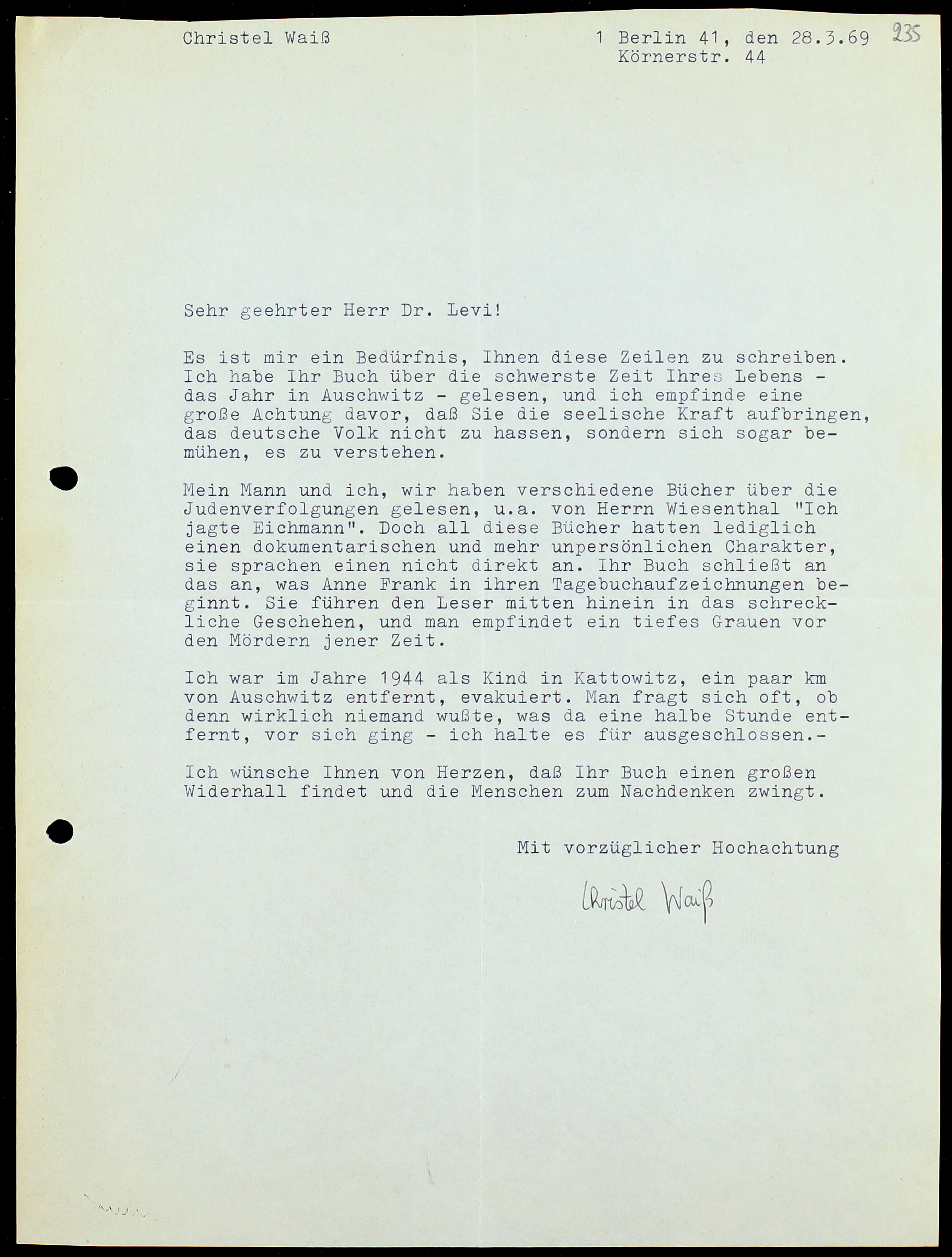
Christel Waiß, who was still a child in 1944 when she was evacuated to Katowice with her family, writes to Levi after reading Ist das ein Mensch? and correlates Levi’s book with those by Simon Wiesenthal and Anne Frank.
Christel Waiß
1 Berlin 41, den 28.3.69 Körnerstr. 44
Sehr geehrter Herr Dr. Levi!
Es ist mir ein Bedürfnis, Ihnen diese Zeilen zu schreiben.
Ich habe Ihr Buch über die schwerste Zeit Ihres Lebens – das Jahr in Auschwitz – gelesen, und ich empfinde eine große Achtung davor, daß Sie die seelische Kraft aufbringen, das deutsche Volk nicht zu hassen, sondern sich sogar bemühen, es zu verstehen.
Mein Mann und ich, wir haben verschiedene Bücher über die Judenverfolgungen gelesen, u.a. von Herrn Wiesenthal„Ich jagte Eichmann”.[1] Doch all diese Bücher hatten lediglich einen dokumentarischen und mehr unpersönlichen Charakter, sie sprachen einen nicht direkt an. Ihr Buch schließt an das an, was Anne Frank in ihren Tagebuchaufzeichnungen beginnt.[2] Sie führen den Leser mitten hinein in das schreckliche Geschehen, und man empfindet ein tiefes Grauen vor den Mördern jener Zeit.
Ich war im Jahre 1944 als Kind in Kattowitz, ein paar km von Auschwitz entfernt, evakuiert. Man fragt sich oft, ob denn wirklich niemand wußte, was da eine halbe Stunde entfernt, vor sich ging – ich halte es für ausgeschlossen. –
Ich wünsche Ihnen von Herzen, daß Ihr Buch einen großen Widerhall findet und die Menschen zum Nachdenken zwingt.
Mit vorzüglicher Hochachtung
Christel Waiß
1 Berlin 41, il 28.03.69 Körnerstr. 44
Stimatissimo Dottor Levi,
sento in me il bisogno di scriverLe queste righe.
Ho letto il Suo libro sull’anno più terribile della sua vita – quello trascorso ad Auschwitz – e provo un profondo rispetto per la forza d’animo con cui riesce non solo a non odiare il popolo tedesco, ma addirittura a sforzarsi di comprenderlo.
Io e mio marito abbiamo letto svariati libri sulle persecuzioni contro gli ebrei, tra questi Ho dato la caccia a Eichmann del signor Wiesenthal.[1] Tutti, però, avevano più che altro carattere documentario e impersonale, non parlavano direttamente al lettore. Il Suo libro invece prosegue ciò che Anne Frank aveva iniziato con il suo Diario.[2] Lei accompagna il lettore nel mezzo di quei terribili accadimenti, e si prova un senso di profondo sgomento di fronte ai carnefici di quel tempo.
Nel 1944 ero bambina, sfollata a Katowice, a pochi chilometri da Auschwitz. Ci si chiede spesso se davvero nessuno sapesse cosa accadeva laggiù, a solo mezz’ora di distanza: io lo ritengo impossibile.
Le auguro di cuore che il Suo libropossa avere un’ampia risonanza e che costringa le persone a riflettere.
Con il più profondo rispetto,
Christel Waiß
1 Berlin 41, March 28, 1969
Körnerstr. 44
Dear Mr. Levi,
I feel compelled to write you these lines.
I have read your book about the most difficult period of your life—the year you spent in Auschwitz—and I deeply respect that you found the strength to not hate the German people, and instead to try to understand them.
My husband and I have read various books about the persecution of the Jews, including Mr. Wiesenthal’s Ich jagte Eichmann (“I Hunted Eichmann”)[1]. But all those books were merely documentary in nature, and rather impersonal; they didn’t speak to the reader so directly. Your book picks up where Anne Frank leaves off in her diary entries.[2] You plunge the reader right into the midst of the atrocities, and one feels deeply horrified by the murderers of that time.
In 1944, as a child, I was evacuated to Katowice, a few kilometers from Auschwitz. People often wonder whether no one really knew what was going on just half an hour away—I think that’s impossible.
I most sincerely hope your book will find wide resonance and force people to reflect.
With the utmost respect,
Christel Waiß
1 Berlin 41, den 28.3.69 Körnerstr. 44
Sehr geehrter Herr Dr. Levi!
Es ist mir ein Bedürfnis, Ihnen diese Zeilen zu schreiben.
Ich habe Ihr Buch über die schwerste Zeit Ihres Lebens – das Jahr in Auschwitz – gelesen, und ich empfinde eine große Achtung davor, daß Sie die seelische Kraft aufbringen, das deutsche Volk nicht zu hassen, sondern sich sogar bemühen, es zu verstehen.
Mein Mann und ich, wir haben verschiedene Bücher über die Judenverfolgungen gelesen, u.a. von Herrn Wiesenthal„Ich jagte Eichmann”.[1] Doch all diese Bücher hatten lediglich einen dokumentarischen und mehr unpersönlichen Charakter, sie sprachen einen nicht direkt an. Ihr Buch schließt an das an, was Anne Frank in ihren Tagebuchaufzeichnungen beginnt.[2] Sie führen den Leser mitten hinein in das schreckliche Geschehen, und man empfindet ein tiefes Grauen vor den Mördern jener Zeit.
Ich war im Jahre 1944 als Kind in Kattowitz, ein paar km von Auschwitz entfernt, evakuiert. Man fragt sich oft, ob denn wirklich niemand wußte, was da eine halbe Stunde entfernt, vor sich ging – ich halte es für ausgeschlossen. –
Ich wünsche Ihnen von Herzen, daß Ihr Buch einen großen Widerhall findet und die Menschen zum Nachdenken zwingt.
Mit vorzüglicher Hochachtung
Christel Waiß
1 Berlin 41, il 28.03.69 Körnerstr. 44
Stimatissimo Dottor Levi,
sento in me il bisogno di scriverLe queste righe.
Ho letto il Suo libro sull’anno più terribile della sua vita – quello trascorso ad Auschwitz – e provo un profondo rispetto per la forza d’animo con cui riesce non solo a non odiare il popolo tedesco, ma addirittura a sforzarsi di comprenderlo.
Io e mio marito abbiamo letto svariati libri sulle persecuzioni contro gli ebrei, tra questi Ho dato la caccia a Eichmann del signor Wiesenthal.[1] Tutti, però, avevano più che altro carattere documentario e impersonale, non parlavano direttamente al lettore. Il Suo libro invece prosegue ciò che Anne Frank aveva iniziato con il suo Diario.[2] Lei accompagna il lettore nel mezzo di quei terribili accadimenti, e si prova un senso di profondo sgomento di fronte ai carnefici di quel tempo.
Nel 1944 ero bambina, sfollata a Katowice, a pochi chilometri da Auschwitz. Ci si chiede spesso se davvero nessuno sapesse cosa accadeva laggiù, a solo mezz’ora di distanza: io lo ritengo impossibile.
Le auguro di cuore che il Suo libropossa avere un’ampia risonanza e che costringa le persone a riflettere.
Con il più profondo rispetto,
Christel Waiß
1 Berlin 41, March 28, 1969
Körnerstr. 44
Dear Mr. Levi,
I feel compelled to write you these lines.
I have read your book about the most difficult period of your life—the year you spent in Auschwitz—and I deeply respect that you found the strength to not hate the German people, and instead to try to understand them.
My husband and I have read various books about the persecution of the Jews, including Mr. Wiesenthal’s Ich jagte Eichmann (“I Hunted Eichmann”)[1]. But all those books were merely documentary in nature, and rather impersonal; they didn’t speak to the reader so directly. Your book picks up where Anne Frank leaves off in her diary entries.[2] You plunge the reader right into the midst of the atrocities, and one feels deeply horrified by the murderers of that time.
In 1944, as a child, I was evacuated to Katowice, a few kilometers from Auschwitz. People often wonder whether no one really knew what was going on just half an hour away—I think that’s impossible.
I most sincerely hope your book will find wide resonance and force people to reflect.
With the utmost respect,
Info
Notes
Tag
Sender: Christel Waiß
Addressee: Primo Levi
Date of Drafting: 1969-03-28
Place of Writing: Berlin
Description:typewritten letter with handwritten signature in black ballpoint pen.
Archive: Archivio privato di Primo Levi, Turin
Series: Complesso di fondi Primo Levi, Fondo Primo Levi, Corrispondenza, Corrispondenti particolari, Fasc. 20, sottofasc. 1, doc. 091, f. 235
Folio: 1, front only
DOI: https://doi.org/10.15160/508s-qj68
1Ich jagte Eichmann. Tatsachenbericht [I chased Eichman. A True Story] was the first book Simon Wiesenthal wrote. It was published in Germany for the first time in 1961 by the publishing company Sigbert Mohn in Gütersloh. It was never translated into Italian and, until now, it had never been established whether Levi knew about it or had read it. The book reconstructs the investigation that enabled Wiesenthal to hunt down Eichmann and hand him over to the Israeli secret services in 1960. For more details, cf. the biography of Christel Waiß.
2Das Tagebuch der Anne Frank [The Diary of Anne Frank] was published for the first time in Germany in 1950 by the publishing company Lambert Schneider in Heidelberg. Regarding how The Diary of Anne Frank was received in Germany, cf. the biography of Christel Waiß.